Quentin Tarantino’s been flirting with a film like The Hateful Eight for awhile now, a beautifully shot, well designed film that goes beyond feeling minor (the way Death Proof feels, for instance) and just ends up being bad. An inverse of Django Unchained, where the bounty hunters and rogues are just as despicable as the murderers and thieves they encounter, The Hateful Eight plays on the director’s obsessions with race and torture and whimsical men who are good at murderin’ folks, but with so little in the way of narrative pull that it often seems like Tarantino is just playing with himself, making a movie for the sake of making a movie, without a hint of impulse control.
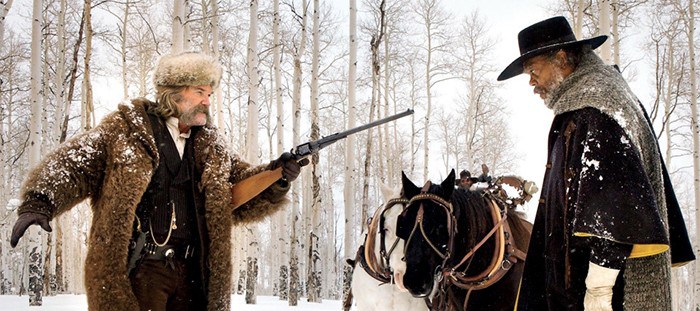
The Hateful Eight concerns eight men and women who are all on their way to Red Rock, Wyoming, a blizzard nipping at their heels. Some of them are bounty hunters. Some are bounties. Some are working men. Not everybody is who they say they are, but there’s hardly any mystery to that considering the cast of regulars Tarantino’s assembled and the kinds of roles they’ve played for him in the past. Our lead bounty hunters—”Hangman” John Ruth (Kurt Russell) and Major Marquis Warren (Samuel L. Jackson)—are suspicious of everyone they encounter, and they’re usually right in their suspicions. Ruth encounters Warren on a trail, sitting atop a pile of dead bounties after his horse died in the snow. He’s on his way to Red Rock with Daisy Domergue (Jennifer Jason Leigh), an outlaw who is worth $10,000 dead or alive, and he prefers taking them in alive so as to not cheat the hangman, hence the nickname. The conversation between Warren and Ruth is intense—Tarantino is at his best when staging conversations between hypermasculine strangers—and when they pick up another snowbound traveler, Chris Mannix (Walton Goggins), the new sheriff—things get more tense. This is just after the Civil War and there’ still tensions between Union soldiers and Rebel ones. Ruth and Warren belonged to the Union. Mannix’s father led a battalion that continued fighting the war in the face of unconditional surrender. None of them could be said to’ve been good men, and Domergue, when she’s not getting punched or spitting up blood, watches them argue with glee.
With the blizzard on them, the stagecoach holes up at Minnie’s Haberdashery, where four other men are already gathered around the fireplace. There’s a fussy British gentleman (Tim Roth), a cowpuncher (Michael Madsen), a Mexican (Demián Bichir) who says he’s looking after the place for Minnie while she visits her family, and a Confederate General (Bruce Dern) who is familiar with Major Warren, even if he doesn’t know it. The idea, according to Tarantino, is for these characters to get together and tell stories to one another like an arc on a western, each person trying to figure out the intention of the other. This has been a pretty basic mode of narrative storytelling for a long time now. You can go farther than westerns like Gunsmoke and The Virginian to Rashomon or The Canterbury tales, people telling stories about things seen and unseen, only here, as Tarantino often has it, our storytellers have guns. Those are mostly holstered until a blood-soaked finale, so much of The Hateful Eight is talk and menace, a locked room there’s only one way out of.
That means lingering, for a long time, on the decisions Tarantino chooses to make. One of them, shooting in 70mm and keeping his characters mostly indoors, is ponderous, but there is a lot of loving detail put into Minnie’s Haberdashery and the sense that something’s off with it. The way-station is a one-room saloon with a couple of beds in it, but Tarantino and cinematographer Robert Richardson make use of cinematic space such that the Haberdashery feels both open and claustrophobic at the same time. There are eight people in the room, eight different perspectives of a single unfolding narrative, and were that narrative any better than it was, the way The Hateful Eight cuts from one to another would be invigorating. But it isn’t. So again, you get to linger with the decisions Tarantino makes. You have three hours to wonder how, even in a movie where he’s only the narrator, Tarantino manages to give himself the film’s most troublingly racist dialog, or why he figures on adding a race allegory to a film about eight miserable bastards to begin with. Sampling, as he has been for some time now, from spaghetti westerns, the Confederate/Union line is one Tarantino plays with and tries to extend to today, but he frankly isn’t good enough to make a salient point, even though Samuel L. Jackson is the man making it. After Christoph Waltz’s Jew Hunter in Inglourious Basterds and Leonardo DiCaprio’s impassioned speech on eugenics in Django—both characters and monologues that Tarantino luxuriated in—it’s hard to take him seriously when he tries to inject social consciousness into The Hateful Eight, which is otherwise the director’s career-long fascination with bondage and torture writ large and gracelessly.
It takes a long time for The Hateful Eight to go anywhere, moving as slow as the stagecoaches that transport the players to their stage. Tarantino, as he’s done time and again since Kill Bill, is trying to make a film about outlaws and gunslingers who stand as legends that are of their time and outside it, but it just doesn’t work here, where he’s convinced to the marrow of his bones that it’s worth keeping the company of eight sadists who don’t have all that much to say. It’s a formula Tarantino has used effectively before, but here that formula is used to the point of exhaustion. And when everybody starts pulling guns on one another, as is Tarantino’s guarantee? More of the same, more of the same.
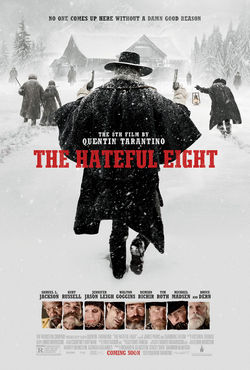 The Hateful Eight (2015)
With Samuel L. Jackson (Major Marquis Warren), Kurt Russell (John Ruth), Jennifer Jason Leigh (Daisy Domergue), Walton Goggins (Chris Mannix), Demián Bichir (Bob), Tim Roth (Oswaldo Mobray), Michael Madsen (Joe Gage), Bruce Dern (General Sandy Smithers), James Parks (O.B. Jackson), Zoë Bell (Six-Horse Judy), and Channing Tatum (Jody). Directed by Quentin Tarantino from a screenplay by Tarantino.
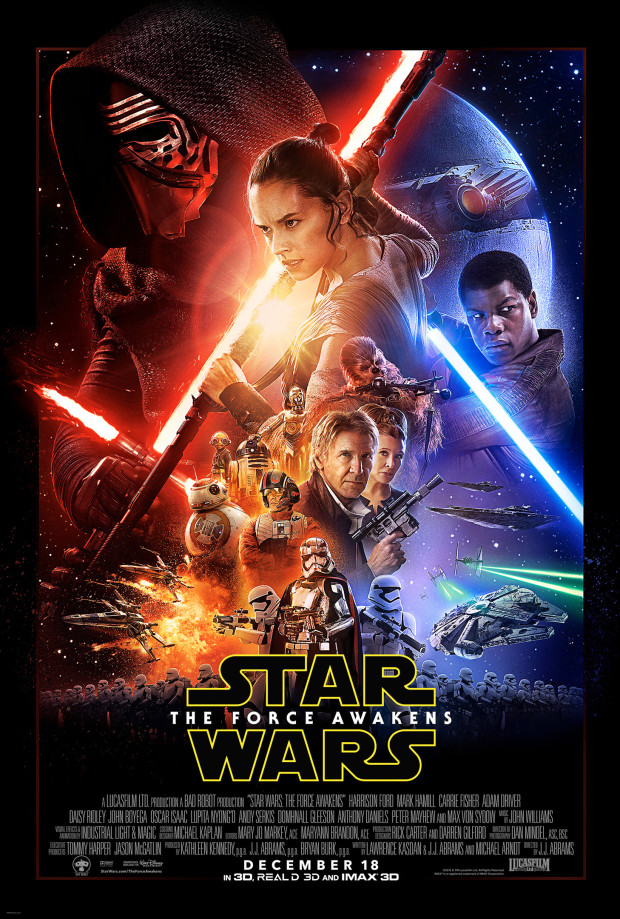 Star Wars: The Force Awakens (2015)
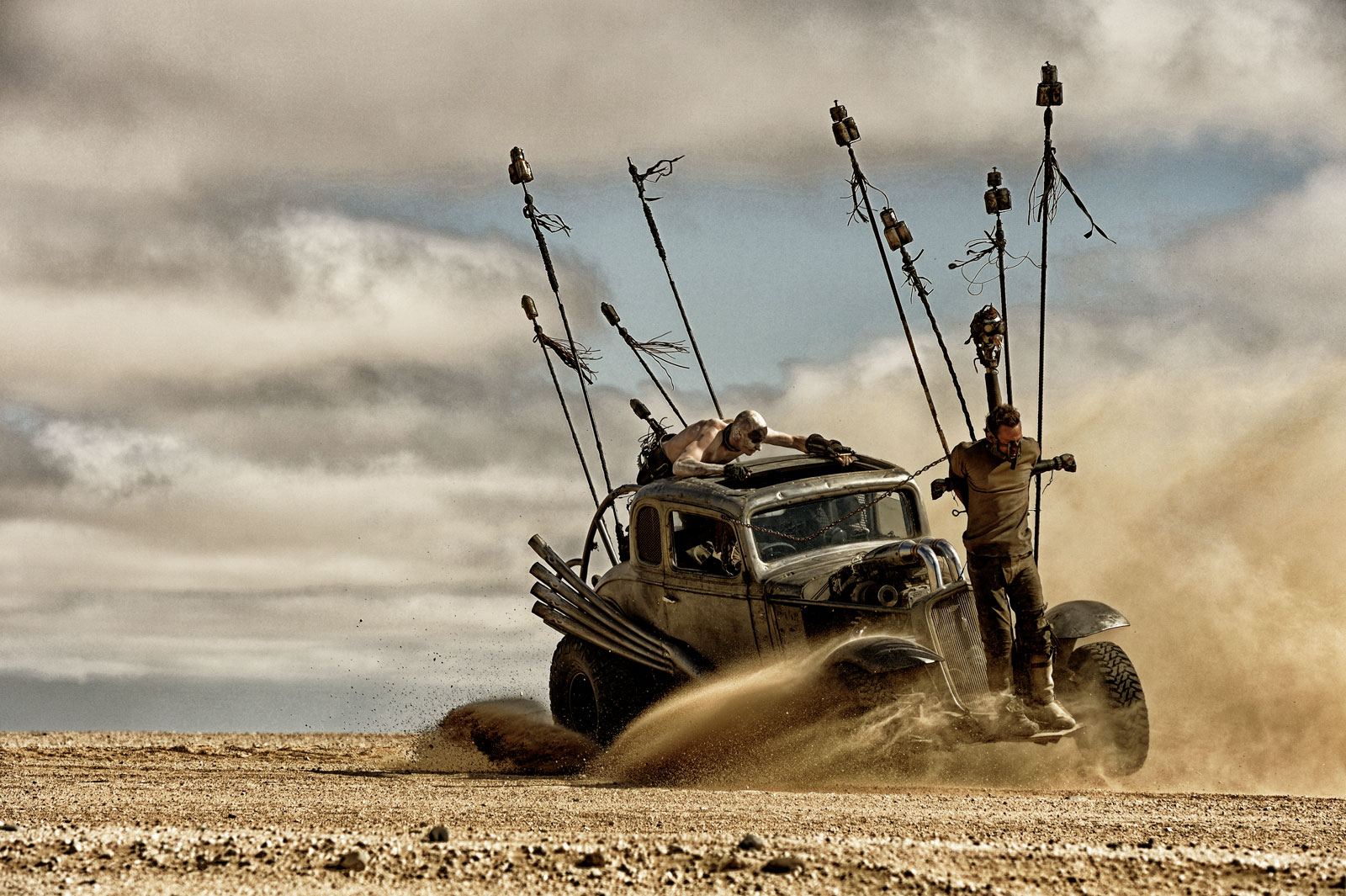
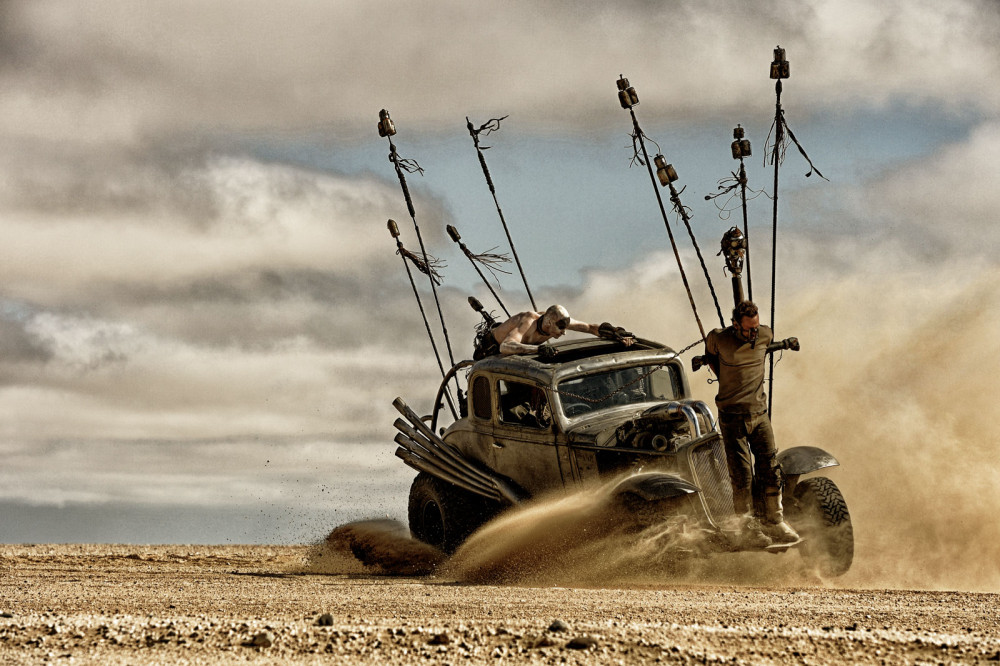
 Max Rockatansky is not his own man, never the focal point of the franchise that bears his name. He’s a cipher, a way for writer-director George Miller to slip into a ruined world, a world that’s too stupid to live and too stubborn to die. If the doomsday prepper set is right and there is something left of our world once we’re done hollowing it out and wasting it away, it’ll take more than a bunker full of Gatorade and beef jerky to survive what’s coming. Beyond any extreme, beyond Beyond Thunderdome, the argument George Miller has made over the course of four films and 36-years is that survival, on such a vast and awful scale, is not something you can prepare for, but is something that’s thrust upon a person, something one suffers until the world stops playing with its food and swallows whole. Max Rockatansky is mad, but he’s never his own man for long. First he’s eating, then he’s the property of a marauding band of chalk-painted dieselpirates, personal bloodbag for a dying lunatic soldier who’d like nothing more than to dip himself in chrome and punch his ticket to Valhalla. It’s one way of living when nothing’s meant to live, at least.