Tag: movie review

  • Movie Review: Avengers: Age of Ultron (2015)

    Movie Review: Avengers: Age of Ultron (2015)

    Avengers

    I remember spending a lot of time in my local library as a kid. It was close, within safe walking distance from my house, and beyond a few people who hung out and read magazines they didn’t want to subscribe to, it was just me, the librarians, and a whole lot of books. Browsing the stacks one day, I found these gigantic treasury editions of 60s and 70s Marvel Comics, which I checked out and read every week for three years. My favorite of them was Marvel’s Greatest Superhero Battles, its cover promising an epic clash between The Hulk and The Thing, my two favorite characters in the yet cinematically undiscovered country that was the Marvel Universe. This was the 1990s, and, say what you will about Stan Lee, but the way he wrote his superheroes (and the way Jack Kirby, Herb Trimpe, Sal Buschema, and John Romita (among others) drew them) still had a way of speaking that appealed directly to this very particular sense of selfhood I was developing. Bruce Banner was a quiet man, Benjamin Grimm a soft-hearted lunk. One wanted to be left alone. The other was doomed to be forever unhappy with his body. I got that. I identified with it. And, sealed away in these treasury books, they belonged to a world that only I had access to.

    Had you told nine-year-old me that The Hulk would be a cornerstone of one of the world’s most successful film franches—man, I don’t even know. 27-year-old me can hardly believe it, and I have lived experience of summers spent in multiplexes that weren’t showing a superhero of some kind. Sitting in the dark waiting for Avengers: Age of Ultron to start, there were three trailers for upcoming superhero films, and I was late. The next in Disney’s Avengers sequence, Ant-Man, is coming out in July. We barely get a month to rest up between episodes now, such is the cultural demand for city-destroying bacchanalia. I was tired. I was restless. I wanted to shove nine-year-old me into a locker for liking this stuff. And when the film started, I was largely still exhausted. Joss Whedon’s latest venture into the Marvel Cinematic Universe is overstuffed and overlong, struggling to contain itself, even at two-hours and 20-minutes. A lot of the bloat, at this point, must be attributed to the fact that an Avengers movie isn’t just a movie—it’s part of a cycle, and, as such, is part of a feedback loop that looks back as far as 2008 and looks forward as far as the heat death of the universe. Around that, Whedon, admirably, is going for something more here than in Avengers. Meglomaniacs get smashed-up real good and the physical and psychic trauma of 9/11 is exported to a countries real and imaginary, but it’s clear at this point that Whedon is most in his element when the world is quiet and his team has divested itself of their spandex.

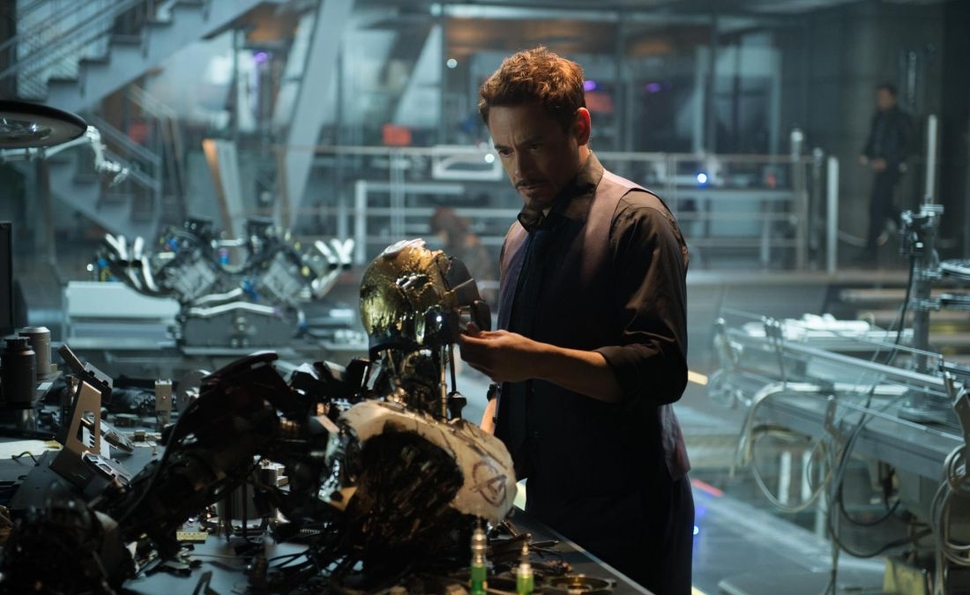
    Then, he can get down to the real meat of Marvel Comics, which is that beneath the spectacle and muscle, superheroes are really just damaged human beings who are very uncomfortable with their bodies. This has been a sub-plot of most MCU films for awhile now, the whole “He’s just a man, but I’ve got an army!” deal, but Whedon’s script ventures beyond that, ruminating on the fallibility of flesh. His villain, Ultron (James Spader), a malevolent, sassy robot whose AI bears a striking resemblance to Tony Stark (Robert Downey, Jr.), sees the body as a necessary step forward in his evolution. Stark knows he will die, leaving his project of world peace unfinished. Hawkeye (Jeremy Renner) is just a regular dude with a bow and arrow. Captain America (Chris Evans) is still acclimating to a world where most of his friends have died. Bruce Banner (Mark Ruffalo) is doomed to be ashamed of his monstrous, green alter-ego, and Black Widow (Scarlett Johansson) has a past that involves bodily disfiguration. Where a villain like Ultron (or Loki, or the assembled horde of Hydra bad guys, or men in knock-off Iron Man gear) see this as the team’s weakness, it’s the axis upon which the whole thing spins—there aren’t many people who could understand their individual circumstances, but they’re all here in a room together, drunkenly trying to lift the hammer that lets Thor (Chris Hemsworth) lay claim to the throne of Asgard.

    But at this point, it’s not enough to truly satisfy. MCU films are, like a hang-out sitcom, an excuse to sit around and chuckle with a group of favorite characters, mind turned off. Battle sequences are well-executed, if perfunctory and consequence free. If you don’t check in on Marvel’s televised output, it’d be easy to assume that the fallout from any given fight is a paycheck from the Stark Relief Fund (which, man, that name) and a new life in a city that maybe won’t host a rampaging Hulk. I feel like complaining about the lack of stakes after eleven Marvel films, far from being a fruitless endeavor, reveals something about the limits of popcorn filmmaking, or at least the men responsible for making them. The Avengers: Age of Ultron can be nitpicked to death or praised for things that happen or are imagined to have happened at its fringes, but at heart this is a big, dumb action movie trying a little too hard to sound smart. This, in general, works for me. I am, if anything, overly enthusiastic about The Fast and the Furious‘ focus on makeshift chosen families, and am still fascinated with The Dark Knight and The Dark Knight Rises‘ attempt and failure to engage with philosophical theory and political science. Whedon does the same here, toying with ideas of fatherhood, Catholicism, and ruined women, but all too frequently it feels like he’s wrestling a Wikipedia page and not the idea itself. The drama will continue in the next wave of Avengers movies, we’re promised, but just once I’d like to see a Marvel movie that is a movie first, rather than an advertisement for an upcoming slate. I’d like something real to chew on. I’d like to go home not dreading the prospect that, someday soon, it will not be enough for a comic book movie to merely entertain me for three hours. Like the villains of these pieces so frequently say, it’s time to evolve. If only the folks behind the camera were listening.


    The Avengers: Age of Ultron. With Robert Downey, Jr. (Tony Stark/Iron Man), Chris Hemsworth (Thor), Mark Ruffalo (Bruce Banner/Hulk), Chris Evans (Steve Rogers/Captain America), Scarlett Johansson (Natasha Romanoff/Black Widow), Jeremy Renner (Clint Barton/Hawkeye), Aaron Taylor-Johnson (Quicksilver), Elizabeth Olsen (Scarlet Witch), James Spader (Ultron), and Samuel L. Jackson (Nick Fury). Directed by Joss Whedon from a screenplay by Whedon, based on the Marvel Comics characters created by Stan Lee and Jack Kirby.
  • Movie Review: John Wick (2014)

    Movie Review: John Wick (2014)

    John Wick

    John Wick is an anachronism, a stylish action thriller whose fight choreography chops are legit to the point that the usual gamut of camera and editing tricks used to create motion where none exists are largely put away. There’s a good bit of background mythology, too, an underworld of contract killers who operate on respect and gold coins, who have pasts they are either proud of or are trying to leave behind. Were it released ten years ago, and had Lionsgate a better sense of how to market a film where a man in a suit kills dozens of men wearing suits, it’s not hard to imagine the dorm rooms I frequented in college having a John Wick poster up on the wall, right next to The Boondock Saints, the Baba Yaga of this film standing shoulder to shoulder with the MacManus brothers in the bro canon.

    I feel a little bad writing that, because I actually enjoyed John Wick a good deal. In 2014, it seems like films leaning heavily upon the aesthetic of early Woo and Tarantino efforts have finally managed to quell the rampaging hormones that soured stylish killers to the point of queasiness. Here, Keanu Reeves is the titular hero, a former hitman of legendary proportion who up and walked away from the game one day. He got married. His wife died. Knowing her husband would be distraught and purposeless without her, she arranged for a puppy to be delivered to John. Before long, a crew of Russian gangsters break into John’s house, looking to steal a car he had earlier refused to sell. They knock John out. They kill the dog. They leave it there for John to find when he comes to. None of them know John Wick’s reputation. They will, soon enough.

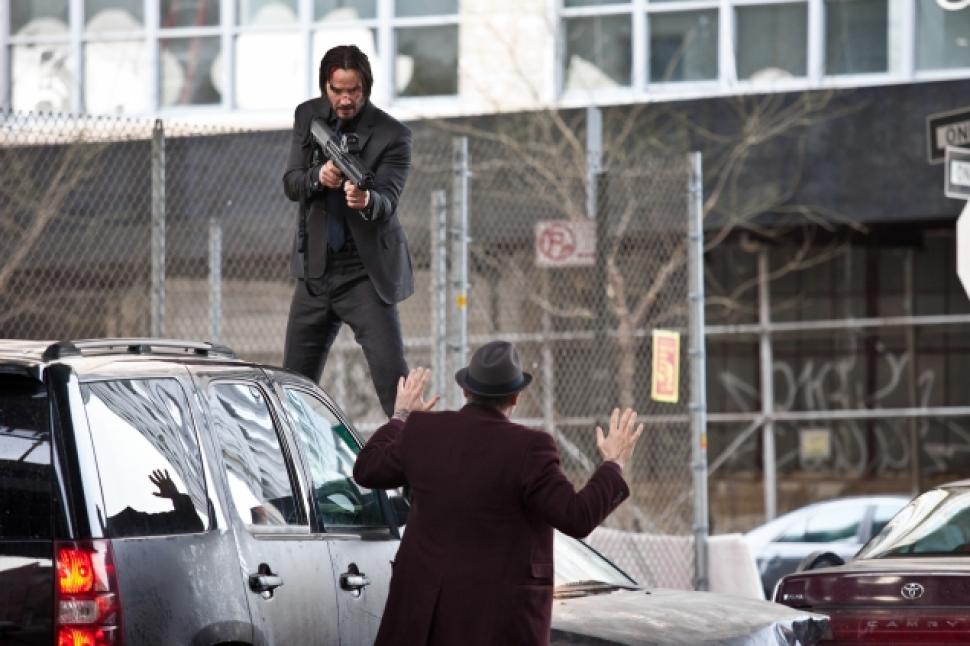
    The revenge plot here is what it is, and it ends as it must. What’s more interesting about John Wick is its underworld, and how Reeves navigates it the way a ghost would, his surroundings both familiar and strange. After stopping an assassination attempt singlehandedly, Wick decamps to The Continental, a full-service hotel/bar/hospital/spa/brothel for men and women of his former profession. If you’ve got a gold coin on you, anything is a phone call away. The Continental has rules—no noise, no violence, no business of any kind. It’s perfect for Wick’s needs, as he has an account and has drawn the ire of Viggo Tarasov (Michael Nyqvist), whose son (Alfie Allen) killed Wick’s dog. Tarasov once worked with Wick, and he knows that it is hopeless to plead mercy on his son’s behalf. So he puts out a bounty for two-million dollars, four if anybody is willing to break The Continental’s strict rules. Wick, when he isn’t perforating Tarasov’s faceless heavies, is hunted by the young, ruthless Perkins (Adrianne Palicki), and protected by Marcus (Willem Dafoe), who always seems to be on the right roof with a sniper rifle. Wick knows all of these people, and others who populate the world-within-a-world that is John Wick‘s playground. It’s a vague, barely sketched out premise, and the fact that it works is a result of a smartly chosen cast meeting ideas that are interesting enough, if not thought about for too long.

    But the mythological aspects of John Wick are what directors Chad Stahelski and David Leitch are hoping to build a cult around. The selling point of this film are its action sequences and its way with gunplay. Stahelski and Leitch were Reeves’ stunt doubles in the past, and the clarity of the carnage throughout is quite satisfying. Reeves moves through a rave or his mansion, tracking and killing every man that stands between him and his ultimate goal, and the camera right along, content with whatever rust there might be on its aging hitman’s bones. There’s a seeming effortlessness to it all, a cool beyond the overly-cool blues that the film is washed in, and it makes Wick a more engaging figure than all of Nyqvist’s growling about his boogeyman, back from retirement. As a veteran of countless Schwarzenegger and Stallone movies about hulking men trying to put some wife-related misery or death out of their minds, my ability to engage with gun-toting men in mourning has withered, and my capacity to appreciate the puddle deep philosophies of those genre pictures that take themselves too seriously is at its end. On some future rainy afternoon, though, it’ll be tough to refuse the proposition of John Wick on cable, with limited commercial interruption. That’s a kind of success, too. Not a poster on a dorm room wall, but something.


    John Wick. With Keanu Reeves (John Wick), Michael Nyqvist (Viggo Tarasov), Adrianne Palicki (Perkins), Ian McShane (Winston), John Leguizamo (Aurelio), and Willem Dafoe (Marcus). Directed by Chad Stahelski and David Leitch, from a screenplay by Derek Kolstad.

  • Movie Review: Jupiter Ascending (2015)

    Movie Review: Jupiter Ascending (2015)

    Jupiter Ascending

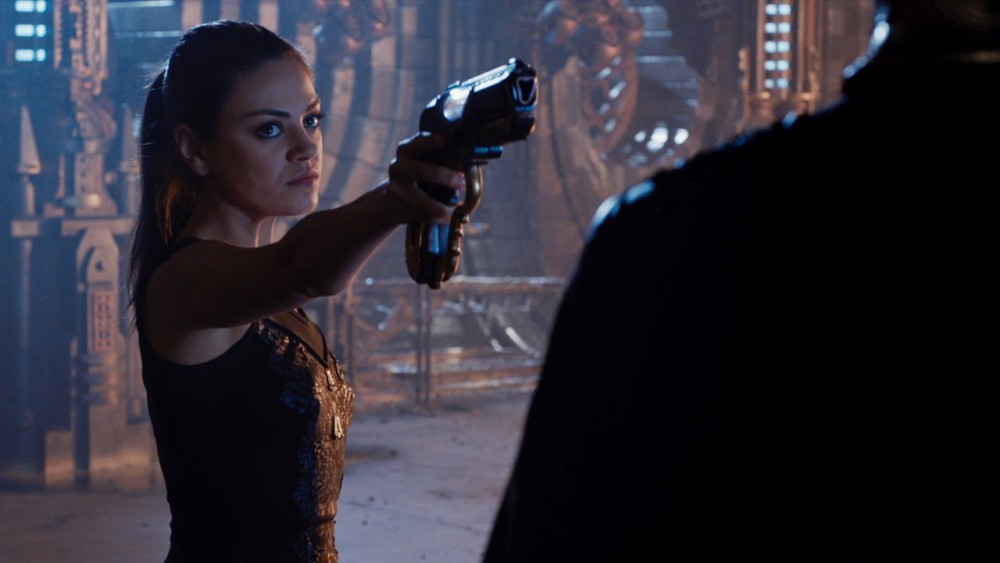
    Calling Jupiter Ascending an original movie is perhaps disingenuous. While it is among those increasingly rare science fiction blockbusters that weren’t adapted from comic books, novels, video games, or television shows, it is, like Pacific Rim before it, a hulking labor of nostalgia for an incredibly specific genre of film, the technicolor fantasia of the space opera. A dazzling array of humans, aliens, and spaceships pass before the eye, each of them unique and carrying loads of often unexplained baggage, but there’s hardly one that doesn’t have a corollary in Star WarsStar TrekClose Encounters of the Third Kind, or something decidedly stranger, more off-beat. Andy and Lana Wachowski have always worn their influences on their sleeve, but here, with the gross domestic product of several small nations at their disposal, they are bearing their hearts, both of them glittering machinations assembled from the detritus of what used to be called nerd culture and what is now just culture. By making a film so decadent and doomed to failure, they seem to have laid claim to that tiny parcel of the collective imagination that is still yet unconquered by the spandex-clad horde.

    None of this is to say that Jupiter Ascending is any good. In fact, most of it is very bad. An array of beautiful images crudely hacked apart and stitched back together in the editing bay, to describe any aspect of the plot here as presented is to sound like one is making assumptions of a very long film after catching the last five minutes on television. Here goes nothing. Jupiter Jones (Mila Kunis) is an undocumented Russian immigrant unsatisfied with her life cleaning toilets in Chicago. One day she is selling her eggs to a fertility clinic, which is surely a first in an action film. The next, she finds out that, through accident of birth, she is the exact genetic duplicate of the matriarch of clan Abrasax and the rightful owner of the planet Earth. This places Jupiter in the middle a family war between a hedonistic prince (Douglas Booth), an eternally young princess (Tuppence Middleton), and their ruthless industrialist of a brother (Eddie Redmayne), her only sure protection in the galaxy (which she will span in its vastness) being a soldier-turned-mercenary human/wolf/insect hybrid (Channing Tatum) first seen smelling her name on a sheet of paper at the clinic. There is a team of bounty hunters. There are little grey men. There are gigantic lizard men. There is the crew of the ship. There are robots and bureaucrats and the individual members of Jupiter’s family. All of them matter. Some are, it seems, audience surrogates, just as confused as we are about the world beyond our world that dances among the stars to an ancient song that can only be heard by those with access to its score.

    Luckily, the Wachowskis are keen to overshare. Large stretches of Jupiter Ascending exist just to fill in the details, coming so hard and heavy that even Jupiter, with her fate and the fate of the world on her shoulders, breaks down and says she doesn’t care about any of it. The other characters know so much and Jupiter so little that she frequently feels like a character without agency, falling for obvious ploys and needing constant rescue from Tatum’s Caine Wise, who has this neat trick where he is rescued from every conceivable deathtrap by the magic of coincidence and given all the credit. This is something of a disappointment, as Jupiter Ascending is, at times, nearly a Marxist, feminist manifesto shrouded by the glitter and doom of a summer blockbuster. Though doing so, I realize, is futile, I keep imagining Jupiter Ascending getting a summer release in a year that wasn’t overburdened with light, spectacle-driven sci-fi, having the billion-dollar success that was envisioned when the project was greenlit. Hundreds of thousands of men watch a woman struggle with the decision to sell her eggs, are enraged for her when her cousin negotiates a large cut of the profits. The working class grow angry with the film’s end boss, his speaking pattern belabored by a state of agonizing, near-constant orgasm as he lectures Jupiter about the need to convert humans into capital. A laugh is had as Jupiter negotiates the bowels of galactic bureaucracy with an over-taxed droid. A moment of silence is shared as a bottle of human goop—the liquid that allows the intergalactic ruling class their millennia-spanning lives—falls to the ground and is shattered.

    But I’ve mentioned a hoped for billion-dollar success, which spoils even my utopian ideal for the film. The larger engine at work throughout Jupiter Ascending is its naked desire for a sequel, the further adventures of Jupiter Jones in space or on Earth or wherever the focus group found itself most pleased. While my brain keeps twisting small moments in Jupiter Ascending into larger academic points (the CGI reconstruction of Chicago, just razed by a CGI spacechase, as a commentary on the vapid nature of such sequences, for example), the Wachowskis bumble about like Tobias Fünke, Yes, Anding themselves to the point of insanity. Jupiter is rescued from little grey men by a disgraced bounty hunter. Yes, and they fall in love. Yes, and their romance is complicated by issues of class. Yes, and there’s a marriage where one of the evil princes tries to marry an exact genetic replica of his mother. Yes, and that is spoiled by the bounty hunter, who was initially hired by the prince under the pretense that he would be reinstated to the military. Yes, and members of the military have wings! Yes, and, without his wings, the bounty hunter has these boots, these anti-gravity heelies that make it look like he’s tearing ass through the mall, even when his life is in danger. Yes, and, uhh, something about bees; an entire house covered in a honeycomb! Yes, and… uhh, wait, bees? Did you say bees? Yes! And, I dunno, maybe Jupiter’s scummy cousin buys a flatscreen TV?

    On and on and on, until the perfunctory action sequence brings us to the required Disney princess ending, which is some weird combination of The Secret and that old, classist pablum that one should be happy with what one has. Here, that means waking up at four in the morning to clean the toilets of the wealthy despite owning the deed to an entire planet, being okay with one’s place in a machine so large that even a Jupiter-sized refinery represents but one small cog within it. Recently, I saw a headline in my Google news feed that asked if Marvel could “save” the Wachowskis. Jupiter Ascending suggests not, as, despite its trappings, this is essentially their Marvel film, disguising the same mostly white, mostly male exceptionalism coded within the MCU with the same safe message that no, really, everybody can be special, the princess or the soldier (never both, and never something else). That’s a marketable idea, but not one the Wachowskis or their film seem to believe in. No, the heart of Jupiter Ascending, beating faintly under layer after layer of bloat, belongs to Terry Gilliam, sniggering maliciously as he affixes a rubber stamp to the deed that awards Jupiter Jones ownership of Earth. It’s a fine dream Jupiter has, of liberating her and her family. How easy, Gilliam’s appearance suggests, for that dream to become madness.


    Jupiter Ascending. With Mila Kunis (Jupiter Jones), Channing Tatum (Caine Wise), Sean Bean (Stinger Apini), Eddie Redmayne (Balem Abrasax), Douglas Booth (Titus Abrasax), Tuppence Middleton (Kalique Middleton), and Terry Gilliam (Seal and Signet Minister). Directed by Andy and Lana Wachowski, from a screenplay by the Wachowskis.

  • Movie Review: American Sniper (2014)

    Movie Review: American Sniper (2014)

    American Sniper

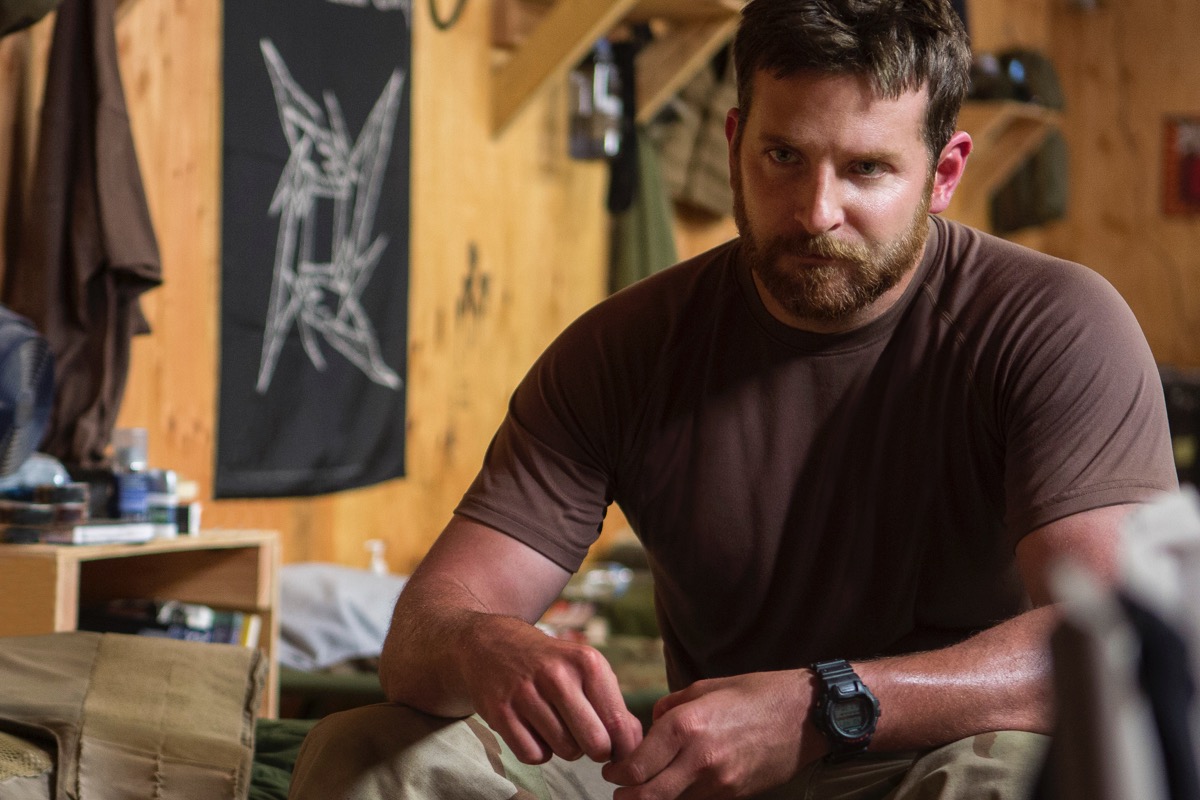
    There are other movies out right now—better ones, too—but I chose to see American Sniper because it is the film everybody has an opinion on right now, and I guess I felt like I needed to formulate one of my own. The memoir that this serves as an adaptation of is likely something I will never read, so I can’t comment on Clint Eastwood and screenwriter Jason Hall’s ability to bring Chris Kyle’s story to the screen as Kyle told it. I know that he uses the word “savage” to describe Iraqis, and I know he later falsely claimed to’ve punched out Jesse Ventura at a bar for mocking veterans. I also know that Kyle said he was responsible for more kills than the Navy SEALs will confirm, and that the government parked him atop the Superdome in New Orleans during Hurricane Katrina, where he allegedly shot and killed “dozens” of American citizens. I don’t know Chris Kyle, but he sounds like a complex, flawed, dangerous fraud, the fabled Good Guy with a Gun who exists only in the collective fantasy of the American right whose life is worth reflecting upon as a means of deconstructing such myths. Clint Eastwood, however, is not the man for such a job. A man who is given to lecturing invisible Barack Obamas on the significance of America and her ideals, Eastwood sees his protagonist as a man wearing a white hat though stranded on a black sea. The war isn’t just something that happens; it’s something that happens to him. Kyle’s story, in the hands of a director more interested in the fact of a hero than his psyche, is as complex as a bologna sandwich.

    American Sniper, rather than linger in the details or fret about the larger implications of what Chris Kyle (Bradley Cooper) does for a living, is largely desensitized to the brutalities he perpetuates and has perpetuated upon him. Exactly one kill shown here has any weight, his first, and that is largely because, as cut for the trailer, it’s a rather compelling microfilm about the weight of one’s choices. That the choice being made here is a white man’s decision to kill or not kill an Arabic woman and her son is shown to be largely irrelevant—it’s not how Kyle imagined his first time pulling the trigger, but he stopped a pair of suicide bombers from wiping out a patrol of Marines. Mission accomplished, end story.

    Between his placing a finger on the trigger and his pulling it, there’s a rather lengthy bit of exposition explaining the kind of person Kyle is. In short, he’s a red-blooded American, an honest-to-God cliché. He loves his country and he loves his woman. The first three images of American life shown in this film involve hunting rifles, bibles, and a football. The suburb Kyle grew up in is shot as beige and featureless as the Iraq he will later occupy. He has sex with the woman who will become his wife (Sienna Miller) and wakes up to live footage from New York City on September 11th, 2001. Both the sex and the act of war inspire Kyle to get better at his job. He says he’s protecting his country. He says his country is the greatest on earth. It’s all been said before, but Chris Kyle is a real man with a real (if embellished) record, a soldier whose funeral filled a football stadium, so coming from the actor occupying him, I suppose all of that’s supposed to lend the script’s bumper sticker platitudes the kind of gravity repeated sequences of bodies spasming, geysering blood, and collapsing dead just can’t earn these days.

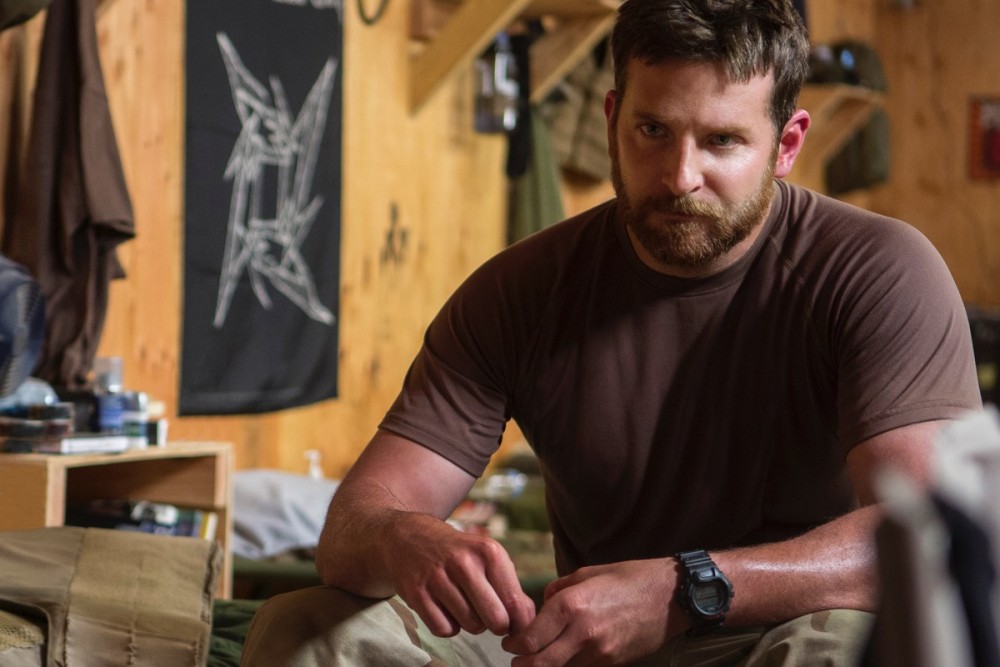
    Given a relatively straightforward script and Eastwood’s by-the-numbers direction, Bradley Cooper isn’t exactly taxing himself as Kyle. Without the real man’s penchant for dehumanizing language, all Cooper has to do is set his jaw firm and speak with a slight drawl. Even when he’s under fire, taking shots from elite enemy snipers—one of whom is described as a former Olympic medalist fiercely loyal to bin Ladin—Cooper’s Kyle doesn’t seem too stressed. His wife can hear gunfire and other soldiers shouting over their cell phone connection, but Kyle always seems to be a readjustment away from leaving the battlefield with his life and a few more notches on his belt. When a sandstorm kicks up over a late-film op, it’s merely one more shade of beige.

    Plenty has been made of the fake babies used to simulate Chris Kyle’s newborn children, which betrays that there’s really not much to American Sniper that’s worth discussing. There’s the political angle and the race-baiting of Kyle’s memoir, but Eastwood seems decidedly uninterested in why we’re at war and what Kyle thinks of the people he is shooting. That’s a problem perhaps, but one of adaptation and not morality. It’s been impossible to log in online without seeing dozens of tweets from morons who saw this film and said how it made them want to kill Arabs, but I suspect the folks responsible for those missives harbored their racist feelings before seeing American Sniper, just as I suspect that the editors responsible for publishing those tweets on every website that leans even slightly left know that morons on Twitter draw a lot of clicks. But I’m a white guy myself, and all I know about movies like this is that it takes a really good one or a really offensive one to get my attention. That’s a failing on my part, I know, but I thought I was going to leave this film convinced of its evils. Instead, I’m at something of a loss. What this film should have done with its subject matter is a matter for debate until the next film about war during the Bush presidencies is made. What it did, however, is nothing.

    American Sniper is further evidence that Eastwood is continually regressing as a director, or that time has finally passed him by and is no longer as interested in the merits of American muscle as he is. I don’t think that filmmakers are necessarily obligated to create pictures that take a hardline stance on the War on Terror, but that this is the story Eastwood has chosen to present as a somber occasion set to taps is disingenuous to all parties involved, including Kyle. Cooper plays him as a man who is somewhat uncomfortable with his notoriety, but Eastwood is set on making him a paragon. So be it. There are better films about this war out there, and still more yet to be made. In terms of fiction, Kathryn Bigelow’s The Hurt Locker and Zero Dark Thirty diptych remain the best place to start.


    American Sniper. With Bradley Cooper (Chris Kyle), Sienna Miller (Taya), Luke Grimes (Marc Lee), and Kyle Gallner (Goat-Winston). Directed by Clint Eastwood from a screenplay by Jason Hall, based on the memoir American Sniper by Chris Kyle, Scott McEwen, and Jim DiFelice.

  • Movie Review: The Interview (2014)

    Movie Review: The Interview (2014)

    The Interview

    I watched The Interview on Christmas. I was alone, away from my family on the holiday for the first time. But even had I been in Detroit with my mom and my sister, I probably would have seen The Interview, because we’re bad Catholics and non-Catholics, my family, and once the Christmas portion of Christmas has concluded, we venture out to the multiplex to see whatever’s playing. Of course, the big deal about The Interview is that it wasn’t playing at so many multiplexes, yanked from the slate of Christmas releases by fear and paranoia that North Korea, the supposed perpetrator of the cyberattack that so hobbled and embarrassed Sony Pictures, might up the ante by bombing any theater that dared screen the film. The Interview stopped being a Seth Rogen/James Franco comedy and became a free speech issue. It was one of the highest rated films on IMDB, a constant source of Facebook chatter, and an issue large enough for President Barack Obama to voice his displeasure over. It became our duty, as Americans, to see this dumb movie about dumb people attempting to assassinate a dumb dictator. Or it was our duty, as Americans, to remind other Americans that it was nobody’s duty to see anything.

    Well, I saw this movie. I saw it on Christmas, as I said, and I read a number of very good articles about why The Interview, as a bastion of free speech, was problematic at best. I also saw Seth Rogen reply to earnest, well-intentioned, well-written criticism of an otherwise forgettable film by pouting and tweeting “Go fuck yourselves” at websites like The Verge. All of it seemed surreal and stupid, and I felt pretty good about my decision to not write about The Interview because it is a very dumb movie, which is fine because it had no aspiration to be anything else, at least not until the rest of the world started to address it as a capital-I Issue. Watching this movie with my dog curled up in my lap, I felt very ill-prepared to talk about The Interview as an Issue or as a misfire by a comedic team whose work I frequently enjoy. I feel very ill-prepared now, but I will try, I suppose, to say something.

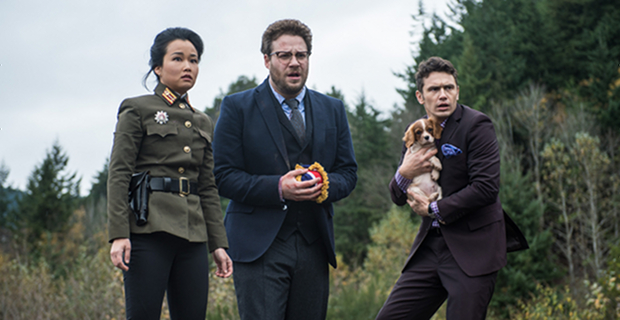
    The particulars of The Interview are common knowledge, but here they are: David Skylark (James Franco) is the host of Skylark Tonight, a popular-but-empty Hollywood talk show on the order of Extra or Entertainment Tonight. Still, he has an uncommonly good rapport with his guests. Rob Lowe is willing to come out as bald on his show, and Eminem tells the world that he’s gay like it’s no big thing. This is big money stuff in entertainment journalism and “real” journalism, which are often the same thing, but Skylark Tonight is looked down upon by more respectable media establishments, and this eats at its producer, Aaron Rapaport (Seth Rogen). When the two hear that North Korea’s Kim Jong Un (Randall Park) simply loves Skylark Tonight, they drunkenly send a flier out to his camp to see if he might want to appear on the show, lending them the serious journalistic credibility Rapaport has always wanted. When it turns out that, yes, Kim Jong Un would like to appear on American television, they are roped into a CIA plot to assassinate the dictator, thus liberating the state from the tyrannical reign the Kim family has long enjoyed.

    To Rogen and co-director/writer Evan Goldberg’s credit (I suppose), The Interview pays lip service to the idea of America as an agent of democracy, and to Hollywood’s interest/involvement in traumatic global crises. It also stands firm and states that enjoying margaritas does not make a man gay. Beyond that, however, and beyond whatever pleasure there is in the notion of riding around in a Soviet tank that is blasting Katy Perry’s “Fireworks,” The Interview seems content to laugh at North Korea from a safe distance, taking the same shots at the country, its leadership, and its people that the American media has taken for decades. Part of the hysterical response to the Sony leak, I’m convinced, was the latent fear that an aggressive, fear-mongering country might not be the hapless cartoon our own media built in the collective consciousness.

    The-Interview-Franco

    If North Korea is responsible for the Sony leak, and if they did it in response to this film, that ultimately changes nothing about its merits, which are few and fleeting. Having journeyed far and wide with their bro comedy tropes, from high school to the apocalypse, Rogan, Franco, and Goldberg elevating them to an international stage doesn’t suddenly validate their material. Rape jokes are rape jokes. Gay panic is gay panic. Asian stereotypes remain Asian stereotypes. In any other context than the one conjured up by the hacking of a multibillion dollar entertainment company, all of this is obvious. I’m not saying anything new here, I know, but I feel like I need to repeat this in my own voice, to hear how it sounds coming from me.

    The Interview is an issue of free speech because it is a film created by straight, white men at the expense of an oppressed people who do not have the right to free speech. This film is an issue of free speech because it is easy for us, as a nation dominated by straight, white men, to look at something like the release or censure of a stoner comedy produced and made by millionaires as a test of our moral turpitude, to see whether or not our country will stand up to a menace whose only definition, for the majority of us at least, is that it is not-white in origin. This film is an issue of free speech in the same way that, say, erecting a “Pants Up, Don’t Loot” billboard is an issue of free speech, only many of us decry the billboard because the trauma it mocks is local while The Interview is quite harmless because it’s only North Korea, whose traumas aren’t even ours, let alone local. So we stood up, valorized this movie and those who made it, spent weeks rallying around the flag. That it was pig-headed and frequently racist wasn’t an issue. This was an American movie, and it was our right as Americans to see and forget about it in any fashion we chose.

    Sure. I agree. And I also agree that this film should have been released as originally planned, in as many theaters as could be booked to play it. That The Interview came, went seen or unseen, and slipped quietly onto home video would have been a blessing. Circumstances dictated that we were to be given something else on Christmas, something precious and in need of protection. That’s fine, too. But now we’re in a situation like 2012, when we spent the summer debating whether or not it was okay for victims of rape to be offended by rape jokes, or right now, when we’re blindly posting Jui sui Charlie on our Facebook walls as if it’s impossible for a progressive publication to also be horrifically racist. Soon, we’re going to have to come to the realization that the “free speech” we’re so thoughtlessly protecting is only free because of its gender, race, and class status. But that requires thinking inwardly. It requires a satire willing to punch upwards instead of at those who are already down. Finding someone who supports the idea of satire is easy. Where are the people who are dedicated to making it?


    The Interview. With James Franco (David Skylark), Seth Rogen (Aaron Rapaport), Lizzy Caplan (Agent Lacey), Randall Park (President Kim), and Diana Bang (Sook). Directed by Rogen and Evan Goldberg, from a screenplay by Rogen, Goldberg, and Dan Sterling.

  • Movie Review: Life Itself (2014)

    Movie Review: Life Itself (2014)

    Life Itself

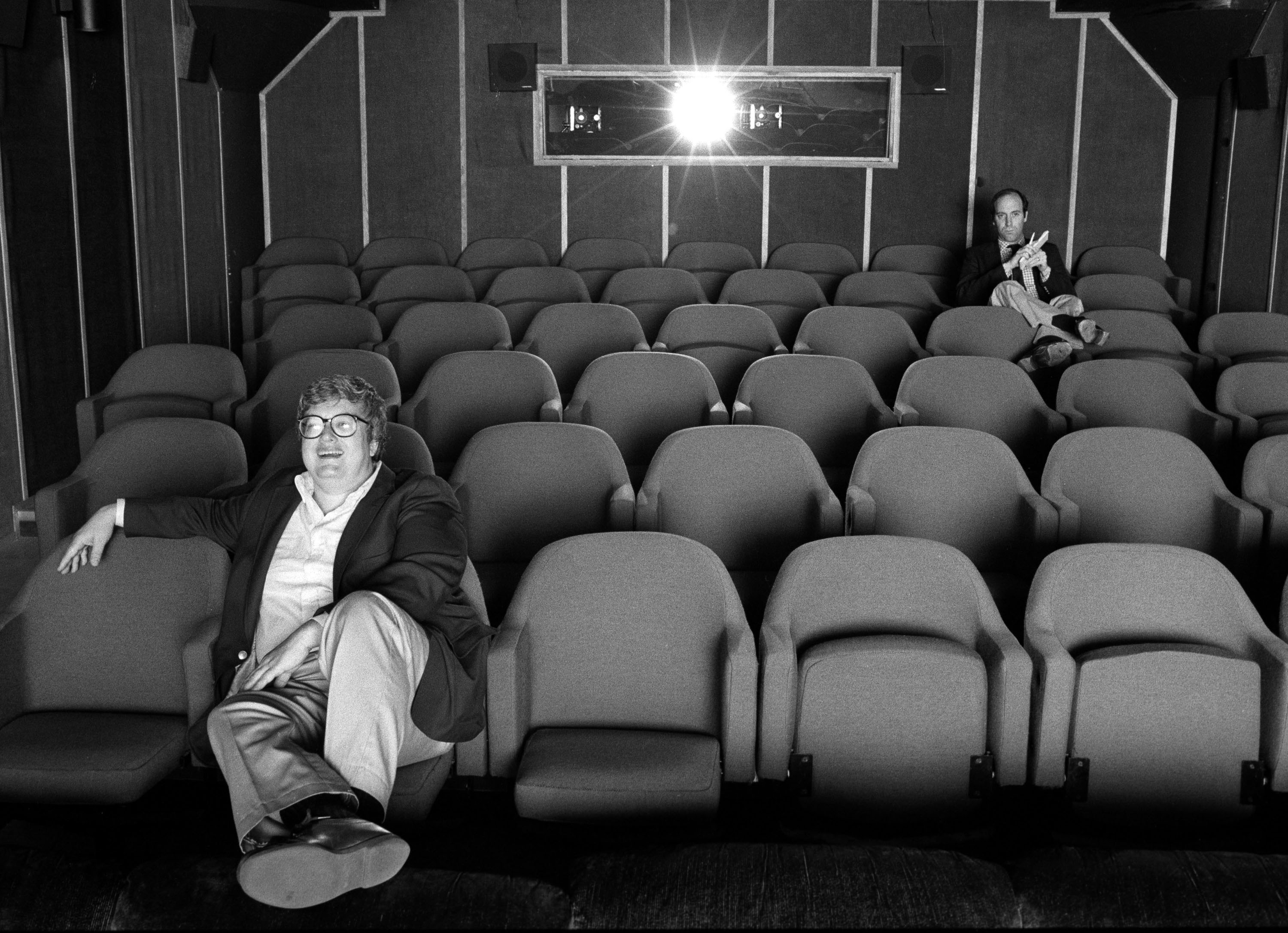
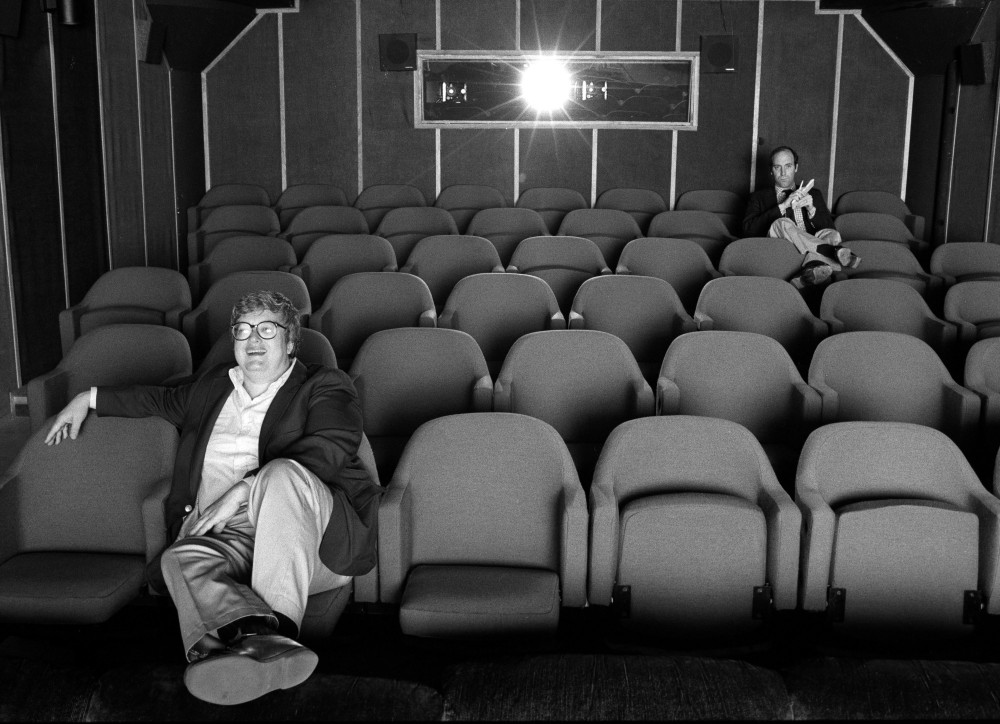
    essentialI’ve been avoiding Life Itself for a long time, as a book and as a film. A paperback copy of Roger Ebert’s memoir is there on my coffee table, between my chair and the screen I watch movies on. I know that cover intimately: The red velvet of the movie theater seats, his black silhouette before an endless screen that could not exist in any reality but one liberally embellished by the mind. I’ve seen movies in the same theater as Ebert, eaten a meal in the same room as him, too. In this documentary, Time Magazine‘s Richard Corliss says that Roger Ebert had been writing about film for half of its existence. He’d been writing about film for the whole duration of my life, was a fixture on T.V. every Friday. He’s been part of my life as a filmgoer and as a writer for as long as I’ve seriously been either of those things, and yet Life Itself loomed ominously, its mere existence a threat. But to what, I wondered, pulling myself through Steve James’ documentary.

    There’s very little about Roger Ebert that isn’t already public record. As an extension of the speaking voice he lost through several surgeries related to thyroid cancer, he launched Roger Ebert’s Journal in 2008 and began blogging regularly in addition to his duties as the film critic of the Chicago Sun-Times. At first, the blog was mostly a supplement to his reviews. There were bits about his status as the only film critic who liked the new Indiana Jones film, his distaste for 3D, and so on, but every now and again there’d be an essay about science fiction or his childhood obsession with the news, something about his life, and it became very clear that Roger Ebert’s Journal wasn’t going to be a typical blog for very long. Once, he wrote that his wife Chaz was bugging him to start writing a memoir. Then his blog began exploring his life in admirable detail: His childhood, his relationship with Russ Meyer, his alcoholism, his marriage. He was writing a working draft of Life Itself the whole time, from 2008 to the publication of the memoir. It was an admirable project, one, he said, that marked the final stage of his life.

    I suppose that’s what I feared: Closure. Which, I realize, is an odd thing to seek from an online relationship between a blogger and a member of his commentariat. But he had an odd way of making such a small relationship seem important. I read Ebert’s website every day for years, trying to better myself as a critic. I dropped comments here and there. Sometimes Ebert would comment back, which was thrilling stuff to a know-nothing college undergraduate whose own blog was a repository of snark and near-opinion on whatever I’d spent the weekend assaulting my brain with. When one of his blog posts became a cookbook, several of my comments were included, and suddenly I was a published author. I put this on my CV, sent it to a few colleges, and all of the sudden I was a graduate student. This was life-changing stuff for me, though it was probably nothing for him. My family still talks about it. Still. When this documentary was on CNN the other day, I got text messages from my mother. It was all I saw on Twitter. For a long time, closure meant acknowledging that whatever project Roger Ebert had embarked on was finished. Watching Life Itself, it quickly became clear how wrong I was.

    Steve James’ documentary is Ebert’s conscious attempt at adapting his book into a film. Initially, that’s how the project is framed: James interviewing the living subjects of the book about Ebert and their role in his life, and interviewing the film critic to dig a little deeper into certain sections of his story, be that his connection with the city of Chicago or his debate with Corliss in the pages of Film Comment or the future of film criticism as the Internet continued to grow, presumably shrinking the influence of the daily newspaper in the process. But as Life Itself opens, Ebert is back in the hospital for a hairline fracture of his hip. Soon, he will realize that the fracture was caused by metastasized tumors, a return of cancer. He will go on as long as he can, but he is frequently too tired for filming or to answer James’ questions, so the director must go back to the book, fleshing out this story he’s stumbled onto, of a beloved literary figure who, for so long, has refused to die.

    Again, there’s little that Ebert has left out of the public eye, so for a reader of his blog or memoir, there’s little new information to be parsed. The inclusion of Ebert’s friends and family, his wife and old drinking buddies like John McHugh, the women who produced his television show and Gene Siskel’s wife Marlene Iglitzen all serve to add perspective to the singular voice of the memoir. The expected things are covered: His was a wide experience, fondly remembered. If he could be difficult, then it was for the betterment of whatever he was working on, or because he had a competitive edge that raised the game of those he worked with. The rehab sessions James witnessed were taken from his fifth visit to the clinic. He was relearning how to walk again, indefatigable. He seemed genuinely excited when James was there capturing that process, or, even better, when the camera was on to see a nurse suctioning his G-tube. A scene where Ebert is fumbling with his computer speakers while the nurse and Chaz wait around impatiently to get the suction over with becomes strange and beautiful when he manages finally to plug the jack in. The song is Steely Dan’s “Reeling in the Years,” and though what he’s enduring can’t be comfortable, he looks relieved, blissful even, as if he knows the music means James got a better shot.

    Life Itself Film 02

    As for the question of how to make a film about a film critic, James lets Ebert’s writing and the films he wrote about do the bulk of the work, utilizing clips from Bonnie and ClydeEl Norte, and other films Ebert gave glowing reviews to while voice actor Stephen Stanton reads the review. Moreover, Ebert’s words appear captioned on the screen, giving new life to old film reviews while showing the intimate relationship art might enjoy with art criticism were the two to be treated with equanimity. Of late (and due, perhaps in part, to the large influence of Siskel & Ebert, which was never intended as serious criticism but was frequently treated as such), it seems like film and film criticism are moving farther and farther apart. A bad review of a popular film is said to be written for attention. The influence of a popular film critic means less now than it did when Siskel and Ebert spent a year stumping for Gates of Heaven on national television.

    But this is the project Ebert had undertaken in the very last days of his life, the expansion of his online reach and the opening of a new channel for young, unknown critics to develop their skills and make their voices heard. After years of breaking filmmakers like Scorcesse, Herzog, Bahrani, and James, his final project was a way of saying that the work is never done. James’ camera shows Ebert scrolling down the contributors’ page of his then yet-to-be-launched website. So many of those faces belonged to women or persons of color. All of them were of people he had influenced, in some way, to write about film. It’s a stunning gesture, allowing his name to amplify the voices of so many others, but he seemed to regard the Internet as the future of film criticism rather than its end. That isn’t closure, but a new frontier. His work continues, though not under his byline. He wrote of movies as a machine that generates empathy. By giving of himself so fully to this one, he ultimately proved his point.


    Life Itself. A documentary, directed by Steve James. Based upon the memoir Life Itself, by Roger Ebert.