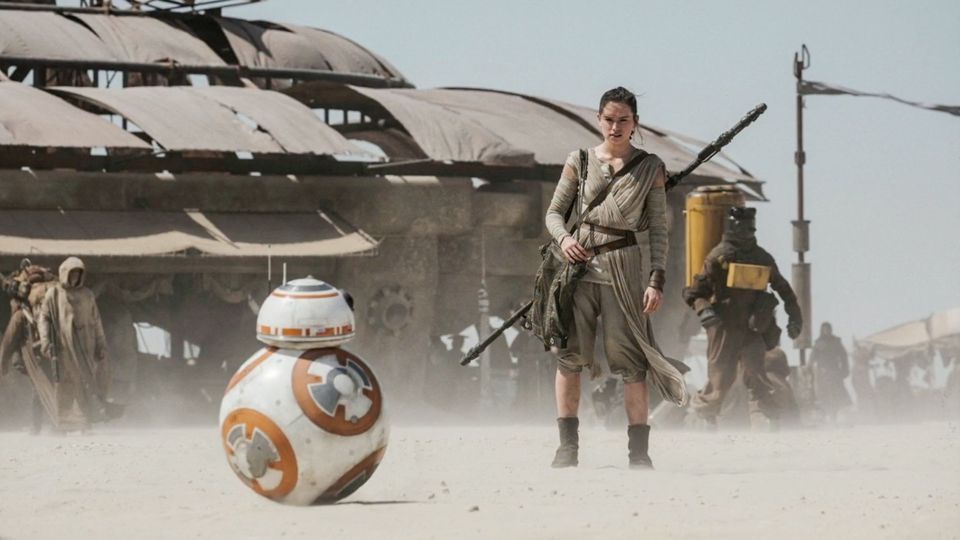
At last, our long national nightmare is over: There is a new Star Wars movie, and it’s pretty good. It feels like we’ve been living with the fact of J.J. Abrams‘ The Force Awakens for as long as we’ve lived with the franchise itself—since Disney purchased Lucasfilm and the rights to Star Wars from George Lucas, the possibility of more Star Wars became the inevitability of Star Wars, and the cultural stewardship of this sainted popular object passed, once again, from people to the corporations that sell things to people. If you ate food, drank water, or breathed air at some point between the release of the first The Force Awakens trailer and now, odds are that its controlling bodies had signed a licensing agreement with Disney so it could stamp BB-8 or Kylo Ren on the box.
As such The Force Awakens is a film designed to play as wide as possible, to get as much right as it can for the largest number of people. It’s a huge, exciting popcorn spectacle that both painstakingly sketches out its post-Rebellion world and has no real need to hit any beats that weren’t established by the original trilogy. Its heroes are orphans. Its villain is pulled between the light and dark sides of the Force. Decades have passed since the fall of the Empire and governments and regimes have changed, but this change, which is actually quite boring when played out in Senate chambers and offices, is mostly felt in costuming and set design tweaks, and what time has done to heroes like Han Solo (Harrison Ford), Leia Organa (Carrie Fisher), and Luke Skywalker (Mark Hamill). No longer controlled by an Empire, the galaxy is stalked by the First Order, a frightening band of sleek new Stormtroopers that seems to have found a balance between adherence to the force and belief in fascistic military rule. With Luke Skywalker vanished, The First Order and the Republic-backed Resistance are in a race to find him in a star system whose map has been compromised with the fall of the Empire. Like in A New Hope, that vital information is stored in the files of an otherwise unassuming droid that ends up stranded on a desert planet, searching for a way to a secret base that finds itself menaced by the enemy’s planet-destroying power.
It’s hard to fault Abrams for nostalgia—Star Wars has largely been a callback machine since Return of the Jedi, and his script, co-written with Lawrence Kasdan, is at least using familiarity to push forward into new territory. That script is unbelievably smart when it comes to handling the legacy of the original films. Luke Skywalker is a mythological figure, the stories about he and his companions rendered unbelievable in the totality of his disappearance. The Force’s role has shifted somewhat, too, from science to sorcery to religion. Leia and Han, having taken their respective roles in the new world, are at the periphery—our principals characters are the cocksure pilot Poe Dameron (Oscar Isaac), Stormtrooper deserter Finn (John Boyega), and desert-bound scavenger Rey (Daisy Ridley). They’re an engaging trio, propelling Abrams’ vision of a Star Wars for the future while burnishing the figures they encounter as the legends of the past.
As for its villains, Abrams really dials up the Riefenstahlesque staging to mark the First Order as the terror of the galaxy, and for however terrifying Darth Vader fanboy Kylo Ren (Adam Driver) appears, the fact that he’s a relative novice to the force means that the banners-and-battle-stations pageantry of these new, sleek Stormtoopers actually means something. The difference between Abrams’ conception of evil and George Lucas’ is stark. In the first action sequence, which is among the best in any Star Wars film, Stormtroopers disembark from a landing craft and fire into a crowd of villagers. Their laser bolts strike, accurate and deadly. There is blood. Finn, yet unnamed, is on his first battle mission and shakes. Dameron fires his rifle at Ren, who freezes the bolt. It hangs suspended in the scene for a minute, then slams home into a piece of machinery after Dameron’s capture. Later sequences don’t have the same impact, but they look like they were staged, directed, and shot by a crew that was having fun with everything, somehow unburdened by the fact that they are making a Star Wars for the sake of getting the gears turning again.
That The Force Awakens is fun is probably Abrams’ biggest accomplishment. For years, he’s been laboring in the shadows of Lucas and Steven Spielberg, making epics that lived and died by the same principles as the epics of his heroes. Given the sandbox he’s so clearly wanted to play in for awhile, Abrams puts on a show that manages to rival his predecessors, creating some of the most indelible images in any Star Wars film to date. The best of these take place on the desert planet of Jakuu, which is littered with the hulks of Star Destroyers abandoned after an unseen battle, an elephant graveyard that scavengers pick scraps from to clean and sell for food. The economy of Jakuu works well as a metaphor for what The Force Awakens represents, which is the stirring of a great machine that will run much longer than anyone can account for. Some of those scraps are just junk, useless pieces of space debris that look cool but serve no real purpose. Some of those scraps are the Millennium Falcon, begging to be taken to lightspeed. This one’s all lightspeed.
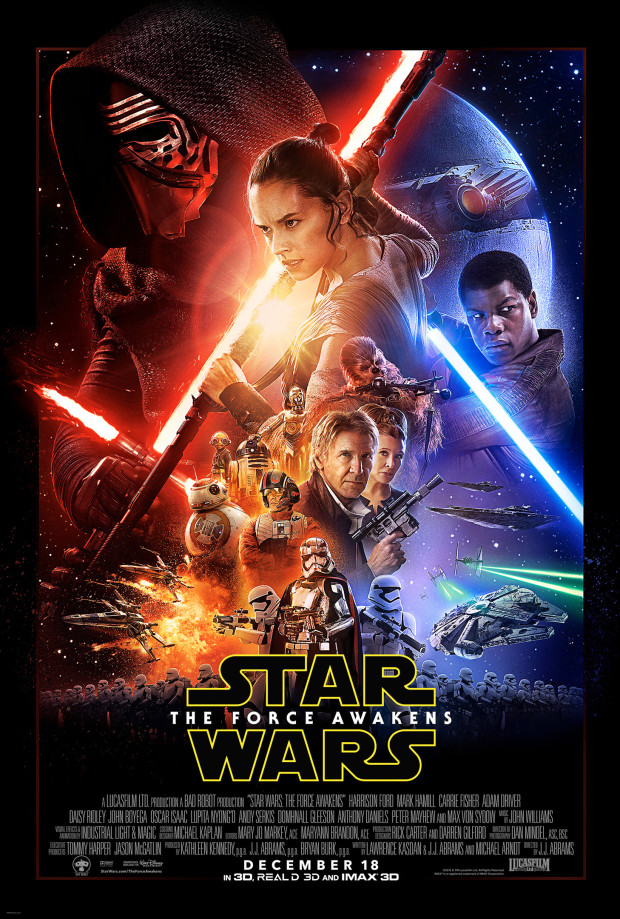 Star Wars: The Force Awakens (2015)
With Daisy Ridley (Rey), John Boyega (Finn), Oscar Isaac (Poe Dameron), Adam Driver (Kylo Ren), Harrison Ford (Han Solo), Carrie Fisher (Leia Organa), Domhnall Gleeson (General Hux), Andy Serkis (Supreme Leader Snoke), Lupita Nyong’o (Maz Kanata), and Mark Hamill (Luke Skywalker). Directed by J.J. Abrams from a screenplay by Abrams, Lawrence Kasdan, and Michael Arndt, based on characters created by George Lucas.

 Let’s clear the air: Dredd is so unlike Sylvester Stallone’s execrable Judge Dredd that, were it not for the title character and the iconic helmet worn by both Stallone and Karl Urban, the two wouldn’t appear to share the same source material. Dredd, though not half as smart as the 2000 A.D. comics that inspired it, has a bleak, is an uncommonly inspired shoot-em-up. Its first shot, with the towering buildings of Mega City One casting grim shadows over the ruined earth the city is build upon, evoke a daytime Blade Runner. Its last borrows liberally from The Dark Knight. The plot, which sees Dredd and a rookie judge navigate their way through a locked-down apartment complex filled with men willing to die in protecting the leader of their drug cartel, happens to resemble that of The Raid: Redemption. But merely comparing Dredd to other action movies won’t do. It’s a smarter, nastier film than many of its contemporaries, and, at its best, gives rise to moments of raw terror and startling beauty, the two often going hand-in-hand.