Tag: George Lucas

  • Movie Review: Star Wars Episode I — The Phantom Menace (1999)

    Movie Review: Star Wars Episode I — The Phantom Menace (1999)

    Star Wars the Phantom Menace

    Star Wars Episode I — The Phantom Menace came out when I was 11 years old, and I’m not going to lie to you: I liked it, so much so that my memory for it to this day is nearly word perfect. It’s an odd thing, remembering what I was like at 11, when the story of young Anakin Skywalker was aimed directly at my heart like a missile gunning towards a space station’s ventilation shaft, but this is hardly something I’m looking at through the lens of nostalgia. Before the release of The Force Awakens, while my various social media streams were reaching, in unison, for the films from the original trilogy, The Phantom Menace was the Star Wars film I reached for. As much as J.J. Abrams’ reboot/remaking of the Star Wars universe was a love letter to the Star Wars films everybody loves, it is very much a product of and response to the ecology of blockbuster film-making that The Phantom Menace largely created, one where the imagination was set free from the limitations of physical space by CGI and bound instead to the principal of narrative ease.

    Star Wars has always been a franchise dedicated to serving the whims of young boys. Its bright colors, easy charms, simplistic moral grounding, and elements borrowed from Joseph Campbell and the sci-fi serials of director/creator George Lucas‘ youth don’t leave much room for complication or nuance. But rather than examining my childhood (which wasn’t exactly damaged by the film) or the childhoods of the assembled horde of folks cheering that a film series owned by the Disney corporation has been liberated from the mind of its creator, The Phantom Menace needs to be examined in terms of the theoretical child George Lucas was directing for. Regardless of whether or not this represents the beginnings of a noble effort to document the fall of a democratic republic, the boy Lucas loved so completely when he made A New Hope is, with The Phantom Menace, a construct he holds in contempt.

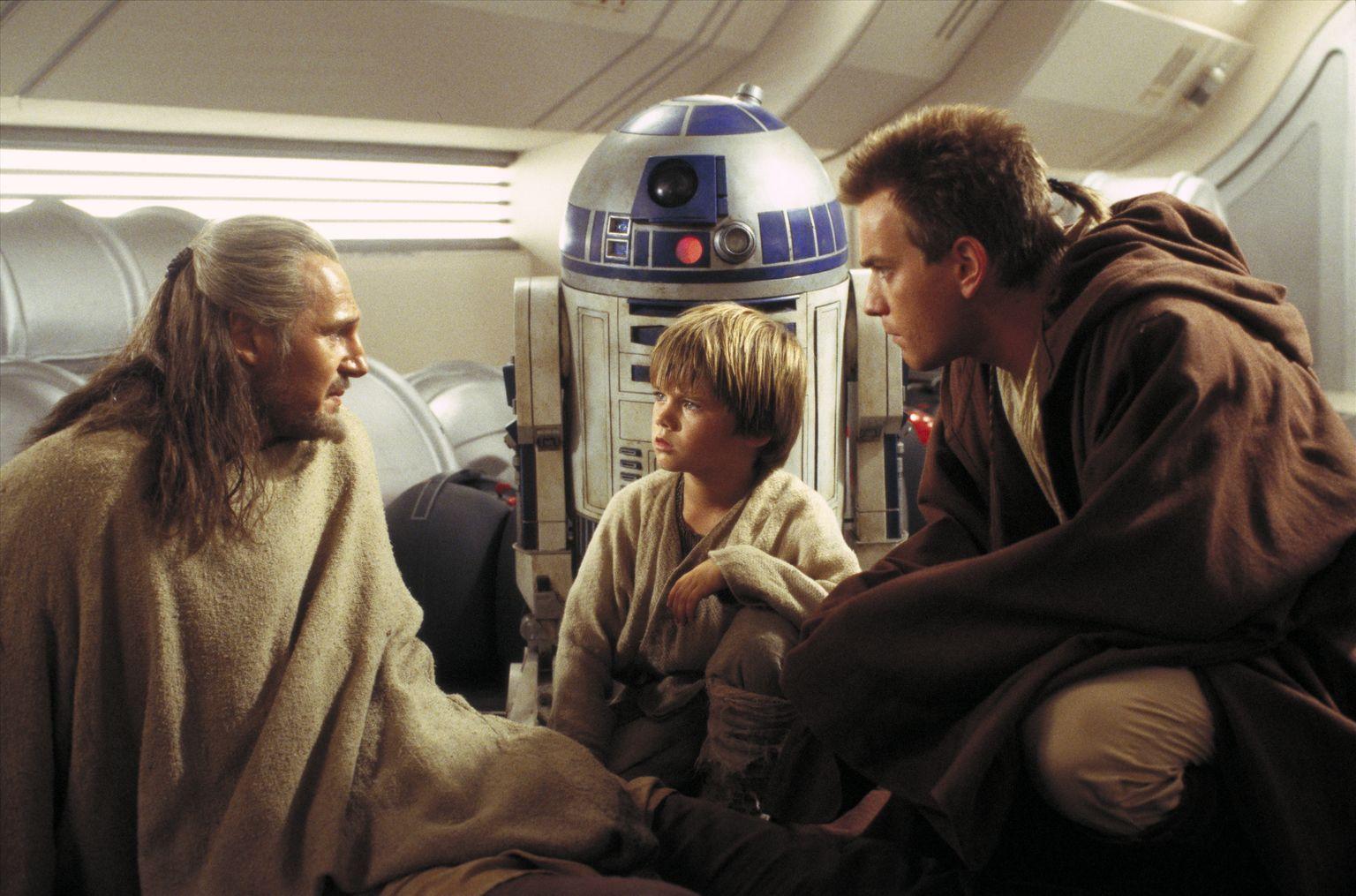
    There’s never a moment in The Phantom Menace where it feels like Lucas trusts his audience to understand what is happening, which is fair considering where he begins: In the middle of a treaty negotiation over blockaded trade routes. Like all great space-fairing epics, the galactic Senate is ineffectively wringing its hands over what to do about the Trade Federation’s illegal occupation of the routes to Naboo, waiting on a report from its Jedi ambassadors Qui-Gon Jin (Liam Neeson) and Obi-Wan Kenobi (Ewan McGreggor) before taking a vote on whether or not to sanction the Federation in some unspecified manner. In a way that’s clever (but not too clever considering the sheer number of corporate sponsorships attached to Star Wars), Lucas imagines the Trade Federation not merely as a corporation, but a body so large it has a seat in Senate. What they produce and who they service is unclear, but everything about The Phantom Menace is only clever on the surface, like the way Jedi Knights function in vaguely similar fashion to Jesuit priests. Because the Trade Federation are evil and stupid, they attack the Jedis with a squadron of easily dispatched droids, who spend the majority of The Phantom Menace bumbling about as various weapons cut through them like their sole purpose is to demonstrate the unspeakable power of the people they oppose. They also serve as a platform for Lucas to demonstrate both upgraded lightsaber techniques and his ability to create characters that would have once required an army of puppeteers and animatronics experts, the whole show meant to dazzle the eye at the cost of everything else.

    Through a series of contrivances involving a hair-raising number of racial stereotypes, Qui-Gon and Obi-Wan rescue Queen Amidala (Natalie Portman) and slip the blockade, landing on the familiar desert backwater of Tatooine. Their ship in desperate need of repair, they decide to rely on the help of a young boy named Anakin Skywalker (Jake Lloyd), who is the premier podracer in the galaxy despite his age. Qui-Gon sees something in the boy and seeks to free him, believing he might be the literal chosen one of a shadowy Jedi prophecy, and wagers it all on Anakin to win the big podrace. While the podracing sequence is a genuinely well-done setpiece that convincingly conveys the speed and danger of this NASCAR-like sport, there’s never any question that Anakin is winning the race. He’s important to the story, but decidedly a background figure, a child on the fringes of consciousness, let alone the centuries-long battle between the Jedi and the Sith, the film’s titular menace. As he jogs to the spacecraft that will take him from the only planet he’s ever known, his new friend is attacked by Darth Maul (Ray Park), a Sith with a double-bladed lightsaber and body modifications (woaaaaaaaaah, cool!).

    The first two acts are long—whatever sense of pacing Lucas had as a director all but swallowed up by the 20-year gap between The Phantom Menace and A New Hope. The film picks up noticeably with the introduction of Maul, cutting back and forth between a siege on the palace of Naboo, a battle on the outskirts of town, a starfight over the orbital blockade, and a duel between the Jedi and the Sith that is easily the standout sequence of the film. It is, at least, the one sequence that feels real, as if the bodies that interact with each other in the scene exist in the same physical space. While the unreal sheen of so many of the organisms and droids in this Star Wars outing may constitute a sort of campy fun for some, they stand out today as the harbingers of special effects shots that are more effect than special.

    The Phantom Menace uses the technological firepower at its command to present armies of droids, starfighters, and amphibious frog creatures from an underwater city, and in doing so it completely eliminates the need to creatively stage a battle sequence. It’s been said by Star Wars obsessives far angrier than me that the Gungans of this film are the Ewoks of Return of the Jedi. Regardless of whether or not that’s true, the battle sequences featuring both make for a good point of comparison. Shooting in a forest and utilizing actors in suits and miniature models, Richard Marquand created sequences that were ridiculous given the combatants, but effective in staging a ground battle like no Star Wars film had or would until The Force Awakens. Given the utter limitlessness of greenscreen film-making, Lucas put two armies across from each other on a visually uninspiring plain and had one walk towards the other.

    The tools refined here by Lucas were handed down to a generation of lesser directors and hacks who took high concept ideas and staged them for the lowest common denominator. This, more than box office (and possibly more than making Star Wars an unavoidable cultural juggernaut for a new generation of wallets), is the legacy of The Phantom Menace, a swath of low-stakes narratives complicated not by the corporeal risks faced by the characters we’re meant to identify with, but the glittering computerized metropolises they ostensibly inhabit. Any threat, large or small, can be conjured with the click of a mouse. So too can those threats be waved away.

    Phantom Menace posterStar Wars Episode I — The Phantom Menace (1999)

    With Liam Neeson (Qui-Gon Jin), Ewan McGregor (Obi-Wan Kenobi), Natalie Portman (Padmé Amidala), Jake Lloyd (Anakin Skywalker), Kenny Baker (R2-D2), Anthony Daniels (C-3P0), Frank Oz (Yoda), Ray Park (Darth Maul), and Samuel L. Jackson (Mace Windu). Directed by George Lucas from a screenplay by Lucas.
  • Movie Review: Star Wars: The Force Awakens (2015)

    Movie Review: Star Wars: The Force Awakens (2015)

    Star Wars The Force Awakens

    At last, our long national nightmare is over: There is a new Star Wars movie, and it’s pretty good. It feels like we’ve been living with the fact of J.J. Abrams‘ The Force Awakens for as long as we’ve lived with the franchise itself—since Disney purchased Lucasfilm and the rights to Star Wars from George Lucas, the possibility of more Star Wars became the inevitability of Star Wars, and the cultural stewardship of this sainted popular object passed, once again, from people to the corporations that sell things to people. If you ate food, drank water, or breathed air at some point between the release of the first The Force Awakens trailer and now, odds are that its controlling bodies had signed a licensing agreement with Disney so it could stamp BB-8 or Kylo Ren on the box.

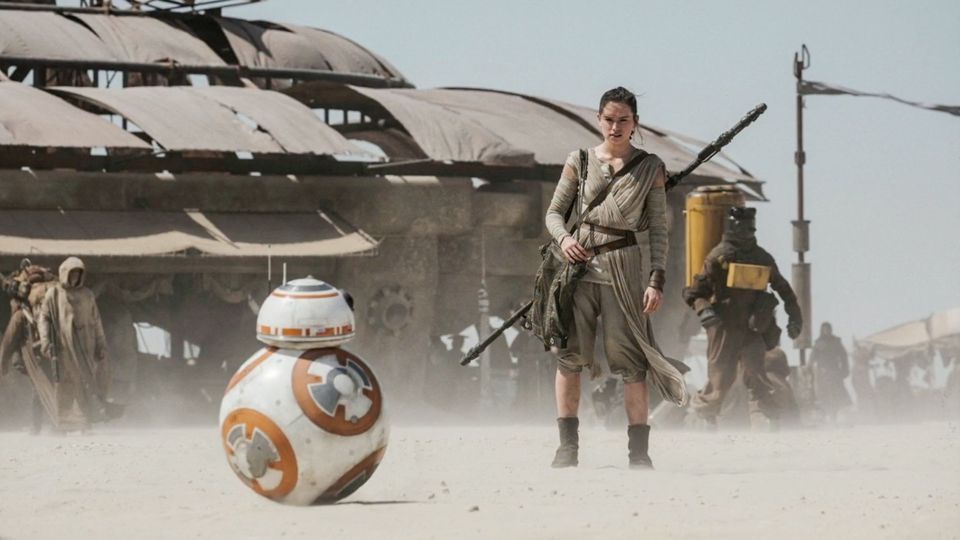
    As such The Force Awakens is a film designed to play as wide as possible, to get as much right as it can for the largest number of people. It’s a huge, exciting popcorn spectacle that both painstakingly sketches out its post-Rebellion world and has no real need to hit any beats that weren’t established by the original trilogy. Its heroes are orphans. Its villain is pulled between the light and dark sides of the Force. Decades have passed since the fall of the Empire and governments and regimes have changed, but this change, which is actually quite boring when played out in Senate chambers and offices, is mostly felt in costuming and set design tweaks, and what time has done to heroes like Han Solo (Harrison Ford), Leia Organa (Carrie Fisher), and Luke Skywalker (Mark Hamill). No longer controlled by an Empire, the galaxy is stalked by the First Order, a frightening band of sleek new Stormtroopers that seems to have found a balance between adherence to the force and belief in fascistic military rule. With Luke Skywalker vanished, The First Order and the Republic-backed Resistance are in a race to find him in a star system whose map has been compromised with the fall of the Empire. Like in A New Hope, that vital information is stored in the files of an otherwise unassuming droid that ends up stranded on a desert planet, searching for a way to a secret base that finds itself menaced by the enemy’s planet-destroying power.

    It’s hard to fault Abrams for nostalgia—Star Wars has largely been a callback machine since Return of the Jedi, and his script, co-written with Lawrence Kasdan, is at least using familiarity to push forward into new territory. That script is unbelievably smart when it comes to handling the legacy of the original films. Luke Skywalker is a mythological figure, the stories about he and his companions rendered unbelievable in the totality of his disappearance. The Force’s role has shifted somewhat, too, from science to sorcery to religion. Leia and Han, having taken their respective roles in the new world, are at the periphery—our principals characters are the cocksure pilot Poe Dameron (Oscar Isaac), Stormtrooper deserter Finn (John Boyega), and desert-bound scavenger Rey (Daisy Ridley). They’re an engaging trio, propelling Abrams’ vision of a Star Wars for the future while burnishing the figures they encounter as the legends of the past.

    As for its villains, Abrams really dials up the Riefenstahlesque staging to mark the First Order as the terror of the galaxy, and for however terrifying Darth Vader fanboy Kylo Ren (Adam Driver) appears, the fact that he’s a relative novice to the force means that the banners-and-battle-stations pageantry of these new, sleek Stormtoopers actually means something. The difference between Abrams’ conception of evil and George Lucas’ is stark. In the first action sequence, which is among the best in any Star Wars film, Stormtroopers disembark from a landing craft and fire into a crowd of villagers. Their laser bolts strike, accurate and deadly. There is blood. Finn, yet unnamed, is on his first battle mission and shakes. Dameron fires his rifle at Ren, who freezes the bolt. It hangs suspended in the scene for a minute, then slams home into a piece of machinery after Dameron’s capture. Later sequences don’t have the same impact, but they look like they were staged, directed, and shot by a crew that was having fun with everything, somehow unburdened by the fact that they are making a Star Wars for the sake of getting the gears turning again.

    That The Force Awakens is fun is probably Abrams’ biggest accomplishment. For years, he’s been laboring in the shadows of Lucas and Steven Spielberg, making epics that lived and died by the same principles as the epics of his heroes. Given the sandbox he’s so clearly wanted to play in for awhile, Abrams puts on a show that manages to rival his predecessors, creating some of the most indelible images in any Star Wars film to date. The best of these take place on the desert planet of Jakuu, which is littered with the hulks of Star Destroyers abandoned after an unseen battle, an elephant graveyard that scavengers pick scraps from to clean and sell for food. The economy of Jakuu works well as a metaphor for what The Force Awakens represents, which is the stirring of a great machine that will run much longer than anyone can account for. Some of those scraps are just junk, useless pieces of space debris that look cool but serve no real purpose. Some of those scraps are the Millennium Falcon, begging to be taken to lightspeed. This one’s all lightspeed.


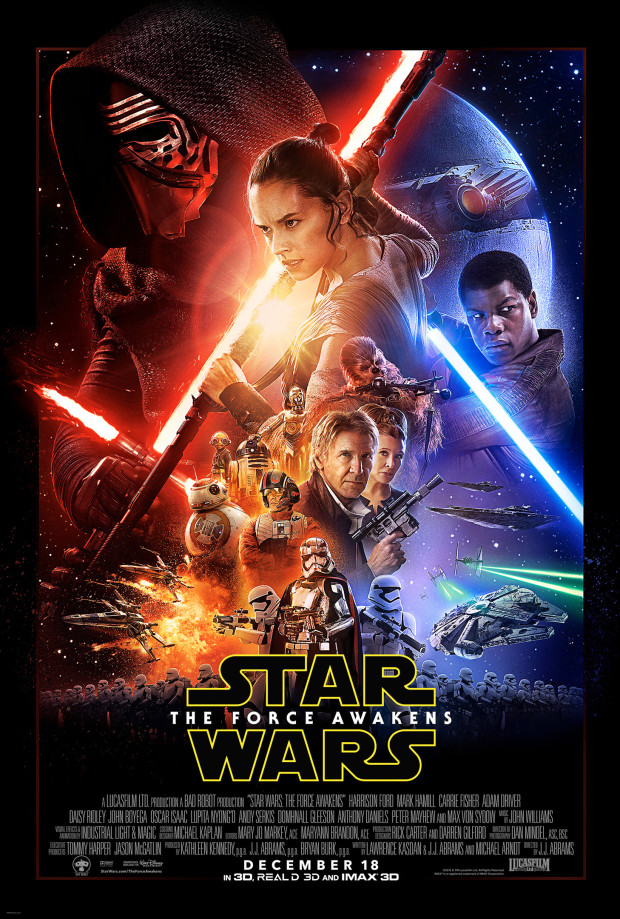
    Star Wars The Force Awakens posterStar Wars: The Force Awakens (2015)

    With Daisy Ridley (Rey), John Boyega (Finn), Oscar Isaac (Poe Dameron), Adam Driver (Kylo Ren), Harrison Ford (Han Solo), Carrie Fisher (Leia Organa), Domhnall Gleeson (General Hux), Andy Serkis (Supreme Leader Snoke), Lupita Nyong’o (Maz Kanata), and Mark Hamill (Luke Skywalker). Directed by J.J. Abrams from a screenplay by Abrams, Lawrence Kasdan, and Michael Arndt, based on characters created by George Lucas.


  • Now This is Podracing

    Now This is Podracing

    I saw Hugo last night, and beyond the fact that it’s the first 3D movie I’ve ever seen that won’t, in retrospect, make me regret paying the extra movie ticket it costs for the “right” or “privilege” to wear those lame plastic Ray-Bans over my unaccommodating pair of prescription lenses, I suppose the big “news” coming from the movie is that Hollywood has pretty much run out of animated kids movies/lifeless horror films/questionably greenlighted action vehicles to spuriously retrofit and up-charge and rub their fingers greedily over, so early next year we’re going to see our multiplexes occupied by re-releases of James Cameron’s Titanic (erroneously billed as the most loved and acclaimed movie (*dramatic pause*) of all time) and, as the first in a series of six planned re-releases, George Lucas’ Star Wars Episode I: The Phantom Menace.

    For the sake of clarity, I don’t particularly know if the version of Phantom Menace hitting theatres in February is going to be updated, changed, or modified from its original theatrical release, nor do I particularly care. At this point, I’ll accept that Han was lucky to survive his encounter with Greedo, that Hayden Christensen is digitally ghosted over the dumpy guy who originally played Anakin Skywalker, and that Darth Vader will forever reprise his world-shattering cry of “Noooooooooo!” as the Emperor hurls lightning at a helpless Luke. Around the time Lucas was re-releasing the original Original Trilogy in unscrubbed, less-than-remastered form after millions of voices cried out over a new round of changes and edits (Han and Greedo shoot at the same time! Wookie Life Day is celebrated at the end of Jedi!), I came to the realization that my Star Wars and George Lucas’ Star Wars are two entirely different things. Whereas I was and always will be satisfied with Obi-Wan’s less-than-intimidating Tusken Raider alarm, a few less Sandtroopers at Mos Eisley spaceport, and an utter lack of Jabba the Hutt (my favorite Star Wars character) in A New Hope, George Lucas, for as long as he lives, will attempt to achieve perfection with what is, at best, an imperfect narrative. What’s more, as long as he keeps chasing perfection, there will be endless legion of people who’ll mope and upload hour upon hour of YouTube video complaining that Boss Nass’ fat rolls jiggle more than they used to. No, I’m not in the business of writing an exhaustive list of complaints. Star Wars is George Lucas’ baby, his toy, and he’s free to bend and pose it in whatever way he wishes. I merely want to point out two things about the trailer for Phantom Menace, and then I’ll shut up about it for the time being.

    First, and perhaps most importantly: These 3D re-releases weren’t the dramatic upgrade to the franchise we were promised, and I’m angry about it—at least as angry as I can be over the somewhat laughable idea of “updating” a movie from 1977 to be shown in the 3D of 2015. When I was a kid, the former Henry Ford Museum and Greenfield Village opened up an IMAX theatre and, living in Dearborn, our school often took field trips to see documentaries projected with such intensity that, if the projectionist felt like pointing the thing at the Moon, we could watch them among the stars. This was well before big tentpole movies and every Disney flick under the Sun was released in IMAX or, as is usually the case, “IMAX,” and well before I went to a movie theatre advertising an IMAX screen, only to wonder what happened to the rest of the screen. I don’t remember much about those movies I saw in IMAX as a child, but I remember the slide claiming the projector could show a movie on the moon, and I remember that, since IMAX was new then, still justifying it’s existence, before every movie they played a trailer for the format, and this was always the first thing I saw:

    The aged and ill-adjusted often assert that my generation has never had a moment like the opening of A New Hope, but I disagree—I had that moment every time I saw an IMAX movie, a moment where I knew that movies, specifically a movie that I had known and loved for as long as I could remember, were going to change forever. For the record, Kid Me was wrong, as Kid Me has often proven to be, but the shot of the Star Destroyer chasing after the Tantive IV on a 62 by 84 foot screen is something that will always stick with me. I’ve been waiting for the Original Trilogy to come out in IMAX since I was a kid, and, for some cruel reason, it looks like I’ll be waiting for the rest of my life. Worse, these new 3D re-releases make it clear that, to Lucas, the wonders of 2D filmmaking are now small potatoes. Here’s an image from the trailer:

    Yes, that image of Luke looking out wistfully to the universe beyond his desert squalor is officially small and meaningless, unless you see it as George Lucas intended it way back in 1977: RealD 3D. See these movies again, the trailer argues, and you’ll forget everything you ever knew about Star Wars.

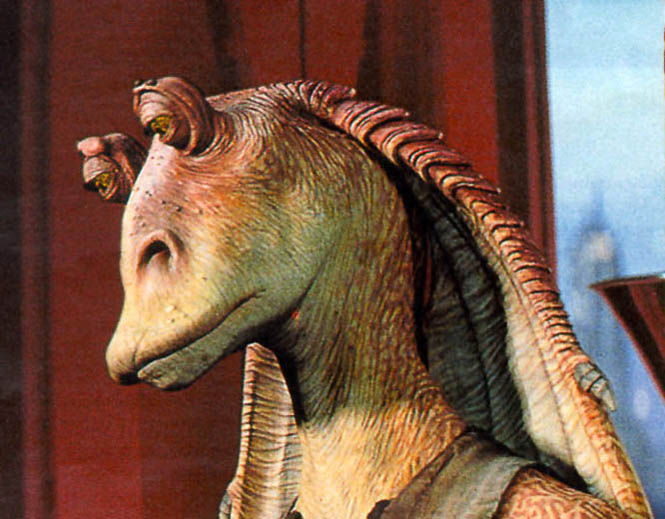
    Yes, according to the above trailer, you’re going to forget all about goofy battle droids, unthreatening trade viceroys, “Are you an angel?” and This is podracing!” In this new, perfect society, Boss Nass is a jovial, fair-minded ruler of a proud, brave race of men and women best represented by this picture…

    …and is not, under any circumstance, the cruel, witless leader of a band of frowned-upon Noble Savages known most notoriously for sharing a common gene pool with one Jar Jar Binks, Bombad General. In 1998, which, according to the number of moments given away by this clip, was before people learned how to make a proper trailer, Jar Jar was practically promised by Lucas to be the world’s new best friend.

    Jar Jar Binks, so universally reviled that his role in the prequels diminished and diminished to the point that only the trivia-hungry will notice it’s him giving the Emperor the right to rule over the galaxy, was pretty much the face of Phantom Menace. He was a Taco Bell toy, a Lays pitchman, a Pepsi addict. He was there when Anakin met Obi-Wan, when R2-D2 met C-3P0, and, for all we know, may actually be the biological father of Luke and Leia. Believe it or not, when the hype for Phantom Menace was at fever pitch, it was Jar Jar Binks who wound up mugging on the cover or Rolling Stone, his name taking prominence over Tom Waits, the Red Hot Chilli Peppers, Columbine, and Kosovo.

    I might be the only person in the world who feels this way, but it’s practically a crime that Jar Jar Binks doesn’t warrant a single frame of the new Phantom Menace trailer. No joke, ladies and gentlemen. As much as you may like or dislike him, Jar Jar Binks is the face of Phantom Menace, not merely the reviled face of Everything That’s Wrong With the Prequels. The sad fact is that Binks isn’t even the fifth worst thing about Phantom Menace, and much like midichlorians, virgin births, and the stick up Samuel L. Jackson’s ass, he, too, will be given a chance to suck in the third dimension. But, unlike all that, the only hint of Jar Jar’s existence is the brief clip of the Gungan army hurling superballs at battle droids.

    This is revisionist history, and, in a way, it’s worse than spending a few million dollars to make sure that Ewoks can blink. Yes, it’s also a cloying admission of guilt on Lucas’ part, and the fact that the guy owns up to such a colossal misfiring is, in a way, worth note. At the same time, Binks is conspicuous in his absence. Re-releasing any movie is an obvious cash grab, and, outside of Disney’s first few shots with The Nightmare Before Christmas, most don’t have much lasting impact. But Phantom Menace represents something much larger, a six year plan that likely represents a huge chunk of change for both Lucas and 20th Century Fox. Now that all six live-action films are out in the wild, it’s necessary to start at the beginning, despite Phantom Menace‘s poor standing as the worst in the saga. No whiff of its stench can be wafted to those in the theatre for Hugo or any other movie this plays before, especially considering that a new generation is due to be introduced to Star Wars and, unfortunately, this is their first shot that isn’t toy or Cartoon Network related.

    If we accept that Jar Jar is the face of Phantom Menace, and that that’s exactly what George Lucas wanted, then it follows that his taking Binks out of the trailer and replacing him with pretty much every explosion in the film represents Lucas acknowledging that everybody who saw the movie deemed his version unworthy. James Cameron, at least, has the stones to put “My Heart Will Go On” in the new Titanic trailer, not to mention his willingness to expose the film as one where Leonardo DiCaprio pretty much stands on things and yells about how great the experience of standing on them feels. It’s a cash grab, but it’s an honest one. Star Wars Episode I: The Phantom Menace is trying to present itself, once and for all, as the beginnings of a cultural milestone and, in redefining itself, looks more boring and pretentious than the grab bag of rehashed cultural stereotypes and  Laurel and Hardy gags no digital editing or 3D surcharges can blind an audience to.

    This is naïve, but I expect a creator to stand by their decade-old work, especially while holding out the collection plate. The trailer for Big Mommas: Like Father, Like Son didn’t try to convince anybody that it wasn’t a cinematic black hole, and it’s not fair that Lucas is trying to hide Howard the Duck by pretending to present The Empire Strikes Back. What’s worse is that the dude has an advantage: we now live in a society where everything we spend money on is automatically great because we don’t want to look stupid for consuming it. I don’t think anybody paying to see Phantom Menace in February will do so under the assumption that it’s a misunderstood masterwork, but you’ll be hard pressed to find any grown man in a Jedi robe that weekend willing to admit his folly. Hell, put it in IMAX, and I might just break out my Darth Vader voice changer. But unless this is the Phantom Edit, let me do so knowing full well that I’m seeing Phantom Menace, warts and all.