Tag: Samuel L. Jackson

  • Movie Review: Star Wars Episode I — The Phantom Menace (1999)

    Movie Review: Star Wars Episode I — The Phantom Menace (1999)

    Star Wars the Phantom Menace

    Star Wars Episode I — The Phantom Menace came out when I was 11 years old, and I’m not going to lie to you: I liked it, so much so that my memory for it to this day is nearly word perfect. It’s an odd thing, remembering what I was like at 11, when the story of young Anakin Skywalker was aimed directly at my heart like a missile gunning towards a space station’s ventilation shaft, but this is hardly something I’m looking at through the lens of nostalgia. Before the release of The Force Awakens, while my various social media streams were reaching, in unison, for the films from the original trilogy, The Phantom Menace was the Star Wars film I reached for. As much as J.J. Abrams’ reboot/remaking of the Star Wars universe was a love letter to the Star Wars films everybody loves, it is very much a product of and response to the ecology of blockbuster film-making that The Phantom Menace largely created, one where the imagination was set free from the limitations of physical space by CGI and bound instead to the principal of narrative ease.

    Star Wars has always been a franchise dedicated to serving the whims of young boys. Its bright colors, easy charms, simplistic moral grounding, and elements borrowed from Joseph Campbell and the sci-fi serials of director/creator George Lucas‘ youth don’t leave much room for complication or nuance. But rather than examining my childhood (which wasn’t exactly damaged by the film) or the childhoods of the assembled horde of folks cheering that a film series owned by the Disney corporation has been liberated from the mind of its creator, The Phantom Menace needs to be examined in terms of the theoretical child George Lucas was directing for. Regardless of whether or not this represents the beginnings of a noble effort to document the fall of a democratic republic, the boy Lucas loved so completely when he made A New Hope is, with The Phantom Menace, a construct he holds in contempt.

    There’s never a moment in The Phantom Menace where it feels like Lucas trusts his audience to understand what is happening, which is fair considering where he begins: In the middle of a treaty negotiation over blockaded trade routes. Like all great space-fairing epics, the galactic Senate is ineffectively wringing its hands over what to do about the Trade Federation’s illegal occupation of the routes to Naboo, waiting on a report from its Jedi ambassadors Qui-Gon Jin (Liam Neeson) and Obi-Wan Kenobi (Ewan McGreggor) before taking a vote on whether or not to sanction the Federation in some unspecified manner. In a way that’s clever (but not too clever considering the sheer number of corporate sponsorships attached to Star Wars), Lucas imagines the Trade Federation not merely as a corporation, but a body so large it has a seat in Senate. What they produce and who they service is unclear, but everything about The Phantom Menace is only clever on the surface, like the way Jedi Knights function in vaguely similar fashion to Jesuit priests. Because the Trade Federation are evil and stupid, they attack the Jedis with a squadron of easily dispatched droids, who spend the majority of The Phantom Menace bumbling about as various weapons cut through them like their sole purpose is to demonstrate the unspeakable power of the people they oppose. They also serve as a platform for Lucas to demonstrate both upgraded lightsaber techniques and his ability to create characters that would have once required an army of puppeteers and animatronics experts, the whole show meant to dazzle the eye at the cost of everything else.

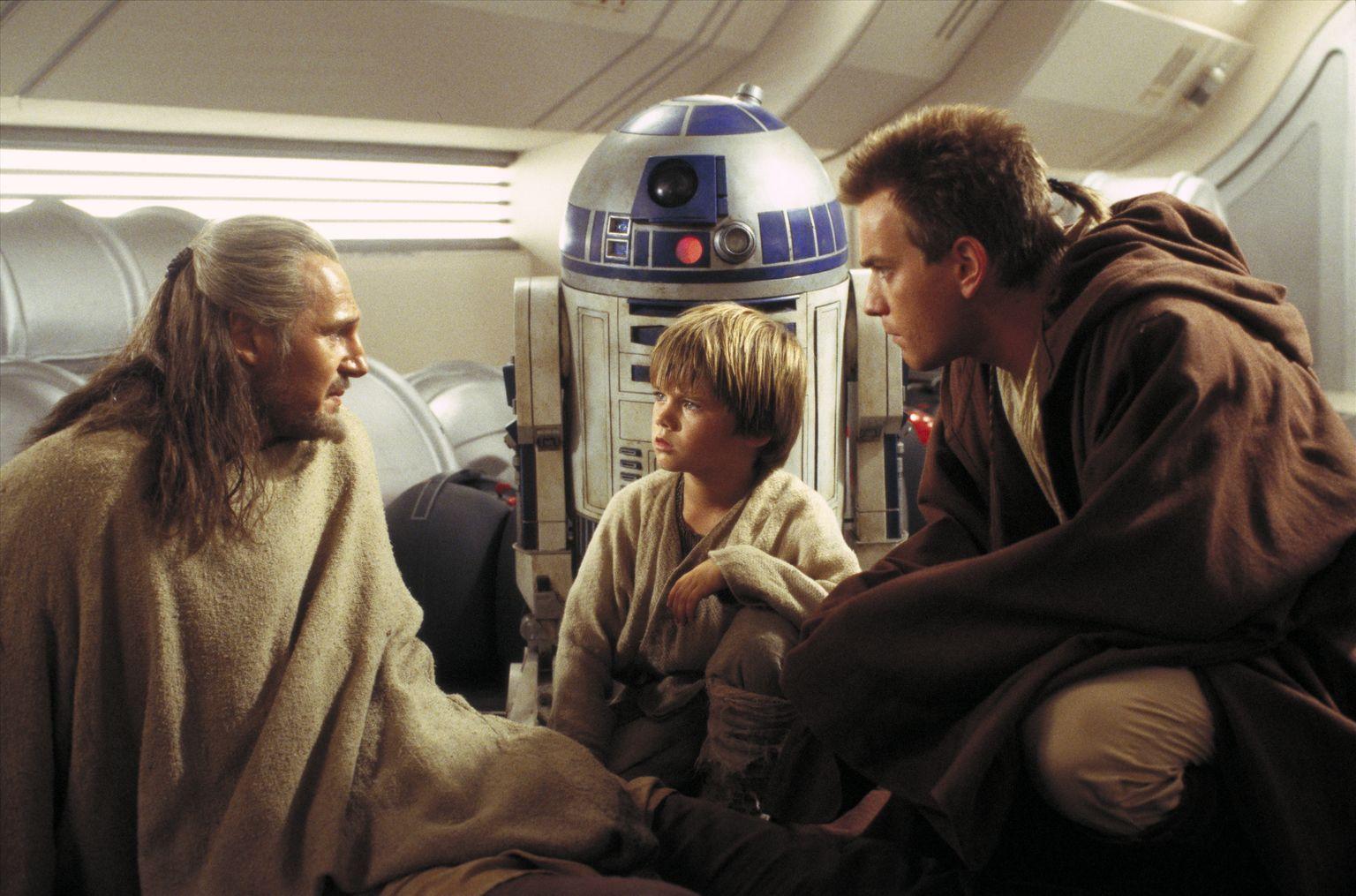
    Through a series of contrivances involving a hair-raising number of racial stereotypes, Qui-Gon and Obi-Wan rescue Queen Amidala (Natalie Portman) and slip the blockade, landing on the familiar desert backwater of Tatooine. Their ship in desperate need of repair, they decide to rely on the help of a young boy named Anakin Skywalker (Jake Lloyd), who is the premier podracer in the galaxy despite his age. Qui-Gon sees something in the boy and seeks to free him, believing he might be the literal chosen one of a shadowy Jedi prophecy, and wagers it all on Anakin to win the big podrace. While the podracing sequence is a genuinely well-done setpiece that convincingly conveys the speed and danger of this NASCAR-like sport, there’s never any question that Anakin is winning the race. He’s important to the story, but decidedly a background figure, a child on the fringes of consciousness, let alone the centuries-long battle between the Jedi and the Sith, the film’s titular menace. As he jogs to the spacecraft that will take him from the only planet he’s ever known, his new friend is attacked by Darth Maul (Ray Park), a Sith with a double-bladed lightsaber and body modifications (woaaaaaaaaah, cool!).

    The first two acts are long—whatever sense of pacing Lucas had as a director all but swallowed up by the 20-year gap between The Phantom Menace and A New Hope. The film picks up noticeably with the introduction of Maul, cutting back and forth between a siege on the palace of Naboo, a battle on the outskirts of town, a starfight over the orbital blockade, and a duel between the Jedi and the Sith that is easily the standout sequence of the film. It is, at least, the one sequence that feels real, as if the bodies that interact with each other in the scene exist in the same physical space. While the unreal sheen of so many of the organisms and droids in this Star Wars outing may constitute a sort of campy fun for some, they stand out today as the harbingers of special effects shots that are more effect than special.

    The Phantom Menace uses the technological firepower at its command to present armies of droids, starfighters, and amphibious frog creatures from an underwater city, and in doing so it completely eliminates the need to creatively stage a battle sequence. It’s been said by Star Wars obsessives far angrier than me that the Gungans of this film are the Ewoks of Return of the Jedi. Regardless of whether or not that’s true, the battle sequences featuring both make for a good point of comparison. Shooting in a forest and utilizing actors in suits and miniature models, Richard Marquand created sequences that were ridiculous given the combatants, but effective in staging a ground battle like no Star Wars film had or would until The Force Awakens. Given the utter limitlessness of greenscreen film-making, Lucas put two armies across from each other on a visually uninspiring plain and had one walk towards the other.

    The tools refined here by Lucas were handed down to a generation of lesser directors and hacks who took high concept ideas and staged them for the lowest common denominator. This, more than box office (and possibly more than making Star Wars an unavoidable cultural juggernaut for a new generation of wallets), is the legacy of The Phantom Menace, a swath of low-stakes narratives complicated not by the corporeal risks faced by the characters we’re meant to identify with, but the glittering computerized metropolises they ostensibly inhabit. Any threat, large or small, can be conjured with the click of a mouse. So too can those threats be waved away.

    Phantom Menace posterStar Wars Episode I — The Phantom Menace (1999)

    With Liam Neeson (Qui-Gon Jin), Ewan McGregor (Obi-Wan Kenobi), Natalie Portman (Padmé Amidala), Jake Lloyd (Anakin Skywalker), Kenny Baker (R2-D2), Anthony Daniels (C-3P0), Frank Oz (Yoda), Ray Park (Darth Maul), and Samuel L. Jackson (Mace Windu). Directed by George Lucas from a screenplay by Lucas.
  • Movie Review: The Hateful Eight (2015)

    Movie Review: The Hateful Eight (2015)

    Hateful Eight

    Quentin Tarantino’s been flirting with a film like The Hateful Eight for awhile now, a beautifully shot, well designed film that goes beyond feeling minor (the way Death Proof feels, for instance) and just ends up being bad. An inverse of Django Unchained, where the bounty hunters and rogues are just as despicable as the murderers and thieves they encounter, The Hateful Eight plays on the director’s obsessions with race and torture and whimsical men who are good at murderin’ folks, but with so little in the way of narrative pull that it often seems like Tarantino is just playing with himself, making a movie for the sake of making a movie, without a hint of impulse control.

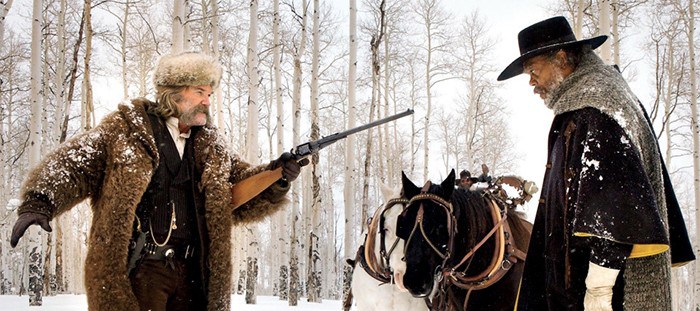
    The Hateful Eight concerns eight men and women who are all on their way to Red Rock, Wyoming, a blizzard nipping at their heels. Some of them are bounty hunters. Some are bounties. Some are working men. Not everybody is who they say they are, but there’s hardly any mystery to that considering the cast of regulars Tarantino’s assembled and the kinds of roles they’ve played for him in the past. Our lead bounty hunters—”Hangman” John Ruth (Kurt Russell) and Major Marquis Warren (Samuel L. Jackson)—are suspicious of everyone they encounter, and they’re usually right in their suspicions. Ruth encounters Warren on a trail, sitting atop a pile of dead bounties after his horse died in the snow. He’s on his way to Red Rock with Daisy Domergue (Jennifer Jason Leigh), an outlaw who is worth $10,000 dead or alive, and he prefers taking them in alive so as to not cheat the hangman, hence the nickname. The conversation between Warren and Ruth is intense—Tarantino is at his best when staging conversations between hypermasculine strangers—and when they pick up another snowbound traveler, Chris Mannix (Walton Goggins), the new sheriff—things get more tense. This is just after the Civil War and there’ still tensions between Union soldiers and Rebel ones. Ruth and Warren belonged to the Union. Mannix’s father led a battalion that continued fighting the war in the face of unconditional surrender. None of them could be said to’ve been good men, and Domergue, when she’s not getting punched or spitting up blood, watches them argue with glee.

    With the blizzard on them, the stagecoach holes up at Minnie’s Haberdashery, where four other men are already gathered around the fireplace. There’s a fussy British gentleman (Tim Roth), a cowpuncher (Michael Madsen), a Mexican (Demián Bichir) who says he’s looking after the place for Minnie while she visits her family, and a Confederate General (Bruce Dern) who is familiar with Major Warren, even if he doesn’t know it. The idea, according to Tarantino, is for these characters to get together and tell stories to one another like an arc on a western, each person trying to figure out the intention of the other. This has been a pretty basic mode of narrative storytelling for a long time now. You can go farther than westerns like Gunsmoke and The Virginian to Rashomon or The Canterbury tales, people telling stories about things seen and unseen, only here, as Tarantino often has it, our storytellers have guns. Those are mostly holstered until a blood-soaked finale, so much of The Hateful Eight is talk and menace, a locked room there’s only one way out of.

    That means lingering, for a long time, on the decisions Tarantino chooses to make. One of them, shooting in 70mm and keeping his characters mostly indoors, is ponderous, but there is a lot of loving detail put into Minnie’s Haberdashery and the sense that something’s off with it. The way-station is a one-room saloon with a couple of beds in it, but Tarantino and cinematographer Robert Richardson make use of cinematic space such that the Haberdashery feels both open and claustrophobic at the same time. There are eight people in the room, eight different perspectives of a single unfolding narrative, and were that narrative any better than it was, the way The Hateful Eight cuts from one to another would be invigorating. But it isn’t. So again, you get to linger with the decisions Tarantino makes. You have three hours to wonder how, even in a movie where he’s only the narrator, Tarantino manages to give himself the film’s most troublingly racist dialog, or why he figures on adding a race allegory to a film about eight miserable bastards to begin with. Sampling, as he has been for some time now, from spaghetti westerns, the Confederate/Union line is one Tarantino plays with and tries to extend to today, but he frankly isn’t good enough to make a salient point, even though Samuel L. Jackson is the man making it. After Christoph Waltz’s Jew Hunter in Inglourious Basterds and Leonardo DiCaprio’s impassioned speech on eugenics in Django—both characters and monologues that Tarantino luxuriated in—it’s hard to take him seriously when he tries to inject social consciousness into The Hateful Eight, which is otherwise the director’s career-long fascination with bondage and torture writ large and gracelessly.

    It takes a long time for The Hateful Eight to go anywhere, moving as slow as the stagecoaches that transport the players to their stage. Tarantino, as he’s done time and again since Kill Bill, is trying to make a film about outlaws and gunslingers who stand as legends that are of their time and outside it, but it just doesn’t work here, where he’s convinced to the marrow of his bones that it’s worth keeping the company of eight sadists who don’t have all that much to say. It’s a formula Tarantino has used effectively before, but here that formula is used to the point of exhaustion. And when everybody starts pulling guns on one another, as is Tarantino’s guarantee? More of the same, more of the same.


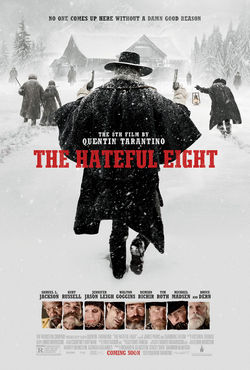
    The_Hateful_EightThe Hateful Eight (2015)

    With Samuel L. Jackson (Major Marquis Warren), Kurt Russell (John Ruth), Jennifer Jason Leigh (Daisy Domergue), Walton Goggins (Chris Mannix), Demián Bichir (Bob), Tim Roth (Oswaldo Mobray), Michael Madsen (Joe Gage), Bruce Dern (General Sandy Smithers), James Parks (O.B. Jackson), Zoë Bell (Six-Horse Judy), and Channing Tatum (Jody). Directed by Quentin Tarantino from a screenplay by Tarantino.

  • Movie Review: Avengers: Age of Ultron (2015)

    Movie Review: Avengers: Age of Ultron (2015)

    Avengers

    I remember spending a lot of time in my local library as a kid. It was close, within safe walking distance from my house, and beyond a few people who hung out and read magazines they didn’t want to subscribe to, it was just me, the librarians, and a whole lot of books. Browsing the stacks one day, I found these gigantic treasury editions of 60s and 70s Marvel Comics, which I checked out and read every week for three years. My favorite of them was Marvel’s Greatest Superhero Battles, its cover promising an epic clash between The Hulk and The Thing, my two favorite characters in the yet cinematically undiscovered country that was the Marvel Universe. This was the 1990s, and, say what you will about Stan Lee, but the way he wrote his superheroes (and the way Jack Kirby, Herb Trimpe, Sal Buschema, and John Romita (among others) drew them) still had a way of speaking that appealed directly to this very particular sense of selfhood I was developing. Bruce Banner was a quiet man, Benjamin Grimm a soft-hearted lunk. One wanted to be left alone. The other was doomed to be forever unhappy with his body. I got that. I identified with it. And, sealed away in these treasury books, they belonged to a world that only I had access to.

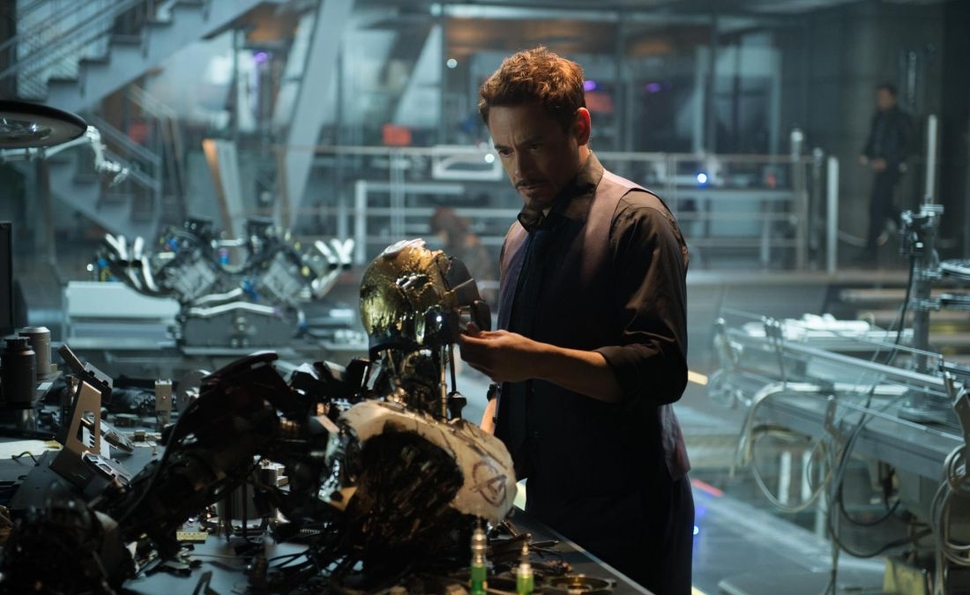
    Had you told nine-year-old me that The Hulk would be a cornerstone of one of the world’s most successful film franches—man, I don’t even know. 27-year-old me can hardly believe it, and I have lived experience of summers spent in multiplexes that weren’t showing a superhero of some kind. Sitting in the dark waiting for Avengers: Age of Ultron to start, there were three trailers for upcoming superhero films, and I was late. The next in Disney’s Avengers sequence, Ant-Man, is coming out in July. We barely get a month to rest up between episodes now, such is the cultural demand for city-destroying bacchanalia. I was tired. I was restless. I wanted to shove nine-year-old me into a locker for liking this stuff. And when the film started, I was largely still exhausted. Joss Whedon’s latest venture into the Marvel Cinematic Universe is overstuffed and overlong, struggling to contain itself, even at two-hours and 20-minutes. A lot of the bloat, at this point, must be attributed to the fact that an Avengers movie isn’t just a movie—it’s part of a cycle, and, as such, is part of a feedback loop that looks back as far as 2008 and looks forward as far as the heat death of the universe. Around that, Whedon, admirably, is going for something more here than in Avengers. Meglomaniacs get smashed-up real good and the physical and psychic trauma of 9/11 is exported to a countries real and imaginary, but it’s clear at this point that Whedon is most in his element when the world is quiet and his team has divested itself of their spandex.

    Then, he can get down to the real meat of Marvel Comics, which is that beneath the spectacle and muscle, superheroes are really just damaged human beings who are very uncomfortable with their bodies. This has been a sub-plot of most MCU films for awhile now, the whole “He’s just a man, but I’ve got an army!” deal, but Whedon’s script ventures beyond that, ruminating on the fallibility of flesh. His villain, Ultron (James Spader), a malevolent, sassy robot whose AI bears a striking resemblance to Tony Stark (Robert Downey, Jr.), sees the body as a necessary step forward in his evolution. Stark knows he will die, leaving his project of world peace unfinished. Hawkeye (Jeremy Renner) is just a regular dude with a bow and arrow. Captain America (Chris Evans) is still acclimating to a world where most of his friends have died. Bruce Banner (Mark Ruffalo) is doomed to be ashamed of his monstrous, green alter-ego, and Black Widow (Scarlett Johansson) has a past that involves bodily disfiguration. Where a villain like Ultron (or Loki, or the assembled horde of Hydra bad guys, or men in knock-off Iron Man gear) see this as the team’s weakness, it’s the axis upon which the whole thing spins—there aren’t many people who could understand their individual circumstances, but they’re all here in a room together, drunkenly trying to lift the hammer that lets Thor (Chris Hemsworth) lay claim to the throne of Asgard.

    But at this point, it’s not enough to truly satisfy. MCU films are, like a hang-out sitcom, an excuse to sit around and chuckle with a group of favorite characters, mind turned off. Battle sequences are well-executed, if perfunctory and consequence free. If you don’t check in on Marvel’s televised output, it’d be easy to assume that the fallout from any given fight is a paycheck from the Stark Relief Fund (which, man, that name) and a new life in a city that maybe won’t host a rampaging Hulk. I feel like complaining about the lack of stakes after eleven Marvel films, far from being a fruitless endeavor, reveals something about the limits of popcorn filmmaking, or at least the men responsible for making them. The Avengers: Age of Ultron can be nitpicked to death or praised for things that happen or are imagined to have happened at its fringes, but at heart this is a big, dumb action movie trying a little too hard to sound smart. This, in general, works for me. I am, if anything, overly enthusiastic about The Fast and the Furious‘ focus on makeshift chosen families, and am still fascinated with The Dark Knight and The Dark Knight Rises‘ attempt and failure to engage with philosophical theory and political science. Whedon does the same here, toying with ideas of fatherhood, Catholicism, and ruined women, but all too frequently it feels like he’s wrestling a Wikipedia page and not the idea itself. The drama will continue in the next wave of Avengers movies, we’re promised, but just once I’d like to see a Marvel movie that is a movie first, rather than an advertisement for an upcoming slate. I’d like something real to chew on. I’d like to go home not dreading the prospect that, someday soon, it will not be enough for a comic book movie to merely entertain me for three hours. Like the villains of these pieces so frequently say, it’s time to evolve. If only the folks behind the camera were listening.


    The Avengers: Age of Ultron. With Robert Downey, Jr. (Tony Stark/Iron Man), Chris Hemsworth (Thor), Mark Ruffalo (Bruce Banner/Hulk), Chris Evans (Steve Rogers/Captain America), Scarlett Johansson (Natasha Romanoff/Black Widow), Jeremy Renner (Clint Barton/Hawkeye), Aaron Taylor-Johnson (Quicksilver), Elizabeth Olsen (Scarlet Witch), James Spader (Ultron), and Samuel L. Jackson (Nick Fury). Directed by Joss Whedon from a screenplay by Whedon, based on the Marvel Comics characters created by Stan Lee and Jack Kirby.

  • Movie Review: Django Unchained (2012)

    Movie Review: Django Unchained (2012)

    Django Unchained

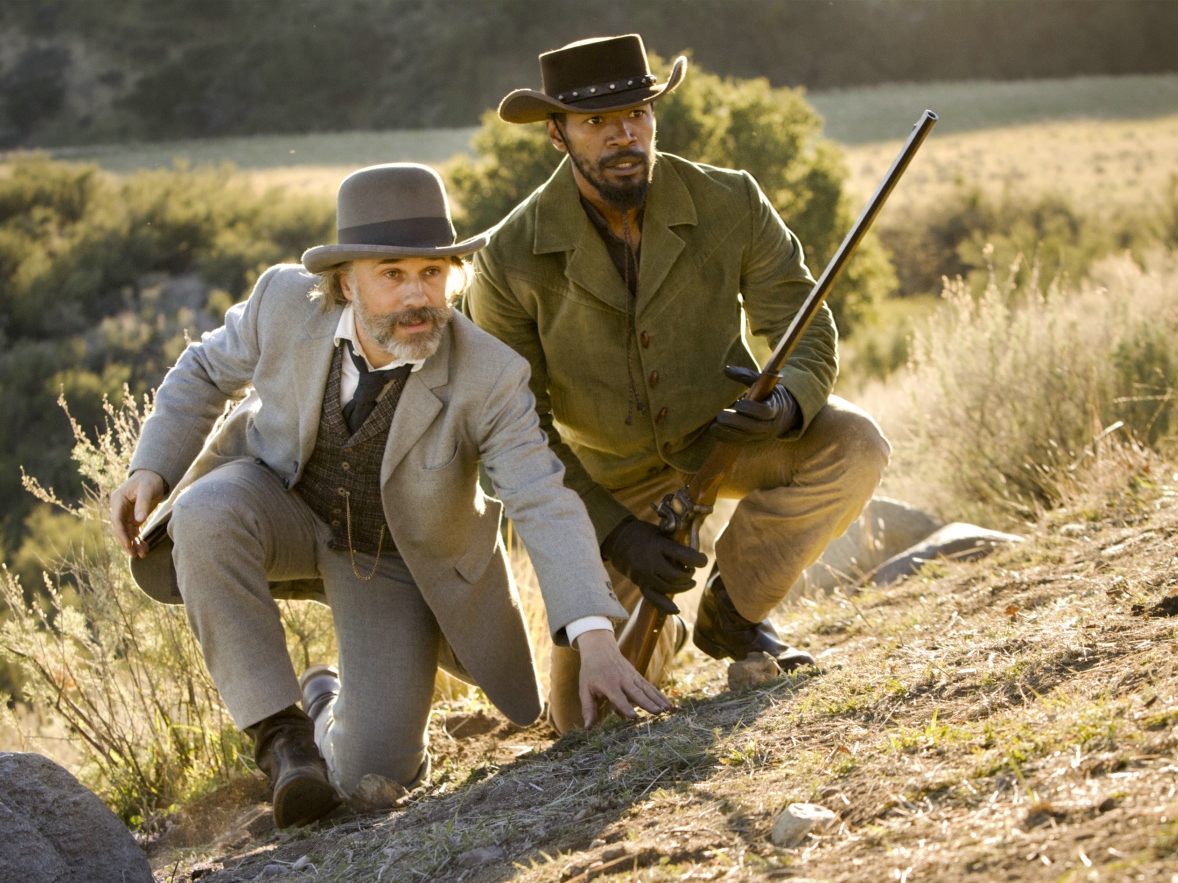
    essentialDjango Unchained, the latest in a string of violent revenge fantasies from director Quentin Tarantino, never quite feels like a finished film. According to Tarantino and Samuel L. Jackson, there exists a much longer cut of the movie that fills in crucial information on a number of characters, and given that its soundtrack is punctuated with bits of dialog not heard in the film, that longer cut is also a few shades more sadistic than what made theaters. Much has been said and written about the way Tarantino peppered Django Unchained with racial epithets unbecoming of a white director or a politically correct society, but it’s the violence I keep coming back to. Not the cartoonish shootouts pitting skillful bounty hunting duo Django (Jamie Foxx) and Dr. King Schultz (Christoph Waltz) against any number of hickish gunslingers, but the violence of slavery itself, particularly as it is visited upon Django’s wife, Broomhilda (Kerry Washington), who is whipped, branded, raped, scolded, and locked in an iron box under the hot sun as punishment for trying to run away.

    At this point in his career, it’s easy to accuse Tarantino of fetishizing violence against and the traumatization of women. Though the perpetrators often get what’s coming to them, Tarantino has been pedaling in this kind of sick thrill since Kill Bill Vol. 1, wherein The Bride is awoken from a coma mid-rape by a mosquito bite. Her rapist has his tongue bitten out and her pimp is beaten to death, but Tarantino luxuriates on the possibility of her rape, just as he does Stuntman Mike’s pursuit of his “girlfriends” in Death Proof and Col. Hans Landa’s psychological torture and eventual murder of double agent Bridget von Hammersmark in Inglourious Basterds. With poor Broomhilda, Tarantino turns up the heat. Looking beyond the director’s pedantic argument that his use of language and human misery is “period accurate,” the constant terror and abuse suffered by the largely agentless Broomhilda von Shaft serves two purposes: fulfilling the obligations of the exploitation genre, and sweetening Django’s revenge.

    In transplanting the spaghetti western to the antebellum South, Quentin Tarantino has succeeded in creating both his largest, most beautiful film to date, and his most narrow in scope. Having moved far beyond the nihilism that marked early efforts like Reservoir Dogs, Pulp Fiction, and From Dusk ‘Til Dawn, Django Unchained is exploitation filmmaking at its most agitating, using slavery and racism to titillate, humor, and enrage the audience. It works very well: the white slavers of Django Unchained are cruel, horrible men whose deaths elicit something close to joy. Unlike in Basterds, where the cruelties of Nazi Germany took place off screen and out of sight, men in endless number are shackled and marched through deserts, forests, and mud-caked auction towns. Black men beat each other for their white owners’ entertainment, black women are treated as objects of lust, and those who disobey are fed to the dogs.

    The two halves of Django Unchained, joined though they are by a brief training montage, play as a film and its sequel. In the first half, Django is set free by Dr. Schultz, a bounty hunter looking for three cattle rustlers by the name of Brittle. Schultz has never seen these men, but Django has: they were the overseers at his old plantation, three sons of bitches whose idea of punishment was pure Old Testament—Broomhilda still has lash marks on her back proving that. During their travels, the naïve Dr. Schultz learns that Django has a wife, and that he plans to buy her freedom with the money he’s been promised for identifying the Brittle brothers. This is a risky gambit: to find his wife, Django will have to find records of her sale in a Mississippi auction city. Even with papers stating that he is free, the odds of him walking out of that city with his freedom intact are quite low. So Dr. Schultz offers Django a deal: partner up for the winter and learn the business of bounty hunting, and gain a partner in the rescue of Broomhilda.

    If one looks at the two halves of Django Unchained as origin story and follow-up, then the film becomes a tale of two plantation owners. In the first half, Django and Dr. Schultz travel from Texas to Tennessee to The Big House, which is owned by a repellant man who is referred to as Big Daddy (Don Johnson). Big Daddy’s plantation functions as a brothel, where he sells his attractive young slaves to anybody with a big enough pocketbook. Later, the two discover that Broomhilda has been sold to a bloodsport named Calvin J. Candie (Leonardo DiCaprio), who inherited the fourth largest plantation in Mississippi. Though his plantation is known as Candie Land, he, too, calls the house that stands on its grounds The Big House. Candie is a major player in mandingo fighting, a Tarantino invention that pits burly slaves in brutal death matches before a private audience. In both cases, Dr. Schultz and Django’s play is the same: in offering a ridiculous sum of money for the particular kind of human flesh Big Daddy and Calvin J. Candie deal in, they gain access to their marks’ plantations and carry out a search for their true prize. Finding the Brittle brothers and Broomhilda, however, is not the hardest aspect of this plan: it’s getting out of those plantations alive, treasure in tow, that matters.

    That Big Daddy and Calvin J. Candie bear as many similarities as they do is intentional: these are vain, horrible men, and it is to our great satisfaction to see them executed by our heroes as such. The difference between the two is that Candie’s second—the head house slave Stephen (Samuel L. Jackson)—sees right through the bounty hunters’ charade. When discussing the characters they’re set to play, Django tells Dr. Schultz that being a black slaver is a lower calling than being the head house slave. If that’s true, Stephen certainly tries to make up for it by being every bit as snide and underhanded as he is old and hobbled by his age. In this role, Jackson is at his most engaging in years; though his character is one whose time on screen was whittled down, he is a man of extremes: before guests and the white workers on the plantation, he is a bumbling, ornery old coot; in private with his master and Django, he is as cold and cunning as they come, as bitter and vengeful as Shylock.

    There is a lot about Django Unchained that doesn’t quite add up; like many of Tarantino’s films over the second half of his twenty year career, his ambition to present a sprawling, grandiose epic of five or six hours was compromised by the need for a Christmas Day release to make money. Working with editor Fred Raskin—Tarantino’s regular editor, Sally Menke, died in 2010—Django Unchained’s seams show more than what’s typical of a Tarantino film. The jokes aren’t as crisp, the characters aren’t as well developed, and the film’s six-shooting bloodbaths eventually blur together, distinguished mostly by what song is playing to pass the time. And yet, Django Unchained is one of the more wildly entertaining films of 2012. Beyond Stephen—the film’s best creation—Jamie Foxx’s Django is as solid a spaghetti western hero as there is, and Christoph Waltz once again establishes himself as the Tarantino actor, the director and screenwriter’s dialog never seeming like words on a page. If the plight of Broomhilda von Shaft is cause for squeamishness—and it should be—and the reward for enduring her pain is pleasing—and, for me, it was—then Tarantino is doing his part as an exploitation filmmaker, and that, really, is the only shield he’s ever held up in defense of his work. As beautiful—the sweeping parries, manicured plantations, and torch-bearing lynch mobs are unprecedented compositions in a Tarantino movie—and exciting as Django Unchained often is, after twenty years, it would be nice to see the director’s raison d’être evolve with his skill.


    Django Unchained. With Jamie Foxx (Django), Christoph Waltz (Dr. King Schultz), Leonardo DiCaprio (Calvin J. Candie), Samuel L. Jackson (Stephen), Kerry Washington (Broomhilda von Shaft), Don Johnson (Big Daddy), Walton Goggins (Billy Crash), and Jonah Hill (Bag Head #2). Directed by Quentin Tarantino and produced by Stacey Sher, Reginald Hudlin, and Pilar Savone. Screenplay by Tarantino.

  • Movie Review: The Avengers (2012)

    Movie Review: The Avengers (2012)

    A time-displaced soldier. A Norse god. A playboy billionaire genius. A brilliant scientist who turns into a raging monster when angry. A former Russian spy. An expert marksman. On paper, a team comprised of six individuals this vastly different shouldn’t work. There are egos to deal with, competitive urges, the occasional extinction-level event. Since 1963, the Avengers have walked the very fine line between being Earth’s Mightiest Heroes and Earth’s Largest Screw-Ups. All it took back then was an assortment of popular comic book characters and the retrospectively brilliant idea of bringing a World War II era hero back from the publishing grave. In 2012, to get The Avengers together under the auspices of one movie took a more herculean effort: Five good-to-great movies serving as pretense, an assemblage of the right actors playing the right characters, and the right director at the helm of so much potential chaos. (more…)