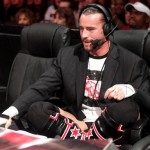
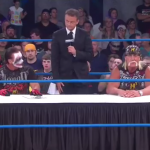
CM Punk Points Out the Logical Fallacies of the WWE Walk-Out: Raw didn’t really start out too strong, with a group of dudes whining about another group of dudes who were whining about the actions of one dude in particular, Triple H. I still can’t make heads or tails of the situation, but moments before the walk out ended, CM Punk, John Cena and Sheamus came out and talked about why the walk out was pretty much stupid. Punk, who walked out of the WWE at Money in the Bank with the WWE Title, wisely pointed out that the individuals walking out were doing so over the actions that they themselves were often responsible for, that it’s tough to complain about an unsafe workplace one minute and club your opponent in the head when his back’s turned the next. He then was incredibly excited to be the guest timekeeper and sole announcer for the John Cena vs. Sheamus match that was to start the show until…
Vince McMahon Returned: And, in anti-Vince fashion, he didn’t make one reference to his supposedly gigantic genitalia. Though the part where the WWE Board of Directors had no problem with HHH as the COO was a little odd, as was McMahon’s distaste for a dude he himself hired and has continuously elevated up the corporate ladder, McMahon’s all-too-brief return and introduction of Johnny “Funkhauser” Ace as the Raw GM was more unnecessary proof of McMahon as one of the greatest talkers in the history of professional wrestling.
Dolph Ziggler’s Response to Johnny Ace Being GM: Ace stood by the door of the arena and shook everybody’s hand as they came in for the day’s work. Most shook it or fist bumped or said “Thank you.” Ziggler said “WHATEVS” and kept going. Brilliant.
Jim Ross Tips His Hat to Ace Upon Being Fired: I might just be the world’s biggest Jim Ross mark, and was incredibly angry to see him get fired in his home state of Oklahoma. Usually it’s good when something in wrestling enrages me, but this is about the 70th time J.R. has been fired in Oklahoma since he was signed to the WWF in time for Wrestlemania IX, and it left us with a problem the WWE’s been unwilling to deal with since this year’s WrestleMania: Their announcers engaged in a four-month long angle where one made fun of the others dead mother. Ross’ exit was class, though: A tip of the hat and a silent exit. He’ll probably be brought back for the 70th time, but by tipping his hat and walking out the door, J.R. silently said more than many men do given a live microphone and 20 minutes.
Questionable Decision of the Week: Hardly any matches ended cleanly, and the two that did weren’t really anything special. Worse, two main-event level matches–Cena/Sheamus and Punk/Del Rio–ended because some dude in a suit wanted to talk, instead. It’s just as well, since Michael Cole spent the rest of RAW crowing about how happy he was JR was gone, and the minute Johnny Ace was made GM, it was just a matter of waiting for the axe to fall and Miz and R-Truth (collectively known as The Sharecroppers) were brought back to end the show. I continue to be disappointed by the WWE’s refusal to tie up the gigantic loose end of this angle, but hey, maybe Kevin Nash has one of those sweet Hulk Hogan deals and only needs to show up to the pay per views. I refuse to be excited about any further developments on Raw until Nash comes back.
CM Punk and Daniel Bryan Get, Like, Five Seconds Against Each Other: In the show’s opening 41-man battle royal (the biggest in WWE history, according to WWE), a lot of dudes got their clubber on with some other dudes, but I was given hope by the brief encounter between CM Punk and Daniel Bryan, who needed to have an extended program yesterday. I thought it was going to happen a year or so ago, when Punk started calling Bryan’s matches, but then Punk got injured and the program was shelved. Too bad.
Beth Phoenix Finally Beats Kelly Kelly Clean: About damn time.
Sin Cara Unmasks Sin Cara: If this means Mistico will be making his proper WWE debut as Mistico sometime soon, I’m game.
A fellow of infinite jest.
Booker T’s explanation For the Sin Cara vs. Sin Cara Feud: “Maybe it’s like those kung-fu movies, where the guy takes the other guy’s soul. Right? Right Josh?”
Swaggler (Dolph Ziggler and Jack Swagger) vs. Kofi Kingston and Zack Ryder: With Evan Bourne suffering from Swaggler’s pre and post match beatdown on Monday Night Raw, Zack Ryder stepped in and teamed with WWE Tag Team Champion Kofi Kingston to take on the team. Vickie Guerrero’s tag team find themselves engaged in three feuds–against Mason Ryan, against Air Boom (ugh, what a name), and against Ryder–and, for a minute, I thought they were going to forget about Ryder. Not so. Over the past few weeks, he’s pinned Dolph Ziggler three times and has eliminated him from a battle royal. I suspect a title match will be coming soon, which will be good.
Questionable Decision of the Week: None, really. Just an overall good show with several good matches, two of which ended with understandable, logical interference. The only minor quibble is that Randy Orton went into his match against Mark Henry as if he’d never been in a 41-man battle royal, but Henry got to dominating him pretty early, so it didn’t matter. As has been true for the show’s duration, SmackDown! continues to be WWE’s better wrestling show. This week, it was more entertaining than Raw, too.
It’s really hard to even begin a review of a movie like What’s Your Number? without selfishly floating a few things out there, so bear this in mind as I try to figure out what, exactly, I saw:
As a man in a household consisting of myself, a sister, and a mother, I’ve seen a ton of romantic comedies. I was practically raised on a diet of Audrey Hepburn and John Hughes, so I’d like to think that I know what works, what’s funny, and what’s romantic. I consider myself not dude-at-a-chickflick, but an unbiased judge of these things.
As a frequent grocery shopper, I often catch glimpse of magazines like Cosmopolitan and Marie Claire, the former being the magazine with the article that is the crux of this film. Other than learning a few overly-complicated methods to the male orgasm (hasn’t friction worked for centuries?), I’ve learned that a good amount of the magazine publishing industry relies on making women feel insecure about their looks, their weight, and how many men they have or haven’t slept with.
As a human being, I can’t help but be sad (and a little angry) about how much money our society pumps into these industries. It seems like every other romantic comedy is an artless slice-of-“life” debating the merits of one relationship crisis article or another. He’s just not that into you? You’ve worn twenty-seven bridesmaids dresses but have yet to be the bride? You’ve slept with twenty dudes? Whatever. There are well over six billion people out there. Twenty isn’t a fraction; it’s a crumb.
But our biological clocks are ticking from the moment of conception, so I suppose it’s not all that unreasonable to feel pressure/begin panicking when, on the eve of thirty, no significant headway has been made towards our mutual goal of not dying alone. This, I suppose, is why I’m supposed to feel sympathy for the plight of Ally Darling (Anna Feris), the woman who has slept with twenty dudes and who is freaked out about the Marie Claire article (researched by a Harvard doctor, no less!) that says she’ll never find happiness.
This, of course, is absolute crap, but go along with it for a bit. In an effort to find her one true love, Ally decides to put off everything, including her sister’s (Ari Graynor) wedding, to track down her twenty ex-loves. Because a woman can’t be expected to do these things on her own, she turns to her neighbor Colin (Chris Evans) who, as the movie has it, knows how to find people. Of course, some people are right out. Colin, for one, since he’s a womanizer and would put her over her number. Julie, a girl she slept with in college, because she’s a dude now. Gerry, a puppeteer, because puppeteers are probably more interesting than divorced guys and Miami gynecologists. She’s really hoping to settle for two options, though: A Senate hopeful (Anthony Mackie) and the son of an incredibly rich guy (Dave Annable), neither of whom question her motives for looking them up again some 5 or 15 years after their last contact. Naturally, the one who’s right for her is right under her nose, having sex with every woman in Boston. Naturally, he comes to realize that she’s the only woman he’ll ever need to have sex with again.
I’d feel bad about spoiling the end of the movie were it not a bastardization of the same ol’, same ol’. The film’s every element is predictable. For example, if I told you that the black senatorial candidate was a Republican, would you be able to guess his sexual orientation? If I said that Ally had a “weird” hobby, would you guess which smokin’ hot bro suggests she make it her career? If I told you that the events of the film surround the wedding of her sister, would you be able to guess which character would grab a fretting Ally by the shoulders on that day to say “Go to him?”
If you can (heck, even if you can’t), it’s probably obvious that Ally’s not a person worth your interest. To the point, she seems like a terrible person, oddly infatuated with the idea of snatching money and power without earning either, to the point that she makes her sister’s wedding about her. None of this would be a problem were the situations comic in nature, but the movie can’t, at any point, decide if Ally is somebody we should be rooting for or somebody we should hate for being a slut, and Anna Ferris, once tabbed as one of the funniest women in Hollywood, can’t make anything about her stick. In a way, the movie’s funniest moment is when Ally’s father tells her to be herself. If she really followed through on that advice, she’d be a gibbering collection of lies she’s told men so she’d get laid.
But getting laid, as every romantic comedy would have you know, is terrible unless it’s with one partner, for the rest of your life. Last night at a Waffle House, I wound up having a conversation with the waitress about this movie. She was pretty drunk during it and couldn’t remember much, but she said “There was nothing wrong with her [Ferris]. A number’s a number. You should own it.” Her number was one. At this, the restaurant Awwwwed. Maybe someday romantic comedies will go back to being about nice women like the waitress at Waffle House, who fall in love with nice people and whose lives are complicated by more than magazine-issue stereotype. Until then, we’ll always have the rom-com slut. We’ll always have our insatiable appetite for slutshaming.
Rating:
What’s Your Number? Directed by Mark Mylod. With Anna Faris (Ally Darling), Chris Evans (Colin Shea), Ari Graynor (Daisy Darling), Joel McHale (Roger), Blythe Danner (Ms. Darling), Andy Samberg (Gerry Perry), Anthony Mackie (Tom Piper), Dave Annable (Jack Adams), and Aziz Ansari (Jay). Released on September 30, 2011, by 20th Century Fox.
The first installment of Wrestling Worth Watching ran about 2,000 words longer than I wanted it to, so from here on out I’ll be splitting the post into three sections. The first will deal with Monday Night Raw and Ring of Honor, the second with TNA IMPACT Wrestling and WWE Friday SmackDown!, and the third with webshows–WWE’s NXT and Superstars, TNA’s Xplosion and so on, in addition to weekly awards and the occasional pay per view or live show report or indie DVD review. I know not everybody reading this blog is here for the wrestling, just like not everybody here is reading the movie reviews or the comic reviews or monster truck odes, but we’ll find a balance as the blog continues to grow and evolve.
Ring of Honor Wrestling (10/8/11) (Watch it on rohwrestling.com)
More Jim Cornette: I’ve still yet to see the second episode of ROH and can’t tell if this was a problem that got fixed right away, but it’s good to see Jim Cornette out there early, taking charge as the lead interviewer. The first episode featured Kevin Kelly announcing, interviewing, shilling, selling hot dogs and offering sexual favors to the viewing audience, and while he’s one of the better play-by-play men in the business right now, the more he wanders away from the commentary table, the more I want to see Jim Cornette out there. Clearly the pre-taped show was picking up on my future brainwaves.
The Briscoe Brothers: If you don’t know the Briscoes, do so. Their response to losing $5,000 for attacking the World Tag Team Champions: “$5,000 can buy a lot of beer and bullets.” These guys aren’t just playing a role–the Southern hick thing is their life, and what life’s worth living once you need to cut back on the beer and ammo budget? Tremendous.
Goofy Censor Noises: An ancient-sounding ring bell covers words like “bitches.” For some reason, I laughed.
ROH In Focus: If you didn’t know Tommasso Ciampa or Prince Nana before this segment, you would after this. Can’t ask for much more than that from any segment, and it’s kind of sad to see how this sort of thing has all but disappeared from from modern wrestling. Give people a chance to account for themselves. They may surprise you. The only bad thing about a segment like In Focus is that it kind of makes the outcome of the match more obvious. This is a new product trying to introduce me to new stars–what are the odds that the guy in the video package loses right after it airs?
A Disgruntled Ex-Ring of Honor Employee: Steve Corino did the commentary for Ciampa’s match against Andy “Right Leg” Ridge, and, beyond being very good, he mentioned that he’s lost the only friend he had–a disgruntled ex-Ring of Honor employee who has crashed events and caused enough chaos that his name has been blacked out on official records, even pertaining to his long and successful run as a tag team champion. Said employee, Kevin Steen, is probably the hottest property in independent wrestling, and his angle is an example of how to slowly tease a guys return, unlike WWE shotgunning CM Punk back onto TV because they had a Pay Per View to promote. ROH doesn’t have 1,000,000 live events depending on Steen’s presence, so they’re allowed to bide their time. When a fan demanded he be brought back, ROH’s color commentator, Nigel McGuinnes, called the kid a “complete wanker” and went back about his business. So far, so good.
Roderick Strong: Claiming that winning the World Title would be better than having sex? That’s dedication.
Davey Richards vs. Roderick Strong: Just a good match for the ROH World Title. If you’re unfamiliar to any style of wrestling but what the WWE offers, it likely won’t convince you of ROH’s absolute dominance in terms of the quality of their wrestling, but in terms of what you can get for free, you take title matches like this and run before the company offering them changes their mind.
Questionable Decision of the Week: Having Kevin Kelly as the main play-by-play guy. Not that he’s not the best PBP guy around (especially seeing as Jim Ross hasn’t found his voice on a three man booth), but Ring of Honor is supposed to be the wrestling of young America, and Kevin Kelly’s about as cool as an uptight neighbor.
This dude spent the early part of his career being clowned on by the Rock and occupying an announce desk with Shane McMahon on Sunday Night Heat. He is better than just about every announcer the WWE has brought in to replace him on his level, it’s clear that he cares about the product and he conveys all of that very well. Wrestling shouldn’t be about how cool you are, but coolness, I’m guessing, is the reason they brought back the bald British guy in his sunglasses to call the action right alongside him. Not having a young, fresh voice (like Dave Parazak, who is very good) calling the matches and introducing the product is, so far, ROH’s third biggest oversight, beyond ending their association with SHIMMER and cutting Chris Hero, Sara Del Rey and Colt Cabana from the roster. ROH will never be the slickest wrestling on TV in terms of presentation, but give a guy with some edge to his voice a headset, and the difference between it and the WWEs and TNAs of the world will be that much more pronounced. Hell, this is the one instance where I think a three man booth is justified, if not required.
TNA IMPACT Wrestling (10/13/11)
Bobby Roode Asks For a Clean Match: Never gonna happen, but it’s nice that he wants it. Angle’s crazy eyes (I’d call them a routine, but I’m not so sure) practically made the opening segment on their own, as Kurt was (as usually) a little less than intelligible, and Roode doesn’t really have much of a character beyond being a dude who wrestles. Angle/Roode promises to be a good wrestling match, though.
Random, Feud Combining Tag Team Matches: I’ve been a fan of these since I was a kid. Two teams, made up of two guys who hate one guy on the other team but might not fit particularly well with their partner? As a way of keeping feuds fresh and interesting, I’m fine with this formula. So fine, in fact, that I won’t bother to complain that they used it twice. AJ Styles/Rob Van Dam vs. Christopher Daniels/Jerry Lynn overcame my indifference towards all four men and was quite entertaining, though neither Styles or Van Dam seemed to remember being attacked with chairs in the back. In the second match, Kid Kash and Austin Aries faced off against Brian Kendrick and Jesse Sorrenson, combining two X-Division feuds that’ve been going on since the Destination X pay per view. Aries is an absolute masterclass deserving of all the exposure in the world. Kendrick is one of my favorite wrestling personalities. Kid Kash, as I mentioned last week, has an amazing name and, when motivated, is pretty good. Sorrenson…I don’t know who he is, and he got beat up a lot. Another good, quick match that does its job in raising interest in the Bound For Glory pay per view.
Matt Morgan vs. Samoa Joe: Two talented hosses a-clubberin’ each other? I’m down, even if I’m kind of tired of watching Samoa Joe lose, and even if I wonder at the logic of putting three hosses in a triple threat match to clubber each other with less structure. I’d love to see one of the three move up the card after this feud’s conclusion. I’d prefer Samoa Joe, who has been horrifically mismanaged, but wouldn’t mind seeing Matt Morgan finally live up to his seemingly infinite potential. Crimson’s got all the time in the world and probably doesn’t need to win.
The Value of Ink Inc. On the Streets: If Mexican America were to pimp out Ink Inc., it’d be for “two cups of soup and a honey bun.” I wonder if those terms are negotiable.
Christina Von Erie: Always nice to see indie talent on TV. Erie recently made her SHIMMER debut, and here she is on IMPACT, backing up Ink Inc. Makes sense, and it gives the Knockout division something different. As Taz says, “she’s drinking the same food and beverages Ink Inc. is.”
Christopher Daniels Would Rather Hear AJ Styles Say “I Quit” than Murder Him Outright: That, friends, is wrestling.
Scott Steiner: Always a fan.
Bobby Roode vs Kurt Angle Hype Video: A definite HBK/Hart vibe to the feud, which actualy makes sense here (Hart and Michaels were the same age, so making Michaels look like the young upstart made Hart look kind of stupid). Both Roode and Angle make good points, and make the match seem like it’ll be one of the more important ones in TNA history. This is why I anticipate that everything’s gonna go wrong.
Jeff Hardy Looking Motivated: Not that Jeff Hardy is the greatest wrestler in the world, but he is certainly the most popular one on TNA’s roster, and it wouldn’t hurt if he legitimately wanted to make up for his failings and his mistakes. I have some problems with his return angle this week, though. First, Roode just got done talking about the company needing a face that wasn’t a cast-off from another company, then he gets saved by Hardy. Second, it really makes me fear that their big match on their big pay per view is going to be marred by 100 guys interfering on Kurt’s behalf, and that Roode, should he win, will only do so if Hardy lays Angle out for him.
Questionable Decision of the Week: Not quite sure why the Knockouts need a Vice President, nor am I sure why Karen Jarrett should be the one to get the dubious title. I know that women’s divisions are historically cordoned off from the men, but taking it to this extreme is just pointless. Why can’t women wrestle without lame pretense? Why can’t we move past authority figure angles? It’s 2011, folks–nobody is gonna live up to Austin/McMahon, and Karen Jarrett’s having a hard time living up to Vickie Guerrero. I do wonder, though, what a “five-and-dime street walking ho’s” going rate is. Five, or a dime? (Lots of prostitution in TNA this week.)
Throughout my educational career, I’ve managed to frustrate many instructors—most of them smarter than me—who liked me, who liked talking to me, who liked my work, but ultimately had to give me a grade lower than what I was capable of. My mom, she’d drive 40 minutes from the suburbs to Detroit and stand in line patiently to speak with one of my teachers, just to be told that I was failing to live up to my potential. There was much hand-wringing; all of it justified. What do you do with potential that refuses to realize itself? That’s a question you could ask of Kevin Smith, whose Red State represents the first film of his that’s free from the yoke of an overseer. It comes close, very close, to being his first film as a mature artist, but ultimately fails to live up to its potential.
This can be said of most of the movies Smith has done since Clerks, which was a great first feature, a great independent comedy, but established the director as a maestro of dick jokes and Star Wars references. Chasing Amy was close to greatness, but for its solipsistic treatment of sexuality. Dogma came close, but couldn’t walk away from Jay and Silent Bob. Clerks 2 refused to grow up. After the failure of Cop Out, Smith threw up his hands and declared himself done with the mainstream. He was going to make a movie his way, on his terms, and thus we have Red State, which has few comedic elements and manages, at times, to be one hell of a gripping movie. Instead of being a platform for Smith, whose rabble rousing about the state of Hollywood and the width of airline seats has not gone unnoticed, it ends up being a scene-stealer for two old hands—Michael Parks and John Goodman—who dance around Smith’s weaknesses and deliver two of the more compelling performances of the year.
To get there, however, we’ve got to get through some stuff about a trio of high school dudes who want to hook up with a chick in her trailer. None of the teens are really that important, save that they’ve got great names (Billy-Ray!) and some of the worst movie hair I’ve seen in a long time. If Red State is a horror movie, then it is very much a Dead Teenager sort of horror film, where the teens don’t count for much beyond cannon fodder. They debate whether or not sleeping with the same woman in succession is a “faggoty” endeavor, but are off on their merry way to meet a woman named Sarah (Melissa Leo), who isn’t quite what her online profile picture indicated. In short order, the boys are knocked out and taken to a compound belonging to the Five Points Baptist Church, headed by Pastor Abin Cooper (Parks).
Five Points: They’re a lot like the Westboro Baptist Church in that they protest funerals (including “that dead pope’s funeral in Italy”), but their extremism is taken, well, to the extreme. They aim to entrap fornicators, philanderers and homosexuals, torturing and killing them in the name of the Lord. This’d be entirely ridiculous were it not for Parks, who delivers his film-dominating sermon with such conviction that the existence of a guy like Abin Cooper is nothing short of plausible. His congregation of sons, daughters and grandchildren are enthralled by his routine, responding to his every call, exalting his words, laughing as he moons around the pulpit. He’s a charismatic guy, and charisma’s really all you need. Worse though, he’s a charismatic guy on the lunatic fringe, which is what makes him dangerous.
After an altercation with the police (including, as the chief, the underutilized Stephen Root), the ATF are called in to search the premise for illegal weaponry. The point man on the operation is Special Agent Keenan (Goodman), who is caught off-guard when Cooper and his clan open fire from the compound. Once he radios in this situation, he’s given an order he struggles with: The complete destruction of the Five Points church. Though the film rushes through it, Goodman is good in the ensuing firefight, as is Parks, but both men are at their best when the gunfire is quiet and both are allowed to speak. Like Dogma, Red State is a film dealing with the dangers of belief. Red State is much more ambitious than Dogma, however, as it’s clear how much Smith fears what our beliefs can drive us to do. The Armageddon of Red State is intense, personal—it is not an apocalypse of loopholes, and Goodman’s character finds nothing funny about a group of nutjobs willing to turn machine guns on the society that mocks them.
But the movie itself does. Maybe it’s necessary to laugh at Abin Cooper’s demise, to see him brought low. If that’s what we, as an audience, need to bring closure to the film, then fine, Cooper’s a fine boogeyman-cum-fool. I’d like to think, however, that we’re smarter than that, that we can deal with and rationalize Cooper without the film reaching for obvious jokes. People like Cooper are, in conversation, legitimately scary. Sometimes it’s nice to laugh off fear. Sometimes it’s better to be scared. Given the continuing radicalization of American discourse, often upon religious lines, I think the latter would have been more effective. For now, that seems like a road Kevin Smith is averse to traveling on.
Rating:
Red State. Directed by Kevin Smith. With Michael Parks (Abin Cooper), John Goodman (Special Agent Keenan), Melissa Leo (Sarah Cooper), Stephen Root (Sheriff Wynan), and Kerry Bishé (Cheyenne). Released September 23, 2011, by Lionsgate.
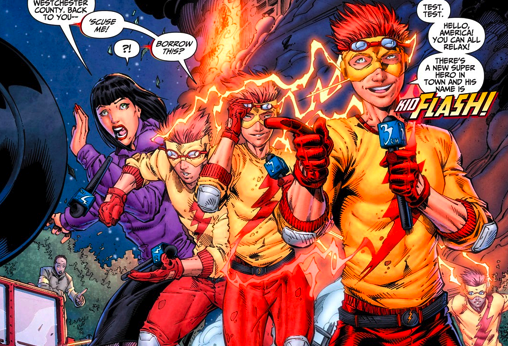
Really, the above frame from Teen Titans #1 is my problem with the idea of teen superheroes in the DC Universe: They are either the emotionally underdeveloped, cocky douchebag kid brothers and sisters of the Justice League, or they’re way too smart, way to poised, way too ready to take on the problems of the world. For all the negativity (rightly) heaped on Frank Miller’s All-Star Batman and Robin the Boy Wonder, his take on the DCU’s hero/junior hero dynamic at least tried to make it clear that, no, things weren’t normal, no, they weren’t going to get better, and yes, everything was terrifying. Scott Lobdell’s Teen Titans so far don’t touch on the terrifying nature of the job these kids are doing, though it hints at the underlying metaphor of superpowers-as-puberty. His Kid Flash is an all-swagger jerk. His Red Robin is, as you’d expect from one of Batman’s compatriots, a master tactician. His Wonder Girl, upon realizing that she’s being hunted by a shadowy extra-governmental organization, says that things will never be the same.
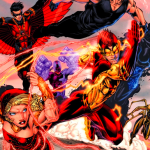
Wonder Girl, it should be said, hates being called Wonder Girl. But that’s life for the kid heroes of the DC Universe, either suffering an identity crisis or from a lack of attention from their chosen role model. But they’ve got bigger problems than worrying about their old, idyllic lives racing stolen cars down the Pacific Coast Highway. The shadowy extra-governmental agency is called N.O.W.H.E.R.E., which is one of those acronyms that will probably forever be without explanation, and Red Robin (Tim Drake, for you Robin III fans out there) is a blogger and proprietor of a Wikileaks-esque operation, an anonymous folk hero who knows that he and other teen heroes, so derided in the media, aren’t going to do well on their own. So it’s a race between Robin and the trenchcoat-bedecked leader of N.O.W.H.E.R.E. to track down the teen heroes (Teen Titans, if you will) and create a team out of ’em. Judging from the cover, it looks like Superboy, Starfire, a purple robot and a spider-woman have yet to join.
This issue never quite rises above teen comic cliche, and every Teen Titans comic runs headlong at the monumental task of equaling the Marv Wolfman/George Perez book from the 80s. It attempts to take a similar path as Marvel’s Runaways and Young Avengers, making it clear that these kids either have no ties to the big league heroes, or that their ties are tenuous at best. They’re on the run. They may have issues with their parents. But they’re archetypes, and as a writer myself, I often wonder if there’s any way to evolve a character from there. Will Red Robin always be the leader? Will Kid Flash always make me want to punch him? It’s issue one, which is way too early to tell…but nothing else in the first issue makes me want to come back and find out.
Brett Booth’s pencils are alright, though they’re very clearly in a Michael Turner vein. Lots of teen side-boob and mostly-naked aliens coming down the pipe. This seems like a wrong (read: dumb) move by DC Comics, who’ve somehow missed out on the potential goldmine the Teen Titans property has represented since the Teen Titans cartoon aired on TV. I don’t know if you know this, but comic books used to be very popular with cartoon-watching children. Not only that, but cartoon-watching children are now a vast, mostly untapped market for the medium. Sideboob and near nudity have been available in nearly every comic book I’ve read since I started reading them. The market for sideboob and near nudity is saturated. Why not throw a bone to the under-sixteen set? Why not try to interest new people? Why not offer something flashy and effervescent? It doesn’t have to be a cartoon, but it should probably be trying to attract the old cartoon’s audience. It doesn’t have to be a farce, but it should be different, shouldn’t it?
It isn’t until the end of Gus Van Sant’s Restless that I feel anything for its protagonist, who begins the film as a petulant funeral crasher, a stranger in a land reserved for those with an intimate knowledge of the dead. He has his reasons for dressing in black and sitting in on services, but I suspect most of us have our reasons for most of the things we do, known only to us. For everybody else, our intent is hidden behind a brick wall.
Enoch Brae (Harry Hopper) is said funeral crasher, and it is at one of these funerals that he meets Annabel Cotton (Mia Wasikowska), who recognizes him as an outsider immediately. She doesn’t seem to mind his presence at the funeral. Matter of fact, she seems interested in Enoch, who is by no means a normal boy. He walks around like the disheveled, moribund hero of a 90s arthouse film. Why? That’s a mystery to her and everybody else who comes into contact with Enoch, but it’s one she sets out to solve.
The caveat is that Annabel has cancer, an inoperable brain tumor that gives her, at best, three months to live. Her friendship with Enoch blossoms into a young romance, but it is obviously doomed. She’s determined not to let it get her down. He’s ambivalent, at times joking, at times not wanting to talk about her impending death, the march of time. They tiptoe through graveyards, childlike, trying to ignore the encroaching darkness.
But Enoch, as I said, is moribund. Depressed. He’s got issues that he’s yet to deal with, and a dying girlfriend isn’t going to help. His aunt (Jane Adams) suffers caring for him after the death of his parents, and he’s apparently haunted by a ghost named Hiroshi (Ryo Kase), a World War II Kamikaze with a passion for Battleship. Enoch blames his aunt for the fact that his parents are dead, and, as his relationship with Annabel deepens, he begins pushing away Hiroshi, who doubts that dating a girl on the verge of death is healthy.
There’s a lot on the fringes of Restless. It is implied that Enoch may have tried to commit suicide. Hiroshi may be a figment of his imagination. He doesn’t go to school. He’s prone to outbursts. All of this is quite overwhelming, an avalanche of emotional detail not usually contained by a single movie. Annabel is his center, but that, as they say, cannot hold. She’s a girl interested in ornithology and Darwin, not ready to die but aware that she can’t go on. She’s told by the staff at the cancer ward that she’s brave for going through her ordeal and wonders what the cancer patients who aren’t brave must be like.
It’s a fair question, and a somewhat tacit incitement of film characters with terminal illnesses, who are almost always flawless paragons of virtue, waiting for death to canonize them. Annabel Cotton, too, is one of these flawless sufferers—she certainly doesn’t look like cancer’s ravaging her, doesn’t often appear to be in pain—but she’s optimistic and steadfast where other films would paint her as the cloying stereotype. Given three months to live, she lives them quietly, with resolve. She doesn’t climb a mountain. She doesn’t abandon ship. She isn’t enshrined by those around her. She’s selfish, sometimes, and always human. Sad as it is to say, that’s a pretty big accomplishment for a movie with terminal illness at its center.
Wasikowska is the most compelling aspect of the film, as she finds a way to navigate the shark-filled waters of her role without being mauled. She’s a waif and a manic pixie girlfriend in equal measure, and she’s good in that role, but the moments where she’s determined to not be Enoch’s coping mechanism are surprising in their weight and authenticity. Unfortunately, she’s destined to be just that, like the equally-interesting Hiroshi—a compelling character in the corners of another, less compelling life. Enoch’s circumstances are unfortunate, true, but even tugging at the heartstrings with all his might, he fails to earn any sympathy.
Despite that, Restless manages to be a compelling, fresh movie. I wonder at what would have resulted had Annabel not been sick, or had her tumor factored into the plot as more than the film’s ticking time bomb, and I’m appreciative if a film manages to stir-up wonder. Though quiet, at the film’s core runs the intense machinery of desire. Like time, it never stops marching.
Rating:
Restless. Directed by Gus Van Sant. With Harry Hopper (Enoch Brae), Mia Wasikowska (Annabel Cotton), Ryo Kase (Hiroshi), Jane Adams (Mabel), and Schuyler Fisk (Elizabeth Cotton). Released September 16, 2001, by Sony Pictures Classics.