Tag: Anthony Mackie

  • Movie Review: Gangster Squad (2013)

    Movie Review: Gangster Squad (2013)

    Gangster Squad

    There’s nothing new to Gangster Squad, Ruben Fleisher’s amalgamation of and fetishized love letter to the film noir. Outwardly, there’s little wrong with Fleisher’s approach—the film looks and feels like a theme park noir, approximating the style, tropes, accents, and dames in red dresses of the pulpy, lurid dramas that continue to pump their dark blood through the heart of American culture. The problem here is that, like a theme park attraction, the performers appear to be dead tired, sleepwalking their way through an old-as-dirt story that’s been repeated to the point of boredom. To compensate, Fleisher paints his sets red with the blood of countless goons and has his stars grit their teeth while pulling the trigger. This solves remarkably little.

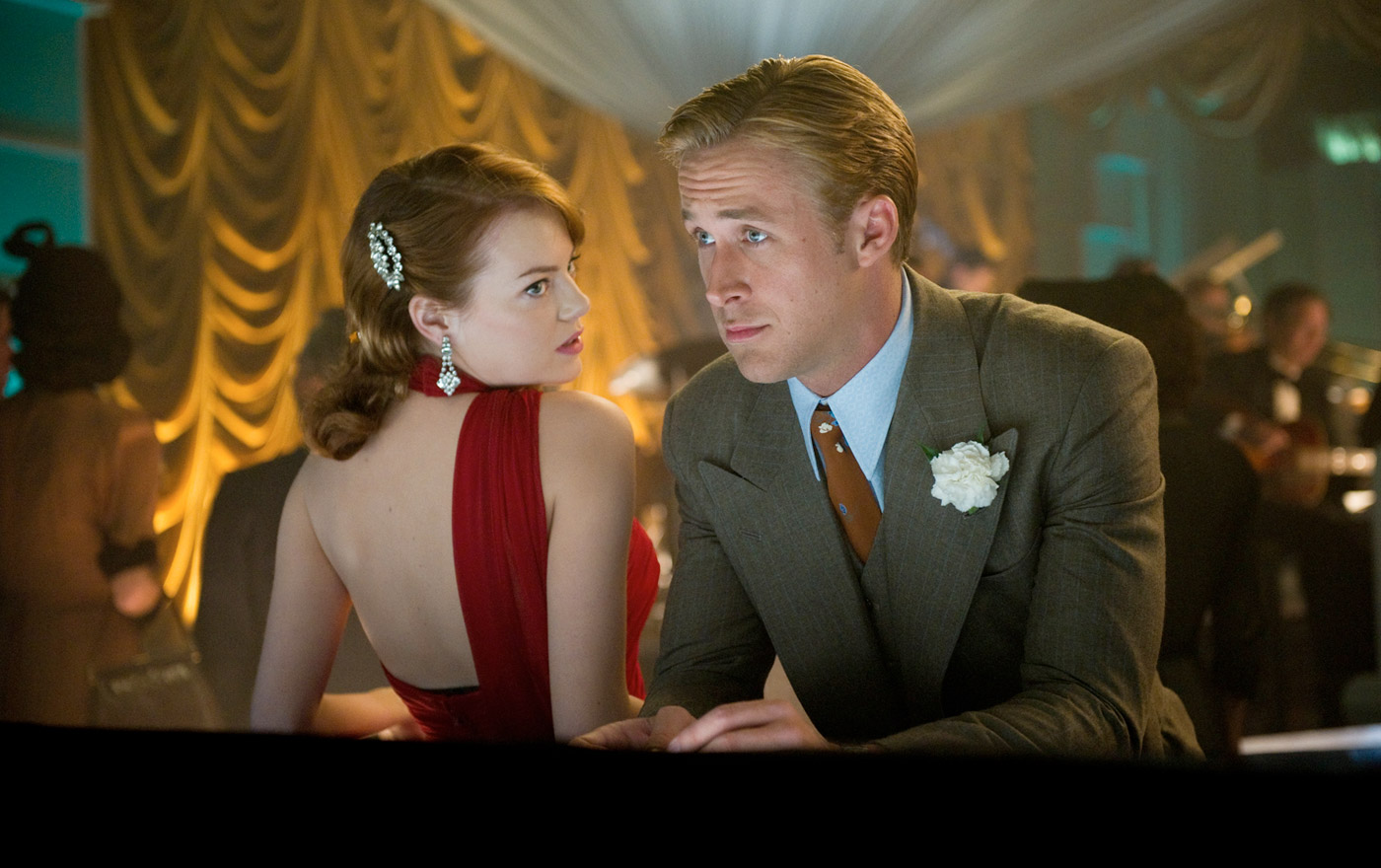
    The story of Mickey Cohen and the Gangster Squad is one of the more thrilling ones in mob canon. At one point in time, Cohen’s mug was capable of selling more papers than anybody in America, and part of his charm (if you can call it that) is that he seemed to genuinely relish his celebrity. He was a complex man, as were those assigned to take him down. Gangster Squad‘s biggest disappointment  then, is in how it goes about simplifying the story: Mickey Cohen (Sean Penn) is a ruthless gangster, John O’Mara (Josh Brolin) is an honest cop, and it’s up to O’Mara and his crew of specialized police officers to cripple Cohen’s operations by sabotaging his business interests and murdering his lackeys. The movie spends a lot of time saying that Cohen is a terrible human being, and, to be sure, being the head of a crime syndicate and a vengeful individual gives Fleischer and screenwriter Will Beall plenty of opportunity to unleash Penn’s squirmy, seething portrayal of Cohen upon Los Angeles, but he is largely backgrounded, yelling at his crew for being foiled by the Squad and leering at Grace (Emma Stone), his moll.

    This leaves the interesting bits up to the Gangster Squad itself, but even given a near two-hour runtime, none of the heroes rise above action figure characterization. O’Mara is chosen to lead the squad because he has special ops training, Jerry Wooters (Ryan Gosling) is a jaded ladies man, Coleman Harris (Anthony Mackie) is the Squad’s connection to the streets, Conwell Keeler (Giovanni Ribisi) is skilled with bugs, Navidad Ramirez (Michael Peña) is the rookie, and Max Kennard (Robert Patrick) is the group’s grizzled, six-shooting veteran. We only know anything about O’Mara, Wooters, and Keeler’s lives beyond the percent for the purpose of drawing a basic emotional response when they or (somebody close to them) get murdered or shot at. This happens frequently.

    Though hardly surprising considering his background in music videos, Fleischer’s sense of style remains the most potent element of his films. His particular quirks are more self-evident in a movie like Zombieland, whose genre is generally ill-served by gifted directors and given over to a relentless stream of jump scares and attempted gross-out kill scenes. That Zombieland has endured to the point of becoming something of a cult movie is a testament not only to the movie’s famous Bill Murray cameo, but well-conceived bits like the Zombie Kill of the Week and its hero’s Survival Rules, both of which are catnip to .gif-addicted Tumblrphiles. Its only competition (and its better) is Shaun of the Dead. It’s unfair, but Gangster Squad courts danger by inviting comparison to The Untouchables, L.A. Confidential, Casino, and Goodfellas—mafia movies that stand apart from the peers of their era in large part because of how good they look—and loses harshly as a result. Gangster Squad has the look and cast of an Oscar-contending prestige picture. Too bad it’s got the brains and heart of a basic cable time-waster. 


    Gangster Squad. With Josh Brolin (Sgt. John O’Mara), Ryan Gosling (Sgt. Jerry Wooters), Sean Penn (Mickey Cohen), Emma Stone (Grace Faraday), Nick Nolte (Bill Parker), Anthony Mackie (Det. Coleman Harris), Giovanni Ribisi (Det. Conwell Keeler), Michael Peña (Det. Navidad Ramirez), and Robert Patrick (Det. Max Kennard). Directed by Ruben Fleischer and produced by Dan Lin, Kevin McCormick, and Michael Tadross. Screenplay by Will Beall, based on the book Gangster Squad: Covert Cops, The Mob, and the Battle For Los Angeles by Paul Lieberman.
  • Movie Review: Abraham Lincoln: Vampire Hunter (2012)

    Movie Review: Abraham Lincoln: Vampire Hunter (2012)

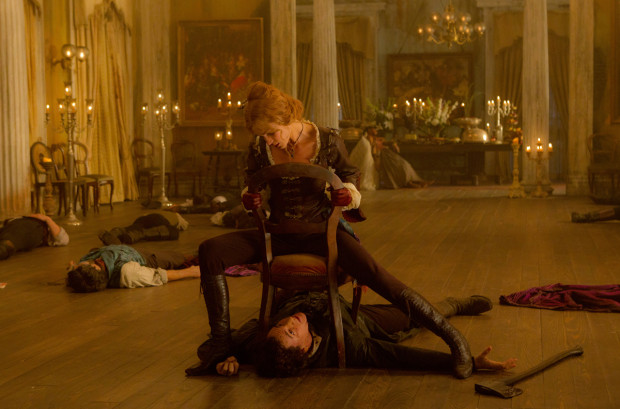
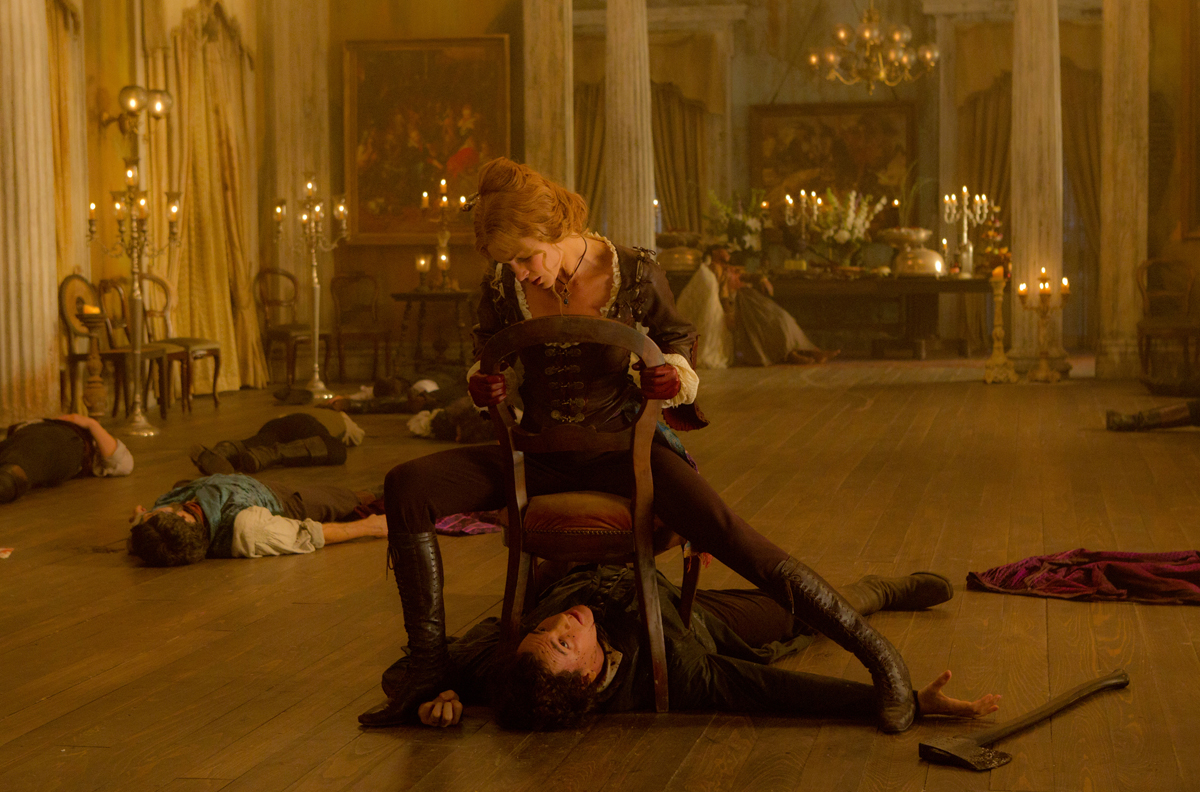
    Abraham Lincoln: Vampire Hunter, like Snakes on a Plane, tells you everything you need to know about it in the four words comprising its title. Timur Bekmambetov’s film gains or loses an audience based on how cool one perceives the sight of Abraham Lincoln chopping down wave after wave of CGI vampires down with a silver-lined ax as being. Whereas Snakes on a Plane suffered from bowing too much to the internet meme culture that got so much from the movie’s premise that they didn’t feel the need to see the actual film, Abraham Lincoln: Vampire Hunter is so dry and mirthless one wonders what the point is. Dour films about CGI bloodsuckers are released two at a time. One featuring a kick-ass, kung-fu president almost can’t help standing out among the crowd. Despite those easy expectations, Bekmambetov—whose Wanted neutered a comic book about a world overrun by Batman villains by becoming an uninspiring Matrix clone—does almost everything in his power to disappoint. In this, he succeeds.

    But let’s forget about that for a moment. Forget, too, everything you think you know about Abraham Lincoln. Let’s say that his true passion in this world was the slaying of vampires, that, after witnessing the murder of his mother by a particularly nasty vampire, the young Mr. Lincoln (Benjamin Walker) puts down his law books and takes up his axe. Endowed by his creator with certain unalienable rights, among them the pursuit of bloody vengeance, Lincoln puts a ball squarely in the eye of Jack Barts (Marton Csokas), his mother’s killer, but Barts doesn’t die. When Lincoln is rescued by Henry Sturges (Dominic Cooper), a man who observed the future president drinking furiously in preparation for his task, he’s let in on the secret history of the world: vampires exist, and, since the colonization of America, have used the vast plantations of the south and the country’s reliance upon slavery as a free buffet.

    This sounds like the set-up to a pretty good genre flick but Lincoln’s vampire slaying origins are hashed out for half of the film’s runtime and involve all manner of uninteresting characters. There’s William Johnson (Anthony Mackie) and Joshua Speed (Jimmi Simpson), two of Lincoln’s earliest and closest friends, and Mary Todd (Mary Elizabeth Winstead), atypical one-dimensional love interest. Sturges himself is a glum tutor with a secret as obvious as the sunglasses he constantly wears, and Lincoln makes for a particularly uninspired chosen one, disavowing guns in favor of an axe he whips around at lightning speed. The antagonist vampires—Adam (Rufus Sewell) and Vadoma (Erin Wasson)—are distinguished mainly by their pointy teeth and flashy attire.

    The movie starts rolling when Lincoln is in the White House. The Emancipation Proclamation is issued to deprive southern vampires of their main food source, Union troops are befuddled when they find that their bullets do little against the vampiric armies of the Confederacy, and the South seems poised to break through at Gettysburg. It’s at this point that Lincoln remembers that silver destroys vampires and orders the appropriation of every last piece of silver. As Roger Ebert points out in his review of this movie, it seems like Lincoln is able to gather, melt, and re-purpose every ounce of silver in the United States of America in a day. The better to reach the film’s climactic action sequence, of course. What’s more strange, to me, is that the protection, fueling, and conduction of the train falls upon Lincoln and his small band of friends. Even if you’re trying to sneak the train past an unsuspecting enemy, is the President of the United States really the best choice to pilot a speeding locomotive?

    Abraham Lincoln: Vampire Hunter lives and dies by that sequence, pitting Lincoln and his friends against the vampire horde determined to derail the train bearing silver munitions to the front line. With the bridge on fire and the odds of survival against them, Lincoln, Speed, Johnson, and Sturges battle a veritable army of vampires, hacking, slashing, and shooting through wave after wave of them, hardly pausing to reload. The effectiveness of this scene is directly proportional to the number of murky, blue and grey lit, slow motion kung-fu action sequences you’ve seen lately. Considering that the market is absolutely saturated with such set pieces and that the only things distinguishing this one from the rest are the president and his ax,  it’s rather unfortunate that Bekmambetov and screenwriter/novelist Seth Grahame-Smith didn’t approach the film with the same lightheartedness the mash-up genre was practically founded upon. The occasion of a president slaying vampires is treated as just another excuse for a group of characters to violently dispatch as many computer generated images as the budget allows. In this instance, Abraham Lincoln: Vampire Hunter is late to the party: the genre has long been out of such excuses.


    Abraham Lincoln: Vampire Hunter.  With Benjamin Walker (Abraham Lincoln), Dominic Cooper (Henry Sturges), Anthony Mackie (Will Johnson), Mary Elizabeth Winstead (Mary Todd Lincoln), Rufus Sewell (Adam), Marton Csokas (Jack Barts), Jimmi Simpson (Joshua Speed), and Erin Wasson (Vadoma). Directed by Timur Bekmambetov from a script by Seth Grahame-Smith, based on the novel Abraham Lincoln: Vampire Hunter, by Grahame-Smith.

  • Movie Review: What’s Your Number? (2011)

    Movie Review: What’s Your Number? (2011)

    It’s really hard to even begin a review of a movie like What’s Your Number? without selfishly floating a few things out there, so bear this in mind as I try to figure out what, exactly, I saw:

    1. As a man in a household consisting of myself, a sister, and a mother, I’ve seen a ton of romantic comedies. I was practically raised on a diet of Audrey Hepburn and John Hughes, so I’d like to think that I know what works, what’s funny, and what’s romantic. I consider myself not dude-at-a-chickflick, but an unbiased judge of these things.
    2. As a frequent grocery shopper, I often catch glimpse of magazines like Cosmopolitan and Marie Claire, the former being the magazine with the article that is the crux of this film. Other than learning a few overly-complicated methods to the male orgasm (hasn’t friction worked for centuries?), I’ve learned that a good amount of the magazine publishing industry relies on making women feel insecure about their looks, their weight, and how many men they have or haven’t slept with.
    3. As a human being, I can’t help but be sad (and a little angry) about how much money our society pumps into these industries. It seems like every other romantic comedy is an artless slice-of-“life” debating the merits of one relationship crisis article or another. He’s just not that into you? You’ve worn twenty-seven bridesmaids dresses but have yet to be the bride? You’ve slept with twenty dudes? Whatever. There are well over six billion people out there. Twenty isn’t a fraction; it’s a crumb.

    But our biological clocks are ticking from the moment of conception, so I suppose it’s not all that unreasonable to feel pressure/begin panicking when, on the eve of thirty, no significant headway has been made towards our mutual goal of not dying alone. This, I suppose, is why I’m supposed to feel sympathy for the plight of Ally Darling (Anna Feris), the woman who has slept with twenty dudes and who is freaked out about the Marie Claire article (researched by a Harvard doctor, no less!) that says she’ll never find happiness.

    This, of course, is absolute crap, but go along with it for a bit. In an effort to find her one true love, Ally decides to put off everything, including her sister’s (Ari Graynor) wedding, to track down her twenty ex-loves. Because a woman can’t be expected to do these things on her own, she turns to her neighbor Colin (Chris Evans) who, as the movie has it, knows how to find people. Of course, some people are right out. Colin, for one, since he’s a womanizer and would put her over her number. Julie, a girl she slept with in college, because she’s a dude now. Gerry, a puppeteer, because puppeteers are probably more interesting than divorced guys and Miami gynecologists. She’s really hoping to settle for two options, though: A Senate hopeful (Anthony Mackie) and the son of an incredibly rich guy (Dave Annable), neither of whom question her motives for looking them up again some 5 or 15 years after their last contact. Naturally, the one who’s right for her is right under her nose, having sex with every woman in Boston. Naturally, he comes to realize that she’s the only woman he’ll ever need to have sex with again.

    I’d feel bad about spoiling the end of the movie were it not a bastardization of the same ol’, same ol’. The film’s every element is predictable. For example, if I told you that the black senatorial candidate was a Republican, would you be able to guess his sexual orientation? If I said that Ally had a “weird” hobby, would you guess which smokin’ hot bro suggests she make it her career? If I told you that the events of the film surround the wedding of her sister, would you be able to guess which character would grab a fretting Ally by the shoulders on that day to say “Go to him?”

    If you can (heck, even if you can’t), it’s probably obvious that Ally’s not a person worth your interest. To the point, she seems like a terrible person, oddly infatuated with the idea of snatching money and power without earning either, to the point that she makes her sister’s wedding about her. None of this would be a problem were the situations comic in nature, but the movie can’t, at any point, decide if Ally is somebody we should be rooting for or somebody we should hate for being a slut, and Anna Ferris, once tabbed as one of the funniest women in Hollywood, can’t make anything about her stick. In a way, the movie’s funniest moment is when Ally’s father tells her to be herself. If she really followed through on that advice, she’d be a gibbering collection of lies she’s told men so she’d get laid.

    But getting laid, as every romantic comedy would have you know, is terrible unless it’s with one partner, for the rest of your life. Last night at a Waffle House, I wound up having a conversation with the waitress about this movie. She was pretty drunk during it and couldn’t remember much, but she said “There was nothing wrong with her [Ferris]. A number’s a number. You should own it.” Her number was one. At this, the restaurant Awwwwed. Maybe someday romantic comedies will go back to being about nice women like the waitress at Waffle House, who fall in love with nice people and whose lives are complicated by more than magazine-issue stereotype. Until then, we’ll always have the rom-com slut. We’ll always have our insatiable appetite for slutshaming.

    Rating:

    What’s Your Number? Directed by Mark Mylod. With Anna Faris (Ally Darling), Chris Evans (Colin Shea), Ari Graynor (Daisy Darling), Joel McHale (Roger), Blythe Danner (Ms. Darling), Andy Samberg (Gerry Perry), Anthony Mackie (Tom Piper), Dave Annable (Jack Adams), and Aziz Ansari (Jay). Released on September 30, 2011, by 20th Century Fox.