Author: Colette Arrand

  • A Kübler-Ross Model For Grieving Independent Wrestling Fans

    A Kübler-Ross Model For Grieving Independent Wrestling Fans

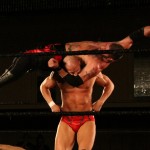
    One of my favorite wrestlers, Claudio Castagnoli, was recently signed by the WWE. He’s since made his début for their Florida developmental territory, FCW, under the decidedly European (but not quite Swiss) name Antonio Cesaro. This, for the uninitiated, is what he looks like:

    His signing didn’t get the same fanfare as the early-January signing of Mistico (now Sin Cara), who got a press conference and an almost immediate début, but this is big stuff for the WWE, regardless. After signing and releasing Castagnoli in 2006, they’ve brought him back with five more years of experience, during a period of transition that has seen the WWE pick up guys who aren’t just ex-football players or ex-bodybuilders or models-turned-“wrestlers,” but men and women of real wrestling ability. One look at Cesaro above tells you that he’s everything the WWE typically wants in a wrestler (height, build, continence), but watching his matches, it’s hard to ignore that the WWE have picked up an incredibly polished professional ready to make an immediate impact.

    I couldn’t be happier for the former Double C, as most pro-wrestlers have dreams of making it in the WWE. Selfishly, I’m going to miss seeing him three or four times a year in 20-minute plus matches (I saw him wrestle in person four times this year, in four of the better matches I’ve seen since my fiendish appetite for wrestling returned in 2010), but I can’t wait for casual wrestling fans to be wowed by Cesaro’s very European uppercuts, his power and his charisma. Understandably, however, there are plenty of indie wrestling fans who, while they may be happy for Castagnoli on a personal level, can’t help but be sad to see him go. We’ve come a long way from ECW fans burying wrestlers departing for the six-figure paychecks of WCW and WWF with “You Sold Out!” chants and near-riotous responses as they exited the ECW Arena for the last time, but there’s still a very vocal contingent who don’t understand why somebody making a living as a wrestler would want to do it in front of a large audience. Not that they’re a group of uncaring jerks; they’re just in mourning. Here’s what to expect from your favorite indie wrestling fan as they suffer the period between Castagnoli’s signing and Cesaro’s eventual Raw or SmackDown! début.

     Stage One: Denial

    Here, the independent wrestling fan will try to convince himself (or herself, I suppose) that the news isn’t true, despite the fact that his every message board post on the wrestler in question has been along the lines of “Well, it’s obvious that he’s lost because he’s going to the WWE!” The fan will frantically refresh the newly-signed wrestler’s official website, hoping to see a new booking at a county fairgrounds in upstate New York, and will grow even more despondent when the webpage disappears entirely, redirecting him to the wrestler’s brand new Florida Championship Wrestling biography page.

    “Oh no!” the fan may scream. “I was going to use his gnocchi recipe this weekend!”

    Stage Two: Anger

    Denial is temporary, however, as the FCW bio page will reveal the indie wrestling fan’s favorite wrestler’s new name. Now, to an outsider, the leap from “Claudio Castagnoli” to “Antonio Caesaro” may not look like much, but to the independent wrestling fan, it means everything. This was not just a wrestler’s name–it was a mark, a badge of pride. This is a lot like hipsters debating the merits of their musical taste by dropping obscure band names on one another until somebody screams for mercy. The indie wrestling fan, when talking to a casual wrestling fan, loves to drop a name that the casual guy has never heard, as “My favorite wrestler right now is PAC” will lead the casual fan to admit the indie fan’s superiority before he can even think of naming Zack Ryder. In the future, “I’m a big fan of Claudio Castagnoli” will lead to responses of “Oh, Antonio Caesaro? He’s alright, I guess, but he’s no Chris Masters.”

    The independent wrestling fan may also be driven to forums at this point in time, believing that it is his right to decry the departing independent wrestler for following his dreams of WWE Superstardom.

    “I didn’t buy his t-shirt at the last show that I saw him at,” the post will begin. “I just told him how awesome I thought he was and that he looked ready for the WWE. Oh crap; is it my fault? I knew I shouldn’t have talked to him!”

    Stage Three: Bargaining

    If the departing independent wrestler has a Twitter account, he’s in for a solid week of Twit-spam from indie wrestling fans who foolhardily believe that asking him not to appear in Tampa will surely get him to appear at next week’s Combat Zone Wrestling show, being held in some grassy patch in Illinois. A smattering of Tweets:

    • @AntonioCaesaro: Please come back! I’ll buy six Ricola Bomb t-shirts!
    • @AntonioCaesaro: If you don’t sell out to Vince, I’ll buy something off your Amazon.com Wish List!
    • @AntonioCaesaro: Please come to next week’s show, Claudio. I’ll make you a cake. A Swiss cake.
    • @AntonioCaesaro: Can you say “hi” to CM Punk for me?
    • @AntonioCaesaro: RT this if Vince is keeping you hostage.
    • @AntonioCaesaro: #LeavetheMemoriesAlone

    It’s a modern take on this:

    Stage Four: Depression
    At this point, the independent wrestling fan will go into a serious funk. Matches featuring the departing indie star, once favorites, will lose their appeal. His t-shirts will go un-worn, his DVDs will go to dust. Oh sure, there are still indie shows to watch and there are other indie wrestlers worth watching, who, like the departing indie star, have their own unique charm about them, but when the official YouTube channel goes un-updated and the news from Tampa has it that the ex-indie star is losing semi-regularly to an ex-bodybuilder picked from a random issue of Muscle & Fitness, it’ll seem to be over for the indie wrestling fan. You can suspend a pinata from a pole and have two Mexican luchadores fight over it, you can book a giant turkey to hatch from a giant egg on a Pay Per View, and you can have Snookie pick up a win at WrestleMania and the wrestling fan will come back. Horrendously misuse a favorite wrestler in the eyes of an indie wrestling fan, however, and there’s little point in even complaining about it online.

    Stage Five: Acceptance

    But lo, the first footage of the former independent wrestling star will emerge on YouTube, and it will be good:

    The independent wrestling fan will view this footage, will note the small child to the right absolutely lose it for the duration of the clip’s three minutes, and his heart, dear readers, will grow like the Grinch’s upon seeing the solidarity of Whoville. After all, seeing a favorite wrestler get signed is like an affirmation from the big guy upstairs (Vince McMahon, who I assume occupies the top floor of Titan Towers) that, yes, independent wrestling fan, you’ve got pretty good taste. Not only that, but you may just be able to identify potential stars who, one day, casual fans will speak of with the same reverence you once did.

    And if things don’t work out, hey, it’s no big deal. The future endeavored former independent wrestling star can always go back to the fairgrounds. His old gear is waiting. His old name is waiting. His old fanbase will follow.
  • First Issue Collector’s : Batgirl #1

    First Issue Collector’s : Batgirl #1

    Batgirl Gail Simone Adam Hughes

    I don’t know how damning this is as a comic book nerd, but I’ve never had an affinity for Barbra Gordon, Batgirl. Barbra Gordon as the Oracle being something totally different, in her original form Gordon evolved from a swinging mod-librarian more excited about accessorizing than fighting crime to one of Batman’s many interchangeable sidekicks, only she was the daughter of Jim Gordon, so she had certain advantages, story-wise, that both Nightwing and Robin didn’t have–imagine the chief of Gotham P.D.’s daughter being captured by the police and revealed as a vigilante! Of course, the Joker shot Barbara Gordon in the spine, paralyzing her from 1988 to 2011, a remarkable era of consistency in a medium that resurrects characters who didn’t die violently enough in the past.

    With Batgirl #1, that’s over, and all of Barbara’s post-Killing Joke stories seem to have been tossed out the window. The Joker still shoots her, the gunshot still paralyzes her, but after three years she’s able to walk again. Gail Simone doesn’t put much effort in explaining the whys and wherefores of this development in Barbara’s life, but she doesn’t exactly need to. Like Grant Morrison in Action Comics #1, Simone is less concerned with history and more concerned with character building. So it’s not important to Gordon why she’s able to walk again, but what she’s going to do now that she can. The answer, obviously, is to go back out on the streets and fight crime.

    Things are hardly perfect on her first night out, however. She’s rusty, prone to error, and almost gets herself and her perp killed. What’s obvious, however, is that Batgirl will soon have more pressing issues than the local murder gang. There’s a supervillain going around town calling himself Mirror. He’s none too pleased with individuals who should have died in random accidents and, like death (the metaphorical concept of death, I suppose) in the Final Destination movies, he takes it upon himself to finish nature’s job. This suburbanite watering his grass, for instance:

    A confrontation between Mirror and Batgirl is inevitable (Barbara Gordon is on his list), and when it does happen, we find that Batgirl is very much afraid of what should happen to her if she is shot through the spine again. This…is actually rather shocking, as it’s not everyday that a superhero demonstrates fear of anything, let alone something as practical as a gun pointed at her stomach. Most superheroes, you will recall, have some sort of weakness. Superman has kryptonite. Green Lantern has yellow. Batman is merely human. But these guys charge headlong into threatening situations without thinking twice and, to be frank, it’s a little boring. Barbara Gordon goes into situations where guys have guns even though she’s terrified of guns and, though one is pointed right at her, she wills herself to continue. If every issue has a moment where a bad guy gets the drop on her and she freezes up, it’ll get old quickly, but it’s nice to know that Gordon isn’t just headed back to the field, carefree, like nothing ever happened. She’s got scars, and she’ll need to battle those.

    Mirror, though, is kind of a lame villain. Beyond the awful name and his spike-knuckled gauntlets, the guy is dressed in black and kills people in a decidedly 1990s way, with as much violence as possible. This may be Simone’s intent, since, as the former curator of Women in Refrigerators, she knows a thing or two about 90s violence, a lot of which can trace its roots back to Moore’s Killing Joke (and his Watchmen, and Frank Miller’s The Dark Knight Returns). Looking at the guy stroll through a hospital blasting cops in half is a stark reminder of what I dislike about comic books, and while Simone does it well enough and, I’m sure, is pushing Mirror in a logical direction, something about the later realism of his killings takes a lot of the fun out of this issue.

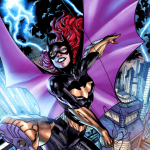
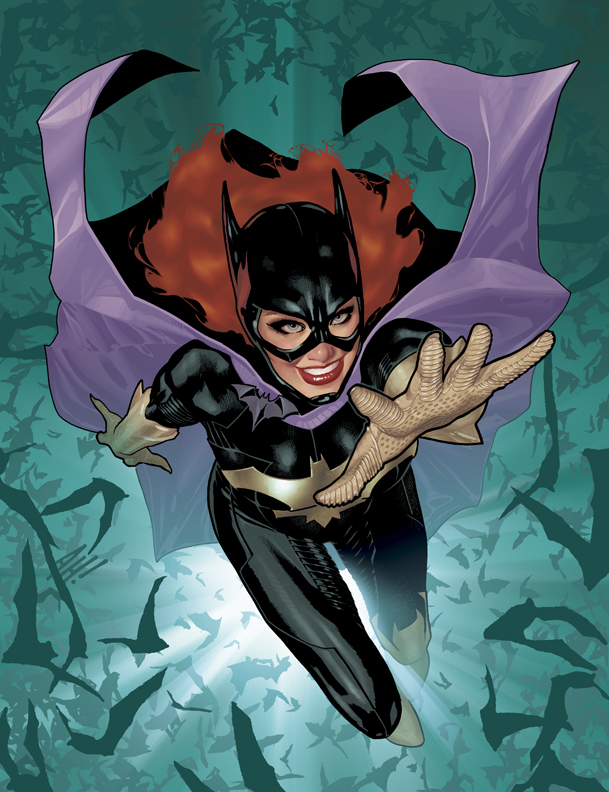
    As far as the art goes, I can’t imagine that Batgirl’s costume stays the way it is for long–the only thing here not covered in intricate line-work is the cape. Adrian Sayf does a good job with it, though, as Batgirl is never portrayed inconsistently. Eventually, though, I suspect a lot of that detail will go away, like when Spider-Man’s costume lost half of its webbing when Steve Ditko left the book. There are moments when the action from panel to panel is so cluttered that the backgrounds melt away into solid color, which is a little annoying, but I suppose that can’t be helped and nothing gets lost along the way.

    It’ll be interesting to see where they go with Barbara, who moves out of her dad’s place and into a new apartment with an activist roommate, the Craigslist special. Simone is one of the best mainstream superhero authors when it comes to depicting women (this is a skill many comic scribes lack) and shortcomings, and it’s clear that Barbara has a lot to deal with. If she’s allowed to deal with it, this’ll be a successful book, and one of my favorites of DC’s relaunch. If she’s a free-swinging airhead this time next year, consider it a lost opportunity.

  • First Issue Collector’s Item: Action Comics #1

    First Issue Collector’s Item: Action Comics #1

    Action Comics 1 Grant Morrison Rags Morales

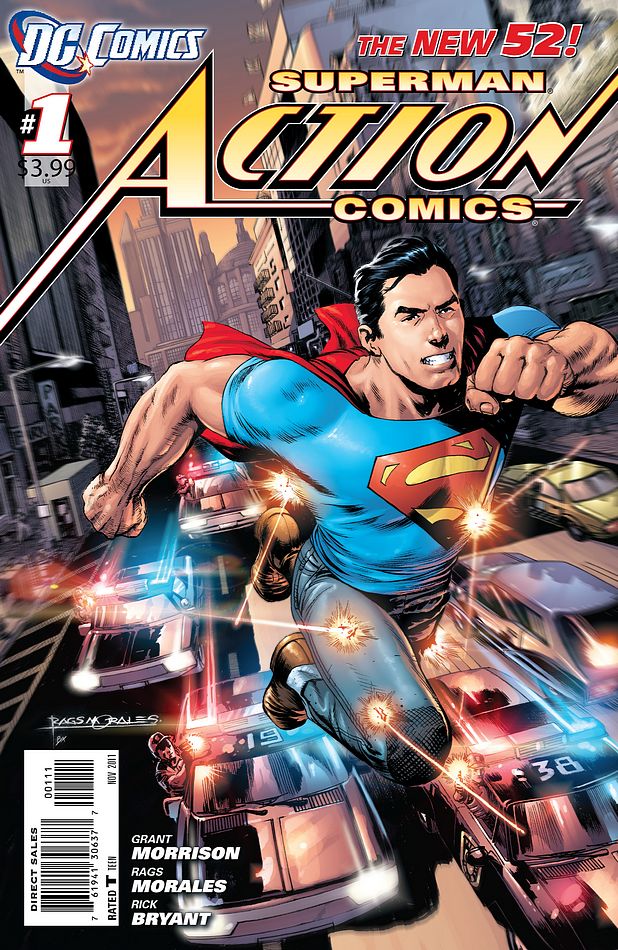
    Yes, Superman is wearing jeans. And a t-shirt. And work-boots. But lost amid the hubub over the Man of Steel ditching the baby blue onesie in favor of a decidedly more working class look is the challenge that comes with taking Action Comics, which has run continuously since June, 1938, stamping a new #1 on the cover and rebuilding the Superman mythos from scratch. This, along with the renumbering of Detective Comics and the rebooting of Batman’s mythos, is the big risk of DC Comic’s push to make its way back into the hearts, minds and hands of America’s children and casual comic book readers, but beyond maybe making a few number-crazy fanboys upset, Superman’s new look and new(ish) mission should come as no surprise–in comicdom, everything is up for revision.

    Everything.

    Unlike Superman-Red/Superman-Blue, the Clark Kent presented by Grant Morrison and Rags Morales actually seems like he’s able to bring the character into a new era. Rather than spending time on his origins (Morrison has already captured Superman’s birth as perfectly and as quickly as possible in All-Star Superman), Action Comics jumps right into Kent’s formative days as a superhero. His mission is to make sure that the ultra-rich of Metropolis abide by the same laws as the ultra-poor, which makes his choice of wardrobe nothing if not appropriate. With his jeans rolled up and his cape hanging to his t-shirt by the force of will, this Superman looks more comfortable putting in a hard day’s work than being a paragon of virtue. (more…)

  • The Insane Clown Posse’s Secret Destiny: Outlaw Country Musicians

    The Insane Clown Posse’s Secret Destiny: Outlaw Country Musicians

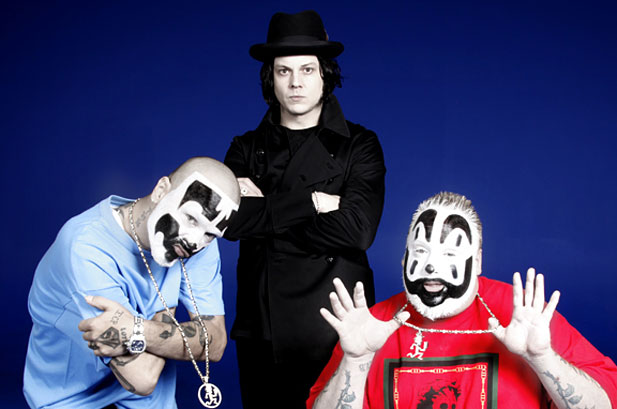
    “Mountain Girl,” the B-side to the Insane Clown Posse, JEFF the Brotherhood, Mozart and Jack White’s titanic collaboration “Leck Mich Im Arse,” has finally leaked to YouTube and, to the surprise of nobody with a sense of humor, it’s actually pretty good. Not that “Mountain Girl” is a lyrical miracle, but it finds Violent J surprisingly at home among honky tonk guitar twangs and cowboy narration. Given that ICP are the kings of a very odd set of rednecks, it’s less jarring to hear them rapping over country music than something decidedly more operatic, but Jack White’s formula for trolling the critical establishment remains intact: One part respected genre, one part divisive figure, one part reviled artist. Shake well and watch heads explode.

    I can’t help but compare this to the efforts of fringe comedian Neil Hamburger, whose album Sings Country Winners isn’t exactly the sort of thing you’d expect from a guy whose act involves turning the audience against him (read: it’s quite good). A few years ago, I saw Hamburger open for Tenacious D. Sweaty and carrying an armload of water-filled glasses he’d never drink from, Hamburger warbled and coughed his way through jokes about Britney Spears’ shaved head and Janet Jackson’s nipples long past their cultural sell-by dates until the crowd grew tired of it and demanded he leave the stage.

    “You cocksuckers are never going to see Tenacious D at this point,” Hamburger taunted, going right into another joke. That’s his act, and people who get it can appreciate it for what it is and be entertained for whatever it’s worth. People suckered by him, however, are not just the subject of his particular brand of humor, but they’re unable to enjoy something as charming as his cover of “Jug Town,” where a wistful son remembers how his dad would “hug his little neck” before heading to the local bar to drown his sorrows (perhaps caused by Hamburger himself) in a jug of wine.

    White’s act here is a lot like Hamburger’s. He knows the reaction is going to be “He killed the White Stripes for this?” but carries on, content to laugh with everybody else who’s in on the joke.

    He may be laughing alone, but I suspect he’s just fine with that.

  • Movie Review: Contagion (2011)

    Movie Review: Contagion (2011)

    The horror of Contagion isn’t the disease itself, the end result of the disease or the social unrest the disease causes. The film begins with the sound of a woman coughing. That woman dies, her son dies and the people who’ve come into contact with them start getting sick, too, but the film, which takes great pains to show simple human-to-human contact–hand shaking, money exchanging, drink serving, hand holding–has a larger point: We are living in the Lysol commercial from Hell. Germs are everywhere, and while we may eventually be able to isolate, reproduce and “cure” what ails us, we’re only really able to buy into placebos (Lysol, hand sanitizer) and hope for the best. The phrase “99% effective” is the world’s largest loophole: You can’t see these things coming, and you can’t see them die.

    We can, however, see the effects of a virus play out on the people around us. The woman coughing, for instance, is Beth Emhoff (Gwyneth Paltrow), whose husband Mitch (Matt Damon) follows her to the hospital. After her death, on his way home, Mitch receives a panicked call from the babysitter: his son has had a seizure. He finds his son dead. In the larger world beyond Minnesota, the Centers for Disease Control and the World Health Organization  try to get a grip on the situation, sending out disease intelligence agents in the Midwest and China to track Beth’s movements, trying to figure out how a businesswoman could have gotten people sick in China, Chicago and Minneapolis. It’s not hard to figure out: she was in a crowded room. She was on an airplane. As we travel, so too do the germs we carry.

    The real joy (if you can call it that) of this movie is watching how director Steven Soderbergh juggles the large and small scale dramas contained by Contagion. There’s Damon’s arc, where, in riot-ravaged Minnesota, he tries to protect his daughter from the virus and from other people. There’s the CDC arc, where Dr. Ellis Cheever (Laurence Fishburne) tries to coordinate the investigation of Dr. Erin Mears (Kate Winslet) while protecting his future wife, providing for the research of Dr. Ally Hextall (Jennifer Ehle)  and fending off the vitriol of popular conspiracy blogger Alan Krumwiede (Jude Law), who may have found an over-the-counter cure. In China, Dr. Leonora Orantes (Marion Cotillard) is kidnapped and held hostage until a village is given the vaccine.

    Not everything holds up. Once Dr. Orantes is kidnapped, she disappears. Mitch, who has done everything he can to avoid breaking down in front of his daughter, has to put up with her as she goes from understanding to typical, complaining of being locked in a prison while the outside world goes crazy. Perhaps most disappointing is Krumwiede, who begins the film as a small-time blogger unable to get traction with the San Francisco Chronicle to a massively popular individual with 12-million unique views and a four-million dollar profit coming his way thanks to the boom in sales to his homeopathic cure. He is Sarah Palin’s image of the blogosphere–unwashed, unsexed and unhinged–and he eventually disappears into the ether without the film giving us a sense if he believes what he’s selling, or if he’s just in it for the money. Jude Law plays Krumwiede as a firebrand, which is about right, but he’s a firebrand without focus.

    Beyond that, Soderbergh manages to keep everything aloft. I wondered, a little, how a world in crisis managed to keep the power and internet running, and I wish more was made of the film’s two or three governmental sub-plots, but by resisting the urge to sensationalize any given aspect of a global epidemic (when you think about it, 12 million worldwide visitors listening to a whackjob blogger is pretty marginal) Contagion manages to do what most films marketed as horror are unable to: scare its audience. A man in the theatre coughs. A woman sneezes. Everybody is touching their face with their hands that have touched the theatre seats, drink cups and popcorn bags that have, of course, touched other people who have touched other things. We all cringe, busy with the business of dying.

    Rating:


    Contagion. Directed by Steven Soderbergh. With Matt Damon (Mitch), Jude Law (Alan Krumwide), Laurence Fishburne (Dr. Cheever), Gwyneth Paltrow (Beth), Kate Winslet (Dr. Mears), Marion Cotillard (Dr. Orantes), Jennifer Ehle (Dr. Hextall) and Elliot Gould (Dr. Sussman). Released September 9, 2011, by Warner Bros.

  • Awful Professional Wrestling Characters: “Macho Warrior” Ric Hogan

    Awful Professional Wrestling Characters: “Macho Warrior” Ric Hogan

    Even if you’ve never seen a pro-wrestling show, I’m pretty sure you can guess at the identities of the four men who gave “Macho Warrior” Ric Hogan his name, his purpose, his reason for being. Picture, if you will, an island where a redneck Dr. Moreau fuses together his favorite professional wrestlers to create new, undefeatable, unaccountably popular spandex-clad warriors. The formula, on paper, looks perfect:

    Macho

    +

    The blue bar cage. Be still, my beating heart.
    Warrior

     +

    Ric

     +

    Hogan

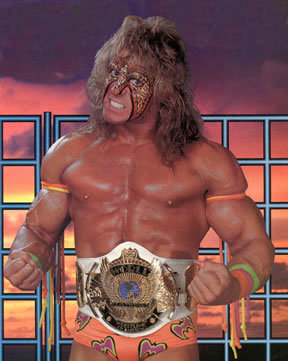
    Arguably, you’ve got the four biggest moneymakers in the history of wrestling on the operating table (well, probably not Warrior, but his reputation was as such at the time), four dudes who headlined Wrestlemania after Wrestlemania, who have won the hearts and minds of millions of fans, casual (Hogan/Warrior) and die hard (Savage/Flair) alike. This, however, is what you get:

    "Macho Warrior" Ric Hogan

    That, right there, is “The Macho Warrior” Ric Hogan: A fat, creepy looking dude with cheap sunglasses and a cheaper bandanna. He wears a t-shirt that says “MACHO WARRIOR RULES” and a pair of Zubaz, because dudes as large as the Macho Warrior are legally prohibited from wearing a pair of trunks like, you know, Ric Flair, Randy Savage, Hulk Hogan or the Ultimate Warrior. Not that I have any problem with the Macho Warrior’s girth–I’m a big supporter of fat dudes in wrestling, be they the awe-inspiring likes of Big Van Vader and Bam Bam Bigelow, the somewhat lesser dudes like Earthquake and Tugboat, or newcomers like Brodus Clay and Tursas. But unlike those guys and countless other Big ‘n Tall wrestlers, the Macho Warrior, well, he’s got the whole world against him, as evidenced by this handy list.

    1. Nothing he ever did was destined to work out. The Macho Warrior was a joke wrestler in a joke territory and, as such, will likely go down in history as a dude whose gimmick has been seen on YouTube by maybe 1,000 people. That’s not his fault, per se, but it’s telling. Check out this video of the Macho Warrior’s debut:

    Twenty years before this, the USWA was putting “Macho Man” Randy Savage on the map. Before that, the territory was briefly in the national consciousness as the home of the ultra-hot Jerry Lawler/Andy Kaufman feud. Here, the USWA was pretty much a vanity project–it’s only reason for being seemed to be as an excuse for Jerry Lawler, wrestling’s own creepy uncle, to hang out with Hooters girls and participate in some of the worst wrestling ever committed to tape. It didn’t help matters much that other wrestling companies with more prolific TV deals were featuring better wrestlers and more diverse storylines, but rolling with a guy like Macho Warrior as a champion of any sort kind of proves that you’ve given up as a company.

    2. He’s awful with his character. I mean…he implements the “Macho” and the “Hogan” just fine…

    …but, really, we’re talking about a guy capable of, at best, a 4th grader’s imitation of any given wrestler. If ya SPEAK like I’m WRITIN’ in a graaaavelly voice, BROTHER, you’re only doing half the job, dig it? There’s two other wrestlers smashed into the guy’s name, and both are rife with comedic potential (if wrestling’s your thing, and you find humor in it). Putting my nerd hat on, I came up with this:

    YOU KNOW SOMETHING, MEAN GENE? I’ve been styling and profiling so long, as ordered to do by my WARRIOR GODS, that I sometimes forget that I’m human, BROTHER. YEAH! Everywhere I go, there are long limousines, beautiful girls, AND ALL THE SLIM JIMS I CAN SNAP INTO, DIG IT? Now Brian Christopher, brother, he’s been going around town worrying about PG-13, BUT HOW DO YOU NOT LOOK INTO THE EYES OF THIS WARRIOR…how do you not look at my 24-inch pythons and not tremble in fear? I’m a kiss stealing, wheeling, dealing son of a gun, Mean Gene, and I’m RIDING THE EDGE OF A LIGHTNING BOLT, BROTHER! So whatcha gonna do, brother, WOOOOOOOOO, when the Macho Warrior Ric Hogan snaps into you? OH YEAH! *SNORT*

    Also, there are so few occasions in life where it’s appropriate to wear a sequined robe, and the Macho Warrior sure blew his.

    3. He’s terrible in the ring, but that doesn’t really have much merit on him as a character. Again, though, this is a somewhat missed opportunity, as all four men he’s parodying have very particular tics and very well-known finishing moves. Not that I expect a huge dude like Ric Hogan to climb the top turnbuckles and hit a Savage-style elbow drop, but Flair’s figure four leg lock and Warrior’s running splash could/should have been part of the equation.

    4. His ring gear:

    The fact that he didn't work an overweight Ronald McDonald gimmick is particularly saddening.

    “Macho Warrior” Ric Hogan, as funny as I actually think the character is, is one of those guys who non-wrestling fans look at with contempt, prompting the typical response of “Oh, that fake stuff?” with the head shake and the “please get the hell away from me” stare. Most wrestling fans probably aren’t fans of the Macho Warrior, either, but that’s beyond the point: He’s a relic of a two year period where wrestling really was a live-action cartoon, where the action was so fake and the gimmicks were so over the top that all but the most dedicated nine-year olds turned their back on the stuff. Granted the Memphis territory wasn’t exactly rolling in money, as evidenced by the 50 or so people crammed into a news station to watch the so-called wrestling, and granted Ric Hogan’s not quite on the same level of badness as big league flops like the Ding Dongs or Phantasmo, but were I a kid flipping through the channels in 1995, Ric Hogan’s the sort of dude who’d convince me to never watch wrestling again.

    But I don’t live in Memphis and I never saw Ric Hogan cut a path of destruction through the USWA on Saturday Mornings. All I’ve got are a handful of YouTube clips of some big dude trying to live his dream, and if they’re unfortunately hilarious now, consider this: Ric Hogan was working for a WWF feeder league, and he was one bright idea away from getting called up to riff on his four namesakes on live television. In a way, Ric Hogan’s an awful character because that never happened.