Navigate / search

Movie Review: Argo (2012)

Was there ever a subject for a dramatization “Based on True Events” more ripe for the loving arms of Hollywood than the “Canadian Caper” that played out during the 1979 Iran hostage crisis? A spy thriller involving the movie industry can easily become a spy thriller about the movie industry, and amid report after endless report on the demise of filmgoing as a form of popular entertainment, few industries are as given to navel gazing as the one that produces motion pictures. Enter Argo, which is at least distinguishable from other military-grade propaganda pieces in that its the work of Ben Affleck, a director whose love of movies and whose skill at arranging gigantic casts assures that this one, at least, passes with a knowing smile.

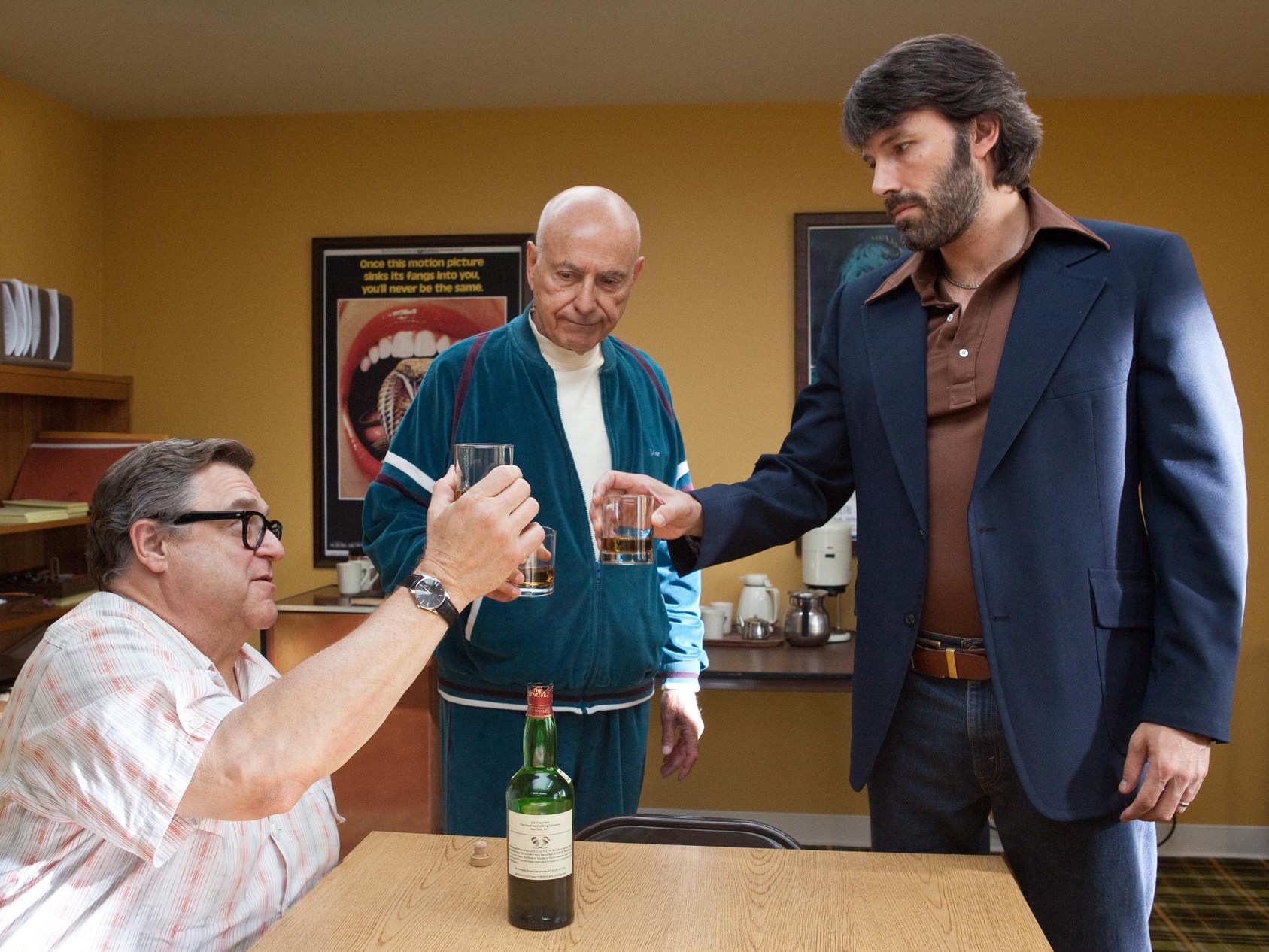
It was a stroke of dumb luck that six U.S. ambassadors escaped from the embassy in Tehran, secreting themselves away under the floorboards of the Canadian ambassador’s home. Extracting them would be no mean feat, but then, extracting people from high risk areas is what Tony Mendez (Affleck) is an expert at. Competing against a litany of dud proposals at the CIA, Mendez gets the green light to pass the six escapees off as the crew of Canadian filmmakers in Teheran scouting for exotic locales upon which to stage a low budget Star Wars ripoff, Argo. In this, he is aided by producer Lester Siegel (Alan Arkin) and make-up artist John Chambers (John Goodman), who are as skeptical as Mendez’s supervisor (Bryan Cranston) about the odds of the mission’s success, but are willing to make some magic.

Argo is all about prep-work, spending most of its time showing the set-up of the dummy Hollywood studio and Mendez’s preparation of the six escapees. Setting up the studio isn’t hard, but there’s an element of human error in crafting new identities for six scared human beings. Should one of them slip, they’ll all be killed. Mendez gives his charges fake passports and a folder full of false information and tells them to memorize all of it. Meanwhile, in the occupied U.S. embassy, an army of child laborers are at work finding and assembling stacks of shredded, confidential documents, among them the proper identification of the six people missing from their group of hostages.

Argo works just fine as a race against the clock, but is undermined somewhat by the reality behind it. Though Mendez and his team’s “location scouting” trip to an Iranian bazaar is fraught with tension, it’s the only moment in the movie where things aren’t too easy for all involved. The situation is dangerous because Affleck and screenwriter Chris Terrio say it is, and because the men and women trapping our Americans in an alleyway are dark-skinned and yelling in another language.

The Hollywood element also fails to rise above reality. As good as Arkin and Goodman are, their characters are Los Angeles stereotypes: gruff, likable cynics who wink and nod their way through press events and production meetings without really adding much to the narrative. Like The Town, Affleck’s 2010 ensemble crime movie that enjoys a popular consensus much more favorable than is merited, Affleck takes a situation imbued with a grey sense of morality and casts it in stark black and white. If The Town suffered because Affleck tried to make a paragon out of bank robbing liar Doug MacRay, Argo suffers because the Iranian Revolution is merely the backdrop for a spy thriller, its antagonists more zombie than human. The Iranians here shout, grope, and carry automatic weapons, but they’re still only obstacles for the shepherd to lead his flock around.

2012 was a year that saw plenty of movies released that, in one way or another, involved the moral ambiguity of deep cover spy operations. All of them, even The Avengers, had more to say on the subject than Affleck’s film. The vast majority of investigative reporting here is done by the great newsanchors of the day, and while Good Night, and Good Luck (directed by George Clooney and written by Grant Heslov, who produced Argo) showed to tremendous effect the greatness to which the American media could rise and the darkness the American government is capable of wallowing in, Argo is just fine celebrating the success of a high-stakes gambit. Even more than Zero Dark Thirty, Argo posits itself as a feature length infomercial for the CIA, telling us that there are good guys and bad guys, and that the good guys listen to Led Zeppelin and worry about their kids back home. It’s finely done and entertaining enough, but certainly is not a film made for our jaded, information-glutted time.

Rating: 

Argo. With Ben Affleck (Tony Mendez), Bryan Cranston (Jack O’Donnell), Alan Arkin (Lester Siegel), John Goodman (John Chambers), Tate Donovan (Bob Anders), Clea DuVall (Cora Lijek), Christopher Denham (Mark Lijek), Scoot McNairy (Joe Stafford), Kerry Bishé (Kathy Stafford), Rory Cochrane (Lee Schatz), Victor Gerber (Ken Taylor), and Kyle Chandler (Hamilton Jordan). Directed by Affleck and produced by Affleck, Grant Heslov, and George Clooney. Screenplay by Chris Terrio, based on the books “The Master of Disguise” by Antonio J. Mendez and “The Great Escape” by Joshuah Bearman.

Movie Review: Red State (2011)

Throughout my educational career, I’ve managed to frustrate many instructors—most of them smarter than me—who liked me, who liked talking to me, who liked my work, but ultimately had to give me a grade lower than what I was capable of. My mom, she’d drive 40 minutes from the suburbs to Detroit and stand in line patiently to speak with one of my teachers, just to be told that I was failing to live up to my potential. There was much hand-wringing; all of it justified. What do you do with potential that refuses to realize itself? That’s a question you could ask of Kevin Smith, whose Red State represents the first film of his that’s free from the yoke of an overseer. It comes close, very close, to being his first film as a mature artist, but ultimately fails to live up to its potential.

This can be said of most of the movies Smith has done since Clerks, which was a great first feature, a great independent comedy, but established the director as a maestro of dick jokes and Star Wars references. Chasing Amy was close to greatness, but for its solipsistic treatment of sexuality. Dogma came close, but couldn’t walk away from Jay and Silent Bob. Clerks 2 refused to grow up. After the failure of Cop Out, Smith threw up his hands and declared himself done with the mainstream. He was going to make a movie his way, on his terms, and thus we have Red State, which has few comedic elements and manages, at times, to be one hell of a gripping movie. Instead of being a platform for Smith, whose rabble rousing about the state of Hollywood and the width of airline seats has not gone unnoticed, it ends up being a scene-stealer for two old hands—Michael Parks and John Goodman—who dance around Smith’s weaknesses and deliver two of the more compelling performances of the year.

To get there, however, we’ve got to get through some stuff about a trio of high school dudes who want to hook up with a chick in her trailer. None of the teens are really that important, save that they’ve got great names (Billy-Ray!) and some of the worst movie hair I’ve seen in a long time. If Red State is a horror movie, then it is very much a Dead Teenager sort of horror film, where the teens don’t count for much beyond cannon fodder. They debate whether or not sleeping with the same woman in succession is a “faggoty” endeavor, but are off on their merry way to meet a woman named Sarah (Melissa Leo), who isn’t quite what her online profile picture indicated. In short order, the boys are knocked out and taken to a compound belonging to the Five Points Baptist Church, headed by Pastor Abin Cooper (Parks).

Five Points: They’re a lot like the Westboro Baptist Church in that they protest funerals (including “that dead pope’s funeral in Italy”), but their extremism is taken, well, to the extreme. They aim to entrap fornicators, philanderers and homosexuals, torturing and killing them in the name of the Lord. This’d be entirely ridiculous were it not for Parks, who delivers his film-dominating sermon with such conviction that the existence of a guy like Abin Cooper is nothing short of plausible. His congregation of sons, daughters and grandchildren are enthralled by his routine, responding to his every call, exalting his words, laughing as he moons around the pulpit. He’s a charismatic guy, and charisma’s really all you need. Worse though, he’s a charismatic guy on the lunatic fringe, which is what makes him dangerous.

After an altercation with the police (including, as the chief, the underutilized Stephen Root), the ATF are called in to search the premise for illegal weaponry. The point man on the operation is Special Agent Keenan (Goodman), who is caught off-guard when Cooper and his clan open fire from the compound. Once he radios in this situation, he’s given an order he struggles with: The complete destruction of the Five Points church. Though the film rushes through it, Goodman is good in the ensuing firefight, as is Parks, but both men are at their best when the gunfire is quiet and both are allowed to speak. Like Dogma, Red State is a film dealing with the dangers of belief. Red State is much more ambitious than Dogma, however, as it’s clear how much Smith fears what our beliefs can drive us to do. The Armageddon of Red State is intense, personal—it is not an apocalypse of loopholes, and Goodman’s character finds nothing funny about a group of nutjobs willing to turn machine guns on the society that mocks them.

But the movie itself does. Maybe it’s necessary to laugh at Abin Cooper’s demise, to see him brought low. If that’s what we, as an audience, need to bring closure to the film, then fine, Cooper’s a fine boogeyman-cum-fool. I’d like to think, however, that we’re smarter than that, that we can deal with and rationalize Cooper without the film reaching for obvious jokes. People like Cooper are, in conversation, legitimately scary. Sometimes it’s nice to laugh off fear. Sometimes it’s better to be scared. Given the continuing radicalization of American discourse, often upon religious lines, I think the latter would have been more effective. For now, that seems like a road Kevin Smith is averse to traveling on.

Rating:

Red State. Directed by Kevin Smith. With Michael Parks (Abin Cooper), John Goodman (Special Agent Keenan), Melissa Leo (Sarah Cooper), Stephen Root (Sheriff Wynan), and Kerry Bishé (Cheyenne). Released September 23, 2011, by Lionsgate.