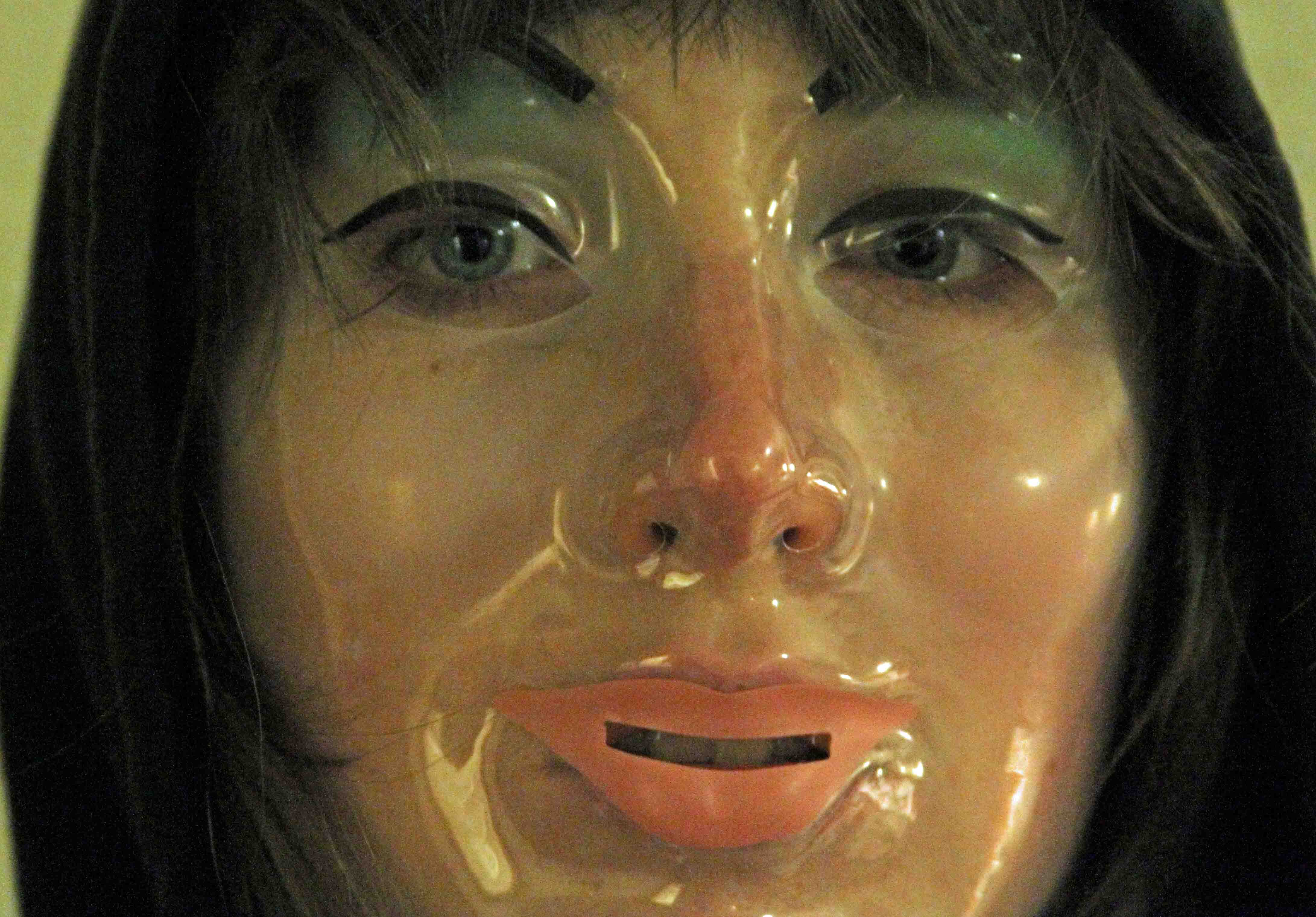
V/H/Sis a horror anthology presented as one complete story, the tale of a gang of thugs who break into a house to recover a specific video cassette for an unidentified employer. They break into a seemingly empty house, scouring it for the cassette, and make two discoveries: a pile of tapes in the basement, and a room with a dead body slumped in a chair. The dead man has apparently been watching some cassettes, so one member of the crew is tasked with watching what’s already loaded into the VCR. Like a child invoking the Candyman in the bathroom mirror, the thought of pressing play and glimpsing whatever the dead guy watched proves irresistible, and, thanks to a cadre of tapes directed by a constellation of indie horror filmmakers, the loop binding together this anthology is closed. Not logically, and not so far as it bears on the plot of the wraparound feature, but it’s closed.
The nicest thing I can say about V/H/Sis that it proves that the horse franchises like Paranormal Activity and [rec] (not to mention Chronicle and any number of cheaply made riffs on The Exorcist) have taken to beating isn’t quite dead yet. There are a number of good, inventive uses of the handheld camera here, a few new tricks to a genre that’d practically exhausted itself with The Blair Witch Project, but they’re all put to middling use. A spy camera hidden in a pervert’s glasses, a paranormal plot that’s carried out mostly through ongoing Skype conversations, a killer who appears on film as a glitch—these are nice gimmicks, but they don’t exactly lead horror—first person or otherwise—anywhere new or exciting.
The segment that comes closest to breaking new ground is Ti West’s “Second Honeymoon,” which is perhaps most like a full length found footage horror movie in that the majority of it is comprised of filler—the “umms” and “ahhs” of a couple roadtripping out west to rekindle their flame. As obvious as this seems, the difference here is that “Second Honeymoon” is only twenty minutes long. Those “umms” and “ahhs” aren’t filler, but are essential in building the couple as some sort of unit, their disagreements hinting at the problems they’ve set out to overcome. Thinking of how much time is wasted in the typical full length setting up the cameras and explaining to the future victims how that rig is going to definitively prove that the house they’re occupying is haunted, “Second Honeymoon” is perhaps the first horror movie about people with cameras that show those people using their cameras as real people would. That it relies on a big, shocking twist is a little cheap, but manages to encourage a second viewing.
The same can’t be said of the rest of V/H/S‘s segments, the shocks and reveals of which are fairly stock. David Bruckner’s “Amateur Night” was singled out as the best of the bunch by The A.V. Clubbut one needs only to observe the strange, quiet girl a group of dunk, high dudes take back to their hotel room to know that she’s literally a maneater, and the “glitch killer” of “Tuesday the 17th,” cool as he sounds, is a slasher killing horny teens in the woods with a knife. “10/31/98,” which sends a group of dudes to an abandoned-looking house they think is first the site of a party, then the sight of a pretty cool haunted house attraction, manages to mash together the beats of a feature-length haunted house yarn into a compact, compelling short feature, but, like its cohorts, is let down by its ending, a bit of lazy storytelling employed by filmmakers who ran out of steam once they let the protagonists out of the house.
In terms of sheer bugfuck weirdery, Joe Swanberg’s “The Sick Thing That Happened to Emily When She Was Younger” takes the cake, presenting itself first as a straightforward haunted apartment scenario before barreling into uncharted territory without pausing for the benefit of those unable to divine Swanberg’s scant signs and portents. “The Sick Thing That Happened,” despite its obviously low budget, contains within it elements of body horror and psychodrama, the webcam cinematography gleaning some genuine tension from a student apartment distinguishable from every other such apartment by how nice and clean it is. The reveal doesn’t quite work in terms of shock—the relationship between the girl and her doctor-in-training boyfriend works best when they’re talking to each other—but it paints the boyfriend in an interesting, unflattering light, casting “The Sick Thing That Happened” as a story about male-female control, with some creepy ghost kids thrown in as a kicker.
For whatever bumps and jolts the individual segments contain, the only uncomfortable moment in V/H/Scomes early in the wraparound, when the gang who eventually break into the house film themselves sexually assaulting a woman in a parking structure. There’s a lot of sex in V/H/S, which is perhaps de rigueur in the genre-at-large, but there’s a cold, septic nastiness to the way the men in this film treat women. The “top-sharking” jerks in the wraparound, the drunken leches who plan to film themselves having sex with women they’ve gotten too drunk to function, the husband who pleads with his wife to allow him to film them having sex—the only people who aren’t fooling themselves here are the horny teenagers, who claim to be exactly what they are, and the dude talking to his girlfriend on Skype.
It’s tempting to claim that the sex and sadism in V/H/Sis a comment on the way men look at women, but it’s no good to just say “men are douchebags” without the sexual tension resolving in any meaningful way. In fact, the women here are deceitful, obsessive banshees in their own right, letting the “nice guy” of the group off any kind of guilty hook because he never managed to get his dick out of his pants, leading her friends into a situation she knows is dangerous, and otherwise “justifying” every untoward act of male sexual aggression. Ugliness is something I have no real issue with, but the ugliness of V/H/Sis so often unaddressed that it bears wondering what’s meant as message, and what’s meant merely to titillate. The two segments that best address their male/female dynamic—”Second Honeymoon” and “The Strange Thing That Happened”—happen to be the best of the anthology, with “10/31/98” serving as the outlier that doesn’t fit the de facto theme. It’s a shame, then, that “Second Honeymoon” ends up pandering to the pud-pullers in the audience. Those five seconds may just be the strongest indication of where the anthology’s head is at.
V/H/S. An anthology directed by Adam Wingard (“Tape 56”), David Bruckner (“Amateur Night”), Ti West (“Second Honeymoon”), Glenn McQuaid (“Tuesday the 17th”), Joe Swanberg (“The Sick Thing That Happened to Emily When She Was Younger”), and Radio Silence (“10/31/98”).
In WWE, the episode of Monday Night Raw before a pay-per-view is colloquially referred to as the “go home show,” the company’s last opportunity to embellish the storylines going into the weekend’s big matches. For me, that description has never worked for any episode of Raw besides the one before WrestleMania, which is, of course, the show, the one that events like this Sunday’s Hell in a Cell serve as a pyrokinetic PowerPoint presentation for, building up a year-long resume for the evening’s stars before the Monday after WrestleMania, where everything resets in order to build up to next year’s show. Regardless, this is the internet, and once nerds like me catch glimpse of phrases like “go home show,” every episode of Raw is evaluated not in terms of entertainment or plot, but in terms of how well it sells the upcoming pay per view.
On that level, tonight’s episode of Monday Night Raw was a puzzling mishmash of bizarre elements, the WWE’s signature brands of comedy and mock seriousness colliding with the otherworldly realness of “Best in the World” C.M. Punk and angry, glowering giant The Big Show. As a sales pitch, Raw is perhaps shackled by the fact that Hell in a Cell offers as its main attractions three first-time encounters in an environment that calls for the end of long-standing beef, but in the business of live, active entertainment, you deal with the cards you’re dealt, and the WWE had been given fan indifference in the face of another Sheamus/Alberto Del Rio encounter, and an injury to John Cena just as his feud with C.M. Punk began hurtling towards finality. The lead-in to Hell in a Cell and the pay per view itself have felt like a shuffling of the cosmic deck. Substituting for John Cena is Ryback. The Big Show has been called in as an audible for Alberto Del Rio. A tournament led to the establishment of a tag team division so that one new tag team could battle another over the tag team championships. This Sunday promises a few return bouts—Kofi Kingston vs. The Miz, Alberto Del Rio vs. Randy Orton, Eve vs. either Kaitlyn or Layla, and perhaps Antonio Caesaro vs. Justin Gabriel—but despite how good those match-ups have proven to be (Kingston/Miz and Caesaro/Gabriel have been pleasant surprises, as has Eve’s run as queen jerk of the WWE Divas), they’re afterthoughts to the ongoing championship reigns of Sheamus, Punk, and Team Hell No.
Stacked up against a presidential debate, Monday Night Football, and Game 7 of the NLCS, the approach taken to building these confrontations, with the exception of Punk/Ryback, played like the WWE’s oft-belittled writing staff throwing everything at the wall to see what sticks to the pre-match hype video. The prime example of this ethic is the story between Team Hell No and the Rhodes Scholars, a feud that’s been simmering since before Cody Rhodes and Damien Sandow won the tag team tournament, way back when WWE let the fans christen Daniel Bryan and Kane “Team Hell No,” as opposed to the meme-worthy “Team Friendship. On the good end of this feud, Daniel Bryan and Kane both had and lost matches due to one dynamic of their partnership or the other: Bryan’s insecurity and Kane’s goofing around in the case of the excellent Bryan/Dolph Ziggler contest, and the Rhodes Scholars vulture-like mentality during Kane’s umpteenth encounter with The Big Show. Less impressive was WWE’s spin on The Newlywed Game, which promised a game of wits between the two tag teams and, instead, served as a platform for WWE afterthought Matt Striker to wish harm upon Team Hell No before getting chucked across the stage by The Big Show. The WWE has oddly succeeded with bits of anti-comedy like this before—as proof, look up their version of The Price is Right—but The Newly Tag Game, awkward name and all, was executed like something thought up on the fly and scratched during the commercial break. Luckily Rhodes Scholars closed out the tag team tournament with a strong match against Rey Mysterio and Sin Cara, so there’s still plenty off intrigue.
This schizophrenic approach has also permeated the issue between The Big Show and Sheamus, but to better effect. Sheamus is an interesting fellow, a big, tough, amiable champion who has grown leaps and bounds in the ring but whose reliance upon broad-stroke comedy has ranged from awkward (Irish stereotypes) to uncomfortable (Mexican and Jewish stereotypes). Against The Big Show, Sheamus has employed a simpleton’s logic: Daniel Bryan beat the big man 45 seconds into his reign as World Heavyweight Champion, Sheamus beat Daniel Bryan in 18 seconds at WrestleMania, therefore the outcome is clear. He’s joked around with Show, grappled with the futility of his Brogue Kick finishing maneuver against a man much taller than any of Sheamus’s prior opponents, and generally goofed around as The Big Show glowers, punches things, and reminds Sheamus that he’d best be serious if he stands a prayer of retaining his title. Tonight, in a clip that’ll just kill me if it sees any further airtime, Sheamus shilled his new Brawlin’ Buddy toy, which was quickly punched across the state line by The Big Show. Luckily, Show’s involvement in Sheamus’ lumberjack match against C.M. Punk did the job of building towards this Sunday’s championship bout.
Speaking of the lumberjack match (and I’ll probably speak more about it this weekend, as the “Wrestling Worth Watching” feature returns to cover individual matches from the week in a way that’s not appropriate in a regular review), it was billed as the largest such match in history, boasting some three dozen men surrounding the ring. I didn’t count them, but that sea of humanity was there for one reason: to part like the Red Sea before an incoming Ryback. It was an impressive image, the WWE Universe vacating one side of the ring to make way for the challenger to C.M. Punk’s title, and Punk’s attempt to get away from Ryback, only to be fed back to the ring by a cadre of good guys for one of Ryback’s impressive power moves, begs the question of what will happen when the two face each other in the cell, which is exactly the question the WWE wants you to ask.
What they don’t want you asking, hence the reshuffling of the deck, is why, exactly, John Cena gave up an opportunity to face Punk mere weeks after insisting, sling and all, that Hell In A Cell was the only way for C.M. Punk to validate his lengthy WWE Championship reign. While serving as Ryback’s cheerleader, Cena wound up being interrupted by Punk, who (in typical heel fashion) claimed it was evidence that Cena had come around to Punk’s overall superiority. Not so, said Cena. He just wasn’t medically cleared. It was incredibly confusing—Cena advocating one moment for the change Ryback represents, then claiming he only did it because he wasn’t cleared—made more confusing when Cena flexed his mighty arm, touting that he’d been cleared and was ready for a fight right-the-hell-now. Naturally, the match didn’t happen (Paul Heyman to Punk: “You don’t fight for free!”), and Cena was quickly called elsewhere, his presence for Hell In A Cell’s main event no longer required.
That “elsewhere” happened to be the ongoing saga of A.J. Lee, the WWE Diva who went from nerd-baiting background occupier to the most popular woman in WWE not named Kelly Kelly to oddly-written authority figure through a dizzying array of personal relationships, uncalled for attacks, and strange business decisions. This week, before her home town (never a good place for a wrestler to be, C.M. Punk excluded), she unceremoniously resigned from the post of Raw General Manager amid rumor that she’d been fraternizing with the boys in the back, namely one John Cena. A.J.’s resignation was one of the more odd, strangely affecting segments in recent WWE history, a curious mix of A.J.’s real history and the bizarre turns her storyline had taken. With her thanking the fans and hugging Vince McMahon (nobody hugs Vince McMahon!), it was a moment simultaneously real and unreal, something that could either go nowhere or herald A.J.’s long-awaited reentry in the Diva’s division.
Instead, she’s now caught up in an alleged affair with John Cena, who has made a habit of appropriating elements of other wrestler’s storylines. After WrestleMania, it was Cena who went against C.M. Punk’s sworn enemy Johnny Ace. It’s Cena who’s taken to the occasional “YES!” or “FEED ME MORE!” chant. And now it’s Cena with A.J., a woman who once carried the promise of being the WWE’s first autonomous female character who now finds herself loosely tied to the affections of another of the WWE’s titans of masculinity. Cena’s constant refrain—he and A.J. had nothing more than a “business dinner”—was as inauthentic as the thought of his being romantically entangled with any of the WWE Divas, and heaps an unnecessary amount of drama onto the role of General Manager, a position that’s best when the character occupying it is conniving and sly, or otherwise invincible. Sure, there are other elements to the story, and Cena needs something to do until his elbow is fully recovered, but none of those elements are clicking, and this isn’t it.
Rating: Stray Observations:
I mentioned it in the post, but the feature “Wrestling Worth Watching” will be returning this week, sometime after the conclusion of Hell In A Cell. There’s a vast difference between the narrative structure of a television show and the merit of an individual wrestling match. Of note here, for the interested: Rhodes Scholars vs. Sin Cara and Rey Mysterio, Dolph Ziggler vs. Daniel Bryan, and the C.M. Punk vs. Sheamus lumberjack match.
Daniel Bryan, on Kane: “You love rainbows!”
Bryan’s reaction to winning The Newly Tag Game was great, a return to his bombastic celebrations as World Heavyweight Champion, but the crowd just wasn’t buying the segment.
Efficient. That’s Steven Soderbergh‘s Haywirein one word. These days, it’s nothing for a thriller to hop around the globe, to squeeze in swerves and car chases, to fashion for themselves a superhuman killing machine. Haywire does these things as well—if not better—than its contemporaries, but its pace is ruthless, breakneck. At 92-minutes, there is no fat on its bones, and no queasy-cam gimmicks, either. When Haywire stops to take a breath, it’s only to show how tightly the net around its heroine is constricted.
Malory Kane (Gina Carano) is our superhuman, the focus of a plot that aims to take her out. As Haywire opens, shes sitting in a cafe in upstate New York, sipping tea. Before she has time to finish her cup, she’s locked in a brutal fight with Aaron (Channing Tatum), a man she worked with on a project in Barcelona. A good samaritan (Michael Angarano) hands her the keys to his car, and the two speed off for Parts Unknown, Kane narrating her story to the mostly terrified teenager. The story is simple enough. Kane’s a contractor who works for a private firm that governments hire out to glean information, recover lost assets, rescue dissidents—spy business. She’s requested to be a member of a team extracting a hostage from Barcelona. Her boss, Jeremy (Ewan McGregor), is hesitant at first, but when his employers—U.S. governmental employee Alex Coblenz (Michael Douglas) and Rodrigo (Antonio Banderas), a man with no specific origin—agree to certain contractual details, Kane is put on the case, the hostage is rescued, and all is well. Or so it seems.
It happens that Jeremy’s business is wholly reliant upon Malory Kane and that, after the dissolution of their personal relationship, Kane is looking to get out of her business obligations with him, as well. First, he gets her to agree to an assignment that’s pretty much a “paid vacation,” a chance to persuade an agent to join Jeremy’s team while at the same time making contact with that agent’s mark under the guise of being a power couple. That agent, Paul (Michael Fassbender), has been assigned to kill the hostage Kane rescued, plant evidence on the body pointing to Kane, then kill her, making it look like an act of self-defense. Simple enough, except that Kane ends up killing him and going on the run, making her way back to the United States to clear her name, uncover the conspiracy against her, and gain a measure of revenge.
Haywire‘s frequent action set pieces are engaging, covering all the bases. Across rooftops, on foot, and behind the wheel of a car, it’s clear that there’s nobody like Malory Kane, who, when she is brought down, succumbs only to the sheer number of people set against her. Soderbergh’s films, regardless of how kinetic they often feel, rarely move like Haywire, which has a fluidity and clarity of vision rarely afforded to a typical thriller. There’s an effortless cool to the way he films Carano chasing down her prey, jumping from roof to roof, and employing her dazzling array of mixed martial arts maneuvers.
Speaking of Carano, this is her first feature film, though it would be surprising were this to prove her last. Carano is granted quite the set of crutches in Haywire: she’s guided by McGregor, Douglas, and Bill Paxton (as Kane’s father), prodded by Banderas, and romanced by Fassbender and the great lunkhead Tatum, who, given this filmand his self-effacing turns in 21 Jump Street and Magic Mike, is perhaps smarter than anybody has yet to give him credit for. Though she sometimes looks out-of-depth when standing across from somebody the caliber of Michael Douglas—it’s worth pointing out that whatever charisma she possesses has, thus far, only been used in brief flashes during pre- and post-fight interviews and press conferences—she mostly holds her own.
It helps that Soderbergh is a director who’s proven masterful at identifying and exploiting the strengths of his cast. The choice of Carano in this role is no less unusual than, say, his choice of Sasha Grey as an escort, and Carano’s fighting skills are put to good use here, the reality of maneuvers like the cross armbreaker and the triangle choke only further embellishing the punishment she deals out. Tatum’s character has his arm broken in Haywire‘s opening sequence. Watching Carano swiftly grab his arm and snap it back, it’s little wonder that Tatum later appears in a cast, arm hanging useless at his side. Here, it’s the little flourishes of realism that matter, that paint Carano as a budding star as opposed to a neat little stunt casting. Like her character, it’s clear that Gina Carano can do things no other actress is capable of. So long as she avoids becoming a female Expendable, her presence in the genre can only change it for the better.
Haywire. With Gina Carano (Malory Kane), Channing Tatum (Aaron), Ewan McGregor (Jeremy), Bill Paxton (John Kane), Michael Fassbender (Paul), Michael Angarano (Scott), Antonio Banderas (Rodrigo), and Michael Douglas (Alex Coblenz). Directed by Steven Soderbergh from a screenplay by Lem Dobbs.
In the year since C.M. Punk—on temporary hiatus from WWE but serving both as the company’s champion and its most talked about figure since the height of the late-90s Attitude Era—christened him as being “fucking awesome,” Gregory Iron has been called an inspiration so many times the words have lost their meaning. Iron, a six-year veteran of professional wrestling, does the same things many men and woman scraping out an existence in independent wrestling do. He trains. He takes brutal road trips for bookings that don’t pay much. He has learned to shoulder nights of physical abuse before a paying crowd. Iron does these things exceptionally well, insisting that he is no different from any other professional wrestler, but he does them with one crucial difference: he suffers from cerebral palsy. His right arm is withered, his range of motion is nowhere near that of your typical wrestler, and he’s had to adapt many of wrestling’s most basic maneuvers to work through his limitations. In short, that Gregory Iron excels at something most able-bodied human beings fail at is incredible.
But, in an industry that’s been around as long as wrestling, that a skilled competitor would come along with a severe disability isn’t exactly new. In fact, Iron has wrestled against and partnered with perhaps the most famous such individual in wrestling, Zach Gowen, who lost one of his legs at a young age to cancer and went on to an improbable run on WWE television where, every week, he was involved with titans like Hulk Hogan, “Rowdy” Roddy Piper, Vince McMahon, and Brock Lesnar. Iron has dreams of reaching World Wrestling Entertainment and has tried out for them in the past, always with the same response: “Maybe next time.”
So Iron continues to grind, sacrificing his weekends and logging endless hours on the road to work for outfits like CHIKARA, Absolute Intense Wrestling, PRIME Wrestling, and Chicago’s AAW. Iron’s moment with C.M. Punk, as described by Colt Cabana on his popular Art of Wrestling podcast, was a mitzvah, a celebration of somebody who’d officially made it. Punk’s speech, the parade he and Cabana gave Iron around the ring, the standing ovation from the crowd, all of it was a gift, a springboard from which Iron could launch a bigger, better career. In short order, the video of Punk, Cabana, and Iron went viral on YouTube. Features on him appeared on ESPN and Sports Illustrated‘s websites. A story about him from a Cleveland television station won an Emmy. He was a guest on FOX News Network’s Fox and Friends.
For an independent wrestler, this level of coverage was unprecedented. Buoyed by his new-found semi-fame, Iron launched a social media campaign where he lobbied for inclusion in the WWE’s annual Royal Rumble event, a battle royal that typically features anywhere from 30-40 wrestlers, including past favorites who aren’t on the regular WWE roster. Needless to say, Iron didn’t compete in the Royal Rumble, though there’s certainly a possibility that he will. To Iron, signing a WWE developmental contract would be the fulfillment of a life-long dream, something he’s wanted since his grandmother introduced him to the exploits of Hulk Hogan, but in 2011, with the eyes of the wrestling world upon him, it wasn’t meant to be. This, however, is not the story of a dream deferred. It’s the story of a curious side-effect of Iron’s quest, that fans in his hometown of Cleveland would look at Greg and his accomplishments and do the unthinkable: boo him out of the building.
Wrestling is not without its share of unusual villains. Greg’s hero, Hulk Hogan, lectured his fans on the importance of training, praying, and eating vitamins for a decade before turning his back on a legion of Hulkamaniacs, and many diminutive ex-WWE superstars—Gowen among them—continue to ply their trade in bingo halls and National Guard armories as brash, cocky egomaniacs, indignant that they’ve been “reduced” to wrestling in a high school gymnasium. Iron is unique among wrestling’s unusual heels in that he was forced into his villainy by a fan-base that rejected him and sided with his tormentor, Iron’s teacher-turned-bully, Josh Prohibition.
To understand fan indifference to Gregory Iron is to understand the atmosphere of your typical Absolute Intense Wrestling event. Here is a crowd that cheers for the high-flying, hard-working exploits of Johnny Gargano, who laugh along with the practiced comedic flow of a Colt Cabana contest, who lust for the blood of hardcore legends like Madman Pondo, but, when given a feel-good, hometown story like Iron’s, are unreceptive to the point that it bears asking if wrestling’s Crippled Crusader personally wronged them. In wrestling terms, Cleveland ranks as a “smart” crowd, but to listen to them debate wheather or not the participants in a no-holds-barred death match employed the use of enough fluorescent light tubes is to wonder if the Cleveland audience is too smart for its own good. Their attitude certainly contributed to the weird atmosphere during Iron’s “Dream Tag Team” match at last year’s Nightmare Before X-Mas 5, where Iron and hand-picked partner Cabana—mere weeks removed from Iron’s christening in Berwin, IL—took on Prohibition and his dream partner, “M-Dogg 20” Matt Cross. The storytelling of that match was exceptionally clear. Prohibition, already a bully, sought to ruin Greg’s good story by calling on his friend Cross, reforming a tag team from pornographer Rob Black’s doomed XPW project. To make matters worse, Cross had just recently attempted to break into WWE by participating in its Tough Enough reality show, getting eliminated early despite a decade of experience because he didn’t show enough flash. No matter. Cross and Prohibition—otherwise known as Youthinazia—are Cleveland-area legends and were cheered as such. Colt Cabana, ever the crowd favorite, was showered with applause. Gregory Iron, in a theme that remained constant for many of his AIW appearances in late 2011 and early 2012, was heckled mercilessly by the crowd. He and Cabana lost the match. What was slated as a Dream Tag Team Match was, for Iron, the beginning of a long, puzzling nightmare.
Though many experts and insiders point to wrestling as a cyclical business—something that’ll be around regardless of popular favor or the economy—wrestlers live by a singular creed: adapt or die. This applies to all facets of the wrestling business. If an injury robs a high-flying luchador of his speed and agility, he must adapt. If a big company goes out of business, the community must adapt. If the crowd in a certain building doesn’t like you, you either adapt or are swiftly run out of town. Parallel to the case of Gregory Iron is that of Dwayne “The Rock” Johnson, who made his World Wrestling Federation debut in 1996 under the name “Rocky Maivia,” a tribute/cash in on the legacies of his father, “Soul Man” Rocky Johnson, and grandfather, “High Chief” Peter Maivia. Everything about Rocky Maivia screamed “babyface,” from his clean-cut hair to his beaming smile to the tassels adorning his gear. The WWF was on the verge of seismic change, much of which happened on the shoulders of Dwayne Johnson, but in 1995 they were still a few steps behind their audience, who did not take well to the future smiling star of Hollywood blockbusters, mercilessly chanting “Die, Rocky, die!” in arenas across the country. Maivia eventually turned on the crowd, spoke of himself in third person, adopted the nickname “The Rock,” and spurred the Attitude Era, becoming arguably the most popular wrestler of all-time. On May 11th this year, taking the microphone after losing to a wrestler named Ophidian in the first round of the J.T. Lightning Invitational Tournament, Greg was looking to do something much smaller, but no less noble, than The Rock: he was looking to turn fan attitude against him into a positive. He was looking to stick in Absolute Intense Wrestling.
Iron’s tirade that evening was a classic bad guy promo, its vitriol towards the audience couched in truth, much like the classic heel lectures of Cactus Jack in ECW, Steve Austin in 2001, and the C.M. Punk currently on television every week. As Cactus Jack, Mick Foley once intoned that “wrestling will never be respected,” the obvious offshoot of that being that professional wrestlers, too, would never see the respect they deserved. Foley’s revelation came to him in a hospital room in Germany, where a nurse threw a piece of his ear into a garbage can while laughing about wrestling’s public image as a theatre of the fake and bizarre, never mind the lump of disembodied flesh in her hand. Iron’s was much more public—a group of like-minded people who previously cheered him screaming “Fuck you, Greg!” and worse during his every appearance—but the common thread linking Iron to Foley, Austin, and Punk—respect—is no less powerful because an odd subsection of wrestling fans congregating in one city have chosen unilaterally to hate his guts. Iron’s a man who got the crap kicked out of him by J.T. Lightning, Prohibition, and others far beyond the point when most members in the audience would have quit. He’s suffered debilitating injuries, nearly died for the sport that he loved and participated in, often for no money. In short, Iron’s a man whose dues, cerebral palsy or not, were paid long ago; who are you to tell him otherwise?
Before that evening, had you voiced your doubts about the ability of a crippled wrestler to turn full-blown megalomaniac, you wouldn’t be alone. In wrestling, everything’s a gimmick: a cocked eyebrow, a blown knee, a punishing disease. On The Art of Wrestling, Iron acknowledges that cerebral palsy, like the t-shirts he sells at shows, is something that he’s used to get noticed. Considering Punk, considering his bookings in Chicago, Michigan, New Jersey, and New York, it’s worked. Sure, Iron has talent, but cerebral palsy’s a kicker, something most people haven’t seen in wrestling before. When Iron says that he doesn’t want his affliction to be a crutch, he means it. One only needs to witness his springboard somersault splash—a move he uses utilizing his shins, rather than his feet, as is customary—or the way he’s been suplexed, kicked, and piledriven by much larger men to realize that Iron is very much a wrestler’s wrestler. There are no easy paydays for him. But his disability has been the fous of Iron’s run in CHIKARA, the point of his feud against Zach Gowen in PRIME, his good humor and determination in the face of such an ailment engendering sympathy where an otherwise healthy wrestler of his size and skill is perhaps looked over by a shrewd promoter or tired crowd. It’s something Iron realizes has a limited shelf-life—both in the independents and should the WWE come calling—something he’d eventually need to shed or use differently to truly succeed.
In Absolute Intense Wrestling, Iron is using his cerebral palsy as a tool to further provoke an already incensed crowd. He’s also using the notoriety gained from Punk and Cabana to stoke the AIW audience’s hatred of him. Referring to the pair as “Phil and Scott,” Iron makes a show of the things he’s accomplished without the use of his right arm. He’s smashed the glasses of a contest winner, assaulted a fan, and has turned to the legal advice of fellow wrestler, Veda Scott. Scott’s another wrestler who has achieved tremendous success despite the obstacles placed before her. She completed her training at the prestigious Ring of Honor wrestling academy and began touring the United States while pursuing a law degree, taking on an unfathomably busy schedule despite the rather limited set of opportunities given to women wrestlers at both the national and independent level. (Recently, a number of articles have questioned if there are too many promotions featuring mostly or exclusively women’s wrestling, something that’s never been asked its male counterpart.) On Ring of Honor television, she’s merely the promotion’s interviewer. In most promotions, she’s a snide hipster chick whose disdain for the crowd is palpable. In Absolute Intense Wrestling, she is Gregory Iron’s legal adviser, a concerned citizen with a Juris doctorate who believes that Iron is discriminated against by the company and its fans due to his disability. Not only has Scott won her client regular time on the microphone, but headed into AIW’s last show, she arranged stipulations unprecedented in the history of professional wrestling: by rule, opponents seeking to beat Gregory Iron by pinfall must keep his shoulders to the mat for a four count, a world of difference from the traditional three.
The result of this new rule couldn’t have played out any better for Iron, who took to the microphone at Point Break to challenge Josh Prohibition to one last match to settle their long-standing issue. Despite being jumped, despite the distraction of Veda Scott, Prohibition took control of the contest, obliterating Iron with his Drunken Driver double-underhook piledriver. With Prohibition covering the former Handicapped Hero, the referee counted to three and called for the bell, only to be told by Scott that he had to adhere to the Gregory Iron Rule and count to four. Prohibition, arguing with Scott over the referee’s shoulder, was in perfect position for Iron to pick him off and roll him up for the traditional three count, the AIW fans justifiably upset.
As unlikely as it sounds, he and Scott are the hottest act in the company. Currently without a match at Absolute Intense Wrestling’s Hell on Earth 8, their appearance, along with the promise of a statement by the two, has been advertised, the speculation being that Scott will argue for a title match on behalf of her client. Given their success, the way they’ve steamrolled through AIW’s management figures thus far, it’s hard to see a scenario where Iron or Scott lose their argument, where a crowd that has come to hate Iron goes home happy. Backstage at Point Break, Gregory Iron explains his recent actions to the camera by sarcastically reciting the lyrics to “Real American,” the song that played Hulk Hogan to the ring countless thousands of times. “When it comes crashing down and it hurts to hide,” Iron sneers, “I’ve got to be a man, it don’t help to hide.” The message is clear: Gregory Iron will go on being an inspiration, whether you like it or not.
For weeks now, the narrative of WWE Monday Night Raw has been this: to cement his legacy as an all-time great champion, CM Punk would need to defeat John Cena within the confines of Hell in a Cell, WWE’s steel cage warzone that’s seen its fair share of company defining moments. On one level, this makes sense: many of the company’s top feuds, from The Undertaker’s battles with Shawn Michaels and Mankind to Triple H’s beefs with Chris Jericho and Cactus Jack, have wound up there, and Cena/Punk is certainly worthy. On another, it’s a complete mystery: Punk’s been involved in two Hell in a Cell matches and hasn’t outright lost to John Cena since before last year’s WrestleMania. The cell has mostly loomed in the background as another specter of WWE past, taunting the long-tenured WWE Champion like Bret Hart, Mick Foley, Jim Ross, and Vince McMahon have over the past few weeks. Tonight was billed as the night CM Punk chose between John Cena and Ryback as his eventual challenger, and also as an evening during which Vince McMahon would potentially choose Punk’s opponent. In a move unsurprising to folks who follow injury reports but inconsistent in terms of overall narrative, neither Punk nor McMahon chose who would be stepping into Hell in a Cell, but John Cena, who abdicated the ring and led the audience in Ryback’s chant of “FEED ME MORE.”
This swerve came despite Cena telling Vince McMahon that he was ready, if need be, for the challenge of the Cell. Despite weeks of him telling Punk that respect and a lasting legacy would only be his if he agreed to the match. Obviously, Cena’s elbow is still an issue, but stepping away from a fight he was previously begging for is something completely outside his character, even when he was a white rapper of questionable associations nearly a decade ago. Ryback, fortunately for the WWE, is an able substitute. Listen to the response he gets, even after failing to lift up the monstrous Tensai for his finishing maneuver a week ago. There is no hotter act in wrestling. The only thing the WWE has to fear is that Ryback’s luster is diminished by a loss, or that a championship victory is too much, too soon. It’ll hurt the narrative a little, but not enough to seriously damage Vince McMahon’s unsinkable ship.
Ryback, love him or hate him (I’m a fan), is the best example of the WWE’s seemingly newfound ability to turn its new stars from awkward newcomers into characters worth investing time into over a short period of time. The law of diminishing returns has effectively caused the Funkasaurus to go extinct, but acts like Damien Sandow and Antonio Caesaro have done well for themselves; Kofi Kingston, The Miz, Cody Rhodes, and Sin Cara have gotten a new sense of purpose; and the much maligned Tag Team and Divas divisions have had an energy to them that has been largely absent for years.
A lot of this, oddly, has been a side-effect of Jerry “The King” Lawler’s heart attack and subsequent hiatus from the broadcast position. That night forced play-by-play announcer Michael Cole to drop his evil ways and return to simply reporting on matches, rather than actively picking favorites. He’s been joined at the table by Jim Ross and John Bradshaw Layfield, both of whom are gifted analysts with whom Cole has tremendous chemistry. Layfield was not on Raw tonight, but Ross has a way of connecting with wrestling fans that, as an announcer myself, is both enviable and hard to describe. Cole, sitting beside him, is tremendously effective in making Ross’s points digestible to the WWE’s young demographic. If the aim of broadcasting this format is to make the wrestlers in the ring look as good as possible, few recent matches have befitted as much as the one between Kofi Kingston and The Miz, which was meant to hype a title fight between the two on WWE’s new Wednesday night show. I’ve been disinterested in Kofi Kingston for some time and have never really been a fan of The Miz, but listening to Ross talk about Kingston’s history and Cole put over The Miz’s accomplishments, it really felt like their match meant something. Considering that the issue sprung from an incident where Larry King’s wife through water in The Miz’s face, that’s saying a lot about both the commentary and the match itself.
Similarly, the WWE has found a way to make The Big Show a compelling character again: a disgruntled carnival strongman with a right hand that’s literally lethal, facing down a grinning goofball Irishman whose most compelling argument for success is that a mutual opponent once beat Show in 45 seconds. Tonight, The Big Show demanded to face Daniel Bryan in a match so he could “erase the memory” of his 45 second title reign and handily defeated the WWE Tag Team Champion. The match achieved the dual purpose of establishing Show as a legitimate threat (something that’s proven hard in the past, despite the man’s size) and further gelling the team of Bryan and Kane, the unlikely champions who belittle each other but are growing into a semi-functional unit. The odd man out here is World Heavyweight Champion Sheamus, who would probably be one of my favorite wrestlers were he not involved in a mind-boggling amount of lame sketches that’ve resorted to bullying, racial stereotyping, and grand theft auto, none of which have utilized his natural charisma, nor the size and strength that make him so impressive.
The result of this episode of Raw is that the Hell in a Cell pay-per-view is now much more full, though it remains unclear as to what matches will actually end up in the cage. There’s Punk and Ryback, as mentioned by Vince McMahon, and I presume Big Show and Sheamus will also end up there. Daniel Bryan and Kane may face the winners of next weeks Rey Mysterio/Sin Cara vs. Damien Sandow/Cody Rhodes encounter in Hell in a Cell, but that’d be three first-time matches taking place in a structure formerly reserved for the end of a long-standing conflict.
In this regard, give CM Punk and manager Paul Heyman most of the credit for selling the upcoming show. Punk, as always, has really taken to the role of smarmy jerk, and if anybody deserves to go through the crucible of Hell in a Cell, it’s him. Punk has been through two such matches, as previously mentioned, but neither of them were classics. Paul Heyman, though, was a big part of one of WWE’s best such brawls, a bloodbath between his client Brock Lesnar and Hell in a Cell staple The Undertaker. He may be pivotal two weeks from now, worrying outside the cage as his man stares across the ring at a young challenger with nothing to lose, unheard of momentum, and an unbeaten record. The vitriol aimed at Punk since he attacked Dwayne “The Rock” Johnson on the thousandth episode of Raw crossed into the realm of reality last week, when Punk punched a fan, retaliating to a hostile crowd trying to push him down a flight of stairs. The WWE Universe is out for his blood, meaning that there was no bad choice for Hell in a Cell. If only that choice had followed the WWE’s already established logic.
Rating:
Stray Observations:
Raw General Manager A.J. Lee has become less and less essential to the show since she was given power and granted a last name, but they’re still portraying her as an emotionally unstable woman who doesn’t like the word “crazy.” This resulted in an odd verbal gaffe by Michael Cole, who noted that he shouldn’t “call A.J. the ‘C-word.’” That’s a basic rule of thumb for all women, Mr. Cole.
Vince McMahon’s reply when Ryback said “FEED ME PUNK?” “I’ll take it under consideration.”
Paul Heyman is perhaps the greatest slimeball manager in wrestling history. The way he tries warming up to Vince McMahon while also setting him up for a match against Punk was great. His response to Vince when McMahon said he’d only take a match against Heyman (“That’s not what I pitched! That’s not what I pitched!”) was golden.
I like Wade Barrett a lot, but I can never tell if he has a new theme song, or if they’ve just given him something that bland and generic. Considering how many times they changed Barrett’s music when he was a member of Nexus and The Corre, I wouldn’t be surprised if they just haven’t settled on one generic rock song or another. Entrance music is a big part of professional wrestling (for one, it lets the audience know exactly how to respond the moment a wrestler enters the arena), and Barrett’s considerable mystique would only be enhanced by something recognizable.
Seven Psychopaths is a movie about making movies. More specifically, it’s a movie about writing movies, putting it in the same ballpark as Barton Fink and Adaptation, but with a few crucial differences. Its protagonist, for example, never holds himself up as some great artist, and once he gets into his story, he approaches his characters with zeal, if not a true sense of where those stories are going. Where Barton Fink and Adaptation (and Charlie Kaufman’s Synecdoche, New York, which was technically about a playwright) are darkly comic, psychologically-intense mirrors of the men who wrote them, Seven Psychopaths leaves darkness out of the equation. There’s scores of violence here, buckets of blood and more than a few charred corpses, but never a sense that it’s weighing too heavily on the writer’s mind. He puts pen to paper, unconscious of the fact that he’s part of his story’s tapestry.
To begin, Irish screenwriter Marty (Colin Farrell, standing in for director Martin McDonagh) is struggling to get through the first draft of his new movie, Seven Psychopaths. His agent is calling him, his girlfriend is barely tolerating him, but he’s got a movie about seven psychopath and not one good psychopath to write about. His friend Billy (Sam Rockwell), an aspiring actor, points out an article in the newspaper about a serial killer known as The Jack of Diamonds, who kills ranking members of organized crime syndicates. He also tells Marty about a Quaker (Harry Dean Stanton) who haunts the man who killed his daughter until, having suffered a complete mental breakdown, the killer commits suicide. He does this guaranteeing his own damnation, but figures he’ll never see the Quaker again. He’s wrong though, as the last thing he sees is the Quaker slitting his own throat. Two psychopaths down.
Despite Billy taking out an ad in the paper for psychopaths looking to tell their stories (a contrivance that leads to the always welcome Tom Waits telling the grisly tale of his and a lost love’s quest to go on a cross-country killing spree) and his wish to see the best damn movie called Seven Psychopaths possible, Seven Psychopaths isn’t about Marty’s quest to write a movie, but about friendship and bonding. After establishing Billy and his partner Hans (Christopher Walken) as a pair of dognappers who’ve abducted the prized Shih Tzu of an emotionally unstable mob boss (Woody Harrelson), the three head out to the desert to camp out, eat peyote, and finish Marty’s movie. Billy has designs on finishing the movie with a grand, climactic, somehow cathartic shootout involving the real and fictional psychopaths they’ve crossed paths with, but both Marty and Hans are pacifists who eschew violence and who want Seven Psychopaths to stand for something more.
As entertaining as the conversation between these three on the nature of violence (in life and in film) is, none of Seven Psychopaths‘ higher ambitions hold up to even cursory scrutiny. Marty speaks of Buddism at one point, but in this very western way that feels ill-considered and improperly applied. There’s a point to his discourse, and the way he, Billy, and Hans speak leading up to the dramatic final shootout is one of McDonagh’s many meta-textual winks and nods, but at no point does it feel like the cleverness of Seven Psychopaths is being put to any true purpose. With nowhere to go, the meta-textuality of Seven Psychopaths tends to distract, rather than enhance.
But Seven Psychopaths doesn’t need a smart hook to succeed. It does so largely on the merits of its characters—most of whom play like outsized urban legends—and the actors occupying them. There’s a kind of sweetness to Billy’s quest to cure his friend of writer’s sickness, to his encouraging Marty to lay off the booze and put pen to paper, an endless charm to Sam Rockwell’s manic energy. Marty’s frustrations and breakthroughs in writing Seven Psychopaths are perhaps the most realistic of any movie outside Adaptation. There’s something about the way he dreads hearing whatever story Waits’s character has to tell, followed by the flash of recognition once it becomes clear that he’s hearing a really, really good story.
The film belongs to Walken, who this year has put aside soulless comedies using him as a man with a funny voice to once again become an actor who has within him the very soul of strangeness. His brand of peculiarity is one that is rapidly disappearing from movies, replaced by increasingly plasticine imitations. Hans is no great stretch for Walken, but it has been awhile since a character of such conviction has stumbled into a bloodbath like Seven Psychopaths. When he talks about a non-violent resolution to Marty’s problem of the Vietnamese warrior who has come to America to kill the men responsible for the slaughter of his village, there’s weight to his proposal. After all, he’s sat across from the man who killed his wife. He didn’t have the urge to pull a gun.
Rating: Seven Psychopaths. Directed by Martin McDonagh. With Colin Farrell (Marty), Sam Rockwell (Billy), Christopher Walken (Hans), Woody Harrelson (Charlie), Michael Pitt (Larry), Michael Stuhlbarg (Tommy), Abbie Cornish (Kaya), Harry Dean Stanton (Man In Hat), Olga Kurylenko (Angela), Gabourey Sidibe (Sharice), and Tom Waits (Zachariah). Released October 12, 2012, by CBS Films.
 V/H/S is a horror anthology presented as one complete story, the tale of a gang of thugs who break into a house to recover a specific video cassette for an unidentified employer. They break into a seemingly empty house, scouring it for the cassette, and make two discoveries: a pile of tapes in the basement, and a room with a dead body slumped in a chair. The dead man has apparently been watching some cassettes, so one member of the crew is tasked with watching what’s already loaded into the VCR. Like a child invoking the Candyman in the bathroom mirror, the thought of pressing play and glimpsing whatever the dead guy watched proves irresistible, and, thanks to a cadre of tapes directed by a constellation of indie horror filmmakers, the loop binding together this anthology is closed. Not logically, and not so far as it bears on the plot of the wraparound feature, but it’s closed.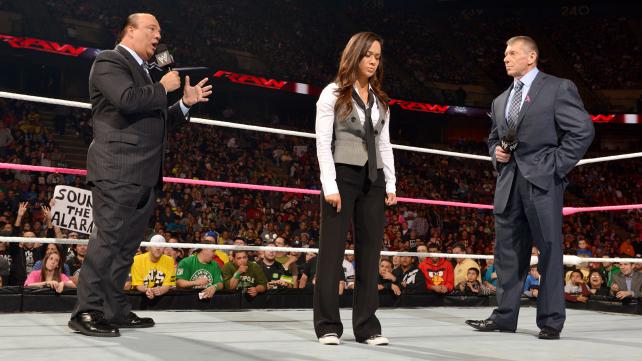
 In WWE, the episode of Monday Night Raw before a pay-per-view is colloquially referred to as the “go home show,” the company’s last opportunity to embellish the storylines going into the weekend’s big matches. For me, that description has never worked for any episode of Raw besides the one before WrestleMania, which is, of course, the show, the one that events like this Sunday’s Hell in a Cell serve as a pyrokinetic PowerPoint presentation for, building up a year-long resume for the evening’s stars before the Monday after WrestleMania, where everything resets in order to build up to next year’s show. Regardless, this is the internet, and once nerds like me catch glimpse of phrases like “go home show,” every episode of Raw is evaluated not in terms of entertainment or plot, but in terms of how well it sells the upcoming pay per view.
 Stray Observations:
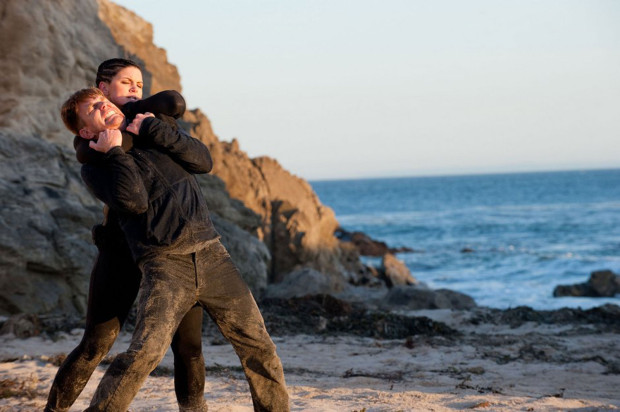
 Efficient. That’s
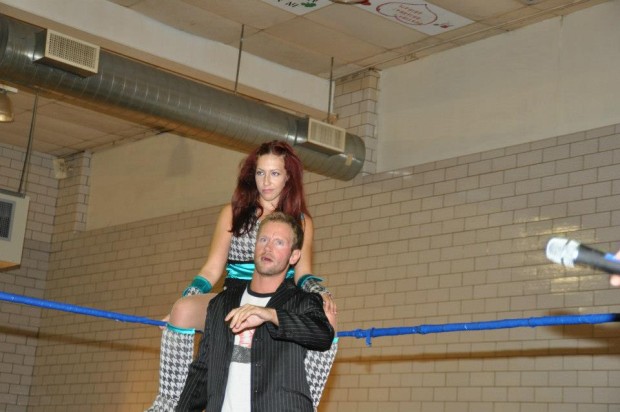
 Wrestling is not without its share of unusual villains. Greg’s hero, Hulk Hogan, lectured his fans on the importance of training, praying, and eating vitamins for a decade before turning his back on a legion of Hulkamaniacs, and many diminutive ex-WWE superstars—Gowen among them—continue to ply their trade in bingo halls and National Guard armories as brash, cocky egomaniacs, indignant that they’ve been “reduced” to wrestling in a high school gymnasium. Iron is unique among wrestling’s unusual heels in that he was forced into his villainy by a fan-base that rejected him and sided with his tormentor, Iron’s teacher-turned-bully, Josh Prohibition.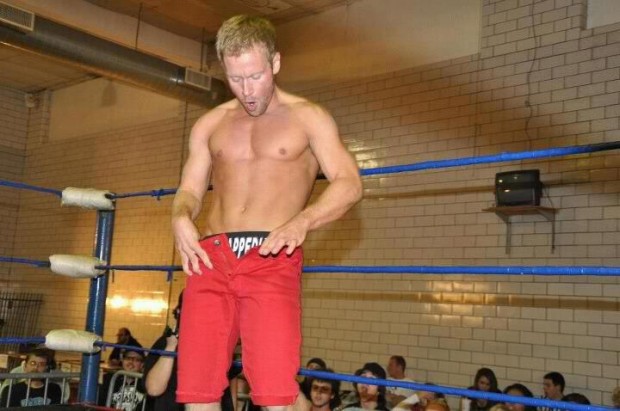
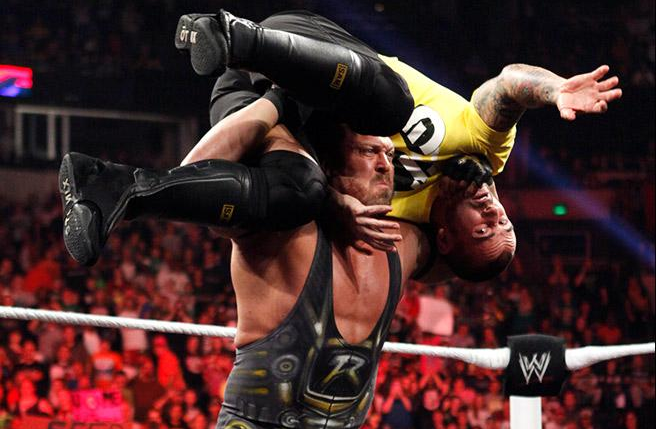
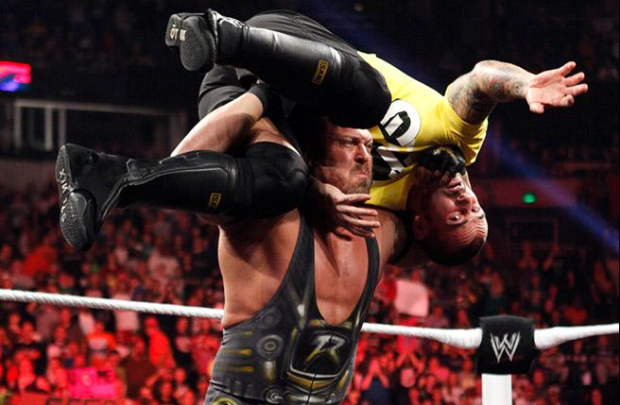 For weeks now, the narrative of WWE Monday Night Raw has been this: to cement his legacy as an all-time great champion, CM Punk would need to defeat John Cena within the confines of Hell in a Cell, WWE’s steel cage warzone that’s seen its fair share of company defining moments. On one level, this makes sense: many of the company’s top feuds, from The Undertaker’s battles with Shawn Michaels and Mankind to Triple H’s beefs with Chris Jericho and Cactus Jack, have wound up there, and Cena/Punk is certainly worthy. On another, it’s a complete mystery: Punk’s been involved in two Hell in a Cell matches and hasn’t outright lost to John Cena since before last year’s WrestleMania. The cell has mostly loomed in the background as another specter of WWE past, taunting the long-tenured WWE Champion like Bret Hart, Mick Foley, Jim Ross, and Vince McMahon have over the past few weeks. Tonight was billed as the night CM Punk chose between John Cena and Ryback as his eventual challenger, and also as an evening during which Vince McMahon would potentially choose Punk’s opponent. In a move unsurprising to folks who follow injury reports but inconsistent in terms of overall narrative, neither Punk nor McMahon chose who would be stepping into Hell in a Cell, but John Cena, who abdicated the ring and led the audience in Ryback’s chant of “FEED ME MORE.”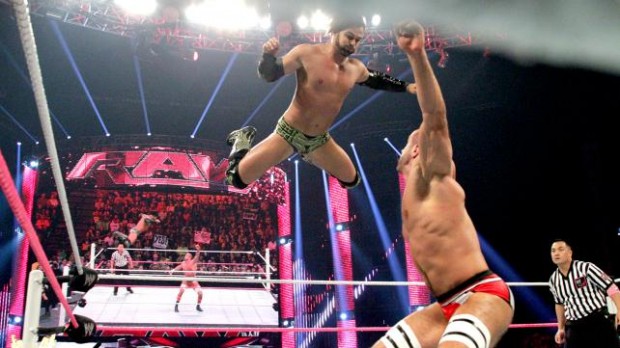
 Stray
Stray 
 Seven Psychopaths is a movie about making movies. More specifically, it’s a movie about writing movies, putting it in the same ballpark as Barton Fink and Adaptation, but with a few crucial differences. Its protagonist, for example, never holds himself up as some great artist, and once he gets into his story, he approaches his characters with zeal, if not a true sense of where those stories are going. Where Barton Fink and Adaptation (and Charlie Kaufman’s Synecdoche, New York, which was technically about a playwright) are darkly comic, psychologically-intense mirrors of the men who wrote them, Seven Psychopaths leaves darkness out of the equation. There’s scores of violence here, buckets of blood and more than a few charred corpses, but never a sense that it’s weighing too heavily on the writer’s mind. He puts pen to paper, unconscious of the fact that he’s part of his story’s tapestry.
 Seven Psychopaths. Directed by Martin McDonagh. With Colin Farrell (Marty), Sam Rockwell (Billy), Christopher Walken (Hans), Woody Harrelson (Charlie),