
Author: Colette Arrand

  • Movie Review: Iron Sky (2012)

    Movie Review: Iron Sky (2012)

    Iron Sky, like many modern exploitation films, sets itself up for failure by promising something much, much greater than it is capable of delivering. The idea that buoys it should have been enough, but director Timo Vuorensola has ambitions beyond mere entertainment. Ambition, too, will kill a modern b-movie faster than bad acting, poor scripting, or lame special effects, all of which are acceptable, even welcome, given the circumstances.  Classic exploitation movies, despite what the genre’s name suggests, didn’t go looking for context. Is there anything more vague than a hero’s struggle against “The Man?” Hardly. Whatever focus grindhouse movies had on social issues, more often than not context and purpose were things applied to the genre well after the its disappearance. The best modern tributes understand that politics and current headlines are elements serving to further sensationalize the bullets, broads, and booze, to further exploit a potential audience. The worst seek to lecture its audience through the use of broad comedy. It has ambitions. Ambitions get in the way.

    The ambition of Iron Sky is to scandalize American politics, notably the Republican Party, most notably Sarah Palin. In the future, the United States is cash-strapped and wholly-reliant upon foreign energy. To distract from this (and potentially bring home some odd space-fuel, ala Avatar), our presidential Palin surrogate (Stephanie Paul), whose Oval Office features an elliptical machine and the spoils of her kills, launches a manned moon-mission. All goes swimmingly. The lander has landed, the gigantic banner of the President unfurled, the astronauts roving the lunar surface. Then, one of them is shot. The other one is captured. The culprit? Nazis. Moon Nazis. Moon Nazis living in a swastika-shaped moon base, the descendants of a group of terrestrial Nazis who launched their own moon mission when it became clear that the Third Reich was to fall. For decades, they’ve lived on the moon, developing space-based attack strategies and educating their children on the glories of Hitler with a state-approved, 10-minute cut of  The Great Dictator. Clearly, a Fourth Reich is imminent.

    For all that promise, Iron Sky falls apart quickly, wandering from the path leading to its eventual lunar blitzkrieg in order to chart the rise of ambitious Moon Nazi Klaus Adler (Götz Otto), who lands in the United States and sets about conquering it by becoming a campaign aide of the President, whose advertising takes on a certain red-white-and-black hue. Adler’s girl, “Earth expert” Renate (Julia Dietze) sneaks abord the ship, which also carries the moon mission’s black astronaut (Christopher Kirby), who has been bleached white by a Nazi scientist (Udo Kier). Why any of this happens is unclear. There’s supposed to be something funny about the Nazi’s dying a black man white, I suspect, but its one of many jokes about the first black man on the moon that falls treacherously flat.

    The centerpiece here is the multi-national space battle launched to repel the Nazi invaders (from outer space), but even Iron Sky‘s impressive special effects can’t distract from the inane plot and cast of caricatures working to undermine. The battle gives rise to one of Iron Sky‘s biggest curiosities, which diminishes whatever pleasures sub-par space opera holds, when the president’s campaign manager (Peta Sergeant), the woman responsible for Adler’s terrestrial success, is installed as the captain of the United States of America’s massive starship. If the point was to criticize Palin or Washington croneyism or, well, anything, having the campaign manager do quite well for someone who, a day earlier, was almost murdered by a gaggle of Moon Nazis probably wasn’t the best way to get Iron Sky‘s point across.

    But really, what greater purpose should Iron Sky have been promoting? Here’s a goofily premised movie trying unsuccessfully to lampoon a political target whose last day in the sun came years ago. Zombie Strippers did the same thing in 2008, taking a buzzworthy exploitation set-up and miring it in needless political commentary, politics (and existentialism) not being a thing within the grasp of a movie about strippers who become zombies. Maybe it seems pedantic to complain about a movie not being the sort of movie I would have made, but it seems like every year there’s a new movie promising a return to the grindhouse, promising a premise, a cast, or an idea that could and should live up to expectation, but does not. In 2008, it was Zombie Strippers. 2010 had Bitch Slap. Last year had Hobo with a ShotgunThis year, it’s Bad Ass and Iron Sky. And I thought digital filmmaking was supposed to liberating. Maybe it wasn’t the struggle against The Man that dignified a genre, but the struggle to produce.

    Rating: Iron Sky. Directed by Timo Vuorensola. With Götz Otto (Klaus Adler), Julia Dietze (Renate Richter), Christopher Kirby (James Washington), Peta Sergeant (Vivian Wagner), Stephanie Paul (The President of the United States of America), and Udo Kier (Wolfgang Kortzfleisch). Released July 25, 2012, by Entertainment One.
  • Wrestling Review: CM Punk: Best in the World (2012)

    Wrestling Review: CM Punk: Best in the World (2012)

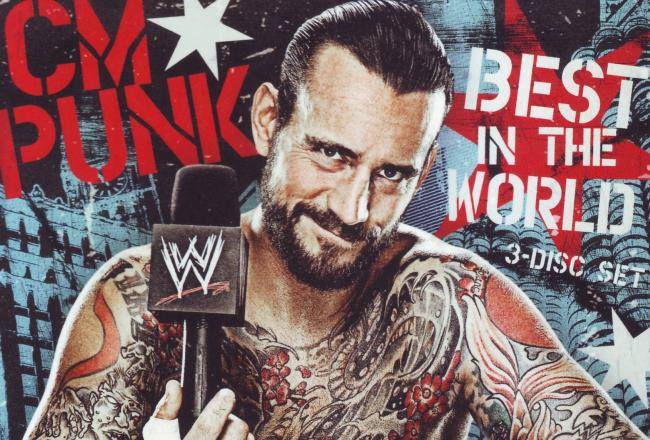
    If you’re even remotely familiar with World Wrestling Entertainment, just one look at CM Punk on a Monday Night Raw telecast will tell you everything that makes his narrative so compelling: in an industry built upon and carried by Herculean physiques, CM Punk doesn’t fit the mould. If you are familiar with WWE, familiar enough, perhaps, to’ve seen one of their many retrospective documentaries, then the difference between Punk and men like Dwayne “The Rock” Johnson, “Stone Cold” Steve Austin, and John Cena are even more clear cut.

    The documentaries chronicling the rise of your typical ten-time world champion all make the same point: becoming a legend in professional wrestling from the outset of one’s career is as unlikely for Ric Flair as anybody else. But many of the narratives pushed by the WWE are remarkably similar, involving men of uncommon drive and ambition who were standout college athletes, second- or third-generation performers, or who had the luck and good fortune to see the workaday, bingo hall grind of territory day wrestling pay off in the most unimaginable, improbable way. They all say something along the lines of “I wasn’t supposed to make it,” but, for whatever polish a man like John Cena lacked upon his debut in the big time, it’s hard to not look at his story—and most stories like it—with a sense of inevitability. Some men were born to be superstars.

    A particular subset of wrestling fans will tell you that CM Punk was destined to be a superstar, and to some extent, that’s true. Wrestling has shrunk and grown, grown and shrunk, and otherwise mutated since Vincent Kennedy McMahon ended the territory system by taking the World Wrestling Federation national on the back of Hulk Hogan, but the cyclical nature of wrestling almost dictated that the territories would come back. They have in the form of independent wrestling, and if CM Punk had never been signed by the WWE, he’d almost indisputably be the biggest wrestler in the world not employed by McMahon’s corporate juggernaut (a slot currently occupied by Punk’s best friend, Colt Cabana), the best independent wrestler in the world. But the WWE is given to signing buzzed-about talent, and in 2005, few men had as much buzz as CM Punk. His story would be unusual enough were it to end there, the land of giants inviting a small, scrappy punk into its fold, and had anybody with the power to hire wrestlers to contracts known what they were getting into with Punk, it’s likely that his story wouldn’t have made it that far. But Punk’s an odd character, a man driven to make it despite his apparent flaws, a man confident enough in his abilities to recognize those flaws as a potential strength. Punk doesn’t fit the WWE’s mould, and he’s just fine with that.

    Best in the World plays a lot like a typical WWE DVD release, with a documentary feature on the superstar in question and a collection of his best matches spanning two discs. The difference here, however, is that Punk did not come up through the modern WWE Superstar’s usual channel (the various promotions WWE has used to develop its future talent), nor are any of his classic independent matches part of the WWE’s mammoth video library. In direct contrast to the company’s “Don’t Try This” PSAs, Punk began his career in a friend’s backyard, a kid with a shameless DIY aesthetic that led him to become one of Chicago’s most successful independent wrestling promoters before seeking proper wrestling training. The nature of Punk’s career and the WWE’s obsession with charting the rise of its most bankable stars necessitates the video libraries of entities like IWA: Mid-South and Ring of Honor—promotions most members of the WWE Universe would be forgiven for not knowing—and interviews with indie wrestling luminaries Ace Steel, Colt Cabana, Bryan Danielson, and Chris Hero, not to mention WWE personel, midcard fixtures, Punk’s friends and surrogate family, and punk musician Lars Fredrickson. That Punk’s early story is supplemented with footage of his contests against Cabana, Hero, and Samoa Joe is an unexpected bonus, something that has the potential to open a WWE fan’s world to a different kind of wrestling in a way that never existed before now.

    It’s a unique line-up of talking heads, all of whom do an exceptional job of telling the story of WWE’s least-likely company figurehead. The “wrestler who wasn’t supposed to make it” storyline is personified by Punk to the point that it should forever be retired. Here’s a guy who is too small and too different to make it (his Pepsi and G.I. Joe tattoos are regularly left off his action figures and video game likenesses), but a man who is nevertheless too vocal, too passionate to submit to a role less than the one he currently occupies. Though Vince McMahon does not appear on this DVD (the Chairman is likely being saved for a a sequel somewhere doen the line), he is very much the authority Punk rages against, even if it’s clear that Punk’s eventual breakthrough in 2011 was good for his company’s bottom line. The WWE version of the Summer of Punk—the 2011 saga that saw Punk give unbelievable speeches about the state of the WWE, threaten to beat John Cena for his WWE Championship on Punk’s final night with the company, then leave with the title—was largely borne from Punk’s frustration with his position on the card and the overall direction of the WWE, a theme that’s being revisited even now as Punk angles his way towards yet another confrontation with Cena over the title the two have come to define.

    If Punk has beaten the odds placed before him—and WWE creative and corporate figures like Michael Hayes (of 1970s and 80s Freebirds glory) and Triple H will be the first to tell you that he has—it’s due to his willingness to barge into McMahon’s office and ask (or demand) for something better. It’s not surprising to learn that the Straight Edge Society—Punk’s messiah-like play on cults and his own straight edge lifestyle—was his idea, but it’s practically unheard of for a wrestler to drop 14 weeks of television on the boss’ desk, even rarer for that plan to be carried even partially to fruition. Best in the World shows Punk at his best in the ring, but its greatest pleasure is in detailing the way CM Punk thinks about the business. To that end, Best in the World doesn’t mythologize its subject, as most WWE documentaries attempt to. This is a quieter, more intimate portrait of a wrestler, something along the lines of WWE’s recent Steve Austin documentary and its earlier efforts focusing on Chris Benoit and Eddie Guerrero. It doesn’t offer much for those who aren’t wrestling fans, but for those who are, it’s an impressive look at one of the medium’s smartest, most gifted performers, a surprisingly strong argument in favor of viewing professional wrestling as art.

    Rating:

    CM Punk: Best in the World. Directed by Kevin Dunn. A documentary featuring CM Punk, Colt Cabana, Chris Hero, Daniel Bryan, John Cena, Triple H, Michael Hayes, Paul Heyman, and others. Released October 9, 2012, by WWE Films. Extras include documentary footage and matches across Punk’s career.


  • Living in a Weird Era: The Success of Louie and the Art of Subversion

    Living in a Weird Era: The Success of Louie and the Art of Subversion

    Over at The Analytical Couch Potato, I’ve written an essay about Louie, which, for my money, is the best show on television. It’s a minor pity that FX and Louis C.K. have announced that the show will not be returning until 2014, but hopefully its year-plus hiatus will give C.K. a chance to reenergize his batteries (while simultaneously touring the country with a new stand-up show) and give the show an opportunity to build its audience Arrested Development-style, via discovery on Netflix.

    On my end, Louie‘s extended hibernation will give me an opportunity to experiment with the television recap form, and for a television show that’s actually still relevant. Starting next week, Fear of a Ghost Planet will begin offering weekly re-caps of Louie and Arrested Development in preparation for the return of both shows, WWE Monday Night Raw and Parks and Recreation because both shows are currently on the air, and 1966’s Batman because I feel like it. Here’s a snippet of my ACP article on Louie. A link follows.

    In 20-minutes, Louie sees his daughters off, declines an invitation to visit his sister, meets an old flame, watches her die, and visits China because, when reading a book to his daughter, the two agreed that the Yangtze River would be a nice place to live. That’s a gross oversimplification of an episode that manages to contrast both the joy of children on Christmas with the agony of the parent who gives all credit to Santa Claus and the joy of a group of hospital employees when the clock strikes midnight on New Year’s Day with the agony of someone who has just witnessed an acquaintance die, but Louie goes places—literally and figuratively—most comedies would be unable to locate on a map. Those turns are often dark and almost always absurd, but the leaps of faith Louie takes routinely reward the viewer. When a regular comedy goes for a big, sentimental cliffhanger, it feels cloying. When Louie goes for one, there’s a sense of relief. The world hasn’t crushed the poor bastard yet.

    Living in a Weird Era: The Success of Louie and the Art of Subversion

  • Movie Review: Resident Evil: Retribution (2012)

    Movie Review: Resident Evil: Retribution (2012)

    Like a video game character bestowed the gift of an infinite lives cheat code, Milla Jovovich‘s Alice, the hero of the incredibly long-running Resident Evil franchise, cannot die. Yes, the Umbrella Corporation, her faceless nemesis, has killed her several times, but Alice, she keeps coming back. Why? It’s impossible to say. At this point, she’s saving a world that was effectively ended several films ago. The Umbrella Corporation are the ones to blame, of course, but their motives are also unclear. If their aim was profit, at least one sane individual in the boardroom would’ve pointed out that killing the entire human race was bad for business. If they want merely to kill Alice, then perhaps that same sane person should point out the benefits of not cloning, reviving, and granting superpowers to their otherwise dead and powerless enemy. It’s a fruitless, twisted war the two fight. Sometimes, extra lives are a curse.

    Resident Evil: Retribution offers no relief for either party. Instead, it shuffles the deck chairs before a presumable final encounter between humanity and the rogue biomedical corporation hellbent on its (and its own) destruction. It wisely figures that not everybody has seen the four previous Resident Evil movies and recaps them to the point where the last one left off: on a boat, with our intrepid heroes under attack. Like this year’s Underworld: Awakening (a franchise helmed by another wife/husband actress/director combination), Alice wakes up from that attack in a mysterious medical facility. She is interrogated by Jill Valentine (Sienna Guillory), a friend turned brainwashed-foe, until the facility’s computer systems are compromised. This frees Alice, who is bound and determined to escape.

    The compound is, of course, impregnable. Buried in a polar ice cap and comprising several impossibly large reconstructions of major cities, this is the Umbrella Corporation’s home base, a place where clones are churned out and monsters run amok, all so the company can test how a given populace would react to an outbreak of its zombie plague. Why Umbrella deems the facility necessary after successfully launching humanity’s biological Armageddon is unknown, but the different settings (Tokyo, Times Square, Moscow, and “Suburbia”) offer Alice and those trapped in the facility with her a rich tableau of creatures to pump full of lead, from a fetishized Japanese zombie to giant, hangman-looking mutants wielding massive hammers to a humanoid of rippling musculature whose brain is unfortunately exposed. It also offers Alice a cute kid (Aryana Engineer) to protect, because it’s not enough that she escape Umbrella’s arctic hellpit on her own.

    Paul W.S. Anderson—the unchallenged master of video game adaptations—uses Resident Evil: Retribution as an excuse to gather the franchise’s most popular characters in the same building. There’s Ada Wong (Bingbing Li), a secret agent dressed for a better occasion than a zombie plague; Albert Wesker (Shawn Roberts), the former head of Umbrella and current smarmy leader of the human remnant; and the crack mercenary team of Leon Kennedy (Johann Urb), Barry Burton (Kevin Durand), and Luther West (Boris Kodjoe), who all function pretty much in the same way, but give fans of the video game different characters whose survival they can pull for or root against. The Umbrella Corporation’s taste for cloning provides for the return of Michelle Rodriguez in various forms—from anti-gun suburbanite to bad-ass, gun-toting company woman—joined from the first Resident Evil by the Red Queen, a computer program bent on snaring Alice in one of any number of elaborate death traps.

    It goes without saying that none of those death traps work, and that, while some characters die, none of them are particularly essential to the resolution of the series. Resident Evil has long been the action genre’s most needlessly complicated franchise, and that tradition continues here. Several characters change allegiance on a whim, and Anderson’s sequel-bating reveal at the end of the movie creates large gaps in logic that otherwise would have passed as setpieces. If the Red Queen is truly on the verge of eliminating the human race, as is her stated goal, why go to the trouble of endlessly cloning a wide-variety of them? If you have the last remaining human beings on Earth pinned to the White House lawn, why bother with the undersea arctic medical facility, its staff, or its prisoners at all?

    I admit, even those questions qualify as “over-thinking it” when it comes to a movie like Resident Evil: Retribution. Everybody who has stepped to the plate to review this film has pointed out that, five installments in, you either like or don’t like the series, and that everything else is either fan quibbling or noise. Fair point. Resident Evil: Retribution sets out to be a Resident Evil movie, and in that regard, it succeeds. The characters are paper-thin, the actors inhabiting them aren’t trying particularly hard, and the script they’re given isn’t good by any means, but if Resident Evil dealt in anything more challenging than archetypes, all that ambition would get in the way of Paul W.S. Anderson’s snazzy action sequences.

    Thinking about Resident Evil: Retribution and Underworld: Awakening again, that’s the main thing that distinguishes the two. For all their similarities (heroines in tight leather bondage gear, CGI monsters, impossible physics, convoluted backstories, expendable side characters), Anderson’s franchise has Len Wiseman’s beat out in sheer terms of clear, decipherable gunfights and martial arts expositions. The colors pop brighter, the bones crunch louder, and the heroine sasses her way through wave after wave of the undead, has no time to sulk or ponder the deeper significance of her existence as a superpowered killing machine. My only issue with Resident Evil: Retribution as a time-waster is that it’s the fifth of its kind. If you’ve seen Milla Jovovich kick one zombie in the head in slow-motion, you’ve seen her kick dozens of zombies in the head in slow-motion. And there’s a dozen more shambling down the hallway.

    Rating: Resident Evil: Retribution. Directed by Paul W.S. Anderson. With Milla Jovovich (Alice), Michelle Rodriguez (Rain), Sienna Guillory (Jill Valentine), Aryana Engineer (Becky), and Bingbing Li (Ada Wong). Released September 14, 2012, by Screen Gems.
     

  • Movie Review: Looper (2012)

    Movie Review: Looper (2012)

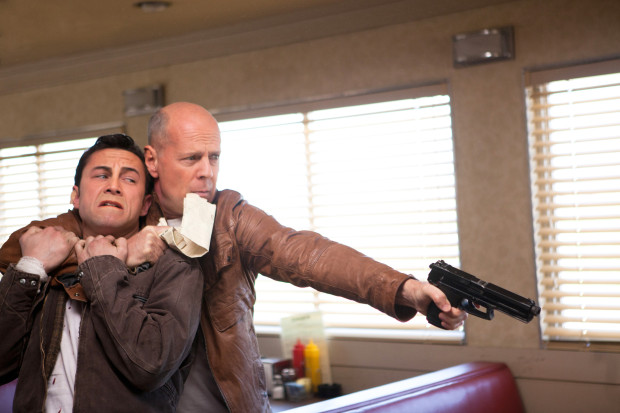
    Looper contains elements of time-traveling science fiction, neo-noir, and pained romance, but, as a chase film, nothing is as complicated as it seems. Yes, there is time travel. There’s also a mob conspiracy, copious drug usage, and the perception and memories of the people involved in these rackets are framed with fuzzy edges, but the elements that play into Looper and the characters involve are there to ground the viewer in an unbelievably plausible, fully-realized United States of America, which, in 2044, is almost irreparably broken—a patchwork quilt of vagrant gangs, men and women with retrograde telekinetic powers, and mafia-run cities ruled by weathered men from the future. If certain aspects of Rian Johnson‘s film seem familiar, it’s because Looper wants to ease the viewer into a film that’s altogether different than anything that’s come before.

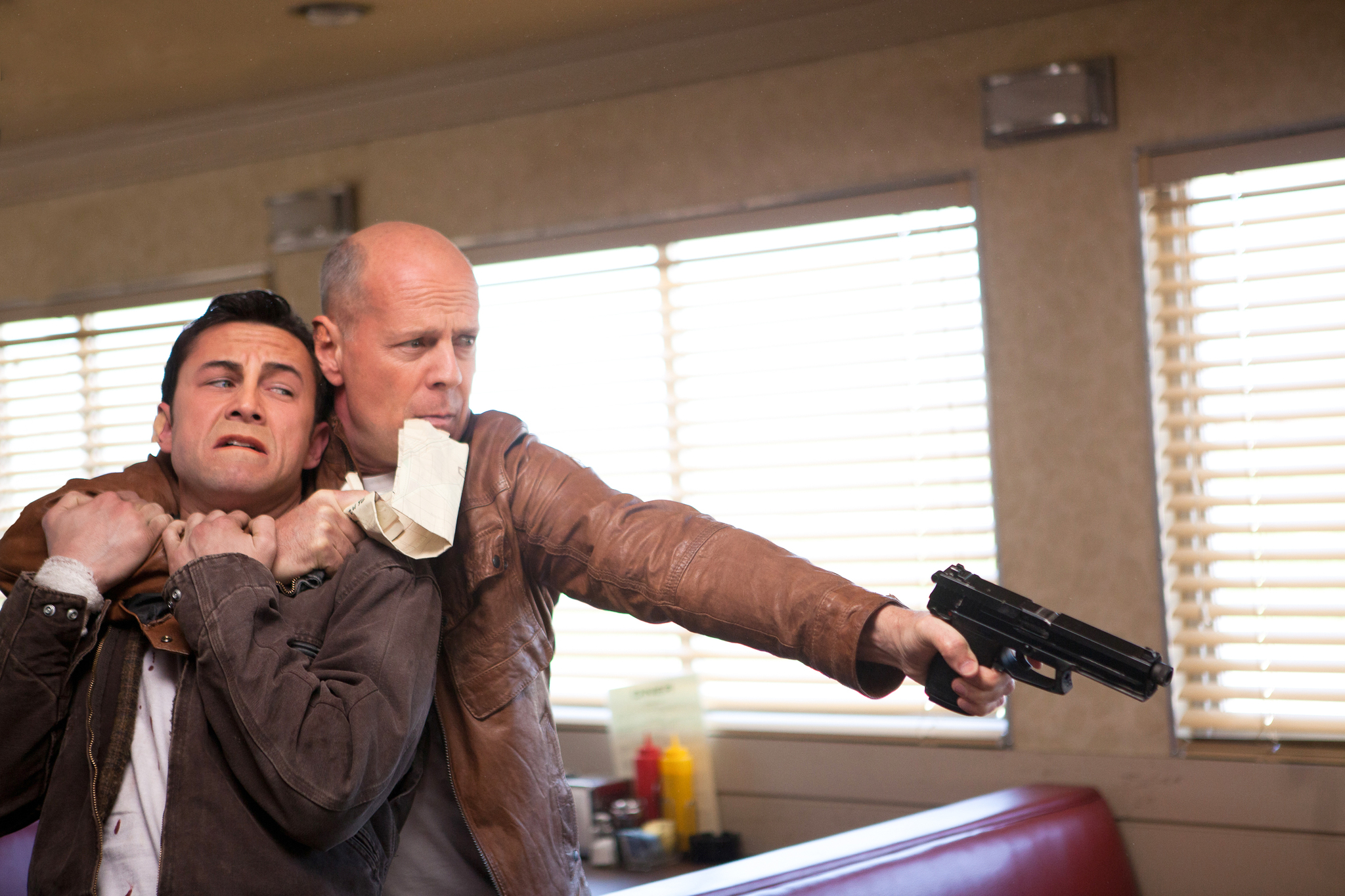
    Joe (Joseph Gordon-Levitt) is a looper, a man hired to take care of mafia hits that come from the future. Though time travel hasn’t been invented in 2044, in 2072 it’s illegal and used as a means to bury bodies. The target is captured and tied, has a bag placed on his head, and is zapped back in time. Once he appears in the past, the looper shoots him, receives his payment, and disposes of the body. When the mafia runs out of uses for a looper, they send the aged version back for the young man to kill. Most loopers are surprisingly fine with this: having been paid a bounty of silver and gold for their work, they’re free to go about lives of reckless hedonism. Sometimes, a future self isn’t quite ready to die. This, of course, presents problems.

    Joe (Bruce Willis) is an eventuality, a man from the future who is the result of a lifetime of bad choices and the grace of a woman he meets after hitting rock bottom. Where most of these eventualities seem resigned to the termination of their contract, Old Joe is different because his wife is a casualty. Unseen in this future is a mysterious mafioso known only as “The Rainmaker,” who, as legend has it, took control of the mob by himself. Why he’s taken to closing extant looper contracts is unknown, but Joe has some crucial information about The Rainmaker’s past: as a boy, he lived around the area where he worked as a young man.

    Though its plot bears some similarity to The Terminator, nobody in Looper is a cold-blooded killing machine. Blood-stained as it is, Johnson’s film doesn’t place an emphasis on gore, and its characters’ decisions are tinged with regret. The focus here is on destiny, if such a thing exists and if it can be changed. In an early sequence, Johnson teases that  yes, the events of the future can be altered by those with knowledge of the past, but despite that scene’s grotesquery, the time travel paradox is mostly backgrounded. It’s an odd comparison, but Looper is so compelling for the same reason Safety Not Guaranteed was: faith in its narrative and refusal to bow to its central gimmick. Personal taste will dictate whether or not you’re satisfied with the way Looper plays with genre conventions, but Johnson is a director who regularly subverts expectation, trading mostly in well-drawn characters and good dialog.

    That’s true here, as the world Looper inhabits is replete with characters outside of the Joe/Old Joe binary, whose fates are inextricably linked to the actions of those two men. The most important such people are Sara (Emily Blunt) and Cid (Pierce Gagnon), who live in the farmhouse that’s circled on Old Joe’s map. Sara is Cid’s mother, and Cid, Old Joe suspects, is one of three children who turn out to be The Rainmaker. Though the movie slows down considerably when the present’s Joe decides to camp out at the farmhouse and wait for his future self, it allows the movie to pause and consider its three main characters: the old man who’d do anything to save his wife, the mother who would do anything to save her child, and the young man with a murky sense of his destiny.

    At the fringes, Looper‘s mob elements threaten to un-do Joe before he or his future self can do anything to prevent or protect what’s coming. They’re led by Abe (Jeff Daniels), a man who’s been sent back in time specifically to take charge of the loopers. He’s kind of a surrogate father to that lot, though he’s very clearly bored in his role (the film notes that he took over organized crime in Kansas City in his spare time), sighing his way through field reports,his lackeys assurances that they’ll catch Joe, and torture because, as he says, he’s from the future. If there’s a point of contention to be had with the logistics of Looper, Abe is it. But Daniels—as part of a supporting cast that includes Piper Perabo as a hooker with connections to Joe and Paul Dano as a looper who can’t pull the trigger on himself—is so slick, so convincing in the role that you take Abe at “I’m from the future” and stop asking questions.

    “Slick” and “convincing” are two words that best sum Looper, and few science fiction movies emerge as tightly conceptualized as this. There’s The Matrix and there’s Blade Runner, and, watching Looper, I felt pangs of admiration for Rian Johnson’s film much the same way I did when I first saw those two fore-bearers. This is sci-fi at its most entertaining and most assured. In the coming weeks, there will be a plethora of posts picking apart how its time travel works or doesn’t, how its inconsistencies boggle the mind or don’t, how a repeat viewing or two will clear away confusion or won’t. Right now, none of that matters. Genre filmmaking, for all the talk of its resurgence, has grown unbelievably stagnant. Looper represents a vital breath of fresh air, something beyond caped crusaders and extraterrestrial invasions. In its otherness, Looper is worthy of merit. It opens a door to something new. Thrillingly, when the film ends, that door is still open.

    Rating: Looper. Directed by Rian Johnson. With Joseph Gordon-Levitt (Joe), Bruce Willis (Old Joe), Emily Blunt (Sara), Paul Dano (Seth), Piper Perabo (Suzie), Pierce Gagnon (Cid), and Jeff Daniels (Abe). Released September 28, 2012 by FilmDistrict.
  • Hulk Hogan vs. Stan Hansen (4/13/90)

    Hulk Hogan vs. Stan Hansen (4/13/90)

    [youtube http://www.youtube.com/watch?v=jQZwqNiTN1E]

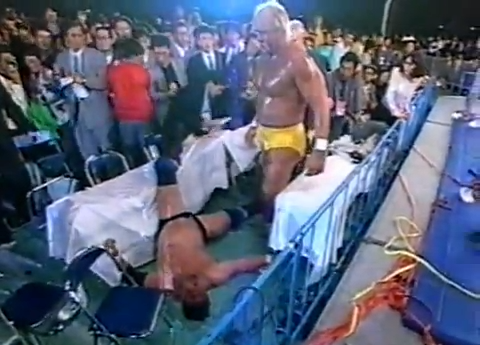
    Almost without question the best match Hulk Hogan had after losing the WWF Championship to the Ultimate Warrior at WrestleMania VI a mere 12 days earlier, this encounter between Hogan and Stan “The Lariat” Hansen has a major advantage over most Hulk Hogan matches—from that era or otherwise—in that it takes place in Japan. I’ve written a little bit about the curious effect Japan had on Hulkamania, but this goes deeper than the Japanese expecting more than routine, about their wanting to see the Axe Bomber lariat and not the Atomic Leg Drop. See, in Japan, Stan Hansen was the living, breathing embodiment of America at its meanest, at its toughest, at its worst. Stan Hansen was worse than any ol’ monster Hulk Hogan had chopped down in America. He was a tobacco chewing, bullrope twirling bully, an American Godzilla.

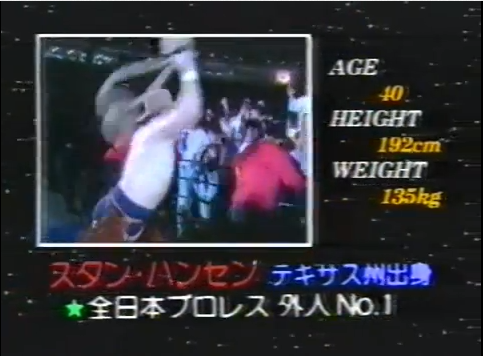
    That’s important, because in any other country but Japan, Stan Hansen in a WWF ring is a cartoon cowboy. Oh, maybe not when he broke Bruno Sammartino’s neck in 1976, but plenty had changed in the intervening 15 years. Heck, 10 years after Hansen and Bruno’s feud, Terry Funk came to the WWF as fodder for Hogan’s budding WWF Championship reign and was portrayed as a cartoon cowboy. A middle-aged and crazy cartoon cowboy, which was actually a good contrast for Hogan, but not quite the Terry Funk 1985 needed. In Japan, Terry Funk is Terry Funk. Stan Hansen is Stan Hansen. He’s a bully. The bad man from Borger. And everything about his ring entrance tells you just that.

    Here he is whipping a fan with his bullrope.
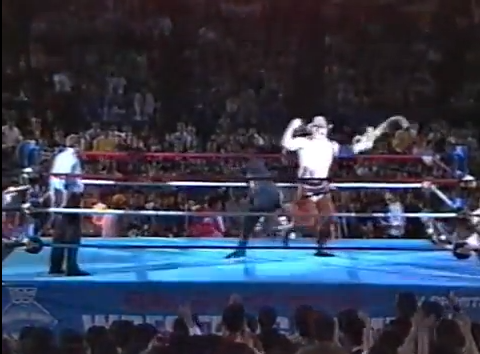
    Here he is checking the ring announcer to the canvas.
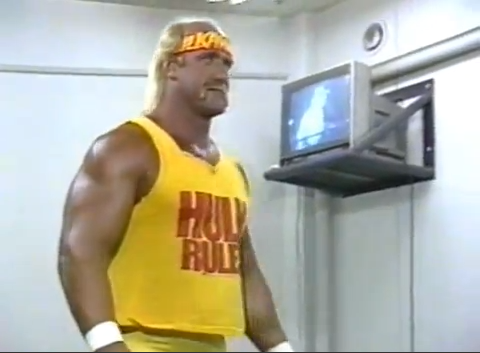
    And here’s Hulk Hogan, presumably terrified.

    The pre-match segment, with Hogan standing around in his locker room stretching, ignoring the Japanese interviewer, and watching Hansen make his way to the ring, is one of my favorite parts of this match. There’s something to be said for WWE-style ring entrances and what they accomplish, but nobody knew how to create an atmosphere for a wrestling match quite like the Japanese. With Hansen out in the ring whipping every thing in sight and Hogan in the back, silently watching, it was pretty obvious that something special, something living up to the “SPECIAL DREAM MATCH” bulling was about to go down. Hogan and Hansen were two bombs, set to explode.

    What’s amazing, at least to me, is that Hansen was a last-minute replacement for Terry Gordy, the All Japan Pro Wrestling Triple Crown champion. A loss to Hogan, Gordy figured, would do him more harm than good. The resulting match, however, has a sense of destiny to it. Hogan teamed with Hansen during Hogan’s time in Japan. He’d grown to be this big, shouty, American teddy bear, a nice enough dude, but somebody Hansen would be deeply ashamed to associate with. Instead of one of those cutesy American matches between former tag team partners—you know, where one man knows the other’s move “almost before it happens!”—things escalate very quickly from Hogan’s mat wrestling display (those who’ve long bemoaned Hogan’s five moves of doom should pay attention to his STF, his cravate, his drop toe-hold, and so-on) to a Hansen-style brawl. Both men throw punches. Both men shed blood.  Hogan, in a decidedly anti-Hogan twist, bodyslams Stan Hansen onto an unbreakable Japanese table. Beyond Hogan’s yellow trunks and his willingness to cheat, he’s almost unrecognizable.

    That’s what I appreciate the most about Hogan’s one-off appearances in Japan, that they represent something utterly different from what I’m used to. I recently listened to Colt Cabana’s interview of William Regal (one of my top five favorite wrestlers), and Regal said something that reminded me to look up this match. He said that, too often, wrestlers (and people involved elsewhere in the industry) get too caught up in the finer details of their craft and forget what interested them as children. For me, it was Hulk Hogan. Sure, I also loved Randy Savage, Bret Hart, Ultimate Warrior, and Jake Roberts, but it was Hogan who got me in the door and, later, Hogan who I most bitterly complained about.

    It’s not my place to talk about Hulk Hogan the person or Hulk Hogan the backstage politician, but Hulk Hogan the wrestler existed, and was not just a figment of my imagination. Beneath his routines, beneath his catch phrases, and beneath his pre- and post-match posedowns there existed a Hulk Hogan who could really go in the ring, but wasn’t called upon to except on the rarest of circumstances. When I watch a Hogan match like this, I think of all the good-to-great John Cena matches I’ve seen, all of the Randy Orton matches I’ve enjoyed despite not really liking Randy Orton, and the divide that exists between people who love those two wrestlers and those who hate them. It’s a wide gulf, one unlikely to be bridged, but take a look at this match and realize that, for 13-minutes, Hogan and Stan Hansen are equals. Then watch John Cena vs. C.M. Punk or Randy Orton vs. Christian and tell me, with a straight face, that one carried the other. I don’t think I’m revealing anything when I say that wrestling, at its core, is a partnership. If the two partners aren’t somehow equal, the match fails. There’s a wealth of Hulk Hogan matches following this one that only proves this point. Wonderfully, none of them take place in Japan.