Tag: Joseph Gordon-Levitt

  • Movie Review: Lincoln (2012)

    Movie Review: Lincoln (2012)

    Lincoln begins in full Spielbergian splendor, capturing the smoky, mud-caked futility of full-scale war. It pulls back quickly and returns to the battlefield only to survey a battle’s aftermath, as the purpose of this film is not to document the ebb and flow of a costly, generation destroying war, but the effect of that war on one man: Abraham Lincoln, 16th President of the United States. As played by Daniel Day-Lewis, Lincoln is a troubled man. His limbs creak. His mind races. The Civil War is nearly at an end, but its major undertaking remains unfinished.

    The passage of the 13th Amendment is paramount to Lincoln’s second term as president, and the line he walks to get it passed in the House of Representatives is perhaps the thinnest in American political history. The South, buckling under the weight of Sherman’s march to the sea and Grant’s pursuit of the Army of Northern Virginia, is ready to capitulate. The North, having seen tremendous losses on both sides, is ready to hear terms of surrender. It is widely thought that the Confederacy will put down their guns if the Union allows them to keep their slaves, but, however much that would please a wounded nation, it is not good enough for Lincoln that so many men die to maintain the status quo. According to Secretary of State William Seward (David Strathairn), there exists a chance for the passage of the 13th Amendment. It requires two concessions on Lincoln’s part: the continuation of an all-but-concluded war, and the extension of bribes to those members of the Democratic Party who could be convinced to change their vote.

    To anybody with even a minute knowledge of American politics, that Lincoln would bribe the opposition in order to get a bill passed will not come as a surprise. Nevertheless, it’s refreshing to see him portrayed as something deeper than the simple, sainted American politician who saved the country and freed the slaves. His decision to push for the 13th Amendment had real, horrifying consequences, and it fell on his shoulders to spin that decision to a country that didn’t so much care if the right thing got done. In one of the film’s best sequences, Lincoln meets with a husband and wife who are disputing with another party over the rights to a toll road. Seward, fuming in the corner, takes the opportunity to ask the pair if they support abolition. Supposing it ends the war more quickly, as the president has promised, then yes, they do. And supposing it doesn’t? Well, better to end the war now than waste the lives of more white boys on the behalf of another race.

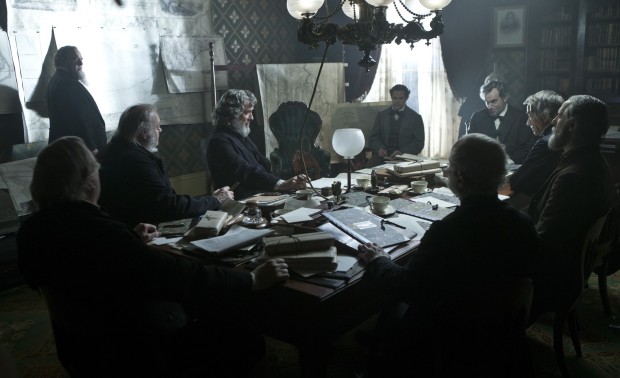
    In sticking to candlelit meeting rooms and harrumphing  political chambers, Steven Spielberg’s film takes on overtones of a Shakespearian tragedy. Lincoln is not without its comedic elements—William Bilbo (James Spader), a Republican lobbyist, finds that his particular brand of salesmanship doesn’t work with every Democrat, even those who stand to gain plenty from his propositions—but, when it wanders off from the main narrative, is mostly taken by melodrama. Given the various tragedies that befall the Lincoln family, a preoccupation with doom and gloom is perhaps understandable. Squeezed in here, Robert Todd Lincoln’s (Joseph Gordon-Levitt) preoccupation with joining the Union war effort, Tad Lincoln’s fascination with daguerreotype images of slave children, and Mary Todd Lincoln’s (Sally Field) stormy, madwoman-in-the-attic private mannerisms seem like loose threads from a much longer cut of the film. Compared to a shot of Lincoln juxtaposed against flickering candlelight or the decision to keep going past the film’s logical endpoint to squeeze in as much of Lincoln’s assassination as possible without making it interesting, these are minor trespasses.

    The resulting film is sloppy and frustrating at times, but fitfully as inspired as anything Spielberg has made. He manages to bring together melodrama, comedy, political tension, and baiting, crowd-pleasing performances like Tommy Lee Jones’ radical Republican leader Thaddeus Stevens in a way that’s rarely insulting, and manages to wring a good amount of drama to one of the most written about eras of American history. Tony Kushner’s adaptation of Team of Rivals: The Political Genius of Abraham Lincoln is sharp and precise. Lincoln’s backwoods lawyer persona comes across in the many parables he tells, but these stories are more important to Lincoln than to those gathered around him. Wrestling with the constitutionality of the Emancipation Proclamation, debating the merits of sending his son to war, the president spends as much time trying to convince himself that he’s taking the proper course of action as he does anybody else. No wonder the war looks to have crippled him. It’s not just the soul of the country he’s gambling on, but his own.


    Lincoln.  With Daniel Day-Lewis (Abraham Lincoln), Sally Field (Mary Todd Lincoln), David Strathairn (William Seward), Tommy Lee Jones (Thaddeus Stevens), Hal Holbrook (Francis Preston Blair), Joseph Gordon-Levitt (Robert Todd Lincoln), James Spader (William Bilbo), John Hawkes (Colonel Robert Latham), and Tim Blake Nelson (Richard Schell). Directed by Steven Spielberg from a script by Tony Kushner, based on the book Team of Rivals: The Political Genius of Abraham Lincoln by Doris Kearns Goodman.

  • Movie Review: Looper (2012)

    Movie Review: Looper (2012)

    Looper contains elements of time-traveling science fiction, neo-noir, and pained romance, but, as a chase film, nothing is as complicated as it seems. Yes, there is time travel. There’s also a mob conspiracy, copious drug usage, and the perception and memories of the people involved in these rackets are framed with fuzzy edges, but the elements that play into Looper and the characters involve are there to ground the viewer in an unbelievably plausible, fully-realized United States of America, which, in 2044, is almost irreparably broken—a patchwork quilt of vagrant gangs, men and women with retrograde telekinetic powers, and mafia-run cities ruled by weathered men from the future. If certain aspects of Rian Johnson‘s film seem familiar, it’s because Looper wants to ease the viewer into a film that’s altogether different than anything that’s come before.

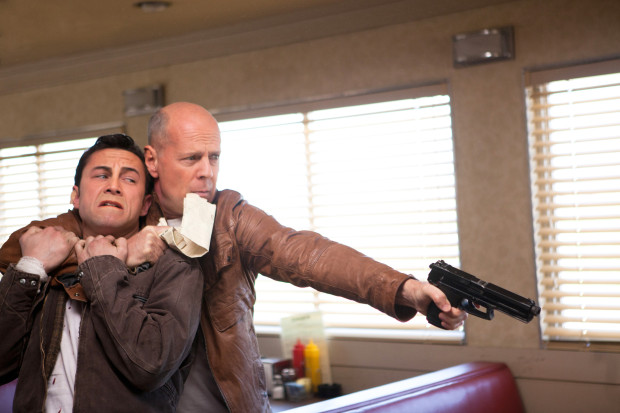
    Joe (Joseph Gordon-Levitt) is a looper, a man hired to take care of mafia hits that come from the future. Though time travel hasn’t been invented in 2044, in 2072 it’s illegal and used as a means to bury bodies. The target is captured and tied, has a bag placed on his head, and is zapped back in time. Once he appears in the past, the looper shoots him, receives his payment, and disposes of the body. When the mafia runs out of uses for a looper, they send the aged version back for the young man to kill. Most loopers are surprisingly fine with this: having been paid a bounty of silver and gold for their work, they’re free to go about lives of reckless hedonism. Sometimes, a future self isn’t quite ready to die. This, of course, presents problems.

    Joe (Bruce Willis) is an eventuality, a man from the future who is the result of a lifetime of bad choices and the grace of a woman he meets after hitting rock bottom. Where most of these eventualities seem resigned to the termination of their contract, Old Joe is different because his wife is a casualty. Unseen in this future is a mysterious mafioso known only as “The Rainmaker,” who, as legend has it, took control of the mob by himself. Why he’s taken to closing extant looper contracts is unknown, but Joe has some crucial information about The Rainmaker’s past: as a boy, he lived around the area where he worked as a young man.

    Though its plot bears some similarity to The Terminator, nobody in Looper is a cold-blooded killing machine. Blood-stained as it is, Johnson’s film doesn’t place an emphasis on gore, and its characters’ decisions are tinged with regret. The focus here is on destiny, if such a thing exists and if it can be changed. In an early sequence, Johnson teases that  yes, the events of the future can be altered by those with knowledge of the past, but despite that scene’s grotesquery, the time travel paradox is mostly backgrounded. It’s an odd comparison, but Looper is so compelling for the same reason Safety Not Guaranteed was: faith in its narrative and refusal to bow to its central gimmick. Personal taste will dictate whether or not you’re satisfied with the way Looper plays with genre conventions, but Johnson is a director who regularly subverts expectation, trading mostly in well-drawn characters and good dialog.

    That’s true here, as the world Looper inhabits is replete with characters outside of the Joe/Old Joe binary, whose fates are inextricably linked to the actions of those two men. The most important such people are Sara (Emily Blunt) and Cid (Pierce Gagnon), who live in the farmhouse that’s circled on Old Joe’s map. Sara is Cid’s mother, and Cid, Old Joe suspects, is one of three children who turn out to be The Rainmaker. Though the movie slows down considerably when the present’s Joe decides to camp out at the farmhouse and wait for his future self, it allows the movie to pause and consider its three main characters: the old man who’d do anything to save his wife, the mother who would do anything to save her child, and the young man with a murky sense of his destiny.

    At the fringes, Looper‘s mob elements threaten to un-do Joe before he or his future self can do anything to prevent or protect what’s coming. They’re led by Abe (Jeff Daniels), a man who’s been sent back in time specifically to take charge of the loopers. He’s kind of a surrogate father to that lot, though he’s very clearly bored in his role (the film notes that he took over organized crime in Kansas City in his spare time), sighing his way through field reports,his lackeys assurances that they’ll catch Joe, and torture because, as he says, he’s from the future. If there’s a point of contention to be had with the logistics of Looper, Abe is it. But Daniels—as part of a supporting cast that includes Piper Perabo as a hooker with connections to Joe and Paul Dano as a looper who can’t pull the trigger on himself—is so slick, so convincing in the role that you take Abe at “I’m from the future” and stop asking questions.

    “Slick” and “convincing” are two words that best sum Looper, and few science fiction movies emerge as tightly conceptualized as this. There’s The Matrix and there’s Blade Runner, and, watching Looper, I felt pangs of admiration for Rian Johnson’s film much the same way I did when I first saw those two fore-bearers. This is sci-fi at its most entertaining and most assured. In the coming weeks, there will be a plethora of posts picking apart how its time travel works or doesn’t, how its inconsistencies boggle the mind or don’t, how a repeat viewing or two will clear away confusion or won’t. Right now, none of that matters. Genre filmmaking, for all the talk of its resurgence, has grown unbelievably stagnant. Looper represents a vital breath of fresh air, something beyond caped crusaders and extraterrestrial invasions. In its otherness, Looper is worthy of merit. It opens a door to something new. Thrillingly, when the film ends, that door is still open.

    Rating: Looper. Directed by Rian Johnson. With Joseph Gordon-Levitt (Joe), Bruce Willis (Old Joe), Emily Blunt (Sara), Paul Dano (Seth), Piper Perabo (Suzie), Pierce Gagnon (Cid), and Jeff Daniels (Abe). Released September 28, 2012 by FilmDistrict.

  • Movie Review: Premium Rush (2012)

    Movie Review: Premium Rush (2012)

    Premium Rush is the sort of title that works two ways, both as the kind of delivery service proffered by the bike messengers of David Koepp‘s film, and as a description of the sort of thrill one of those messengers—Wilee (Joseph Gordon-Levitt)—gets from his chosen profession. Let’s get the former out of the way quickly: The envelope handed to Wilee is a MacGuffin, the object that sets him pedaling across Manhattan, dodging pedestrians, taxi cabs, buses, and bicycle cops. Though the movie backtracks a bit to establish the particular importance of this envelope and its contents, it only matters so much as another man—Detective Bobby Monday (Michael Shannon)—wants it for himself. See, Det. Monday’s in deep with a Chinese gambling concern, and he has a very tight deadline, by which he needs to have his debt paid. The envelope is worth enough money to do just that, but, unfortunately for him, what goes in Wilee’s bag stays there until it’s delivered. (more…)

  • Movie Review: The Dark Knight Rises (2012)

    Movie Review: The Dark Knight Rises (2012)

    The word “ambitious” has been used to describe Christopher Nolan‘s The Dark Knight Rises, almost as an apologia. In a summer containing superhero epics that’ve conquered the globe through a combination of charm, polish, and weightless fun, a glum, glowing Batman film can’t help but feel like a party-crasher, a mirthless rebuttal to the joyful hedonism proffered by Marvel Studios. It just so happens that Nolan’s third and final Batman film is ambitious. Functioning as a third act, it introduces a slew of new characters, expounds upon ideas Nolan subtly presented behind the smokescreen of Heath Ledger‘s mesmerizing performance as The Joker in The Dark Knight, and brings his massive, decade-spanning and character-defining story to a close while leaving the door slightly ajar, suggesting both a Gotham without Batman, and a Gotham that can’t survive without one. It’s an audacious juggling act that’d succeed on the merit of sheer scale were it not for the fact that The Dark Knight Rises is just as successful as its predecessors in painting an only slightly-warped representation of our society, gently nudged to its extremes. If The Avengers and The Amazing Spider-Man were long on great power, trading in narrative subtly for titanic struggles between Good and Evil, The Dark Knight Rises is a sobering reminder that any struggle, no matter how titanic, is a grey affair, that the people who fight with the greatest power also have the greatest responsibilities and, ultimately, should make the greatest sacrifices. Its ambition is to hold its characters up to the audience as a mirror. (more…)