Tag: Channing Tatum

  • Movie Review: The Hateful Eight (2015)

    Movie Review: The Hateful Eight (2015)

    Hateful Eight

    Quentin Tarantino’s been flirting with a film like The Hateful Eight for awhile now, a beautifully shot, well designed film that goes beyond feeling minor (the way Death Proof feels, for instance) and just ends up being bad. An inverse of Django Unchained, where the bounty hunters and rogues are just as despicable as the murderers and thieves they encounter, The Hateful Eight plays on the director’s obsessions with race and torture and whimsical men who are good at murderin’ folks, but with so little in the way of narrative pull that it often seems like Tarantino is just playing with himself, making a movie for the sake of making a movie, without a hint of impulse control.

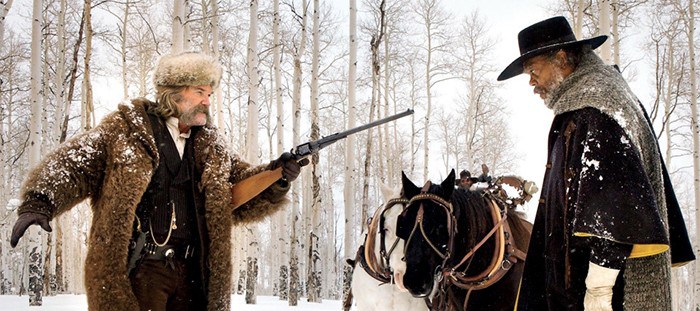
    The Hateful Eight concerns eight men and women who are all on their way to Red Rock, Wyoming, a blizzard nipping at their heels. Some of them are bounty hunters. Some are bounties. Some are working men. Not everybody is who they say they are, but there’s hardly any mystery to that considering the cast of regulars Tarantino’s assembled and the kinds of roles they’ve played for him in the past. Our lead bounty hunters—”Hangman” John Ruth (Kurt Russell) and Major Marquis Warren (Samuel L. Jackson)—are suspicious of everyone they encounter, and they’re usually right in their suspicions. Ruth encounters Warren on a trail, sitting atop a pile of dead bounties after his horse died in the snow. He’s on his way to Red Rock with Daisy Domergue (Jennifer Jason Leigh), an outlaw who is worth $10,000 dead or alive, and he prefers taking them in alive so as to not cheat the hangman, hence the nickname. The conversation between Warren and Ruth is intense—Tarantino is at his best when staging conversations between hypermasculine strangers—and when they pick up another snowbound traveler, Chris Mannix (Walton Goggins), the new sheriff—things get more tense. This is just after the Civil War and there’ still tensions between Union soldiers and Rebel ones. Ruth and Warren belonged to the Union. Mannix’s father led a battalion that continued fighting the war in the face of unconditional surrender. None of them could be said to’ve been good men, and Domergue, when she’s not getting punched or spitting up blood, watches them argue with glee.

    With the blizzard on them, the stagecoach holes up at Minnie’s Haberdashery, where four other men are already gathered around the fireplace. There’s a fussy British gentleman (Tim Roth), a cowpuncher (Michael Madsen), a Mexican (Demián Bichir) who says he’s looking after the place for Minnie while she visits her family, and a Confederate General (Bruce Dern) who is familiar with Major Warren, even if he doesn’t know it. The idea, according to Tarantino, is for these characters to get together and tell stories to one another like an arc on a western, each person trying to figure out the intention of the other. This has been a pretty basic mode of narrative storytelling for a long time now. You can go farther than westerns like Gunsmoke and The Virginian to Rashomon or The Canterbury tales, people telling stories about things seen and unseen, only here, as Tarantino often has it, our storytellers have guns. Those are mostly holstered until a blood-soaked finale, so much of The Hateful Eight is talk and menace, a locked room there’s only one way out of.

    That means lingering, for a long time, on the decisions Tarantino chooses to make. One of them, shooting in 70mm and keeping his characters mostly indoors, is ponderous, but there is a lot of loving detail put into Minnie’s Haberdashery and the sense that something’s off with it. The way-station is a one-room saloon with a couple of beds in it, but Tarantino and cinematographer Robert Richardson make use of cinematic space such that the Haberdashery feels both open and claustrophobic at the same time. There are eight people in the room, eight different perspectives of a single unfolding narrative, and were that narrative any better than it was, the way The Hateful Eight cuts from one to another would be invigorating. But it isn’t. So again, you get to linger with the decisions Tarantino makes. You have three hours to wonder how, even in a movie where he’s only the narrator, Tarantino manages to give himself the film’s most troublingly racist dialog, or why he figures on adding a race allegory to a film about eight miserable bastards to begin with. Sampling, as he has been for some time now, from spaghetti westerns, the Confederate/Union line is one Tarantino plays with and tries to extend to today, but he frankly isn’t good enough to make a salient point, even though Samuel L. Jackson is the man making it. After Christoph Waltz’s Jew Hunter in Inglourious Basterds and Leonardo DiCaprio’s impassioned speech on eugenics in Django—both characters and monologues that Tarantino luxuriated in—it’s hard to take him seriously when he tries to inject social consciousness into The Hateful Eight, which is otherwise the director’s career-long fascination with bondage and torture writ large and gracelessly.

    It takes a long time for The Hateful Eight to go anywhere, moving as slow as the stagecoaches that transport the players to their stage. Tarantino, as he’s done time and again since Kill Bill, is trying to make a film about outlaws and gunslingers who stand as legends that are of their time and outside it, but it just doesn’t work here, where he’s convinced to the marrow of his bones that it’s worth keeping the company of eight sadists who don’t have all that much to say. It’s a formula Tarantino has used effectively before, but here that formula is used to the point of exhaustion. And when everybody starts pulling guns on one another, as is Tarantino’s guarantee? More of the same, more of the same.
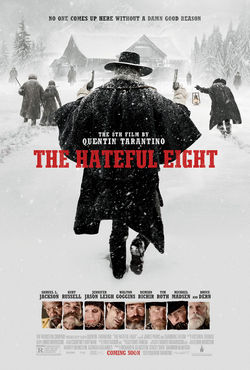


    The_Hateful_EightThe Hateful Eight (2015)

    With Samuel L. Jackson (Major Marquis Warren), Kurt Russell (John Ruth), Jennifer Jason Leigh (Daisy Domergue), Walton Goggins (Chris Mannix), Demián Bichir (Bob), Tim Roth (Oswaldo Mobray), Michael Madsen (Joe Gage), Bruce Dern (General Sandy Smithers), James Parks (O.B. Jackson), Zoë Bell (Six-Horse Judy), and Channing Tatum (Jody). Directed by Quentin Tarantino from a screenplay by Tarantino.


  • Movie Review: Jupiter Ascending (2015)

    Movie Review: Jupiter Ascending (2015)

    Jupiter Ascending

    Calling Jupiter Ascending an original movie is perhaps disingenuous. While it is among those increasingly rare science fiction blockbusters that weren’t adapted from comic books, novels, video games, or television shows, it is, like Pacific Rim before it, a hulking labor of nostalgia for an incredibly specific genre of film, the technicolor fantasia of the space opera. A dazzling array of humans, aliens, and spaceships pass before the eye, each of them unique and carrying loads of often unexplained baggage, but there’s hardly one that doesn’t have a corollary in Star WarsStar TrekClose Encounters of the Third Kind, or something decidedly stranger, more off-beat. Andy and Lana Wachowski have always worn their influences on their sleeve, but here, with the gross domestic product of several small nations at their disposal, they are bearing their hearts, both of them glittering machinations assembled from the detritus of what used to be called nerd culture and what is now just culture. By making a film so decadent and doomed to failure, they seem to have laid claim to that tiny parcel of the collective imagination that is still yet unconquered by the spandex-clad horde.

    None of this is to say that Jupiter Ascending is any good. In fact, most of it is very bad. An array of beautiful images crudely hacked apart and stitched back together in the editing bay, to describe any aspect of the plot here as presented is to sound like one is making assumptions of a very long film after catching the last five minutes on television. Here goes nothing. Jupiter Jones (Mila Kunis) is an undocumented Russian immigrant unsatisfied with her life cleaning toilets in Chicago. One day she is selling her eggs to a fertility clinic, which is surely a first in an action film. The next, she finds out that, through accident of birth, she is the exact genetic duplicate of the matriarch of clan Abrasax and the rightful owner of the planet Earth. This places Jupiter in the middle a family war between a hedonistic prince (Douglas Booth), an eternally young princess (Tuppence Middleton), and their ruthless industrialist of a brother (Eddie Redmayne), her only sure protection in the galaxy (which she will span in its vastness) being a soldier-turned-mercenary human/wolf/insect hybrid (Channing Tatum) first seen smelling her name on a sheet of paper at the clinic. There is a team of bounty hunters. There are little grey men. There are gigantic lizard men. There is the crew of the ship. There are robots and bureaucrats and the individual members of Jupiter’s family. All of them matter. Some are, it seems, audience surrogates, just as confused as we are about the world beyond our world that dances among the stars to an ancient song that can only be heard by those with access to its score.

    Luckily, the Wachowskis are keen to overshare. Large stretches of Jupiter Ascending exist just to fill in the details, coming so hard and heavy that even Jupiter, with her fate and the fate of the world on her shoulders, breaks down and says she doesn’t care about any of it. The other characters know so much and Jupiter so little that she frequently feels like a character without agency, falling for obvious ploys and needing constant rescue from Tatum’s Caine Wise, who has this neat trick where he is rescued from every conceivable deathtrap by the magic of coincidence and given all the credit. This is something of a disappointment, as Jupiter Ascending is, at times, nearly a Marxist, feminist manifesto shrouded by the glitter and doom of a summer blockbuster. Though doing so, I realize, is futile, I keep imagining Jupiter Ascending getting a summer release in a year that wasn’t overburdened with light, spectacle-driven sci-fi, having the billion-dollar success that was envisioned when the project was greenlit. Hundreds of thousands of men watch a woman struggle with the decision to sell her eggs, are enraged for her when her cousin negotiates a large cut of the profits. The working class grow angry with the film’s end boss, his speaking pattern belabored by a state of agonizing, near-constant orgasm as he lectures Jupiter about the need to convert humans into capital. A laugh is had as Jupiter negotiates the bowels of galactic bureaucracy with an over-taxed droid. A moment of silence is shared as a bottle of human goop—the liquid that allows the intergalactic ruling class their millennia-spanning lives—falls to the ground and is shattered.

    But I’ve mentioned a hoped for billion-dollar success, which spoils even my utopian ideal for the film. The larger engine at work throughout Jupiter Ascending is its naked desire for a sequel, the further adventures of Jupiter Jones in space or on Earth or wherever the focus group found itself most pleased. While my brain keeps twisting small moments in Jupiter Ascending into larger academic points (the CGI reconstruction of Chicago, just razed by a CGI spacechase, as a commentary on the vapid nature of such sequences, for example), the Wachowskis bumble about like Tobias Fünke, Yes, Anding themselves to the point of insanity. Jupiter is rescued from little grey men by a disgraced bounty hunter. Yes, and they fall in love. Yes, and their romance is complicated by issues of class. Yes, and there’s a marriage where one of the evil princes tries to marry an exact genetic replica of his mother. Yes, and that is spoiled by the bounty hunter, who was initially hired by the prince under the pretense that he would be reinstated to the military. Yes, and members of the military have wings! Yes, and, without his wings, the bounty hunter has these boots, these anti-gravity heelies that make it look like he’s tearing ass through the mall, even when his life is in danger. Yes, and, uhh, something about bees; an entire house covered in a honeycomb! Yes, and… uhh, wait, bees? Did you say bees? Yes! And, I dunno, maybe Jupiter’s scummy cousin buys a flatscreen TV?

    On and on and on, until the perfunctory action sequence brings us to the required Disney princess ending, which is some weird combination of The Secret and that old, classist pablum that one should be happy with what one has. Here, that means waking up at four in the morning to clean the toilets of the wealthy despite owning the deed to an entire planet, being okay with one’s place in a machine so large that even a Jupiter-sized refinery represents but one small cog within it. Recently, I saw a headline in my Google news feed that asked if Marvel could “save” the Wachowskis. Jupiter Ascending suggests not, as, despite its trappings, this is essentially their Marvel film, disguising the same mostly white, mostly male exceptionalism coded within the MCU with the same safe message that no, really, everybody can be special, the princess or the soldier (never both, and never something else). That’s a marketable idea, but not one the Wachowskis or their film seem to believe in. No, the heart of Jupiter Ascending, beating faintly under layer after layer of bloat, belongs to Terry Gilliam, sniggering maliciously as he affixes a rubber stamp to the deed that awards Jupiter Jones ownership of Earth. It’s a fine dream Jupiter has, of liberating her and her family. How easy, Gilliam’s appearance suggests, for that dream to become madness.


    Jupiter Ascending. With Mila Kunis (Jupiter Jones), Channing Tatum (Caine Wise), Sean Bean (Stinger Apini), Eddie Redmayne (Balem Abrasax), Douglas Booth (Titus Abrasax), Tuppence Middleton (Kalique Middleton), and Terry Gilliam (Seal and Signet Minister). Directed by Andy and Lana Wachowski, from a screenplay by the Wachowskis.

  • Movie Review: 21 Jump Street (2012)

    Movie Review: 21 Jump Street (2012)

    When Easy A was released last year, it ushered in a brief era of John Hughes nostalgia and the feeling that things within the high school comedy genre could, in fact, get better. A year of repeat viewings and Emma Stone Tumblr .gifs later, and the shine of Will Gluck’s comedy has mostly diminished. It’s a ramshackle tribute to a bygone era in teen filmmaking, its obsolescence made clear by a lack of Hollywood follow-through  It’s much easier to throw a handful of Disney Channel stars into a foreign country or move the cheerleader movie plot into another sport than to hit the sweet spot Easy A was lucky enough to find. No matter. For all that film’s charm and quirk, I was left waiting to see if the high school comedy’s raunchier parasitic twin would crawl its way out of the ditch a legion of Superbad imitators left it dying in. Finally, with 21 Jump Street, it has.
    It’s as odd a candidate as any. A remake of an 80s television program granted enduring cult popularity due to the later fame of one of its stars, featuring a pair of 30-year-old men impersonating high school students doesn’t immediately figure as a good time. Directors Phil Lord and Chris Miller have been here before, though, eviscerating high school culture with their MTV cartoon Clone High, and are smart enough to realize that pop culture and mass media have muddied old tropes and expectations. Nerds, geeks, and environmental activists are portrayed as hip, now. Gays and lesbians are accepted by their peers. While real life rarely bears this out, this is the entertainment industry’s standard operating procedure when making mainstream high school movies. Quirky girl meets sensitive guy, is guided towards relationship by gay best friend. Rinse, wash, repeat. It’s within that formula that 21 Jump Street scores its biggest points. The fish are large and the barrel is small, but Lord and Miller are the first to take aim and fire.

    Morton Schmidt (Jonah Hill) and Greg Jenko (Channing Tatum) are two police academy graduates who’ve long dreamed of the exciting life cops lead. Formerly the high school nerd and jock, respectively, Schmidt and Jenko find each other in class struggling through the areas of their expertise. Jenko helps Schmidt with the rigorous physical activities required of men on the beat, and Jenko helps Schmidt prepare for the exam. They graduate as partners, but police work is hardly the fantasia of explosions, guns, and high-speed chases they imagined. Patrolling the park on their bicycles, they deal with lost Frisbees and rowdy kids. When they luck into a bust of a drug-dealing motorcycle club, they botch things royally and find themselves hustled down to a relaunched undercover program headquartered on 21 Jump Street.

    Though it’s intoned that the Jump Street program is a last resort for young-looking cops this close to handing in their guns and badges, those working the beat seem experts at breaking up high school drug rings. Jenko and Schmidt are assigned to one such task at a school where a new drug is on the verge of going viral, spreading uncontrollable giggles and potential overdoses across the city. Schmidt, the most popular person of his graduating class, is beyond elated for this second chance to relive his peak years. Jenko, who survived his four years at school as an obese Eminem-lookalike, is less than stoked. But it’s 2012, and everything is different. Because of a mix-up with their files, Morton ends up in the less-challenging classes intended for his partner, while Greg ends up taking AP chemistry. Somehow, they fall in with those crowds. Morton becomes one of the most popular guys in high school while Greg falls in with the calculator-and-pocket-protector brigade, still rendered invisible. Morton even ends up skirting an affair with Molly (Brie Larson), the most popular girl in school.

    21 Jump Street never really comments on the creepiness of Jonah Hill’s character having an obvious, hopeless crush on someone half his age, but it has a lot of fun showing him and Tatum so obviously out of their respective elements. Of course, the seedy underbelly of the popular nerd crowd is that they’re the ones dealing drugs, so Morton is caught trying to remain popular with them while figuring out who their supplier is. And Tatum, high on the new drug and blowing through a pop-culture-addled science equation involving unobtanium and radioactive spiders, is appropriately awkward as an obviously too-old-for-high-school man way out of his league. In these situations, 21 Jump Street is often funny enough that it doesn’t matter that both men are being fed bulk amounts of Valuable Life Lessons.

    Where the movie falters is in the police procedural stuff that exists at the film’s fringes. The drug kingpin is an underwhelming reveal, and beyond a sequence where flammable objects refuse to blow up, action movie parody has been done better elsewhere. Ice Cube’s turn as a deliberate, knowing black police captain stereotype is the film’s most tired joke. Cube has enough charisma to make it work once, but even then, it’s redundant: Parks and Recreation‘s Nick Offerman, in a cameo as Jenko and Schmidt’s initial supervising officer, is so note-perfect in drolly observing the ridiculousness of rebooting a mostly forgotten program from the 1980s because the department has “completely run out of ideas” that any further comment from the duo’s supervisors feels like overkill. Going to college with Ice Cube hurling angry thunderbolts at his incompetent officers is an exhausting proposition, but then again, so was the idea of a completely frivolous re imagining of a cult TV show.


    21 Jump Street.  With Jonah Hill (Schmidt), Channing Tatum (Jenko), Brie Larson (Molly), Rob Riggle (Mr. Walters), Ice Cube (Capt. Dickson), Chris Parnell (Mr. Gordon), Ellie Kemper (Ms. Griggs), Nick Offerman (Capt. Hardy), Peter DeLuise (Doug Penhall), and Johnny Depp (Tom Hanson). Directed by Phil Lord and Chris Miller from a screenplay by Michael Bacall, based on the television series 21 Jump Street, created by Patrick Hasburg and Stephen J. Cannell.

  • Movie Review: Haywire (2012)

    Movie Review: Haywire (2012)

    essentialEfficient. That’s Steven Soderbergh‘s Haywire in one word. These days, it’s nothing for a thriller to hop around the globe, to squeeze in swerves and car chases, to fashion for themselves a superhuman killing machine. Haywire does these things as well—if not better—than its contemporaries, but its pace is ruthless, breakneck. At 92-minutes, there is no fat on its bones, and no queasy-cam gimmicks, either. When Haywire stops to take a breath, it’s only to show how tightly the net around its heroine is constricted.

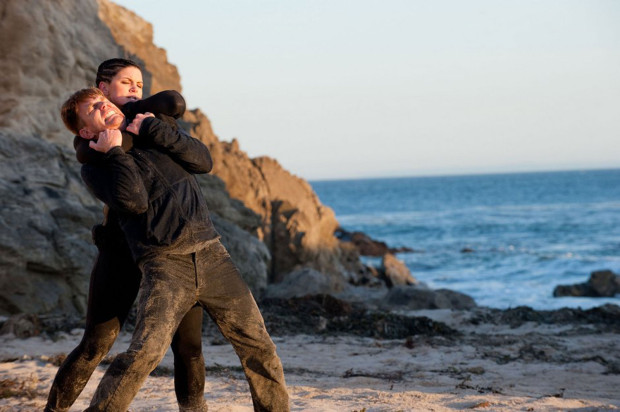
    Malory Kane (Gina Carano) is our superhuman, the focus of a plot that aims to take her out. As Haywire opens, shes sitting in a cafe in upstate New York, sipping tea. Before she has time to finish her cup, she’s locked in a brutal fight with Aaron (Channing Tatum), a man she worked with on a project in Barcelona. A good samaritan (Michael Angarano) hands her the keys to his car, and the two speed off for Parts Unknown, Kane narrating her story to the mostly terrified teenager. The story is simple enough. Kane’s a contractor who works for a private firm that governments hire out to glean information, recover lost assets, rescue dissidents—spy business. She’s requested to be a member of a team extracting a hostage from Barcelona. Her boss, Jeremy (Ewan McGregor), is hesitant at first, but when his employers—U.S. governmental employee Alex Coblenz (Michael Douglas) and Rodrigo (Antonio Banderas), a man with no specific origin—agree to certain contractual details, Kane is put on the case, the hostage is rescued, and all is well. Or so it seems.

    It happens that Jeremy’s business is wholly reliant upon Malory Kane and that, after the dissolution of their personal relationship, Kane is looking to get out of her business obligations with him, as well. First, he gets her to agree to an assignment that’s pretty much a “paid vacation,” a chance to persuade an agent to join Jeremy’s team while at the same time making contact with that agent’s mark under the guise of being a power couple. That agent, Paul (Michael Fassbender), has been assigned to kill the hostage Kane rescued, plant evidence on the body pointing to Kane, then kill her, making it look like an act of self-defense. Simple enough, except that Kane ends up killing him and going on the run, making her way back to the United States to clear her name, uncover the conspiracy against her, and gain a measure of revenge.

    Haywire‘s frequent action set pieces are engaging, covering all the bases. Across rooftops, on foot, and behind the wheel of a car, it’s clear that there’s nobody like Malory Kane, who, when she is brought down, succumbs only to the sheer number of people set against her. Soderbergh’s films, regardless of how kinetic they often feel, rarely move like Haywire, which has a fluidity and clarity of vision rarely afforded to a typical thriller. There’s an effortless cool to the way he films Carano chasing down her prey, jumping from roof to roof, and employing her dazzling array of mixed martial arts maneuvers.

    Speaking of Carano, this is her first feature film, though it would be surprising were this to prove her last. Carano is granted quite the set of crutches in Haywire: she’s guided by McGregor, Douglas, and Bill Paxton (as Kane’s father), prodded by Banderas, and romanced by Fassbender and the great lunkhead Tatum, who, given this film and his self-effacing turns in 21 Jump Street and Magic Mike, is perhaps smarter than anybody has yet to give him credit for. Though she sometimes looks out-of-depth when standing across from somebody the caliber of Michael Douglas—it’s worth pointing out that whatever charisma she possesses has, thus far, only been used in brief flashes during pre- and post-fight interviews and press conferences—she mostly holds her own.

    It helps that Soderbergh is a director who’s proven masterful at identifying and exploiting the strengths of his cast. The choice of Carano in this role is no less unusual than, say, his choice of Sasha Grey as an escort, and Carano’s fighting skills are put to good use here, the reality of maneuvers like the cross armbreaker and the triangle choke only further embellishing the punishment she deals out. Tatum’s character has his arm broken in Haywire‘s opening sequence. Watching Carano swiftly grab his arm and snap it back, it’s little wonder that Tatum later appears in a cast, arm hanging useless at his side. Here, it’s the little flourishes of realism that matter, that paint Carano as a budding star as opposed to a neat little stunt casting. Like her character, it’s clear that Gina Carano can do things no other actress is capable of. So long as she avoids becoming a female Expendable, her presence in the genre can only change it for the better.


    Haywire. With Gina Carano (Malory Kane), Channing Tatum (Aaron), Ewan McGregor (Jeremy), Bill Paxton (John Kane), Michael Fassbender (Paul), Michael Angarano (Scott), Antonio Banderas (Rodrigo), and Michael Douglas (Alex Coblenz). Directed by Steven Soderbergh from a screenplay by Lem Dobbs.

  • Movie Review: Magic Mike (2012)

    Movie Review: Magic Mike (2012)

    Magic Mike is a movie about strippers. It is not, however, a movie about stripping. That’s an important distinction to make, as a movie about stripping, as proven by all movies about stripping, would get old fast. Gyrating to the right or to the left, dancing with a skinny girl or an old woman, dressed in trenchcoats or loincloths, the stripper still strips, his function is still to take off clothes, his biggest conflict is with a caught zipper, a button that won’t unsnap from his tearaway pants. Make no mistake, Magic Mike is quite knowledgeable in this field, but Steven Soderbergh‘s film—based on its star’s experiences on the stage—knowingly subverts its audience’s expectations, presenting a melodrama where the stripping is a glitzy side dish, something that threatens to steal both the audience’s attention and the protagonist’s autonomy. (more…)