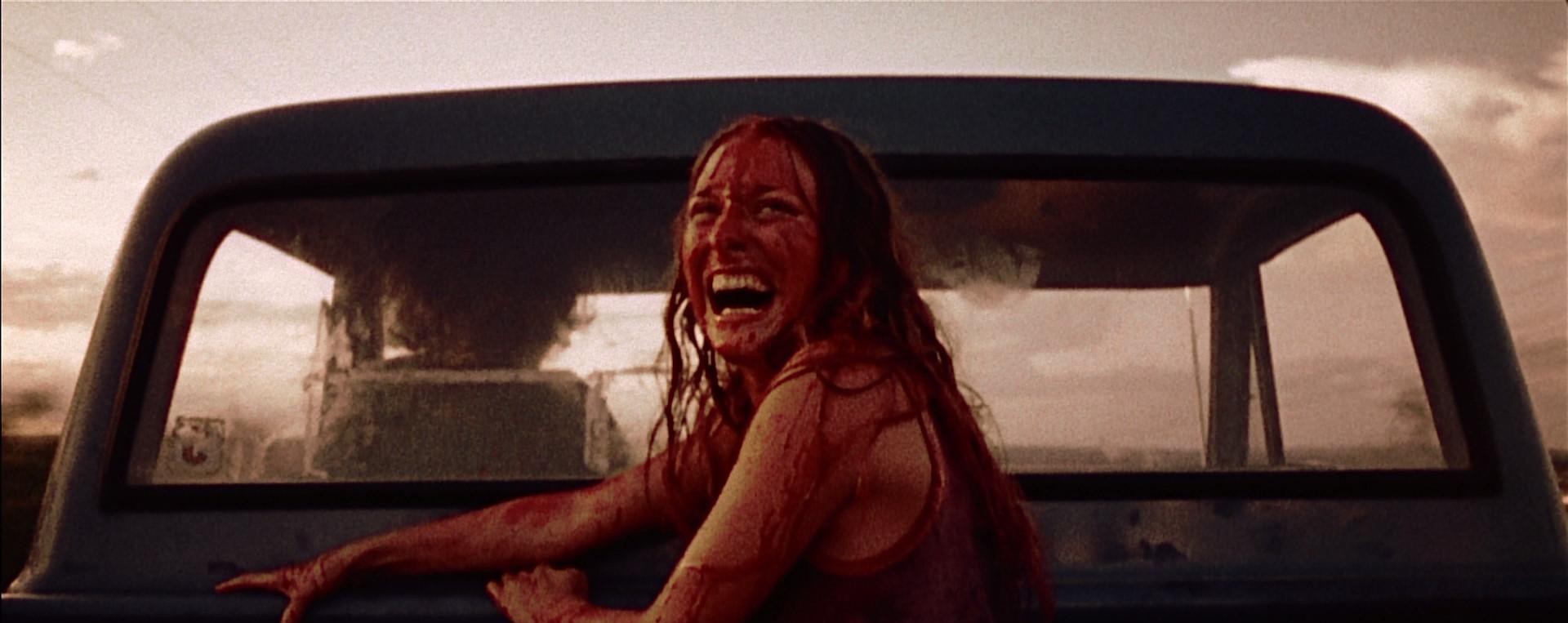
Forty years later, The Texas Chain Saw Massacre shouldn’t be as powerful as it ultimately is. Tobe Hooper’s film is written in the bones of anybody who has even a slight appreciation for horror, and has been diminished by sequels and remakes and the continued recycling of its plot and scares. When I saw it recently at an anniversary screening, the audience spent much of their time laughing. Until Leatherface. With his hammer. With his mask. With his chainsaw. The plight of young adults looking to screw speaks to the young, I guess, but a man wearing another person’s skin over his face? That’s universal terror.
The film is unsettling from the opening note of its score, which is set against the title card’s laughable claim that the young men and women who found their way into Leatherface’s clutches were enjoying an “idyllic summer” (because the idylls of youth are often spent wondering if your grandfather was dug up by a cult of art-maniacs and pissing into a bottle on the side of the freeway). The first shots are disorienting, a sequence of flashbulbs casting an intense, brief light on rotting meat. Human meat. A corpse in the awful Texas summer. There’s nothing right about the world here, and yet, for the kids assembled in that van, there’s nothing to do but move forward. The worst is always behind them until it’s right there, screaming and swinging his chainsaw.
It’s never clear why Sally Hardesty (Marilyn Burns), her brother Franklin (Paul Partain), and their friends (Allen Danziger, William Vail, and Teri McMinn) decide to stay the night at the old Hardesty homestead. They’re out of gas (because of course they are) and the closest station won’t have any until morning, but the house they’re planning to sleep in is a husk (because of course it is) and their van is smeared with the blood of a lunatic hitchhiker, who slashed Franklin with a straight razor after terrifying everybody in the van by pulling faces and cutting open the palm of his hand. They can’t leave, but it doesn’t seem like they want to. Texas is gritty and hot, a miserable, sick place where people tailgate at the local cemetery, but the Hardestys can’t help where they are, nor what those places do to them.
This is America, Hooper’s film argues, a brutal land that hides away its psychopaths in places where they can quietly maim the innocent. It’s an argument made more visceral by the conditions the film was shot under—brutal sixteen-hour days in excessive heat, with no pay up front. The sweat, exhaustion, exasperation, and terror is real. But the screening I attended would seem to suggest that these things no longer hold sway the way they did in 1974. The audience laughed at the crazed hitchhiker (Edwin Neal), Grandfather (John Dugan), Old Man (Jim Siedow) and Leatherface (Gunnar Hansen) in drag; twice—when the opening scene reveals the corpse art, and when the family has Sally over for dinner—a man raised a digital camera to his eye and took pictures of the screen. As The Texas Chain Saw Massacre was creating its grim spectacle from ramshackle houses and chicken bones, I found myself as agitated by the crowd watching the film as I was by the film being watched.
The Texas Chain Saw Massacre is not a film that allows its audience to get comfortable for long, though. Leatherface’s murders are too brutal for that, deftly edited so that the shock of seeing a man get clubbed by a hammer quickly moves to the nausea of watching him twitch on the ground. Though its influence is unmistakable, few American slasher films work to this level. Its elements—the houses, the masks, the power tools, the fresh-faced victims—are endlessly transplanted, but are powerless when divorced from their original context. Its descendants play up the camp or the gore, gaze longingly at the bodies of those wandering into hell, or are completely undermined by the utter clarity of digital cinema. The Texas Chain Saw Massacre warns the audience that the events it is about to see are real, then presents those events through so many layers of grime and filth it’s hard to believe that anybody left the set unscathed. If the image of the family gathered around Sally at dinner seems ridiculous in 2014, the shots it is cut with—Sally’s eye in extreme close-up, widened and darting around the room for a means of escape—cast that image as real; the eye screams though she doesn’t. Her eye screams even if we refuse to scream along with it.
Finally, we are left with Leatherface, dancing with his chainsaw in the morning sun. Are there many horror films that do their gristly work in the daylight? Or with such unsettling beauty? Made on a paltry budget with limited physical resources, Hooper and cinematographer Daniel Pearl subtly shift gears from the docu-realism of the graveyard scenes to the grotesque tableau of Leatherface’s murders so that it all feels unmistakably real, even when a man in a bad latex mask is feebly trying to live up to his reputation as the best killer at the old slaughterhouse. Far from operating under the pretense that a good murder or two is all that it needs to be memorable, The Texas Chain Saw Massacre revels in a miasma of sick, miserable images. It takes a prism to our world and twists it something awful, but manages, even in its darkest corners, to delight and disgust the viewer, often in the same frame.
The Texas Chain Saw Massacre. With Marilyn Burns (Sally Hardesty), Paul A. Partain (Franklin Hardesty), Allen Danziger (Jerry), William Vail (Kirk), Teri McMinn (Pam), Edwin Neal (Hitchhiker), Jim Siedow (Old Man), and Gunnar Hansen (Leatherface). Directed by Tobe Hooper, from a screenplay by Hooper and Kim Henkel.
Last night, I watched wrestling. This is admittedly nothing new. Since the advent of the WWE Network, I watch wrestling every day, sometimes for hours. I’m writing a book of poetry about wrestling, I run a few Tumblrs about wrestling—it all comes with the territory. But last night I watched Raw, which I haven’t gotten a chance to do much this summer because the work that I’ve done this summer and the reason I do it often leaves me scrambling to bask in the warm glow of nostalgia. Though I can’t imagine a scenario where my friends and I don’t gather in my new house to watch the WWE Network’s less-than-stellar stream of Summerslam this Sunday, anything going on right now serves as a less-than-welcome reminder that soon enough I’ll be sitting down in front of a computer to listen to the rich talk about the problems inherent with having only a million dollars put away in an IRA. But it’s Hulk Hogan’s birthday, and even though The Hulkster now exists largely to talk about the virtues of the WWE Network (which, at 700,000 subscribers paying $9.99 a month to watch video footage Vince McMahon acquired for pennies on the dollar, is somehow considered a failure because the world of business has rules as made up, impenetrable, stupid, and fake as professional wrestling), I love the big orange bastard and always will. True fact: I went to WrestleMania XXX this year mostly because I wanted to see a 60 year old man rip his shirt off and flex his ancient muscles. When he messed up and called the Superdome the Silverdome (where he body slammed Andre the Giant some 27 WretleManias earlier), I was the only person in the arena not booing, because that was my WrestleMania, brother. The one in Detroit. The one that set the records. The Greatest Night In the History of Our Sport.
I had to get through three hours of Raw for Hulk Hogan’s birthday celebration, which, frankly, is insane. Exactly zero things on television this side of a holiday marathon of The Twilight Zone should last three hours, but that’s exactly what Raw does: It lasts. It staggers. It lurches. It finishes, out of breath and somehow overtime, maneuvering its various pieces around in an effort to hide the fact that nothing is happening. The recurring theme of an episode of Raw these days is the price point of the WWE Network, where, oddly, you can’t watch Raw, because even though Vince McMahon has cast his lot with the future, he still finds his business shackled to the mediums of the past. 700,000 is, to me, an impressive number of human beings who are willing to pay for access to a staggering number of frankly mediocre wrestling shows, but the last I checked, the average episode of Raw manages to pull in 3,000,000, and they sit through ads for things like Juicy Drop Pops and Sonic Chili Cheese Dogs. They’ll sit through the not-infrequent advertisements that air during an episode of Raw, too, where the comedic wrestlers on the show shill food or beverage in a way that makes me wish I couldn’t ingest things. But I can, and I do. Often during wrestling. Tonight, it was curry. Sunday, when my $9.99 will allow me to watch Summerslam? Who knows? Summerslam was the focus of tonight’s episode of Raw, as all of the men and women who will have matches on the show did their bit to advance their storyline to the point where that match would take on some semblance of meaning. Some of the matches on Summerslam, you can tell, are just there to eat the clock. While I know a lot of people are looking forward to Dean Ambrose vs. Seth Rollins, and while I suppose it makes a certain amount of sense that a feud based on one man’s quest to hunt down another who keeps running away would come to a head in a lumberjack match—that’s a match where the ring is surrounded by the wrestlers who will not be wrestling that evening—Ambrose and Rollins work much better when they have the arena as their playground. Similarly, an old-school Russia vs. USA Flag Match—the winner is the man who retrieves his flag from a pole that rises high above the ring—seems like a fun idea, but the WWE writer’s room stopped having interesting-if-poorly-informed things to say about the current political situation in Russia a few months ago, and Tea Party Patriot cum hirsute manager Zeb Coulter (picture Yosemite Sam on a fly fishing trip) constantly making reference to Rocky and Bullwinkle isn’t going to make Rocky IV feel any fresher in 2014.
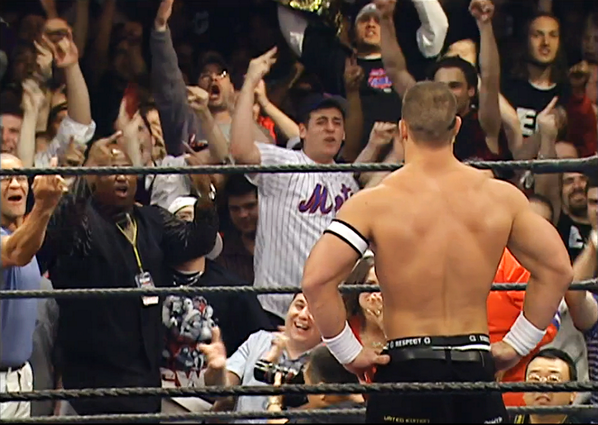
But WWE can do a remarkable job of promoting a big match, and that is the axis upon which Summerslam revolves, the WWE World Heavyweight Championship clash between 15-time champion John Cena and unleashed Kraken Brock Lesnar. I like John Cena. I really like John Cena. I think the first John Cena match I saw was against Rob Van Dam at a WWE-produced revival of Extreme Championship Wrestling, a 90s entity that is responsible for revolutionizing wrestling in a number of ways large and small, one of which was to turn every professional wrestling fan over the age of 25 into an overly-entitled rage monster. I wasn’t watching wrestling much in 2006, but I remembered and liked ECW, so I went to a Buffalo Wild Wings in Taylor, Michigan to watch the somewhat local ECW legend Van Dam (from Battle Creek, MI) finally ascend to the WWE Championship (something I’d “borrowed” my mom’s credit card a few times to see in 2001, though Van Dam never clinched the title). ECW One Night Stand took place in the Hammerstein Ballroom in New York City, which was a major hotbed for the organization when it was a real thing and not a marketing tool, and which remains a magnet for large independent wrestling events to this day. When John Cena’s music hit, 2,460 adult human beings really got on John Cena’s case for daring to be a professional wrester. He wore jean shorts, sneakers, and useless sweatbands, sure, but watching Cena go to work in that environment, 2,460 human adults chanting things like “Cena swallows” (a “hardcore” addendum to the time-tested chant of “Cena sucks”), I was won over by him immediately. By the time the people in the Buffalo Wild Wings, several thousand miles from New York City, started joining in on the chants emanating from the Hammerstein Ballroom, I knew I had a new favorite wrestler.
And so it’s been for me since then, which is a decision that’s treated me well. I’m into wrestling for the wrestling matches these days, and more often than not, on big shows, against big opponents, John Cena has one hell of a match. My favorite John Cena match in the past few years was the one that he had against Brock Lesnar at Extreme Rules in 2012, a stupidly named and often poorly booked show of “hardcore” matches that exists as a way to get a few thousand extra orders on a show that isn’t WrestleMania or Summerslam and that should go away post-haste, since the WWE Network exists, and, for $9.99, I’d watch WWE Singles Match if that’s what they wanted to call the damn thing. Cena vs. Lesnar had happened before, when John Cena was new and Brock Lesnar was thinking about quitting wrestling to try out for the National Football League, but I wasn’t watching and neither man was the symbol they’d become by the time 2012 brought Lesnar back to the world of fake fighting. Cena was the face of the WWE. Lesnar had gone legit, capturing the UFC Heavyweight Championship and maneuvering that sport towards an atmosphere that looked and sounded a lot like WWE, just without the benefit of goosed narratives. Diverticulitis took Lesnar out of the UFC, and a gigantic contract brought him back to a limited schedule of dates for the WWE. Now he functions much like Godzilla: When a major event comes around, he surfaces, wrecks a bunch of stuff, and leaves. He is the closest thing we have on this planet to a legitimate movie monster, and he is a glorious thing to behold. I love John Cena, but I want to see Brock Lesnar break him in half. I want him to make it look easy, like he’s hanging out on his ranch, shooting rifles with his brother, and eating a pile of terrible submarine sandwiches. Because John Cena is at his absolute best against guys like Lesnar, who are so good at the work they’ve been put here to do that they hate that work and the people who’d pay to witness it. Cena is great when he has to work for something, and ridding the WWE of the guy who crushed The Undertaker at WrestleMania, whose 21-0 streak going into WrestleMania XXX was the only thing in wrestling that could be said to mean more than any given title, is the only something left.
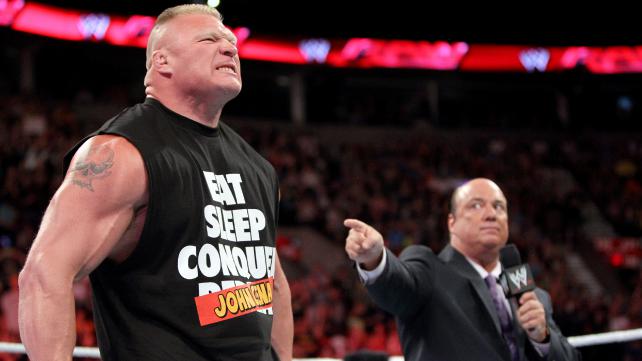
This episode of Raw presented something of a debate between Lesnar—represented by his advocate, Paul Heyman—and Cena; two extended interview segments that were both quite good. Heyman rapped, which, when you’re a 48-year-old man who was once prominently billed as “The Psycho Yuppie,” sounds more like Dr. Seuss than N.W.A., and Cena spoke largely about passion, how he has it, and how Lesnar’s lack of it means that he doesn’t deserve the WWE World Heavyweight Championship. Heyman hit his peak a few weeks ago when he brought Lesnar out as the man who would conquer John Cena’s 15th reign as champion and has been coasting a bit since—making fun of Cena’s origins as the horrible white rapper from the mean streets of West Newbury has been a thing since Cena was that character—but that’s kind of the point. He’s the dude standing behind King Kong. He doesn’t need to try very hard, because even a subpar effort from Paul Heyman on the microphone is museum quality compared to anybody else in the game.
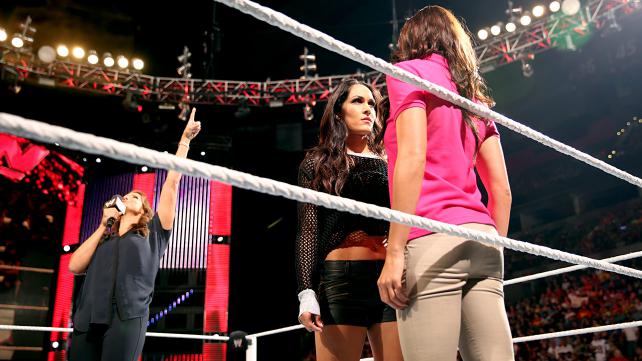
This was made painfully obvious by the evening’s other large piece of non-physical storytelling, the ongoing saga of Brie Bella and Stephanie McMahon. An offshoot of last summer’s program that saw the rise of bearded populist hero Daniel Bryan in the face of a heartless corporate power structure that didn’t get why arenas across the country were making a big deal out of a guy they’d branded “goat face,” Bryan’s triumph at WrestleMania XXX (he beat Triple H, the head of the Authority, and then defeated Randy Orton and Batista to become the WWE World Heavyweight Champion) quickly turned sour, as his father died and he suffered a severe neck injury. This has caused him to relinquish the championship and largely disappear from television as he rehabs en route to an eventual return. Since, they’ve shunted the Bryan vs. Authority storyline to Brie Bella and Stephanie McMahon, the wives (in reality and in wrestling) of Bryan and Triple H.
Sometimes, when Stephanie McMahon is leading Brie through segments, everything is fine. Stephanie McMahon has grown considerably as a character over the past 15 years of her being in the spotlight, and is perhaps the second best Evil Boss character in the history of the medium, behind only her father. Brie Bella…is not good at talking. That’d be fine in a reality television show, where she actually thrives, but in a storyline that requires her to garner sympathy from an arena full of angry dudes, it’s going to take more than blackmailing the boss and calling her a bitch every week to get people invested. So this week, Stephanie brought out Daniel Bryan’s personal trainer, who awkwardly admitted to having an affair with the former champion, Brie’s husband, etc. This was, I guess, supposed to embarrass Brie Bella, but the segment was mostly terrible because, for starters, the woman playing the physical therapist was an atrocious actor even by wrestling standards. McMahon intimating Bryan’s cries “Yes! Yes! Yes!” in a tone suggesting the fake pornographic moans of an Herbal Essences commercial was funny, and I guess it makes sense that a heel would resort to slutshaming (the poor physical therapist is there in the corner watching McMahon imitate her during sex) in an effort to make the live fans cheer for Brie, but I checked out on this angle around the time McMahon was thrown into a gigantic kiddie pool of human waste, and whatever loyalty I have to Daniel Bryan doesn’t automatically transfer over to his spouse, because that isn’t how well-developed characters are created. Still, McMahon vs. Bella is the second most important match on the second most important show on the WWE calendar, and the crowd absolutely eats it up whenever the two get into a physical confrontation. There’s probably something to be said about the fact that these confrontations have been built around the signature moves of their husbands, but I’m not swimming through the kiddie pool of human waste to retrieve it. Therein you’ll probably also find a salient point about the biggest insult hurled by McMahon or Bella, beyond “bitch,” is the insinuation that Brie Bella is not good at sexually satisfying Daniel Bryan, which is, I guess, the job you sign up for when you get married.
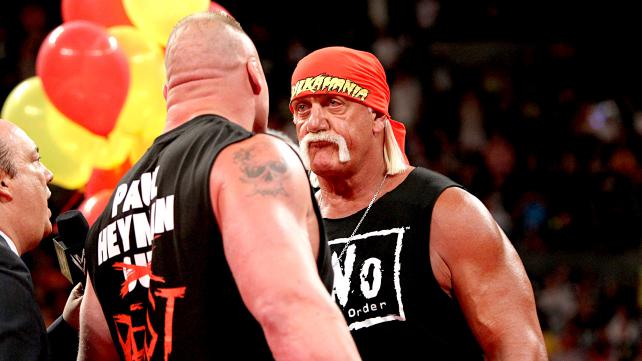
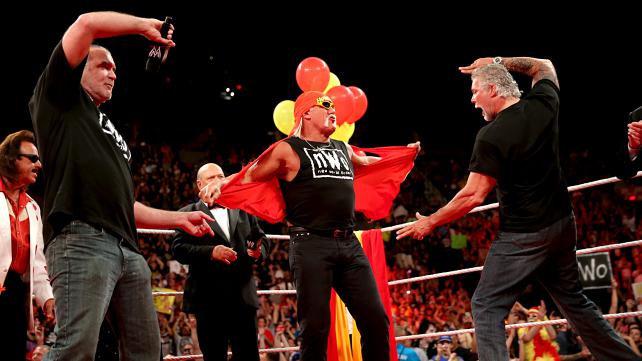
Finally, Brock Lesnar crashed Hulk Hogan’s birthday party, because of course he did. “Party’s over, grandpa,” he said, leering like the villain of an 80s film. Brock Lesnar is there to beat up the collective childhoods of everybody in that arena—beyond Hogan, the ring had filled with Roddy Piper, Ric Flair, the nWo of Scott Hall and Kevin Nash, “Mean” Gene Okerlund, Jimmy Hart, and “Mr. Wonderful” Paul Orndorff. John Cena saved the day, because of course he did, but that doesn’t matter much. Nothing happened between he and Lesnar, because that can wait until Sunday, until Summerslam, until you’ve given up $9.99 for it and the rest of the card. Before those two had their final confrontation, and before all of the old-timers came out and Scott Hall had a bit of fun running through his old nWo catchphrases and Hogan ripped off his red and yellow Hulkamania shirt to reveal the black and white New World Order shirt beneath, Gene Okerlund directed Hogan’s attention to the video screen, where a legitimately touching tribute to Hogan played. It was set to Bob Dylan’s “Forever Young.” Hulk Hogan is 61 now, and while he can come out and run through the catchphrases and rip his shirt off and do the same bodybuilding poses I saw as a four-year old, he’s never going to wrestle again. Time has officially caught up to Hulk Hogan, and seeing clips of him dropping leg after leg to Dylan was strange at first, somehow dissonant to what Hogan was, until it hit me that, well, it kind of fit. The Ultimate Warrior died this year. Randy Savage died in 2011.”When you turn 61-years-young,” Hogan said, bringing down the energy after mustering a bit of that vintage Hogan hype, “you start to reflect back on a few things.”
Nothing Hogan could say on a night that ended with him cutting into a birthday cake festooned with candles spelling out “9.99” was going to reach the zenith of what turned out to be the final public appearance of The Ultimate Warrior, but last night, The Immortal Hulk Hogan pondered his mortality. And while the footage of his staring down Brock Lesnar will likely be replayed over and over for the next year, if not longer, the fact that there was no physical altercation between the two—not even Lesnar shoving Hogan to the mat, which would have blown the roof off of the building—speaks volumes about what Hulk Hogan is capable of in 2014. Hulkamania may be willing, brother, but all the training, prayers, and vitamins in the world can’t stop time. Beyond a paycheck, this is why someone like Hulk Hogan might be interested in forking over $9.99 for the WWE Network. Not for Summerslam, which will be there regardless, but because he’ll be dropping legs and shredding t-shirts on it forever, immortal, as promised. For a wrestler—for the wrestler—that’s not a bad legacy.
Results:
Paul Heyman addressed Brock Lesnar’s upcoming match against John Cena by “rapping.” Since he did so without a beat, one could even say he freestyled.
Bray Wyatt and Chris Jericho had a face-to-face confrontation that was lifted entirely from The Silence of the Lambs.
Seth Rollins def. Rob Van Dam via pinfall. After the match, Dean Ambrose emerged from a giant gift box to attack Rollins, who ran away through the crowd.
Stephanie McMahon interviewed Daniel Bryan’s physical therapist, who admitted to having an affair with Bryan. This led Bryan’s wife, Brie Bella, to slap the therapist and attack McMahon, putting her in Bryan’s signature finishing maneuver, the Yes! Lock.
Jack Swagger def. Cesaro via submission. He then stared down Rusev, their inactivity a metaphor for the Cold War.
Eva Marie def. WWE Diva’s Champion AJ Lee by pinfall due to a distraction by Paige, who then read a terrible poem to mock her “frienemy,” which is an awful word to hear a trio of middle-aged men repeat seven or eight times in six minutes.
John Cena called out Brock Lesnar, who did not respond.
Brie Bella vs. Stephanie McMahon did not occur, as Brie Bella was arrested for assaulting Daniel Bryan’s physical therapist.
Hulk Hogan’s birthday party was interrupted by Brock Lesnar. The assembled old folks there to celebrate Hogan’s 61 years of Hulkamania running wild were saved from a beating by John Cena. Rather than fight, Lesnar ditched the ring, saving the inevitable clash for this Sunday’s Summerslam.
Rating:
For no reason other than that they played him down to the ring to it last night, be sure to listen to Paul Orndorff’s brilliant theme song:
First, I’d like to acknowledge that the mere existence of a movie likeG.B.F.is a good thing. Maybe it’s because I wasn’t looking hard enough (or at all) as a teenager, but there haven’t been many gay high school romantic comedies created for a mainstream audience. They existed at the fringes of culture, no doubt, but not to someone whose key to the world of cinema was a Blockbuster Video membership card. Even as the genre has progressed and films are more accessible due to the rise of Netflix and VOD, the LGBT community has mostly sat this one out: for various reasons, lesbians, bisexual men and women, and trans men and women (not to mention folks all across the spectrum) have largely been erased from popular culture (when a show like Orange Is the New Black is a success, this is the exception), and gay men are mostly there as sidekicks, ready to roll their eyes at a moment’s notice. We live in a supposedly post-everything society, and this is still how culture presents people outside the margins.
So it’s good, then, that G.B.F.exists, and that it opens on a group of friends comprised thusly: two gay men, one queer woman, one straight man of color. This is not the way characters in this genre are grouped. This may be the first group in so heavily and innocuously queered. This is vital because representation is vital, and because, too often, marginalized groups aren’t represented at all. And this is cinema we’re talking about. Gay, liberal cinema. It’s important to have a gay romantic comedy because But I’m A Cheerleader came out in 1999. Because Glee is one television show, and one is nothing. Because it’s nice to have a film that doesn’t begin, climax, or end in tragedy. G.B.F.wastes no time at all in letting you know that things are different. The opening credits feature a panda vomiting rainbows. This, the panda roars, spewing hues of pride across page after page of a high school yearbook, is gonna be gay. Only instead, this is just another bad high school comedy. This one just happens to sting a bit more.
It’s not enough, I think, for a movie to have good intentions. When I first heard about G.B.F., it was in the context of its MPAA rating, which is R, and how that rating might prevent some kid who needs a movie like this in their life from seeing it. This isn’t far outside the realm of possibility—the documentary This Film Is Not Yet Rated makes abundantly clear the kind of hell liberal censors put artists through; poor John Waters, after screening A Dirty Shame for the board, was told that, after awhile, they simply stopped counting the film’s infractions. While an R rating is hardly as damming now as it was before the internet made it possible to acquire everything regardless of entities like the MPAA, the R rating is the province of teen sex movies where sluggish miscreants get hammered with their mutant pals while trying to have sex with some object the dictionary calls “woman,” not that of the sweet-natured romance G.B.F.is marketed as. There’s a point to that, of course, but presuming G.B.F.was released with a PG-13 rating, it’d likely be the only one that drops a word like “jizzbin” as a casual means of describing one of its characters.
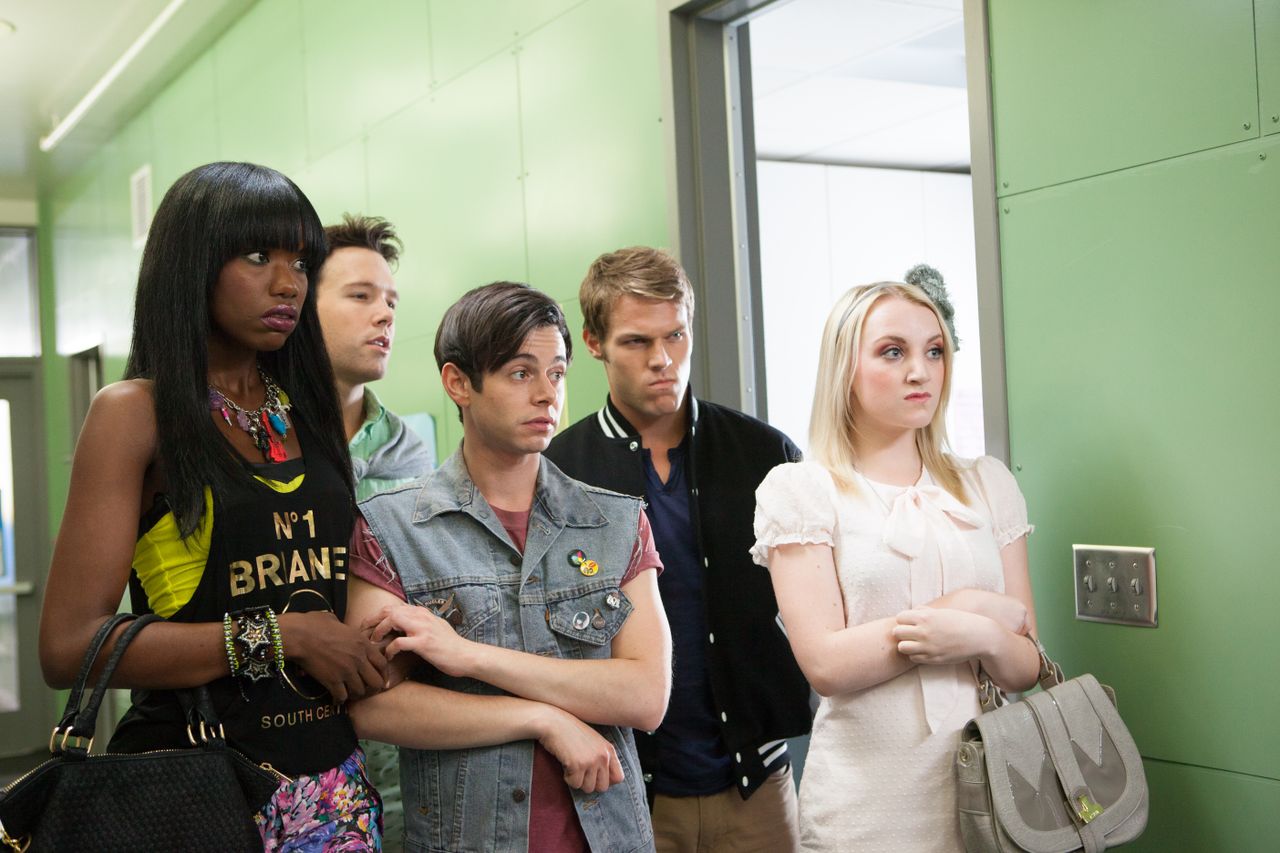
Not to act as the tone police or anything, but G.B.F. issurprisingly mean-spirited for what it’s meant to be, or, I suppose, what it could have been. In the history of North Gateway High School, there’s never been a publicly gay student. There’s a smattering of them, sure, all obviously gay (though nobody in the film can parse this, short of the parents back home) but none of them are out. When a teen rag reports that gay best friends are on trend, one of those students in the closet plans to come out, hoping to leverage that article into a role as sidekick to one of the three most popular girls in school. Tanner Daniels (Michael J. Willett) is this closet queen’s accomplice, an also-in-the-closet kid who’d rather read comic books and not get beaten up than climb to social ladder. But when a series of contrivances leads to the school’s Gay-Straight Alliance outing him (they need an actual, living gay person in the group for it to exist, or something), he becomes the first and gains all of the privilege and esteem and makeover montages that come with that designation.
There are a number of topics here that are worth talking about, all of which are frequently glossed over in many discussions about gay rights. The pressure placed on an individual to come out, the sometimes detrimental actions of allies—heck, just growing up gay in a society that now “accepts” that—but G.B.F.has 90-minutes to play with and no interest in the details it uses to race to the finish of its cut-and-paste plot. Prom is coming up, after all, and to be its Queen, one of those three popular girls will have to play hag to the school’s lone fag. In a movie replete with stereotypes, these three can be labeled thusly: The “White” One, The “Mormon” One, and The “Black” One. You can assign these labels to all of the primary characters—The “Gay” One, The “GAY” One, The “Lesbian” One, The “Mormon” One Who Is in the Closet—without exaggerating how poorly the screenplay understands teenage culture; everybody is as fake as the Bucci sweaters they wear.
There is some sweetness here—Megan Mullalley shows up as a mother who has been waiting for some time for her son to tell her that he’s gay—but it is largely wasted; everyone in G.B.F.is beautiful and the biggest consequence anybody has to face for racism, sexism, or homophobia is that they’re not invited to the cool kid prom…but then everybody is anyway, and the world keeps on spinning. A better script wouldn’t necessarily have made G.B.F. a good teen movie—the direction is much too flat, and none of the adult roles register much higher than celebrity cameo—but that’s the major sticking point here, that the “teenage voice” adopted here is curdled to the point of bitterness. The result is an awkward, gawky prom date who means well, but keeps saying the wrong thing. Loudly. If this is what a gay teen comedy looks, sounds, and acts, maybe the genre isn’t ready to come out of the closet.
G.B.F. With Michael J. Willett (Tanner Daniels), Paul Iacono (Brent Van Camp), Sasha Pieterse (Fawcett Brooks), Xosha Roquemore (Caprice Winters), Andrea Bowen (‘Shley Osgoode), Evanna Lynch (McKenzie Pryce), Natasha Lyonne (Ms. Hogel), and Megan Mullally (Mrs. Van Camp). Directed by Darren Stein, from a screenplay by George Northy.
Katniss Everdeen has nightmares. This is important. This means something. Luke Skywalker blew up a space station that housed millions of men and women without shedding a tear. James Bond remembers the dozens of women slaughtered by association by naming martinis after them and glowering at the baccarat table. Bella Swan slurps blood from a Styrofoam cup. The Hunger Games: Catching Fire doesn’t allow its heroine much time to rest after her victory in the franchise’s titular organized bloodletting, but when it does, even her few moments of rest are shattered by memories of the Games. A nation believes they’ve gained a young star. In reality, they’ve rendered a young woman a hollow shell.
Having made history as the first ever co-winners of The Hunger Games, Katniss (Jennifer Lawrence) and Peeta Mellark (Josh Hutcherson) clearly suffer from PTSD. Twenty-two children were killed in the Games, and while they weren’t personally responsible for even the majority of them, they lived for months expecting knives in their backs, finding solace in the report of an unseen cannon. Back in District 12, they try to return to something like a normal life, but even if nobody from home treats them any differently for making it out of the arena, the state has relocated them to the district’s Victor’s Village, whose only other occupant is Haymitch Abernathy (Woody Harrelson), whose alcoholism probably makes a little more sense to them now. Though they barely know each other, Katniss and Peeta survived by convincing a nation that they were star-crossed young lovers. Thrust into the role of celebrity, they have to maintain that ruse before the cameras and the fawning millions in their living rooms. Both wonder if eating the poison berries that won them the Games would have been a kinder fate.
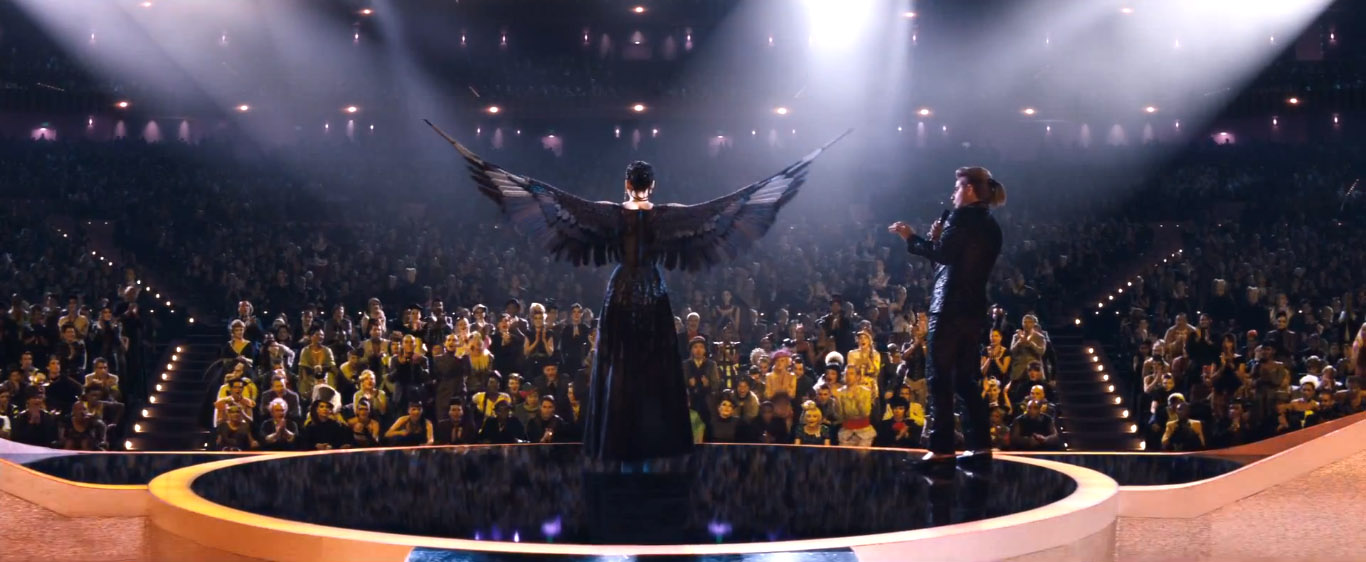
In victory, Katniss becomes a symbol, a sign to the downtrodden lower districts that they can rise up against the opulence of Panem, whose capitol houses the uber-wealthy who exploit the labor of the starving working class. President Snow (Donald Sutherland), who watched ambivalently as Katniss and Peeta upended the rules of his Games, takes a much more active role in Katniss’ life outside the arena. He meets her in District 12, threatening to kill her and her family and her actual boyfriend, Gale (Liam Hemsworth), if her act with Peeta isn’t convincing. Her happiness—or the perception of her happiness—may quell a brewing rebellion. This is a losing proposition. On the train to the Capitol, where a huge party is to be held in her honor, Katniss sees graffiti of the mockingjay symbol she’s become associated with and anti-government slogans. When she arrives in District 11, her and Peeta are unable to read the cards prepared for them by their PR rep, Effie Trinket (Elizabeth Banks), and instead give teary dedications to Rue, the little girl who died in their Games. An old man in the crowd whistles the call Katniss and Rue had and holds up a sign of the revolution. He is dragged before the stage and shot in the head. Katniss and Peeta read from the cards from that point on, but this scene continues to play itself out.
Catching Fire eventually makes its way back into the arena, but it and its predecessor are at their most interesting when exploring the kind of dystopia that would broadcast the life-or-death struggle of 24 well-armed children. While The Hunger Games only captured glimpses of the other districts, focusing largely on the Games themselves, Francis Lawrence finds the franchise’s heart beating in the districts. Lawrence, whose I Am Legend and Constantine were toothless sci-fi adaptations to whom the concept of mythmaking was alien, while not doing anything to rock the boat too hard, manages to craft a middle entry that does three things more expertly than many expensive sequels: feel larger than its predecessor, further define the characters, and improve upon what previously worked. Much of that is due to Jennifer Lawrence, whose Katniss is now a character and not an archetype. It’s still hard to believe that the star of these massive Hunger Games films and Oscar-baiting prestige ensembles like Silver Linings Playbook was in Winter’s Bone three years ago, and it’s something of an odd fortune that the trajectory of her career matches that of the character she’ll likely forever be identified as. In life, Lawrence gets Google news alerts when she steps out of the house with a new haircut. In Catching Fire, a pregnancy hoax involving her is nearly enough to end a seventy-five year tradition.
By involving Snow and featuring a new game maker (Philip Seymour Hoffman, playing himself as a D&D dungeonmaster with one of the series’ more ridiculous names), Catching Fire raises the stakes so high that the 75th Hunger Games’ twist—all of the competitors are surviving winners from Games past—feel trifling by comparison. Sutherland’s despotic President Snow is sniveling and arch in a way villains in movies this large no longer are allowed to be; watching him preen and glower like an evil, gay Santa Claus has been a highlight of the series. Hoffman’s Plutarch Heavensbee isn’t quite as dynamic, but he’s an upgrade over the original film’s focal point for Katniss Everdeen’s rage, who was mostly notable for his beard. Heavensbee is the architect of a plot to restore the districts to order by wiping out their symbols of hope. While it’s hardly subtle, watching him tell President Snow to broadcast speculation about Everdeen’s wedding dress and honeymoon location next to scenes of beatings and executions in the districts is the kind of specific, calculated evil action movies figure their audiences can’t handle. Here, the storm clouds never dissipate. If any sunshine is going to punch through, it’s sure taking its damn time.
All of which is nice, but ultimately somewhat empty. Catching Fire is somewhat hamstrung by its obligations to young adult literature in a post-Twilight world, which necessitates a go-nowhere love triangle between Katniss, Gale, and Peeta. Beyond the state’s intervention, there’s never a moment when one of the men in her life controls her, and in the arena it’s usually Peeta who is in need of rescuing. This makes The Hunger Games the standard bearer for love triangles done pleasantly enough, if that’s a standard worth bearing, but I can’t help watching the scenes where Katniss and Peeta pretend to love one another with an editor’s eye, wondering if it would have been more dramatic had two actual lovers been forced into the Games twice instead of two people who have to pretend for the sake of a narrative. Stanley Tucci returns as Caesar Flickerman, the voice of that narrative, and while he’s charming and funny in his role as the ingratiating host of The Hunger Games, success has made his character something of an ironic statement, simultaneously mocking the hosts and unearned grandeur of reality television talent contests while occupying a significant amount of space in a major Hollywood movie being used to shill everything from Subway sandwiches to Covergirl makeup. Not that Catching Fire had to inspire revolution to work, but if a major film harps on the need for its audience to question authority while simultaneously shilling for the footlong creamy sriracha steak melt—a delicacy the denizens of District 12 would murder you for the right to look at, let alone consume—how successful can that film be in realizing its ambitions?
The answer, of course, is very. Catching Fire’s ambition is to make money, and it is doing so hand over fist. The film rarely falters or falls short of being entertaining spectacle, but it’s telling that for all the scorn it heaps upon the rich for enjoying the bread and circuses of the Games, it never stops long enough to ask the same question of the audience in the theater. Intrinsically, one knows that the ritualized slaughter of children is a horrible practice. Perversely, The Hunger Games franchise films these long sequences not as a horror, but an entertainment. The kills are quick and clean and leave no blood. When the show’s helicopter arrives to dispose of a body, it is hefted into the air striking a messianic pose to a theme commissioned just for the solemnity of the occasion. Those who die in the Games are offerings to the state, sure, but are they not also offered up to us? Are we not somewhat culpable?
The Hunger Games: Catching Fire. With Jennifer Lawrence (Katniss Everdeen), Josh Hutcherson (Peeta Mellark), Liam Hemsworth (Gale Hawthorne), Woody Harrelson (Haymitch Abernathy), Elizabeth Banks (Effie Trinket), Lenny Kravitz (Cinna), Philip Seymour Hoffman (Plutarch Heavensbee), Stanley Tucci (Caesar Flickerman), and Donald Sutherland (President Coriolanus Snow). Directed by Francis Lawrence and produced by Nina Jacobson and Jon Kilik. Screenplay by Simon Beaufoy and Michael deBruyn, based on the novel Catching Fire, by Suzanne Collins.
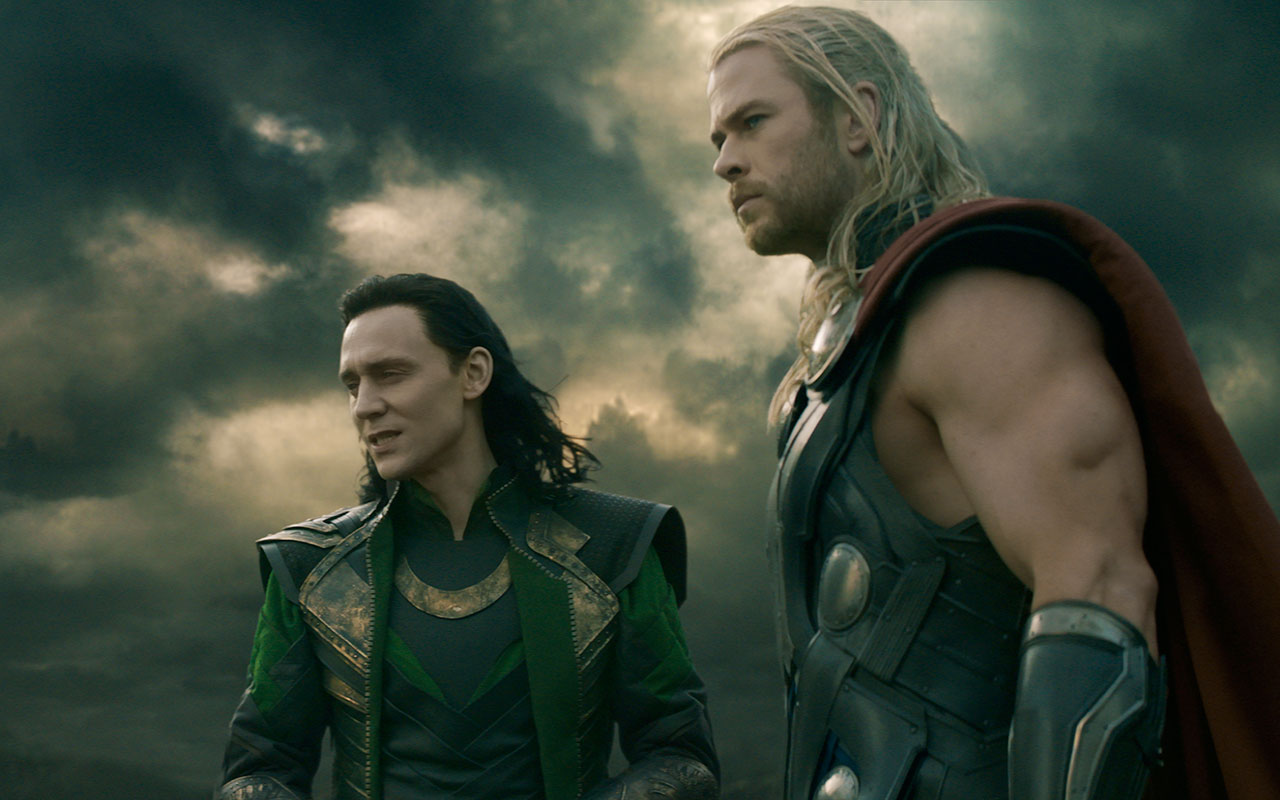
Thor: The Dark World is the year’s fifth superhero movie. That’s five different films where spandex-clad men bash in the brains of other spandex-clad men. Five films featuring speeches on subjects like truth, justice, and doing the right thing. Five films where one major city or another—sometimes fictitious, sometimes not—is turned into a smoking cinder by the gods who use it as an arena. The Thor films—counting The Avengers, whose villain Loki is central to the narrative of the entire Marvel cinematic universe, there have been three—have a decided advantage over other movies in the genre. In Thor, director Kenneth Branagh was able to find a nice balance between fish-out-of-water humor and action largely indebted (though unfortunately not monetarily so) to Jack Kirby. Thor: The Dark World director Alan Taylor wisely decides to spend much of his time exploring Thor’s celestial homeworld of Asgard. It’s a nice change of pace from a Marvel film’s usual focus on large, clean military installations and glittering R&D research laboratories, but even the best aspects of this movie aren’t enough to distract from what is now a very shopworn formula.
But if long-running network sitcoms and The Avengers franchise have proven anything, it’s that people like hanging out with their favorite characters, even if nothing truly significant happens. Thor: The Dark World does more with the fallout from The Avengers than Iron Man 3, did, sending Thor (Chris Hemsworth) planet-hopping with his warrior friends to quell the revolts stirred in the wake of Loki’s (Tom Hiddleston) rebellion against Odin (Anthony Hopkins) and his near-conquest of Earth. Odin’s helpful narration reveals that there’s a threat much greater than these rebellions, a long-lost cosmic weapon created by a race of dark elves upset that the Big Bang turned all the lights of the universe on. The opening scene—Norse gods crossing their swords and shields against the space lasers and gravity grenades of their elven enemies—is a highly polished mash-up of pulp sci-fi and hard fantasy paperback covers, but there’s nothing particularly creative or threatening about this largely faceless horde. Even their weapon—The Aether, which threatens to turn the lights off again—inspires a shrug of the shoulders. But when Thor’s girlfriend Jane Foster (Natalie Portman) finds herself the vessel of this cosmic power, the God of Thunder hastily arrives on Earth to whisk her away to the halls of Asgard, hopeful for a cure.
Of course, there isn’t one. Odin, clearly the most pragmatic man on a floating rock connected to the rest of the universe by a rainbow bridge, suggests that Jane’s malady is evidence of the difference between the fate of an Asgardian and the fate of a human, imploring his son to maybe fall in love with someone more suitable as Queen of the realm; Sif (Jaimie Alexander), for instance. But Thor: The Dark World doesn’t fool around with love for long. The Aether is something of a homing beacon, and its inhabitance of Jane Foster’s body sends a signal to the dark elves, who’ve long been asleep at the fringes of the universe. They storm Asgard furiously, laying waste to the city and killing Frigga (Rene Russo), the Queen. Odin vows to quash the elves, even at the cost of his realm. Thor, however, has other ideas. Hoping to save his people and Jane Foster, he reaches out in desperation to Loki, serving out a life-sentence in a rather nice-looking jail cell for his crimes, and plots a sneak attack on the elf Malekith (Christopher Eccleston) and his few compatriots who remain from the prelude’s long-ago war.
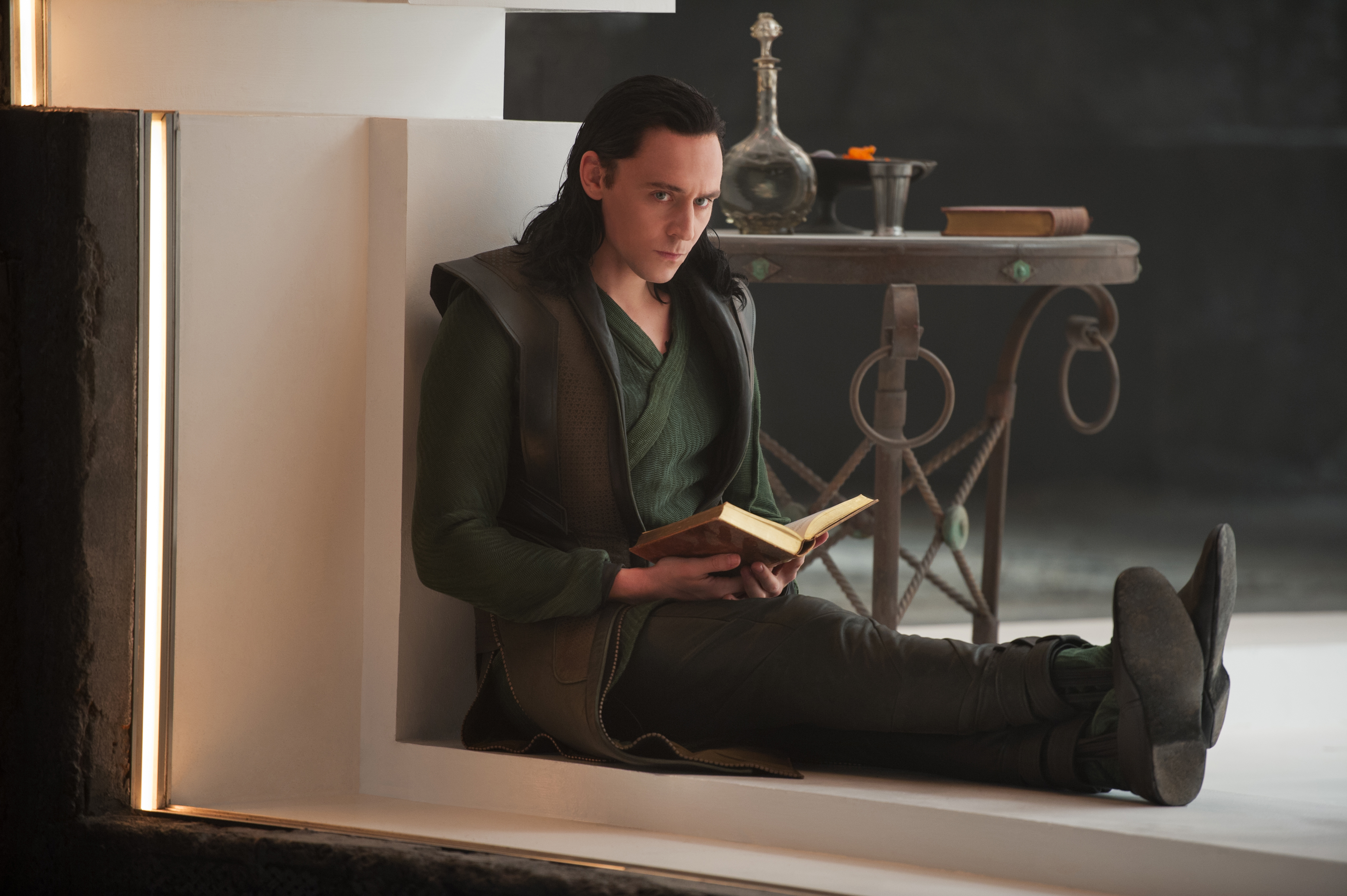
Of course, the real draw here is Hiddleston’s Loki, who is once again the most compelling, entertaining aspect of a Marvel film. This is causing something of a problem, narratively speaking, as all of the movies in this franchise have largely used even their heroes most iconic villains as one-off castaways, focusing instead on whatever piece of world-destroying technology they happen to possess. Loki’s popularity, which is potentially greater than that of any of the Avengers save Iron Man, virtually guarantees that he’ll continue to be part of the narrative, even as phases two and three of the Marvel cinematic universe provide ever-diminishing space for him. Thor: The Dark World flirts with making Loki something of an anti-hero. Sure he destroyed an entire town in New Mexico and most of Manhattan in a fit of jealousy, but he was pithy and funny while he did it, and he is burdened with issues of identity, purpose, and godhood in a world where he may be the only person smart enough to qualify as a psychoanalyst. While plotting his jailbreak, every character (and the audience) knows for a fact that any Loki/Thor team-up is doomed to end in betrayal, but they (and we) go along with it. For Asgard, Loki serves as an unlikely last hope. For the audience, the ambitious terrorist of the cosmos happens to be written in such a way that he seems like the most fun guy to have a drink with.
As for the film’s human ciphers—Foster, Erik Selvig (Stellan Skarsgard), and Darcy Lewis (Kat Dennings)—they’re largely inessential, shoehorned in because the final battle needs some recognizable faces running around in panic while the world burns. Portman, as Jane Foster, does her usual capable job, and a scene where she goes on a dinner date with some guy but can’t think of anybody but Thor is one of those fleeting instances where these movies actually address what it’d be like to be a normal human being in a world occupied by gods and monsters, but even with a cosmic entity flowing through her veins she’s little more than a combination damsel in distress/MacGuffin. The Selvig character has the most to do with the continuing story of The Avengers, though his function here as the world’s most brilliant man to have stripped nude at Stonehenge while muttering incoherently about Ragnarok is largely that of comic relief. Skarsgard and Dennings are given the film’s snappiest non-Loki dialog, but the film just isn’t as interesting when focusing on its earthbound characters, which, if anything, is an indication of how fully-realized Asgard has become, almost by accident. Jane Foster’s visit and the dark elf raid necessitates that a good deal of Thor: The Dark World‘s runtime takes place on Asgard, which, fantasy tropes aside, manages to feel like a real place. The plot doesn’t allow for much exploration of the realm’s tertiary Asgardians, which is something of a shame. I have a rough idea of what a political science major does, but a character like Heimdall (Idris Elba), who can see some ten trillion souls, probably deserves a better fate than serving as Thor’s Facebook app or failing at his job as gatekeeper.
Thor: The Dark World was perfectly enjoyable; not only was it the best superhero film of the year, it may be the best of The Avengers series. But these movies have quickly become a succession of James Bond adventures, right down to the credit text assuring viewers that THOR WILL RETURN in a year or so, whenever the next production requiring a blonde-haired, hammer-wielding meathead is mounted. The difference is that Thor is part of something larger and ultimately more organized than Bond or any other long-running franchise, and coming at a two- or three-a-year pace as these Marvel movies do, there’s less opportunity for Thor to distinguish himself from Captain America, let alone allowing Thor: The Dark World to stand apart from Thor. For now, audiences seem contented by these opportunities to sit down and catch-up with their favorite superheroes and villains. Manhattan may still be smoking, and Liverpool may lie in ruins, but nothing about Earth is fundamentally altered. There’s comfort in that, I suppose, but it’d be nice if a Marvel movie shocked the world by growing up a little, maybe by being something more than not terrible.
Thor: The Dark World. With Chris Hemsworth (Thor), Tom Hiddleston (Loki), Natalie Portman (Jane Foster), Anthony Hopkins (Odin), Christopher Eccleston (Malekith), Jaimie Alexander (Sif), Rene Russo (Frigga), Idris Elba (Heimdall), Stellan Skarsgard (Erik Selvig), and Kat Dennings (Darcy). Directed by Alan Taylor and produced by Kevin Feige. Screenplay by Christopher Yost, Christopher Markus, and Stephen McFeeley, based on the comic book Thor, created by Stan Lee, Larry Lieber, and Jack Kirby.
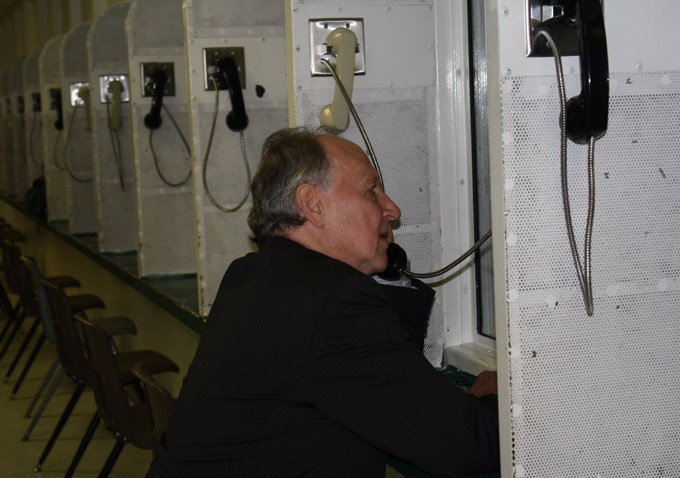
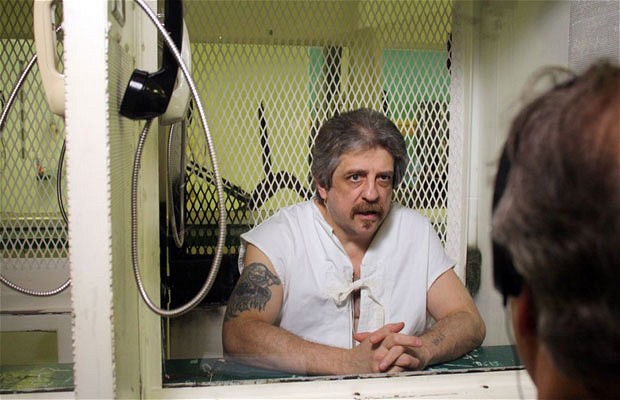
Clocking in at about the length of an ambitious arthouse film, it is perhaps generous to consider the act of watching the four episodes of Werner Herzog’s On Death Row “binge-watching,” but Herzog’s shortform meditation on the American justice system and its use of capital punishment is nevertheless an act of attrition. Hidden away from the world by the machinations of the prison-industrial complex, it isn’t until cameras are brought to bear on the men and women of death row that the implications of their sentence truly resonate. Articulate, impassioned, and more knowledgeable about the American justice system than the average true crime junkie, the subjects of these interviews (and those of Herzog’s companion film, Into the Abyss) are fascinating not because of the crimes they’ve been convicted of committing, but because, like many of the individuals Herzog focuses his camera on, they live in pockets of the universe too uncompromising and barbarous to be properly rationalized.
On Death Row profiles five men and women whose lives are consumed by their long wait for execution. Though Herzog is the one who conducts interviews with the convicted and those involved with the case, he never appears on camera, instead shooting his subjects in such a way that they speak directly to the viewer. Were this any other project, such a set-up might inspire pleas of innocence to a sympathetic ear. Though Herzog cannot see the case for capital punishment, his is not a forum for exoneration. “Sympathizing with your quest to have procedural injustices corrected in your case does not necessarily mean that I have to like you,” he tells James Barnes, a Florida man convicted of murdering his estranged wife. After converting to Islam, Barnes was compelled to confess to an infamous unsolved murder, which saw him sentenced to death. His conversations and letters with Herzog would later prompt Barnes to confess to two additional unsolved cases. With this revelation, however, Herzog must consider if Barnes is being truthful, or if his confessions are a ruse meant to prolong his life.
Barnes is unquestionably guilty of the two murders he’s previously confessed to, and George Rivas, the leader of the Texas Seven, a gang of inmates who led the largest jailbreak in Texas history, carries the burden of knowing that he shot and killed a police officer on Christmas Eve. His other interviewees, Linda Carty and Hank Skinner, find themselves caught in impossibly complex legal situations. Carty is a British citizen who claims to have been an undercover informant for the DEA. Skinner, on death row for the murder of his girlfriend and her two sons, was only minutes away from his execution when he received a stay from the U.S. Supreme Court, who found that he could successfully sue for the right to have unused evidence from his trial tested for DNA. Joseph Garcia, one of the Texas Seven, is awaiting execution despite not having fired a shot at the slain police officer; Texas law has it that accomplices to crimes are culpable to the same degree as the perpetrators, so his sentence was the same as Rivas’. He joined the Texas Seven because he was sentenced to life in prison for a murder he claims was self-defense. His conviction to that end was so strong that he refused to take a plea bargain of fifteen years. His testimony—which involved a demonstration of his skills with a butterfly knife—could not have gone more disastrously.
The circumstances of On Death Row‘s production—Herzog’s interviews were limited to an hour, and repeat visits were permitted months apart—and Herzog’s rather blunt way of telling the inmates that his interest in their case does not indicate a wish to be friends makes the resulting intimacy of each episode something of a surprise. One senses that Rivas, despite being guilt-ridden over the murder of Officer Aubrey Hawkins, is proud of his achievements, not only his ability to coordinate a jailbreak and evade capture for so long, but in the sheer cleverness of his many heists. Skinner is a natural-born storyteller, and if one is willing to suffer his excursions into Templar history and the connectedness of all things, he has one hell of a story to tell. What the mini-series makes clear is how remarkable an interviewer Herzog is. A German national with a deliberate way of speaking, he’s able to draw from James Barnes’ twin sister a heartbreaking portrait of being raised by their father, a strict disciplinarian who forced his children to whip James when he misbehaved, which was frequently. He manages to push Skinner beyond the realm of coincidence and into the mindset of a man who has been served his last meal. The attorneys he speaks to, of course, are more than willing to talk, but he hardly allows them to use his camera as a bully pulpit. When the prosecuting attorney in the Linda Carty case warms against humanizing Carty, Herzog replies “I do not make an attempt to humanize her. She is simply a human being, period.”
When thinking of a partner for Herzog to present a TV miniseries about death row inmates, Investigation Discovery seems the least likely option. The network’s bumper, an insidious voice whispering “investigate” in a manner shrill enough to haunt dreams, is more of piece with the network’s regular offerings, shows like Who the (Bleep) Did I Marry? and I (Almost) Got Away With It. Scanning through these shows on Netflix, Herzog’s presence among them is the only thing separating something like Stalked: Someone’s Watching from John Beard’s To Entrap a Local Predator: Orange County Edition: Super Creeps; a calm, contemplative voice in a room crowded with lunatics. Investigation Discovery somewhat mitigates this by bringing in Paula Zahn as a “presenter.” This role sees her standing imperiously next to the words “ON DEATH ROW,” which are presented in an austere typeface in Herzog’s film but are bold and oppressive otherwise, fading into a grungy Photoshop filter to emulate dirt that won’t wash out. Zahn does little more here than issue the usual rhetoric about “hardened criminals” and “brutal murders,” and her presence eventually diminishes to the point that her overly simplistic case notes amount to little more than minor annoyance. The experience of these people and their account of the crimes they either confess to committing or fight vehemently against are far beyond the bounds of rote description.
This is a remarkable project which, along with Into the Abyss, comprises two four-episode seasons, one film, and, one assumes, plenty of unpublished literature. In keeping his focus on the inmates and their circumstances, Herzog is able to avoid the pitfall of much true crime programming, which is to lionize both the circumstances of the crime and the punishment meted out. Though these men and women live in cages so small that facial hair is a privilege and dreams of avocados are treasured, it is those privileges and dreams Herzog is fascinated with, that inspire him to a conclusion worthy of one of his most heralded films. Driving the same 40-mile route the Texas Department of Corrections uses to transport convicts from the Allan B. Polunsky Unit, where death row inmates are housed, to the Huntsville Unit, which contains Texas’ death house, Herzog observes “the landscape, bleak, forlorn. And yet everything there all of the sudden looked magnificent. As if entering the holy land.” It’s a strange path Herzog cuts through the world, much of it maudlin and courting insanity. He is the same as the mannequins he discovers between the Polunsky and Huntsville units, an apostle on the road to death. His subjects may not deserve the freedom they fitfully dream of, but neither do they deserve the torment of knowing when and how that road terminates.
 Forty years later, The Texas Chain Saw Massacre shouldn’t be as powerful as it ultimately is. Tobe Hooper’s film is written in the bones of anybody who has even a slight appreciation for horror, and has been diminished by sequels and remakes and the continued recycling of its plot and scares. When I saw it recently at an anniversary screening, the audience spent much of their time laughing. Until Leatherface. With his hammer. With his mask. With his chainsaw. The plight of young adults looking to screw speaks to the young, I guess, but a man wearing another person’s skin over his face? That’s universal terror.