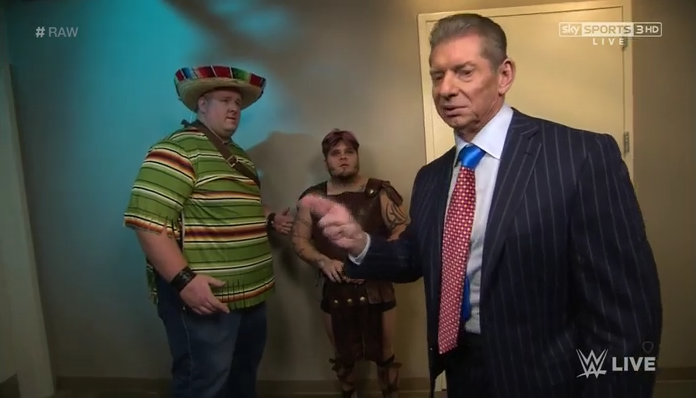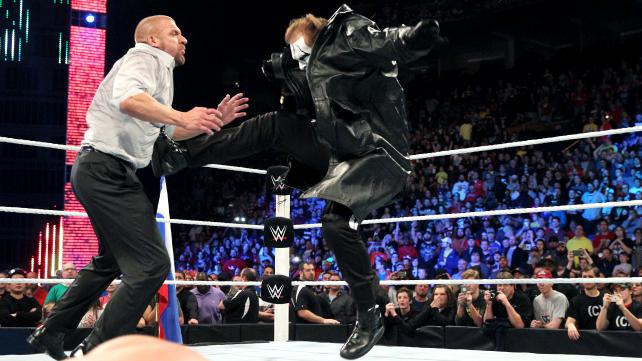
Yes, Sting. But we’ll talk about that when it happens. I mentioned in my review of Raw this week that I was officially excited for Survivor Series because, for the first time since WrestleMania XXX, I had no idea what to expect. Haphazardly, Team Authority vs. Team Cena had become this strange battleground where anything could happen. Anything. And then I read the results of SmackDown! and learned that Team Cena would be fired if they lost. Hahaha, no way. So without the bit of drama where the winner and the loser isn’t pre-determined, it fell upon the participants of the main event to make the match exciting despite the foregone conclusion that threatening John Cena’s career presents. Hence Vince McMahon’s presence at the beginning of the show, the pay-per-view that means more to the aura of Vincent Kennedy McMahon—Mr. McMahon to all of us—than any single event in the man’s professional life. When Vince McMahon shows up at Survivor Series, it’s because things are happening. Here, he’s setting up the rules of engagement. If Team Authority wins, Team Cena is fired, whatever. But if Team Cena wins, Stephanie McMahon and Triple H are gone for good, and the only person who might bring them back is John Cena. This is a weird caveat to add to this contract that apparently changed between Monday and today, and opens up yet another way that WWE might turn their franchise heel, which they won’t, but the opening promo with McMahon and his children and John Cena is, if nothing else, a promise that things are moving forward, changing in a way that they haven’t since April, when everything felt so new and uncertain and exciting. This whole time, it’s like WWE has been recovering from Daniel Bryan’s neck injury. Tonight’s the night they figure it out and make good on all the people who’ve decided to scam the evening’s event with the WWE Network’s free preview month or return to struggling for some direction until Bryan’s return.
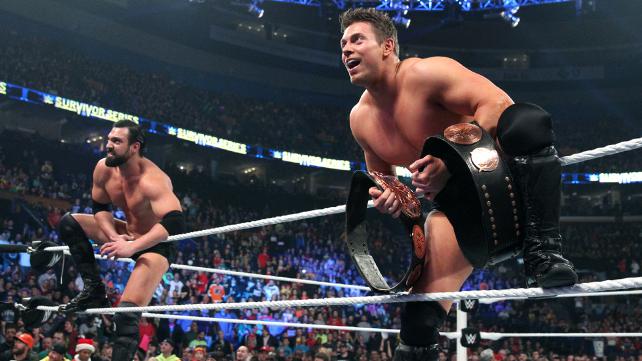
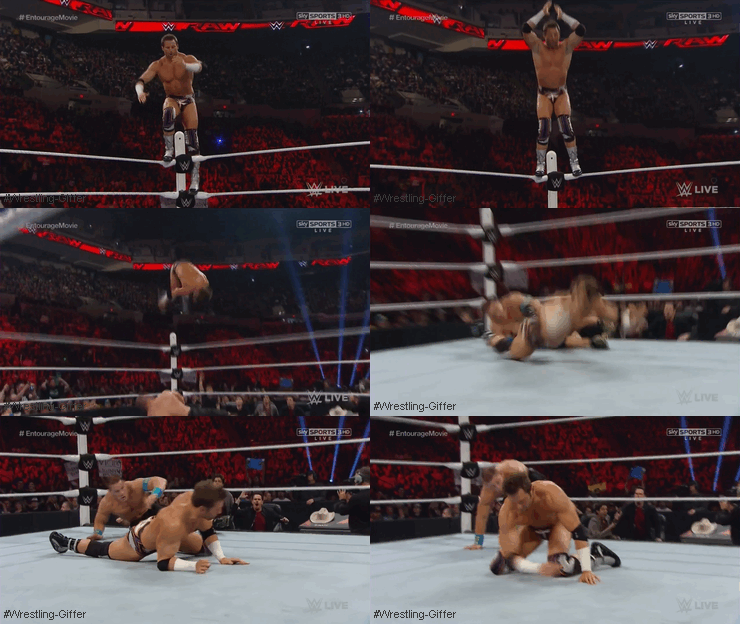
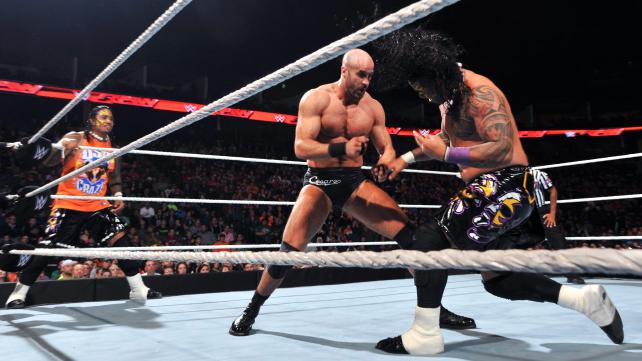
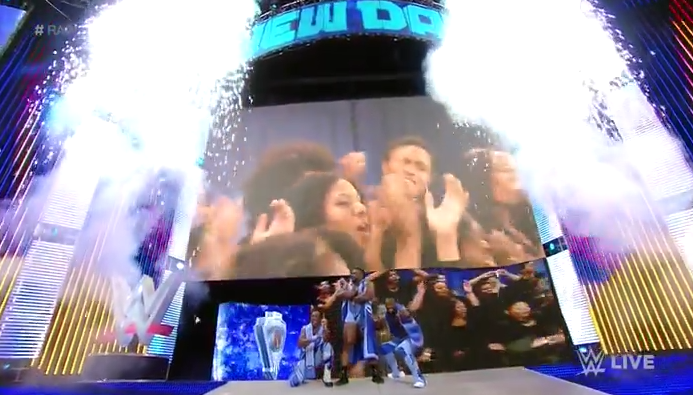
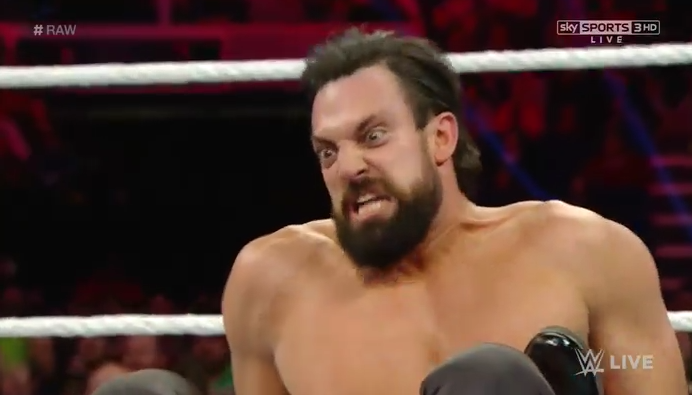
WWE World Tag Team Championship Title Match — Goldust and Stardust (Champions) vs. Los Matadores (w/El Torito) vs. The Miz and Damien Mizdow vs. The Usos: You can tell that Survivor Series is a big deal tonight, as two out of four of the teams involved in this match come out with new gear. Los Matadores are wearing more opulent bullfighter outfits, and Stardust’s onesie features red trim and facepaint. Stardust starts the match against Fernando (finally named!), and hisses at El Torito at ringside. JBL speculates that Fernando is really Rob Van Dam because he hits a leg sweep. Miz tags in surprisingly and gets a two on Fernando with a roll-up, but the Matadores quickly take over. Diego tags in and hits a senton for two and continues to take the fight to Miz. Mizdow sells everything, including taking a bump over the ropes when his partner is thrown from the turnbuckles, and is easily the most popular dude in the ring. The gimmick where Miz teases a tag to Mizdow but doesn’t do it is the most effective heat The Miz has gotten in years, if not ever. Stardust and Jey Uso go through their well-established Usos/Dust Brothers stuff, but the crowd wants to see Mizdow. So they don’t. But Miz gets back into it with a Matador and Mizdow continues miming The Miz, so it’s all good. Miz finally tags Mizdow in after a round of BOO and YAY chants for Miz… but Goldust tags himself in and Mizdow is right out. Goldust and Stardust take the fight to one of the Matadors, who have been working under these hoods for a year or so now and are still the most generic tag team to’ve ever been given a million dollar gimmick. Stardust responds to the crowd’s chanting for Mizdow by saying that they really want him. So they get more Goldust and Stardust vs. Los Matadores. The Matadores try to act like they matter, but man, I feel pretty bad for the Colons. Goldust and Stardust do this weird, nonsensical sunset flip/German suplex combo that nets a two because Miz and Mizdow get involved. Los Matadores take over after a series of teased tombstone piledrivers ends up in a very pretty tornado DDT. Jimmy Uso tags in after a two count and starts whaling on Goldust. The Usos are so good at what they do that their bland characters don’t matter. Goldust powerslams Jey and gets a two count. There is one powerslam in wrestling that’s better than Goldust’s, and that belongs to Randy Orton. The Usos hit their FLYING USOS, MAGGLE spot, then Stardust hits a dive, then El Torito hits a dive and nearly dies because nobody can quite handle him, then the goddamn Matadores do some dives. Finally, the one Matador who didn’t dive ends up getting caught by Goldust on the top rope, and its Los Matadores and Goldust and Stardust doing a tower of doom spot. Jey Uso, who is legal, does a Superfly splash, but Miz tagged him just before takeoff. Mizdow tags Miz and makes the cover. To rapturous applause, Mizdow gets the three. Winners: The Miz and Damien Mizdow via pinfall. Grade: B
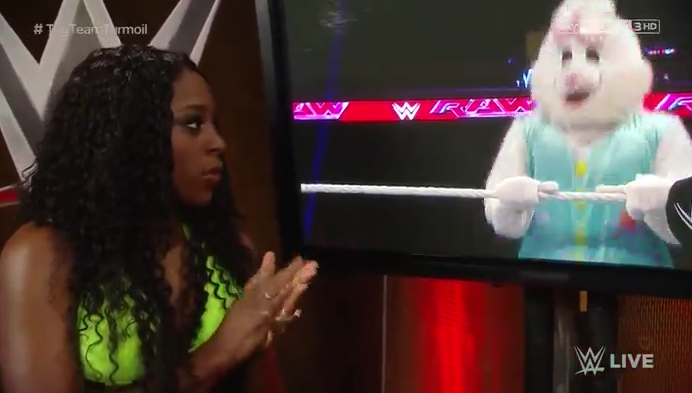
Really, Damien Mizdow’s story is about as miraculous as things get in WWE these days, as his go-nowhere character officially become the WWE’s breakthrough character that everybody wants to see more of. Where they go with this I have no idea, but watching the fans cheer for Mizdow while booing The Miz has this incredibly fresh, unique dynamic to it, somewhat reminiscent of how the fans got behind Kane and Daniel Bryan, effectively making Daniel Bryan a star. Of course, Bryan’s gimmick wasn’t that he was imitating Kane, so again, who knows where this will go. Probably farther than the Adam Rose vs. The Bunny angle, which is extended backstage via the two playing with action figures. Heath Slater and Titus O’Neil remember that they’re a tag team and show up to make fun of the two. Adam Rose calls them “two party poopers out to crash our party,” and Titus says “yeah, one of y’all stink.” Did you know that you have to be an experienced television writer to write this stuff? Adam Rose claims to be the hero of the Exotic Express, which is is because that’s his gimmick, and Titus O’Neil asks if he meant “gyro,” because putting Adam Rose on a spit, cooking him, and carving him up for lunch sounds more pleasurable than watching him play with action figures. Adam Rose challenges Slater Gator to a tag match against himself and The Bunny. “You’ll find out why they call me a God,” he says. “What,” O’Neil replies. “You’ve been hanging out with Yeezus?” Titus O’Neil is the very best.
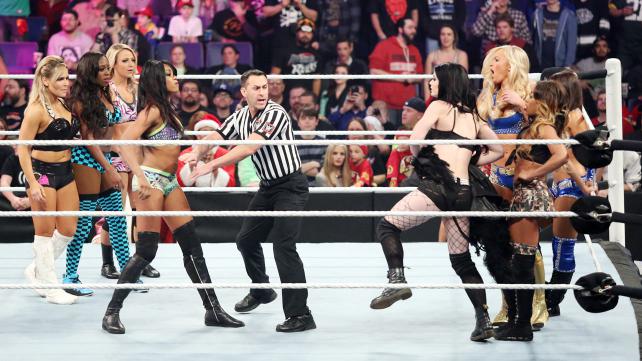
Survivor Series Match — Paige, Cameron, Summer Rae, and Layla vs. Natalya (w/Tyson Kidd), Naomi, Emma, and Alicia Fox: I have no idea how they put these teams together. I guess they drew them from a hat. Paige and Fox have their issues, of course, so it’s good to see that going. Paige hurling her ring jacket at Fox as she enters the ring is about as heated a moment as the WWE Divas are allowed to have. Cameron and Naomi used to be partners, but they split, so it makes sense to see them on opposite teams. Summer Rae, Layla, Natalya, and Emma are all, to the best of my knowledge, faces, but a Survivor Series match needs at least four people on each team to work and most of the women WWE employs don’t get screen time outside of Total Divas, so I guess you have to know what’s going on there to know why anything is happening. I don’t watch that show and it’s months old by the time it airs, so I can’t imagine any issue from it taking precedence during this match. Tyson Kidd gets a “NATTIE’S HUSBAND” chant, which is good. I’m glad to see that a gimmick of his is finally getting over. Paige and Natalya start the match off, which is also good, because it’s the only combination I want to see beyond Paige/Fox and Paige/Emma.
Nattie hits Paige with a double underhook suplex and follows with a baseball slide to the outside. When they get back into the ring, Paige drills Nattie with a forearm and tags in Layla. Layla goes for a leg drop, but Natalya rolls out of the way and tags in Emma. She does a Mr. Perfect necksnap on Layla, who kicks out at one. Emma, I guess, has a clumsy gimmick now. That’s how they’ve decided to interpret her awkward dancing gimmick. She and Layla exchange some slick roll-ups for two counts. This reminds me a bit of the Vickie Guerrero Invitational Battle Royale from WrestleMania XXX, where every woman in the ring went at it as hard as they could though they were competing against the audience’s shock that The Undertaker lost. Layla hits Emma with some kicks, but Emma kicks out. Emma becomes the focus of Team Paige while JBL brings up AJA GODDAMN KONG because sometimes he is not a monster. Jerry Lawler has never heard of AJA GODDAMN KONG because his brainpan is full of Smucker’s jelly. Fuck him. Team Paige wears Emma out, and it’s awesome because physicality between women is what should be happening in a wrestling show. She and Paige make their way to the turnbuckles, and Emma hits a superplex. Paige tags Cameron in, and things are about to get interesting. Emma’s pretty good, but Cameron might be the worst wrestler in the history of World Wrestling Entertainment. The crowd, waiting for AJ Lee to wrestle before chanting “CM PUNK,” chant “WE WANT MIZDOW” because men are horrible monsters, like JBL but with no redeeming qualities. Emma tries to make her way to the corner and does. She tags in Naomi, who kicks her ex-partner in the head and climbs to the top rope. She dives off and hits Cameron with a crossbody, but nearly eats it on the landing. That’s something about Naomi that I can’t help but notice every time I see her wrestle—she’s incredibly athletic, but so far that has not translated to her being a good wrestler. She puts herself at risk far too frequently. She takes Team Paige out, but this lets Cameron get back into things. Naomi hits Cameron with a wheelbarrow stunner, but Layla breaks up the pin. It’s early, but there are no eliminations. This might end up being the longest women’s match of the year.
Summer Rae gets into the ring, as does Emma, and Emma takes Summer Rae out. Natalya takes Paige out, then Cameron tries to hit Natalya with a bulldog but can’t because she is just awful. Still, Natalya takes the invisible bulldog with gusto because she’s the best woman on the roster. Naomi rolls Cameron up and pins her, and the worst wrestler in the world is gone. (Cameron is eliminated.) Paige looks concerned but shouldn’t be. Summer Rae takes over for Cameron and can be charitably described as being better, at least, than her partner. But barely. And maybe only because Cameron didn’t have much time to do anything. Maybe she’s worse and I don’t know any better and should be thankful. An awkward collision sends Summer Rae to the ground, and she backs away from Naomi screaming. She gets kicked in the face anyway. Rae gets the advantage and splashes Naomi’s arm, which is just weird. Why do that? She tries again and Naomi moves her arm, so Summer Rae crashes into the canvas. Womp womp. Naomi tags Natalya in, but Summer Rae has fighting spirit and clears Natalya’s team out. Naomi tags herself back in and gets real serious, bulling Summer Rae to the ground a few times before she starts dropkicking her. Summer Rae sells these like she has no idea where she is at all. Maybe she doesn’t. Everybody is trying really hard, but part of the problem plaguing any effort at presenting women’s wrestling seriously on WWE television is that it has been treated as an opportunity to reset between exciting things and is rarely presented as an exciting thing itself. That’s what’s happening in this match. Sure Summer Rae is flopping around awkwardly, but it’s more interesting than hearing the same facts about Jerry Lawler’s terrible and ancient Survivor Series teams get dragged out as a talking point for the eighth year in a row. You have eight wrestlers on the screen right now. Maybe talk about how hard they’re fighting to get noticed in a landscape that would otherwise ignore them. Also during this “fun banter,” Michael Cole calls Joey Abs of the Mean Street Posse “Jimmy,” so I’m done with him forever.
Alicia Fox starts wearing out all three members of Team Paige, and it’s honestly pretty awesome until she tries to get a “CHICKEN” chant started. Summer Rae tags in Layla, who is quickly taken down and manhandled by Fox. Fox is one of those performers who I never thought much of, but she’s come a long way over the past few years. She suplexes Layla with a bridge, but Layla kicks out. Layla hits a springboard crossbody in the corner, but Alicia hits her with a tilt-a-whirl backbreaker and pins her for the elimination. (Layla is eliminated.) Paige gets into the ring immediately and starts beating Fox up. She then rather stupidly tags Summer Rae in, and she is quickly overwhelmed and taken back to Fox’s corner. It’s 4-2 in favor of Team Natalya (or Fox, I guess? They should go back to giving teams goofy names), and it’s Natalya who comes in. She clotheslines Summer Rae and kicks her three or four different ways, but Summer Rae manages to make the tag after Paige lays into her with a kick of her own. Summer Rae continues stinking it up. I have no idea what her character is or why she does what she’s doing and just want to get to the part where Paige takes on four women by herself. Emma comes into the match next and takes it to Summer Rae. Cole is super excited for just about everything Emma does, which is good because she might still have a future after the incident where she accidentally shoplifted something. She puts Summer Rae in the Muta Lock and gets her to tap out. (Summer Rae is eliminated.) Finally, it’s Paige against everybody. The fans want to see Paige win because they’ve done a good job of building her with nerds like me. Paige looks like she’s going to bail, but Emma catches her. This is a mistake though, because once they’re back in the ring Paige clobbers her. She headbutts Emma and stomps her in the corner. Emma’s hope spot is to grab Paige’s boot, stand, and use Paige’s leg to hurl her to the ground. It’s awesome. Natalya tags in and goes for a bodyslam, but Paige slips out and drills Nattie with a superkick. Natalya reverses Paige’s attempt at a short-arm clothesline into a German suplex throw across the ring. Natalya tags in Naomi, who goes for a split-legged moonsault, but Paige gets her knees up and catches Naomi on the chin. Paige stumbles into Alicia Fox, who decks her. This sends Paige reeling to the center of the ring, where Naomi leaps and hits her with the Rear View, which is the terrible, ass-centric name they’ve given her leaping hip check finisher. Paige starts getting up, and Naomi locks her into a headscissors before driving her head into the canvas. That’s the kind of thing that should be her finish. Awesome looking move. She makes the cover, and that’s it. (Paige is eliminated.) Winners: Naomi, Alicia Fox, Natalya, and Emma via pinfall. Grade: B-
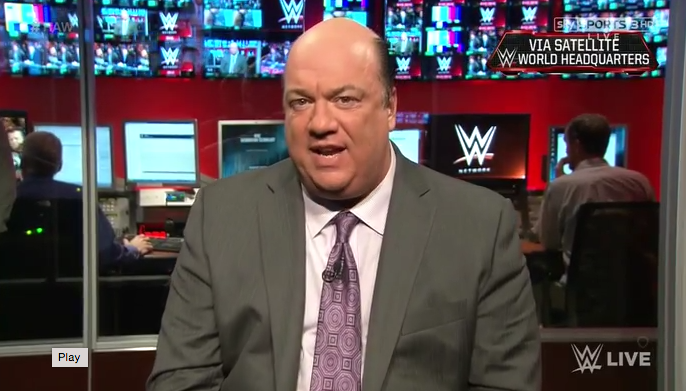
Had Paige gone through all four members of Team Natalya, it would have been the WWE Divas division equivalent of Ric Flair running through the roster at Royal Rumble 1992. But they needed to start building contenders for the Divas Championship who aren’t Paige or one of the Bellas, and this accomplished that handily. Beyond Summer Rae and Cameron, everybody here looked good. Tyson Kidd takes Nattie’s spotlight as she celebrates, which is awesome. Way to build two things at once, guys. On the kickoff show they redebuted Fandango, which, yes please. I’m a huge fan of heelish dancing white dudes, and Fandango is the best of that rather limited bunch. He has new theme music, which is too bad, and a new dance partner in Rosa Mendes. He beat Justin Gabriel, which is just a thing that you do when you wrestle Justin Gabriel. He didn’t even take off his shirt. But hey, he’s still got his leg drop, and that rules. Also, when he pinned Gabriel, he held his arm to the mat like they were dancing. Give Fandango all of the titles. They also brought Bad News Barrett back. He was injured, but honestly, with his character it’s a mystery why he ever had to leave television. Have him stand at his ridiculous podium and insult people. Done deal. But now that he’s back he can go about doing that and elbowing people in the face. It’s all good. The all-star panel of experts discuss what they’ve seen so far. Booker T is wearing an amazing suit and scarf. Alex Riley is a boring man who exists. Paul Heyman is Paul Heyman. The way he looks just being there, pissed off to be alive, is great. They ask him what he thinks about the main event, and he sells it by reminding us that Cena, in addition to tonight’s match, also has a date against Brock Lesnar coming up. They promise Vince McMahon and the winners of the match on the post game show, but that’s just a joke everybody because there is no post game show. It’s all in your heads.
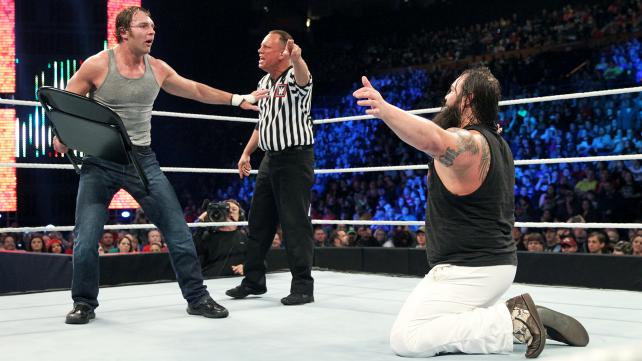
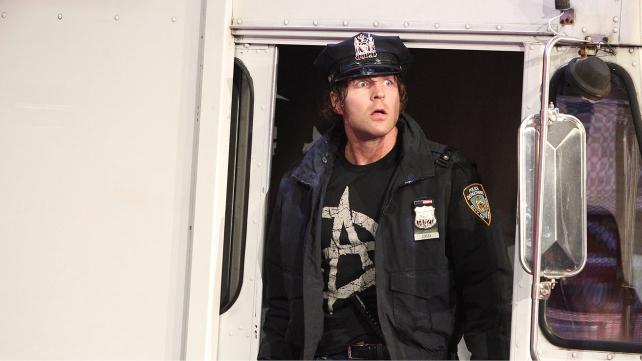
Dean Ambrose vs. Bray Wyatt: The promotional video makes the build-up to this match look much better than it was. The image of Bray Wyatt clinking a tin can against the bars of a jail cell like some old-time drunk in a Western? Priceless.Regardless of this feud’s failings, there’s still a big fight feel for this one. Bray Wyatt is even wearing a new shirt for the occasion, a lovely pattern of vines and sugar skulls. Wyatt and Ambrose stare each other down, then start hammering each other. Bray has the weight advantage, so he takes over early, but Ambrose has got that fire and comes right back. The two continue to brawl until Ambrose surprises Wyatt with a clothesline. They go outside the ring, and Bray tries to put Dean back in the ring, but Ambrose will not be denied, rolls out while Bray has his back turned, and hits another clothesline. Ambrose climbs the apron, then dives off with a forearm shiver to Wyatt’s jaw. Ambrose gets Wyatt back in the ring and hits him with a sliding clothesline, but Wyatt quickly takes over from there, catching Ambrose sleeping with his brutal flying body block. This nets a two count. Ambrose manages to gain the advantage again when Wyatt wastes his time in the corner, cutting him off with another forearm. Wyatt goes to the outside and Ambrose goes for a slingshot plancha, but Wyatt sees it coming and uppercuts his falling opponent. He sends Ambrose into the ring steps, then stomps his hand on them. He puts Ambrose back into the ring and headbutts him to the mat. After a snap suplex, Wyatt nails Ambrose with his senton and wastes some time before going for the cover. He gets a one and hooks Ambrose up into the full nelson. Ambrose breaks it by grabbing at Wyatt’s fingers and wrenching, which Wyatt sells tremendously, screaming and clawing at Ambrose’s face. Ambrose ducks a few clotheslines and goes for a cross body, but Bray Wyatt is twice his size and just stands there, trucking poor Dean in the process. He dumps Ambrose to the outside and chases after him. He goes for a clothesline, but Dean Ambrose has the same idea and both men go down. The referee starts a 10 count, but neither that spot nor anything leading up to it has made the match feel that such dramatic intention has been earned. At the count of nine, both men miraculously recover from staggering around like a couple of drunks and make it back into the ring.
Having reset, Ambrose knocks Wyatt down a few times by checking him, then checks him in the turnbuckles and follows up with a bulldog. Ambrose mocks Bray Wyatt by striking the dude’s favorite yoga pose. He sets up for the Double Arm DDT, but Bray slips it and runs for the ropes. Ambrose meets him with a knee to the gut. Ambrose charges at a stunned Wyatt, but Bray recovers and catches Dean in the set-up for Sister Abigail. He’s holding him loosely though, so Ambrose slips out and goes for a roll-up. A fan in the front row holds up a sign that has the number two magic markered on it, and that’s what Ambrose gets. He gets up, then sidesteps a charging Wyatt, who ends up on the ring apron. He ties Wyatt up in the ropes, then hits him with a running dropkick. With Bray hanging over the middle rope, Ambrose climbs to the second turnbuckle and hits Wyatt with a guillotine leg drop. That’s always been a favorite move of mine, and I’m glad to see it make a comeback. Wyatt kicks out. Ambrose climbs to the top rope, but takes too long; Bray meets him with another uppercut, which staggers Ambrose. Wyatt climbs up after him and does a few clubbing forearms to Ambrose’s back, but Ambrose refuses to be suplexed down. He headbutts Wyatt and hits him with a Dusty Rhodes bionic elbow. With Wyatt back in the ring, Ambrose goes for a double ax-handle smash, but Wyatt catches him for a sambo suplex. Ambrose slips it and goes for his rebound lariat out of the ropes, but Wyatt steps aside and catches Ambrose with the the suplex he’d just missed. Ambrose kicks out of it, though. Wyatt follows with a senton from the second turnbuckle, but Ambrose moves out of the way. Ambrose takes him over for a crucifix roll-up and gets another two count. Wyatt recovers by chopping Ambrose in the throat. Ambrose is shoved into the ropes and returns with his lariat. He climbs to the top rope, no wasted motion, and comes down on Wyatt with an elbow drop, which is unique because Ambrose does it to dudes while they’re standing. It’s a good looking move, regardless of whether Ambrose is doing it to one guy or a crowd. JBL and Lawler say that they’ve never seen it before. They saw it, oh, every week on Raw for a month when Ambrose came back from shooting that movie. It’s worth a two. Ambrose follows Wyatt into the corner and goes for a traditional ten-punch, but Wyatt hooks him for a powerbomb. Ambrose punches Wyatt to the point that Wyatt has to throw him off, so Dean runs off the ropes and Wyatt turns around and levels Ambrose with a wicked looking clothesline.
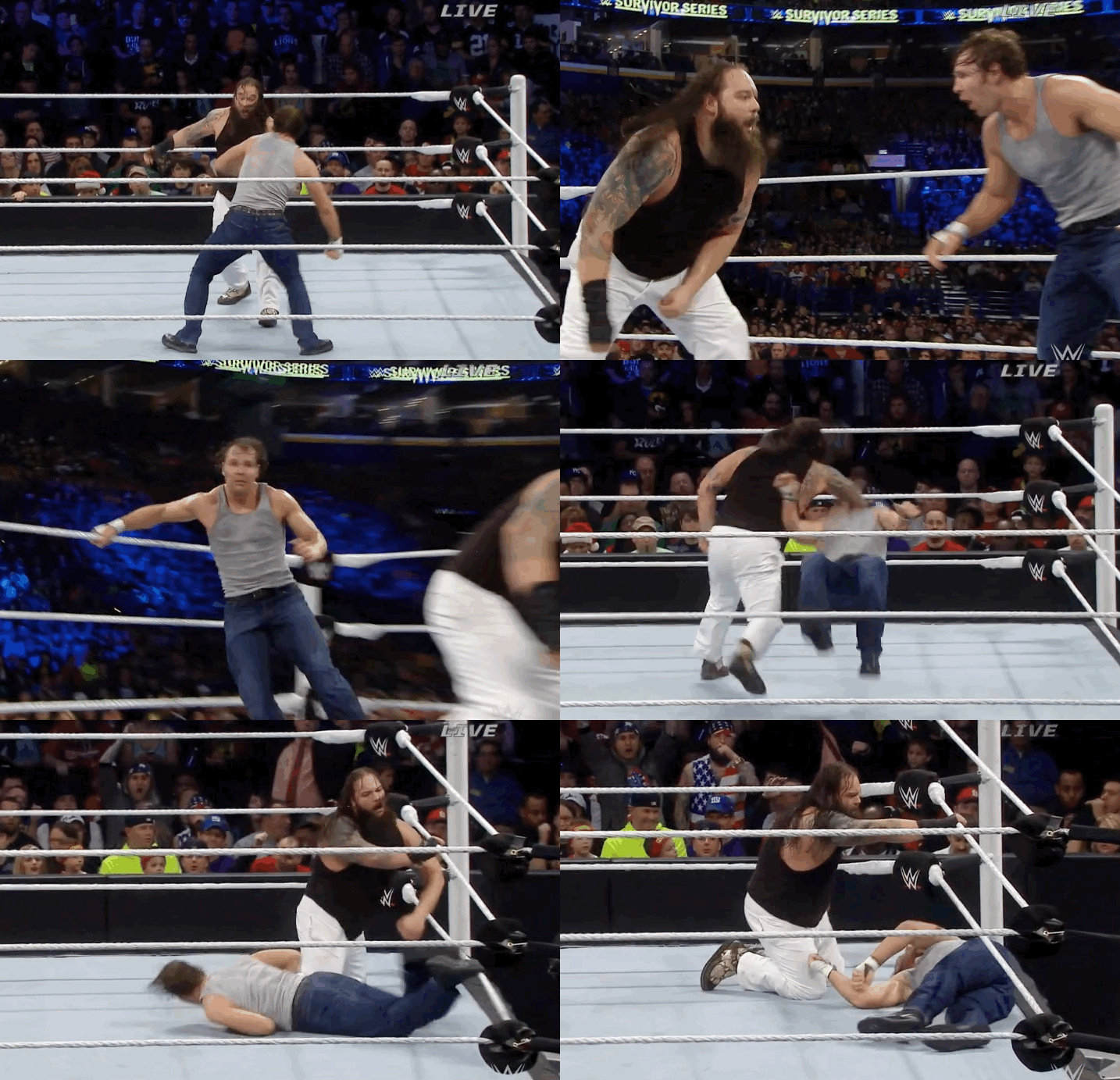
Wyatt follows Ambrose to the floor and dumps him (softly) on the ring steps with another sambo suplex. Wyatt picks Ambrose up and deposits him in the ring, but only gets a two count for his effort. Wyatt can’t believe it and starts looking distraught that he can’t put Ambrose away. He calls for a microphone and gets it. He asks Ambrose why he continues to fight when he could have just joined him in ruling the world or hanging out in the woods or whatever. They’re both special. He apologizes, but Dean has chosen his path, and that path is to get socked on the jaw for not staying down. Wyatt goes under the ring and grabs a couple of chairs. He slides them into the ring, but Ambrose intercepts one while the referee pushes the other away, and Wyatt seems to have made a critical error. Wyatt gets on his knees and asks Ambrose to club him. The referee threatens to disqualify Ambrose, who shouldn’t care about things like that because this is a blood feud. Wyatt takes Ambrose’s stalling as a sign that maybe he’s reconsidered and takes the opportunity to extend the olive branch. Really, it’s a sign that you’re not allowed to hit people in the head with chairs anymore, so with Wyatt on his feet again, Ambrose hits Wyatt in the gut and on the back with the chair, and that’s it. Winner: Bray Wyatt via disqualification. Rating: C+
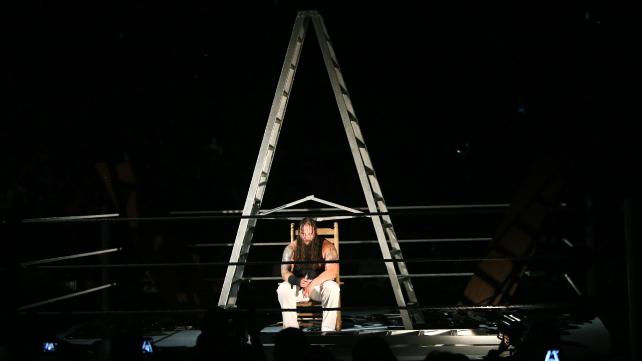
Woof. I think I had high expectations on this based on a few things: The magnificence of every Shield vs. Wyatt Family trios match from early in the year, and the fact that Bray Wyatt is almost exclusively a big match character. This was trying to be a big match, but in the end it was just an exchange of moves; one guy does something, then the other guy does something, and they both continue doing something for twenty minutes. None of that something included a story until the very end, and that story was “Wait until next month, folks.” We’ve been waiting for next month with Dean Ambrose since The Shield dissolved. Like in January when they tried to shift focus from Daniel Bryan to Batista by putting Bryan in a feud with the Wyatts, all this is doing is killing Ambrose’s momentum while leaving a lot of questions about Bray Wyatt’s tenability as a long-term property unanswered. The difference is that Ambrose isn’t Daniel Bryan—he’s not quite that singular an entity—and he is unlikely to be rescued from this by relentless crowd support. After the match, Ambrose double-arm DDTs Wyatt onto a chair. He leaves the ring and finds a table beneath it, because yeah, tables should just be under the ring, why not? He sets Wyatt up on the table in the ring and elbow drops him through it. He grabs another table, which is under the ring in case they decide to have a mid-show convention. He puts it on top of Wyatt, just lays it there, and smacks the table a few times with a chair. Then he starts throwing chairs into the ring. Some fans chant “ECW,” which, no. Ambrose finds more chairs under the ring and throws those in, too. He teases leaving, but turns back to the ring, goes under the apron, and pulls out a gigantic ladder. Next month’s pay-per-view is called Tables Ladders and Chairs, but I can’t imagine this is related. Ambrose sets the ladder up in the ring. He climbs it aaaaaaaaaaaand… his music hits, so he poses. Wait until next month, folks.
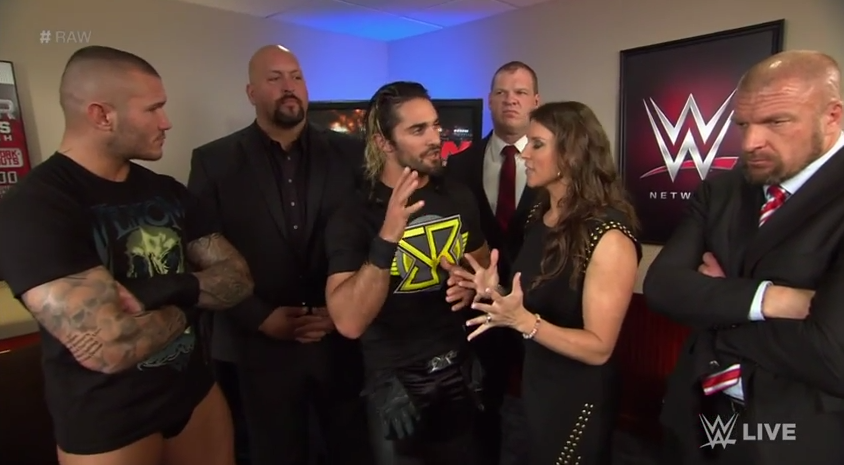
Backstage, Team Authority stand around like they’re waiting to take a family photo:
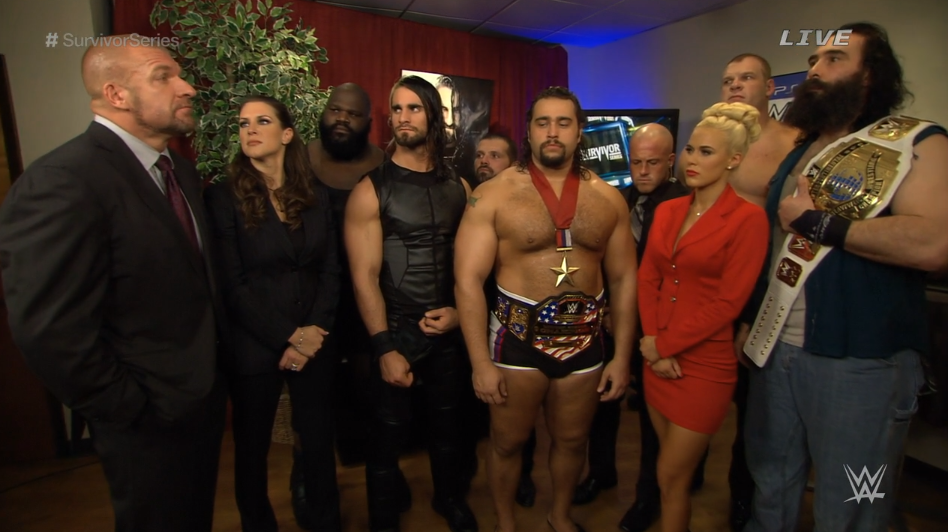
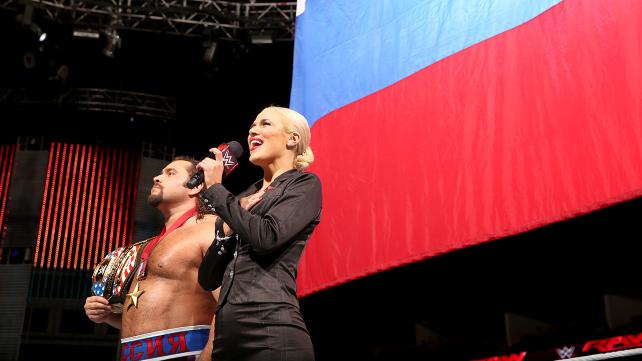
Triple H is worried that his team might lose, so he gives them a corporate pep talk. He says that the people who will benefit the most are his team. They’ll get more title matches, money, and so on if they win. Stephanie McMahon is on the verge of tears saying that they can’t lose. She is the queen of heels. Triple H says that this is a defining moment, a moment when everything will change forever. That’s probably not true. He says that if The Authority lose, his team won’t be fired, but that they’ll wish they were. Whoever takes over, he says, will make sure that their lives are a living hell. Champions will lose their titles. People who haven’t been champion never will be. He doesn’t know who will take over if he’s gone, so that’s pretty presumptuous. The only dude on the team who is really staked to Triple H and Stephanie McMahon is Rollins, when you think about it. Regardless, Rollins making a big frowny face while Rusev rubs his United States Championship is awesome stuff. Rusev also looks super excited to yell “FIGHT!” over and over again. Rusev is my favorite.
Adam Rose and The Bunny vs. Heath Slater and Titus O’Neil: There are people in the crowd with signs for The Bunny. They must be plants. Rose and The Bunny are still having their issues about who gets to do Adam Rose’s entrance. Slater Gator’s music hits, and it is a horrible, wondrous beast of yelling, barking, and crazy guitars. The Bunny requests to start the match and he does, against Heath Slater. He goofs around, so Adam Rose tags himself in. Rose lectures The Bunny, turns around, and is kicked in the mush by Slater. That gets a two count. Slater tags in Titus O’Neil, who picks Rose up and hits him with a few backbreakers before throwing him across the ring. The Bunny looks on in horror, as we all must, and Titus assaults Rose in the corner. The referee separates them, and the space gives Rose a means of fighting back. Rose tags in The Bunny, who leaps over the ropes and catches Slater with a dropkick on his way in. He continues to catch Slater with dropkicks while Jerry Lawler worries that folks who might be seeing their first pay-per-view might be confused about why there’s a bunny wrestling. The Bunny flapjacks Slater, who I’m not a fan of but who I feel deeply sorry for right now. JBL makes references to Monty Python and the Holy Grail’s killer rabbit by its full name, and also Harvey, because what the hell else are you going to do while a dude dressed in a bunny costume is wrestling an intentionally shitty match, reacting to his stuff with a sense of manchildlike wonder? The Bunny continues to do dropkicks, and now we’re talking about his being the literal party animal on The Exotic Express, which is the worst thing. The Bunny pins Heath Slater while Adam Rose looks on as if bearing witness to a nightmare. I’d screencap his face, but I just don’t care. Winners: Adam Rose and The Bunny via pinfall. Grade: F
The Bunny celebrates while Adam Rose looks on, his hand out for a tag that will never come. It appears that The Exotic Express has a new god. After this, they show a trailer for a movie featuring Larry the Cable Guy and Santino Marella, which might be the only thing worse than continuing the beef between Rose and The Bunny. It’s a sequel to Jingle All the Way, which hurts like a fucking knife in my back. Back live, Roman Reigns joins us via satellite, wearing a leather jacket and wet hair because he wants to look like a tough wrestler, even in rehab. Michael Cole asks Reigns how his recovery from a hernia is going, and Reigns gives us an update. It’s typical sports blah blah blah, but Reigns isn’t mumbling and is trying to be emotive when he speaks, so there’s some progress. He says that if he was there, he’d cock his fist and “make it rain in that bitch.” Woah, dude. Relax. JBL brings him back to reality quickly and asks how he’ll feel once Seth Rollins wins the main event and increases the power of The Authority. Reigns says that he has no love lost for Rollins, but that it also doesn’t matter who has the power in WWE. He says he’s coming back in a month. Backstage, Erick Rowan doesn’t hear any of this because he’s playing with a Rubik’s Cube:
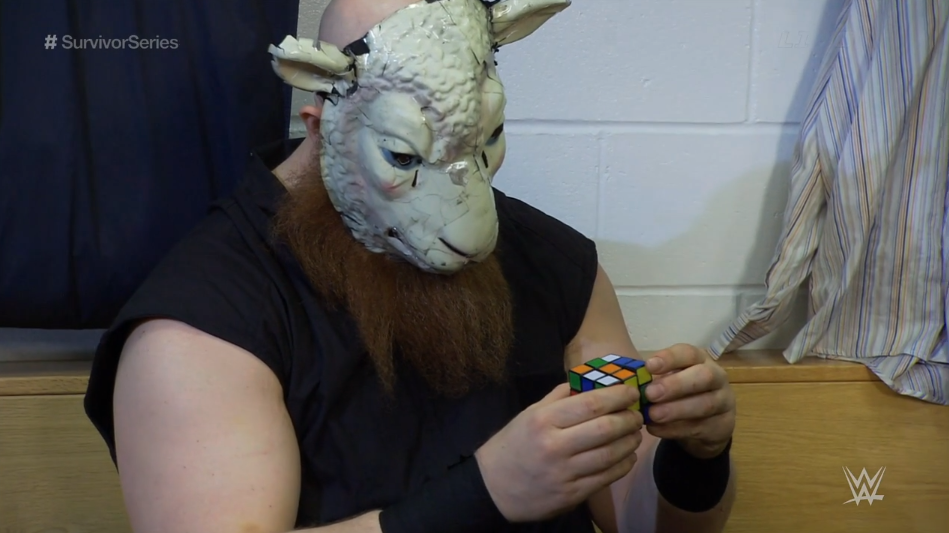
Team Cena, minus its leader, talks about how important tonight’s match is for them. It is, after all, a match they need to win if they want to keep their jobs. Cena shows up to give everybody a nice pep talk. He says he’s going to try hard to make sure nobody gets fired. Ziggler is on fire though. This is a big moment for him, one of the biggest of his career in a legitimate way, and when he goes through his babyface fire routine, I won’t lie: I get kinda tingly. Ryback is hungry. Rowan looks up from his Rubik’s Cube long enough to offer that the only thing his team needs to do to survive… is win. That gets Cena super pumped.
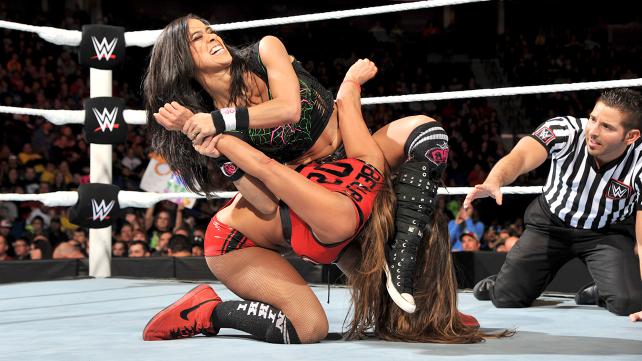
WWE Divas Championship — AJ Lee (Champion) vs. Nikki Bella (w/Brie Bella): Brie Bella’s Seattle grunge & E! reality star get-up is hilarious and terrible. Nikki continues to dress like a cheerleader. Brie has two more days left under the employ of Nikki, per the stipulations of their match at Hell in a Cell. Nikki, I guess, is trying to leverage that into the Divas Championship, but the story, with AJ thrown in, has been so convoluted that it’s hard to tell how that’s going to happen. AJ Lee skips her way down to the ring and she and Nikki get a main event introduction, which happens for women’s matches never. I’m all for it. Brie gets up on the ring apron, holding the Diva’s Championship. This distracts AJ, who goes over to push Brie away, so Brie grabs AJ and sexually assaults kisses her.
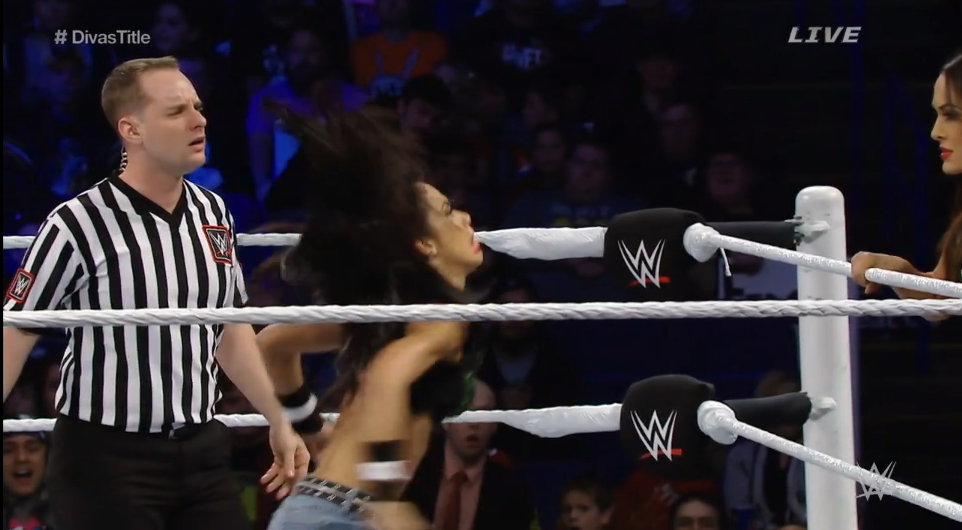
AJ turns around from this and Nikki drills her with her forearm, which continues to look like a convincing finish. Nikki picks AJ up, nails her with the Rack Attack (also a good looking move), and that’s it. Winner: Nikki Bella via pinfall. Grade: F
I mean, seriously. I guess it plays into the storyline between Brie and Nikki and ties into, oh, the whole history of AJ Lee’s character, but this was terrible, especially if, as rumored, this is it for AJ in wrestling. This, they assert, is almost exactly what happened when AJ kissed Daniel Bryan at WrestleMania. I guess, only the kiss was consensual and not a horrible ruse? Brie presents Nikki with the title, pleased as punch. I guess she’s cool being her sister’s slave, and the neckbeareded weirdos of the internet can now go hunting for pictures of Brie Bella kissing AJ Lee. I’m looking forward to Brie trying to justify this when she inevitably turns face on Raw. They announce that Dean Ambrose and Bray Wyatt will meet in a Tables Ladders and Chairs match at TLC in December. What a shock.
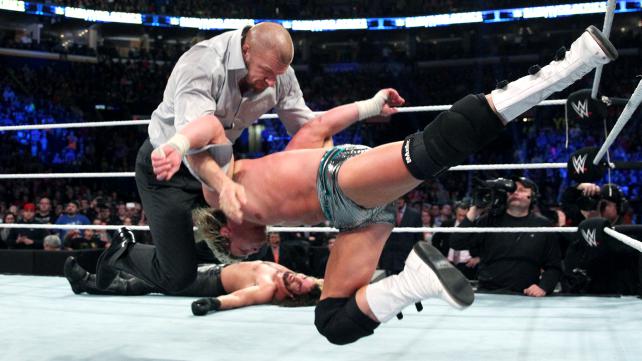
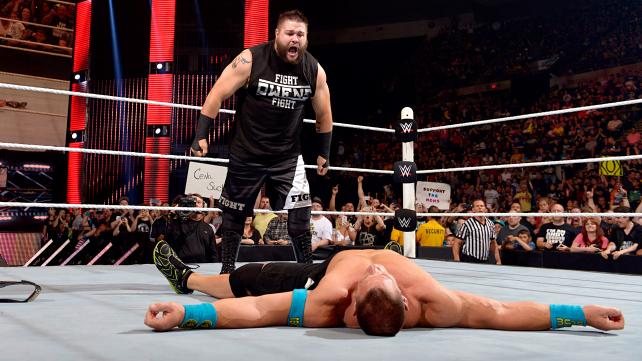
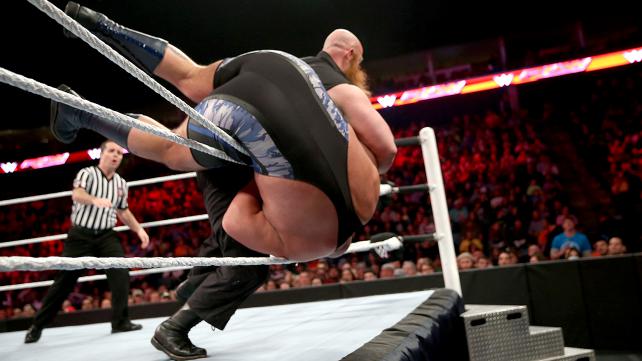
Survivor Series Match — John Cena, Dolph Ziggler, The Big Show, Ryback, and Erick Rowan vs. Seth Rollins (w/Triple H, Stephanie McMahon, Jamie Noble, and Joey Mercury), Rusev (w/Lana), Mark Henry, Kane, and Luke Harper: If Team Cena wins, The Authority (that’s Triple H and Stephanie McMahon) are no longer in charge of running WWE shows. If Team Authority wins, everybody on Team Cena is fired. This is going to be a long one, a full hour. A lot of ins and a lot of outs. The build for this was haphazard, to the point that Erick Rowan was a last-minute audible when Sheamus fell to an injury (thinking about it, Cesaro would have been better, if not equally nonsensical). I also don’t quite get why Triple H isn’t wrestling this match for himself. Given Kane’s less-than-sterling record this year, he’d probably be a better choice. It takes some time to introduce all the players, which is perfectly fine because Survivor Series matches are all about gigantic masses of humanity. Team Authority is out first, then Team Cena. Mark Henry and Big Show start the match off, with Mark Henry threatening to whoop everybody’s ass. Big Show stares him down. He charges at Big Show and gets KO punched right in the jaw. Show goes for the cover, and immediately Team Authority is down a man. (Mark Henry is eliminated.)
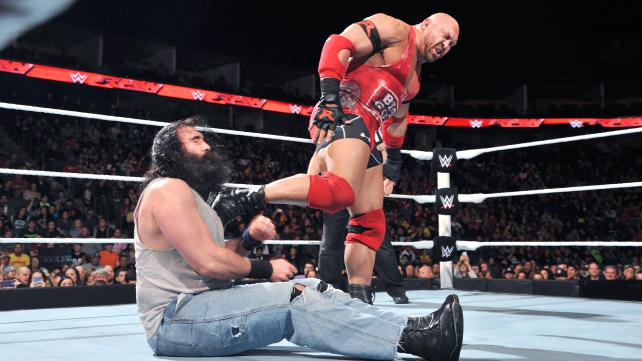
Triple H and Stephanie look on shocked while the crowd goes nuts. A big warning shot across the bow of Team Authority, though really, why does it always have to be poor Mark Henry? Team Authority play mind games with Big Show, acting like Harper is going to get into the ring, which allows Seth Rollins to sneak attack Big Show from behind. It’s to no avail though, as Big Show is on fire. All of Rollins strikes do nothing to the giant, who swats him around like nothing. Rollins tags Kane in, and now it’s Big Show vs. Kane in the 1,000th chapter of their never-ending saga. Big Show wears Kane out and tags in John Cena, who is also a frequent enemy of Kane. Cena starts his evening by hitting Kane with his big match dropkick. Kane bails and tags in Luke Harper, so Cena tags Erick Rowan. The crowd really gets into this, which is a shock. I don’t remember Rowan being anything more than the afterthought of the Wyatt Family, but here he is now, solving Rubik’s Cubes and getting gigantic pops from the crowd. Lord knows why he wants to fight Harper, but hey, I’m for it. But Seth Rollins tags himself in. As a reward, his head is grabbed and immediately smashed into the turnbuckle. He also body slams Rollins and stomps around the ring impressed with himself. Rowan tags in Ryback, who throws Rollins to the mat by his head. Ryback muscles Seth Rollins around, slamming him from turnbuckle to turnbuckle before military pressing him to the lights. Rollins slips out, though, ducks a clothesline, and gets back body dropped. Luke Harper hits the ring and gets decked by The Big Guy. Ryback then lifts Harper up and holds him for a few seconds before finishing a vertical suplex. Very impressive strength. Harper tags out to Kane. He momentarily gains the advantage on Ryback, whips him into the ropes, and gets Thesz pressed and splashed for his trouble. Then Kane tags out to Rusev. Yes, please. They throw punches at each other until Rusev cuts Ryback off with a knee to the gut. Rusev starts kicking at Ryback, then runs off the ropes. Ryback surprises Rusev with a massive spinebuster. I guess you shouldn’t run at (or stand in front of a running) Ryback. The Big Guy hits the Russian with the Meathook Clothesline, but can’t follow up with the Shellshock. Rusev, from behind, shoves Ryback into a big boot from Kane, and the whole match breaks down.
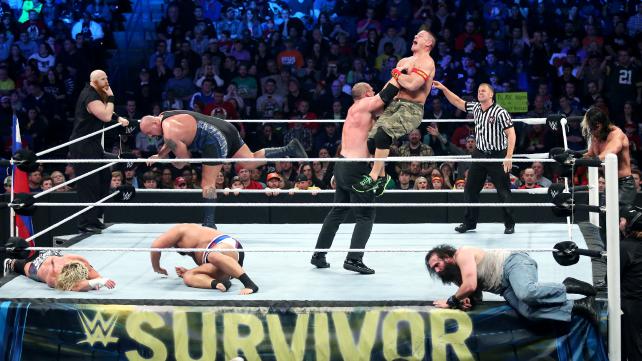
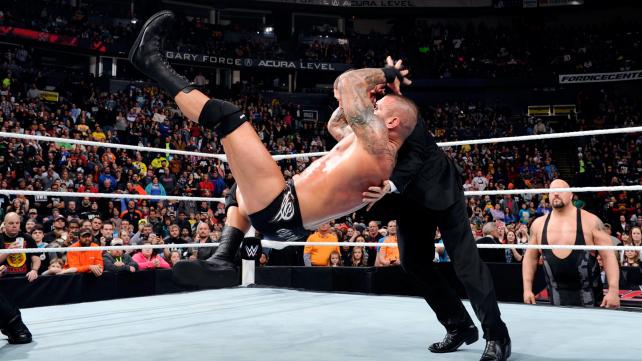
With everybody fighting and Ryback on the mat, Seth Rollins hits him with the Curb Stomp and bails before the ref can see him. Rusev is still the legal man for Team Authority, and he pins Ryback after hitting him with a running kick to the jaw. (Ryback is eliminated.) We reset with Big Show and Rusev. Rusev backs Big Show into the corner and charges to the other side of the ring. He rushes back and gets caught with a big boot. Big Show calls for the chokeslam, but Rusev wiggles out of his grip and tags in Luke Harper. He fairs no better against The Big Show until he’s able to catch him by surprise with a huge dropkick before tagging in Seth Rollins. He kicks Big Show in the face and gets a two count. He quickly tags in Kane, who dropkicks a seated Big Show for another two. Kane tags Harper back in. Harper locks Big Show in his gator roll, and The Authority is now firmly in control of this match. But Big Show is too big, and once he’s in trouble he’s able to hit Luke Harper with a back suplex and easily tag in Dolph Ziggler. He takes Harper off his feet with a pair of clotheslines and follows with a Stinger splash in the corner and a neckbreaker. Ziggler hits an elbow drop, attacks Rollins, runs at Harper, but gets planted with a black hole slam. Harper tags Rollins in, and Rollins wears Ziggler out in the corner with a flurry of stomps. He then tags out to Rusev. He stomps Rollins some more before covering him for a two count. Ziggler gets kicked in the face and watches as Rusev switches over to Kane. Kane continues to stomp Ziggler. He picks him up and deposits Ziggler in the middle of the ring with a sidewalk slam. It gets a two. Kane works Ziggler over some more and brings in Luke Harper. Harper steps on Ziggler’s face while Cena yells some stuff to his teammate about never giving up. Harper picks Dolph Ziggler up for a suplex, then drops him and jacks his jaw. It’s worth a two count. Rusev comes back into the match and brings his foot down across Ziggler’s back. He manhandles Ziggler, who is completely spent, shoving him around the ring and kneeing him. Rusev talks trash to Ziggler in Russian, and Jerry Lawler says “speak English, Rusev” because you can be xenophobic and still be a good guy in WWE. Rusev picks Ziggler up and presses him against the ropes. From there, he proceeds to knee Ziggler in the gut until the referee forces him to break with a five count. He backs off, still carrying Ziggler, faces down Team Cena, and throws Dolph down with an overhead slam. That gets a two count, and Rusev brings in his captain, Seth Rollins. Ziggler tries to make it to his corner, but can’t. Rollins picks him up from the ground and punches him in the face. Rollins takes some time to praise his team, and this allows Ziggler to fire back. Rollins catches him, though, and uses a flatliner to drive Ziggler’s face into the turnbuckle. Ziggler kicks out, and Rollins brings Rusev back in. He grinds Ziggler down with a chinlock. Ziggler creates some space with a jawbreaker and tries to leap over Rusev, but Rusev catches him. Ziggler uses his momentum to plant Rusev with a DDT. He goes for the cover on Rusev, but Luke Harper breaks it up, only to be met by John Cena and an Attitude Adjustment. This brings Kane into the ring to chokeslam Cena. Kane turns around and is met with a Big Show chokeslam. Rollins, though, springboards off the top rope and kicks Big Show in the face to stymie Team Cena’s momentum. But he forgets Erick Rowan, who lifts Rollins onto his shoulders by his throat. Rollins punches to counter the powerbomb and is thrown off. Rollins stuns Rowan with a kick to the sternum, but is back body dropped over the top rope and onto a pile of bodies. Rowan isn’t paying attention, and that allows Rusev to nail him with his big leg lariat. Dolph Ziggler and Rusev are still legal.
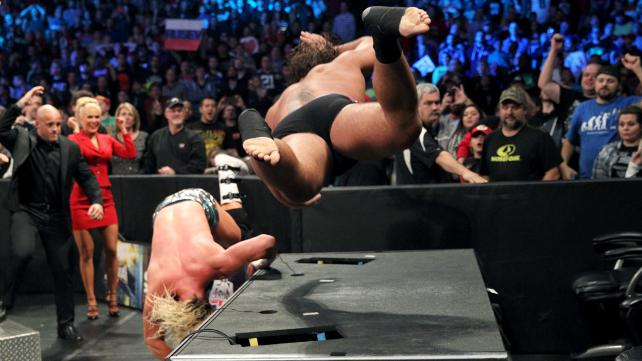
Ziggler gets up and tries to hit Rusev with the Fameasser, but Rusev counters by powerbombing Ziggler over the ropes and into the combined mass of Teams Cena and Authority. Rusev rolls out of the ring and starts to dismantle the Spanish announcers’ desk. He does the same to the American one, then pushes a bunch of rolly chairs out of his way. He grabs Dolph Ziggler by the hair and drags him to the Spanish table. He climbs the American one and tries to hit Ziggler with a running splash, but Dolph moves out of the way and Rusev crashes through the table on his own! In the ring, the referee is administering a 10 count (in a Survivor Series match, the regular rules still apply), and are up to six before anybody starts moving. Rusev is out cold. Team Authority try to threaten the referee, but he continues doing his job. Ziggler’s crawling, using the ring steps to get up to his feet. The count is at seven. Ziggler rolls in at nine! The Authority try to roll Rusev in, but they’re a couple of tiny dudes and can’t get the job done, so Rusev is counted out! (Rusev is eliminated.) Rusev wasn’t pinned nor did he submit, so he’s still technically undefeated by anything but his own hubris. Kane takes over for Rusev and throttles Ziggler, who is still the legal man. He picks Ziggler up by the throat and goes for a chokeslam, but those are no sure thing in 2014. Ziggler manages to escape and tag in John Cena, safe from elimination at last.
Cena gets into the ring and goes shoulder block, shoulder block, powerbomb, all in the usual fashion. He sets up for the Five Knuckle Shuffle and hits that, too. Kane gets up and eats an Attitude Adjustment, but Seth Rollins interjects himself before Cena can make the cover, kicking him in the gut and nailing the Curb Stomp. Cole reacts like he’s seen Hulk Hogan turn his back on WCW, which is a bit much. This brings Erick Rowan into the ring, and he finally faces off against Luke Harper. Rowan quickly gains the advantage and beals his former partner into the turnbuckles. Harper gets up, just in time for Rowan to hit him with a splash in the corner.Kane tries to get involved, but Rowan knocks him off the ring apron. That’s enough of a distraction for Harper to get back into it, and he jumps on Rowan’s back and puts him in a sleeper hold. Rowan backs him into the turnbuckles, clears Rollins from the apron, ducks a Harper clothesline, and catches him on the rebound with a spin kick! Kane tries to chokeslam Rowan but can’t. It doesn’t matter though, as Rollins flies in from out of nowhere to kick the big man in the face. Harper hits his discus clothesline and pins the man he once considered his brother. (Erick Rowan is eliminated.) Big Show, watching from the outside, looks distressed to see Rowan go. He climbs back up to his corner. John Cena’s already in the ring, still suffering after Rollins’ Curb Stomp, and this makes him the legal man. Big Show scans the ring and enters, facing down Harper, Rollins, and Kane. He gets ready to throw his knockout punch, but looks wary. Cena is still out. Big Show is all alone. Show encourages Cena to get up, and Cena does, slowly. When he gets to his feet, Big Show decks Cena with the knockout punch! It’s a complete shock to everybody, including Team Authority, and Seth Rollins wisely scrambles over to cover the captain of Team Cena, who is out cold. (John Cena is eliminated.) I think this is brilliant. Big Show was the anchor of Team Cena early, but he’s watched Ziggler get beaten to hell, Cena get abused, and Rowan taken out by team tactics. He was all for Cena heading into this match, but anybody who has watched Big Show knows that the guy is essentially a mercenary. He looks out for himself. So with Cena staggering and the whole of Team Authority daring him to do something, he jumps ship. He looks heartbroken about it (after all, The Authority nearly bankrupted him), and Triple H looks the most shocked of anybody. Big Show extends his hand to Triple H, and the COO of WWE shakes it. Big Show then leaves the ring, and is functionally counted out. (Big Show is eliminated.) Stephanie McMahon rubs it in Cena’s face because she’s amazing.
That leaves Dolph Ziggler. He’s in there against Kane, Luke Harper, and Seth Rollins. All over but the crying. Triple H and Kane wake Dolph Ziggler up because they’re a couple of nice guys. Kane helps Ziggler to his feet and sends him caroming into the barricade surrounding the ring while Cena takes the long walk back to the showers. Kane puts Ziggler back in the ring and starts working him over. Ziggler kicks out of a pin attempt, but it’s academic from here as Kane tags out to Harper. He walks over Ziggler and tags in Rollins. Seth Rollins, of course, is an asshole, so he makes a point of showing Dolph Ziggler how many partners he has left: zero.
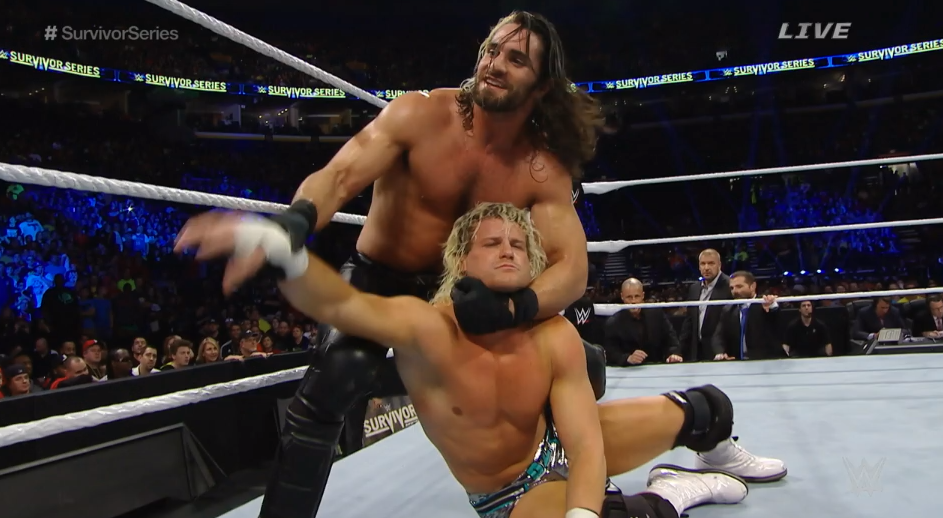
Rollins tags Kane back in, and Kane puts Ziggler up on the top rope. He uppercuts Ziggler, as is his custom, and follows him up, looking for a superplex. Ziggler fights him off, though. He surprises Kane with a cross body block of the top rope, but it only results in a two count. He superkicks Kane, catching him flush, and follows up with the Zig Zag! Just like that, it’s two on one! (Kane is eliminated.) Luke Harper comes into the ring and crushes Ziggler with a big boot. Ziggler rolls out of the ring, but he’s not safe from Harper. Luke Harper runs off the ropes and dives outside the ring, catching Ziggler with a tope suicida! Harper puts Ziggler back into the ring and follows him in with a superkick of his own. Ziggler kicks out! Harper follows with his huge sit-out powerbomb, and Ziggler manages to kick out of that, too! Harper can’t believe it, and he stalks around the ring frustrated. This lets Ziggler surprise him with a flash roll-up, and just like that we’re down to a one-on-one contest! (Luke Harper is eliminated.) Rollins doesn’t let Ziggler rest of long, though, as he’s back in the ring, and back at stomping away on poor Dolph. He throws Ziggler out of the ring, then hurls him into the barricade. Rollins does it again, but the fans are chanting “LET’S GO ZIGGLER,” and anything is possible. Rollins puts Ziggler back into the ring, but Ziggler catches him in a roll-up! Rollins kicks out, but as soon as he’s back to his feet, Ziggler scores with a DDT! Rollins kicks out again. Triple H and Stephanie McMahon continue to do an amazing job at ringside. Momentum shifts back to Rollins, who hits Ziggler with a powerbomb into the turnbuckle. That’s a two count. Rollins punches a defenseless Ziggler a few times before climbing to the top rope. Ziggler meets him up there, but is shoved off. Rollins goes for a Curb Stomp from the top, but Ziggler avoids it and hits the Fameasser! Two count! Every single move here gets a massive ovation, as it should. This is a great story. This is a great match, one of the best of the year, which has been full of amazing multi-man matches.
Ziggler goes for the Zig Zag, but Rollins has the ropes and shrugs him off. Joey Mercury and Jamie Noble try to get involved, but Ziggler manages to fight them off. Rollins goes for a splash, but Ziggler avoids it and hits a rebounding Rollins with the Zig Zag! He goes for the cover… and Triple H pulls the referee out of the ring! The zoom in on Ziggler’s cover, minus the referee, is brilliant. They somehow cut back to this shot while Triple H is punching the referee, though, so that’s less good. Mercury and Noble get in the ring and assault Ziggler while the fans in the arena cry out in frustration. Ziggler fights them off again, though, and sends them crashing into Stephanie McMahon, who falls off the ring apron and into Triple H. Ziggler superkicks both of Rollins’ goons, but Rollins ducks the kick intended for him and does another buckle bomb. Rollins goes for the Curb Stomp, but Ziggler moves. ZIG ZAG! The place is going berserk, but there’s no referee! One slides into the ring and gets to two, but Triple H slides in and attacks this referee, too! He throws the referee out of the ring and begins assaulting Ziggler himself. Triple H is a collage of muscles and sweat-drenched business clothes—that’s how hard he’s been working as a manager. Triple H does Ziggler in with the Pedigree. He rolls Ziggler over and drags Rollins on top before calling out another official. It’s Scott Armstrong, the “crooked” referee who has been in The Authority’s pocket when they needed him. He starts to count… and a crow cries out from the TitanTron:
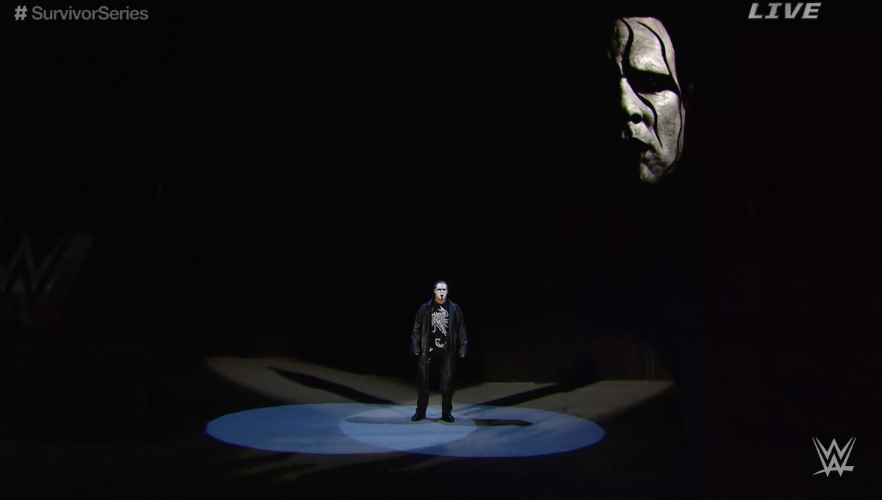
IT’S STING! And, leaving aside his new entrance music (which isn’t good) and his insane hairline, Sting’s sauntering out to a WWE ring for the first time is about as cool, as iconic, as things get in 2014. Everybody freaks out about this. Everybody. Stinger punches Armstrong and enters the ring. He stares at Triple H, who can’t believe what he’s seeing, and just those two men, standing in the ring together, is enough for the crowd to launch into chants of “HOLY SHIT!” and “THIS IS AWESOME!” For once, they’re not needlessly exaggerating. Sting and Triple H and the announcers let everything pass in silence. This is a goddamn moment. And then Triple H tries to attack Sting and…
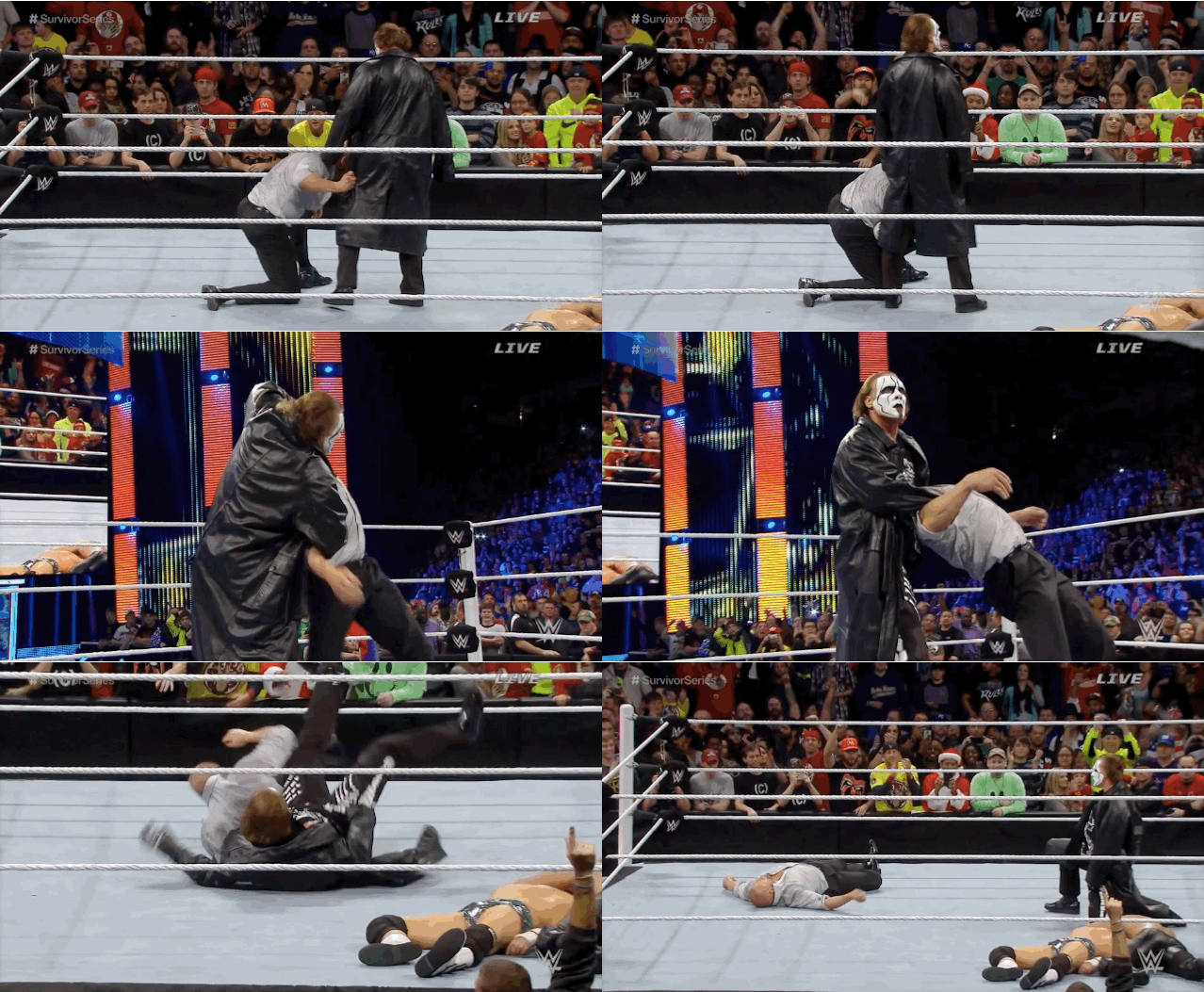
…all of the sudden it’s 1997, and I’m nine years old. Sting didn’t exactly disappear when WCW folded in 2001, but it feels like he did, wrestling for TNA Wrestling in front of crowds that, at their largest, were a couple thousand strong. This is an NHL arena with 20,000 people in it. There’s significance to Sting’s every action. And what he does is hit Triple H with the best Scorpion Deathdrop of his life, drag Dolph Ziggler on top of Seth Rollins, and watch as the referee counts the pinfall. (Seth Rollins is eliminated.) Winner: Dolph Ziggler via pinfall. Grade: A
Now, here are several caveats to how goddamn exciting Sting is, and how great I found the match. First, for how goddamn brilliant the closing sequence between Ziggler and Rollins was, it would have been amazing for one of them to finish the match. Second, while Team Cena vs. The Authority wound up being good, all on the back of this match, the fight against Triple H and his goons was Daniel Bryan’s, and it sucks that injuries prevented him from slaying the dragon. But what this match accomplishes is a lot. Dolph Ziggler has arrived. Seth Rollins, if he wasn’t already, is legitimately one of the top heels in the company. Everybody involved has something to do in the aftermath of this match, even Mark Henry, and everybody left the show having put in some of the best work of their lives. Watching Triple H and Stephanie McMahon realize what happened, Triple H looking defeated and Stephanie wailing like a banshee, there’s an air of unpredictability hanging over WWE right now. That’s when wrestling is at its best—when anything can and will happen, and does so without breaking its own rules or logic. Survivor Series had two absolutely dreadful matches and one that should have been much, much better. But in the end, the main event hit the reset button on what’s been an agonizing season of programing, and kicks off the road to WrestleMania in ernest. I like where it’s going. I don’t know where it’s going. I like that I don’t know where it’s going.
Rating: