

Category: Essentials

  • Movie Review: Cosmopolis (2012)

    Movie Review: Cosmopolis (2012)

    essentialIn reviewing the Don DeLillo novel that became this film, John Updike lamented that, despite the “haloes of import” weaving themselves around the events of the book, “the trouble with a tale where anything can happen is that somehow nothing happens.” There’ve been many odysseys since Homer recounted the one undertaken by Ulysses, but the modern odyssey has been cursed with the observation that nothing happens—despite all possibilities and evidences to the contrary—since Leopold Bloom took his in the novel bearing the homeric hero’s name. Boiled down, Ulysses is an argument that a single day in the life of an ordinary man has the same epic potential as a woe-begotten voyage across the sea.  Cosmopolis, the DeLillo novel adapted by David Cronenberg, makes the same argument, except its protagonist is so obviously set apart from the notion of normality that, rather than watching him shit in an outhouse, we’re left wondering if he shits to begin with.

    Don’t take this as evidence that nothing important happens here. Eric Packer (Robert Pattinson) is as unsympathetic as protagonists get—an unaccountably rich young man who travels across the city in his bulletproof, cork-lined, technological terror of a limousine for a haircut despite Presidential visits, populist uprisings, and threats directed specifically towards him—but there’s something profound in the mundane way he comes to realize that his life is in crisis, something powerful about the way he responds.

    It’s clear from the start that Packer could live in his limousine if he needed or wanted to. It’s outfitted with supercomputers and high-definition video screens, comes with a dedicated driver and crack security force. He tells a person in the car with him that he had the limo lined with cork to keep out street-level noise. There’s a hint of annoyance when he reports that it doesn’t work. He asks the driver where the cars go at night. He’s moved by the death of a rapper whose music constantly plays on the second of his private elevators. Packer’s elevated himself to godhood and isolated himself in his car, his office, and his apartment, but this is the day the world checks in to remind him that he is just a man.

    This is fine by Packer, whose unstated goal for the evening is complete self-destruction. A parade of people who work for him (Jay Baruchel, Juilliette Binoche, Samantha Morton, and Emily Hampshire, among others) sit across from him in the limousine and deliver various bits of bad news. He gambled against the rising value of the Yen and lost. He cannot buy and transport a cathedral from Europe for the purpose of sealing it away from the rest of the world. His wife (Sarah Gadon) seems to only tenuously remember their marriage. Both question its function, have yet to consumate. His chief of security (Kevin Durand) knocks on the window to tell him that it’s better to turn back. There’s the President’s visit. The rapper’s funeral. A riot. His limo is battered, damaged, vandalized. He is stalked through the city despite his vehicle’s relatively mundane appearance among the rest of the white limousines. Though his life is actively worsening with every inch of separation between his limo and its point of origin, Hacker remains undaunted. He will have that haircut.

    The haircut, of course, is nothing. It’s desire. Desire, Cronenberg suggests, more often than not ends in disappointment. Of the two arguments Cosmopolis makes, this is the more successful. This is obviously a film for and of its time, but any statement Cronenberg tries to make about the nature of money and misery can’t help but ring hollow. Eric Packer is a man too far removed from humanity to let something like the loss of wealth and autonomy spoil this detachment, and when a figure emerges from the shadows to embarrass him, his response is a fit of brutal violence. The most effective scenes here involve Packer’s interrogations of those whom he has real, unadulterated contact with. How does one detach themselves from the notion that someone is only sleeping with you because the thought of you as an assassination victim is a small excitement in an otherwise routine day? The idea of a haircut is nice, but does the excitement remain once the barber has dusted your shoulders? If he should slip and cut off too much?

    Cosmopolis is a surprisingly unsettling film for much of its runtime, content to limit the actions to the busy, businesslike world of Packer’s limousine and the anarchy going on outside. The limo is not unlike the gate of a fortress, and those outside it, having laid siege on the vehicle’s occupant for most of the day, are tantalizingly close to bashing those gates in. One Packer roams free from his car, Cronnenberg is unable to maintain the vibe and momentum he’d so subtly built. The conflict, from that point on, is no longer between two colliding worlds, but two ships sending each other conflicting signals. In the barber chair or seated across from his “credible threat” (Paul Giamatti), Packer’s interactions with the people unfortunate enough to be in the same room as him feel like two people reading aloud pages from vastly different books. On one hand, that’s human interaction. On the other,  Cosmopolis‘ refusal to submit to the needs of a standard narrative leads to a frustrating conclusion, with nothing resolved. The lives of two men intersect. All we know is that both have urges. For what? Not even they seem so sure.


    Cosmopolis. With Robert Pattinson (Eric Packer), Kevin Durand (Torval), Jay Baruchel (Shiner), Juliette Binoche (Didi Francher), Samantha Morton (Vija Kinsky), Sara Gadon (Elise), Emily Hampshire (Jane Melman), and Paul Giamatti (Benno Levin). Directed by David Cronenberg from a screenplay by Cronenberg, based on the novel Cosmopolis by Don DeLillo.

  • Movie Review: The Master (2012)

    Movie Review: The Master (2012)

    essentialPaul Thomas Anderson’s The Master is an often impenetrable movie, its characters—masters of obfuscation, all—shroud themselves in secrecy and purposeful vagueness in much the same way their real-life counterparts did. Forget the Church of Scientology, though. If you go into this film looking to see how Anderson does or doesn’t explore the motivations of a man like L. Ron Hubbard, you’ll only end up lost. The Master is a movie involving a cult. For it’s members, it is The Way, not The Cult. That’s how all cult members see their cult of choice, and that’s all anybody can really say about the subject-at-large. Instead of considering The Master as a film about a cult, think of it as a film about the strange, seemingly incongruous relationship between the man at the helm of a burgeoning movement and another man who is very much an outsider. The common denominator between the two? Magnetism.

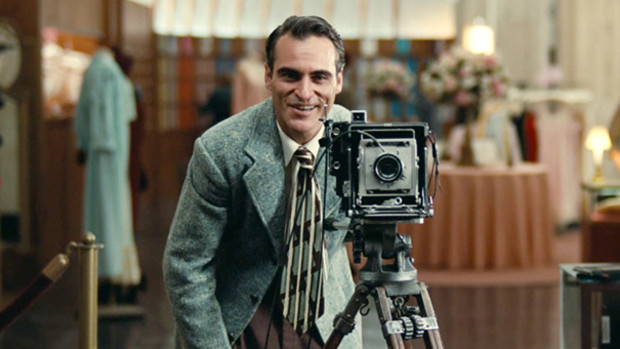
    Of course, magnetism is what draws devotees to a master, but Freddie Quell (Joaquin Phoenix) is a rabid, masterless animal whose primary concerns are sex and alcohol. In the Navy, as a department store photographer, working fields in California, Quell is an artist of unorthodox liquors, guzzling rocket fuel, paint thinner, mouthwash—everything but beer, whiskey, or wine, so long as he remains in a pleasant stupor. The men and women Quell works with are inexplicably drawn to Quell and his potions, surrendering sex and sense for the stuff in Freddie’s flask. That some people end up dead after drinking his liquor is of no greater consequence to him than a morning hangover, the realization that he can’t remember his evening. That a migrant worker dies because of Freddie’s mixture has him on the run, but fortune smiles upon him: he stows himself aboard a private yacht belonging to a wealthy author who agrees to take him on as a seaman so long as he produces more of “that wonderful potion.”

    The author in question is Lancaster Dodd (Phillip Seymour Hoffman), a man who claims that his books hold the key to humanity’s shedding its animaistic urges and ascending to a higher plane of being. He’s promised the world—and his growing group of followers—a sequel that will reveal more of what’s necessary. On the boat, he entertains guests by day and locks himself in the study at night, working on the book. Then he finds Freddie. Freddie with his potions. Freddie the animal. Freddie whose conversion to Dodd’s way of thinking would represent a major breakthrough for The Cause. Freddie who hasn’t felt at home, who hasn’t been purposed, since returning from the war. Lancaster Dodd offers Freddie Quell a home and a purpose. Of course he joins.

    Inevitably, this has repercussions neither party foresaw, though it’s probably worth questioning if Freddie thinks any of his actions through before undertaking them. Dodd has in Quell something of a Pit Bull, an animal who lashes out to protect his master. A man like that has his uses, but if the aim is to civilize the beast within Freddie, his boorish behavior isn’t helping. Dodd, staring into the jagged, broken crevasse of Quell’s face, must wonder if his new devotee hears his message, or if he merely pretends to, having no other place to go. Freddie, meanwhile, takes to the rituals and routines of The Cause like a tortured psychiatric patient, which, I would argue, he is. The film’s best sequences have Dodd and Quell seated across from one another, Dodd pestering Quell with a series of questions, statements, or tasks. His rules are strict. If Freddie makes an error, they begin again. Freddie makes many errors. Dodd’s relentless calm taunts him. Quell breaks down. Screams. Cries. Pours forth stories he’s never told anyone. Then Dodd asks if he’s a liar. They begin again. Sometimes Dodd’s son-in-law (Rami Malek) is in the room with him as an agent provocateur, theorizing about and insulting Freddie as he calmly tries to take this round of abuse. He’s often unable to sit through the first sentence, having already jumped to the conclusion. They begin again.

    The impenetrability of The Master, whatever the codified messages contained in the mostly un-preached-from books of The Cause stand for, are subterfuge for a narrative mostly concerned with the deeply intense relationship that quickly develops between Dodd and Quell, who find themselves wrestling—sometimes literally—with opponents they’ve grossly underestimated. This is most evident observing the behavior of Dodd, the man who wants to cure man of its animal impulse. The façade he’s built and strengthened, the movement he’s grown, the success he’s experienced, all that comes under fire as it becomes more and more clear that Freddie isn’t improving, that the methods of The Cause are inspiring little to no change him. The pressure this causes leads Dodd—who flawlessly presents himself as an erudite man of class and good standing on most nights—to blow-up at the timid followers who know more about Dodd’s Cause than he does, rebuking them more harshly than he does Freddie because, unlike Quell, they won’t fight back.

    Quell, either because he wants to ride this train as long as possible or because he really does see The Cause as a way to better himself, finds temptation everywhere. Despite the war and his behavior, women are drawn to him. There’s always a steady supply of alcohol, always a man who needs to be assaulted to protect Dodd’s interests. Dodd tries breaking Quell’s behavior through the endless repetition of question and task, often leading Freddie to bash his head against the wall. Peggy Dodd (Amy Adams)—Lancaster’s wife—takes a more direct approach as members of The Cause grow increasingly wary of him, threatening abandonment if he can’t stop drinking. He agrees, but, again, Freddie’s a liar. He can’t stop himself from drinking anymore than he can stop Dodd’s daughter (Ambyr Childers) from flirting with him. Both, after all, are methods of escape Freddie has experience with, that he knows will feel good, even if only for a little while.

    It won’t take much deep reading to see Peggy as the true driving force of The Cause, a woman who knows she’s married to a fraud and has every intention to continue perpetuating it. She drives Dodd to write, pushes him across country to promote his teachings, perceives the damage Freddie has caused them. Lancaster’s actions are not those of a man who is the master, but of a man who finds himself serving two taskmasters: his wife, and his mission to cure Freddie. One has to give. When he hugs Quell, congratulating him on finally passing examination, it is very much like the kiss Judas gave to Christ, simultaneously a knife in the back and an act for those around them left not bleeding. Really, the hug is meant to assuage Freddie Quell’s growing doubt and rage, but Dodd has made another critical underestimation of his pupil, not nearly the simpleton rube he seems.

    Plenty has been written about Paul Thomas Anderson’s decision to film The Master in 65mm, both in terms of how the format may have been wasted on a film that doesn’t spend much time outdoors, and how the increasingly rare process draws the viewer into the landscapes provided by Hoffman and Phoenix. The way a film is shot often rates as minutia, but here, I think is purpose. There’s an intensity between the characters that matches the scope of the screen, the two men struggling with their need and desire to conquer each other, the woman losing sight of the small empire she’s built. The triangle between the three is not unlike the relationships between characters in a D.H. Lawrence novel: there’s a sexual charge to the proceedings, but the men lack the vocabulary necessary to trigger any release. Anderson’s focus on interior space here also recalls Lawrence, making the brief interludes when the film opens to wide spaces—the ocean, the desert—all the more terrifying. As Freddie rides a motorcycle out to the vanishing point, leaving Lancaster Dodd and his family to observe him growing smaller and smaller in the distance, the silent space between the two men could suffocate them both.


    The Master. With Joaquin Phoenix (Freddie Quell), Phillip Seymour Hoffman (Lancaster Dodd), Amy Adams (Peggy Dodd), Laura Dern (Helen Sullivan), Ambyr Childers (Elizabeth Dodd), Jesse Plemons (Val Dodd), and Remi Malek (Clark). Directed by Paul Thomas Anderson from a screenplay by Anderson.

  • Movie Review: Moonrise Kingdom (2012)

    Movie Review: Moonrise Kingdom (2012)

    essentialWes Anderson’s Moonrise Kingdom, like many of his films, functions as a nostalgist’s guide to childhood and the weightiness of romance. The difference here is that Anderson focuses on two children, children who, unlike Rushmore‘s Max Fisher, are actually children. They don’t approach love in Fisher’s clinical, precise way, nor do they regard life as a bitter procession of tragic events, as do the man-children of The Life AquaticThe Royal Tenenbaums, and The Darjeeling Limited. Their way is more innocent, one ignorant of societal norm and responsibility, but still couched in the grim truths of reality. Considering how movies now try to appeal to children through the liberal use of rainbow wigs and catchphrases, this attitude, and the intelligence of Moonrise Kingdom, seems reliquary, lost to the past.

    In the summer of 1965, Sam (Jared Gilman) and Suzy (Kora Hayward) run away together, into the secluded New England wilderness of New Penzance, an island Suzy and her family live on which is only accessible by plane or ferry. The pair spent an entire year plotting their escape, beginning with a chance meeting between the two while performing in a school play, and continuing through a series of business-like correspondences. Sam is an orphan and a Khaki Scout. Suzy is the record- and book-collecting daughter of wealthy parents who are strangers to each other. Same brings with him camping equipment and the ability to read maps. Suzy has her records, her books, her binoculars, and her cat. They are decidedly ill-prepared for the coming journey.

    Their plot discovered, Sam and Suzy’s flight brings together the disparate members of the small community. Walt (Bill Murray) and Laura Bishop (Frances McDormand)—Suzy’s parents—Captain Sharp (Bruce Willis)—the island’s lone police officer—and Scout Master Ward (Edward Norton)—the meticulous leader of New Penzance’s pack of Khaki Scouts—spread out and go looking for the kids. The remaining Khaki Scouts, having long considered Sam a weirdo, hunt for him like he’s an animal they want to mount on the treehouse wall. When they’re found, it’s in a beachfront kingdom they’ve made for themselves. It’s just them, the cat, her records and books, a campfire, and the moon. It’s a perfect kingdom—an idyllic place right out of the books Suzy carries—but, like all utopias, Sam and Suzy’s piece of land is doomed from the start.

    Walt and Laura Bishop, ever the reactionary, mostly absent parents, expressly forbid their daughter from seeing that strange boy again. Sam’s foster parents decided they can’t handle the responsibility anymore, so Captain Sharp takes him in while Social Services (here represented by Tilda Swinton) flies to the island so Sam can be shipped off to a juvenile refuge. The Khaki Scouts, meanwhile, having learned a valuable lesson about friendship and impressed with Sam’s resiliency  decide to spring the couple and get them to the mainland, that wild, unspoiled stretch of earth to large and secretive for even the most obsessive parents and public servants to uncover them.

    That the relationship between Sam and Suzy never wears thin is Moonrise Kingdom‘s most considerable accomplishment. The threat of precociousness looms large over every story about a couple of crazy kids, but Anderson manages to exercise restraint, stopping just short of letting his children run amok in the woods. Again, there’s something to be said here about the difference between Anderson and Roman Coppola’s script in comparison that of any other recent children’s entertainment: say what you will about Anderson’s appreciation for and liberal application of whimsy and hipster quirk, but his characters don’t abandon their parents so they can gulp soda, gobble candy, and have endless and endlessly merchandisable fun. Nobody sits Suzy down for some big, lame speech about morals, and halfway through the one he delivers to Sam, Captain Sharp realizes how stupid, futile, and condescending he’s being and pours out a little beer for the sad kid whose dreams have been wrecked. The adults at the corners of this film are more than vacuous governors of joy. They bring their own problems to the island. They’re as ill-prepared to face them as their runaways.

    The most obvious problem is that Laura is cheating on Walt with Captain Sharp. Beneath the unhappiness of this particular damaged relationship, there’s a subcontinent of grief. The Bishops, of course, remain together for their children. Captain Sharp, living alone in a trailer on the island, is by no means a bad person. Neither, for that matter, is Laura. He is driven to her by loneliness, she to him because he represents something wholly different—and thus more exciting—than the family she knows. Theirs is a relationship running parallel to Sam and Suzy’s. Where the Bishops would seek to end it, Sharp comes to see himself in the orphan, seeking a way to keep him out of the system.

    The outlier here is Scout Master Ward. As tempting as it is to lump him in with Anderson’s stable of man-children, few of his characters live as meticulously or selflessly. He, like many adults, is oblivious to the inner-workings of the children he looks after. When he realizes this, he becomes Moonrise Kingdom‘s most vulnerable character. He considers himself a failed scout master when Sam runs away, is depressed when Sam tenders his resignation from the troop, and is largely helpless before Social Services. He begins the film as a man as well-manicured as any number of Anderson’s dollhouse sets. Like New Penzance, the Belafonte, Rushmore, and the Darjeeling Limited, Ward’s put-togetherness is a facade, something that’s beginning to crack and fissure.

    Moonrise Kingdom is Anderson’s eighth film, and hardly the first to deal with dysfunction and longing. He’s no chameleon—even the claymation of The Fantastic Mr. Fox looked, felt, and sounded like something distinctly of his brand—but Anderson continues finding subtle ways to express his themes differently. Here, it’s the intersection of Sam and Suzy’s dream with the reality of the adults who watch over them. The lives led by the Bishops, Captain Sharp, and Scout Master Ward are fractured and sometimes terrible. However well they think they’re hiding this, however much they assume their children remain oblivious, the two understand the problems of the real world, perhaps better than their wards. That the unknown holds so much potential is why they run away. But potential is often not realized, and is rarely perfect. Their utopia, the Moonrise Kingdom, lies at the edge of the sea. Storm clouds are gathering. Look at their empire. How easily the ocean could sweep it away.


    Moonrise Kingdom. With Jared Gilman (Sam), Kara Hayward (Suzy), Bruce Willis (Captain Sharp), Edward Norton (Scout Master Ward), Bill Murray (Walt Bishop), Frances McDormand (Laura Bishop), Tilda Swinton (Social Services), Jason Schwartzman (Cousin Ben), and Harvey Keitel (Commander Pierce). Directed by Wes Anderson from a screenplay by Anderson and Roman Coppola.

  • Movie Review: Bernie (2012)

    Movie Review: Bernie (2012)

    essentialImmediately, Bernie doesn’t seem like much of a film beyond the performance of Jack Black in the titular role. Based on Skip Hollandsworth’s Texas Monthly article “Midnight In the Garden of East Texas,” the pseudo-documentary style director Richard Linklater brings to the story of genteel assistant funeral director turned murderer Bernie Tiede (Black) seems destined to keep things small potatoes. Beyond the core cast, Bernie fills itself out with character actors and townsfolk, talking into the camera about a beloved community figure—devout christian, endlessly charitable, patron of the arts—who nobody believes is capable of grisly murder. Yes, Bernie is a film buoyed by Black, Matthew McConaughey, and Shirley MacLaine, but as the community continues to assert Bernie’s innocence (despite his tearful confession), it’s clear that Linklater’s aim is not merely strong, character driven drama, but the portraiture of a town driven temporarily insane by its passion for a favorite son.

    Bernie is most certainly guilty, but what he’s guilty of beyond the murder of curmudgeonly millionaire widow Marjorie Nugent (MacLaine) is the question the townsfolk pose to exasperated D.A. Danny Buck (McConaughey). Figuring that Bernie is otherwise “too light in the loafers” to shoot someone in cold blood, they propose that he must have been temporarily insane to shoot Nugent in the back and stuff her in the freezer. It’s a fair point, one that Linklater is careful to examine. Bernie, who routinely dotes upon the little old ladies of his church, the newly widowed women who happen into his funeral home, gives his life to Nugent. As the owner of a prominent local bank, she’s the kind of person who’d shred a person’s loan application before thinking to look at it. Is it Bernie’s persistance that wins her over, or does she see in him a simpleton rube, a man she can exploit endlessly and without complaint? How culpable is Mrs. Nugent in her own demise, the townsfolk ask?

    Linklater crafts an extremely effective procedural despite there being little in the way of actual police work. His film acts as an anthropologist, unearthing details of the relationship between Bernie and Nugent—who wouldn’t be driven crazy by someone’s habit of chewing each bite of refried beans 25 times?—and examining a D.A. driven to wit’s end by a city sympathetic towards a confessed killer. McConaughey’s performance is less showy than Black’s—indeed, Linklater seems one of only a few directors well-suited to Jack Black’s bombast and propensity to sing—but serves as an anchoring neutral between the overwhelming niceness of Bernie and the spiteful nastiness of the woman he serves. The townsfolk paint Danny Buck as a guy just seeking reelection at Bernie’s expense, and the way Buck brags about the way he’s nabbed perpetrators in the past, that’s more than a bitter claim. But this case is a no-doubter, something he should be able to sleepwalk through. Instead, he’s assailed in restaurants, pestered at the grocery store, taunted by everybody in town that they’ll acquit Bernie if called to the jury. Sure, it’d be easy to acquit a man like Bernie Tiede, but what kind of justice is that?

    It’s the trial of Bernie Tiede that serves as the best scene here. After moving the case to a different county, Danny Buck does everything he can to paint Bernie as a big city liberal, and Bernie plays right into his hands. His love of theatre, the vacations he and Mrs. Nugent took to New York, the first class seats on the plane to the city—outside of Carthage, away from those who know him and his victim, Bernie’s a freak, a man who murdered and old lady for her considerable fortune. It’s brilliant, the way Buck barbecues Bernie, and the disbelief with which the accused responds is genuine. He’ll admit to being a murderer, but a monster? Hardly.


    Bernie. With Jack Black (Bernie Tiede), Shirley MacLaine (Marjorie Nugent), and Matthew McConaughey (Danny Buck). Directed by Richard Linklater from a screenplay by Linklater and Skip Hollandsworth, based on the Texas Monthly article “Midnight in the Garden of East Texas” by Hollandsworth.

  • Movie Review: Haywire (2012)

    Movie Review: Haywire (2012)

    essentialEfficient. That’s Steven Soderbergh‘s Haywire in one word. These days, it’s nothing for a thriller to hop around the globe, to squeeze in swerves and car chases, to fashion for themselves a superhuman killing machine. Haywire does these things as well—if not better—than its contemporaries, but its pace is ruthless, breakneck. At 92-minutes, there is no fat on its bones, and no queasy-cam gimmicks, either. When Haywire stops to take a breath, it’s only to show how tightly the net around its heroine is constricted.

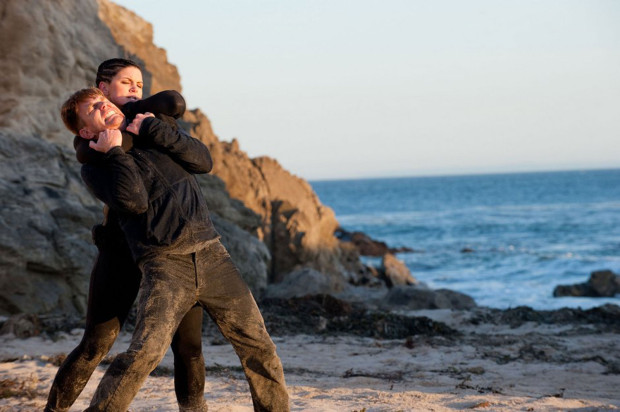
    Malory Kane (Gina Carano) is our superhuman, the focus of a plot that aims to take her out. As Haywire opens, shes sitting in a cafe in upstate New York, sipping tea. Before she has time to finish her cup, she’s locked in a brutal fight with Aaron (Channing Tatum), a man she worked with on a project in Barcelona. A good samaritan (Michael Angarano) hands her the keys to his car, and the two speed off for Parts Unknown, Kane narrating her story to the mostly terrified teenager. The story is simple enough. Kane’s a contractor who works for a private firm that governments hire out to glean information, recover lost assets, rescue dissidents—spy business. She’s requested to be a member of a team extracting a hostage from Barcelona. Her boss, Jeremy (Ewan McGregor), is hesitant at first, but when his employers—U.S. governmental employee Alex Coblenz (Michael Douglas) and Rodrigo (Antonio Banderas), a man with no specific origin—agree to certain contractual details, Kane is put on the case, the hostage is rescued, and all is well. Or so it seems.

    It happens that Jeremy’s business is wholly reliant upon Malory Kane and that, after the dissolution of their personal relationship, Kane is looking to get out of her business obligations with him, as well. First, he gets her to agree to an assignment that’s pretty much a “paid vacation,” a chance to persuade an agent to join Jeremy’s team while at the same time making contact with that agent’s mark under the guise of being a power couple. That agent, Paul (Michael Fassbender), has been assigned to kill the hostage Kane rescued, plant evidence on the body pointing to Kane, then kill her, making it look like an act of self-defense. Simple enough, except that Kane ends up killing him and going on the run, making her way back to the United States to clear her name, uncover the conspiracy against her, and gain a measure of revenge.

    Haywire‘s frequent action set pieces are engaging, covering all the bases. Across rooftops, on foot, and behind the wheel of a car, it’s clear that there’s nobody like Malory Kane, who, when she is brought down, succumbs only to the sheer number of people set against her. Soderbergh’s films, regardless of how kinetic they often feel, rarely move like Haywire, which has a fluidity and clarity of vision rarely afforded to a typical thriller. There’s an effortless cool to the way he films Carano chasing down her prey, jumping from roof to roof, and employing her dazzling array of mixed martial arts maneuvers.

    Speaking of Carano, this is her first feature film, though it would be surprising were this to prove her last. Carano is granted quite the set of crutches in Haywire: she’s guided by McGregor, Douglas, and Bill Paxton (as Kane’s father), prodded by Banderas, and romanced by Fassbender and the great lunkhead Tatum, who, given this film and his self-effacing turns in 21 Jump Street and Magic Mike, is perhaps smarter than anybody has yet to give him credit for. Though she sometimes looks out-of-depth when standing across from somebody the caliber of Michael Douglas—it’s worth pointing out that whatever charisma she possesses has, thus far, only been used in brief flashes during pre- and post-fight interviews and press conferences—she mostly holds her own.

    It helps that Soderbergh is a director who’s proven masterful at identifying and exploiting the strengths of his cast. The choice of Carano in this role is no less unusual than, say, his choice of Sasha Grey as an escort, and Carano’s fighting skills are put to good use here, the reality of maneuvers like the cross armbreaker and the triangle choke only further embellishing the punishment she deals out. Tatum’s character has his arm broken in Haywire‘s opening sequence. Watching Carano swiftly grab his arm and snap it back, it’s little wonder that Tatum later appears in a cast, arm hanging useless at his side. Here, it’s the little flourishes of realism that matter, that paint Carano as a budding star as opposed to a neat little stunt casting. Like her character, it’s clear that Gina Carano can do things no other actress is capable of. So long as she avoids becoming a female Expendable, her presence in the genre can only change it for the better.


    Haywire. With Gina Carano (Malory Kane), Channing Tatum (Aaron), Ewan McGregor (Jeremy), Bill Paxton (John Kane), Michael Fassbender (Paul), Michael Angarano (Scott), Antonio Banderas (Rodrigo), and Michael Douglas (Alex Coblenz). Directed by Steven Soderbergh from a screenplay by Lem Dobbs.