Category: Essentials

  • Movie Review: Room 237 (2013)

    Movie Review: Room 237 (2013)

    Room 237

    essentialThe theories held by the crackpots who are given time to talk about their obsession with Stanley Kubrick’s The Shining during Room 237‘s investigation of the film’s many supposed secret meanings are all crazy, but, in a way, they aren’t. More than any Kubrick film beyond 2001: A Space Odyssey, The Shining has inspired so much writing, diagramming, alternate screening methodologies, and impassioned conspiracy theories that to print them all out and assemble them into a cohesive narrative of cinematic obsession would be impossible. That director Rodney Ascher has made anything from this geyser of misinformation is a respectable achievement in itself, a remarkable feat of picking, choosing, and whittling down, working an unwieldy tangle of trees into a serviceable canoe. That Room 237 is so compulsively watchable is a tribute to Kubrick’s filmmaking, which is captivating even when taken out of context, toyed with, projected back on itself, and advanced frame-by-frame through moments that, without the benefit of ghost hunting, simply wouldn’t be compelling on their own.

    Room 237 does not purport to hold any of the answers to the questions its five interviewees ask, and is a much better documentary for not playing referee. Its more academic theories—that The Shining is either a deconstructionist take on 2001: A Space Odyssey that plays that film’s narrative backwards, or that the film is subliminally about sexually deviant behaviors—hold more water than the conspiratorial ones that range from the genocide of Native Americans to the Holocaust to Kubrick’s supposed involvement in a staged moon landing, but that those ideas wouldn’t be out of place in a panel at a respectable academic conference makes them less interesting, even as they lend credence to Ascher’s purpose in making this film. What bonds the two schools of thought together is the absurd amount of attention the theorists pay even the most esoteric details of the film, not just the Tang in the pantry or the Native American art hanging in the Colorado Lounge, but that Jack Torrence’s typewriter is of German make, or that the color of the Volkswagen the Torrences drive to the Overlook Hotel is not red, as Stephen King described, but orange. It’s also fun to note how interviewees see different things in the same scene and use those bits of ephemera as irrefutable evidence of their truth without acknowledging any other argument: the Tang in the pantry represents the falsified moon landing to one, the Calumet baking powder, with its Native American emblem on the tin, a sure sign of genocide to another.

    Were these five unique visions of The Shining‘s purpose presented separately, the best the presenters could hope for would be to exhaust their audience. Instead, though nobody addresses a theory that isn’t their own, Ascher’s sequencing of opinions places Bill Blakemore, Geoffrey Cocks, Juli Keans, John Fell Ryan, and Jay Weidner in conversation with one another, not necessarily about what The Shining means, but about what it means to truly, deeply fall in love with a film and its director, to be bugged by it, prodded by it, and ultimately changed by your experience of it. Each one of the subjects Ascher interviews tells a somewhat similar story of how they came to understand The Shining. Most, mirroring the critical consensus of the time, found themselves underwhelmed by the film upon first viewing. Kubrick, afterall, was a master, and master filmmakers don’t waste their time on horror pictures (never mind the fact that they often do). Something about the movie stuck with them, though, prompted a repeat viewing during which The Shining unlocked itself to them the way room 237 unlocked itself to Danny and Jack Torrence. Sure, their love is much more obsessed than, say, the frat boy who is really in touch with The Boondock Saints—mapping out the impossible windows of the Overlook seems a particularly depressing enterprise, Rob Neary sculpting Devil’s Tower from his plate of mashed potatoes without the benefit of a Spielbergian payoff—but people don’t talk about movies in loving detail anymore. Rather than mock these people—a tough impulse to resist when one implicates that NASA has been harrassing him for uncovering the truth—we should value them.

    That being said, the fatal flaw of each argument presented in Room 237 is that the kind of deep-belief necessary to formulate these theories and present them to a skeptical audience requires the interviewees to blind themselves to the fact that Kubrick, dictatorial as he was on set, was as error-prone as any other director, or that coincidence is often more intoxicating if taken as proof in ones belief than as pure happenstance. When a red Volkswagen does appear in The Shining, crushed under an overturn semi-truck on the impassable road between Dick Hallorann and the Overlook Hotel, is not just a red Volkswagen; instead, it’s a subtle kiss-off to King, an announcement that his novel was to take a back seat to Kubrick’s global mea culpa for the fake moonshot. Some of the claims made in Room 237—that Barry Lyndon was “the work of a bored filmmaker,” for one—feel like non-starters, even when they’re presented as magic bullets. But that’s the thing with belief: what looks like a tiny wrinkle to an outsider is a pillar of faith to somebody else. And that, ultimately, is what Ascher sets out to prove with his “inquiry into The Shining;” not that anybody interviewed here is correct, but that everybody is, that the act of watching a film is an act of ownership. Stanley Kubrick may have made The Shining, but you may mold it into anything you like.


    Room 237: Being An Inquiry Into The Shining In Nine Parts. A documentary directed by Rodney Ascher and produced by Tim Kirk.

  • Movie Review: Dredd (2012)

    Movie Review: Dredd (2012)

    Dredd

    essentialLet’s clear the air: Dredd is so unlike Sylvester Stallone’s execrable Judge Dredd that, were it not for the title character and the iconic helmet worn by both Stallone and Karl Urban, the two wouldn’t appear to share the same source material. Dredd, though not half as smart as the 2000 A.D. comics that inspired it, has a bleak, is an uncommonly inspired shoot-em-up. Its first shot, with the towering buildings of Mega City One casting grim shadows over the ruined earth the city is build upon, evoke a daytime Blade Runner. Its last borrows liberally from The Dark Knight. The plot, which sees Dredd and a rookie judge navigate their way through a locked-down apartment complex filled with men willing to die in protecting the leader of their drug cartel, happens to resemble that of The Raid: Redemption. But merely comparing Dredd to other action movies won’t do. It’s a smarter, nastier film than many of its contemporaries, and, at its best, gives rise to moments of raw terror and startling beauty, the two often going hand-in-hand.

    Dredd begins by surveying the oppressive expanse of Mega City One, giving a curt assessment of the cursed remainder of America that stretches from Boston to Washington D.C. The only thing standing between the city and self-imposed extinction are the judges, who enforce a rather draconian set of laws from the monolithic Hall of Justice. The Judges can only respond to six percent of crime in the city, so it’s a particularly unlucky day for the criminal that runs across one. Here’s how quickly things can spiral out of control for a Judge in Mega City One: Dredd ends up storming the Peach Trees apartment complex with a rookie Judge because he recognizes the burns on the mouth of a mutilated corpse as belonging to the paraphernalia found on a trio of reckless drivers taken down on a prior bust. The drug is called Slo-Mo, and it’s a tricked out super-crank that allows its users to experience life in grungy, slightly candy colored variant of bullet time. Obviously, the dudes who were skinned alive and tossed from a balcony while under the influence didn’t enjoy their trip.

    The dynamics between Dredd’s old, hardened cop and Anderson’s naive rookie, the threat of a new drug going viral, a ruthless crime lord eyeing aggressive expansion onto new turf—none of Dredd‘s elements are particularly fresh, but the fact that the film is willing to hit the beats of these tropes without relying on too many gimmicks beyond the lurid, graphic details of its violence sets it apart from a generation of action movies that’ve mined  and processed the better parts of exploitation movies to the point that original material has largely been rendered unpalatable. Shot on practical sets, using 3D cameras, and cutting back on CGI excess, Dredd‘s a relatively cheap film—hence the use of asthma inhalers and caulk guns as key props—that looks expensive, as opposed to the other way around. Karl Urban’s Judge Dredd is the genre’s first genuine synthesis of Eastwood grit and Bronson nihilism, a balance that’s only previously been struck when one of those icons walked onto the turf of the other. The film sometimes violates its internal logic and, once it settles into Peach Trees, is only able to match the uniquely American horrors of the opening act in brief flashes, but there are pleasures to be found in standard, apolitical action movies, and Dredd finds those, too.

    Dredd‘s strength lies in how screenwriter Alex Garland pares down the galaxy-trotting Dredd mythos while suggesting the larger world beyond the blast shields of Peach Trees. While movies like Total Recall and The Matrix suggest that it is possible to create great, world-hopping science fiction on film, the closed world presented here forces the viewer to confront the reality of its titular character. Though Anderson is given more than her fair share of the script’s weaker moments, she serves as an able means of accessing Dredd—because identifying with him directly is impossible for all but the most detached—and as a strong, capable hero in her own right. That’s the best trick Dredd pulls: providing one hero with which one sympathises, and another that acts as a brutal extrapolation of America’s extremist overcorrection for violent tragedy. Anderson pushes forward while Dredd causes one to recoil in horror. Bodies liter the food court and there’s blood in the wishing fountain, but fret not; the mall will re-open in one hour.


    Dredd. With Karl Urban (Judge Dredd), Olivia Thirlby (Cassandra Anderson), Lena Headey (Ma-Ma), Wood Harris (Kay), Domhnall Gleeson (clan techie), and Warrick Grier (Caleb). Directed by Pete Travis and produced by Alex Garland, Andred MacDonald, and Alion Reich. Screenplay by Garland, based upon the 2000 A.D. comic book Judge Dredd, created by John Wagner and Carlos Ezquerra.

  • Movie Review: Django Unchained (2012)

    Movie Review: Django Unchained (2012)

    Django Unchained

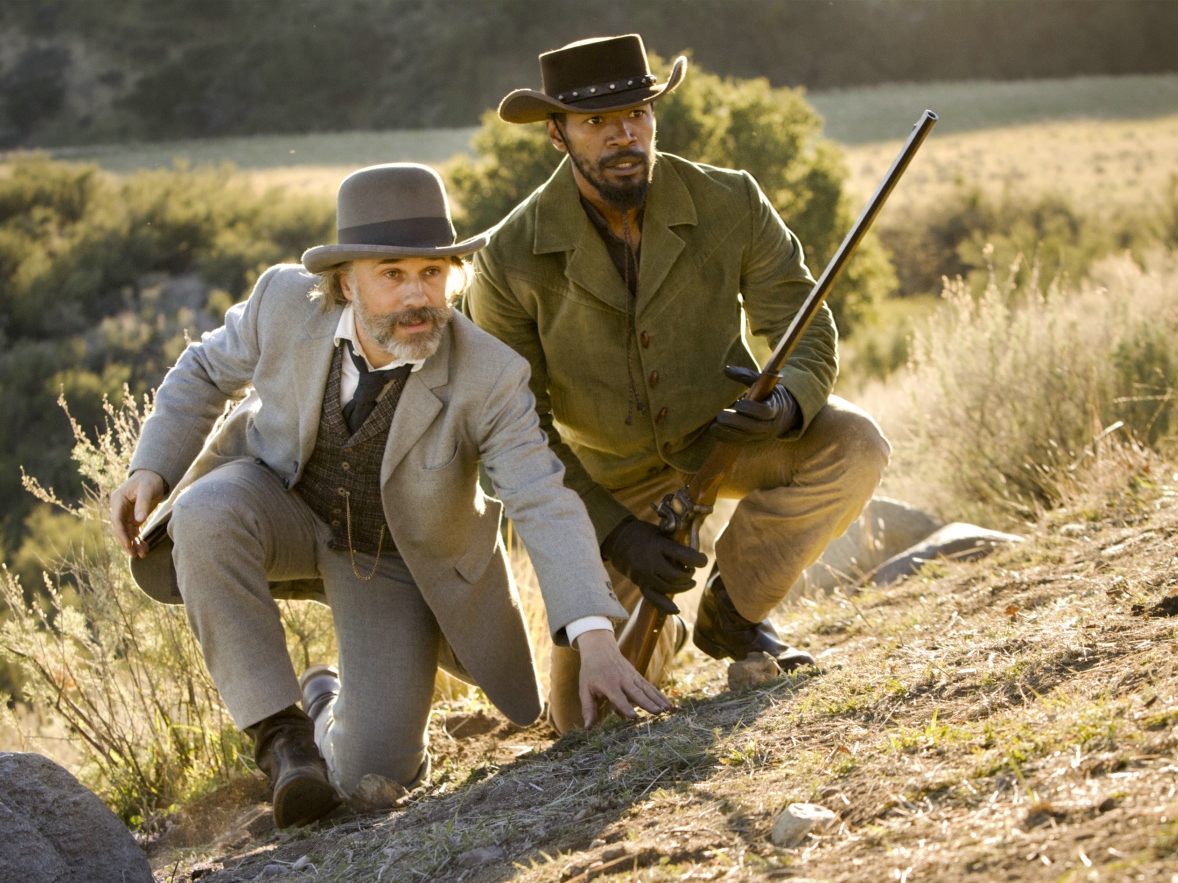
    essentialDjango Unchained, the latest in a string of violent revenge fantasies from director Quentin Tarantino, never quite feels like a finished film. According to Tarantino and Samuel L. Jackson, there exists a much longer cut of the movie that fills in crucial information on a number of characters, and given that its soundtrack is punctuated with bits of dialog not heard in the film, that longer cut is also a few shades more sadistic than what made theaters. Much has been said and written about the way Tarantino peppered Django Unchained with racial epithets unbecoming of a white director or a politically correct society, but it’s the violence I keep coming back to. Not the cartoonish shootouts pitting skillful bounty hunting duo Django (Jamie Foxx) and Dr. King Schultz (Christoph Waltz) against any number of hickish gunslingers, but the violence of slavery itself, particularly as it is visited upon Django’s wife, Broomhilda (Kerry Washington), who is whipped, branded, raped, scolded, and locked in an iron box under the hot sun as punishment for trying to run away.

    At this point in his career, it’s easy to accuse Tarantino of fetishizing violence against and the traumatization of women. Though the perpetrators often get what’s coming to them, Tarantino has been pedaling in this kind of sick thrill since Kill Bill Vol. 1, wherein The Bride is awoken from a coma mid-rape by a mosquito bite. Her rapist has his tongue bitten out and her pimp is beaten to death, but Tarantino luxuriates on the possibility of her rape, just as he does Stuntman Mike’s pursuit of his “girlfriends” in Death Proof and Col. Hans Landa’s psychological torture and eventual murder of double agent Bridget von Hammersmark in Inglourious Basterds. With poor Broomhilda, Tarantino turns up the heat. Looking beyond the director’s pedantic argument that his use of language and human misery is “period accurate,” the constant terror and abuse suffered by the largely agentless Broomhilda von Shaft serves two purposes: fulfilling the obligations of the exploitation genre, and sweetening Django’s revenge.

    In transplanting the spaghetti western to the antebellum South, Quentin Tarantino has succeeded in creating both his largest, most beautiful film to date, and his most narrow in scope. Having moved far beyond the nihilism that marked early efforts like Reservoir Dogs, Pulp Fiction, and From Dusk ‘Til Dawn, Django Unchained is exploitation filmmaking at its most agitating, using slavery and racism to titillate, humor, and enrage the audience. It works very well: the white slavers of Django Unchained are cruel, horrible men whose deaths elicit something close to joy. Unlike in Basterds, where the cruelties of Nazi Germany took place off screen and out of sight, men in endless number are shackled and marched through deserts, forests, and mud-caked auction towns. Black men beat each other for their white owners’ entertainment, black women are treated as objects of lust, and those who disobey are fed to the dogs.

    The two halves of Django Unchained, joined though they are by a brief training montage, play as a film and its sequel. In the first half, Django is set free by Dr. Schultz, a bounty hunter looking for three cattle rustlers by the name of Brittle. Schultz has never seen these men, but Django has: they were the overseers at his old plantation, three sons of bitches whose idea of punishment was pure Old Testament—Broomhilda still has lash marks on her back proving that. During their travels, the naïve Dr. Schultz learns that Django has a wife, and that he plans to buy her freedom with the money he’s been promised for identifying the Brittle brothers. This is a risky gambit: to find his wife, Django will have to find records of her sale in a Mississippi auction city. Even with papers stating that he is free, the odds of him walking out of that city with his freedom intact are quite low. So Dr. Schultz offers Django a deal: partner up for the winter and learn the business of bounty hunting, and gain a partner in the rescue of Broomhilda.

    If one looks at the two halves of Django Unchained as origin story and follow-up, then the film becomes a tale of two plantation owners. In the first half, Django and Dr. Schultz travel from Texas to Tennessee to The Big House, which is owned by a repellant man who is referred to as Big Daddy (Don Johnson). Big Daddy’s plantation functions as a brothel, where he sells his attractive young slaves to anybody with a big enough pocketbook. Later, the two discover that Broomhilda has been sold to a bloodsport named Calvin J. Candie (Leonardo DiCaprio), who inherited the fourth largest plantation in Mississippi. Though his plantation is known as Candie Land, he, too, calls the house that stands on its grounds The Big House. Candie is a major player in mandingo fighting, a Tarantino invention that pits burly slaves in brutal death matches before a private audience. In both cases, Dr. Schultz and Django’s play is the same: in offering a ridiculous sum of money for the particular kind of human flesh Big Daddy and Calvin J. Candie deal in, they gain access to their marks’ plantations and carry out a search for their true prize. Finding the Brittle brothers and Broomhilda, however, is not the hardest aspect of this plan: it’s getting out of those plantations alive, treasure in tow, that matters.

    That Big Daddy and Calvin J. Candie bear as many similarities as they do is intentional: these are vain, horrible men, and it is to our great satisfaction to see them executed by our heroes as such. The difference between the two is that Candie’s second—the head house slave Stephen (Samuel L. Jackson)—sees right through the bounty hunters’ charade. When discussing the characters they’re set to play, Django tells Dr. Schultz that being a black slaver is a lower calling than being the head house slave. If that’s true, Stephen certainly tries to make up for it by being every bit as snide and underhanded as he is old and hobbled by his age. In this role, Jackson is at his most engaging in years; though his character is one whose time on screen was whittled down, he is a man of extremes: before guests and the white workers on the plantation, he is a bumbling, ornery old coot; in private with his master and Django, he is as cold and cunning as they come, as bitter and vengeful as Shylock.

    There is a lot about Django Unchained that doesn’t quite add up; like many of Tarantino’s films over the second half of his twenty year career, his ambition to present a sprawling, grandiose epic of five or six hours was compromised by the need for a Christmas Day release to make money. Working with editor Fred Raskin—Tarantino’s regular editor, Sally Menke, died in 2010—Django Unchained’s seams show more than what’s typical of a Tarantino film. The jokes aren’t as crisp, the characters aren’t as well developed, and the film’s six-shooting bloodbaths eventually blur together, distinguished mostly by what song is playing to pass the time. And yet, Django Unchained is one of the more wildly entertaining films of 2012. Beyond Stephen—the film’s best creation—Jamie Foxx’s Django is as solid a spaghetti western hero as there is, and Christoph Waltz once again establishes himself as the Tarantino actor, the director and screenwriter’s dialog never seeming like words on a page. If the plight of Broomhilda von Shaft is cause for squeamishness—and it should be—and the reward for enduring her pain is pleasing—and, for me, it was—then Tarantino is doing his part as an exploitation filmmaker, and that, really, is the only shield he’s ever held up in defense of his work. As beautiful—the sweeping parries, manicured plantations, and torch-bearing lynch mobs are unprecedented compositions in a Tarantino movie—and exciting as Django Unchained often is, after twenty years, it would be nice to see the director’s raison d’être evolve with his skill.


    Django Unchained. With Jamie Foxx (Django), Christoph Waltz (Dr. King Schultz), Leonardo DiCaprio (Calvin J. Candie), Samuel L. Jackson (Stephen), Kerry Washington (Broomhilda von Shaft), Don Johnson (Big Daddy), Walton Goggins (Billy Crash), and Jonah Hill (Bag Head #2). Directed by Quentin Tarantino and produced by Stacey Sher, Reginald Hudlin, and Pilar Savone. Screenplay by Tarantino.

  • Movie Review: Zero Dark Thirty (2012)

    Movie Review: Zero Dark Thirty (2012)

    Zero Dark ThirtyessentialThe most difficult aspect of Zero Dark Thirty, the Kathryn Bigelow/Mark Boal dramatization of the ten year search for Osama bin Ladin, is not that the film depicts torture as a tool utilized by the United States of America, but that torture was used in reality, necessitating its appearance in fiction. The myth of American innocence is inexplicably powerful given the bulk of American history, but the idea of this country as one that did not torture died in the years following 9/11 with the approval of the Bush Administration. However uncomfortable Zero Dark Thirty’s opening act plays, however brutal the film’s depiction of waterboarding, confinement, and humiliation, Bigelow’s interpretation of events are a facsimile; what really happened was much worse. That’s the general effect of Zero Dark Thirty. The hunt of Osama bin Ladin led America into wars and the darker places beyond war, but any attempt to draw something intellectual out of the War on Terror leads either to outrage or justification. Bigelow and Boal try very hard to walk the tightrope between the two—and, based on thousands of thinkpieces on the way torture is depicted here, they failed—and the result is a sometimes thrilling, sometimes laughably clichéd mollification of a difficult era in American history.

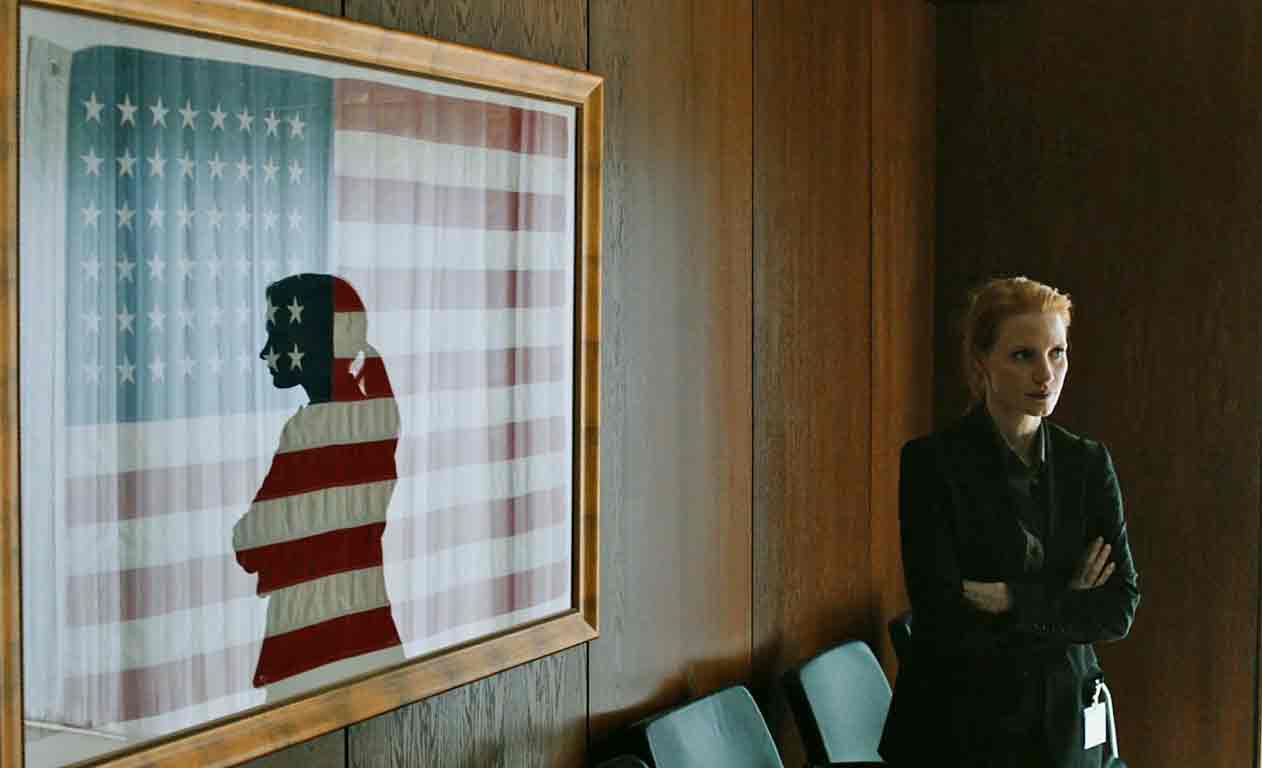
    To set the mood, Zero Dark Thirty begins with a 911 call from inside the World Trade Center playing over a blank screen. It’s exploitive, but also a chilling reminder of day and the nation’s lust for revenge that followed. Two years later, in an undisclosed CIA Black Site, Maya (Jessica Chastain) witnesses the torture of a detainee with links to Saudi terrorists. The interrogator, Dan (Jason Clarke), appears before his victims as the very picture of swaggering Americanism, shaggy haired and attired in jeans and band t-shirts. Maya watches him work the detainee over, humiliating and waterboarding him. If she’s initially horrified by what she sees, that horror quickly turns to passivity. There’s no moral outrage on her part here: torture is a tool, and tools can be quite useful. She picks up a lead suggesting that a man named Abu Ahmed is bin Ladin’s primary contact with the outside world and becomes obsessed with finding this man, hoping he’ll lead her to the top of Al Qaeda.

    The Abu Ahmed plot is Zero Dark Thirty‘s through-line, running beneath interludes of torture, hotel bombings, and political rest, but for much of the film Maya is a bystander, watching as her friends pursue their leads. Once Dan is reassigned to Washington (“I’ve seen to many dude’s penises,” he says), she mostly speaks to and plans operations with Jessica (Jennifer Ehle), who survives the Islamabad Marriott bombing with Maya and has high hopes that she can flip a Jordanian who claims to be one of bin Ladin’s doctors. Her belief leads her to insist that the soldiers at Camp Chapman dispense with their usual security measures. Camp Chapman is thus bombed. By the time Maya’s Abu Ahmed option remains the only practical one on the table, few within the CIA are as taken with the bin Ladin mission as she is.

    But Jessica’s death has a transformative effect on Maya. Recruited into the CIA out of high school for the specific purpose of hunting bin Ladin, the man is now not only responsible for 9/11 but also for the removal—through death or by other means—of Maya’s very limited network of friends. Through two acts of Zero Dark Thirty, her Abu Ahmed lead is put on the back burner. After the Camp Chapman bombing, finding this man is tantamount to an act of vengeance, which Maya pursues like a renegade cop avenging a fallen partner. She is the lone wolf, and bin Ladin is her prey. As good as Chastain is, and she has proven adept at being the calm center of an otherwise chaotic prestige film, lone wolf narratives have been worn out by thrillers of all stripes: by the time she discovers bin Ladin’s Abbottabad compound—and through old-fashioned detective work, no less—and takes to writing the number of days of CIA inactivity on her superior’s door, she’s no longer a recognizable human being. If her eventual acceptance and embrace of torture in her line of work can be chalked up to continuous exposure, much of Maya’s later actions can be explained much more simply: she’s a character in a movie, and things are progressing as they should.

    Maya’s journey from initiation to kill stands as a convenient metaphor of this country’s pursuit of vengeance, but it’s particularly disappointing that, save the film’s last shot, her journey is so similar to many that have been filmed before. For long stretches of time, Bigelow and Boal are able to effectively smokescreen this plot. The torture, the way Maya’s team tracks Abu Ahmed, the climactic raid on the Abbottabad compound—these sequences in particular are imbued with a peculiar kind of tension and, in the torture sequences especially, horror. In an age of WikiLeaks and unrestricted access, that the execution of bin Ladin works cinematically is nothing short of a testament to Bigelow’s skill as a craftsman. But Zero Dark Thirty is not the kind of film that invites one to marvel at its creation. At its best, Zero Dark Thirty makes digestible some of the more unbelievable events from the War on Terror. Its violence, dazzlingly executed, is awful to behold. Too often, however, Bigelow and Boal lack the strength of their protagonist. Their promised uncompromising take on a deeply flawed global manhunt is ultimately as compromised, as flawed, as the mission they document.

    Perhaps this remains secondary to concerns over the way torture is portrayed as that which brings bin Ladin down. Fine. Before Zero Dark Thirty’s release, when it was scheduled to debut before the election, the talk surrounding the film was that it would unfairly swing the election in favor of President Obama. In the aftermath of its release, the new controversy is that Zero Dark Thirty justifies the use of torture. Generally speaking, I agree with the sentiment that the author of a particular piece of artwork is the least well-equipped to speak of their intent, but I also agree with Bigelow, an avowed pacifist, when she says she would never seek to justify torture. A pro-torture apologist is unlikely to employ thirty minutes of torture as a means of justification. Those sequences of America at its lowest are Zero Dark Thirty‘s finest. If the statement Bigelow makes with her opening isn’t overtly political, then it at least asks the audience to take those scenes in and consider the reality of them. The rest of the film asks nothing quite so serious of anybody. It understands that those among the crowd who are thoroughly disgusted have been through quite the ordeal and offers, with clear eyes and a three act structure, to lead those poor, beleaguered filmgoers to safety.


    Zero Dark Thirty. With Jessica Chastain (Maya), Jason Clarke (Dan), Joel Edgerton (Patrick), Mark Strong (George), Jennifer Ehle (Jessica), Mark Duplass (Steve), and Chris Pratt (Justin). Directed by Kathryn Bigelow and produced by Bigelow, Mark Boal, and Megan Ellison. Screenplay by Boal.

  • Movie Review: Beasts of the Southern Wild (2012)

    Movie Review: Beasts of the Southern Wild (2012)

    essentialBeasts of the Southern Wild is an astonishing debut film. Its cinematography, score, and lead performances are among the most compelling of the year, drawing apt comparisons to Terrance Malick and David Gordon Green, whose pastoral films are often unnerving in their attention to man’s connection (or lack thereof) to nature. Beasts of the Southern Wild is a film about community, a unique community of survivors stranded but enjoying life on The Bathtub, a tiny island that’s the only un-flooded piece of land in what used to be the Louisiana bayou. Director Benh Zeitlin and writer Lucy Alibar—working from Alibar’s play Juicy and Delicious—are never quite clear about what happened to Louisiana or how the remaining United States could so callously erect a levee separating The Bathtub from civilization, but given the biblical rainstorm and the melting polar ice caps, it’s obvious that nature is not just something to be in awe or take advantage of, but an irresistible force. Humans, in the face of such power, are ever the movable objects.

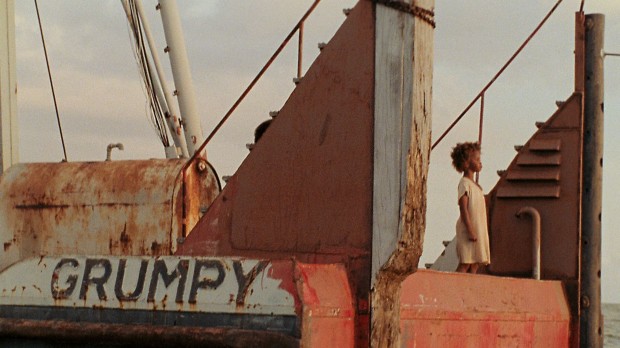
    But the people living in The Bathtub are resilient, tragically so. Early on, Hushpuppy (Quvenzhane Wallis), the film’s six-year-old narrator, leads us through this place. Though signs of trouble are evident—the film is quite liberal in its application of ruin and rust, and characters wear sub-thrift store quality clothing—Hushpuppy looks at life on the island as something special and idyllic, not exactly untroubled, as her relationship to her father, Wink (Dwight Henry), will later attribute, but nice enough compared to the worries of folks in the city across the bay. In The Bathtub, people live on what nature provides. There’s enough fish, poultry, beer, and vegetation to go round, and things have been going round now for sometime.

    Hushpuppy and the children living on the island with her go to school to learn the basics of survival. Despite the fireworks and baby races of the film’s opening minutes, Beasts of the Southern Wild takes place in a ruined world teetering on the brink of complete destruction. Hushpuppy’s teacher (Gina Montana) talks about a race of beasts called the Aurochs—great, man-eating pigs who existed only as engines of destruction. Kill or be killed, is the message. Take care of your own or get taken care of.

    Hushpuppy’s dad isn’t exactly in the business of taking care of his own. After spending the bulk of the year with the film’s excellent, unavoidable trailer in my head, it was rather jarring to see several moments spun as pieces of a whimsical father-daughter relationship come instead from a place of raw, devastating meanness. Hushpuppy’s relationship with Wink, the driving force of the film, is one teeming with fear. Having set her house on fire—the two live in separate houses, and Hushpuppy is trusted with gadgets like flamethrowers—Hushpuppy hides under a cardboard box as Wink storms the house, looking for her. It isn’t the thought of being consumed by fire that impels Hushpuppy to flee her burning shelter, but the thought of being caught by Wink. The ensuing confrontation between the two—Wink slaps Hushpuppy, Hushpuppy tells Wink she hopes he dies so she can eat cake on his grave, Hushpuppy punches Wink in the heart hard enough to upset a sickness that worsens as the film goes on—is the first of several incredibly tragic sequences. But the two never separate for long, and from there Wink is determined to instill in her some sense of masculinity, something he believes she’ll need once he’s gone. The relationship between the two oscillates between Hushpuppy’s belief that her actions are what’s responsible for the world breaking, and Wink coming to realize his daughter’s unique, self-fashioned strength.

    The performance of Quvenzhane Wallis is Beasts of the Southern Wild’s strongest asset. Young and untrained, she has a genuine, unforced nature that captivates, propelling the film through even its murkiest sequences. A child philosopher and a patently unreliable narrator—are the monsters pursuing her real, or a figment of the imagination?—Hushpuppy’s various theories about the nature of the world and her role in it, without Wallis’ untrained readings, would sound too esoteric, too purposefully vague, too precocious. However naïve Hushpuppy’s beliefs, her soliloquies have the benefit of sounding like hard-won knowledge. The relationship between her and Wink also feels more grounded as a result of the actors in these roles, essential given the film’s use of magical realism. Before starring in Beasts of the Southern Wild, Dwight Henry owned a deli across the street from the casting agency. If what transpires between he and Wallis never feels quite like true father/daughter interaction—and given what passes as Wink’s idea of fatherhood, that’s just as well—that their relationship plays like two people living together and not an actor and a child actress working together makes things that much more visceral.

    The metaphors used by Beasts of the Southern Wild are often blunt, something akin to a railroad spike driven home with a sledgehammer. Katrina imagery looms large over the flooded Bathtub, and the survivors clear status as second- or third-class citizens is meant to be evocative of those left behind in New Orleans, even if the hurricane and the city are left unmentioned. The club Hushpuppy eventually finds herself in—a strip joint offering food and the companionship of adults, but also the sad realities of life away from The Bathtub and Wink, a place Hushpuppy was clearly not meant to stay—is called Elysian Fields, a little too on-the-nose considering who Hushpuppy thinks she meets there and the significance of that missing person to her incomplete childhood. That’s a consequence of using a child’s point-of-view as the film’s frame of reference, the added storybook sheen that sometimes twists the knife and sometimes feels alien.

    Another consequence is that Hushpuppy’s unquestioned love of The Bathtub and those living in it sometimes comes across as the filmmakers paying reverence to a band of noble savages. Well-intentioned or un-thought of, Wink’s almost-unquestioned leadership of the refugees and the film’s constant praising of them for living as nature gives and scrapping by when nature takes away feels creepily similar to the cult worship of the noble savage in other films. When Hushpuppy is taken in by the government and is put in a dress with her hair combed back, Wink’s resistance and Hushpuppy’s silence are clear signals that something is wrong, that these people, rescued from their flooded wasteland, are prisoners. Their escape and flight back home is meant as this swelling moment of uplift. Maybe, putting aside all notions of responsibility, it is. But The Bathtub and Wink’s way of living aren’t just dangerous, they’re doomed. Tragic as the fate of those living in The Bathtub may be, that their resolve to stay is played for cheers may be Beasts of the Southern Wild’s most subtle twist of the knife.


    Beasts of the Southern Wild. With Quvenzhane Wallis (Hushpuppy), Dwight Henry (Wink), and Gina Montana (Miss Bathsheba). Directed by Benh Zeitlin from a screenplay by Zeitlin and Lucy Alibar, based on the play Juicy and Delicious by Alibar.

  • Movie Review: Goon (2012)

    Movie Review: Goon (2012)

    essentialGiven the National Hockey League’s flirtation with work stoppage-induced disaster, Goon plays like an unrequited love letter to a sport whose heart is three sizes too small. The hockey immortalized here—the slow, bone-crunching, blood curdling style of play where one or two men on every squad was hired more for their fists than their abilities with a stick—has been on the endangered list for some time now, first as a consequence of the League’s desire for a faster game, then as concerns over concussion-related brain damage rose, but that doesn’t matter. The hockey of Goon is that of pop-culture past, three twenty-minute periods of blood, mullets, and dirty-minded foreign players. Those wondering how hockey could engender such a devoted, wounded fan base would find their answer here.

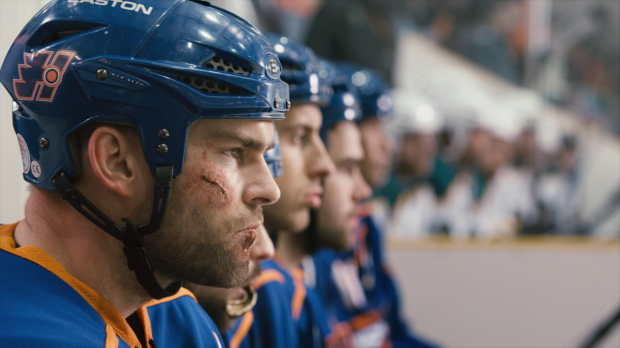
    Goon’s hero is a nice, well-adjusted dude named Doug Glatt (Seann William Scott). He’s a bouncer with fists of steel and an indestructible head, skills that serve him well when his buddy Pat (Jay Baruchel, who also co-wrote with Superbad‘s Evan Goldberg) lets his mouth run away with him at a game. When a player has enough of Pat, he charges into the stands. He is promptly put down by Doug, who is quickly invited to play for the local squad. He turns into a local sensation and is hired onto a farm-league team in Halifax, where he’ll serve as an enforcer to Xavier LaFlemme (Marc-Andre Grondin), a shaken star trying to return to form after suffering a monstrous, highly illegal hit from Ross “The Boss” Rhea (Leiv Schreiber), a goon whose particularly dirty style of play sees him in the minor leagues and on his last legs.

    Like Slap ShotGoon follows its fictional team through the wilderness that is minor league hockey. Their hometown of Halifax is a veritable paradise compared to the prospect of “riding piss-hole” on the bus to another town, the punishment for turning in a particularly awful performance. Doug’s teammates are the usual assemblage of sports comedy also-rans: LaFlemme is a womanizing drug addict, the captain is an alcoholic, the coach issues meaninglessly aggressive proclamations, and the announcer is a half-hearted amalgam of Bob Uecker in Major League and John Candy in Rookie of the Year, but the Slap Shot formula—as proven successfully here and by Major League—still works, putting those stereotypes to work as parts to a lovingly constructed machine as opposed to identifiable components left out on the workbench.

    It helps that Doug Glatt is an incredibly likable focal point. A well-meaning, dim-witted black sheep in a family of doctors, Doug’s a guy trying to make the best of the gifts he has. He’s incredibly polite to the men he bludgeons, but his parents look at his barbaric conquests on the rink—and the signs in the crowd reading “Glatt is Hebrew for ‘Fuck you!’”—with obvious disdain. He’s supported by Pat and his brother, but those guys would support him through anything. In a strange city, teaming with a bunch of weird men who look at him like he’s a circus freak, its understandable that Doug looks for some outside validation. He finds it in Eva (Alison Pill), a self-described bad girlfriend who loves beer and finds the violence of the hockey rink a huge turn-on.

    The only character beyond Doug who receives more than an embellishment of detail is Ross Rhea, his rival in the pugilistic arts. That’s thanks largely to reputation. With his mullet, his goatee, and his seen-it-all attitude, Leiv Schreiber is an amalgam of the game’s deadliest goons, a caveman philosopher who sees the destruction of Doug Glatt as a last chance to define his legacy before the game phases him out completely. The miracle of Goon is that it’s able to build anticipation for the eventual slugfest beyond the occasional reminder that, yes, this is important stuff. Even better, the fight lives up to the hype, a gladiatorial death match that’s more gruesome than the pile of dead teenagers at the end of a slasher film.

    If you’re able to look past Goon‘s flaws as a sports movie—the relationship between Scott and the talented but underutilized Alison Pill, being a romance between a nice athlete and a girl with low self-esteem, begins saccharine sweet and ends up somewhat grating—what’s left is an incredibly pleasant experience, made better when the credits roll without the film taking an uncalled for detour into pious sermonizing. Sports movies have become a mostly toxic genre thanks to the odd notion that without several manufactured moments of life-affirming uplift, the events depicted will register as mostly pointless. Goon is proof that if filmmakers love a subject enough, something worthwhile will emerge.


    Goon. With Seann William Scott (Doug Glatt), Leiv Schreiber (Ross Rhea), Alison Pill (Eva), Jay Baruchel (Pat), Marc-Andre Grondin (Xavier LaFlemme), and Eugene Levy (Dr. Glatt). Directed by Michael Dowse from a screenplay by Baruchel and Evan Goldberg.