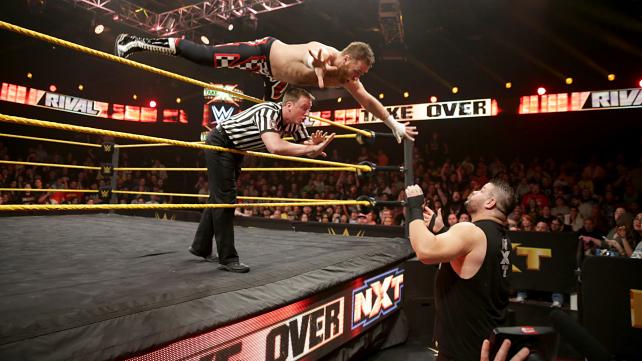
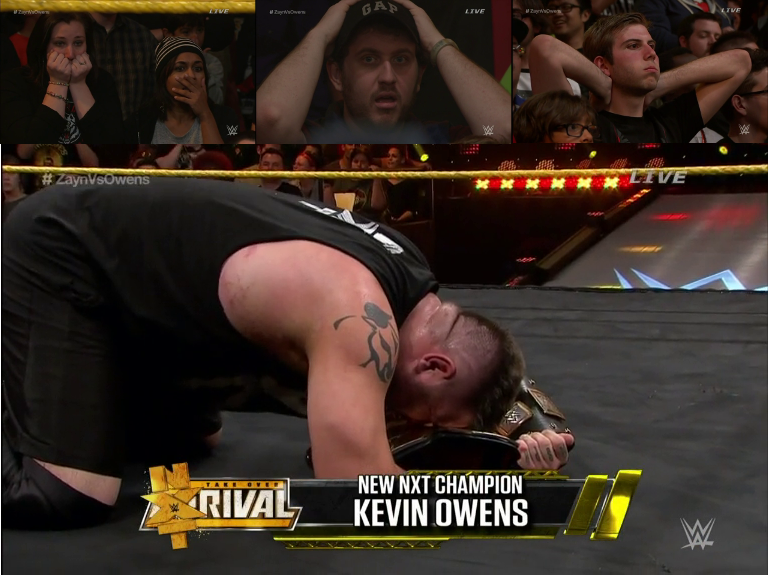
 I’ve dabbled in New Japan Pro Wrestling since the dawn of streaming video websites. Though nobody who documents the internet will give credit where its due, the success of sites like YouTube and Dailymotion, at least back when the Internet was the Wild West, had at least a little to do with the sheer amount of Japanese professional wrestling uploaded to those services, thirty years of content long relegated to video tapes and DVDs swapped endlessly through the mail now available to anybody with a working connection and a little bit of patience. Japanese wrestling promotions like NJPW and NOAH were slow to capitalize on American demand for their product, which is fair considering how most acquired access to it illegally—hardly how one wants to gauge a potential audience—but now, as NJPW is in the middle of a ridiculously successful period, the proliferation of online streaming technology has made it possible not only for the promotion to launch their own WWE Network-like online site, but for nebulous, ill-defined groups like Jeff Jarrett’s Global Force Wrestling to offer English-speaking fans a chance to watch the show with the benefit of an English broadcast. NJPW is reaching out with Wrestle Kingdom 9, and it’ll be very interesting to see how their first real foray into the American market fares.
I’m hardly a Japanophile—pretty much all of the Japanese I know is actually English words for wrestling maneuvers, made Japanese through pronunciation—but I’ve always liked the Japanese broadcasts. Though I can’t understand much of what is being said, wrestling itself is a universal language, and the story the announcers are telling is modulated through the way they yell for big spots or get really quiet when a popular grappler appears to be fading in a submission move. But Global Force Wrestling’s big card was the signing of WWE Hall of Fame announcer Jim Ross to serve as play-by-play for the event, and Ross is a favorite of mine, really my idol given my brief stint in the industry. Of less interest (really a detriment, if you ask me) was their bringing in Matt Striker, a former WWE color commentator, to serve as Ross’ second. Striker has always been an annoyance, a dude who makes up facts and hideous nicknames and talks over the other announcers, usually while slipping in bits and pieces of lame right-wing propaganda to his commentary, but he somehow has a cult following among folks who’ve grown tired of the Michael Cole/JBL/Jerry Lawler desk and he’s good enough at feigning knowledge, so he’s here to lead the audience of supposed newbies through their first NJPW show.
This is the broadcast I’ve chosen to go with. NJPW will soon be debuting a television show in the United States, and this version of Wrestle Kingdom 9, I figure, is a good preview for how that show will be presented. The footage I was able to procure is without the pre-show battle royal (a shame, because I’d love to hear Jim Ross call The Great Kabuki in 2015) and the opening ceremonies of the event. If I am able to get that footage later, I’ll be sure to add it to this post, which, I’ll warn you right now, is going to run long. Pack a lunch, folks.
IWGP JR. HEAVYWEIGHT TAG TEAM CHAMPIONSHIP: ReDRagon (Kyle O’Reilly and Bobby Fish, champions) def. The Young Bucks (Matt and Nick Jackson), Forever Hooligans (Alex Kozlov and Rocky Romero), and Time Splitters (Alex Shelly and KUSHIDA) via pinfall. GRADE: B.
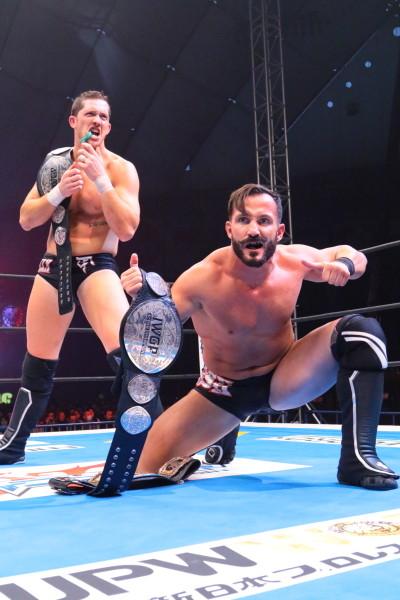
The first match is a four team sprint for the most exciting championship in professional wrestling, and features four of the best tag teams in the world today. The Young Bucks are probably the most popular tag team on the American independent scene. ReDRagon are one of the best elements of Ring of Honor, a pairing that completely redefined what most thought of O’Reilly and Fish. Time Splitters and Forever Hooligans are both former champions and perennial contenders for these titles. The only man team in the match at a potential disadvantage here is the Time Splitters, as KUSHIDA doesn’t travel to the United States with his partner Alex Shelly, and thus hasn’t seen as much of ReDRagon as the Young Bucks, Forever Hooligans (who spent a little time in ROH over the past two years), and Shelly. During introductions, Matt Striker says that the Young Bucks have “only” been wrestling 10 or 11 years but are “already” revolutionizing tag team wrestling, which is weird. He also says that the Forever Hooligans are great, communism aside. Ugh. Jim Ross says that, as an old Oakie, he’s going to stick with calling the International Wrestling Grand Prix (the fake governing body of NJPW’s championships) just plain ol’ IWGP. That’s what everybody does, so it’s okay, Jim.
Right away, it’s kind of cool to hear Jim Ross and Matt Striker talking about Ring of Honor. It brings back the idea of wrestling as a global entertainment, which was something frequently emphasized by all of the major American wrestling promotions during different times in the 1990s. WCW in particular worked in tandem with NJPW frequently, mentioning results from “Egg Dome” shows and allowing their championships to be defended on huge New Japan cards, tracing back a lot of their Cruiserweight Championship lineage to their “When Worlds Collide” show from AAA in Mexico. ROH and NJPW have a much younger working relationship (ROH used to work with NOAH, when that was the promotion ROH’s fans preferred), but ReDRagon holding the IWGP Jr. Heavyweight and ROH World Tag Team Championships makes them the best pound-for-pound team in the world according to Striker and Ross, and that’s hard to argue. Also hard to argue: Bobby Fish has the best facial hair in professional wrestling.
KUSHIDA starts off against Bobby Fish. Normal tag team rules apply, first team to score a pinfall or a submission win the titles. KUSHIDA begins by outwrestling Bobby Fish, his MMA background and quickness allowing him to outmaneuver Fish’s technical wrestling ability. The two go for dropkicks at the same time and KUSHIDA is back to his feet first, so his second dropkick connects. That brings in Kyle O’Reilly, who comes in without a tag. This confuses Ross a little, as the referee doesn’t seem to care too much, and Striker says that “wrestling is what triumphs,” which, I guess, means you can do whatever you want so long as you’re wrestling. The referee is motioning to the corner, telling O’Reilly to get out of there, but whatever. O’Reilly kicks KUSHIDA into the ropes and whips him across, but Shelly has tagged in without the champion noticing. Shelly punches him in the gut and KUSHIDA follows up with a knee strike to the side of the head.
That brings the Young Bucks in, and the Bullet Club members quickly go to the eyes of Shelly and Kushida, give each other nWo too sweets, give the Time Splitters the DX crotch chop, and are promptly back body dropped out of the ring. Shelly goes back to Fish, wrings the arm and tags in KUSHIDA. He wrings the arm and tags in Shelly, who wrings the arm and tags in KUSHIDA, and they are officially SPLITTING TIME. Or Bobby Fish’s arm. Fish gets tired of that business and shoves KUSHIDA into Shelly, knocking Shelly off the apron onto the floor. Fish whips KUSHIDA into the ropes. Alex Kozlov tags in off the whip. Fish goes down for a back body drop and gets kicked in the mush by KUSHIDA, who goes to follow up but is sent out of the ring by the referee, who looks to make up for earlier by being overzealous on the tag, which he saw, and which matters because tagging in and out is a part of tag team wrestling, which is what triumphs.
Kozlov ducks a strike by Fish and runs off the ropes. Fish goes for a side slam but Kozlov’s momentum allows him to catch the champion in a spinning head scissors. Kozlov scores with a dropkick and calls for his Cossack hat, which he puts on so that he can dance around the ring, kicking Fish in the head. Oh yes. He double stomps Fish’s head to the ground and goes for the cover on Fish, who has been in the ring for a long time now, but Fish kicks out at two. Kozlov ends up in ReDRagon’s corner and can’t fight his way out. Fish sneaks to the outside and sweeps Kozlov’s leg, which allows O’Reilly to drop a knee on him. Ross, noticing the lack of a tag, brings up that old announcer standby of maybe having two referees out there to keep track of things like tags, and that’s one of my favorite announcer suggestions, so I’ll let it stand. The referee, for his part, is like, “Oh, hey, Kyle O’Reilly, did you make the tag?” and O’Reilly is like “Whatever, dad” before kicking Kozlov in the back and wagging his finger at the world, so he is now the legal man, at least until he tags Fish back in, negating his unfairly gained advantage.
Fish runs off the ropes and dives at Kozlov, hitting him with a flying double forearm and landing with an impact that sounds like a cannon being fired in an arena. He hooks Kozlov’s leg on the cover and gets a near fall. Alex Shelly keeps coming in to break up the pinfall, which hasn’t needed breaking up, and this is what has the referee so distracted. O’Reilly picks Kozlov off but gets punched. This sends him staggering into the corner of Matt and Nick Jackson, who both tag in. This is illegal and they know it, but they’re in the Bullet Club and are thus not nice people, so they get into the ring at the same time and clear the apron of the other five men in the match. They aren’t just innovative, according to Matt Striker. They’re “uniquely innovative.”
The Bucks are alone in the ring with Alex Kozlov. They go for a double team back suplex, but Kozlov lands on his feet. He fights one out of the ring, but that allows him to get tripped up as he runs at the other. Matt Jackson holds Kozlov on the outside while Nick runs at him, but Kozlov ducks, and the kick meant for him smacks off the face of Matt Jackson. Kozlov gets back into the ring and tries to tag out, but Nick Jackson keeps him out of a corner. Kozlov ducks a spinning roundhouse kick but runs into a back elbow. Nick goes for a superkick, but Kozlov moves and ends up hitting a spinning kick of his own! Kozlov tags out to Rocky Romero, who hits a springboard dropkick on an encroaching ReDRagon. He tries to kick Nick Jackson in the gut, but Jackson catches the leg. Romero misses an enziguri but recovers to kick Jackson in the face anyhow. With four men in four turnbuckles, Romero begins charging around the ring like a raging bull, hitting a series of clotheslines in succession. Just when the Young Bucks think they’ve escaped Romero’s clothesline fury, they’re caught with a double clothesline that has both of them spun inside out! Romero and Kozlov are in the ring now and do some double team work on Matt Jackson, who kness out of a double suplex attempt. KUSHIDA tags himself into the match and clears the ring of his opposition, rallying the fans behind the Time Splitters.
Romero tries to attack KUSHIDA but is sent over the top rope. KUSHIDA directs traffic, and Alex Shelly leaps off the apron with a knee strike to Romero. Time Splitters have the advantage as everything breaks down, with Shelly outside the ring hitting a superkick. KUSHIDA looks to start a dive but is stopped by Rocky Romero, who finishes KUSHIDA’s thought by diving onto Shelly and O’Reilly. His partner Alex Kozlov soon follows with a tope con hilo onto the pile. Matt Jackson dives through the ropes and dropkicks everybody but skins the cat, showing off his athletic ability while his brother dives over him with a corkscrew plancha to the floor. Striker mentions how innovative the Young Bucks are for the seventh or eighth time, bringing WWE-style overstatement to the Tokyo Dome at last. KUSHIDA finally gets to dive now, going Swanton off the top rope and to the floor. Legal man no longer matters as the Time Splitters work over the Young Bucks. Their Outta Time neckbreaker/moonsault combination gets a two count before it is broken up, so they go into their double team routine. Forever Hooligans break this up initiating a sequence of strikes that ends up with the Young Bucks throwing superkicks around. Matt saves Nick from a doomsday device, but not for long as Shelly and Kozlov join up, just this once, to put the Bucks down. They put the brothers up on their shoulders as Alex Kozlov flies off for a double clothesline, which connects, but the Bucks land on their feet! Superkicks all around, and then the Bucks hit the Meltzer Driver!
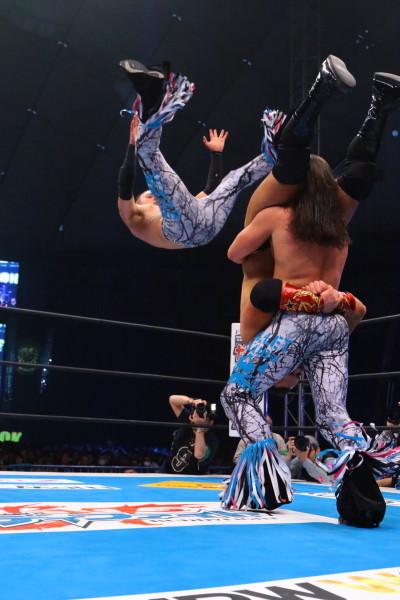
That gets a two count, as everybody is in to break it up. Lots of bodies in the ring now as Fish and O’Reilly try in vain to slow things down. They get a handspring back elbow from KUSHIDA for their trouble, and he gets a double superkick for his. The Bucks go for their More Back For Your Buck finish, but ReDRagon break it up, and Kyle O’Reilly officially tags in. He and Fish take over on Alex Shelly, hitting a backbreaker/knee drop combination, then a double arm DDT/wheelbarrow suplex combo. Fish executes a top rope falcon arrow. O’Reilly picks Kozlov up for a suplex but gets small packaged for a two. O’Reilly gets some payback with a couple of hard strikes on Kozlov, who is quickly taken over with a Bobby Fish exploder suplex. O’Reilly picks Kozlov up into suplex position and Fish kicks the Hooligan in the back of the head before his partner finishes with a brainbuster. That’s their finisher, and Alex Shelly is too late jumping into the ring to break it up.
A great match in terms of the number of cool-looking sequences, but that’s really all this was. The Jr. Heavyweight tag team division is used here to establish a quick pace and up-beat mood for these big shows, and that’s perfectly fine. I prefer matches to have something more going for them then just moves, but that’s probably just me.
Hiroyoshi Tenzan, Satoshi Kojima, and Tomoki Honma def. Jeff Jarrett, Bad Luck Fale, and Yujiro Takahashi via pinfall. GRADE: C.
I groaned mightily when old bro Jeff Jarrett, wrestling cockroach, debuted in New Japan as part of the reformulated Bullet Club, which needed Double J and AJ Styles to compensate for Fergal Devitt’s departure for World Wrestling Entertainment. His sad sack TNA entrance music plays, which is at least better than Kid Rock’s “Cowboy,” or any number of mock country & western shitkickers he was saddled with a dog’s age ago. I guess Scott D’Amore is also in Bullet Club. He must have bought his Bullet Club blazer from Pro Wrestling Tees. Bad Luck Fale is a big ol’ Tongan, which wrestling doesn’t have enough of in 2014, and Takahashi is a dirtier, Japanese Val Venis, which rules.
Their opponents are a crew of New Japan stalwarts. Tenzan was my least favorite NJPW representative who frequently moonlighted in WCW as a member of nWo Japan, but I was a dumb child, so what did I know. Kojima has been kicking around New Japan forever, as well, and Honma is making his name after spending a lot of time on the Japanese independent circuit. Formerly a deathmatch wrestler, his tights now say HONMANIA on them in Hulkamania font, which is amazing. I hope he pops Jeff Jarrett with some light tubes before dropping the big leg. Six man tag team matches often feel like they’re just a way of getting folks on a card, but who knows. The Bullet Club angle doesn’t feel as hot or magical as it did to me when Devitt was its leader, but it’s still a big deal, and if this is part of New Japan reasserting the honor and purity of professional wrestling in the face of a billion crotch chops, then I’m on board.
The match begins with Karen Jarrett shoving Honma, which isn’t the best way to begin things. The Bullet Club starts brawling immediately. Jarrett is on Honma, Takahashi on Tenzan, and Fale on Kojima. Tenzan and Kojima fight back and lift the massive Fale for a double suplex. Striker says that Fale is the hoss of the team, “hoss” being a word that needs to be stricken from wrestling’s dictionary unless Ross is saying it. Jarrett brawls with Honma on the outside while Ross puts some of the spotlight on referee Tiger Hatori, which is a cool thing to do. Kojima gets Takahashi in the corner and chops him a dozen times while the Tokyo Dome crowd HEYs along with each one. He whips Takahashi across the ring and follows in with a leaping forearm. Ross calls Kojima’s Ace Crusher both the RKO and Diamond Cutter, and now I’m kinda sad because “ACE CRUSHAAAAAA” is one of my favorite things to hear on a Japanese broadcast. Kojima takes too much time to rally the fans and gets crushed by a charging Bad Luck Fale. Hatori sends him out of the ring while Takahaski tags in Double J. He comes in kicking and punching and gets a two count off of a clothesline. Striker praises Jarrett for holding over 70 championships, many of them as prestigious as the 120 held by Jerry “The King” Lawler.
Jarrett tags in Fale, who bullies Kojima back to the canvas before tagging Takahashi back in. He slaps Kojima around and challenges him to fight back. Kojima does, hitting the cocky young adult film star with a forearm. Takahashi knows he doesn’t want to be involved in a slugfest, so he rakes the eyes. Matt Striker claims that the Japanese are unfamiliar with disrespect in professional wrestling. Considering that New Japan invented the nWo and ran their own version of it longer and more successfully than WCW way before Bullet Club, not to mention the long and tremendous history of really mean American wrestlers coming in and attacking fans at ringside, this is another thing Matt Striker is making up. Kojima hits his ace crusher and tags in Honma. Honma takes Bullet Club out before returning his attention to Takahashi, body slamming him to the canvas. In the corner, Takahashi eats a diving elbow and a bulldog. Honma psyches himself up and goes for a headbutt, but he misses. Takahashi follows up with a suplex that verges pretty close to a brainbuster, and gets a two count on his stunned foe. Takahashi continues to press his advantage until he charges at Honma, who gets his headbutt in.
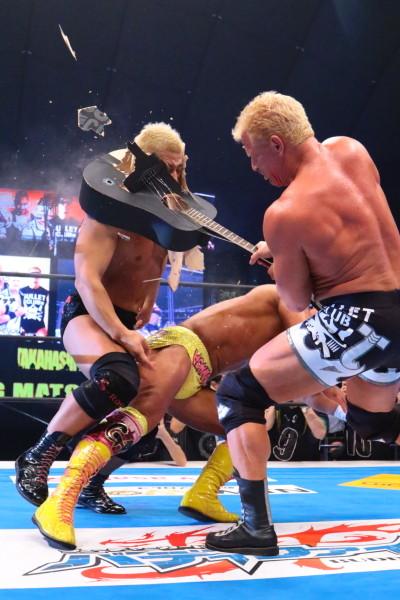
Karen Jarrett distracts Tiger Hatori, so Jeff Jarrett enters the ring with his guitar. Honma blocks Jarrett’s attempted el-kabong, but Takahashi enters the ring and holds Honma up. Jarrett swings and Honma moves, so Takahashi eats Jarrett’s wood while Striker chuckles about it because that’s what you do when calling a wrestling match where a man hits another man with a guitar. Tenzan and Kojima come in and hit Jarrett with a double back suplex and take care of Fale by clotheslining him over the top rope. Striker calls this a “lariato” because he was watching the same YouTube matches I was 10 years ago, I guess, or to make himself seem more authentic to any potential Japanese girlfriends.
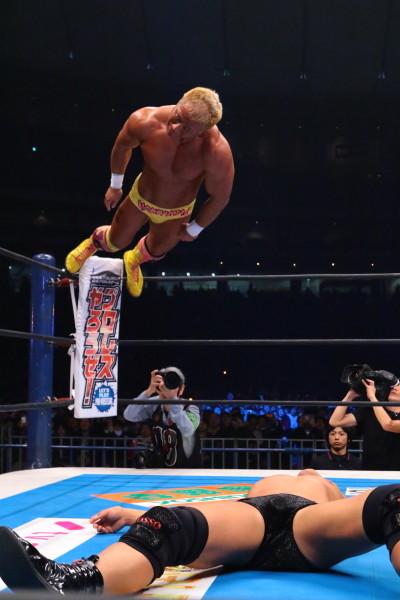
Takahashi eats a double team Ace Crusher, and Jim Ross is an adorable American wrestling fan for calling it the 3D and asking where the Dudley Boys are. Honma calls for his top rope headbutt and hits it without much of a problem and scores the pinfall. Nothing wrong there, just a solid six man tag with a good prospect in Honma being given the gift of a victory on the biggest show of the year by two of its most respected wrestlers. I think this qualifies as the first Jeff Jarrett match I’ve enjoyed since his feud with Booker T 15 years ago, so congratulations Jeff Jarrett.
Toru Yano, Naomichi Marufuji, Mikey Nicholls, and Shane Haste def. Takashi Iizuka, Shelton “X” Benjamin, Lance Archer, and Davey Boy Smith Jr. via pinfall. GRADE: C+
Jim Ross doesn’t have a chance to catch his breath, as the next match starts just as soon as Honma, Tenzan, and Kojima take their celebration to the entrance ramp. Iizuka, Benjamin, Archer, and Smith are all members of a huge, all-encompassing stable led by to the ring by TAKA Michinoku, who is ageless and wonderful and also not wrestling tonight. Iizuka, who I have not seen much of at all, looks like a total crazyman. I already love him. He used to partner with Toru Yano, but he stabbed him in the back to join Suzukigun, and Yano went to Pro Wrestling NOAH for the three men who will team with him for this match. I’ve not kept track of NOAH at all and am thus only familiar with Marufuji, who is really good. Really good. Like, really good, guys. He is the GHC Heavyweight Champion, which is a big deal even if you’ve never heard of it. Nicholls and Haste are the team known as TMDK, The Mighty Don’t Kill. Yano has a staple gun, so I guess he, too, is a crazyman, though less of a Bruiser Brody crazyman and more of a deathmatch crazyman. I’m kind of at a loss here because I like the idea of NOAH guys more than I like the idea of WWE guys, but I like ugly beards and weird faces more than I like staple guns. LET’S SEE WHAT HAPPENS.
What happens is a brawl, which, you know, there are eight people in the ring, so why not. Yano and Iizuka end up in the ring together. Yano hits Iizuka with a BRAIN CHOP, which is my favorite wrestling move without question, but Iizuka is unfazed and takes the fight to his former partner. He goes to strangle Yano with a piece of rope, but Yano ducks it and pulls on the beard. The referee breaks this up, which gets Iizuka angry because his beard got tugged harder, and while Iizuka is doing a crazyman stumble, Yano takes of the turnbuckle covering, which, in Japan, exposes all three turnbuckles at once. Iizuka picks up the turnbuckle pad and smashes Yano with it, which is like hitting somebody with a body pillow. Yano goes down hard, because this is a pillow fight with hate.
Iizuka tags in Shelton Benjamin, who was a fine wrestler at the Intercontinental Championship level in WWE, capable of great matches but never possessing much in the way of character. Thankfully, that’s not much of a problem in NJPW. He immediately hits Yano with one of his trademark maneuvers, a swinging kick to the mouth, and tags in Lance Archer. I haven’t seen much of Archer in NJPW because I usually skip his matches, but when he was a member of WWE’s ECW roster, he was a boring dude with a hideous lower back tattoo. Here he enters the ring with his partner Davey Boy Smith Jr., son of the British Bulldog and tag team specialist, and the two hit Yano with a Hart Attack, patterned off of Davey Boy’s uncles Bret Hart and Jim Neidhart. Archer can’t maintain the advantage for long, though, and Yano soon tags out to one member of TMDK, which brings them both in to work on Archer. That brings in Davey Boy Smith Jr., and it’s TMDK vs. KES, with both teams looking pretty evenly matched. Lance Archer can’t hit the chokeslam he’s looking for until he does, and when he does, man does he get some good height on it. Jim Ross, who has seen a billion chokeslams, digs this one, so you know it’s pretty good.
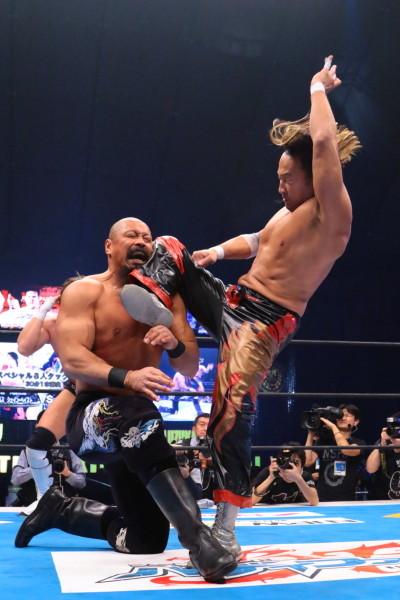
Iizuka is tagged back in, but Marufuji is in this match for the first time now, and he is a house of fire, which is wrestlingspeak for well-rested and ready to go. Iizuka whips Marufuji into the turnbuckles but is stopped by a kick, then is stopped by many kicks. The crowd welcomes Marufuji back into the auspices of NJPW while he gets a two count on Iizuka. Marufuji goes for Sliced Bread #2 but is posted, allowing Shelton Benjamin to leap up after him and belly-to-belly suplex him all the way across the goddamn ring! With TAKA and co. running interference outside the ring, Iizuka dons the most ridiculous pair of brass knuckles I’ve ever seen and misses when he takes a swing at Marufuji. The GHC Champion takes care of an interfering El Desperado on the ring apron, but gets caught with an Iizuka Manhattan drop. Iizuka goes into his tights and retrieves a piece of rope, which he uses to strangle NOAH’s ace. As soon as Iizuka lets go, though, Marufuji recovers and catches him under the chin with a wicked knee lift. Marufuji calls in his TMDK teammates, who tandem gorilla press Iizuka to the lights. They swing him down hard to the canvas and pick him up for Marufuji, who is calling the shots. He crushes Iizuka with another knee lift, and that is the end of Iizuka.
The camerawork never quite picked up on the constant ringside interference of Suzukigun on the outside, so this never quite felt like an upset or come from behind victory. Oddly for a match with betrayal at its center, Marufuji and TMDK are the conquering heroes of this match, mostly relegating Yano to the sidelines. I’ve got no idea if that means they’re sticking around for awhile, but I wouldn’t mind it. I continue to really enjoy Marufuji’s work and was impressed by what I saw out of Haste and Nicholls. Matt Striker continues to congratulate the winners of the match, which is my least favorite thing about his commentary. Coming from a quasi-heel color guy, it seems suspiciously hollow. Stop it, dude.
Minoru Suzuki def. Kazushi Sakuaba via referee stoppage. GRADE: B+
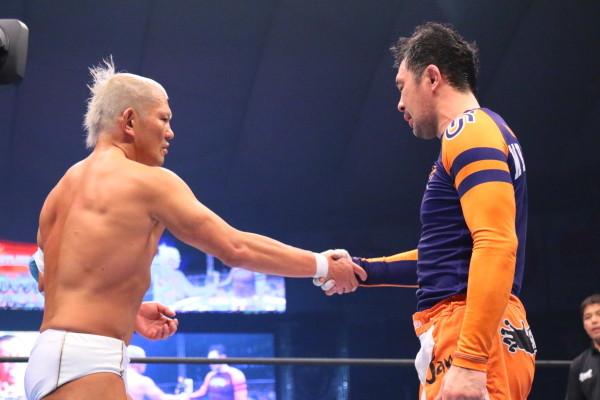
Jim Ross gets serious, as “this match has been a lifetime in the making.” Both men are protégés of Karl Gotch and Billy Robinson, which is as wrestling as wrestling gets. Ross calls them their finest students, which is pretty goddamn high praise. Striker goes over Suzuki’s history as a mixed martial artist, which is vast and deep, and in Japan the two artforms, wrestling and MMA, have always had an easier time of commingling. Striker says that this contest is being fought under UWF-I rules, which I did not know about going in. That is very exciting to me, because pretty much the only MMA I ever got into was Noboshoku Takada’s long-defunct shoot promotion. Volk Han, baby. Lou Thesz’s original World’s Heavyweight Championship, brother. Very serious and regal stuff. Beautiful, elegant carnage. The rules here: You can only win by submission, knockout, or referee stoppage. Ross puts Suzuki over as a legit psychopath. Sakuaba hits the ring next to his crazy dance megamix of a theme song. He’s the greatest MMA fighter in the history of Japan, has beaten a bunch of Gracies, etc. Striker figures that if there’s ever going to be a real MMA hall of fame, these men are the first two that need to be inducted. That’s great, but I’m sick and tired of this hall of fame junk being a talking point in combat sports, sports entertainment, or anything, really. I just want blood.
The fans are into this before the bell rings, as they should be: It’s the first one-on-one match between the two. They circle , and Sakuaba goes behind Suzuki with a waistlock. They exchange go-behinds and hit the mat. Suzuki tries to gain control, but Sakuaba sweeps the leg, and both men get back to their feet. Applause from the crowd. Knuckle lock, quickly broken by Sakuaba, who goes for a single leg takedown. Suzuki widens his base to block it, then walks Sakuaba around and tries to sit out on him, but Sakuaba is able to roll through. Suzuki is in guard and Sakuaba kicks at his leg before leaping over Suzuki, which is a tactical error because he almost ends up in a kneebar. He stands, though, and goes for a sharpshooter (or the power lock, as it’s known in Japan), but it’s way too early for that and Suzuki turns out of it. They roll into the ropes and the referee calls for a break, but neither man wants to give it.
Finally, they do, but rather than returning to a neutral position, Suzuki rolls out of the ring. Sakuaba kicks at him through the ropes and Suzuki responds with some open hand strikes. They keep fighting in the ropes until Suzuki catches an arm and goes into a triangle chokes over the ropes. Suzuki breaks and drops to the floor, dragging Sakuaba out after him. We’re transitioning out of MMA and into pro wrestling now, as Suzuki walks Sakuaba out onto the walkway and snapmares the PANCRASE founder onto it. Suzuki puts Sakuaba into a seated position and walks up the ramp, presumably to charge his opponent, but Sakuaba is up quickly and catches Suzuki with a roundhouse kick. They’re exchanging strikes on the ramp. There is no countout, so they can fight there all they want. A few of Sakuaba’s kicks find their mark, and he sinks in a kimura on the ramp. The match can only end in the ring, but hey, if you break a dude’s forearm or wrist, you’re probably going to win the match. The referee successfully convinces Sakuaba to release the kimura and go back to the ring. Suzuki is going to have to deal with his arm for the rest of the match.
Once the two are back in the ring, Sakuaba continues to assault Suzuki with a series of hard kicks to the chest. The referee backs Sakuaba off and begins a standing 10 count. Suzuki’s facial expression is pure murder as he gets to his feet. He shrugs off some kicks and lands a hard shot to Sakuaba’s jaw! They palm strike each other simultaneously, but it’s clear that Suzuki has the power here, and he knocks Sakuaba to the canvas! Suzuki backs off for the 10 count, but Sakuaba is back to his feet and back to throwing kicks. Suzuki shouts them off, so Sakuaba goes back to the arm, rolling through his own key lock attempt into a potential cross armbreaker. Suzuki locks his hands, though and nearly counters it, but Sakuaba stays on it and breaks Suzuki’s grip! Suzuki is in serious pain now, but is close enough to the ropes that he can hook them with his foot, earning a break.
Sakuaba kicks at Suzuki’s arm, invites him to his feet, then kicks him in the arm some more. He gets some old-fashioned wrestling stomps in and then calls for the standing 10 count. Suzuki is feeling it, he looks a bit shaken, and what was once murder has turned, perhaps, to fear, but he’s up at nine. Sakuaba returns to his kicks, but Suzuki isn’t having any of them. He lands another palm strike. They exchange kicks and palm strikes. Suzuki invites Sakuaba to kick his injured arm and just takes it, continuing to counter with palm strikes. He catches a kick and lands another strike, then knocks Sakuaba to the canvas with one and follows up by kicking his face in. He could ask for a 10 count, but no. Sakuaba is defenseless, and Suzuki puts him in a rear-naked choke. He turns his hips and slings Sakuaba over, still in the choke! He wants to end this match now, and this is his best shot. Sakuaba says no, waving the referee off, but Suzuki will not let go. Sakuaba goes limp, and the referee calls for the bell.
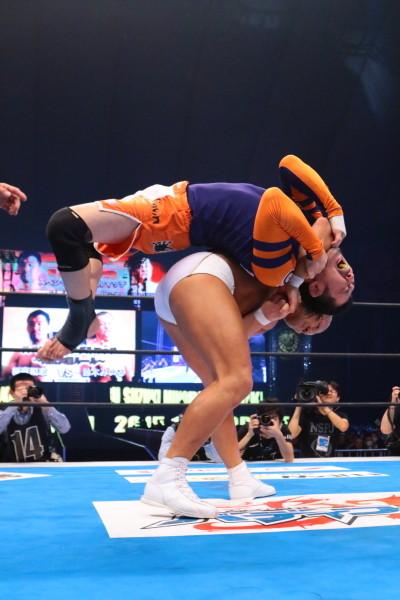
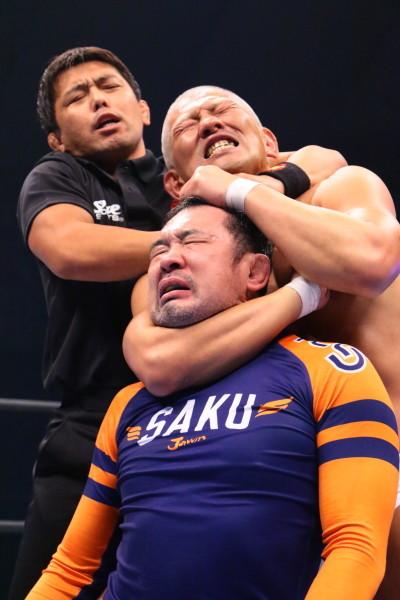
I love worked shoot wrestling; I think it is one of the best things that ever happened to professional wrestling. This wasn’t a classic, I don’t think, as the ramp fighting was a bit gratuitous and I could have gone for more fighting, but the closing sequence was nasty, and Suzuki’s rear-naked choke a thing of beauty. Sakuaba wakes up a bit stunned while everybody is iced down. Matt Striker is sad that there aren’t men like Suzuki or Sakuaba around anymore. Matt Striker is not a man like Suzuki or Sakuaba and should probably shut up. Sakuaba offers his hand and Suzuki takes it. Everybody is super happy about it, as they should be. On his way out of the arena, Suzuki takes off his ice pack because he doesn’t give a damn.
Jim Ross loves that NJPW doesn’t screw around and keep people waiting, and neither do I. Led Zep’s “Immigrant Song” starts playing, which, ha, how goddamn rad, and it’s time for our next match.
NEVER OPENWEIGHT CHAMPIONSHIP: Togi Makabe def. Tomohiro Ishii (champion) via pinfall. GRADE: A-
NEVER, if you’re wondering, stands for New Blood, Evolution, Valiantly, Eternal, and Radical. But what the acronym stands for and what the division actually is are two different things, as NJPW’s NEVER division shut down right as they crowned the first champion, and all of its champions have been established talent. Pretty much, it’s open to anybody, but the matches tend to favor big, bruising tanks. Togi Makabe is out first. He was once an IWGP Heavyweight Champion and winner of the G1 Climax, meaning he was one of the most talented wrestlers in the world, but now he prefers a brutal brawling style and goes by the name “Unchained Gorilla,” which is the best. Tomohiro Ishii is the “Stone Pitbull,” and this is a battle of the best nicknames in the world. He is stocky and thick and mean looking, three great things for a wrestler to be. Ishii’s shoulder is taped, as he separated it during the G1 Climax. He finished the tournament with a dead arm. Striker says that Ishii’s quest is to raise the status of the NEVER Openweight Championship, and defending it here would be a good way of doing that.
The bell rings and the two charge at one another, trading clotheslines and forearms. All of these are shrugged off, the initial salvos in a battle between two unsinkable ships. Makabe looks to run off the ropes for an advantage, but he is followed by Ishii, who hits him with a running forearm. Having staggered Makabe, Ishii runs off the ropes. He ducks a lariat and just runs into Makabe, who bounces off the ropes and runs into Makabe! The two exchange shoulder tackles, neither giving an inch. Makabe runs at Ishii one more time, but gets powerslammed! Off their feet for the first time, Makabe and Ishii get back to a standing base, and now it’s Makabe who powerslams the champion! They stagger each other with simultaneous clotheslines, and it looks like Ishii and Makabe are human after all. Ishii switches to chops now, Makabe favoring large overhand right hands. Ishii chops Makabe in the throat, and that puts the challenger down. Now that he has the high ground, Ishii headbutts his challenger. He follows with a second headbutt and a third, then just kicks at Makabe.
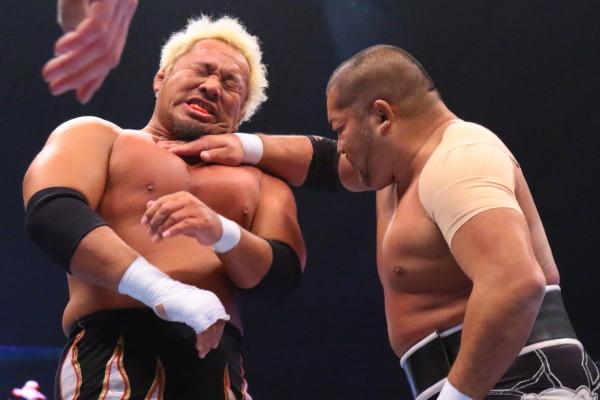
The Unchained Gorilla takes this as a sign of disrespect and gets back to his feet, challenging the champion to take his best shot. He withstands several of them and punches the Stone Pitbull into the corner. He hits two running lariats and an American 10-punch, the crowd counting along. Ross really likes Makabe, who is a devotee of Bruiser Brody. Ishii is less impressed though, as he slaps his challenger. They trade slaps, then progress to punches. These are heavy blows, uglier than hell, and I love them. He lands a Northern Lights Suplex, the first thing resembling a wrestling hold in this match, and gets a two count.
Undaunted, Makabe continues his offensive. Ishii is fading in the corner while Makabe lays in forearms. But that has a way of waking up gigantic monsters, and Ishii makes his way back to consciousness and lays into Makabe with a forearm of his own. With Makabe in the corner now, Ishii puts his challenger on the top turnbuckle and goes for a superplex. Ishii deadlifts Makabe and both men go crashing to the canvas. Ishii powerbombs Makabe and holds him for a pin, but Makabe kicks out. The two go into a big guy exchange where hitting one guy’s arm as they go for a lariat is enough to spin him around, and it’s Makabe who comes out of it with the advantage, finally hitting Ishii with a lariat. Makabe with a kneeling powerbomb now, which he holds for a pin, but Ishii is able to roll his shoulder up from the mat.
Makabe waistlocks Ishii, who tries to elbow his way out, but Makabe will not be denied and takes the champion over with a German suplex. That’s a two. The replay shows that Makabe shifted Ishii so that he would land on his injured shoulder, which is the kind of subtlety you don’t often see in wrestling. Makabe is in complete control now, whipping Ishii into the turnbuckles and following him in with a clothesline to the back of the head. He seats Ishii on the top rope and goes for a German suplex from there, but Ishii’s elbows work this time and he turns around and tries to headbutt Makabe off. It almost works, but Makabe’s leg strength is too much—he does a hanging sit-up back to the turnbuckle and takes a big swing at the champion, stunning him. Using the middle rope as his base, Makabe puts Ishii on his shoulders and brings him down with an ugly Samoan drop. Ross seems legitimately surprised that Ishii kicked out.
Ishii might still be in the match, but just barely. Makabe lariats him so hard that the champion spits, and Striker, who usually giggles at this kind of thing, lets out a stunned “Oh” instead. Makabe does it again, waking up the monster. Ishii goes for an enziguri, but Makabe easily blocks it. He follows up with a straight murderous lariat, but Ishii kicks out at one! Matt Striker calls it a “lariato” again and makes plans to snuggle with his body pillow after the show. The referee checks on Ishii, who is conscious, but just barely. Makabe goes for a clothesline, but Ishii ducks and hits a release German suplex. Makabe is up first and charges the champion, but is clotheslined down! Makabe goes into the lateral press immediately but only gets a one count. Matt Striker wants Jim Ross to scream “Lariato” now, because there’s nothing better than western men making fun of the way the Japanese pronounce English words. Ross laughs uncomfortably, then says the word with disdain because he wants to enjoy this match without some asshole demanding he be cute.
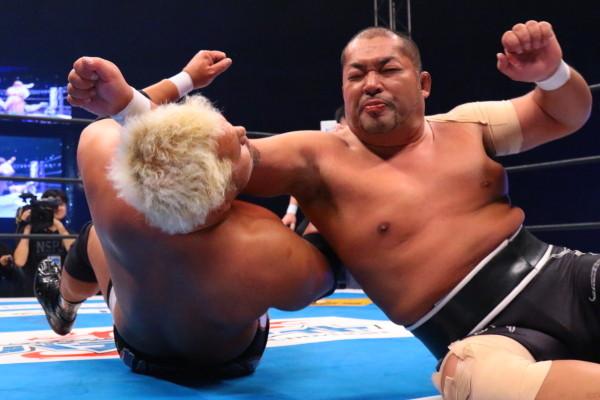
Back to their feet, it’s looking like Makabe is the fresher man, but they meet once again with a pair of clotheslines that could fell a tree, and neither man has an edge. It’s a clothesline battle for a hot moment, then Makabe starts chopping Ishii’s shoulder, which Ishii replies to with a brutal headbutt. Makabe sits up and eats a sliding lariat from Ishii for a near fall. Ishii goes for a suplex, but Makabe counters into one of his own. Ishii slips it and hits the enziguri, aka the back brain kick. It’s an incredibly common move now, but when a gigantic man is performing it without all the fancy filigree, just a leap and a kick to the back of the head, it’s as dangerous as ever. Makabe falls to the canvas and Ishii jackknifes the legs for a pin, but Makabe kicks out. More clotheslines, this time with Makabe coming out ahead. He gets behind Ishii and locks the arms, taking his man over with a dragon suplex, but it’s not enough!
More forearms now, both men stopping to talk trash. Ross wishes he could speak Japanese, and I do, too. Ishii gets ahead on forearms and headbutts his challenger again. Makabe stumbles back, out on his feet, but when you’re out on your feet you’re dumb enough to respond to a headbutt with one of your own. He follows with a sledgehammer blow to Ishii’s taped shoulder. Ishii returns fire, but another Makabe sledgehammer puts him down. Ishii gets up and is immediately put down by another sledgehammer, but this time he gets a one count. Ishii makes it to his feet and is gifted an utterly disgusting clothesline. That’s a two count. Ishii doesn’t get up though, so Makabe goes to the top turnbuckle and drops a knee on the back of Ishii’s head, Bruiser Brody’s King Kong knee drop. The referee counts to three, and this one, mercifully, is over.
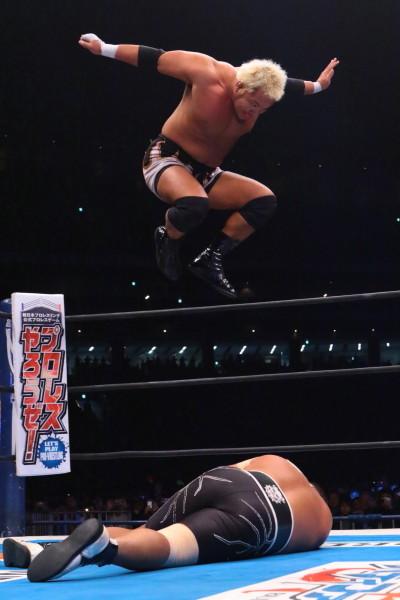
Giant dudes dishing out giant punishment. This has become a capital-T Thing for many pro wrestling fans over the past year or two, with plenty of chatter of an unofficial “Hoss Division” in the WWE ranks and a Hoss Division Championship in promotions like Absolute Intense Wrestling. If ever there was a hoss fight, though, this is it. Two impossible human beings surviving lethal strikes and suplexes, both men seemingly mirror images of each other, until something gave. Here it was Ishii, but considering that his shoulder (and his knee) were taped up, the fact that he survived as long as he did was a miracle. Makabe gets a cheap shot in on Ishii and flips off the heavens because that’s the kind of man he is. I want a rematch the moment Ishii isn’t hindered by an injury. I want a rematch now. I want a rematch every day.
IWGP JR. HEAVYWEIGHT CHAMPIONSHIP MATCH: Kenny Omega def. Ryusuke Taguchi (Champion) via pinfall. GRADE: B
Kenny Omega is the “cleaner” of the Bullet Club, their big new recruit of 2014. Omega has been wrestling in Japan for a long time now, long enough that he is fluent in Japanese, but when he signed with NJPW and joined the Bullet Club, he refused to speak anything but English, which is a great heel move. Jim Ross compares Omega to Brian Pillman, which, coming from Jim Ross, is very, very high praise. Omega is followed to the ring by his Bullet Club buddies, and he’s doing the Scott Hall toothpick routine. Matt Striker says that Omega swerved the fans and Jim Ross says that he doesn’t know what “swerve” means because he is my hero. Ryusuke Taguchi, the Funky Weapon, was Fergal Devitt’s tag team partner until Devitt turned on him and formed the Bullet Club, who he has been fighting ever since. Omega doesn’t look impressed with the funkiness of Taguchi’s weapon at all. Omega completes the Scott Hall toothpick routine by throwing it in the referee’s face, and we’re off.
Omega and Taguchi wrestle into the ropes and Omega breaks, slapping the champion lightly and giving him a John Cena A-OK sign. They tie up again and Taguchi backs Omega into the corner and disrespects him coming out of the ropes. Omega doesn’t like this and slaps the Funky Weapon, who has his dander up now. The two exchange leapfrogs and drop downs until Taguchi gets the advantage and sends Omega over with an armdrag. Omega is up first and runs off the ropes, but Taguchi meets him with a leaping hip check and gets funky, utilizing it a few more times on a seated Omega. Taguchi rams Omega into the turnbuckle. He sends him across the ring and pursues, but Omega does an impossible leap over Taguchi and rolls out of the corner. Omega comes back and goes for a hurricanrana, but Taguchi catches him in an ankle lock and drags him to the center of the ring!
Omega rolls over and kicks out of the ankle lock, but gets taken over with another armdrag. Taguchi with a nice back elbow sends Omega into the ropes and clotheslines him over. The Young Bucks get involved, distracting the referee, which allows Kenny Omega to grab a can of cold spray from under the ring. Taguchi goes to deal with Omega and gets sprayed right in the eyes. Omega sprays himself down with the stuff like a frat bro overapplying AXE and gets back into the ring. Omega is completely in control, chopping Taguchi into the corner, then charging in at incredible speed and crushing the champion in the corner. Two count. Taguchi is still blind, and Omega is still in control, fighting dirty and choking Taguchi in the corner. Omega goes for a suplex on Taguchi, who tries to fight his way out. Omega, however, is strong enough to keep Taguchi in the air to finish the suplex. Omega wanders around the ring wasting time, pulling an invisible chainsaw and making “VRIMMMM-NIM-NIM-NIM” noises. This is a dude WWE let slip through their goddamn fingers. Chainsaw fully revved up, he proceeds to rake his forearm over the eyes and forehead of the champion. Striker says that Omega shaved his arms a few days ago and that he has stubble growing in so that the move, already illegal, is more annoying, which is a good bit of psychology.
The referee pulls Omega off of Taguchi and gets shoved for doing his job. Taguchi is still not at 100% after the cold spray attack, but he ducks an Omega leaping roundhouse and gets his leg grabbed by the Young Bucks at ringside. Ross can’t fathom why the referee doesn’t do something about it, which is a pretty good point I guess, but man is he belaboring it. Omega runs at Taguchi, who is able to backdrop the champion over the ropes and onto his cohort. With the Bullet Clubon the floor, Taguchi executes a beautiful tope con hilo. He gets Omega back in the ring and hits a springboard missile dropkick for two. Taguchi gets Omega up and hits two suplexes in sequence, but before he can do a third, Omega knees him on top of the head and starts to slap him on the back of the neck. Omega grabs the waistlock, but Taguchi executes a go behind. Omega escapes with some elbows to the head and runs at Taguchi, using his blistering speed to redirect himself and confuse the champion before kicking out his knee. Omega leapfrogs into a facecrusher, executes a lazy pin, and gets a two count.
Omega continues to wear out his opponent with chops and stomps, then goes for a running Liger bomb. But Taguchi counters this, using a hurricanrana to send Omega hurtling into the turnbuckles. Taguchi with a sit out powerbomb of his own, but he can’t get much pressure on the pin attempt and gets a two. Taguchi goes up the turnbuckles but is met by Omega. The challenger falls off, but the champion isn’t quich enough to capitalize. Omega is punched off again and Taguchi leaps off, only to be dropkicked on the chin. Omega deadlifts Taguchi into a gutwrench powerbomb and gets a two. Now he picks Taguchi up onto his shoulder, but the champion gets out and tries for a tiger suplex. Omega rolls through and gets a two count. Omega gets up and turns into a knee to the jaw. Taguchi chickenwings the arms and lifts Omega, drives him down into a facebuster, and Omega kicks out!
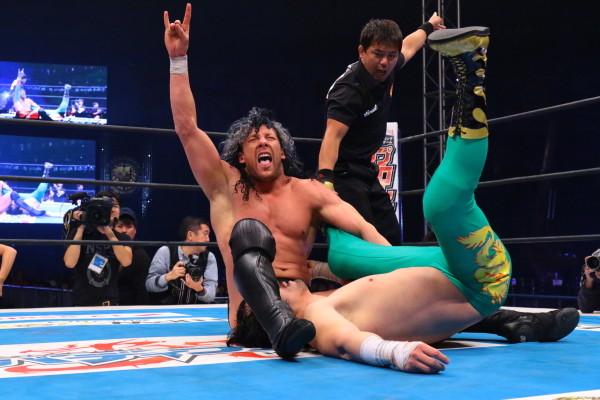
Taguchi returns to the ankle lock, but the Bucks get involved again. It’s to no avail though, as Taguchi moves out of an Omega flying knee and hits a tiger lungblower. Omega somehow kicks out. The Funky Weapon feels that he has the match in hand and tries to lift Omega. Omega fights out of a torture rack and catches the champion trying another hip check, snapping him down with his trademark brutal German suplex. Omega follows with a running knee drive, puts Taguchi into electric chair position, then drives Taguchi to the mat with the One Winged Angel. Three seconds later, we have a new champion.
Ross compared Omega to Brian Pillman early on, and that comparison may be apt. I’m so far behind on NJPW that I haven’t seen much of his work in Bullet Club, but he wrestles with an incredibly weird charisma in this heel persona, staggering around in an imitation of drunken boxing. It’s the charisma of Pillman’s Loose Cannon persona with the talent of his early days as Flyin’ Bryan. Omega is already a great wrestler, but if he stays healthy, he might just become a legend.
IWGP TAG TEAM CHAMPIONSHIP:Meiyu Tag (Hiroki Goto and Katsuyori Shibata) def. Bullet Club (Karl Anderson and Doc Gallows, champions) via pinfall. GRADE: B
Bullet Club have been champions for one full revolution around the sun. Meiyu Tag, however, have a non-title victory over Gallows and Anderson, so the Americans are looking vulnerable going into this contest. Jim Ross loves that the champions come to the ring last. Gallows has his face painted and reminds Ross of gaijin bruisers like Stan Hansen and Terry Gordy. Karl Anderson reminds Jim Ross of Arn Anderson, which is amazing. Matt Striker is really into Amber O’Neil, and I hope the second time he says the phrase “Bullet Babe” is his last. Striker calls Gallows a “good bruther” because he listens to Colt Cabana’s podcast. Meiyu Tag wait around while the Bullet Club two sweet each other, and it’s former partners Anderson and Goto who start things off.
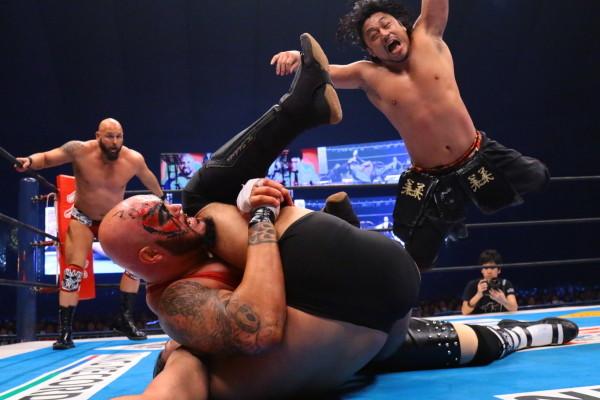
Goto gains the advantage by outwrestling and outslugging Anderson, but he is kicked in the back by Gallows and the champions take over. Anderson runs off the ropes, and Shibata takes a page out of the Bullet Club handbook, catching Anderson in a sleeper hold. He transitions to holding Anderson for his partner, but Machine Gun is able to get out of the way and Goto clotheslines Shibata off the apron. He turns around into a huge superkick from Doc Gallows, who is in the ring illegally. Bullet Club take over, Anderson with a Senton and Gallows with a leg drop. That gets a two count. Anderson gets another two count off of a leg lariat. A series of near falls, actually, as he won’t let go of the cover. He tags Doc Gallows in, and the mood changes with the entry of the big brawler.
Jim Ross doesn’t know anything about the Bullet Babe, but suspects that “she’ll earn her money tonight.” Gallows hammers away at Goto in the corner. Goto tries to lift Gallows but can’t, so they exchange clotheslines until Goto’s speed advantage allows him to take Gallows off his feet with one. Goto rolls over and tags in his partner. Shiabata enters the ring, kicks Anderson off the apron, and gets leveled by a Gallows forearm. Undeterred, Shiabata returns to his feet and soon has Gallows grounded in the corner, grinding away at him with repeated forearm shots. Shiabata creates some separation so he can charge at the huge American, but Gallows is back up and catches his challenger with a huge lariat, swallowing Shiabata’s head whole and taking him down to the canvas. Gallows whips Shiabata into the ropes, misses with a clothesline, and gets dropkicked. Anderson runs in and finds himself in an octopus stretch, but that leaves Shiabata open to an attack by Doc Gallows, who clubs him in the back. All four men are in the ring now, and the referee is just letting things happen. Meiyu Tag finally take control of the match with a pair of seated dropkicks to Gallows and Anderson. They hit Gallows with a double back suplex and get a two count.
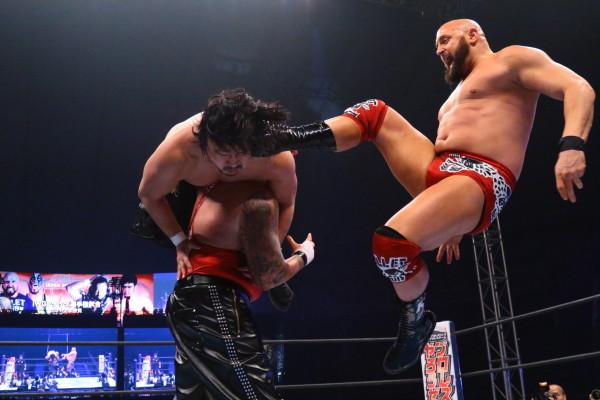
They try to continue the double teaming, but Anderson cuts Goto off and Bullet Club begin abusing Shibata. A backbreaker/elbow drop combination that looks particularly nasty gets the pair a two count before Goto reenters the ring to break up the fall. Gallows picks Goto up and Anderson kicks him in the head before Gallows spins him out to the mat. A double team cutter gets Bullet Club another two, but Shiabata will not be denied. Meiyu Tag get Gallows out of the ring, and Goto and Anderson deny each other their finishers until Goto gets Gallows to the mat, where Shibata drills him with a penalty kick. They don’t see Gallows coming, though, and are double clotheslined. Shibata eats a chokebomb, but gets his shoulder up at two. Bodyslam from Gallows, who goes up top. Big dudes don’t belong up there, though, and Meiyu Tag recover in time to double up on him, slamming him to the mat. Gallows breaks up a double team and goes for his chokebomb on Goto, but Goto denies him with a headbutt. Shibata holds Gallows, Goto clotheslines, him, and Gallows falls back into a Shibata sleeper hold. He lets go to take care of Anderson, who is trying to get back into the ring, and Goto brings Gallows to his feet. Goto lifts the massive frame of Doc Gallows and tosses him to his partner, who kicks him. With Gallows stunned, Shiabata takes his head off with another penalty kick, and we’ve got new tag team champions.
Good tag team match, with the two childhood friends overcoming the American interlopers. New Japan, beyond the Junior Heavyweight Division, seems to have Bullet Club completely under control at this point, having wrested all but one championship away from the stable. But the big boss of Bullet Club is still out there, and he happens to be next.
AJ Styles def. Tetsuya Naito via pinfall. GRADE: A-
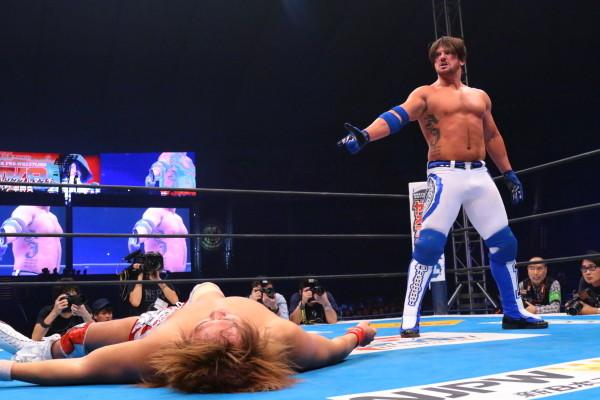
I do not like AJ Styles. I never have and suspect I never will, but I also have gone out of my way to avoid his New Japan stuff after years of annoyance at his tendency to fill matches with unnecessary spots, so all I really know about him is that his Styles Clash finisher has broken a neck or two in Japan but he still uses it, which is dangerous and unsafe but is now part of his gimmick. I’ve heard a lot of good things about his run in Japan from plenty of folks whose opinion I trust and respect, so I’ve got as open a mind as is possible, given 10 years of distaste. Speaking of time, Striker says that the Styles Clash is “quickly” becoming feared and respected, though that has been AJ’s finish, oh, for as long as he’s been somebody worth paying attention to. Sure, it just recently broke two necks with the move, but when most of your major wins have come via the move, it’s already feared and respected. Styles is a member of Bullet Club, the true replacement for Devitt. Striker is still going on about this Westernization thing, which I don’t get. Tetsuya Naito comes out in an absolutely amazing ring jacket. He is the “Stardust Genius,” which, no offense to STONE PITBULL or UNCHAINED GORILLA, is my pick for best nickname in wrestling.
AJ Styles is on Naito before the bell rings, going for the Styles Clash early. Naito counters out, and we’ve got ourselves a brawl. Styles goes for it again, but Naito picks the former IWGP Champion up and puts him on the apron. He runs after Styles, who back body drops him over the ropes. AJ Styles goes for a moonsault press off the ring apron, but Naito moves and Styles lands on his feet. Naito scores with an elbow, climbs onto an apron, and lands a running dropkick, the first high impact move of the match. Naito continues to go with the dropkick until Styles interrupts a corner combination by grabbing Naito’s leg and snapping it over his shoulder. Styles continues to work the leg, elbow dropping Naito several times and dropping his knee on it. Styles lets Naito back to his feet, only to kick the leg out from under him. Back on the canvas, Styles locks Naito in a deathlock variation. The submission gives Striker and Ross some time to talk about Styles as the greatest thing TNA developed, which is actually true, and for Striker to claim that this is a boom period in wrestling, which is not. There’s a lot of choice in wrestling if you’re an American fan who knows that there’s a world beyond the WWE’s main roster, but New Japan is likely one of the only promotions in the world that’s actually enjoying a period of sustained creative and financial success, and there’s no such thing as a one promotion boom. Ross says that it would be cool to see one of these men as a surprise entrant in the Royal Rumble, and now I’m less into the “wrestling as a global form of entertainment” thing than I was two hours ago.
Styles scores with a tornado DDT on Naito, who may be the least likely to enter the Royal Rumble, but Naito gets up and fights back, taking Styles over with a biiiiig hip toss, which he follows with a dropkick and a senton. Styles tries to kick at a charging Naito in the corner, but Naito catches Styles’ legs and swings them through the ropes, catching a compromised Styles with a hanging neckbreaker. That gets a two count, and Naito tries to work some feeling into his knees. He puts Styles on the top rope and follows him up. Styles puts him off with a few headbutts, which allows AJ to eventually land a springboard forearm. A series of suplex attempts leads to Styles hitting Naito with a gross-looking neckbreaker, which Naito kicks out of it. Styles goes for a German suplex and nails it. He goes for another, but Naito rolls through and gets a two count. He hits a German suplex of his own and scores another near fall.
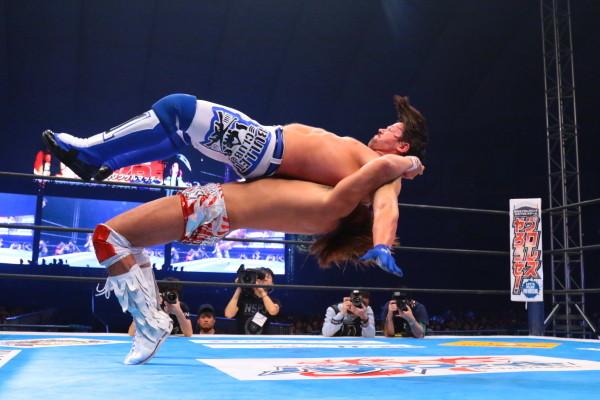
Styles lands a combination of strikes but misses the killing blow, allowing Naito to land an enziguri. Styles reverses an Irish Whip, but Naito uses the momentum to land a leaping forearm shot. He goes to the top rope for his Stardust Press but takes too long to find his footing, allowing AJ to get back into it by taking out Naito’s legs. Styles goes for a back suplex off the top rope, but Naito flips out and tries to land on his feet. That doesn’t quite work, as his leg is injured, but Styles took the worst of that fall. Naito charges at Styles, who rolls through and locks in his calf killer submission. Naito scrambles, looking for the ropes, but the calf killer takes away half of his body, and his leg is already weak. Styles moves his hands up to the toe of Naito’s boot so he can exert more pressure, which is fantastic, and reaches back with one to swat Naito’s arm away from the ropes, which is also a really, really good psychological touch. Naito pushes back on his leg, trying to find some relief, looks to smother Styles with his arm, does everything he can. He presses up and looks ready to tap out, but that gives him enough space to dive for the ropes, which he makes. Tremendous submission sequence, but that leg is done and most of Naito’s offense is gone with it.
Styles picks the leg, and Naito fights him off. Styles picks it again and gets enziguried for going back to the well, then Naito takes him over with a uranage suplex. Naito waistlocks Styles back to his feet, maybe for a German suplex, but Styles has more energy and breaks the hold, only for Naito to go under his arms and carry his opponent over with a dragon suplex! That’s a two count. Naito gets Styles in a pumphandle, but AJ muscles out of it and lands a glancing blow with his Pele Kick. Styles hits a double-underhook impaler DDT, the Bloody Sunday, which belonged to former Bullet Club leader Fergal Devitt, and Naito is out. Styles signals for the Styles Clash, but Naito counters by back dropping Styles up and falling back until Styles flies out of the ring to the floor. Styles is back in at 19, giving Naito some time to recover. Naito just kinda wanders back into the corner, where Styles uses the tights to ram his opponent into the turnbuckle. From there, though, Naito trips the leader of the Bullet Club and lands the swinging dropkick that got him in trouble in the opening moments of the match. Naito goes for a hurricanrana off the top rope, but Styles catches him. Naito is in perfect position for AJ Styles to set up for the Styles Clash, which he lands from the second rope, and ain’t nobody getting up from that.
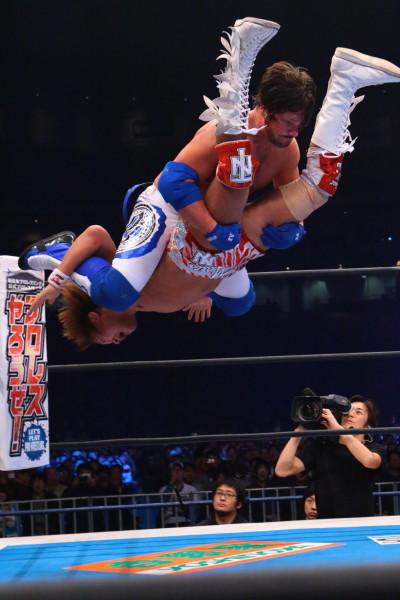
Very smartly worked contest that leads me to believe Styles has gotten much better since the glory days of the X Division, where he got insane praise for matches where he was breaking up chokeholds with stupid springboard 720 splashes. The best wrestlers in the world do get smarter as they get older, and if you’ve got a lot of talent and aren’t trading in on WWE fame (which Styles isn’t), going to a place like New Japan and working all of the top guys will make you that much better. Striker and Ross made a big deal out of Naito’s inability to win a match at Wrestle Kingdom, as this was his fourth attempt and fourth loss. But he wrestled so much of this match on a gimpy leg and was only put away with a super-version of a move that legit has a reputation as one of the most dangerous in wrestling, so he’s going to be fine.
IWGP INTERCONTINENTAL CHAMPIONSHIP: Shinsuke Nakamura (champion) def. Kota Ibushi via pinfall. GRADE: A+
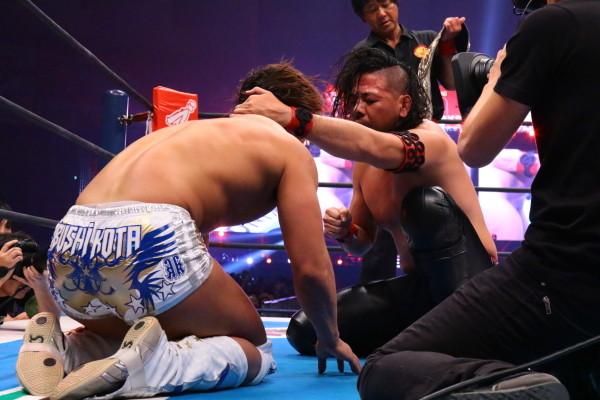
For most American fans, this here is the one. Nakamura has a cult following among American fans who follow Japanese wrestling, as does Kota Ibushi. Their feud, documented in the pre-match promotional video, has been lengthy and intense. Though they’re around the same age, Ibushi’s road to New Japan Pro Wrestling was hard and long, and he’s still pretty much a rookie in the promotion compared to Nakamura, who has been here for some time and, along with Tanahashi and Okada, is one of NJPW’s ace wrestlers. A win over Nakamura at a Dome show puts Ibushi right up there with them, as the “Golden Star” quickly graduated from the Jr. Heavyweight ranks due to his unrivaled popularity within that division. To beat Nakamura, though, he’s going to have to bring something extra to the table, proving that he’s not the supremely talented guy who goofed around fighting blow-up dolls on the indies. He returns to the scene of his greatest triumph, Wrestle Kingdom, where in 2014 he defeated Fergal Devitt for the Jr. Heavyweight Championship. He’s out first, leaping out from beneath the stage like Rey Mysterio Jr. Nakamura comes out in a crown and a robe, because he is the King of Strong Style. Ross talks about how he loves Michael Jackson and Freddie Mercury, but is still a badass. This entrance really sells that point, man. It is something.
The two begin by circling each other, each man testing the other with hard kicks to the legs. Nakamura eventually closes in on Ibushi, getting a waistlock. He backs Ibushi into the ropes and breaks clean, but Ibushi slaps him on the back of the head. Nakamura shoots in with a knee and whips Ibushi into the ropes, but Ibushi reverses. Nakamura grabs the ropes, putting the breaks on, and manages to avoid Ibushi’s attempted dropkick. Ibushi crashes to the canvas but avoids a stomp. He’s back to his feet already, kicking again at Nakamura’s legs. He blocks two of Nakamura’s knee strikes, and the two back off into opposing corners. Jim Ross talks about how children have Shinsuke Nakamura’s haircut. Nobody has Kota Ibushi’s, because, as my friend Robert Newsome frequently points out, he has your Aunt Diane’s hairstyle. Nakamura offers his hand to Ibushi as a show of respect and Ibushi foolishly takes it, opening himself up to a short-arm knee strike, followed by an axe kick. Nakamura goes for the BomaYe early but Ibushi is too fast and avoids it, following with a dropkick to Nakamura’s shoulder.
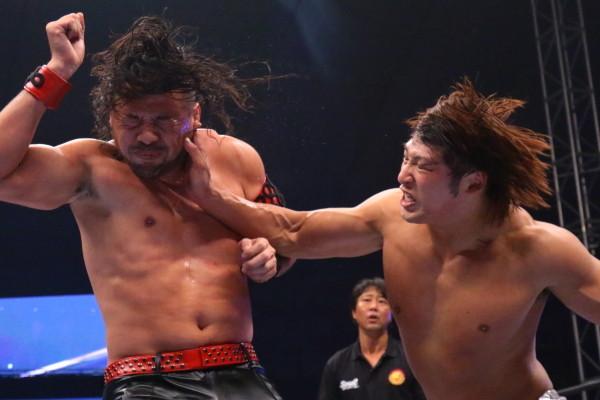
In the corner, Ibushi lets loose with a few strikes before washing Nakamura’s face with his boot, which is a Nakamura signature. Shinsuke Nakamura looks none too impressed with this, while Kota Ibushi stands back, telling the champion to bring it. Nakamura gets up and invites Ibushi to take a running start, which he does. Nakamura lands a knee, then throws Ibushi into the turnbuckles, where he stomps a mudhole in the Golden Star. Nakamura bridges Ibushi across the top ropes in the corner and blasts his helpless foe with a running knee right to the ribs. Ibushi falls to the ring apron, where Nakamura follows with a pair of knee strikes, the first one running on the floor, the second leaping from the apron. Ibushi is dazed on the floor while the referee starts his 20 count, failing to get into the ring on his first try, but he’s in at eight. Nakamura takes control with the cravate, snapmaring Ibushi over before dropping another knee, this time to Ibushi’s forehead. Ibushi kicks out of a showy cover and sinks in a chinlock. Nakamura leverages that into several cradle attempts, but Ibushi kicks out of them all and makes his way to the ropes for a break.
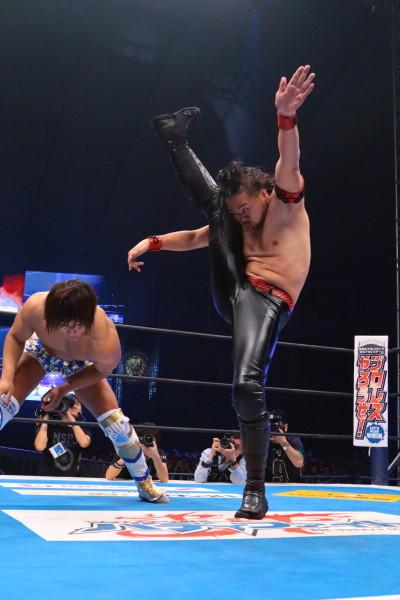
Ibushi gets up and forearms Nakamura, who brushes it off. Ibushi goes for a second, and Nakamura brushes that off, too. This has Kota Ibushi mad, but his third forearm goes nowhere, and Nakamura cuts him off with a few forearms of his own. He bends Ibushi over and slaps him in the face until he crumbles to the mat, where he goes for a roundhouse kick and misses. Ibushi is back to his feet, firing slaps and chops of his own, and the two go nose to nose. Ibushi misses with a shot, and Nakamura capitalizes with a backstabber. Ibushi flips out of a back suplex, though, and takes Nakamura over with a Frankensteiner. Nakamura’s on the apron now, but is swiftly dropkicked off. Alone in the ring and with room to run, Ibushi leaps onto the turnbuckles and uses those to propel himself into a moonsault press to the floor, where Nakamura is standing! Ibushi rolls through and sticks the landing, because that’s how good he is. Ibushi rams Nakamura into the ring apron and sends him back into the ring, where he drills Nakamura with a springboard dropkick. His German suplex is dropped, but Ibushi is too fast for Nakamura on this exchange, hitting him with slaps and kicks, finishing with a hard roundhouse kick to the sternum. Ibushi’s standing shooting star press nets him a near fall.
Nakamura makes his way to the corner, where he’s able to back drop Ibushi to the apron. He goes to suplex Ibushi in, but is kneed in the top of the head. Nakamura staggers away, allowing Ibushi to springbord into the ring, but Nakamura catches him with a one-legged dropkick to the chin. Ibushi gets to his feet and ducks one kick, but Nakamura keeps his momentum going and lands another to Ibushi’s jaw. He takes Ibushi down with a classic front suplex and moves immediately into a succession of knee strikes. Ibushi is making his return from a concussion, so knees to the head is the way to go. Nakamura charges in for the BomaYe, but Ibushi sidesteps it and the champion rushes headlong into the turnbuckles. Ibushi an’t take advantage right away, but Nakamura tries going upstairs, where the challenger stops him with a slap to the chest. Nakamura fights Ibushi off, sending him to the ring apron. Ibushi gets a shot in, stunning Nakamura, and this lets Ibushi connect with a springboard hurricanrana off the top turnbuckle! He scrambles over for the cover, hooks the leg, and only gets two.
Ibushi gets Nakamura in a full nelson, looking for a dragon suplex, but Nakamura breaks it. He looks for an elbow, but Ibushi sees it coming and scores with a quick-release dragon suplex, dumping Nakamura on his head. He misses a kick, but lands a standing corkscrew splash, and that’s a two count, too. Ibushi looks to crank up the nastiness a bit, going for a piledriver, but Nakamura has his leg and hangs on for dear life. So Ibushi kicks him in the head and goes for it again, only this time Nakamura’s counter is a back body drop. Ibushi hangs on to the waistlock and is able to roll through with a sunset flip, scoring another near fall. He scores with a roundhouse kick to the back of Nakamura’s skull as both men get to their feet and follows that with a sit-out super powerbomb. He has both of Nakamura’s legs locked, but the champion is able to kick out because Ibushi gets confident and starts counting along with the referee! Ibushi goes for his Phoenix Splash but Nakamura moves and he eats the canvas. Nakamura follows up with the BomaYe, right to the back of Ibushi’s head! He’s still dazed from the powerbomb, however, and can’t follow up with an attempt at a pinfall, so with Ibushi trying to use the ropes to get back to his feet, Nakamura gets up and starts stomping away at the challenger, kicking him hard on the back of his head and to the side of the face, but Ibushi is smiling as the referee drags the champion off!
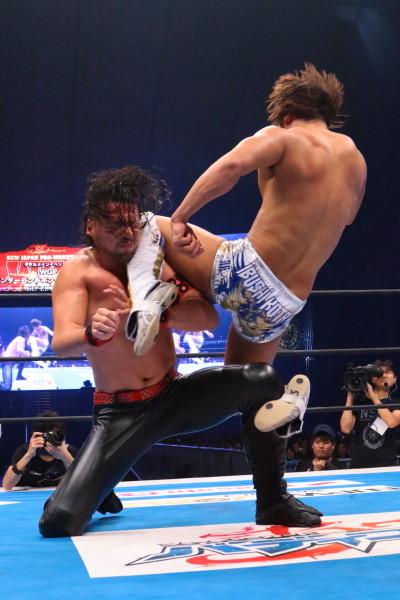
He turns around and drills Nakamura with a few palm strikes, transitioning quickly into just straight up punches, which are rare and indicative of true hatred. The referee gets between the two to admonish Ibushi, and Nakamura shoves the official, charging in and destroying Ibushi with a straight fist of his own. Ibushi ducks another one and goes for a shot of his own, but Nakamura catches the ball of Ibushi’s fist and uses the challenger’s momentum to carry them both through into a cross armbreaker! Ibushi is able to lock his hands, though, stands, and gets out of the hold by kicking Nakamura right in the goddamn face. Nakamura is down on the canvas, and Ibushi continues to kick him, hard and mean. He’s wrestling like a prick, and it is wonderful. He brings Nakamura up and takes him over with a dirty half and half suplex. He crushes Nakamura with a BomaYe, but that only gets a one count! Ibushi doesn’t sit around and wonder what it’s going to take, oh no. He gets up and starts punching Nakamura in the back of the head. This is a completely new look for Nakamura, this grit and intensity when his pretty flips and strikes aren’t getting it done, and I like it a lot. Nakamura wakes up a bit, though, and push-kicks Ibushi away, into the turnbuckles. Now it’s Nakamura with the ugly kicks and stomps, Ibushi literally tasting leather at one point, as his tongue is out and Nakamura grinds the toe of his boot into it.
The two are back to their feet, trading brutal-sounding strikes. Nakamura gains the advantage temporarily and tries to make something out of it, running off the ropes, but Ibushi hits him with a double stomp, taking the champion down! Double stomps are becoming so common it’s hard to care about them, but this one was really, really beautiful, and Nakamura’s facial expression really goes a long way in selling the effectiveness of the move. Both men are winded, having wrestled at a breakneck pace for awhile now, but Ibushi has Nakamura dead to rights. He lifts the wounded champion up on the apron, leaps onto the top rope, and brings him back into the ring with a dragon suplex from the top rope! It’s hideous and breathtaking at the same time, and again Ibushi’s celebrating the count as it happens is what allows Nakamura to kick out. Ibushi knows he still has the match in hand, though, so he reasserts his control, going for another powerbomb. Nakamura headbuts his way out of it though, and captures Ibushi, elbowing the bejesus out of him before hitting a BomaYe from the second turnbuckle! But Ibushi is back up! The two charge at each other, but they have the same idea, kicking each other in the leg. Ibushi recovers first, but Nakamura sees him coming, lifts him into a fireman’s carry, then drives him down to the mat. Ibushi stands, and Nakamura kills him with another BomaYe knee. This one is too much for Ibushi to recover from, however, and the referee counts to three.
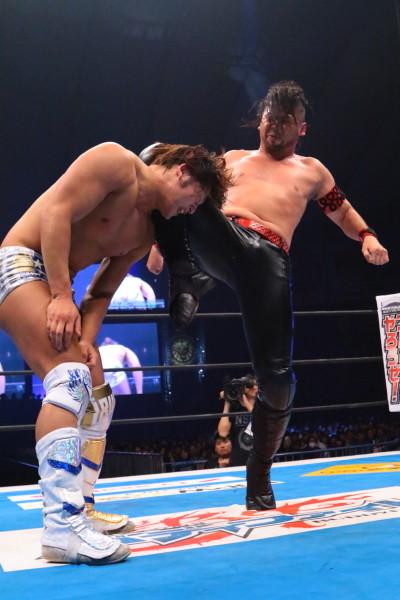
This is it. This is the best wrestling match of the year, and it took place four days into it. WWE may match or equal it in terms of pomp and circumstance at WrestleMania and put on one of its classic sports entertainment contests in front of a larger, international crowd, but this was a beautifully wrestled contest, a perfect merger of two unique, inscrutable styles. If you like New Japan and have Shinsuke Nakamura as the best wrestler in the world, Kota Ibushi has to be your second best after this. If you’ve been following Ibushi’s career and have a soft spot for the guy, then Nakamura is right up there with him. This isn’t Ibushi’s crowning moment, he didn’t go home with the Intercontinental Championship, but he is undeniably a star after this match, one of the biggest NJPW has, which makes him one of the most important professional wrestlers in the world. Nakamura celebrates with his championship while Matt Striker marks out like an adult trying to act like a child, and Nakamura shows his challenger some respect, checking to see if he’s okay after the BomaYe and giving him a fist bump. One of the young boys at ringside puts the belt around Nakamura’s waist while Ibushi looks on, cradling his head. It’s a magnificent shot from the closing moments of a magnificent match:
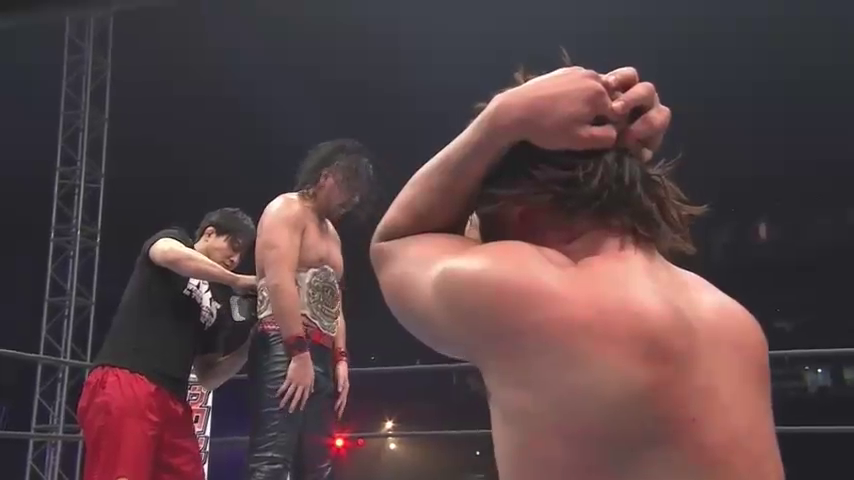
Jim Ross spent some time in this match praising New Japan for managing to make each of their championships rank equally in terms of importance, and that truly is a unique accomplishment that few promotions have been able to do, let alone maintain. The NWA managed to do it for awhile in the 1980s, when the Four Horsemen held all the gold and each title was significant, and the WWF had a good thing going when the World and Intercontinental titles were all they had, but it was always very clear that the World Heavyweight Championship was the end goal that all aspired to. In New Japan, it’s arguable. The IWGP Heavyweight Championship has the weight of history behind it, but the Intercontinental Championship has Nakamura, the most popular wrestler in the country, and it has matches like this. It’s a young title, but one of the three most important championships in the world. This match further bolsters its reputation, and the reputation of the men who fought for it on this night. Nakamura calls Ibushi the best, which he may very well be, and Nakamura calls it a night. Jim Ross says that being able to call this match made it worthwhile to celebrate his birthday away from his family. He’s still the best in the world when it comes to conveying how important the spectacle of professional wrestling is, at least in my eyes.
IWGP HEAVYWEIGHT CHAMPIONSHIP: Hiroshi Tanahashi (champion) def. Kazuchika Okada via pinfall. GRADE: A
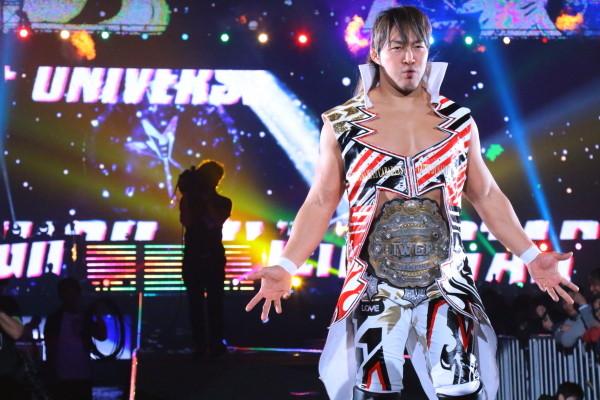
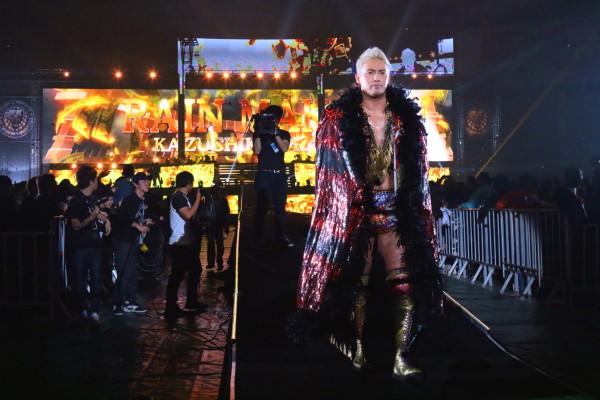
I don’t have a translation of the promo video that played before this match, but the tone of this one is that Tanahashi is NJPW’s ace, and Okada his cocky usurper. Tanahashi hangs out with fans and high fives children while Okada stands in front of his mansion, wearing suits and feeling fine. Tanahashi lives for NJPW, Okada for himself. But they’re both very popular, so it’s all good. Okada comes out in a robe that’s half Savage, half Flair, and all man. He takes it off to reveal his usual rad duster. Tanahashi’s entrance promo claims that he is the Ace of the Universe, and so long as he’s the IWGP Heavyweight Champion, that’s true. Tanahashi plays air guitar down to the ring while Ross talks about Tanahashi’s credentials as a fan and a wrestler. Tanahashi is Mr. Tokyo Dome, having main evented the venue nine times. This is the seventh encounter between Tanahashi and Okada, with their matches being talked about in the same hushed tones as Ric Flair and Rickey Steamboat’s epic, decades-spanning rivalry. Ross mentions that, along with Brisco/Funk, Rock/Austin, and Michaels/Undertaker.
They tie up and begin by wrestling, Tanahashi outworking the other until Okada takes control of the arm. They exchange arm holds, but Tanahashi works Okada into a drop toe hold and grabs a side headlock. Okada slips it and grabs one of his own. Okada keeps it on for awhile, hitting a shoulder block with Tanahashi shoots him into the ropes. Okada shoots Tanahashi into the ropes and has his knee taken out from under him by the champion, who slides out of the ring and back in to regain control with another headlock. Ross loves Okada’s dropkick. He wants to see it. Tanahashi maintains the headlock until Okada shoots him into the ropes, then he gets the shoulder block. Tanahashi does a side headlock takeover, but Okada counters with a headscissors, and we’re at a stalemate.
Okada and Tanahashi wrestle each other into the corner now, exchanging positions because neither wants to be the man who needs a break. Finally, Okada makes like he is going to give Tanahashi a break, only to nail him with a forearm in the corner. Tanahashi fires back with a few of his own, and we’re in a slugfest, forearms and uppercuts, no punches thrown. Tanahashi bodyslams Okada and climbs to the middle rope, but Okada is up before Tanahashi can leap, hitting him with a sprinting uppercut that sends Tanahashi tumbling to the Tokyo Dome floor. Okada pursues the champion, kicking him over the guardrail that surrounds the ring. He then drags Okada over the railing and hits a hanging DDT. Okada stops the referee from continuing his count and starts taking Tanahashi out onto the Tokyo Dome ramp. He goes for a tombstone piledriver, but Tanahashi deadweights and refuses to go. He fights Okada off and hits him with a jawbreaker before air guitaring his way up the ramp. Nakamura sprints down the ramp at Okada, who lifts the champion up onto his shoulders and hits an Attitude Adjustment on the ramp. The difference between Okada and John Cena, though, is that The Rainmaker’s AA is snug and harsh-looking.
Okada gets Tanahashi back into the ring and hits him with a fast, low dropkick. Okada misses a leaping forearm smash in the corner but gets his boot up on an oncoming Tanahashi, bodyslams him, and misses a senton. Tanahashi lands some strikes, punctuated by a diving forearm off the ropes. He climbs to the middle turnbuckle and lands a somersault senton for two. Tanahashi springs off the ropes and gets flapjacked by his challenger. Tanahashi scores with a back elbow, though, and misses with a crossbody. Okada looks for a roll-up, but instead locks Tanahashi in a crucifix submission. The champion scoots forward and grabs the ropes to break the submission. Thus indisposed, however, Okada easily lands a slingshot senton over the ropes, and scores a near fall. Okada challenges Tanahashi to get back into things, but the champion’s forearms aren’t doing it. Okada’s, however, have their desired effect. Eventually, champion and challenger have each other by the hair, and Tanahashi takes over with an uppercut. Okada replies with a trio of uppercuts and tries to kick Tanahashi, who is telegraphing his back body drop, but Tanahashi traps the leg and slams his elbow down on the kneecap. Okada, however, still manages to level Tanahashi with a dropkick, sending the champion into the corner.
Okada goes for another fireman’s carry slam, but Tanahashi catches Okada’s neck and brings him down by it. That’s a two count. Okada puts Tanahashi on the top rope and struggles up the turnbuckles to meet him. The champion elbows his way off of Okada’s shoulders and knocks him off. Okada’s in position for the High Fly Flow frog splash, but Okada moves and drills Tanahashi with a driving uppercut as he’s trying to get back to his feet. That’s a two count. Okada picks Tanahashi up in another fireman’s carry and brings Tanahashi’s neck and shoulders down across his knee. Another near fall. Okada takes his time and executes a top rope elbow drop on Tanahashi, hitting his pose. The camera zooms waaaaaaaay out, and Okada goes for his Rainmaker lariat, but the champion counters into a roll up, getting a near fall. The two exchange counters, Tanahashi catching Okada’s boot and bringing it down, where he executes a dragon screw leg whip.
Tanahashi begins working the leg, as that, according to Striker, is where he gets the drive for his lariat. Good call. Tanahashi dropkicks the knee, and Jim Ross starts getting sad because he wants to see Okada’s drop kick. Okada sends Tanahashi into the guardrail and follows after him, but Tanahashi moves out of the way and the challenger takes a header over the railing and onto the concrete floor. Tanahashi climbs onto the top turnbuckle in the ring and considers his options, leaps, and lands a High Fly Flow (really more of a cross body since Okada is standing), clearing a lot of distance in the process!
Tanahashi struggles to get Okada back to the ring, but gets the job done. He climbs to the top rope and manages to avoid crashing and burning when Okada ducks him, and turns the Rainmaker lariat into his Slingblade, a set up for the High Fly Flow. He goes up top and hits it while Okada is standing, but the Rainmaker rolls through and stands with Takada gripped for the Tombstone, which is an amazing feat of strength and body control. Tanahashi reverses it in the classic style, flipping it over and going for one of his own, which he lands! It is a heavy, nasty tombstone from a dude who doesn’t use the move often, if ever, and thus looks particularly devastating. Rather than cover his man, Tanahashi ascends the turnbuckles once more and sticks the High Fly Flow on Okada’s back. He rolls Okada over and goes up top once more. He lands the move a second time, has Okada covered, but the challenger kicks out!
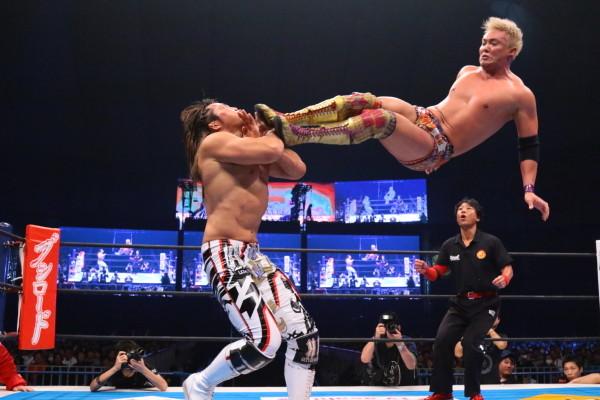
Ross can’t believe how many High Fly Flows Tanahashi has used in such a brief span, and, well, it is actually pretty unusual for a wrestler to use their finish as frequently as the IWGP Heavyweight Champion does. Tanahashi goes for the Texas Cloverleaf, but is kicked away by Okada. Tanahashi tries to regain control, but Okada fires back with an uppercut. Tanahashi gets one of his own in and lands another Slingblade before doing a Rainmaker pose of his own. Tanahashi goes for the Rainmaker lariat, but Okada ducks and rips Tanahashi back into his own Rainmaker, which lands the champion nastily on his head. Okada goes for the cover, but Tanahashi kicks out, which is something nobody, Tanahashi included, has done before.
Okada and Tanahashi struggle to their knees, where they begin exchanging forearms once more. They forearm each other back to a standing position, and Okada manages to get Tanahashi into tombstone position. The champion, however, has other plans, and scores with a roll-up. Okada kicks out, but just barely. Tanahashi catches Okada’s leg on a kick and dropkicks the one planted on the mat. Tanahashi starts slapping Okada, who falls to his knees. Tanahashi brings him back up and tries for another open hand strike, but Okada ducks and goes for the backslide. That gets a two count. Okada goes for another Rainmaker, but Tanahashi ducks and goes for a dragon suplex. Okada breaks the arms, though, only for Tanahashi to straightjacket them and take him over with a German suplex that nearly ends the contest.
Okada slips another attempt at the dragon suplex and hits a beautiful bridging German of his own for two. Tanahashi gets out of a second and hits his dragon suplex, but that doesn’t end it, either. Tanahashi goes off the ropes, but Okada hits his dropkick, which Ross calls like he just saw Jeff Hardy fall off a ladder. He is into this match, and, even after the brilliance of Ibushi/Nakamura, it is hard not to be right there with him. Okada misses another Rainmaker, and Tanahashi makes him pay with another dragon screw. Tanahashi does another one, this one over the ropes, and that’s going to take away the power of the Rainmaker for sure. Okada’s leg is limp and he’s having trouble getting it out of the ropes, so Tanahashi takes advantage, climbing the turnbuckles and landing an incredible High Fly Flow, sandwiching Okada into the mat! Hardly finished, Tanahashi hits the dragon screw from a fourth position and hits another High Fly Flow, this time while Okada is seated. Okada is out, done, and Tanahashi goes up top once more, turning his body mid-air for the High Fly Flow, his third in a row, and the one that ends it.
Both men are spent on the canvas, the Ace of the Universe and the Rainmaker. Okada put in one hell of an effort, but Tanahashi’s game plan was resplendent. Even if the dragon screws didn’t deter Okada from attempting the Rainmaker, they slowed the younger man down and enabled the champion to avoid him. Later, those dragon screws incapacitated Okada to the point that Tanahashi was able to land three High Fly Flows, each one more impressive than the last. Even if Okada had managed to kick out of the last one, Okada was done, a Texas Cloverleaf away from giving the match to Tanahash regardless of whatever grit he had left.
Tanahashi accepts his championship and raises his hand in victory. Okada, meanwhile, is led back to the locker room, openly weeping. Man. Even at the end this match’s story is compelling. Okada obviously has nothing to be ashamed of, but he came into this match as the slight favorite and was bested. Tanahashi tells the 27-year-old challenger that he wasn’t ready to be New Japan’s ace yet, which is some salt in the wounds for sure. Tanahashi closes the show by playing air guitar, because that’s his Hogan pose, and Hogan always closes with a pose, brother.
Overall, this was an incredible wrestling event, featuring something for everybody. . As far as the presentation goes, this was just the regular New Japan feed with different commentary. Matt Striker, when he wasn’t trying too hard to be an über-fan, was great, though his tendency to shout out podcasts and t-shirts and shamelessly drop insider terms for no reason irked the hell out of me. Everybody’s mileage varies on the guy, and if he’s the color commentator on NJPW’s eventual American TV show, it’s not like I’m going to skip watching it because he’s on commentary. Jim Ross knows his shortcomings when it comes to pronunciation of Japanese names and is forthcoming about them, and if he seems “off,” then it’s because he’s less shouty here than he was late in his WWE tenure. I thought he did a tremendous job, particularly during the biggest matches of the night, where his reverence for the performers and their skills felt genuine, which I suspect it was. I love the old guy and his foibles, agree with a lot of his takes on the tiny, presentational aspects of the game, and don’t mind that he doesn’t think Freddie Mercury was a badass. If the company feels the need to go with a big, “name” announce team, there probably aren’t many out there who can top this one. Announcing is something of a lost art in wrestling, so it’s good to have a guy like Jim Ross out there, still practicing it.
There are, I think, four matches worth going out of your way to see from this card, and perhaps two more depending on how much you like Kenny Omega and/or the work-shoot style of pro wrestling. That is a lot of great wrestling stretched out over four hours, and whether you’re seeing New Japan through a service like Jeff Jarrett’s Global Force Wrestling or through NJPWWorld, this event appears to be the ground floor for a promotion that currently knows no ceiling, whose roster is at an artistic peak, and whose audience continues to expand.
 Creed (2015)