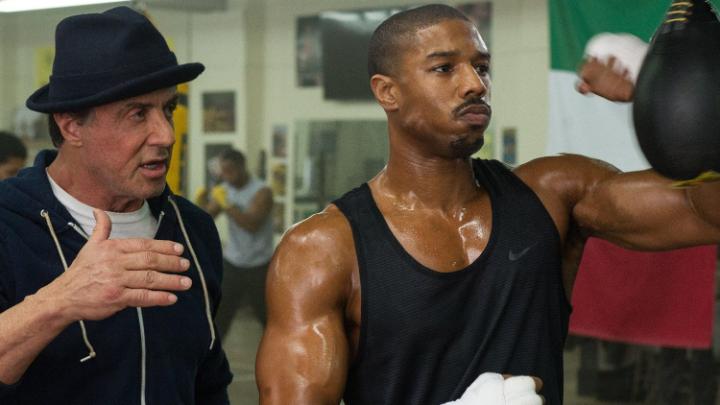
 It’s hard to write about Creed because it is a movie I fell in love with early and repeatedly, a film that had me on the verge of tears at times and past that verge at other times. So I’m going to start with what I found most impressive about director Ryan Coogler’s re-framing of Rocky and its legacy, which is that Creed has a heart of its own, not one merely borrowed from its predecessor. Considering that the likability of Rocky Balboa, one of the great screen characters of American history, is what propels the bulk of the franchise through bloat, bad script choices, and an inability to recall its own identity, Creed‘s ability to stand on its own merit is both necessary and surprising. Creed is less about the revitalization of a character that will see his 40th anniversary next year than it is about loving something so much that something new and, frankly, equal to the original is created.
It’s a Rocky film, so it is grounded largely in cliché. But, as the series has repeated over and over with a piston-like ferocity, it isn’t a fighters origins that matter so much as what he makes of them. To that end, Adonis Creed (Michael B. Jordan) was dealt a particularly bad hand of cards. The illegitimate son of boxing great Apollo Creed, Adonis is introduced as an orphan in a juvenile detention center, in lock-up for fighting to defend his dead mother’s name, which he later takes up as an adult looking to build his own name. He is adopted by Apollo’s wife (Phylicia Rashad) and raised in his home, but it’s obvious that he’s a second-class Creed: no gym will train him, and he’s stuck taking up bar fights on the weekend in Mexico for the experience. Self-taught and using his mother’s name so he can avoid the pressure of legacy, Adonis quits his job and rents a room in Philadelphia, hoping to convince his father’s former rival and training partner Rocky Balboa (Sylvester Stallone) to come out of the shadows and become his trainer.
Creed recalls the narrative and structure of Rocky, playing on its themes and iconography in a way that would have been tired if this were once again a film about an aging Stallone putting on the gloves for one last fight. Wearing a hoodie and reading glasses, Rocky Balboa looks well past the aged, muscled fantasy warrior Stallone has been projecting for a decade now. He’s a hard worker whose instincts are keen, but Balboa is in his 70s and the torch he carried for so long, with his wife dead of cancer and his son estranged from him, is out. He’s a ghost, his image and name haunting Philadelphia and boxing, and Adonis finds him shuffling around a restaurant built to house both. There is the question of whether or not Rocky will train Adonis, but it’s never one that much hangs over the young Creed’s head. He came to Philadelphia with a purpose, and it’s clear that he’s going to try to achieve it with or without Balboa’s help.
That Adonis is always his own man in a film that could have easily become a redemption story is due largely to Creed‘s smart script, by Coogler and Aaron Covington. Creed is never not a Rocky film, but it’s never Rocky’s film—Stallone’s arc here is the B-story, it serves to complicate Adonis’ already complicated rise to boxing prominence, but it is told so well by Coogler and Covington and acted so well by Stallone that the melodrama outside the ring acts as Creed‘s driving force. A boxer’s life outside of boxing, in film and in reality, is necessarily reduced to recognizable, sellable figures: Balboa the working-class palooka; Creed the unknown orphan; and Creed’s eventual rival, “Pretty” Ricky Conlan (Tony Bellew) the fighter who came from nothing and was compromised by his fame and fortune. Watching Creed, I thought of the year’s other boxing film, Southpaw, and how it reduced its fighters to the same necessary images. How the Rocky films after Rocky did the same. The assumption is that the audience’s payoff is a triumph of one body over another, which necessitates the long, erotic training sequences: if a man can transform his body enough, he can punch through any obstacle.
Creed‘s strength is knowing that there are some obstacles a boxer can’t beat. There’s time, which Balboa is fighting a losing battle against. There’s regret. There’s pride. There’s the possibility that a man’s passion and skill can very literally kill him or leave him damaged beyond repair. Winning a boxing match changes none of this, and a good boxing story knows it. A good boxing story can use that knowledge to make the rest of the boxer’s world seem sharper, more necessary than a judge’s decision at the end of 12 rounds, and Creed is a very good boxing story. It is capable, at times, of feeling like more than a boxing story. It’s the story of a city. It’s a romance. It’s all of these things at once. Trying to sleep after a particularly fruitless day, Adonis is kept awake by the louder than necessary music of his downstairs neighbor, Bianca (Tessa Thompson). She’s a beautiful woman, and Adonis falls for her immediately, but again Creed‘s script is so good that Bianca never feels ancillary until the structure of a boxing film makes her so. A talented singer coming up in Philadelphia’s club scene, Bianca suffers from progressive hearing loss and continues to make music though she’ll someday be unable to. She’s a character with her own dreams and ambitions, and, like a boxer, she’s racing against time to put together something meaningful, something that will last longer than a body that will progressively fail her. It’s something of a departure for a film like Creed that the relationship between a boxer and a woman goes two ways, that her desires are as large and as important as his, but for Coogler, the triumph of one man’s body over another is secondary to watching people create something from nothing: a relationship, a life.
If Creed falters, than it does so in its third act, where Bianca is largely Adonis’ cheerleader after the two have a falling out over a fight between he and a headlining musician at Bianca’s biggest gig. That she nails the show performance should feel triumphant, but Creed hasn’t quite figured out what to do with Bianca’s art beyond the fact that she makes it, and that its creation mirrors the way Adonis creates himself for the purpose of a fight. If there is a follow-up to Creed, then what’s already present here suggests that Coogler and his team are smart enough to not make the same decisions Stallone did decades ago, that he will focus on the humanity of Adonis and those around him, rather than the idea of him as a macho icon. Michael B. Jordan is clearly up to such a challenge, as are Stallone and Thompson. And if it is necessary to yield to the carnage of the ring (which, let’s be frank, it is), then at least boxing’s thrilling spectacle of excess seems as though its being put to some greater use, rather than being the end all of its players are the means to.
 Creed (2015)
With Michael B. Jordan (Adonis Creed), Sylvester Stallone (Rocky Balboa), Tessa Thompson (Bianca), and Phylicia Rashad (Mary Anne Creed). Directed by Ryan Coogler from a screenplay by Coogler and Aaron Covington, based on characters created by Stallone.

