Author: Colette Arrand

  • Movie Review: The Sitter (2011)

    Movie Review: The Sitter (2011)

    After The Sitter and Your Highness, I’m becoming increasingly convinced that the only projects David Gordon Green finds worth his time are stoned in-jokes spitballed between he and his friends in his smoke-filled basement, over a soundtrack of early-90s hip-hop. This is a director who has previously displayed immense talent but, perhaps egged on by the commercial and critical success of Pineapple Express, which is still quite good despite representing the nadir of the buddy stoner flick, he keeps going back to the well despite ever-diminishing returns. The Sitter, which is a 90-minute assemblage of uncomfortably bad jokes, bad characters, and bad set pieces, is a bad movie, and it’s badness is on another level than even that of Your Highness. Sitting through that movie, you wonder how its stars and its director convinced a studio to finance the shoot. Sitting through this one, you wonder why they bothered.

    For Jonah Hill, this represents a precipitous drop-off from Moneyball, a drop-off that even rivals the one James Franco took between 128 Days and, well, Your Highness. In The Sitter, he plays Noah, a sex-obsessed chubster who doesn’t get much action. He’s got no job, no goals, and no car. His dad left he and his mom high-and-dry for the babysitter years ago and owes something like ten years of alimony. His “girlfriend,” if you can call her that, invites him over so he can go down on her, then pushes him out the door so he can go to a party. If you’re thinking to yourself that it’s not possible for Noah to navigate three insane children through a minefield of drugs, overlords, exploding toilets, jewel heists, racial stereotyping, stolen cars, and cheating parents while teaching them (and himself) valuable lessons about the importance of being/respecting yourself, then you’re not giving The Sitter enough credit for trying harder than most movies do to heap sugar into an otherwise vile concoction.

    Does it work? Not even close. The Sitter isn’t aided any by the kids Noah is forced to babysit. There’s Slater (Max Records), a headcase who carries with him a fanny-pack full of pills and a promise that, if given any responsibility, he’ll snap; Blithe (Landry Bender), who is obsessed with celebrity and “hot gossip” and smearing make-up on her face; and Rodrigo (Kevin Hernandez), an adoptee who dabbles in explosions, the needless destruction of property, and “running away,” which is so literal a threat that he has a GPS tracker sewn into his jacket. Why these kids are this way is never really The Sitter‘s concern, but Noah, while stealing money from a bat mitzvah or crashing the minivan because Blithe farted, has the time to make crucial, insightful observations into their young lives. The speech Noah gives Slater is as close as The Sitter comes to genuine sentiment, but for two issues: 1. Slater’s outburst is practically lifted from Little Miss Sunshine, and 2. Noah’s message that it’s OK to be gay comes with the promise that Slater will, after enduring a torturous high school career, land a sweet gig in the entertainment industry, where he’ll be organized and smell nice.

    The other scenes like the one between Noah and Slater work similarly, and are clearly meant to cut the film’s otherwise bitter, jaded aesthetic. They just don’t work, though, as Hill is pretty much talking to two of the worst child characters yet conceived. Blithe’s crime is that she’s a subplot delivery device in a movie that barely has a main plot to begin with, her “hot gossip” being that her dad is sleeping around with some guy. She wears a lot of badly-applied make-up and talks about celebrities so Noah can tell her that celebrities and women who wear make-up are whores, thereby realizing that his “girlfriend,” who used to date a cagefighter, is just that. Rodrigo is plopped into the script to speak Spanish, because it’s funny when the white guy doesn’t understand another language and makes threatening suggestions in response. He blows things up and steals things and acts mischievous, and it’s not clear if that’s because he’s a kid or because he, like the black dudes at the pool hall or the gay dudes lifting weights, is a caricature, a modern-day Frito Bandito who only wants to be loved.

    Eventually, Hill builds an impressive rap sheet and forms a bond with the kids, not that any of it matters. This is the kind of movie where an eccentric drug dealer (Sam Rockwell) employs a gang of homoerotic bodybuilders because it’s meant to look funny, where the white hero wins over a gang of clichéd street thugs by getting punched out and bumbling through cribbed street lingo, and where a potential love interest hears the hero admit that his girlfriend really isn’t his girlfriend, only to indignantly ask “So you have a girlfriend?” a minute later. The street thugs exist to save Noah’s ass, the bodybuilders because a gay villain can’t be a gay villain without gay henchmen, and the love interest so Noah has somebody to move on to after he’s been properly beaten up and abused for his karmaic sins. So much of this movie happens separate from the narrative because someone thought it’d be funny. One of those things: an in-joke cameo of James Franco, doing his thing on an episode of General Hospital. He looks happy. He should be: he’s not in The Sitter.

    Rating:

    The Sitter. Directed by David Gordon Green. With Jonah Hill (Noah), Max Records (Slater), Landry Bender (Blithe), Kevin Hernandez (Rodrigo), and Sam Rockwell (Karl). Released December 9, 2011, by 20th Century Fox.

  • Movie Review: The Twilight Saga: Breaking Dawn Part I (2011)

    Movie Review: The Twilight Saga: Breaking Dawn Part I (2011)

    Edward and Bella meet.

    Assuming you, like me, somehow missed out on of the middle chapters of the Twilight saga, what happens next?

    Anything is possible, but if you want a logical ending, see another movie.

    A. Edward (Robert Pattinson) and Bella (Krirsten Stewart) get married and, as Edward is the vampire son of a couple of rich vampires, the two can afford to jet set across the world to a private island off the coast of Brazil, stopping in Rio for the obligatory 360° shot of Christ the Redeemer. The Cullen clan, of course, have an opulent mansion on the island, where Bella and Edward can play house and smile at one another in leisure, safe from the responsibilities inherent to being successful high school graduates. As newlyweds, the two mutually experience, for the first time, the joys of marital relations and lead long, fulfilling lives. Eventually Bella dies. Edward is sad, but so it goes.

    B. Edward and Bella’s future coital plans are interrupted because, as a vampire, Edward is naturally much stronger than Bella, and one wrong thrust can render the poor girl a puddle of gore. Despite—or perhaps because of—this danger, the two moon-faced newlyweds consummate their vows. Bella wakes up the next morning to a destroyed bedroom and Edward asking if he’s hurt her badly. She is shown the bruises on her own body. He apologizes for harming her, though it seems more like he’s apologizing for her inability to handle his sexual aggression. Bella, who has, at some point, expressed her desire to be as strong, courageous, and passionate as the husband who wrecked the room and left bruises, wishes to try again. She attempts to seduce him like a woman new to the idea of seduction. He, similarly new to the idea, gives in easily. You’ll notice how cold Edward is when he lifts Bella’s shirt to reveal her bruises. You’ll note that, in any other story, Edward’s attitude and actions would not be unlike those of an abuser. There are paid servants who are shipped to the private island to clean up Edward and Bella’s mess. They notice, too. Edward and Bella continue on, playing chess on the beach. Edward, being a vampire, has hundreds of years of experience on his bride. When he takes her king, he does so aggressively. Bella eventually tires of this, but, being dutiful, never lets on to Edward, who constantly makes a show of his superior strength, knowledge, and beauty. Bella ages, and eventually dies.

    C. Edward and Bella consummate their marriage and, by some miracle, conceive. Bella begins foisting ridiculous names upon the unborn child, but there are complications. The child, being the spawn of a vampire and a human, is half-vampire. She begins killing her mother, but can’t help her nature or ridiculous name. Thus springs a debate: Should the child stay, or should the child be ejected? There are two schools of thought:

    1. Bella keeps the baby. This is championed by Bella herself, and some in Edward’s family. It is Bella’s hope that, as soon as the child is born, Edward’s father (Peter Facinelli) can turn her into a vampire as well, thus saving everybody. The odds? Never tell Bella the odds.
    2. The child is aborted. Edward, not wanting to lose Bella, is for this. He has support from an unlikely ally: Jacob (Taylor Lautner), a werewolf and Bella’s best friend (beyond her new husband, of course).

    In either scenario, the likelihood of Bella’s survival is slim, but things do not proceed as they do in choice A. If Bella aborts or keeps the baby and dies, Jacob will kill Edward. If Bella has the baby and is successfully turned, a needlessly complicated treaty between the werewolves and the vampires will be broken, and there will be war. Neither much matters to Bella, who is so focused on the child’s health that she drinks blood from a Styrofoam cup. She also looks terrible, and will not wear make-up. Her’s is a large cross, but she bears it.

    D. Edward and Bella have sex and, seeing as Bella is 18 and Edward has been playing 18 for centuries, neither are prepared for the consequences of their act. The two attempt to make it on their own but struggle. Eventually, their marriage falters. Edward, who can’t stop noticing Bella’s small but growing flaws, grows interested in somebody else. Bella can’t take her mind off of Jacob, who hangs around town, often shirtless, to make sure Bella can’t get past him. Everything capitulates, and the two divorce. Bella gets custody of the child, who will outlive her for centuries, and she eventually marries Jacob, who bears an obvious resentment towards Bella’s daughter. They have several children of their own and almost don’t notice that the daughter grows up feeling neglected. The alimony Edward pays Bella will eventually go to a therapist. Edward, meanwhile, will start high school in another town and, having submitted to his carnal lust, becomes an insatiable sex addict. It’s a hollow, endless life, but Jacob and Bella eventually die, and he eventually forgets them.

    Which option is closest to the reality presented by Breaking Dawn doesn’t matter, as its target audience, still split in the Team Edward/Team Jacob binary, have neither the time nor the patience required to understand that neither man—Jacob with his snide comments, or Edward with his vacant, awkward pauses—are really right for her, or anybody. Their cruelty, I suppose, is tempered by that of Jacob’s pack, who wish to eradicate the Cullens and the abomination in Bella’s belly, and the shadowy guild of vampire lords, seen here in a nightmare where they wear black to a White Party, but Bella’s really only tied to anybody here because she still lacks the ability to self-identify. As Bella’s best friend (Anna Kendrick) points out at the wedding reception, she’s not a member of the volleyball team, student council, or really any club. All she’s got to distinguish herself is Edward, who has found in Bella a woman perfectly willing and able to tell him how great he is. If Bella didn’t have Edward, she’d have nothing.

    To be fair, this is a much better effort than any film in Twilight cannon. The young cast around Edward, Bella, and Jacob, chosen primarily based on how good they look either in tight shirts or completely out of them, are horribly crippled in terms of any real acting ability. Director Bill Condon seems aware of that fact, directing his sheep through a pasture where they only need to look pretty in the background while the franchise’s triumvirate stumble their way through activities and dialog that are either laughable or the very height of romance, depending on where your interests lie. It’s not a good film by any stretch of the imagination, but Breaking Dawn had within it more genuine laughs than many comedies released this year. At least a few of those laughs were in spots I’m sure were intended.

    Rating:

    The Twilight Saga: Breaking Dawn Part I. Directed by Bill Condon. With Kristen Stewart (Bella Swan), Robert Pattinson (Edward Cullen), Taylor Lautner (Jacob Black), Billy Burke (Charlie Swan), Peter Facinelli (Carlisle Cullen), and Anna Kendrick (Jessica Stanley). Released November 18, 2011, by Summit Entertainment.

  • Now This is Podracing

    Now This is Podracing

    I saw Hugo last night, and beyond the fact that it’s the first 3D movie I’ve ever seen that won’t, in retrospect, make me regret paying the extra movie ticket it costs for the “right” or “privilege” to wear those lame plastic Ray-Bans over my unaccommodating pair of prescription lenses, I suppose the big “news” coming from the movie is that Hollywood has pretty much run out of animated kids movies/lifeless horror films/questionably greenlighted action vehicles to spuriously retrofit and up-charge and rub their fingers greedily over, so early next year we’re going to see our multiplexes occupied by re-releases of James Cameron’s Titanic (erroneously billed as the most loved and acclaimed movie (*dramatic pause*) of all time) and, as the first in a series of six planned re-releases, George Lucas’ Star Wars Episode I: The Phantom Menace.

    For the sake of clarity, I don’t particularly know if the version of Phantom Menace hitting theatres in February is going to be updated, changed, or modified from its original theatrical release, nor do I particularly care. At this point, I’ll accept that Han was lucky to survive his encounter with Greedo, that Hayden Christensen is digitally ghosted over the dumpy guy who originally played Anakin Skywalker, and that Darth Vader will forever reprise his world-shattering cry of “Noooooooooo!” as the Emperor hurls lightning at a helpless Luke. Around the time Lucas was re-releasing the original Original Trilogy in unscrubbed, less-than-remastered form after millions of voices cried out over a new round of changes and edits (Han and Greedo shoot at the same time! Wookie Life Day is celebrated at the end of Jedi!), I came to the realization that my Star Wars and George Lucas’ Star Wars are two entirely different things. Whereas I was and always will be satisfied with Obi-Wan’s less-than-intimidating Tusken Raider alarm, a few less Sandtroopers at Mos Eisley spaceport, and an utter lack of Jabba the Hutt (my favorite Star Wars character) in A New Hope, George Lucas, for as long as he lives, will attempt to achieve perfection with what is, at best, an imperfect narrative. What’s more, as long as he keeps chasing perfection, there will be endless legion of people who’ll mope and upload hour upon hour of YouTube video complaining that Boss Nass’ fat rolls jiggle more than they used to. No, I’m not in the business of writing an exhaustive list of complaints. Star Wars is George Lucas’ baby, his toy, and he’s free to bend and pose it in whatever way he wishes. I merely want to point out two things about the trailer for Phantom Menace, and then I’ll shut up about it for the time being.

    First, and perhaps most importantly: These 3D re-releases weren’t the dramatic upgrade to the franchise we were promised, and I’m angry about it—at least as angry as I can be over the somewhat laughable idea of “updating” a movie from 1977 to be shown in the 3D of 2015. When I was a kid, the former Henry Ford Museum and Greenfield Village opened up an IMAX theatre and, living in Dearborn, our school often took field trips to see documentaries projected with such intensity that, if the projectionist felt like pointing the thing at the Moon, we could watch them among the stars. This was well before big tentpole movies and every Disney flick under the Sun was released in IMAX or, as is usually the case, “IMAX,” and well before I went to a movie theatre advertising an IMAX screen, only to wonder what happened to the rest of the screen. I don’t remember much about those movies I saw in IMAX as a child, but I remember the slide claiming the projector could show a movie on the moon, and I remember that, since IMAX was new then, still justifying it’s existence, before every movie they played a trailer for the format, and this was always the first thing I saw:

    The aged and ill-adjusted often assert that my generation has never had a moment like the opening of A New Hope, but I disagree—I had that moment every time I saw an IMAX movie, a moment where I knew that movies, specifically a movie that I had known and loved for as long as I could remember, were going to change forever. For the record, Kid Me was wrong, as Kid Me has often proven to be, but the shot of the Star Destroyer chasing after the Tantive IV on a 62 by 84 foot screen is something that will always stick with me. I’ve been waiting for the Original Trilogy to come out in IMAX since I was a kid, and, for some cruel reason, it looks like I’ll be waiting for the rest of my life. Worse, these new 3D re-releases make it clear that, to Lucas, the wonders of 2D filmmaking are now small potatoes. Here’s an image from the trailer:

    Yes, that image of Luke looking out wistfully to the universe beyond his desert squalor is officially small and meaningless, unless you see it as George Lucas intended it way back in 1977: RealD 3D. See these movies again, the trailer argues, and you’ll forget everything you ever knew about Star Wars.

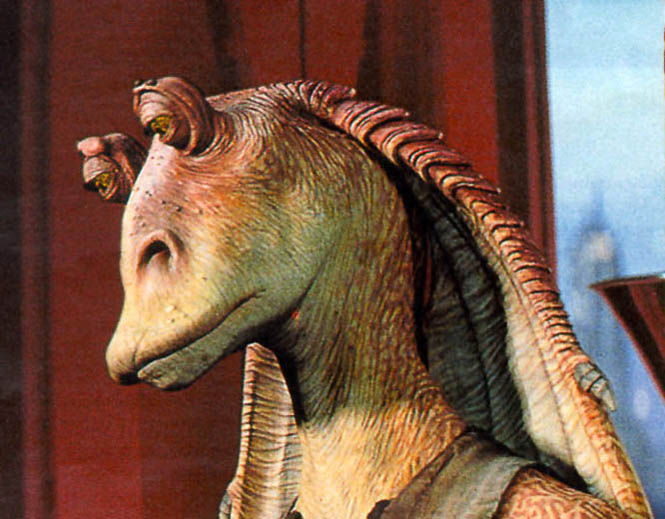
    Yes, according to the above trailer, you’re going to forget all about goofy battle droids, unthreatening trade viceroys, “Are you an angel?” and This is podracing!” In this new, perfect society, Boss Nass is a jovial, fair-minded ruler of a proud, brave race of men and women best represented by this picture…

    …and is not, under any circumstance, the cruel, witless leader of a band of frowned-upon Noble Savages known most notoriously for sharing a common gene pool with one Jar Jar Binks, Bombad General. In 1998, which, according to the number of moments given away by this clip, was before people learned how to make a proper trailer, Jar Jar was practically promised by Lucas to be the world’s new best friend.

    Jar Jar Binks, so universally reviled that his role in the prequels diminished and diminished to the point that only the trivia-hungry will notice it’s him giving the Emperor the right to rule over the galaxy, was pretty much the face of Phantom Menace. He was a Taco Bell toy, a Lays pitchman, a Pepsi addict. He was there when Anakin met Obi-Wan, when R2-D2 met C-3P0, and, for all we know, may actually be the biological father of Luke and Leia. Believe it or not, when the hype for Phantom Menace was at fever pitch, it was Jar Jar Binks who wound up mugging on the cover or Rolling Stone, his name taking prominence over Tom Waits, the Red Hot Chilli Peppers, Columbine, and Kosovo.

    I might be the only person in the world who feels this way, but it’s practically a crime that Jar Jar Binks doesn’t warrant a single frame of the new Phantom Menace trailer. No joke, ladies and gentlemen. As much as you may like or dislike him, Jar Jar Binks is the face of Phantom Menace, not merely the reviled face of Everything That’s Wrong With the Prequels. The sad fact is that Binks isn’t even the fifth worst thing about Phantom Menace, and much like midichlorians, virgin births, and the stick up Samuel L. Jackson’s ass, he, too, will be given a chance to suck in the third dimension. But, unlike all that, the only hint of Jar Jar’s existence is the brief clip of the Gungan army hurling superballs at battle droids.

    This is revisionist history, and, in a way, it’s worse than spending a few million dollars to make sure that Ewoks can blink. Yes, it’s also a cloying admission of guilt on Lucas’ part, and the fact that the guy owns up to such a colossal misfiring is, in a way, worth note. At the same time, Binks is conspicuous in his absence. Re-releasing any movie is an obvious cash grab, and, outside of Disney’s first few shots with The Nightmare Before Christmas, most don’t have much lasting impact. But Phantom Menace represents something much larger, a six year plan that likely represents a huge chunk of change for both Lucas and 20th Century Fox. Now that all six live-action films are out in the wild, it’s necessary to start at the beginning, despite Phantom Menace‘s poor standing as the worst in the saga. No whiff of its stench can be wafted to those in the theatre for Hugo or any other movie this plays before, especially considering that a new generation is due to be introduced to Star Wars and, unfortunately, this is their first shot that isn’t toy or Cartoon Network related.

    If we accept that Jar Jar is the face of Phantom Menace, and that that’s exactly what George Lucas wanted, then it follows that his taking Binks out of the trailer and replacing him with pretty much every explosion in the film represents Lucas acknowledging that everybody who saw the movie deemed his version unworthy. James Cameron, at least, has the stones to put “My Heart Will Go On” in the new Titanic trailer, not to mention his willingness to expose the film as one where Leonardo DiCaprio pretty much stands on things and yells about how great the experience of standing on them feels. It’s a cash grab, but it’s an honest one. Star Wars Episode I: The Phantom Menace is trying to present itself, once and for all, as the beginnings of a cultural milestone and, in redefining itself, looks more boring and pretentious than the grab bag of rehashed cultural stereotypes and  Laurel and Hardy gags no digital editing or 3D surcharges can blind an audience to.

    This is naïve, but I expect a creator to stand by their decade-old work, especially while holding out the collection plate. The trailer for Big Mommas: Like Father, Like Son didn’t try to convince anybody that it wasn’t a cinematic black hole, and it’s not fair that Lucas is trying to hide Howard the Duck by pretending to present The Empire Strikes Back. What’s worse is that the dude has an advantage: we now live in a society where everything we spend money on is automatically great because we don’t want to look stupid for consuming it. I don’t think anybody paying to see Phantom Menace in February will do so under the assumption that it’s a misunderstood masterwork, but you’ll be hard pressed to find any grown man in a Jedi robe that weekend willing to admit his folly. Hell, put it in IMAX, and I might just break out my Darth Vader voice changer. But unless this is the Phantom Edit, let me do so knowing full well that I’m seeing Phantom Menace, warts and all.

  • The New 52: Demon Knights #1, Frankenstein – Agent of S.H.A.D.E. #1, Resurrection Man #1, Swamp Thing #1, Voodoo #1

    The New 52: Demon Knights #1, Frankenstein – Agent of S.H.A.D.E. #1, Resurrection Man #1, Swamp Thing #1, Voodoo #1

    Demon Knights #1

    Writer: Paul Cornell / Artist: Diogenes Neves

    Yes, yes, yes, yes. When I heard that DC was relaunching their whole line, that they were going to be re-contextualizing much of their stilted universe, a comic book like Demon Knights #1 was exactly what I was hoping for, not the shoehorning-in of extra characters and teams whose revitalization wasn’t tantamount to artistic or commercial success. While I highly doubt Demon Knights is the sort of comic that’ll ever crack the top 20 monthly sales charts, it is a well-written, gorgeously drawn book that grounds some of the more magical elements of the DC universe in the Dark Ages, effortlessly blending in the story of Etrigan the Demon, Madame Xanadu, the Shining Knight, and King freakin’ Arthur and the fall of Camelot in one issue.

    Etrigan is somewhat liberated from his ridiculous gimmick of rhyme, which only the best comics scribes were able to do without coming off ridiculous, as it’s revealed that he’s a demon held captive by the wizard Merlin, who watches helplessly as Camelot is overrun by an attacking horde. In his last act before disappearing, Merlin joins Etrigan to the body of Jason of Norwich, a young knight now cursed to harbor a demon inside him. After the fall of Camelot, the world plunges into the dark ages. At a tavern, Jason and Madame Xanadu meet the berserker Vandal Savage, the Shining Knight, an Amazonian (I think), and a few others before the tavern is attacked by a horde claiming to be emissaries of the queen.

    If this sounds like the set-up to a role-playing game, well, it is. Obviously, your mileage will vary, but this set-up is one that I’d probably pay $60 to play, excitedly. As the first issue in a series, it’s got everything that I’m looking for. The plot interests me. The characters, known and unknown, are a good mix of personality and gimmick. The art, which usually doesn’t matter much to me, is perfectly evocative of this slightly twisted world. Demon Knights represents the first real slam dunk of the New 52, a book that starred into the abyss of a rebooted universe and decided to roll the dice. I’m in until low sales see it cancelled (this always happens), then I’m in on the petition to bring it back.

    Frankenstein: Agent of S.H.A.D.E. #1

    Writer: Jeff Lemire / Artist: Alberto Ponticelli

    Given that I was a big fan of Grant Morrison’s Seven Soldiers project, I’m genuinely happy to see some of its elements make themselves apparent in the new DC universe. S.H.A.D.E., his T.H.U.N.D.E.R. Agents tribute from the Seven Soldiers: Frankenstein miniseries gets its own ongoing, and, within a few pages, it looks like its borrowed more than a few things from Mark Millar’s The Ultimates, which envisioned the Avengers as a government led and funded super-organization dedicated to stopping world-level threats. What Frankenstein: Agent of S.H.A.D.E. has on The Ultimates is characters that are genuinely interesting beyond being Captain America…but different, and the characters are so C and D list that literally anything is possible.

    That all sounds like a backhanded compliment, but it isn’t supposed to be. Father Time, the leader of S.H.A.D.E., is one of those ruthless, insane leader-types, willing to underwrite projects where scientists turn themselves into gillwomen and whole cities are shrunken to fit inside a steel sphere three inches in diameter. Frankenstein, whose origins are what you’d think, is a late-period John Wayne, regarding all this technological muck knowingly, trudging through it because he must. He’s got a lot to deal with, too. The gillwoman is the leader of a team comprised of many human/Universal monster hybrids–a werewolf, a vampire (sadly not a Dracula), and an honest-to-God mummy. They’re put together because Frankenstein’s wife (yup!) was sent to stop an invasion of Lovecraftian monsters from wrecking a small town, only to disappear.

    I really dug this issue, but it’s pretty much a mash-up of everything I love, with a brief discussion on Milton and Keats thrown in to make sure I’d sing its praises. Jeff Lemire, whose DC Comic’s work has skewed towards science fiction, riffs on its inspirations that feels more inspired than insulting, and Alberto Ponticelli’s rough-hewn pencils lend the proceedings the grit and character necessary for a comic book about the end of the world. Frankenstein: Agent of S.H.A.D.E. promises to explore some of the weirder corners of the DC Universe, but it is a weird universe, and it’s good that the big, green, undead guy exploring it is cut from the same cloth.


    Resurrection Man #1

    Writers: Dan Abnett & Andy Lanning / Artist: Fernando Dagnino

    When I worked at the Pack Shack, I was always under the impression that Abnett and Lanning were the Lennon/McCartney of mundane DC Comics books that I’d never in a million years crack the spines of, mostly because the Legion of Superheroes is, literally, the most confusing idea in the history of comic books, and that’s what they wrote. Unfortunately, Resurrection Man #1 does little to dispel my ill-informed beliefs, even though Abnett and Lanning are working with their own character, on a completely blank slate.

    It’s not that the idea itself is bland. In a world where the only dead walking the earth are doing so to hunt human flesh, it’s nice if there’s a guy or two who dies, comes back, and is relatively normal. Resurrection Man, being a disposable, reusable superhero, isn’t exactly normal, but coming back to life with the power of magnetism makes for more interesting dinner conversation than “BRAAAAAAAAINS!” It seems that each time Resurrection Man resurrects, he comes back with a power suitable for the task he finds himself against, making him stunningly useful for a guy who dies a lot. That being said, Resurrection Man’s been overdue for a stay in heaven/hell, so the forces of some shady gray area are after him, trying to stop him from coming back.

    This kind of cat-and-mouse can be pretty compelling, but Resurrection Man #1 just isn’t, failing in the worst way high concept ideas can fail: by being satisfied with the concept. If things were happening, if Resurrection Man was trying to stop the world from ending/his girlfriend from getting killed, his car from getting repoed, but he couldn’t because he kept dying and coming back, losing valuable time/money/sanity, then something would be happening. As it stands, he dies and comes back, ready to continue the chase. He’s the ghosts from Pac Man, if they had their own ongoing series. Even though that sounds awesome, if the result of failure is a do-over, what’s the point?


    Swamp Thing #1

    Writer: Scott Snyder / Artist: Yanick Paquette

    On the subject of integrating Vertigo characters back into the DC Universe, I’m for it as long as it’s done well. A character like Swamp Thing, after all, has a long history apart from your Supermen, your Batmen, and your Aquamen, so just hurtling the character from one continuity to the other all haphazardly would be a disservice both to what came before and potential new readers. Luckily, Swamp Thing #1 is gradually reintroducing its titular monster to the DC Comics fold, explaining who Swamp Thing was for the benefit of those who thought buying 52 new comics sounded like a grand idea while realizing that there’s room for Swamp Thing’s utter weirdness among DC’s heavy hitters.

    The long and short of Swamp Thing #1 is this: The world is dying, and in ways the Justice League can’t help or figure out. Dr. Alec Holland, the former Swamp Thing, knows this, but is seemingly uninterested in solving the problem. He’s down and out after his stint as the monster, convinced that plants are more violent than we give them credit for, that, for all his brilliance as a scientist, he simply doesn’t have what it takes to solve the world’s problems anymore. Meanwhile, a group of shady looking customers look for something out in the wastelands and, in the most grisly scene I’ve seen in any of the new #1s, are compelled to snap their necks and walk around with their heads on backwards.

    It’s a little gross and a little weird, and the proceedings are certainly meditative, but that’s what I expect from Swamp Thing. It’ll be interesting to see how much room DC Comics gives this title. Yanick Paquette, for instance, is a superstar artist on a book that isn’t going to sell enough copies to justify a superstar artist. How short is his leash? Who replaces him? How long does Snyder have to make his vision stick? Swamp Thing #1 gives me a lot of hope, but when the hype dies down and we’re reading issues 10, 11, and 12 of the New 52, I wonder at his ability to survive in the marketplace. I’m willing to put aside any Alan Moore comparisons until that point, so here’s hoping Swamp Thing has a long, prosperous shelf-life.


    Voodoo #1

    Writer: Ron Marz / Artist: Sam Basri

    I’d love to give Voodoo #1 the benefit of a doubt. After all, it’s one of a few female solo books DC has decided to launch in an effort to reach out to new readers, and, more, it’s an effort to integrate an interesting (if ripped from They Live) idea from the clutches of the 90s comics that birthed it. But Voodoo, whose solicits ask the reader if she’s hero/villain/both, is a stripper whose tattoos murder people, and that appears to be it. Taken on it’s own, it’d be a disappointing, lifelessly drawn comic with potential but for the poor execution (DC’s own Witchblade, which, surprise, Ron Marz spent time writing), but Voodoo spends so much time stripping, changing clothes, and stripping that the comic quickly devolves into self-parody, which, to be honest, was evident from the issue’s come-hither cover. Voodoo #1 isn’t a good comic book by any stretch of the imagination. Even if you’re looking for a decent cheesecake comic, there are better ones available. I’ve seen Zack Snyder movies more capable of recognizing women as something greater than a fetish object, and he’s the guy who thought Watchmen needed more rape.

  • The Undiscovered Country: The Gobbledy Gooker

    The Undiscovered Country: The Gobbledy Gooker

    Note: In pop culture, plenty of things fail. It’s the nature of the business. Movies, albums, TV shows–hundreds of products are made in an effort to get us to buy them and, generally speaking, it’s a good year for those industries if we dig a fraction of what comes out. The Undiscovered Country, a new series at Fear of a Ghost Planet, will take a look at some of pop culture’s more fascinating failures, the obscure and the cult alike, and wonder what’d happen if things went slightly different. The series begins with one of pro-wrestling’s more infamous–ahem–turkeys.

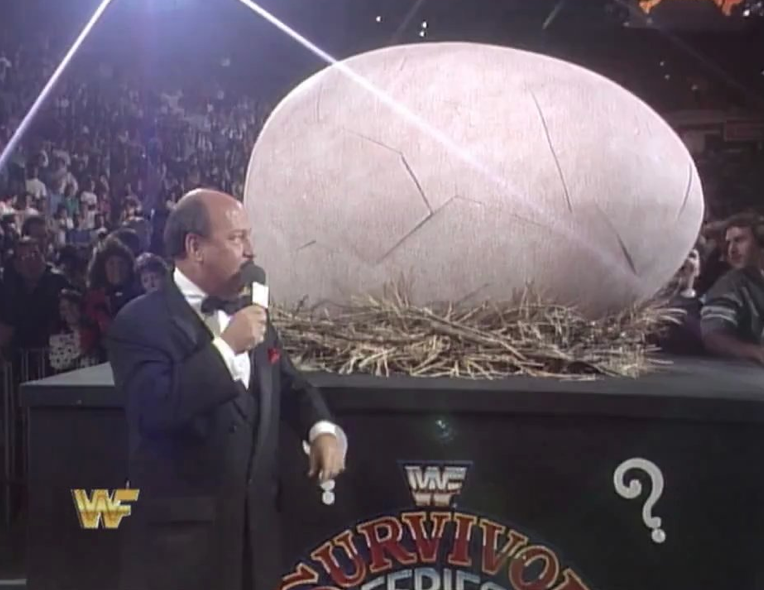
    A little backstory: In the fall of 1990, the WWF was carting around a giant mystery egg from show to show, with the promise that it would hatch at the WWF’s Thanksgiving spectacular, the Survivor Series. Yes, a mystery egg. There was absolutely no way that anything in that egg was getting over, but the WWF gamely toted it from town to town and, somehow, people seemed to be interested in the egg’s eventual hatching. I doubt it showed up in the bottom line, but based on the reaction of the Hartford crowd when the egg started to crack (not to mention when “Mean” Gene Okerlund mentioned that it could be the Playmate of the Year, among other ridiculous possibilities), there were people looking forward to the egg’s contents making his/hers/its debut. Here, for the record, is what happened:

    Make no mistake, The Gobbledy Gooker was a terrible gimmick, perhaps the worst of all time. Sure, wrestling has had its Shockmasters and its Arachnamans, its Ding Dongs and its Lazer Trons (also portrayed by the man in the Gooker outfit) (weird that I’m only naming WCW gimmicks), but the Gooker was so bad that he lasted one show. One. They made that costume. They carted that egg around. They gave him nine minutes of time on one of the biggest pay per views a year. He didn’t make it off of his first show, which, in wrestling, is amazing. The Shockmaster lasted a few months. The Boogeyman went a couple of years. Plenty of terrible wrestlers with awful gimmicks get eons to make it, as a wrestling character is, essentially, an investment in the future. As seen from the following promotional videos, the Gooker was supposed to stick around, but the reaction was so bad that giving the poor bird another shot would have been suicide:

    The Gooker has since passed into legend, his name synonymous with terrible wrestling gimmicks. The old queen of wrestling websites, Wrestlecrap, annually hands out the Gooker Award for excellence in bad booking. It’s pointless to defend the gimmick, but that’s not what I’m setting out to do here. As awesome as a Koko B. Ware/Gooker tag team run would have been (or, for that matter, a Gooker/Tugboat team, just to pair Gooker and Shockmaster), the fact of the matter is that the WWF blew the whole Gobbledy Gooker thing by hiring a really talented wrestler to inhabit the suit, a wrestler who was doing stuff that few, if any, wrestlers in the WWF were doing at the time.

    Re-watch that video of the Gooker’s debut. A lot of ink and bile has been spilled about the square dancing and the turkey strut and “Mean” Gene’s athletic prowess and the hard sell job by Roddy Piper and Gorilla Monsoon, but there’s more to the angle than that. In a hostile crowd, in a full body suit, Hector Guerrero, he of the famous Guerrero wrestling family, was able to jump into the ring, do a forward and back roll, a cartwheel, and, most impressively, a flip into the ring followed by another forward roll. Were he just Hector Guerrero, were this just a segment on WWF Superstars or All-American Wrestling, were he squashing the Brooklyn Brawler or “Quick Draw” Rick McGraw, Hector Guerrero’s debut would have represented the first significant penetration of the Mexican lucha libre style in the promotion since Madison Square Garden lifted their ban on masked grapplers, which allowed Mil Mascaras to feud with Billy Ghaham for the WWF Title. Moreover, Hector was a rather talented wrestler, as these 1997 matches against Dean Malenko will illustrate:

    Yeah, I know, it’s a match against Dean freaking Malenko, who, it is publicly documented, never had a bad match, ever. Besides which, these matches took place seven years after the Gooker gimmick flopped, when Hector was in his 40s, a ring technician and jobber to the stars. Here’s a match from 1995, two years earlier, against 2 Cold Scorpio for the ECW Television Title:

    2 Cold Scorpio was also a good wrestler, but I think you get the point. Hector Guerrero was a wrestler’s wrestler, man. A joy to watch, regardless of his sparkly WCW trunks or the fact that his most significant television exposure, for most wrestling fans, came in the twilight of his career. He was a smart wrestler from a smart family, and, watching him at 43 against Dean Malenko and at 41 against Scorpio, it’s tempting to think that, had Eddie Guerrero not died in 2005, he would have been wrestling a similar style, if slightly modified for the WWE main event scene’s purposes.

    But this is still Hector at 41 and 43, which, for a wrestler, is an eternity from the 36 at which he donned the Gooker suit. Had he been the Hector of his brief WCW and ECW stints, he would have faded away–a good wrestler working a less than interesting gimmick in an era where interesting gimmicks were absolutely necessary. But it didn’t have to be that way, either. Check out this singles match from Championship Wrestling from Florida, where, in an all-stereotype match, Hector Guerrero takes on Chief Joe Lightfoot:

    The guy seconding Hector, with the beard and the bandoliers, is Chavo Guerrero, father of Chavo Guerrero Jr., and the gimmick they’re working in CWF, at least to me, looks like a precursor to the lying, cheating, stealing Eddie and Chavo Guerrero tandem that, along with the teams of Edge/Rey Mysterio and Kurt Angle/Chris Benoit, defined an era of WWE SmackDown!, giving Brock Lesnar maybe the best midcard support any champion had since Hulk Hogan and the nWo dominated WCW.

    You know how WWE really blew it with the Gooker? They could have done Los Guerreros 12 years before they did, adding another strong tag team to what was already a great tag team division, and instead they got a turkey to square dance with “Mean” Gene. As a wrestling fan, the Gooker’s utter failure is humorous, and his in-ring debut at Wrestlemania X7 was worth the wait (he was eliminated second in the event’s gimmick battle royale, after the Repo Man), but the prospect of Rockers vs. Guerreros or Hart Foundation vs. Guerreros is tantalizing to my wrestlethalmus. Here Hector and Chavo are against the Rock and Roll Express, and Hector teaming with Mando against the Badd Company, who, later, would become the Orient Express, who, as previously documented, had an awesome match at Royal Rumble 1991 against the Rockers.

    But, on the flip side, had the Gooker never made his debut, had the Guerrero Brothers made their way to the WWF instead of a man in a giant turkey suit, the potential for incredibly awkward Diva’s division returns would be lost to all of us, and Thanksgivings would be decidedly void of the one-off wrestling character it so richly deserves.

  • The New 52: Batwing #1, Birds of Prey #1, Catwoman #1, Nightwing #1, and Red Hood and the Outsiders #1

    The New 52: Batwing #1, Birds of Prey #1, Catwoman #1, Nightwing #1, and Red Hood and the Outsiders #1

    Batwing #1

    Writer: Judd Winick / Artist: Ben Oliver

    There are room for superheroes in Africa, I know there has to be. While the concerns dealt with by American comic book characters–drug abuse, alcoholism, crime, choosing between Betty or Veronica–are pedestrian in comparison to those that would likely be faced by a hero operating in the Congo, there must–must–be a way of portraying that hero in a way that intelligently confronts those issues, and you’d have to imagine that a comic book capable of doing that would be a home run, finally and fairly representing a sorely underrepresented group of people. Unfortunately Batwing #1 isn’t that book. It isn’t offensive, but it has the feel of a comic conceived after skimming through a fairly long essay on the famine and war plaguing the continent. Its heart is in the right place, but, more often than not, its head is up its ass.

    Batwing, as you might’ve guessed, is the Batman of Africa, given a suit and a cave by Bruce Wayne in an effort to spread the message and ideal of Batman throughout the world. This is an interesting idea (one of many interesting ideas cooked up by Grant Morrison), but, in execution, I can’t help but cringe watching Batman show up to lecture Batwing on the finer points of crime fighting. In this issue, he admits that Batman was right when he said a bat would scare African criminals, thanks Bruce for the suit, and unnecessarily reminds him that he’s responsible for the bank of computers he works from. He then waltzes into work the next morning and finds the entire police precinct massacred by a warlord/supervillain. Of course, he blames himself. Too bad Batman wasn’t there to lend a hand.

    I’ve never been much for Judd Winick’s writing, which is too bad since he is one of the DC roster’s most prodigious writers. I guess I’ve always found that, while dealing with big issues like sexuality, identity, and race, his scripts never reach far beyond the basics, often feeling sloppy, rushed, and half baked. Batwing #1 is much the same way. Great idea, yes, but the execution leaves a lot to be desired, and the end result is a less earnest Blood Diamond clone with capes. The issue is not helped by the artwork of Ben Oliver, who I’m sure has his fans, but I’m not much for comic art that tries to be photorealistic. There’s a kind of uncanny valley effect to artwork like Oliver’s–by trying hard to emulate the looks, emotions, and real life responses of actual people, Batwing #1 is a cold, emotionless shell of a book. I don’t feel anything for the character, and, in a weird way, I almost find the photorealistic dismembered limbs and severed heads a bit disrespectful. These things have really happened in Africa, and Batwing’s set-up doesn’t seem strong enough to resolve those issues with the respect and consideration they deserve. I feel my time would have been better spent looking through a photo essay on the continent. I feel like Batman should have known better.


    Birds of Prey #1

    Writer: Duane Swierczynski / Artist: Jesus Saiz

    I was irked by Birds of Prey #1 immediately upon looking at the cover. I’m usually loathe to gripe about comic book fashion, having long since tired of bat-nipples and endless pouches, but the long sleeves and 90s shoulderpads with hot pants and fishnets ensemble they gave to Black Canary is the second ugliest re-envisioning of a character’s costume since the ill-fated relaunch of Wonder Woman saw Diana Prince dressed up for a night at the club. The worst, if your wondering, also goes to Birds of Prey #1, whose Poison Ivy wears a puke green body suit and limp red hair so horrible I had to check Wikipedia just to be absolutely sure it was her and not some limp-wristed imitation. Poison Ivy, for the record, is my favorite Batman villain. She’s also quite the fashion plate, so what the hell guys?

    *ahem*

    Even if I were able to look past the seemingly arbitrary and wholly unnecessary costume changes (I can’t! I won’t!), Birds of Prey #1 would only irk me again upon the realization that, in this brave new world, absolutely nothing that was great about Gail Simone’s long, incredible run on the book survived Flashpoint to make it into the new DC Universe. I’m biased, as Birds of Prey was the first book that got me into DC Comics as a young reader and comic shop employee, but it was nice that a book existed that wasn’t just about super heroics, but personal relationships and subtle nuance. The characters in Birds of Prey were smart and well-rounded, and I can’t help but be a little sad that that’s been tossed out the window in an effort to return to the tone established by Chuck Dixon’s run on the title, with the difference being that Black Canary and OracleBatgirl are not only no longer teammates, but that Barbara Gordon isn’t even on the team.

    Now were I able to set both of my issues with Birds of Prey #1 aside before I’d read the book, Duane Swierczynski’s take on the team would still be pedestrian stuff–a light, sexless take on Sucker Punch (which wasn’t exactly heavy. Or sexy.) with little ambition beyond showing hot chicks do the cool things people in action movies often do–drive cars, fight thugs, be party to explosions. Everything that happens here feels so unnecessary, so lifeless and stilted and just plain off. A lot of that probably has to do with my strong attachment to Simone’s run. A lot of it probably has to do with the fact that I find dialog like “God, it’s you…the Black Canary. Wanted for murdering a man with a punch” laughable in the way B movies are. Most of it, however, has to do with Birds of Prey #1 having the vitality of a book that’ll be cancelled within a year. It lacks a certain…vitality. I might read a few more issues to see how Poison Ivy is handled (I do bad things for the sake of keeping up on favorite characters), but, one issue in, it’ll be more out of morbid curiosity than anything else.


    Catwoman #1
    Writer: Judd Winick / Artist: Guillem March

    Catwoman, too, was a title instrumental in getting me into DC Comics, as the Ed Brubaker/Darwin Cooke/Cameron Stewart series did more with the noirish elements of the Batman mythos I’d grown up with in Batman: The Animated Series than any other Batman title, both in terms of Brubaker’s strong sense of Selena Kyle as a character, and Cooke and Stewart’s incredible sense of Gotham City as a place. It’s been a long time since the character or a book featuring her has been relevant to my interest, which is too bad because, in the right hands, she’s quite capable of presenting a different side of Gotham, one that Batman, Batgirl, and the Birds of Prey are incapable of exploring. I’m not sure if the Selina Kyle of Catwoman #1 is a woman capable of carrying her own book, of if my displeasure in the road Judd Winick takes is due to my biases, both for the character and against the writer.

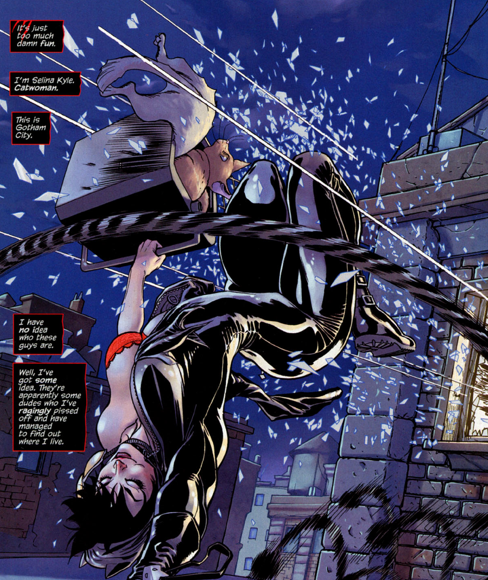
    Selina Kyle, as written by Winick, is much the same as she was in the 90s; a woman with an ambiguous moral code and expensive taste. The things that defined her as a person when Brubaker was writing her are gone, replaced with the cat-ridden apartment and a sloppy-but-sexy demeanor that fails to do much in defining her. On the first page, when she’s cramming eight cats into a cat carrier and jumping out the window half dressed, I had to stop myself from closing the book. Sure, my Catwoman would have been prepared, in costume. Yes, my Catwoman probably would have had two cat carriers. But this is Judd Winick’s East End, and I’m just nervously shuffling down the sidewalk, eyes to the pavement.

    It’s clear from the narration that Winick’s Catwoman will be couched in Frank Millerisms. Like one of his tough talking prostitutes, Selina Kyle isn’t afraid to be groped by a dirtbag if it means that she gets what she wants, and she’s certainly not above using her body to lure her marks in. It’s lazy and unconvincing, but is a masterstroke compared to the relationship between Catwoman and Batman, which reads like some nerd’s Batman Returns fanfic, if that fanfic somehow won a contest to be drawn by a real comic book artist. I’m cool with Batman and Catwoman having sex, but, here, it seems like it’s defining Winick’s take on the character, that Batman needs to be there, not just for all the kissing and straddling DC will allow, but so that she’ll have something hanging over her head when she goes off to do something that might be morally iffy–a relationship with a man.

    All of this is annoying before the issue’s last words invite comparison between Batman/Catwoman and Watchmen‘s Nite Owl II/Silk Spectre II, who, being characters in an Alan Moore comic book about identity (and 900 other things), are much better equipped to deal with the issue. It’s not a fair comparison, but few things are. A more fair comparison: like Birds of Prey, I’m in for a few more issues, if only because I’m curious to see where, exactly, Winick is going. It helps that Guillem March draws an awesome Catwoman. It’s only right, considering that it’s her book, but she stands apart from everything surrounding her–even when the writing tries to tie her down.


    Nightwing #1

    Writer: Kyle Higgins / Artist: Eddy Barrows

    I guess I’ve never really understood the need for Nightwing. Yes, there’s a need for character evolution, and Dick Grayson wasn’t always going to be Robin, but it feels like Nightwing never quite stepped out of Batman’s shadow. He moved to a new town, got himself some villains, saw the town crumble and went back to Gotham, where he took up the Bat-mantle when Bruce died (funny how “evolution” means taking on someone else’s identity) and handed it back when he returned. Now back as Nightwing and back in Gotham, Nightwing #1 breaks no new ground for Dick Greyson. He’s still in Batman’s shadow, still fighting his scraps, still struggling to find his identity without Bruce.

    I suppose it’s fitting that the circus Dick once worked for is back in town, as it allows him to visit his old demons and reflect on his history, for those who are new to the character. It’s a big deal, I suppose, that he’s back in hero-choked Gotham, living in a loft in one of the city’s rough (but maybe gentrifying) sections, living in the place he’s trying to improve. There’s also a big carrot dangled at the end of the issue that there might be more to Dick than even he knows, but in this, the first issue of his own book in a new continuity, he’s taking on a nameless, faceless killer. I know that not all of these new books can be barnburners and that a book like Nightwing #1 has an established audience, but it’d be nice to see writer Kyle Higgins going beyond the character’s firmly entrenched comfort zone. Fans of Dick Greyson will probably be mollified, as this is the first time he’s had a solo book since 2009, but beyond those fans, nothing here is going to convince the masses that the character, or the book he’s in, is worth the money.


    Red Hood and the Outsiders #1

    Writer: Scott Lobdell / Artist: Kenneth Rocafort

    Enough bloggers have commented on the economic stupidity of taking Starfire–a character three million children, a number much larger than the thirty thousand your typical comic book would be lucky to get–from her cutsey Teen Titans leanings and hurling her headlong into the COOL and RAD world of Red Hood and the Outsiders #1, where she is not only the most powerful member of the team, not just the one with the biggest breasts, longest hair, and skimpiest costume, but also the biggest slut, so I probably don’t need to add my voice. It is a stupid decision, but then again, it was pretty stupid to publish this comic book in the first place.