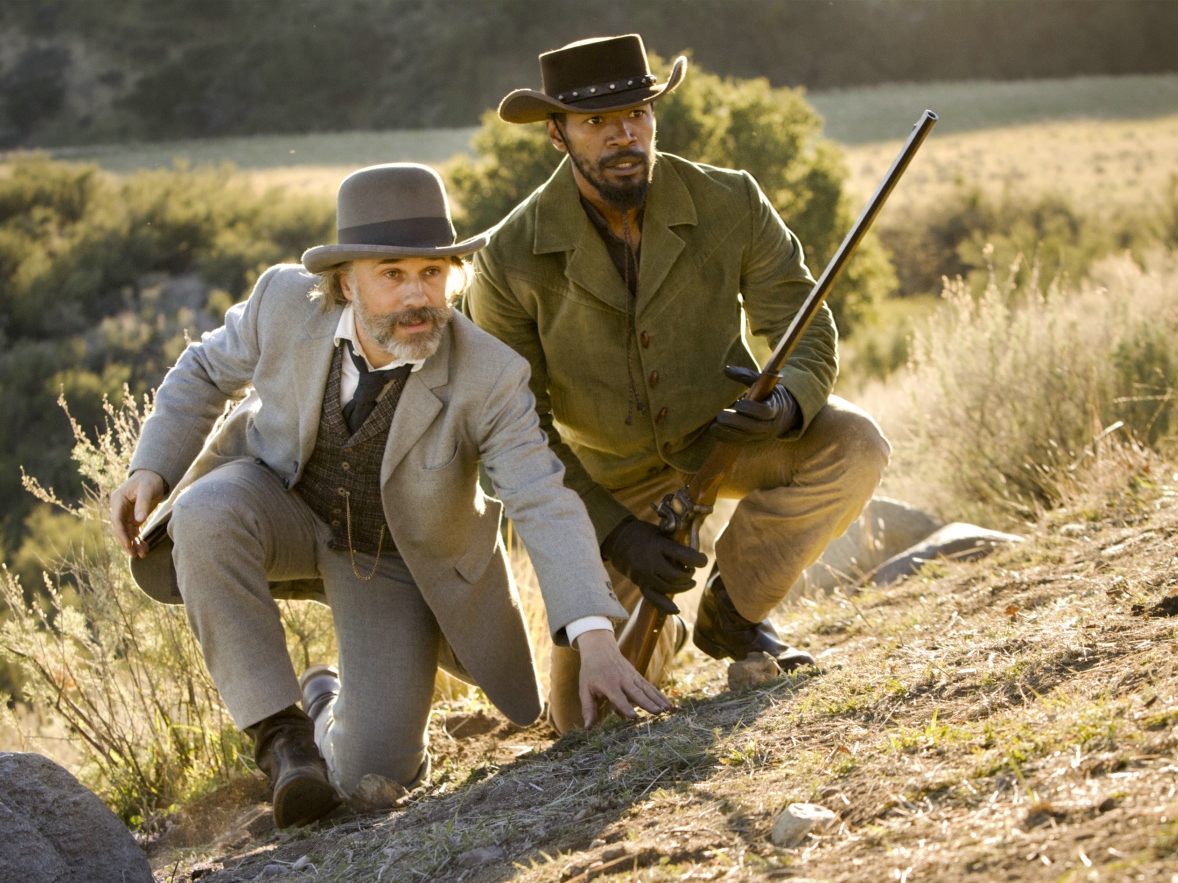
 Django Unchained, the latest in a string of violent revenge fantasies from director Quentin Tarantino, never quite feels like a finished film. According to Tarantino and Samuel L. Jackson, there exists a much longer cut of the movie that fills in crucial information on a number of characters, and given that its soundtrack is punctuated with bits of dialog not heard in the film, that longer cut is also a few shades more sadistic than what made theaters. Much has been said and written about the way Tarantino peppered Django Unchained with racial epithets unbecoming of a white director or a politically correct society, but it’s the violence I keep coming back to. Not the cartoonish shootouts pitting skillful bounty hunting duo Django (Jamie Foxx) and Dr. King Schultz (Christoph Waltz) against any number of hickish gunslingers, but the violence of slavery itself, particularly as it is visited upon Django’s wife, Broomhilda (Kerry Washington), who is whipped, branded, raped, scolded, and locked in an iron box under the hot sun as punishment for trying to run away.
At this point in his career, it’s easy to accuse Tarantino of fetishizing violence against and the traumatization of women. Though the perpetrators often get what’s coming to them, Tarantino has been pedaling in this kind of sick thrill since Kill Bill Vol. 1, wherein The Bride is awoken from a coma mid-rape by a mosquito bite. Her rapist has his tongue bitten out and her pimp is beaten to death, but Tarantino luxuriates on the possibility of her rape, just as he does Stuntman Mike’s pursuit of his “girlfriends” in Death Proof and Col. Hans Landa’s psychological torture and eventual murder of double agent Bridget von Hammersmark in Inglourious Basterds. With poor Broomhilda, Tarantino turns up the heat. Looking beyond the director’s pedantic argument that his use of language and human misery is “period accurate,” the constant terror and abuse suffered by the largely agentless Broomhilda von Shaft serves two purposes: fulfilling the obligations of the exploitation genre, and sweetening Django’s revenge.
In transplanting the spaghetti western to the antebellum South, Quentin Tarantino has succeeded in creating both his largest, most beautiful film to date, and his most narrow in scope. Having moved far beyond the nihilism that marked early efforts like Reservoir Dogs, Pulp Fiction, and From Dusk ‘Til Dawn, Django Unchained is exploitation filmmaking at its most agitating, using slavery and racism to titillate, humor, and enrage the audience. It works very well: the white slavers of Django Unchained are cruel, horrible men whose deaths elicit something close to joy. Unlike in Basterds, where the cruelties of Nazi Germany took place off screen and out of sight, men in endless number are shackled and marched through deserts, forests, and mud-caked auction towns. Black men beat each other for their white owners’ entertainment, black women are treated as objects of lust, and those who disobey are fed to the dogs.
The two halves of Django Unchained, joined though they are by a brief training montage, play as a film and its sequel. In the first half, Django is set free by Dr. Schultz, a bounty hunter looking for three cattle rustlers by the name of Brittle. Schultz has never seen these men, but Django has: they were the overseers at his old plantation, three sons of bitches whose idea of punishment was pure Old Testament—Broomhilda still has lash marks on her back proving that. During their travels, the naïve Dr. Schultz learns that Django has a wife, and that he plans to buy her freedom with the money he’s been promised for identifying the Brittle brothers. This is a risky gambit: to find his wife, Django will have to find records of her sale in a Mississippi auction city. Even with papers stating that he is free, the odds of him walking out of that city with his freedom intact are quite low. So Dr. Schultz offers Django a deal: partner up for the winter and learn the business of bounty hunting, and gain a partner in the rescue of Broomhilda.
If one looks at the two halves of Django Unchained as origin story and follow-up, then the film becomes a tale of two plantation owners. In the first half, Django and Dr. Schultz travel from Texas to Tennessee to The Big House, which is owned by a repellant man who is referred to as Big Daddy (Don Johnson). Big Daddy’s plantation functions as a brothel, where he sells his attractive young slaves to anybody with a big enough pocketbook. Later, the two discover that Broomhilda has been sold to a bloodsport named Calvin J. Candie (Leonardo DiCaprio), who inherited the fourth largest plantation in Mississippi. Though his plantation is known as Candie Land, he, too, calls the house that stands on its grounds The Big House. Candie is a major player in mandingo fighting, a Tarantino invention that pits burly slaves in brutal death matches before a private audience. In both cases, Dr. Schultz and Django’s play is the same: in offering a ridiculous sum of money for the particular kind of human flesh Big Daddy and Calvin J. Candie deal in, they gain access to their marks’ plantations and carry out a search for their true prize. Finding the Brittle brothers and Broomhilda, however, is not the hardest aspect of this plan: it’s getting out of those plantations alive, treasure in tow, that matters.
That Big Daddy and Calvin J. Candie bear as many similarities as they do is intentional: these are vain, horrible men, and it is to our great satisfaction to see them executed by our heroes as such. The difference between the two is that Candie’s second—the head house slave Stephen (Samuel L. Jackson)—sees right through the bounty hunters’ charade. When discussing the characters they’re set to play, Django tells Dr. Schultz that being a black slaver is a lower calling than being the head house slave. If that’s true, Stephen certainly tries to make up for it by being every bit as snide and underhanded as he is old and hobbled by his age. In this role, Jackson is at his most engaging in years; though his character is one whose time on screen was whittled down, he is a man of extremes: before guests and the white workers on the plantation, he is a bumbling, ornery old coot; in private with his master and Django, he is as cold and cunning as they come, as bitter and vengeful as Shylock.
There is a lot about Django Unchained that doesn’t quite add up; like many of Tarantino’s films over the second half of his twenty year career, his ambition to present a sprawling, grandiose epic of five or six hours was compromised by the need for a Christmas Day release to make money. Working with editor Fred Raskin—Tarantino’s regular editor, Sally Menke, died in 2010—Django Unchained’s seams show more than what’s typical of a Tarantino film. The jokes aren’t as crisp, the characters aren’t as well developed, and the film’s six-shooting bloodbaths eventually blur together, distinguished mostly by what song is playing to pass the time. And yet, Django Unchained is one of the more wildly entertaining films of 2012. Beyond Stephen—the film’s best creation—Jamie Foxx’s Django is as solid a spaghetti western hero as there is, and Christoph Waltz once again establishes himself as the Tarantino actor, the director and screenwriter’s dialog never seeming like words on a page. If the plight of Broomhilda von Shaft is cause for squeamishness—and it should be—and the reward for enduring her pain is pleasing—and, for me, it was—then Tarantino is doing his part as an exploitation filmmaker, and that, really, is the only shield he’s ever held up in defense of his work. As beautiful—the sweeping parries, manicured plantations, and torch-bearing lynch mobs are unprecedented compositions in a Tarantino movie—and exciting as Django Unchained often is, after twenty years, it would be nice to see the director’s raison d’être evolve with his skill.
Django Unchained. With Jamie Foxx (Django), Christoph Waltz (Dr. King Schultz), Leonardo DiCaprio (Calvin J. Candie), Samuel L. Jackson (Stephen), Kerry Washington (Broomhilda von Shaft), Don Johnson (Big Daddy), Walton Goggins (Billy Crash), and Jonah Hill (Bag Head #2). Directed by Quentin Tarantino and produced by Stacey Sher, Reginald Hudlin, and Pilar Savone. Screenplay by Tarantino.

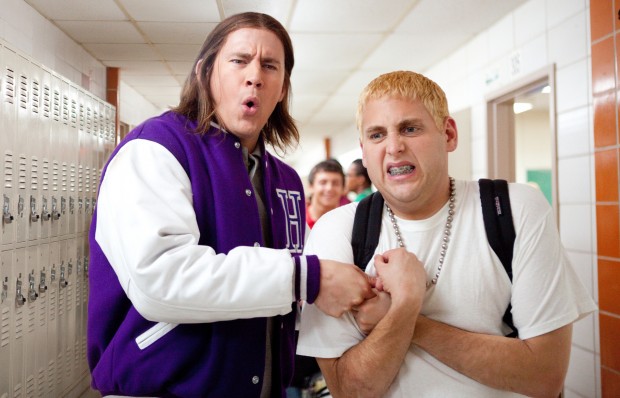 When Easy A was released last year, it ushered in a brief era of John Hughes nostalgia and the feeling that things within the high school comedy genre could, in fact, get better. A year of repeat viewings and Emma Stone Tumblr .gifs later, and the shine of Will Gluck’s comedy has mostly diminished. It’s a ramshackle tribute to a bygone era in teen filmmaking, its obsolescence made clear by a lack of Hollywood follow-through It’s much easier to throw a handful of Disney Channel stars into a foreign country or move the cheerleader movie plot into another sport than to hit the sweet spot Easy A was lucky enough to find. No matter. For all that film’s charm and quirk, I was left waiting to see if the high school comedy’s raunchier parasitic twin would crawl its way out of the ditch a legion of Superbad imitators left it dying in. Finally, with 21 Jump Street, it has.