I’ve been thinking a lot about tag team wrestling lately, mostly how it is perceived as being a dying artform, which is a fair assessment if the only wrestling you watch is the WWE. For the past year or so, there’s been talk that the WWE are going to make a serious effort to revamp their tag team division, which, despite a good number of teams that stand out above your Smoking Gunns and your Highlanders, has mostly been a shambles for the better part of the decade. The term “tag team specialist” is rarely bandied about anymore, and that’s probably because tag team specialists don’t make as much money as popular singles competitors do. Just when it seemed like Evan Bourne and Kofi Kingston were going to change that, forming a tag team popular enough to have their own shirts (honestly, when’s the last time a tag team had a t-shirt?), Bourne was suspended for his second violation of the WWE wellness policy, and we’re left with a WWE tag team division that features an odd mix of the good-but-undistinguished (Primo and Epico, The Usos), random pairings that worked out better than first expected (Jack Swagger and Dolph Ziggler, Curt Hawkins and Tyler Recks), and teams that, frankly, don’t make a whole lot of sense (Kofi Kingston and R-Truth, the house show pairing of Santino and Mason Ryan). There is rampant internet speculation/hope that the artists formerly known as Claudio Castagnoli and Chris Hero were signed by the company to take the division to the promised land, but those hanging onto this particular dream have failed to note the treatment the last few good-to-great WWE Tag Teams — The Hart Dynasty, Chris Jericho and Big Show, Cryme Time, Cade and Murdoch — were handled: Just as a pair was getting over (obviously circumstances for Jerishow were different), the team was hastily split up/feuded/future endeavored.
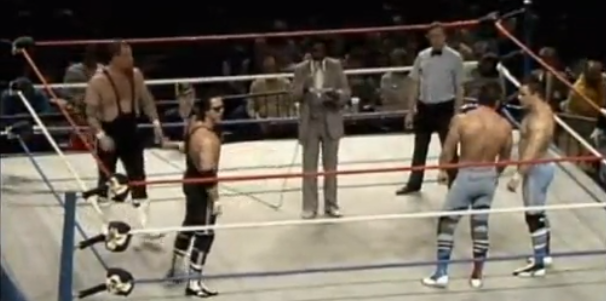
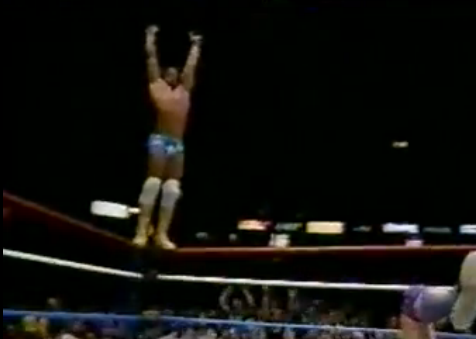
I’m not saying this as a way of saying that the WWE tag team division is never going to get better. They’re a few teams away from really having something, but, just the same, things will probably never be the way they were when tag team wrestling served as a platform for new wrestlers to hone their craft and get comfortable in front of an audience. Point in case, this match right here. You might not realize it, looking at the men in the ring before most of them had established their personalities and chisled their physiques, but two of the participants in this contest — Bret Hart and Davey Boy Smith — would go on from their respective teams and be main eventers for much of the 90s. The other two went down completely different roads — Neidhart was, for lack of a better term, a career tag team specialist (say what you will about the New Foundation, but Owen Hart was a star shortly thereafter), and the Dynamite Kid, who was at this point already the godfather of lightheavyweight wrestling, wound up mentally and physically ravaged and was mostly out of the business by the early 90s.
But forgetting all of that, what this match, what the WWF tag team division had that it currently lacks, are teams with a) a sense of continuity and b) personality. You look at the Bulldogs and the Harts, and you’re looking at two of the best teams ever, two teams who seem to have been built to their partner’s specifications. Hart was small, still nervous on the microphone. Neidhart was large and charismatic. Davey Boy was powerful. Dynamite Kid was lightning quick. Tag teams used to compliment each other. Now they’re thrown together because two dudes had nothing better to do.
Not only were the Harts and Bulldogs great tag teams, they were great opponents. They feuded for much of the time the Bulldogs were in the WWF, and each match felt fresh and unique, regardless of time or place. The Bulldogs and the Foundation would later compete over the WWF Tag Team Titles, but here they’re merely in it to win it, two teams testing each other and trying to prove to each other who the better men are. Few tag team divisions in history were well-stocked enough to handle a feud of this magnitude concurrent to what the champions were doing, but both the WWF and the NWA/WCW had that going for years. Moreover, the tag teams of that era were just as over as some of the singles stars. Listen to the reaction the fans have for this match. Realize that the Road Warriors are one of the best draws of all time, that a feud like the Midnight Express could have a 15 year run without growing stale.
It’s true, both the Hart Foundation and the British Bulldogs broke up, but they left an indelible mark on wrestling before splitting up, so much so that you could argue for their inclusion in any reputable pro-wrestling hall of fame without Bret Hart’s magnificent run as a top singles star, or the height of Davey Boy’s popularity, or Dynamite Kid’s series against Tiger Mask. The problem with the WWE tag team division today isn’t so much a lack of focus, but that the tag teams that might draw people’s interest are so often temporary pairings. It’s a near-miracle that a combination like Big Show and Chris Jericho went on as long as it did, and who knows how long Air Boom were meant for this world. Until the powers that be decide to find a few more teams like the Usos and Primo and Epico, teams that wouldn’t rightly function with anybody else at the helm, teams made up of something more than interchangeable parts, the division will continue to flounder, and the best examples of great tag team wrestling will continue to be the past, Japan, and the independent scene, where a good tag team or a good match can still draw a response like the one the Bulldogs and the Foundation got above.
I love Bruce Springsteen, and I am cautiously looking forward to Wrecking Ball, a few tracks of which I’ve listened to and have been impressed by. The Boss is pushing this record harder than any I can remember since I started listening to him, releasing one song from the album every day to various popular websites, appearing on Late Night with Jimmy Fallon, and generally throwing himself into this album like he’s got something to prove. The above blurb, from author Dennis Lehane (Mystic River, Shutter Island), is the kind of thing from which one gleans nothing: Countless books come out every year with boilerplate like Lehane’s opinion of Wrecking Ball (some including phrases like “I hate hyperbole,” followed by extreme hyperbole), and few things with such amped-up standard-bearers become anything like what the blurb claims it will, in short order.
That being said, Lehane has taken the time and effort necessary to compile a list of albums Wrecking Ball compares to; a list worth attention if only because Springsteen’s new album is being compared to five albums, some of which, I’m willing to bet, are in the discussion of being among the best records of all time. Care to guess which of these five populate that list? Feel free to choose more than one…
Bruce Springsteen – Born to Run (1975)
Bob Dylan – Highway 61 Revisited (1965)
Rolling Stones – Exile on Main St. (1972)The Clash – London Calling (1979)
Green Day – American Idiot (2004)
It is simply too much to fathom how somebody looks at a list of rock albums that’ve come out since rock was invented and selects Green Day’s American Idiot as being one of those rare albums that changes and shapes a generation of musicians and listeners, so let me divine the following from Lehane’s rather brazen list: Either Wrecking Ball ends up being one of the best albums ever, or it’s an absolutely horrible trainwreck of an album that nevertheless sells six million copies and launches a greatest hits CD worth of singles. I’m not too good at math, but Lehane’s list gives Wrecking Ball a 4/5 chance of being the best thing ever recorded. We find out tomorrow.
I may have fallen shy of my goal to read every new series DC Comics published as part of its New 52 initiative, but one of the books I did not miss, that I’m very glad to have not missed, was Wonder Woman. I’m a huge fan of the character, and I am always, always happy to see her done well. Unfortunately, with the exception of three recent bright spots, it seems like DC Comics are content to do things with the character that, in 2012 (or 11, or 10, or 09, and so on), seem less forward-thinking than they are head-scratching — making the call to change costumes to get the character on TV and then making a pilot so averse to networks that it’ll be years until anyone touches her, making her origins less Greek, handing her over to writers who, in turn, either didn’t do much with her or made her book unreadable, for any number of reasons — and this, in turn, has led to the current DC Comics landscape, where the DC Trinity consists of Batman, Superman, and Green Lantern, who is so whitebread that Hulk Hogan’s “Real American” may as well be blasting from the pages of the book whenever the guy does something remotely heroic.
The best thing about the New 52 is that Wonder Woman hasn’t been this good since Greg Rucka’s run on the book. I didn’t expect this from a rebooted universe where a character popular with 20 million children was recast as an intergalactic hooker, but good things are happening with my favorite fictional character, so, for now, I am happy enough to give DC Comics my money.
Pictured: Progress.
But now DC is going through with a “second wave” of New 52 books, “introducing” Earth-2, a needlessly complicated system of parallel world-building that made sense 40 years ago when Superman was gaining new, ridiculous powers every week and Bruce Wayne needed to face the consequences for his playboy lifestyle, but now, in 2012, months removed from literally creating a whole new world that was meant to put to rest all of the nerdy problems that resulted from so many parallel planets, feels forced; a way for the company to try to keep up with Marvel despite having just one property (Batman) capable of competing with the heavy hitters of the other line.
The accepted, science-fictional standard for parallel worlds is that, often, the timeline on the other planet diverged at some point, resulting in fundamental changes from the planet we’re familiar with. Say Joe Chill was suffering from the flu the night he murdered Batman’s parents. On Earth 1, he figures he could use the dough to buy flu medication, wanders off to the movie theatre in Crime Alley, murders him some millionaires, and we’ve got ourselves a Batman. On Earth 2, Chill decides to roll over and go back to sleep. Bruce Wayne is healthy and well-adjusted and never gets the idea to fight crime dressed up as a bat, instead having grown-up to be a prime piece of kidnap bait. That kind of fundamental change, however, rarely comes from Earth 2 situations in comic books for one, simple reason: You take away Batman or Superman, and you take away a fan’s reason to read. That’s fair, though, as only the most die-hard of die-hards can be expected to work themselves up over the alternate origins of Matter-Eater Lad.
Well have I got a story for you!
No, when it comes to modifying the origins of a superhero for the purposes of an alternate world, you need to do something radically different while keeping the character fundamentally unchanged. For Wonder Woman, this has meant any number of things: Making her less or more mythological, going back to her first encounter with “Man’s World,” taking away her powers and costume and making her a kung-fu fighter, giving the title of “Wonder Woman” to somebody completely different, and so on. This time out, however, Earth 2 writer James Robinson promises the following for the character:
Due the events that open the saga of EARTH 2, Wonder Woman is already the last Amazon of this world and she is determined to avenge her sisters…at whatever cost.
This is conjecture, but if my powers of intuition are correct, Earth 2 promises to slaughter all but one resident of Themyscira. It’s not uncommon for comic books to slaughter an entire race, minus one — this, after all, being the origin of Superman — but the fundamental difference between Earth 2 and “Doomed planet. Desperate scientists. Last hope. Kindly couple.” is that Krypton’s destruction, at least, was gender neutral.
This is where things get contentious, see, because the conversation surrounding comics lately — a conversation made heated by AMC’s Comic Book Men (emphasis on “Men”), the aforementioned up-sexying of not only Starfire, but Suicide Squad‘s Amanda Waller and Catwoman‘s Selena Kyle, and DC Comics releasing a poll that, boiled down, claims that women don’t read comics — has shifted from the long-dated “Comics ain’t just for kids!” mode of thinking to the much more charged “Comic books are inherently, reprehensibly sexist.” Say what you will of this argument and its supposed extremism — Cracked.com readers, in response to a simple article about sexist superheroine costumes, already have — but Earth 2 promises two things: Gendercide, and a cold, mirthless Wonder Woman.
This, I realize, might not appear to be a problem. They’re not grossly oversexualizing Wonder Woman, and they’re promising to do something major with a major character who is often left out of the loop when DC does major events. If you believe, as the company does, that women don’t read comic books, it may follow that the impending slaughter (or whatever) of the Amazons is, in fact, no big deal. It’s all part of a larger story, a mystery. It’s something we’re meant to unravel, something that’ll make Wonder Woman “interesting” and “relevant” and “marketable” and all those other things the character already is, but that DC has, almost comically, been unable to realize for decades. Here’s Earth 2 editor Pat McCallum to tell us how different this brave new world will be:
While there will be recognizable faces and settings on EARTH 2, don’t for a moment think you’re on familiar ground. Do that, and you let your guard down…and then you’ll end up like the rest of the Amazons.
This all sounds decidedly familiar. Granted I’m no comics historian, and I can’t claim to have read every Wonder Woman story to have ever seen print, but here’s what I’ve gleaned about the denizens of Paradise Island throughout the years:
When it comes to men, the Amazons are painfully naive, so much so that they need to send a representative to “man’s world” to report back on them.
With the exception of Wonder Woman herself, there isn’t a single Amazon capable of showing an emotion beyond anger.
The Amazons are a bloodthirsty race, capable of two things: Warring on “man’s world” and showing a deep distrust of it.
Inevitably, the Amazons will turn on Wonder Woman, presumably because she, in living among men, has come to accept and perhaps enjoy their company.
Here, they’re not even afforded modern weaponry.
The Wonder Woman of Earth 2 will probably be some combination of the above traits: Naive, angry, bloodthirsty and distrusting. This, at least in my opinion, is the worst permutation of Wonder Woman possible, an uninteresting, stock babe in a swimsuit, hacking and slashing her way through those she feels wronged her until somebody (likely a dude) stops her. She’ll end up fighting with the group of heroes who presumably let her whole society perish, this despite Themyscira having a surplus of women in refrigerators. Eventually, there’ll be a survivor, and her and Wonder Woman will be forced to fight. That’s because, no matter how cool or great or iconic Wonder Woman is, she’ll always end up in gender war stories, and sure as every other old-school Wonder Woman cover had Diana bound by her own weapon, you can bet on two things:
Wonder Woman will side with the boys.
The boys will always win.
This goes back to the belief that only men read comic books, the feedback loop that says that, since that’s the case, it’s OK for comic books to maintain a somewhat (or, in some cases, a full-blown) sexist worldview, presenting, in 2012, a shockingly bankrupt take on a society free from the input of men, one wherein the gaggle of man-hating lesbians are invaded and conquered by their supposed betters. Earth 2 could have done something completely different, something completely un-comic book, but going against the grain, reaching across gender boundaries, and attempting to hook new readers are all goals less important than appeasing an ever-dwindling market and holding out for that rarest of rarities: A profitable film/TV show.
This.
Sadly, nobody involved seems to get Wonder Woman’s mythology, which is perhaps the most fascinating in comics. Nobody seems to care about the idea of an immortal race of women who, left alone for centuries, developed their own customs, technology, and skills. As long as we maintain our view of comic books as the stuff of testosterone-laden fantasy, the women appearing on those four-color pages will remain, by and large, either Cool Female Buddies or The Other, likely a combination of both, that intangible mix of fascination and fear. As long as we’re cool with the idea of female genocide for entertainment, not only will a vast, mostly-untapped demographic remain uninterested (or continue to be portrayed as uninterested), but the idea of comic book reader as basement dwelling, angry virgin will persist. We will remain hiding among our longboxes, afraid that Amazons may yet attack.
It strikes me odd that I’ve never seen fit to write about Harley Race before, though I suspect that mostly has to do with the way I’m familiar with him, which is as the burly, tough-as-nails old man who used to accompany Big Van Vader to the ring in WCW. Harley, in brief, is one of the greatest wrestlers of all time. Sadly, being one of the greatest of all time didn’t really mean much in the Rock ‘n Wrestling Era, where the leisure-suited Race of the 70s and 80s (a gruff, mean precursor to Ric Flair’s slicker, smoother style) would have been laughed out of the building despite the years he spent atop the NWA, terrorizing the world with his majestic afro, his stiff punches, and his crisp execution of just about everything, from knee drops to piledrivers. Harley is still active in wrestling, as a trainer of good repute. His handiwork can be seen on WWE TV in the persons of Ted DiBiase and Michael McGuillicutty, and he’s also the trainer of several other second and third generation stars, including Mike DiBiase, Reid Flair, Amy Hennig, and Ricky Steamboat Jr. When the DiBiases, the Flairs, the Hennigs, and the Steamboats of the world are sending their progeny to you, that’s respect.
Like I said though, that didn’t quite translate to Race’s WWF career, where they billed him as “The King” of professional wrestling. Race won the second King of the Ring tournament in WWF history in 1986, back when the tournament was not televised, and became the first man to parlay victory in the tournament into a gimmick, as evidenced by the crown, the robe, and the royal purple trunks, adorned with another crown. Race’s crown was the official one in the WWF for some time, passing from him to Haku to Jim Duggan to Randy Savage, who made perhaps the best use of the gimmick as the “Macho King.” Race, however, was in the twilight of his career during the whole “King” thing, which did see him feud against Hulk Hogan, which is about as high profile as wrestling for Vince McMahon in the 1980s got. Sadly, he suffered a hernia in a match against Hogan, and after a brief comeback, was let go. His last match as an active competitor was in 1991, at which point he was hired to be a manager in WCW.
But what made Race so great was still evident during his run as King, even though his reign as king served as a precursor to other King of the Ring wins that did nothing for the new regent. Granted he’s in the ring against the freaking Macho Man, but Race here is the rare wrestler who doesn’t prove the announcer a fool when talking about “ring experience” and “ring positioning.” Race takes a few of Savages best shots–the bionic elbow and top rope double axe-handle combo at around the 10-minute mark–and calmly, naturally puts his feet on the ropes. Too often, a wrestler’s leg shoots up for the ropes at the last second, using the same amount of energy it’d take to kick out. When Savage goes to pin Harley after the double axe-handle, Race lets Savage’s own momentum swing his leg over the rope. Simple. Effective. Smart.
I’ve written a ton of nice things about Savage on this blog in the past, and there’s no need to reiterate much of it. This, for historical purposes, was during his transition to a full-blown face. Gorilla Monsoon mentions the Honky Tonk Man’s ill-intentions towards Elizabeth at the start of the contest, and it was that feud, not the association with Hulk Hogan, that won the fans over to the Macho Man’s side. People don’t often compliment on Elizabeth much beyond her beauty, but her ability to engender sympathy was truly second to none. She single-handedly turned Savage face not once, but twice, and both under amazing circumstances. She might not have been a great manager the same way a guy like Bobby Heenan was, but in terms of performing a useful function, Elizabeth was one of the WWF’s most reliable ringside presences.
Every year, it’s the same thing: Somebody is tapped to play the Super Bowl halftime show, and everybody hates it. While it’s true that you can’t satisfy everybody, in the Internet age, the noise people make about a 15 minute chunk of a four hour spectacle devoted to men making more money we can dream of and the cars only they can afford to drive is nothing short of deafening, almost willfully looking over the following facts:
It’s a free, fifteen minute concert.
The artist involved has to pare down years of hits into this frame of time, rehearsing snippets of songs in new configurations and, depending on what kind of music the artist does, structured around a million-plus dollar sound and light show involving hundreds (if not thousands) of people the band has never worked with before, dance moves that will be learned and promptly discarded, and, in a post Janet Jackson world, wardrobe changes that reveal nary an inch of flesh.
The nature of the Super Bowl dictates that only acts as huge and overblown as the Super Bowl itself get to interrupt the near constant stream of E*TRADE baby, Coca-Cola polar bear, and Budweiser Clydesdale ads that interrupt the announcers, desperately trying to insist that a) the game is why you’re tuned in and b) the game is as great as all the other Super Bowls, perhaps even better.
Madonna, by any reasonable standard, did well at halftime last night, but my opinion is essentially meaningless because I’m a Madonna fan and because, as somebody who obsesses over the past, my brain carries faint flickerings of the Aerosmith/Britney Spears/N*Sync three-headed monster that once constituted the evenings brief respite from heavily padded gladiatorial combat. For many, I suspect that Madonna will rank among that halftime show (and, indeed, the Janet Jackson one) as a great misfiring from the home office, the NFL not understanding what “football music” is.
Before anybody calls that crowd sexist, those same people, given “football music” (I assume Bruce Springsteen and The Who qualify) find another way of complaining, claiming that those acts are simply “too old.” It doesn’t really matter how good (Springsteen, Prince, etc.) or bad (The Who) a halftime show is; we only watch it to complain. If that’s what we’re going to do regardless of who plays, the NFL and Bridgestone Tires should do away with all pretenses of entertainment and just do what they did in 1989: Run out the most awkward, depressing act they can find, and present the whole thing as part of a themed night, bringing together the magic of television, advertisement, and showmanship.
The modern Super Bowl era started in 1991, when New Kids on the Block performed their tribute to 25 years of the Super Bowl. Before that, the event came and went with little fanfare. Marching bands performed tributes to Duke Ellington, and something called Up With People performed four times a record only Justin Timberlake, Aerosmith, and the Miami Sound Machine come close to matching.
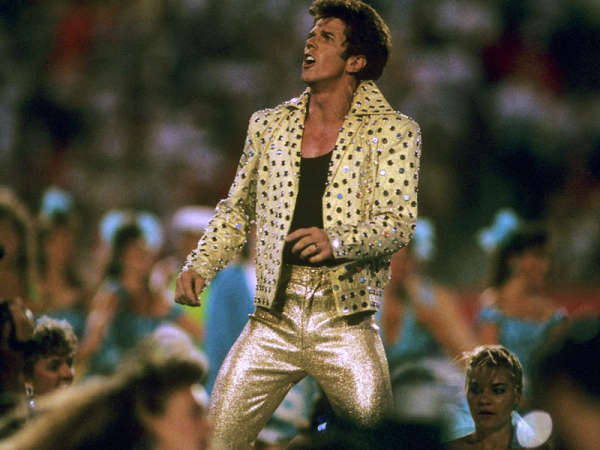
The transition from one era to the next was marked using the only technology that made sense: 3D. In 1989, the world was to be ushered into the future. Coke promised the world the first 3D commercial, giving away free 3D glasses at convenience stores, and, tying in to this auspicious occasion, the NFL presented “Be-bop Bamboozled,” a singing, dancing tribute to the 1950s, featuring Elvis impersonator and magician Elvis Presto, who would attempt the world’s largest card trick, in three dimensions!
Make no mistake about it, the Presto idea was a terrible one. In the middle of a great game between the 49ers and the Bengals, Presto took the stage and sung exactly zero Elvis songs, likely because nobody was much interested in paying the rights fees needed. The “card trick” itself was about as gimmicky as possible, too, with Presto attempting to guess the card underneath the seats at Joe Robbie stadium via the time-tested applause-o-meter. Though he doesn’t notice it (and despite YouTube footage being too grainy for a good look in 2012), Presto failed to guess correctly. Having been apart of a few card stunts myself, I can tell you exactly why: There are always a few thousand assholes looking to make somebody look like an idiot. Here, for the record, is the entirety of that halftime show, complete with the Diet Coke commercial:
Granted I was one at the time, but I suspect the reaction to Be-bop Bamboozled was such that America needed two decades of recovery in order to accept 3D again. The Diet Coke ad proved, twenty years ahead of its time, that 3D was an unnecessary gimmick, and Elvis Presto faded into obscurity. The best part of this show, other than that some firm named “MagicCom” was once affiliated with the now unavoidable marketing giant that is the NFL, is Bob Costas making fun of the whole thing, distancing himself just enough so its stench doesn’t cling to him.
But this is the way halftime shows were, largely because, in 1989, we were foolish enough to believe that the Super Bowl was about football. Sure marching bands were often involved, but before New Kids on the Block set the precedent we’ve been living with for 22 years, halftime shows were either an awkward pageant put on by a charity, or an awkward magician doing his best to entertain an unimpressed crowd.
In Elvis Presto’s world, Nipplegate is no longer possible, the biggest bands in the world make due not playing free concerts, and internet dweebs debate the merits of “football magic.” This, obviously, is what we should go back to; awkward shows actually worthy of derision. It might not be the Super Bowl halftime show America wants, but it’s clearly the one America deserves. Madonna, she did good last night. Historically great, given the majority of the competition. If Super Bowl viewers are really that offended that a woman gets to do the halftime show once every ten years, they deserve a lifetime of Presto, Up With People and Paul McCartney’s “Freedom.” Then they, like the city of Detroit when saddled with Nickleback, will know the true meaning of suffering.
In all honesty, Underworld: Awakening is the first movie in the franchise I’ve seen that makes complete, perfect sense. Previous films in the Underworld series relied on an intricate, muddied backstory as a kind of smokescreen, lending significance to three rather insignificant movies where a woman in a leather catsuit blasted away at waves of CGI creatures who resemble the original Wolfman in name only. They were digestible enough, but boy did they have an unwarranted sense of self-importance, going on and on about vampire elders and ancient vamp/werewolf relations as if Kate Beckinsale needed an excuse for the outfit and the guns.
The only past Underworld: Awakening is concerned with is the recent past, where Selene (Beckinsale) and her lover Michael (Scott Speedman, in previous films) attempt to escape underground in the aftermath of the human discovery of vampires and lycans, the human population having turned to mass genocide to rid themselves of both species. They’re both captured, but 12 years later Selene is released from her cryogenic freezing chamber, deep in the bowels of a medical research facility.
In this brave new world, vampires and lycans have been driven deep underground, and, more importantly, Selene has a daughter, Eve (India Eisley), with whom she can telepathically communicate. As a vampire/lycan hybrid, Eve is of particular importance to the werewolves, who wish to use her genetic make-up to do some scientific hooey that’ll make their race unstoppable. The lab guys, led by Dr. Jacob Lane (Stephen Rea), also want Eve back, but if that’s due to her being “lab property” or because Lane has other, seedier plans is unknown. Pretty much, this sets up a bunch of shoot outs, chase scenes, and fight sequences where Selena and any number of allies take on the lycan horde and the occasional human interloper.
That, in a nutshell, is Underworld: Awakening. Yes, there are subplots. The vampire underground is as snaky and worthy of mistrust as they were in previous installments, led by an elder vampire who holds Selene and her offspring in disregard. While this was the motivating factor behind other films in the franchise, here, one can’t help but sympathize with them. When the leader points out that most vampires fortunate enough to share a room with Selene end up dead, he is proven correct in short order, as the clan comes under attack from the lycan horde hunting her. Then there is the matter of the werewolf twice the size of any yet seen. The idea of lycan steroids is kind of interesting and barely touched upon, but in the end it plays out as you’d expect: The double werewolf gets the upper-hand for awhile, but he dies just like a normal one would. I presume the movie wants me to imagine a world where there are a ton of giant lycans running around, but the problem there isn’t the ridiculous conceit. Bigger might mean more dangerous, but considering that the wolves are all CGI, an army of giant werewolves standing shoulder to shoulder would probably make them look like normal werewolves.
But complaining about the unnecessary in a movie like Underworld: Awakening is pretty pointless. We’re four movies in on this franchise, and it now appears to have found a comfort zone, like the Resident Evil series, where nothing really makes sense, but things keep happening if only because they must. Heck, the only real difference between the two franchises is a question of superpowers, and considering that Selene and the rest of the vampires in the Underworld quadrology don’t suck much blood and use guns to get their killing done, even that difference is negligible. Resident Evil holds an advantage over Underworld in that it doesn’t take itself too seriously, but Underworld has its backstory from which to rip new, blandly efficient vehicles from. It will always have vampires. It will always have werewolves. It, for better or worse, will always be safe.
Unfortunately, “safe” in 2012 means “projected in 3D,” which means muted color schemes of gunmetal and cobalt in every conceivable location. There is little variance from one gunfight to the next and, apart from one or two cringeworthy bits during the fighting, nothing really exciting happens. There’s a pile of dead bodies in this film that reaches to the vanishing point, but they’re all nameless, faceless, without impact, either carrying guns or brandishing claws. This, certainly, is to be expected from most brainless entertainments, but Underworld has long pretended to be something more than that. And yet, beneath the skintight catsuits and the endless gunplay, Underworld: Awakening is heartless, antiseptic. I can’t say I’m surprised by my lack of interest in Selene’s ongoing plight, given all that. One doesn’t stay 15 forever. Eventually, women become real.
Rating:
Underworld: Awakening. Directed by Måns Mårlind and Björn Stein. With Kate Beckinsale (Selene), Stephen Rea (Dr. Jacob Lane), Michael Early (Det. Sebastian), Theo James (David), and India Eisley (Eve). Released January 20, 2012, by Screen Gems.