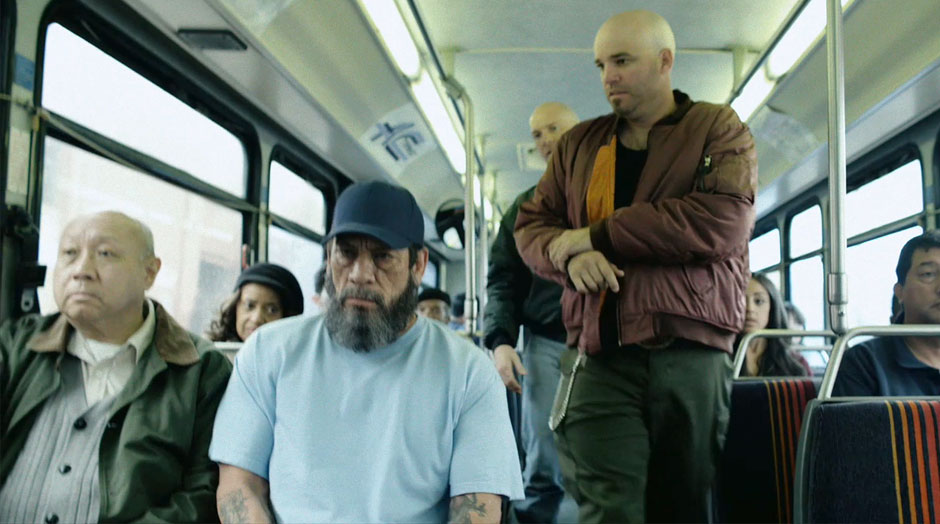
Seven Psychopaths is a movie about making movies. More specifically, it’s a movie about writing movies, putting it in the same ballpark as Barton Fink and Adaptation, but with a few crucial differences. Its protagonist, for example, never holds himself up as some great artist, and once he gets into his story, he approaches his characters with zeal, if not a true sense of where those stories are going. Where Barton Fink and Adaptation (and Charlie Kaufman’s Synecdoche, New York, which was technically about a playwright) are darkly comic, psychologically-intense mirrors of the men who wrote them, Seven Psychopaths leaves darkness out of the equation. There’s scores of violence here, buckets of blood and more than a few charred corpses, but never a sense that it’s weighing too heavily on the writer’s mind. He puts pen to paper, unconscious of the fact that he’s part of his story’s tapestry.
To begin, Irish screenwriter Marty (Colin Farrell, standing in for director Martin McDonagh) is struggling to get through the first draft of his new movie, Seven Psychopaths. His agent is calling him, his girlfriend is barely tolerating him, but he’s got a movie about seven psychopath and not one good psychopath to write about. His friend Billy (Sam Rockwell), an aspiring actor, points out an article in the newspaper about a serial killer known as The Jack of Diamonds, who kills ranking members of organized crime syndicates. He also tells Marty about a Quaker (Harry Dean Stanton) who haunts the man who killed his daughter until, having suffered a complete mental breakdown, the killer commits suicide. He does this guaranteeing his own damnation, but figures he’ll never see the Quaker again. He’s wrong though, as the last thing he sees is the Quaker slitting his own throat. Two psychopaths down.
Despite Billy taking out an ad in the paper for psychopaths looking to tell their stories (a contrivance that leads to the always welcome Tom Waits telling the grisly tale of his and a lost love’s quest to go on a cross-country killing spree) and his wish to see the best damn movie called Seven Psychopaths possible, Seven Psychopaths isn’t about Marty’s quest to write a movie, but about friendship and bonding. After establishing Billy and his partner Hans (Christopher Walken) as a pair of dognappers who’ve abducted the prized Shih Tzu of an emotionally unstable mob boss (Woody Harrelson), the three head out to the desert to camp out, eat peyote, and finish Marty’s movie. Billy has designs on finishing the movie with a grand, climactic, somehow cathartic shootout involving the real and fictional psychopaths they’ve crossed paths with, but both Marty and Hans are pacifists who eschew violence and who want Seven Psychopaths to stand for something more.
As entertaining as the conversation between these three on the nature of violence (in life and in film) is, none of Seven Psychopaths‘ higher ambitions hold up to even cursory scrutiny. Marty speaks of Buddism at one point, but in this very western way that feels ill-considered and improperly applied. There’s a point to his discourse, and the way he, Billy, and Hans speak leading up to the dramatic final shootout is one of McDonagh’s many meta-textual winks and nods, but at no point does it feel like the cleverness of Seven Psychopaths is being put to any true purpose. With nowhere to go, the meta-textuality of Seven Psychopaths tends to distract, rather than enhance.
But Seven Psychopaths doesn’t need a smart hook to succeed. It does so largely on the merits of its characters—most of whom play like outsized urban legends—and the actors occupying them. There’s a kind of sweetness to Billy’s quest to cure his friend of writer’s sickness, to his encouraging Marty to lay off the booze and put pen to paper, an endless charm to Sam Rockwell’s manic energy. Marty’s frustrations and breakthroughs in writing Seven Psychopaths are perhaps the most realistic of any movie outside Adaptation. There’s something about the way he dreads hearing whatever story Waits’s character has to tell, followed by the flash of recognition once it becomes clear that he’s hearing a really, really good story.
The film belongs to Walken, who this year has put aside soulless comedies using him as a man with a funny voice to once again become an actor who has within him the very soul of strangeness. His brand of peculiarity is one that is rapidly disappearing from movies, replaced by increasingly plasticine imitations. Hans is no great stretch for Walken, but it has been awhile since a character of such conviction has stumbled into a bloodbath like Seven Psychopaths. When he talks about a non-violent resolution to Marty’s problem of the Vietnamese warrior who has come to America to kill the men responsible for the slaughter of his village, there’s weight to his proposal. After all, he’s sat across from the man who killed his wife. He didn’t have the urge to pull a gun.
Rating:  Seven Psychopaths. Directed by Martin McDonagh. With Colin Farrell (Marty), Sam Rockwell (Billy), Christopher Walken (Hans), Woody Harrelson (Charlie), Michael Pitt (Larry), Michael Stuhlbarg (Tommy), Abbie Cornish (Kaya), Harry Dean Stanton (Man In Hat), Olga Kurylenko (Angela), Gabourey Sidibe (Sharice), and Tom Waits (Zachariah). Released October 12, 2012, by CBS Films.
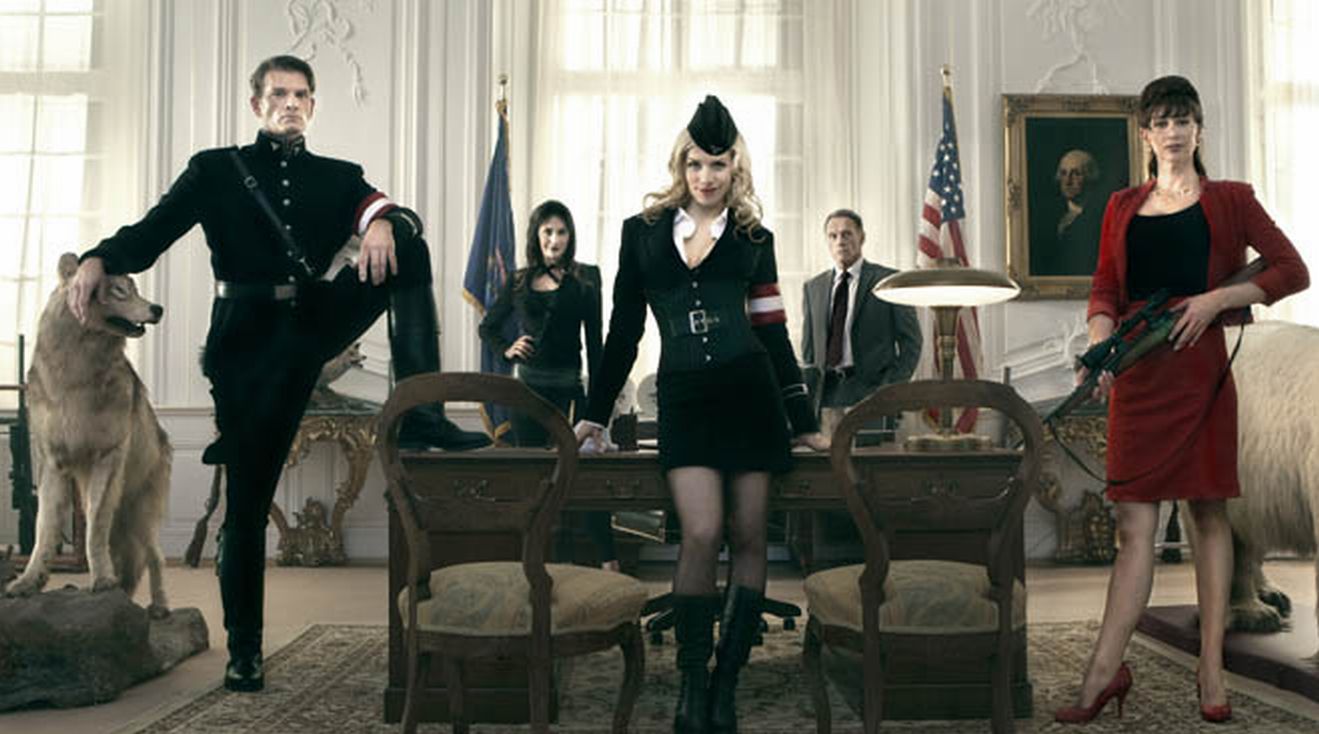
 Iron Sky, like many modern exploitation films, sets itself up for failure by promising something much, much greater than it is capable of delivering. The idea that buoys it should have been enough, but director Timo Vuorensola has ambitions beyond mere entertainment. Ambition, too, will kill a modern b-movie faster than bad acting, poor scripting, or lame special effects, all of which are acceptable, even welcome, given the circumstances. Classic exploitation movies, despite what the genre’s name suggests, didn’t go looking for context. Is there anything more vague than a hero’s struggle against “The Man?” Hardly. Whatever focus grindhouse movies had on social issues, more often than not context and purpose were things applied to the genre well after the its disappearance. The best modern tributes understand that politics and current headlines are elements serving to further sensationalize the bullets, broads, and booze, to further exploit a potential audience. The worst seek to lecture its audience through the use of broad comedy. It has ambitions. Ambitions get in the way.
 Iron Sky. Directed by Timo Vuorensola. With Götz Otto (Klaus Adler), Julia Dietze (Renate Richter), Christopher Kirby (James Washington), Peta Sergeant (Vivian Wagner), Stephanie Paul (The President of the United States of America), and Udo Kier (Wolfgang Kortzfleisch). Released July 25, 2012, by Entertainment One.

 Resident Evil: Retribution. Directed by Paul W.S. Anderson. With Milla Jovovich (Alice), Michelle Rodriguez (Rain), Sienna Guillory (Jill Valentine), Aryana Engineer (Becky), and Bingbing Li (Ada Wong). Released September 14, 2012, by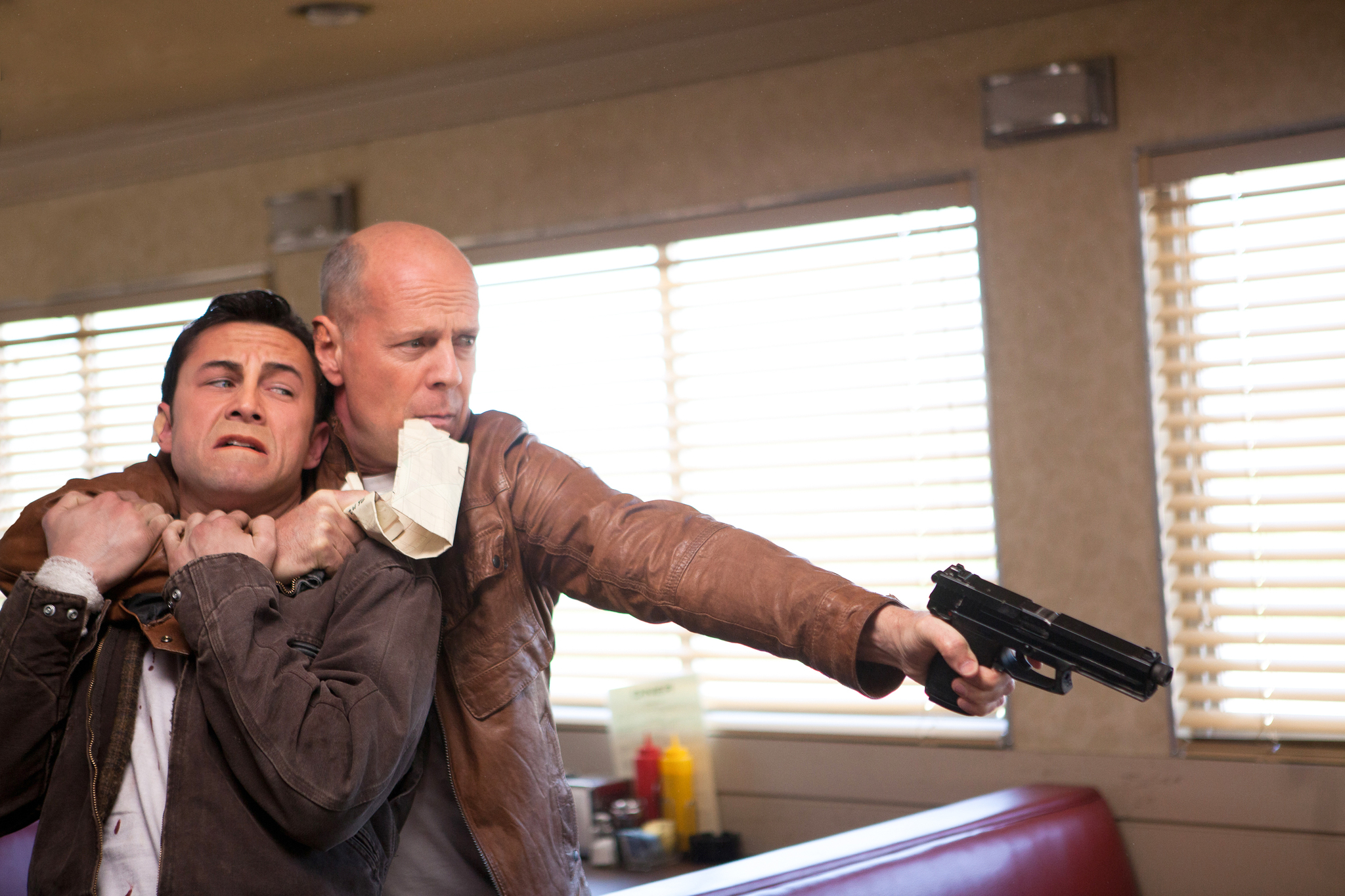
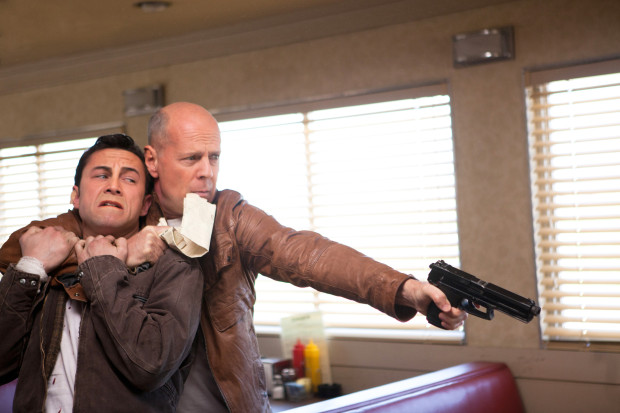 Looper contains elements of time-traveling science fiction, neo-noir, and pained romance, but, as a chase film, nothing is as complicated as it seems. Yes, there is time travel. There’s also a mob conspiracy, copious drug usage, and the perception and memories of the people involved in these rackets are framed with fuzzy edges, but the elements that play into Looper and the characters involve are there to ground the viewer in an unbelievably plausible, fully-realized United States of America, which, in 2044, is almost irreparably broken—a patchwork quilt of vagrant gangs, men and women with retrograde telekinetic powers, and mafia-run cities ruled by weathered men from the future. If certain aspects of
  Looper. Directed by Rian Johnson. With Joseph Gordon-Levitt (Joe), Bruce Willis (Old Joe), Emily Blunt (Sara), Paul Dano (Seth), Piper Perabo (Suzie), Pierce Gagnon (Cid), and Jeff Daniels (Abe). Released September 28, 2012 by