A time-displaced soldier. A Norse god. A playboy billionaire genius. A brilliant scientist who turns into a raging monster when angry. A former Russian spy. An expert marksman. On paper, a team comprised of six individuals this vastly different shouldn’t work. There are egos to deal with, competitive urges, the occasional extinction-level event. Since 1963, the Avengers have walked the very fine line between being Earth’s Mightiest Heroes and Earth’s Largest Screw-Ups. All it took back then was an assortment of popular comic book characters and the retrospectively brilliant idea of bringing a World War II era hero back from the publishing grave. In 2012, to get The Avengers together under the auspices of one movie took a more herculean effort: Five good-to-great movies serving as pretense, an assemblage of the right actors playing the right characters, and the right director at the helm of so much potential chaos. (more…)
Tag: movie review
-

Movie Review: The Cabin in the Woods (2012)
As an exercise in metatextuality, The Cabin in the Woods really only rises above mere cleverness once, when the small band of attractive college undergraduates gather in the living room of their rustic soon-to-be deathtrap to play a game of truth or dare. The one christened as the dumb blonde of the group is dared to make out with the taxidermied head of a wolf. The wolf—surely a big and bad one, before the axe fell—has teeth so sharp and eyes so bright one is tempted to think its mouth will snap closed, devouring our poor heroine. It’s a nice bit of tension, yes, but its jaws never clamp down. Instead, this young, blonde woman makes out with the head of a dead animal. She has three audiences: Her friends, the men and women watching on monitors from an undisclosed location, and you. Presumably, all three are titillated, and for precisely the same reason: Something pristine, unspoiled, and innocent (remember, blonde hair is a trigger for sympathy) is being deflowered by something wild, merciless, and foreboding. (more…)
-

Movie Review: Lockout (2012)
Lockout wants desperately for you to believe that its hero, the wise-cracking Snow (Guy Pearce), is a bad enough dude to save the president’s daughter. If creating an action hero were like ordering sushi a la carte, Snow would be the type of man who checks off a lot of boxes: Ex-CIA, wears leather jackets and sloganeering t-shirts, spouts rapid-fire jokes, uses big guns, has an active disinterest in forming relationships with attractive women, habitually smokes. Snow smokes despite a friend’s protest that it’s the future and nobody does that anymore. That’s how cool Snow is. He’s such a bad dude, he could likely rescue two president’s daughters. (more…)
-

Movie Review: The Raid: Redemption (2012)
I have, I think, a fairly unusual appreciation of kung-fu movies. It’s not just that I enjoy them, but that I’ve invested so much in them in terms of personal mythology. Like wrestling and like comic books, kung-fu movies are, at heart, a battle between Good and Evil. The characters within the genre are interchangeable, the level of violence variable. Fight sequences act as a kind of hand-to-hand chess match—the winner isn’t often the clear-cut best fighter, but the man or woman who has the best read on the board, who better anticipates his opponent’s strategy. Good defeats Evil, as it must, but Evil gets plenty of good licks in before the end of the film, looks sexier, feels more dangerous. (more…)
-

Movie Review: Mirror Mirror (2012)
Tarsem Singh‘s Mirror Mirror is a constant disappointment, a re-imagining of Snow White so droll and lifeless one wonders when a valiant prince will wander by to resuscitate the poor thing. Though it supposes itself a radical take on classic material, there is little—if anything—new going on here. The Queen is still evil. The princess is still beautiful. The prince, though oafish, is still charming. The two will mostly likely live happily ever after, the very picture of hetero-normative bliss.
Here, Snow White (Lily Collins) is the daughter of a King (Sean Bean). Her mother dies at birth, and her father re-marries. When he disappears, his second wife, Clementianna (Julia Roberts) becomes The Queen, using her royal appointment to drive up taxes and throw lavish parties. The kingdom, as one would expects, is in crippling financial peril, and The Queen must find a suitor who’ll provide her with a line of credit capable of maintaining her lifestyle. In wanders Prince Alcott (Armie Hammer), stripped to his underwear after a roadside encounter with a band of thieves. The Queen is immediately smitten and begins plotting to take him as a husband, but he is woefully infatuated with Snow White, who cut him down from the thieves’ trap. When White and Alcott dance at a ball the Queen throws to ensnare the Prince, it’s clear that the two were meant to be with each other.
Naturally, this enrages The Queen, who instructs her henchman (Nathan Lane) to take her to the woods, where she’ll be killed by a griffin-like creature who first appeared around the time The Queen took power. Despite Brighton’s slavish devotion to The Queen, he lets Snow White run away, where she takes up with the thieves—the seven dwarves. Together, they plan to return the Queen’s unfair taxes to the townspeople and restore Snow White to the throne, where she’ll presumably marry Prince Alcott and rule in peace. But The Queen, using the aid of her magic mirror, has Alcott under her spell, setting the stage for a royal wedding.
As cut-and-dry as it seems, Mirror Mirror is an absolute mess of plot elements, bits and baubles of fairy tale shtick stuck here and there to prop up an incredibly weak plot. The mirror, for example, seemingly exists as the story’s sole tangential connection to any previous version of Snow White; her ability to conjure love potions and send puppet assassins after Snow and the dwarves carrying a faint whiff of deus ex machina. The dwarves, too, are superficially updated for our time, given names like Half-Pint, Butcher and Chuckles, saddled with the backstories to match. They take Snow White in, teach her how to fight, and are then locked in their own house when the time comes for them to fight. This is perhaps a better fate than the one that befalls Brighton, who is turned into a cockroach for not killing Snow in the forest. “A grasshopper had his way with me,” he complains to The Queen, preparing for her wedding.
As one expects from a Tarsem movie, Mirror Mirror is visually sumptuous. The castle’s architecture, the odd hut that houses the mirror, the dazzling array of dresses worn by both Roberts and Collins, all of these things look terrific, perhaps better encompassing the heightened, romantic reality of a fairytale than many films that’ve come before. Unfortunately, they’re put in the service of a film so benign that even its climactic role-reversal feels trite, a matter of focus group tested obligation. The action sequences, too, are listless, staged like lazy re-creations of the brawls from Shrek.
Roberts, at least, appears to be having fun, and she is Mirror Mirror‘s saving grace. Though not quite sympathetic—Tarsem reportedly wanted the audience to look upon a woman who’d poison a teenager with an apple as more human than monster—her vanity not only makes her more human than any other character in the film, but also provides for all of the film’s worthwhile scenes, among them a lavishly ridiculous spa-treatment involving bees, worms, and bird droppings. When the cartoon peril is finished, I’m left feeling like The Queen probably deserves Prince Alcott more than Snow White does. God knows she put more work into her pursuit.
Rating:
Mirror Mirror. Directed by Tarsem Singh. With Julia Roberts (The Queen), Lily Collins (Snow White), Armie Hammer (Prince Alcott), Nathan Lane (Brighton), and Sean Bean (King). Released March 30, 2012, by Relativity Media.
-

Movie Review: Wrath of the Titans (2012)
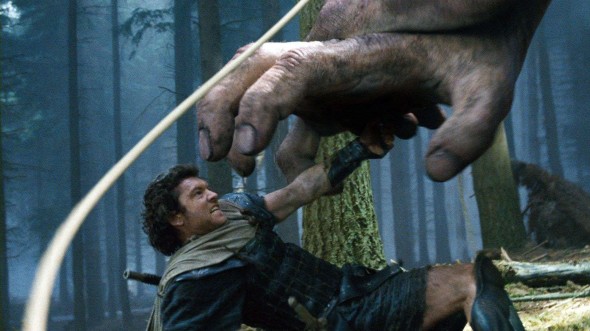
Much like its predecessor, Wrath of the Titans has, as it’s title, a misnomer: The only Titan here is Cronus, who, I’ll grant, is the Titan and is rather quite wrathful. In the Titans franchise’s continuing effort to streamline the whole of Greek mythology for the sake of added explosions, Cronus is much lesser a god than previous, here being a giant demonesque thing made of molten rock. As he spits words like “Zeus” and “Hades” at his children—who, as Zeus helpfully points out, he tried to kill many years ago—it’s hard to imagine the guy fashioning the universe, let alone concocting a successful, treacherous plan to spring him from the eternal prison of Tartarus. But, with the Olympian gods weakened from a lack of prayer and sacrifice, even the likely false promise that his accomplices will be allowed to keep their immortality is enough for the ruler of the underworld to take a flier on the guy who, tens of thousands of years ago, ate him fresh from his mother’s womb.
But, Wrath of the Titans would surely insist were it able, this is decidedly not a movie about the gods, whose time is ending. It’s about men, heroic men, men like Perseus (Sam Worthington), who will outlast the gods and forge new destinies without them. Perseus, last seen slaying the Kraken, is now a simple fisherman, a father hoping his son will never know war or pick up a sword. That dream ends as soon as Zeus (Liam Neeson) pays Perseus a visit, telling his son that the walls of Tartarus are falling, asking his assistance in rebuilding them. It’s a good thing Perseus doesn’t go, as Hades (Ralph Finnes) and Ares (Edgar Ramirez) double cross Zeus as soon as they arrive in the underworld, imprisoning him and killing Poseidon (Danny Huston). They hook Zeus up to Cronus somehow, intending to jumpstart the Titan as one would a car battery.
Meanwhile, the walls between this world and the underworld begin to crack, allowing demons to spill out from Tartarus and cause all manner of havoc. One of them visits the town Perseus lives on, a three-headed, fire-breathing monster whose anatomy is impressive if impractical, and, after killing it and finding a dying Poseidon, he knows he must set things to right. Pegasus spirits him away to the frontline of a hopeless war, where the warrior queen Andromeda (Rosemund Pike) grants him an audience with Agenor (Toby Kendall), who is not only the son of Poseidon, but who knows how to reach the island where Hephaestus (Bill Nighy) lives, Hephaestus being the god who forged the weapon that allowed the Olympians to defeat Cronus those many years ago. The three set off to seek his aid, the fate of the universe upon their shoulders.
Clash of the Titans, the remake of Ray Harryhausen’s homespun cult epic, is a movie that grew on me over time and repeated viewings on HBO one bored summer. I doubt Wrath of the Titans will do the same, as director Jonathan Liebsman just smooshes together various elements of Greek myth with no thought given to plot or pace. His band of warriors move from demons to a tribe of cyclops to the minotaur to a rather poorly-planned battle against Cronus and his sparsely-populated army, and while that looks like a lot of cool, eye-poping, dumb fun, the movie plods along, cutting short battle sequences and focusing instead on trite dialog between Perseus, Andromeda, and Agenor, who are all of a type, even when what they have to say is somewhat witty.
I wouldn’t mind any of that were the plot not so lazily conceived. True, Greek epics tend to begin in media res, but the human characters of Wrath of the Titans, Perseus and Andromeda in particular, seem to have a sprawling relationship built upon events the movie never hints at. Yeah, it’s obvious where the movie is going the moment Perseus buries his wife, but it’d be nice if the movie treated its characters like characters, didn’t excuse a prior history with a curt “It’s so good to see you again,” actually showed a budding romance. That Liebsman has the audience fill in the blanks contributes to Wrath of the Titans feeling brief, incomplete, but still somehow padded at 99 minutes.
All of this is too bad, because Wrath of the Titans does have a good cast slumming as Greek gods, with Bill Nighy adding some much-needed levity to the old routine of long beards and deep, bellowing voices. In a different movie, the aging and de-aging and aging of the gods would have been an effective bit of camp. Impressive, too, are the special effects, though it’s still hard for me to be charmed by an army of artists strapped to their computers, having been raised on a steady diet of clay and men in rubber masks. The labyrinth, which is the movie’s most stirring set-piece, is appropriately exciting, if easily solved.
I get the feeling, however, that these movies, like a great many in its genre, are only as good as its villain. Clash of the Titans had a CGI monstrosity so well-marketed its heralding became a catchphrase. Wrath of the Titans could have used something like “Release the Kraken!” Cronus—who, again, created the whole universe—could have been an effective, compelling villain, a being of unimaginable power and intellect. Instead, he’s a lava-monster, prone to blowing up the same mountain. The film hopes that we, like so many helpless virgin sacrifices, will find ourselves chained to that mountain. Unfortunately, Wrath of the Titans gives one little to believe in.
Wrath of the Titans. Directed by Jonathan Liebsman. With Sam Worthington (Perseus), Liam Neeson (Zeus), Ralph Finnes (Hades), Bill Nighy (Hephaestus), Rosamund Pike (Andromeda) Toby Kendall (Agenor), Edgar Ramirez (Ares), and Danny Huston (Poseidon). Released March 30, 2012, by Warner Bros.


