
Tag: Bill Nighy

  • Movie Review: Pride (2014)

    Movie Review: Pride (2014)

    I’m going to be honest here: The same thing that drew me to Pride had me dreading my experience of the film. Dreading it. I saw a set of .gifs on Tumblr, a showy scene where a queer activist tells a mostly closeted kid that a big part of queer history was reclaiming the slurs used against the community and using them against the oppressor. True, I suppose… but for a bunch of activists holed up in an apartment above a gay book store, everybody seemed so clean. They looked like characters from an ensemble comedy, or “punk” retrospectives like CBGB, where even the most strung out and miserable dregs of the scene were presented like automatons from a ride at Walt Disney World. I thought, based entirely on a series of images that’d been taken out of context, that I was in for a glib view of history, a film informed by the Vaseline-smeared lens of cinematic uplift.

    And I wasn’t entirely wrong. Pride is big and showy, an ensemble drama that’s more about culture clash than it should be, because that’s what happens with the passage of time: Corporations decide to fund and distribute a film about a socialist movement, the brief and unlikely union of red queers and mining unions, and a big deal must be made of gay vs. straight, London vs. Whales, young vs. old. Before a camera, with the issue’s many moving parts streamlined to make it all fit within the confines of a single motion picture, the people who were part of the movement become larger than what they stood for. It’s easy, after all, to talk about heroes. It’s uncomfortable, however, for a state-funded film to speak of revolution. A film like this has to frame the battle as won. A film needs resolution, and a film about queer and worker politics needs a resolution that says things got better so we can feel better about the world we live in when we leave the theater.

    So Pride isn’t about revolution or politics, despite its trappings. A group of lesbian and gay activists, seeking to stick it to Margaret Thatcher, figure out that governmental policies effecting Welsh miners are just as oppressive as the policies they face at the outset of the AIDS epidemic. Mark Ashton (Ben Schnetzer) forms the Lesbians and Gays Support the Miners campaign and, along with his comrades at the book store, starts raising money for the strike fund of the first miner’s hall that will welcome them. A garbled connection over the phone sends LGSM to the village of Onilwyn, where they are begrudgingly accepted because they’ve come with a good bit of coin. LGSM starts winning over the majority of the miners with the support of union leaders Cliff (Bill Nighy) and Dai Donovan (Paddy Constantine), miner’s wives (led by Jessica Gunning), and their dancing. But there’s a homophobic faction of villagers who are willing to damage their own cause so long as it sends the gays and lesbians back to London where they belong.
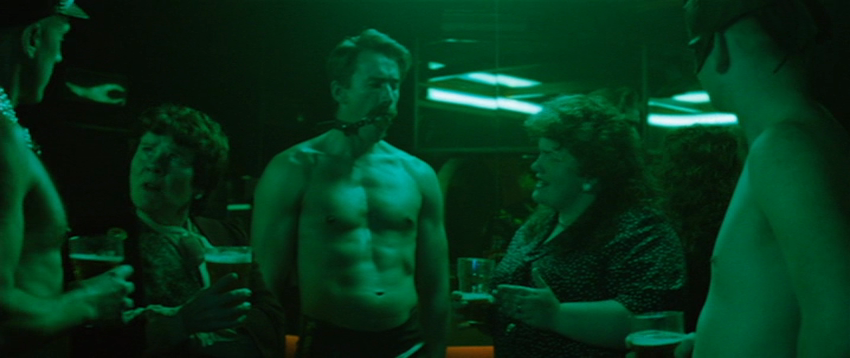
    Pride 2014 leather bar

    The year-long strike and its inner-workings are Zola’s Germinal brought to life, but Zola is dour and sad and suggests that coal miners—all workers, really—will be crushed endlessly under the boot heel of the bourgeois. Pride is a crowd-pleaser, though, all big hair and synth-driven soundtrack, punctuated by the occasional protest song or bit of danger. The first thirty minutes or so feature a lot of hard looks and hocked loogies from the breeder set. Bill Nighy gives a walking tour and recites poetry. Dominic West has an elaborate dance number where he leaps onto a table and shouts about how he misses disco. The old women of the village have a hell of a time learning about gay culture. There are two coming out narratives and two AIDS narratives, all of which suggests a story better suited to a TV miniseries. But while the whole enterprise should feel overstuffed and exhausting, Pride manages to be very fun, a heaping spoonful of sugar to go along with the biter knowledge that the 1980s weren’t all that enjoyable, music and fashion and community aside.

    That fun is tempered by Pride’s treatment of history as a closed book with some of its chapters excised. In the opening information dump, a newscaster mentions Thatcher’s plans to cut jobs, but goes into no detail about how a general strike works or what it entails. It looks like a long game of bingo over a few pints. Thatcher’s anti-gay policies are also at the fringes of the film, but here we’re operating with the blind faith that LGSM’s handshake deal with the miner’s union will pay off somehow. Everybody but LGSM, it seems, is living it up, as if government oppression was a thing only seven or eight queer people in all of London wanted to deal with. There again is the problem of framing this material as a film and not something longer and looser, a thing that can contract and expand and breathe. Nowhere is this more apparent than how the film presents feminist issues as an odd collection of notions to be laughed at (what, worry for your safety as a gay woman in a town full of leering miners?) or nodded to in knowing solidarity (yes, yes, sex can be enjoyable for women!). Also odd is the miners’ stated goal of getting everything back to normal, but that’s a movie revolution for you: All of the red propaganda filling the screen is a prop, “authentic,” but not authentic.

    While there’s nothing particularly striking about the visuals of Pride, I’m a union baby through and through—I was raised singing “Solidarity” and get misty-eyed when I see large-scale demonstrations in the movies, even if the people marching are too clean to suggest the kind of real-life suffering that engenders public action. It’s not much of a spoiler to say that Pride ends at the 1985 London Pride Parade, where LGSM are told they’ll have to march in the back. Nobody wants politics anymore. Everybody wants to party. Mark cries bullocks into his megaphone, but the attitude of the parade organizers and the film they appear in are the same, at heart. All of that political stuff is hard to handle. Can Bill Nighy recite another poem, please?


    Pride. With Bill Nighy (Cliff), Imelda Staunton (Hefina Hedon), Dominic West (Jonathan Blake), Paddy Constantine (Dai Donovan), Andrew Scott (Gethin Roberts), George MacKay (Joe Copper), Ben Schnetzer (Mark Ashton), and Jessica Gunning (Siån James). Directed by Matthew Warchus, from a screenplay by Stephen Beresford.

  • Movie Review: Total Recall (2012)

    Movie Review: Total Recall (2012)

    The problem with Len Wiseman‘s remake of Total Recall is a lack of imagination. Yes, that’s a problem most remakes suffer from, but this version of Total Recall actually doesn’t clash much with the Paul Verhoeven-helmed, Arnold Schwarzenegger-starring film of the past. The names and plot remain more or less the same, as does the mysterious memory-implanting company ReKall, but where Verhoeven built an entire planet—populating it with mutants and promising that, yes, there is life on Mars—Wiseman shrinks his worldview considerably, ousting Mars entirely to focus on a poisoned-earth narrative where the rich get richer while the poor build the engines of their own destruction. While the living space issue and the rich/poor divide suggest a film mindful of current events (Verhoeven, by contrast, seemed more concerned with having a good time), Wiseman’s fictionalized current events are window dressing to a plot that sees a stock Chosen One fight to dismantle an army of killer robots. There’s a long, distinguished line of movies like that, and Total Recall just doesn’t stack up. (more…)

  • Movie Review: Wrath of the Titans (2012)

    Movie Review: Wrath of the Titans (2012)

    Much like its predecessor, Wrath of the Titans has, as it’s title, a misnomer: The only Titan here is Cronus, who, I’ll grant, is the Titan and is rather quite wrathful. In the Titans franchise’s continuing effort to streamline the whole of Greek mythology for the sake of added explosions, Cronus is much lesser a god than previous, here being a giant demonesque thing made of molten rock. As he spits words like “Zeus” and “Hades” at his children—who, as Zeus helpfully points out, he tried to kill many years ago—it’s hard to imagine the guy fashioning the universe, let alone concocting a successful, treacherous plan to spring him from the eternal prison of Tartarus. But, with the Olympian gods weakened from a lack of prayer and sacrifice, even the likely false promise that his accomplices will be allowed to keep their immortality is enough for the ruler of the underworld to take a flier on the guy who, tens of thousands of years ago, ate him fresh from his mother’s womb.

    But, Wrath of the Titans would surely insist were it able, this is decidedly not a movie about the gods, whose time is ending. It’s about men, heroic men, men like Perseus (Sam Worthington), who will outlast the gods and forge new destinies without them. Perseus, last seen slaying the Kraken, is now a simple fisherman, a father hoping his son will never know war or pick up a sword. That dream ends as soon as Zeus (Liam Neeson) pays Perseus a visit, telling his son that the walls of Tartarus are falling, asking his assistance in rebuilding them. It’s a good thing Perseus doesn’t go, as Hades (Ralph Finnes) and Ares (Edgar Ramirez) double cross Zeus as soon as they arrive in the underworld, imprisoning him and killing Poseidon (Danny Huston). They hook Zeus up to Cronus somehow, intending to jumpstart the Titan as one would a car battery.

    Meanwhile, the walls between this world and the underworld begin to crack, allowing demons to spill out from Tartarus and cause all manner of havoc. One of them visits the town Perseus lives on, a three-headed, fire-breathing monster whose anatomy is impressive if impractical, and, after killing it and finding a dying Poseidon, he knows he must set things to right. Pegasus spirits him away to the frontline of a hopeless war, where the warrior queen Andromeda (Rosemund Pike) grants him an audience with Agenor (Toby Kendall), who is not only the son of Poseidon, but who knows how to reach the island where Hephaestus (Bill Nighy) lives, Hephaestus being the god who forged the weapon that allowed the Olympians to defeat Cronus those many years ago. The three set off to seek his aid, the fate of the universe upon their shoulders.

    Clash of the Titans, the remake of Ray Harryhausen’s homespun cult epic, is a movie that grew on me over time and repeated viewings on HBO one bored summer. I doubt Wrath of the Titans will do the same, as director Jonathan Liebsman just smooshes together various elements of Greek myth with no thought given to plot or pace. His band of warriors move from demons to a tribe of cyclops to the minotaur to a rather poorly-planned battle against Cronus and his sparsely-populated army, and while that looks like a lot of cool, eye-poping, dumb fun, the movie plods along, cutting short battle sequences and focusing instead on trite dialog between Perseus, Andromeda, and Agenor, who are all of a type, even when what they have to say is somewhat witty.

    I wouldn’t mind any of that were the plot not so lazily conceived. True, Greek epics tend to begin in media res, but the human characters of Wrath of the Titans, Perseus and Andromeda in particular, seem to have a sprawling relationship built upon events the movie never hints at. Yeah, it’s obvious where the movie is going the moment Perseus buries his wife, but it’d be nice if the movie treated its characters like characters, didn’t excuse a prior history with a curt “It’s so good to see you again,” actually showed a budding romance. That Liebsman has the audience fill in the blanks contributes to Wrath of the Titans feeling brief, incomplete, but still somehow padded at 99 minutes.

    All of this is too bad, because Wrath of the Titans does have a good cast slumming as Greek gods, with Bill Nighy adding some much-needed levity to the old routine of long beards and deep, bellowing voices. In a different movie, the aging and de-aging and aging of the gods would have been an effective bit of camp. Impressive, too, are the special effects, though it’s still hard for me to be charmed by an army of artists strapped to their computers, having been raised on a steady diet of clay and men in rubber masks. The labyrinth, which is the movie’s most stirring set-piece, is appropriately exciting, if easily solved.

    I get the feeling, however, that these movies, like a great many in its genre, are only as good as its villain. Clash of the Titans had a CGI monstrosity so well-marketed its heralding became a catchphrase. Wrath of the Titans could have used something like “Release the Kraken!” Cronus—who, again, created the whole universe—could have been an effective, compelling villain, a being of unimaginable power and intellect. Instead, he’s a lava-monster, prone to blowing up the same mountain. The film hopes that we, like so many helpless virgin sacrifices, will find ourselves chained to that mountain. Unfortunately, Wrath of the Titans gives one little to believe in.

    Rating:

    Wrath of the Titans. Directed by Jonathan Liebsman. With Sam Worthington (Perseus), Liam Neeson (Zeus), Ralph Finnes (Hades), Bill Nighy (Hephaestus), Rosamund Pike (Andromeda) Toby Kendall (Agenor), Edgar Ramirez (Ares), and Danny Huston (Poseidon). Released March 30, 2012, by Warner Bros.