Tag: Warner Bros

  • Movie Review: The Hobbit: An Unexpected Journey

    Movie Review: The Hobbit: An Unexpected Journey

    The Hobbit

    Peter Jackson’s The Hobbit: An Unexpected Journey, attempts a rare trick, inflating the narrative of a relatively short novel to accommodate a studio’s need for a franchise. By revisiting his earlier Lord of the Rings movies, plumbing the depths of other Tolkien works, meandering, as The Fellowship of the Ring did, in the Shire, and through invention, Jackson has succeeded in his task—J.R.R. Tolkien’s The Hobbit, as interpreted by Jackson, Guillermo del Toro, and an army of writers, producers, actors, extras, and digital effects artists, will indeed fill the overlarge frame it’s been mandated. The question going into The Hobbit, and this is of particular importance following the bloat of the underrated King Kong and the nigh unforgivable The Lovely Bones, is whether or not Jackson would be able to pull back on his particular brand of bombast long enough to tell a good, engaging story about a band of outsiders questing to rid a mountain of a gold-loving dragon.

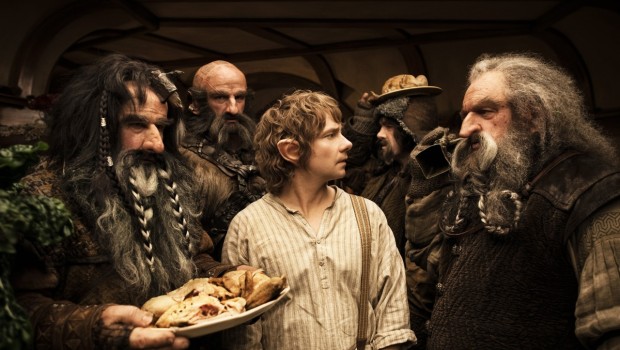
    Yes and no. At times, The Hobbit: An Unexpected Journey manages to recall the highest points of Jackson’s Lord of the Rings trilogy. The characters are warm, the landscapes vast and pristine, the CGI mostly an enhancement. In adapting a beloved book as a prequel to a beloved film franchise, Jackson invites nostalgia from the film’s opening moments, as Bilbo Baggins (played as an older hobbit by Ian Holm, and for the majority of the film by Martin Freeman) is shown writing an account of his life for the benefit of his nephew Frodo (Elijah Wood), himself a future adventurer. Gandalf the Grey (Ian McKellen), Elrond (Hugo Weaving), Galadriel (Cate Blanchett), Saruman (Christopher Lee), and Gollum (Andy Serkis) appear throughout, if not to propel the plot, then to gently remind viewers of the elements shared by this trilogy and the one from the recent past.

    The bulk of this chapter deals with the preparations made by Bilbo, Gandalf, and a company of dwarves—led by the brooding, kingly Thorin Oakenshield (Richard Armitage)—before attempting to infiltrate the former dwarven homeland, now occupied by a dragon named Smaug. Much has been made of how slowly the first hour of The Hobbit slogs through these details, and that’s true; however clever it seems to have the old Bilbo coyly writing his memoirs as Frodo waits for the arrival of Gandalf with his fireworks, one can’t help but feel cooped up in Bilbo’s den, especially when entering the film with the knowledge that Bilbo sets off on an adventure, finds a ring, gains the respect of his company, and so on. This is an inferiority complex unique to prequels, one that has damned many such efforts in the past, but once Jackson sets his company out into Middle Earth, things pick up considerably.

    The Hobbit also suffers from some of Jackson’s penchant for self-indulgence. I saw the movie in 2D, and while the vistas of New Zealand and its populace of CGI orcs, mountain trolls, and giant eagles looked mostly good, there were times, when panning through the goblin kingdom or over a vast mountain, when the visuals were noticeably less crisp than in any recent Jackson film, as if I were being punished for choosing not to see the film in 3D and at a higher framerate. In one of the film’s huge battle sequences, pitting the dwarves and Gandalf against a gleefully Dickensian goblin king (Barry Humphries) and his army, the disconnect between what’s real and what was filmed against a greenscreen becomes too much. It’s obvious that none of the dwarves will die, but they rack up the kills on the poor, witless goblin army like an expert video gamer in the early levels of a well-worn arcade game.

    Though he certainly tries, Jackson is unable to differentiate many of the dwarves tagging along with Bilbo and Gandalf on their journey. Some are fatter, older, or jollier than others, but, for the exception of the mopey, vengeful Thorin, they’re all mostly the same. The Hobbit: An Unexpected Journey relies upon Freeman and McKellen to carry the bulk of the film’s 169-minutes, which they’re quite capable of. When Gandalf the Grey is held back by a largely ominous, slow-moving discussion foreshadowing the conflict of the second film, Bilbo finds himself matching wits against Gollum. As Gollum, King Kong, Cesar the Ape, or Captain Haddock, few actors have meant as much to special effects spectacles as Andy Serkis, who could probably lend humanity to a broomstick. The tragedy of Gollum and the character’s madness, however, are two well-trod roads, and his game of riddles against Bilbo Baggins, though vital to series lore, never rises above being a witty aside. Compared to Gandalf’s conversation with Elrond, Galadreil, and Saruman, however, it’s pressing, kinetic stuff. Still, for all its down moments, The Hobbit: An Unexpected Journey is that rare creature: a good, mainstream fantasy film, a franchise-extending artifact that manages to find enough warmth to justify its existence.

    I’ll admit, when it comes to splitting book adaptations into an endless succession of questionable sequels, I’m a bit of a skeptic. It’s a recent trend, the franchise addendum, and begs an odd indulgence of its core audience, the fans of the book: pay for some now, and pay again for the rest later. Harry Potter did this. The Twilight Saga did this. Upcoming adaptations of The Hunger Games and 50 Shades of Grey will likely follow suit, with little question of the studio’s motive in releasing as many gigantic blockbusters as possible in successive years. But that’s decidedly not the tone of the coverage surrounding this particular adaptation. A relatively slim volume, especially compared to the tomes that contain the largely empty prose of E.L. James, Stephanie Meyer, or Suzanne Collins, the only precedent for turning Tolkien’s fantasy into a full-blown sojourn on the level of the Lord of the Rings trilogy are the expanded editions of those films, which further packed and padded a series of movies that were, at times, already overstuffed. For many fans of Harry Potter or Twilight, the added film served as an opportunity to bring the series to a fitting, properly epic conclusion. As a casual onlooker, I can’t say I agree with their enthusiasm. I try, as much as possible, to separate a book from the film based upon it, but, for me, the adaptations that work the best are the ones that pare down on the impulses a blank page grants an author, rather than eat-up more than an already considerable chunk of time trying to please every die-hard in the audience.

    What Jackson has done with The Hobbit is rare in that the decisions he’s made in adding to The Hobbit are decidedly not made for the benefit of his die-hard audience, who, to paraphrase the words of The Mountain Goats’ John Darnielle, want a one-film version of The Hobbit where a dragon is slain in the end. I won’t suggest that Jackson’s planned trilogy (who knows—maybe they’ll split the third film in two, like a magician with a saw) isn’t an opportunity for Warner Brothers, New Line Cinema, and MGM to fashion themselves a clutch of gold, but if any literary universe is capable of sustaining the sort of expansion the director and his writers have undertaken, its Tolkien’s. The horde of books, short stories, note cards, and outlines the author left is breathtaking, and the odds of any of that material making its way to the theatre on its own are slim. Some of Jackson’s additions, like Radagast the Brown (Sylvester McCoy)—a wizard who speeds his way through Middle Earth on a rabbit-driven sled, his goofiness in the face of world-ending danger a reminder of the sillier aspects of George Lucas’ Star Wars prequels—add nothing. A necromancer (Benedict Cumberbatch in name only—he appears momentarily as a CGI construct, bits and bytes over flesh and blood) from another Tolkien story serves to perhaps unnecessarily tie together events from this film and the Lord of the Rings. But the film’s main addition, the Pale Orc, is not only something created wholecloth for this film, but is a character whose quest to murder Thorin Oakenshield for the loss of his arm is more immediately relatable to on screen than, say, a pack of talking dogs or a flock of hyper-intelligent eagles. The stakes of prequel films, whose outcome is determined by prior movies whose success does not always equal interest in “the rest of the story,” are notoriously low. By playing with elements from Tolkien’s expanded Middle Earth, Peter Jackson has found a way to infuse his prequels with tension and suspense. In its best moments, The Hobbit: An Unexpected Journey easily meets the expectations of its pedigree. The Hobbit may not be either a perfect film or adaptation, but neither were those sainted films preceding it.


    The Hobbit: An Unexpected Journey. Directed by Peter Jackson. With Ian McKellen (Gandalf the Grey), Martin Freeman (Bilbo Baggins), Andy Serkis (Gollum), Richard Armitage (Thorin Oakenshield), Sylvester McCoy (Radagast the Brown), Hugo Weaving (Elrond), Cate Blanchett (Galadreil), Christopher Lee (Saruman), Ian Holm (old Bilbo), and Elijah Wood (Frodo).

  • Movie Review: Haywire (2012)

    Movie Review: Haywire (2012)

    essentialEfficient. That’s Steven Soderbergh‘s Haywire in one word. These days, it’s nothing for a thriller to hop around the globe, to squeeze in swerves and car chases, to fashion for themselves a superhuman killing machine. Haywire does these things as well—if not better—than its contemporaries, but its pace is ruthless, breakneck. At 92-minutes, there is no fat on its bones, and no queasy-cam gimmicks, either. When Haywire stops to take a breath, it’s only to show how tightly the net around its heroine is constricted.

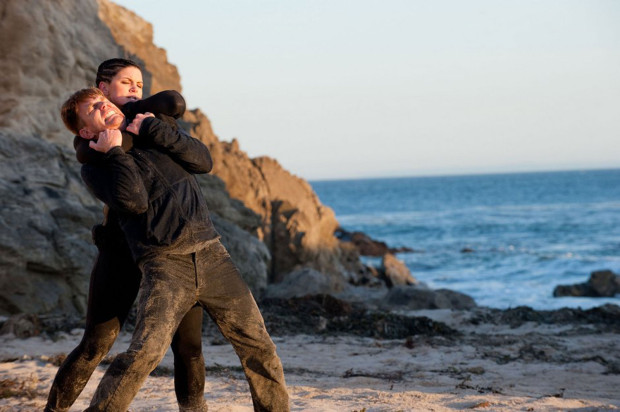
    Malory Kane (Gina Carano) is our superhuman, the focus of a plot that aims to take her out. As Haywire opens, shes sitting in a cafe in upstate New York, sipping tea. Before she has time to finish her cup, she’s locked in a brutal fight with Aaron (Channing Tatum), a man she worked with on a project in Barcelona. A good samaritan (Michael Angarano) hands her the keys to his car, and the two speed off for Parts Unknown, Kane narrating her story to the mostly terrified teenager. The story is simple enough. Kane’s a contractor who works for a private firm that governments hire out to glean information, recover lost assets, rescue dissidents—spy business. She’s requested to be a member of a team extracting a hostage from Barcelona. Her boss, Jeremy (Ewan McGregor), is hesitant at first, but when his employers—U.S. governmental employee Alex Coblenz (Michael Douglas) and Rodrigo (Antonio Banderas), a man with no specific origin—agree to certain contractual details, Kane is put on the case, the hostage is rescued, and all is well. Or so it seems.

    It happens that Jeremy’s business is wholly reliant upon Malory Kane and that, after the dissolution of their personal relationship, Kane is looking to get out of her business obligations with him, as well. First, he gets her to agree to an assignment that’s pretty much a “paid vacation,” a chance to persuade an agent to join Jeremy’s team while at the same time making contact with that agent’s mark under the guise of being a power couple. That agent, Paul (Michael Fassbender), has been assigned to kill the hostage Kane rescued, plant evidence on the body pointing to Kane, then kill her, making it look like an act of self-defense. Simple enough, except that Kane ends up killing him and going on the run, making her way back to the United States to clear her name, uncover the conspiracy against her, and gain a measure of revenge.

    Haywire‘s frequent action set pieces are engaging, covering all the bases. Across rooftops, on foot, and behind the wheel of a car, it’s clear that there’s nobody like Malory Kane, who, when she is brought down, succumbs only to the sheer number of people set against her. Soderbergh’s films, regardless of how kinetic they often feel, rarely move like Haywire, which has a fluidity and clarity of vision rarely afforded to a typical thriller. There’s an effortless cool to the way he films Carano chasing down her prey, jumping from roof to roof, and employing her dazzling array of mixed martial arts maneuvers.

    Speaking of Carano, this is her first feature film, though it would be surprising were this to prove her last. Carano is granted quite the set of crutches in Haywire: she’s guided by McGregor, Douglas, and Bill Paxton (as Kane’s father), prodded by Banderas, and romanced by Fassbender and the great lunkhead Tatum, who, given this film and his self-effacing turns in 21 Jump Street and Magic Mike, is perhaps smarter than anybody has yet to give him credit for. Though she sometimes looks out-of-depth when standing across from somebody the caliber of Michael Douglas—it’s worth pointing out that whatever charisma she possesses has, thus far, only been used in brief flashes during pre- and post-fight interviews and press conferences—she mostly holds her own.

    It helps that Soderbergh is a director who’s proven masterful at identifying and exploiting the strengths of his cast. The choice of Carano in this role is no less unusual than, say, his choice of Sasha Grey as an escort, and Carano’s fighting skills are put to good use here, the reality of maneuvers like the cross armbreaker and the triangle choke only further embellishing the punishment she deals out. Tatum’s character has his arm broken in Haywire‘s opening sequence. Watching Carano swiftly grab his arm and snap it back, it’s little wonder that Tatum later appears in a cast, arm hanging useless at his side. Here, it’s the little flourishes of realism that matter, that paint Carano as a budding star as opposed to a neat little stunt casting. Like her character, it’s clear that Gina Carano can do things no other actress is capable of. So long as she avoids becoming a female Expendable, her presence in the genre can only change it for the better.


    Haywire. With Gina Carano (Malory Kane), Channing Tatum (Aaron), Ewan McGregor (Jeremy), Bill Paxton (John Kane), Michael Fassbender (Paul), Michael Angarano (Scott), Antonio Banderas (Rodrigo), and Michael Douglas (Alex Coblenz). Directed by Steven Soderbergh from a screenplay by Lem Dobbs.

  • Movie Review: Magic Mike (2012)

    Movie Review: Magic Mike (2012)

    Magic Mike is a movie about strippers. It is not, however, a movie about stripping. That’s an important distinction to make, as a movie about stripping, as proven by all movies about stripping, would get old fast. Gyrating to the right or to the left, dancing with a skinny girl or an old woman, dressed in trenchcoats or loincloths, the stripper still strips, his function is still to take off clothes, his biggest conflict is with a caught zipper, a button that won’t unsnap from his tearaway pants. Make no mistake, Magic Mike is quite knowledgeable in this field, but Steven Soderbergh‘s film—based on its star’s experiences on the stage—knowingly subverts its audience’s expectations, presenting a melodrama where the stripping is a glitzy side dish, something that threatens to steal both the audience’s attention and the protagonist’s autonomy. (more…)

  • Best Worst Movie, or Worst Movie? — Batman & Robin (1997)

    Best Worst Movie, or Worst Movie? — Batman & Robin (1997)

    Cultish devotees of film often celebrate failure, box office, critical, or otherwise. By designating awards to the year’s worst movies, organizing midnight screenings of a film on the fringe, and writing endlessly about one flop or another, bad movies have a way of sticking around well beyond their typical cultural sell-by date. The phrase “so bad it’s good” is often ascribed to these movies when, in a pre-Internet, pre-Mystery Science Theatre 3000 world, they used to be considered so bad, they’re virtually forgotten. This week, as part of the Camp & Cult Blogathon at She Blogged By Night, Fear of a Ghost Planet is introducing a new feature that takes a good, hard look at the supposed jewels hiding in a cinematic junk heap. The first edition of Best Worst Movie, or Worst Movie? seeks to answer that question of Batman & Robin, long a movie the author considered a trashy favorite. How well does it hold up, fifteen years later?

    Batman & Robin doesn’t take long to announce its intent to annoy. Before Robin proclaims that chicks dig the car, before our first shot of a Batcave decked out in unnecessary logos and drenched in dry ice fog, before even the first glimpse of a bat-nipple, there are the opening credits. There is Batman’s logo, quickly frozen by some neon-blue ice before giving way to the neon-red backdrop against which the primary offenders names are cast. Those two colors, not only are they among the worst man has created, but they come to dominate the color palate utilized by director Joel Schumacher, whose affectation for these two colors is, to the Gotham City styled by Tim Burton, a revisionist disaster on par with Ecce Homo.

    There’s nothing good about Batman & Robin, that much I readily admit, but there’s rarely anything good about a Best Worst Movie. To appreciate something like this, to enjoy such a film, is to enjoy wallowing in muck. Well, I have been carrying this not-so-secret shame for some time: I have been a fan of Batman & Robin for fifteen years now. It’s beyond any reasonable basis of judgement, but for the better part of my life I have stuck up for this movie, in every conceivable way the ugly duckling of the Batman mythos. For the longest time, I’ve been planning to write something to that effect, to gather my reasons for liking this movie and stand my ground. Not to posit a secret genius to Schumacher’s work, per se, but to propose that, in the right frame of mind, Batman & Robin is actually enjoyable, indeed a candidate for the status of Best Worst Movie. But I recently caught the last thirty minutes on TV, and, well, they left me cold. Now, much to the chagrin of my inner-nine-year-old (who practically grew up at the local dollar theatre), I’m ready to repent. (more…)

  • Movie Review: The Campaign (2012)

    Movie Review: The Campaign (2012)

    The Campaign is so obvious in its intent that, within the movie’s brief runtime, two characters are able to lament that “Big Money” controls the government. It concerns a pair of Congressional candidates from North Carolina—both of whom are almost criminally unfit for office—one of which is funded by the shadowy, money hungry Motch Brothers (John Lithgow and Dan Aykroyd), who hope to use their seat in congress to get the ball rolling on something they call “insourcing,” the importing of Chinese labor and regulations to American factories, to double their already stupendous profits.

    (more…)

  • Movie Review: The Dark Knight Rises (2012)

    Movie Review: The Dark Knight Rises (2012)

    The word “ambitious” has been used to describe Christopher Nolan‘s The Dark Knight Rises, almost as an apologia. In a summer containing superhero epics that’ve conquered the globe through a combination of charm, polish, and weightless fun, a glum, glowing Batman film can’t help but feel like a party-crasher, a mirthless rebuttal to the joyful hedonism proffered by Marvel Studios. It just so happens that Nolan’s third and final Batman film is ambitious. Functioning as a third act, it introduces a slew of new characters, expounds upon ideas Nolan subtly presented behind the smokescreen of Heath Ledger‘s mesmerizing performance as The Joker in The Dark Knight, and brings his massive, decade-spanning and character-defining story to a close while leaving the door slightly ajar, suggesting both a Gotham without Batman, and a Gotham that can’t survive without one. It’s an audacious juggling act that’d succeed on the merit of sheer scale were it not for the fact that The Dark Knight Rises is just as successful as its predecessors in painting an only slightly-warped representation of our society, gently nudged to its extremes. If The Avengers and The Amazing Spider-Man were long on great power, trading in narrative subtly for titanic struggles between Good and Evil, The Dark Knight Rises is a sobering reminder that any struggle, no matter how titanic, is a grey affair, that the people who fight with the greatest power also have the greatest responsibilities and, ultimately, should make the greatest sacrifices. Its ambition is to hold its characters up to the audience as a mirror. (more…)