Category: Reviews

  • Movie Review: The Girl With the Dragon Tattoo (2011)

    Movie Review: The Girl With the Dragon Tattoo (2011)

    In two movies now—The Girl With the Dragon Tattoo and The Social Networkdirector David Fincher has made something exciting out of the mundane. Not that the mystery at the heart of this remake isn’t engrossing, but the way its protagonists set about solving it, in the hands of just about any other Hollywood director, would be the film’s nadir. Like The Social Network‘s sequences involving long, impenetrable sequences of code, much of The Girl With the Dragon Tattoo is spent researching, blowing up photographs, looking through slide shows, the Bible, and, in 2011, a card catalog.

    This meticulous combing through of old evidence should be boring, but it draws the eye in, asks the viewer to pitch in and solve the mystery with the detectives. It works, even if you can solve the mystery; even, I suspect, if you’ve read the original novel or seen the 2009 Swedish adaptation of it. The Girl With the Dragon Tattoo is beautifully crafted and well-paced. Clocking in at well over two hours, containing three seemingly unwieldy plots that don’t converge at the center until midway through the movie, Fincher manages to cast familiar territory (even if you haven’t read the novels, the set-up is pure Agatha Christie) as dark, ominous and full of dread. It’s obvious the characters in the movie are walking through a minefield. The suspense is waiting for one of them to make the wrong step.

    After being brought down by a Swedish tycoon for a supposedly libelous article in Millennium Magazine, disgraced journalist Mikael Blomkvist (Daniel Craig) is hired by the millionaire Henrik Vanger (Christopher Plummer) to investigate the 40-year-old case of his murdered niece, Harriet. The circumstances of the day—a family reunion/company board meeting on a private island, the bridge to which was cut off by an automobile accident—means that Harriet was murdered by one of her own family members, all of whom lead reclusive lives on the island’s various houses. All of the family members appear unbalanced, some of them were Nazi sympathizers during the war. The mystery, for all intents and purposes, seems indecipherable; Blomkvist has been hired to chase after ghosts at the edges of old photographs.

    He is eventually assisted by Lisbeth Salander (Rooney Mara), a damaged, abused young woman who, like Blomkvist, is an expert investigator, though she comes from an entirely different school of detection. Where Blomkvist relies on personal interviews and the old trick of posting suspect’s names on the wall, Salander is a search engine savant, an obsessive observer, and not entirely pleasant company. A ward of the state, Salander’s guardian suffers a stroke and is no longer able to handle her case. She is given over to Nils Bjurman (Yorick van Wageningen), a sadistic bureaucrat who’ll only give Salander an allowance should she be willing to trade in sexual favors. These scenes are gross and horrifying in ways unrivaled by films whose sole purpose is to be gross and horrifying, and Salander’s revenge is appropriately brutal and torturous. More importantly, they give her the necessary motivation to join Blomkvist. She is a victim chasing an abuser, a woman capable of great violence hunting men who hate women unable to fight back.

    The great success of this film, beyond Fincher’s obvious talent for style, is in the performances. Even at the end, when the movie is plodding through the detritus of the investigation that saw Blomkvist disgraced, Lisbeth Salander is a captivating human being. She lives in the margins of other people’s lives. It becomes obvious that she doesn’t always want things to be that way, but the big mystery, bigger still than the one on Henrik Vanger’s island, is how she’ll become something more than the fetishized object of men like Bjurman’s—even Blomkvist’s—desire. Blomkvist, indeed, seems currently incapable of looking at Salander as something more than object. She does her job well and one presumes he finds her enjoyable in bed, but his tastes run mundane (his editor-cum-mistress Erika (Robin Wright)) and, as a romantic interest, Salander’s a bit of a reclamation project.

    The plot strands Salander and Blomkvist in a cottage on Vanger’s island, connected nominally to the mainland by a bridge but, in fact, worlds away from either person’s idea of normalcy. The Vangers, whose business ventures have faltered since the sudden disappearance of Harriet 40 years ago, are an odd assortment of shut-ins, misanthropes, and Nazis. Even the two nicest members of the family, Henrik and Martin (Stellan Skarsgård) don’t seem quite right, as their lifetimes of isolation and power have effectively knocked the family from orbit. Most of the people encountered by Salander and Blomkvist are evil or under the direction of evil people, and the Vangers are so varied, so rough, so unlikable, that it’s quite possible any one of them murdered Harriet.

    That, ultimately, is the problem with the mystery at the heard of The Girl With the Dragon Tattoo: The film spends so much time obsessing on Salander, Blomkvist, and the minutiae they’re wading  in that much of the plot carries itself out, a precision timepiece ticking away in the background. On its own, the Vanger plot is engrossing material, one of a couple of plotlines that probably could have sustained its own film. While it’s effectively juggled, for the most part, The Girl With the Dragon Tattoo is nevertheless guilty of some wonky storytelling, if only because it is so taken with its leads. There’s good reason for all that, not the least of which being that the movie doesn’t take many liberties with the original plot. It’s just that I can’t imagine antagonists much more brooding and mysterious than the Vangers, and their coming and going in one film seems all too easy, even if their purpose is to prove our heroes capable. They are, and they’re worth returning to. The Girl With the Dragon Tattoo effectively sets the table—I just hope what’s next justifies leaving the island.

    Rating:

    The Girl With the Dragon Tattoo. Directed by David Fincher. With Daniel Craig (Mikael Blomkvist), Rooney Mara (Lisbeth Salander), Christopher Plummer (Henrik Vanger), Stellan Skarsgård (Martin Vanger), and Robin Wright (Erika Berger). Released December 20th, 2011, by Columbia Pictures.

  • Movie Review: The Sitter (2011)

    Movie Review: The Sitter (2011)

    After The Sitter and Your Highness, I’m becoming increasingly convinced that the only projects David Gordon Green finds worth his time are stoned in-jokes spitballed between he and his friends in his smoke-filled basement, over a soundtrack of early-90s hip-hop. This is a director who has previously displayed immense talent but, perhaps egged on by the commercial and critical success of Pineapple Express, which is still quite good despite representing the nadir of the buddy stoner flick, he keeps going back to the well despite ever-diminishing returns. The Sitter, which is a 90-minute assemblage of uncomfortably bad jokes, bad characters, and bad set pieces, is a bad movie, and it’s badness is on another level than even that of Your Highness. Sitting through that movie, you wonder how its stars and its director convinced a studio to finance the shoot. Sitting through this one, you wonder why they bothered.

    For Jonah Hill, this represents a precipitous drop-off from Moneyball, a drop-off that even rivals the one James Franco took between 128 Days and, well, Your Highness. In The Sitter, he plays Noah, a sex-obsessed chubster who doesn’t get much action. He’s got no job, no goals, and no car. His dad left he and his mom high-and-dry for the babysitter years ago and owes something like ten years of alimony. His “girlfriend,” if you can call her that, invites him over so he can go down on her, then pushes him out the door so he can go to a party. If you’re thinking to yourself that it’s not possible for Noah to navigate three insane children through a minefield of drugs, overlords, exploding toilets, jewel heists, racial stereotyping, stolen cars, and cheating parents while teaching them (and himself) valuable lessons about the importance of being/respecting yourself, then you’re not giving The Sitter enough credit for trying harder than most movies do to heap sugar into an otherwise vile concoction.

    Does it work? Not even close. The Sitter isn’t aided any by the kids Noah is forced to babysit. There’s Slater (Max Records), a headcase who carries with him a fanny-pack full of pills and a promise that, if given any responsibility, he’ll snap; Blithe (Landry Bender), who is obsessed with celebrity and “hot gossip” and smearing make-up on her face; and Rodrigo (Kevin Hernandez), an adoptee who dabbles in explosions, the needless destruction of property, and “running away,” which is so literal a threat that he has a GPS tracker sewn into his jacket. Why these kids are this way is never really The Sitter‘s concern, but Noah, while stealing money from a bat mitzvah or crashing the minivan because Blithe farted, has the time to make crucial, insightful observations into their young lives. The speech Noah gives Slater is as close as The Sitter comes to genuine sentiment, but for two issues: 1. Slater’s outburst is practically lifted from Little Miss Sunshine, and 2. Noah’s message that it’s OK to be gay comes with the promise that Slater will, after enduring a torturous high school career, land a sweet gig in the entertainment industry, where he’ll be organized and smell nice.

    The other scenes like the one between Noah and Slater work similarly, and are clearly meant to cut the film’s otherwise bitter, jaded aesthetic. They just don’t work, though, as Hill is pretty much talking to two of the worst child characters yet conceived. Blithe’s crime is that she’s a subplot delivery device in a movie that barely has a main plot to begin with, her “hot gossip” being that her dad is sleeping around with some guy. She wears a lot of badly-applied make-up and talks about celebrities so Noah can tell her that celebrities and women who wear make-up are whores, thereby realizing that his “girlfriend,” who used to date a cagefighter, is just that. Rodrigo is plopped into the script to speak Spanish, because it’s funny when the white guy doesn’t understand another language and makes threatening suggestions in response. He blows things up and steals things and acts mischievous, and it’s not clear if that’s because he’s a kid or because he, like the black dudes at the pool hall or the gay dudes lifting weights, is a caricature, a modern-day Frito Bandito who only wants to be loved.

    Eventually, Hill builds an impressive rap sheet and forms a bond with the kids, not that any of it matters. This is the kind of movie where an eccentric drug dealer (Sam Rockwell) employs a gang of homoerotic bodybuilders because it’s meant to look funny, where the white hero wins over a gang of clichéd street thugs by getting punched out and bumbling through cribbed street lingo, and where a potential love interest hears the hero admit that his girlfriend really isn’t his girlfriend, only to indignantly ask “So you have a girlfriend?” a minute later. The street thugs exist to save Noah’s ass, the bodybuilders because a gay villain can’t be a gay villain without gay henchmen, and the love interest so Noah has somebody to move on to after he’s been properly beaten up and abused for his karmaic sins. So much of this movie happens separate from the narrative because someone thought it’d be funny. One of those things: an in-joke cameo of James Franco, doing his thing on an episode of General Hospital. He looks happy. He should be: he’s not in The Sitter.

    Rating:

    The Sitter. Directed by David Gordon Green. With Jonah Hill (Noah), Max Records (Slater), Landry Bender (Blithe), Kevin Hernandez (Rodrigo), and Sam Rockwell (Karl). Released December 9, 2011, by 20th Century Fox.

  • Movie Review: The Twilight Saga: Breaking Dawn Part I (2011)

    Movie Review: The Twilight Saga: Breaking Dawn Part I (2011)

    Edward and Bella meet.

    Assuming you, like me, somehow missed out on of the middle chapters of the Twilight saga, what happens next?

    Anything is possible, but if you want a logical ending, see another movie.

    A. Edward (Robert Pattinson) and Bella (Krirsten Stewart) get married and, as Edward is the vampire son of a couple of rich vampires, the two can afford to jet set across the world to a private island off the coast of Brazil, stopping in Rio for the obligatory 360° shot of Christ the Redeemer. The Cullen clan, of course, have an opulent mansion on the island, where Bella and Edward can play house and smile at one another in leisure, safe from the responsibilities inherent to being successful high school graduates. As newlyweds, the two mutually experience, for the first time, the joys of marital relations and lead long, fulfilling lives. Eventually Bella dies. Edward is sad, but so it goes.

    B. Edward and Bella’s future coital plans are interrupted because, as a vampire, Edward is naturally much stronger than Bella, and one wrong thrust can render the poor girl a puddle of gore. Despite—or perhaps because of—this danger, the two moon-faced newlyweds consummate their vows. Bella wakes up the next morning to a destroyed bedroom and Edward asking if he’s hurt her badly. She is shown the bruises on her own body. He apologizes for harming her, though it seems more like he’s apologizing for her inability to handle his sexual aggression. Bella, who has, at some point, expressed her desire to be as strong, courageous, and passionate as the husband who wrecked the room and left bruises, wishes to try again. She attempts to seduce him like a woman new to the idea of seduction. He, similarly new to the idea, gives in easily. You’ll notice how cold Edward is when he lifts Bella’s shirt to reveal her bruises. You’ll note that, in any other story, Edward’s attitude and actions would not be unlike those of an abuser. There are paid servants who are shipped to the private island to clean up Edward and Bella’s mess. They notice, too. Edward and Bella continue on, playing chess on the beach. Edward, being a vampire, has hundreds of years of experience on his bride. When he takes her king, he does so aggressively. Bella eventually tires of this, but, being dutiful, never lets on to Edward, who constantly makes a show of his superior strength, knowledge, and beauty. Bella ages, and eventually dies.

    C. Edward and Bella consummate their marriage and, by some miracle, conceive. Bella begins foisting ridiculous names upon the unborn child, but there are complications. The child, being the spawn of a vampire and a human, is half-vampire. She begins killing her mother, but can’t help her nature or ridiculous name. Thus springs a debate: Should the child stay, or should the child be ejected? There are two schools of thought:

    1. Bella keeps the baby. This is championed by Bella herself, and some in Edward’s family. It is Bella’s hope that, as soon as the child is born, Edward’s father (Peter Facinelli) can turn her into a vampire as well, thus saving everybody. The odds? Never tell Bella the odds.
    2. The child is aborted. Edward, not wanting to lose Bella, is for this. He has support from an unlikely ally: Jacob (Taylor Lautner), a werewolf and Bella’s best friend (beyond her new husband, of course).

    In either scenario, the likelihood of Bella’s survival is slim, but things do not proceed as they do in choice A. If Bella aborts or keeps the baby and dies, Jacob will kill Edward. If Bella has the baby and is successfully turned, a needlessly complicated treaty between the werewolves and the vampires will be broken, and there will be war. Neither much matters to Bella, who is so focused on the child’s health that she drinks blood from a Styrofoam cup. She also looks terrible, and will not wear make-up. Her’s is a large cross, but she bears it.

    D. Edward and Bella have sex and, seeing as Bella is 18 and Edward has been playing 18 for centuries, neither are prepared for the consequences of their act. The two attempt to make it on their own but struggle. Eventually, their marriage falters. Edward, who can’t stop noticing Bella’s small but growing flaws, grows interested in somebody else. Bella can’t take her mind off of Jacob, who hangs around town, often shirtless, to make sure Bella can’t get past him. Everything capitulates, and the two divorce. Bella gets custody of the child, who will outlive her for centuries, and she eventually marries Jacob, who bears an obvious resentment towards Bella’s daughter. They have several children of their own and almost don’t notice that the daughter grows up feeling neglected. The alimony Edward pays Bella will eventually go to a therapist. Edward, meanwhile, will start high school in another town and, having submitted to his carnal lust, becomes an insatiable sex addict. It’s a hollow, endless life, but Jacob and Bella eventually die, and he eventually forgets them.

    Which option is closest to the reality presented by Breaking Dawn doesn’t matter, as its target audience, still split in the Team Edward/Team Jacob binary, have neither the time nor the patience required to understand that neither man—Jacob with his snide comments, or Edward with his vacant, awkward pauses—are really right for her, or anybody. Their cruelty, I suppose, is tempered by that of Jacob’s pack, who wish to eradicate the Cullens and the abomination in Bella’s belly, and the shadowy guild of vampire lords, seen here in a nightmare where they wear black to a White Party, but Bella’s really only tied to anybody here because she still lacks the ability to self-identify. As Bella’s best friend (Anna Kendrick) points out at the wedding reception, she’s not a member of the volleyball team, student council, or really any club. All she’s got to distinguish herself is Edward, who has found in Bella a woman perfectly willing and able to tell him how great he is. If Bella didn’t have Edward, she’d have nothing.

    To be fair, this is a much better effort than any film in Twilight cannon. The young cast around Edward, Bella, and Jacob, chosen primarily based on how good they look either in tight shirts or completely out of them, are horribly crippled in terms of any real acting ability. Director Bill Condon seems aware of that fact, directing his sheep through a pasture where they only need to look pretty in the background while the franchise’s triumvirate stumble their way through activities and dialog that are either laughable or the very height of romance, depending on where your interests lie. It’s not a good film by any stretch of the imagination, but Breaking Dawn had within it more genuine laughs than many comedies released this year. At least a few of those laughs were in spots I’m sure were intended.

    Rating:

    The Twilight Saga: Breaking Dawn Part I. Directed by Bill Condon. With Kristen Stewart (Bella Swan), Robert Pattinson (Edward Cullen), Taylor Lautner (Jacob Black), Billy Burke (Charlie Swan), Peter Facinelli (Carlisle Cullen), and Anna Kendrick (Jessica Stanley). Released November 18, 2011, by Summit Entertainment.

  • Movie Review: A Very Harold & Kumar 3D Christmas (2011)

    Movie Review: A Very Harold & Kumar 3D Christmas (2011)

    If A Very Harold & Kumar 3D Chistmas does anything—and part of its charm is that it so effectively does nothing—it’s that it finally, definitively unseats 1953’s The House of Wax from its throne as the King of 3D Sight Gags. No matter how many skulls Nicholas Cage threw at the screen, no matter how many detached, piranha-bitten penises were floated my way, it was going to take Hollywood’s best shot to top House of Wax‘s paddleball master, paddling his ball in all three dimensions as Vincent f’n Price commented on the utter banality of the gimmick.  Whereas most 3D films, including the aforementioned Drive Angry and Pirhanna—those being the modern standard-bearer for the use of 3D in ways unpretentious—have failed in their responsibility both to prove Price wrong and justify the ludicrous, attendance-killing practice of charging an extra matinee ticket for low culture films and a dimmer picture. Not A Very Harold & Kumar 3D Christmas. It lives in the third dimension, where protesters huck 3D eggs, Catholic priests have 3D teeth punched out of their 3D mouths, and Danny Trejo—playing Harold’s disgruntled, Christmas-loving father-in-law—ejaculates onto an eight-foot Douglas Fir tree because otherwise how would you know if the 3D surcharge was really worth it?

    Stuck a mash-up of every sitcom episode where a group of buddies set out to save Christmas, Harold (John Cho) and Kumar (Kal Penn) find each other at opposite ends of the spectrum. Harold’s now a married, successful business man with lame, white friends, whereas Kumar is single, alone, and buying weed from a mall Santa. They’re brought together again by a mystery package containing a gigantic joint that sets Harold’s father-in-law’s prized Christmas tree on fire. To save Christmas (I resisted the urge to type that in all caps), Harold, Kumar, Kumar’s pervert friend Adrien (Amir Blumenfeld), and Harold’s squarish “friend” Todd (Thomas Lennon), who, by bringing along his toddler daughter, will surely win Father of the Year. As you can probably guess, the plot doesn’t really matter in a movie like A Very Harold & Kumar 3D Christmas. When something happens outside the parameters of rescuing Christmas, it’s either to poke fun at the cheap commercialism of the season (Wafflebot, perhaps the best fake movie toy since Turboman), or, ironically, to cash-in on some easy product placement (the Russian mafia…playing Mafia Wars).

    The above is a no-frills plot summary, but I’ve got to admit, reviewing A Very Harold & Kumar 3D Christmas is hard. And pointless. The movie, like many comedies, practically gives itself to you through the trailer and previews, spoiling all of the best humor not involving penises in a vain attempt to draw attention to a Christmas movie that, for some reason, was released in early November. The list of things name-checked by the previews is rather impressive: Rankin-Bass claymation Christmas specials, stoned children, Chrismas in New York City, holiday TV specials, violence towards Santa, Jesus Christ, Neil Patrick Harris (even his best sight gag is in the trailer), marijuana, 3D, Wafflebot, and, jeez, even one of the film’s two big dick jokes (there’s no way to write around that). Odds are that something there appeals to you, and, obviously, your mileage will vary. Me, I like Rankin-Bass, New York Christmas movies, Neil Patrick Harris, the gleefully ridiculous usage of 3D as a gimmick, and the idea of a robot that makes and serves waffles.  I wish A Very Harold & Kumar 3D Christmas had been released closer to the holiday it lampoons, as it would have made for effective counter-programming to Spielburg and Scorsesse’s 3D children’s films and whatever Arthur Christmas is,  but, for whatever reason, it’s here…and it’ll be back on DVD in time for Christmas (or Easter) next year, returning to taunt me with visions of Wafflebots, dancing in my head.

    The major let-down here is that, for however crazy those elements sound in my head, put together on screen they don’t do anything to push boundaries or get subversive. The shoehorned-in Neil Patrick Harris sequences are edgy when he’s using his presumed homosexuality to take advantage of the dancers in his TV special, but beyond that, A Very Harold & Kumar 3D Christmas is a surprisingly warm-hearted, holiday-themed victory lap. It’s enjoyable enough, but, like the 32-inch 3D HDTV that promises to make Avatar look Avatarded, the movie is a little too lifeless, the bow topping it off a little too neat.

    Rating:

    A Very Harold & Kumar 3D Christmas. Directed by Todd StraussSchulson. With John Cho (Harold), Kal Penn (Kumar), Neil Patrick Harris (Neil Patrick Harris), Thomas Lennon (Todd), Amir Blumenfeld (Adrien), and Danny Trejo (Mr. Perez). Released November 4, 2011, by Warner Bros.

  • The New 52: Batman #1, Batman and Robin #1, Batman: Dark Knight #1, and Detective Comics #1

    The New 52: Batman #1, Batman and Robin #1, Batman: Dark Knight #1, and Detective Comics #1

    To be honest, I sometimes worry about things like Batman. I know that in a world plagued with real problems, it is mostly ridiculous to care about the portrayal of a comic book character, but if comic books are one of the ways I choose to escape the kung-fu grip of reality, I will likely find myself worrying about my unreality. The way things were in 2006, when I stopped reading comics regularly, my unreality was in a shambles. Batman, my barometer for all things mainstream comic book, had been brought low by the events of Identity Crisis and, in DC’s mad scramble to create another Hush, he’d been pushed through some pretty lame storylines across his own books. In Detective Comics, he stopped detecting. In Batman, he did more brooding over ancient history than punching the crap out of crime. Jason Todd was coming back. Bruce Wayne was going to die or be zapped to the past or something. His mind had been erased. There were chinks in the armor. It was too much to truly care about. But nothing will attract my attention quite like promising a line-wide relaunch, so here I am, reviewing all 52 of DC’s new number ones while the company presses on, this month releasing issue #3s and, for the first time in quite awhile, actually eating into Marvel’s previously unchallenged marketshare. Once again, I find Batman to be my barometer. If the Bat books are shaky, with this much on the line, why bother? I’m racing to catch up with the DC Universe, so today, and until I’ve written about all 52 new books, I’ll be cramming my reviews together. Here are my thoughts on Batman #1, Batman and Robin #1, Batman: Dark Knight #1, and Detective Comics #1. This, too, will serve as a preview of how weekly comic book reviews will be handled in the near and glorious future when I’m not trying to get my bearings in a strange new universe.

    Batman #1

    Writer: Scott Snyder / Artist: Greg Capullo

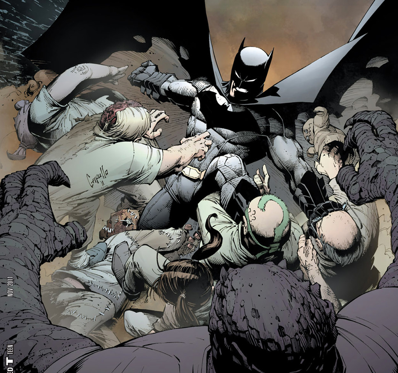
    Were I the sort who judged a book by its cover, the sight of the Riddler with his hair buzzed to a green question mark would have turned me off of Scott Snyder and Greg Capullo’s take on Batman immediately. That’s not the Riddler I want, I would have bemoaned, little realizing that that the Riddler I want is, in all likelihood, the one of my imagination. It’s easy to project my expectations, my wants, my wishes onto a comic book, easier still to not pick one up because it seems like those things will not be satisfied in 22 pages, for three dollars, but the Riddler was hardly a factor in Batman #1, which, beyond featuring the most interesting detective narrative of the four big Bat books, also had the most compelling take on Bruce Wayne the philanthropist. I don’t know if it was editorial edict to have Bruce spend half the pages of his books standing behind a podium at a fundraiser or cocktail party, talking hopefully of one project or another, but the Bruce Wayne of Batman #1, issuing platitudes about what Gotham City is (“Gotham is hell,” “Gotham is damned,” “Gotham is Batman,” etc.) and the wisdom of his father, does more to show Batman’s sense of civic pride and obligation more than the Bruce Wayne who promises not to give birth to a cannibal, to not be afraid of the unknown. Batman here is much more capable of putting on a public face and, early, it leads to something more interesting than a confrontation with the thousandth cop to piece together the Wayne/Batman connection.

    The mystery at the center of this book, involving the grisly murder of a man with the use of old throwing knives, is also compelling, though the twist and the end of the book comes off as a little expected, and will likely wind up being some kind of framejob. Scott Snyder’s script effectively flips the switch from Bruce Wayne: Philanthropist to Batman: World’s Greatest Detective, though it probably helps that the touches defining both are familiar: Batman is always encroaching on Bruce Wayne, making him look absent minded at times, and the way the threat on Bruce Wayne’s life is handled comes straight out of the past. Though these elements lack novelty, it is good to see the character getting back to basics.

    Batman is worth returning to, perhaps the biggest reason being Greg Capullo’s art. Of the Batman family books, only J.H. Williams III’s Batwoman has a more captivating take on Gotham City, though Capullo’s is closer to what I’ve always identified as the “real” Gotham, the one of Batman: The Animated Series. He draws a dynamic Batman, at once human and cartoon, and while the Arkham Asylum slugfest that opened the book was a little bland, brief glimpses of his Two-Face, Clayface, and Mr. Freeze have me looking forward to possible future storylines involving those characters.


    Batman and Robin #1

    Writer: Peter J. Tomasi / Artist: Patrick Gleason

    If Batman and Robin #1 (and likely the Grant Morrison Batman and Son arc that preceded it) is anything to go by, having a superhero as a father would not be a cool experience. Matter of fact, it’d be a life fraught with mistrust, disobeyed orders, and, perhaps worst of all, constant bickering. It’s not that Batman isn’t cool, because what isn’t cool about fighting crime and driving souped up machines of death? The problem is that Damien Wayne, the fifth person to take up the mantle of Robin, is a petulant, self-important brat, and, even if that’s the way he’s supposed to be, I’m not going to cop well to a 10-year-old pointing in Batman’s face while yelling about being “light years ahead” of the other Robins.

    Maybe Damien (hopefully not named after the kid from The Omen) and his sour temperament are the result of being raised by the League of Assassins, but, as written by Peter J. Tomasi, the relationship between Batman and Robin is stock parent/teen disagreement, but over ridiculously high stakes like irradiated fuel rods. When they speak to each other, it feels a bit like Edward Furlong talking to the Terminator, if Furlong’s John Conner suddenly desired for his pet cyborg to start waxing random passers-by. I don’t know that the failings of Batman and Robin #1 are Tomasi’s–usually a solid hand–or those of the character at the heart of this book. At the center of the Batman/Robin partnership has always been Bruce’s obligation to whatever orphan was dropped on his doorstep. The thing was, those characters–even Tim Drake, by no means a victim of tragedy until Identity Crisis–had a way of humanizing Batman that socialite girlfriends and weekly dinner parties couldn’t. They needed him, and he needed them. I get the sense that Damien is relatively unchanged by the shifting circumstances of his life, that his conflict doesn’t involve learning to be a hero or learning to accept Bruce as his father, but that he’s going to constantly be whining about a perceived lack of respect. If the goal here was to create a completely unlikable Robin, mission accomplished. Eventually, I hope Batman hauls off and decks the kid for his endless backtalk. Or that I get to phone in a vote for him to be blown up in an abandoned shed.

    That being said, Patrick Gleason’s art is stunning. Scrumptious. If it were in service to a character I enjoyed, I’d buy two copies so I could hand one to strangers and tell them to see how great a Batman comic can look. The Crime Alley sequence, in particular, is A+ stuff, an elevation of material long taken for granted. Were the issue printed without dialog, there’d be something touching about a father taking his son to the last place he saw his parents, the shower of pearls in the gutter, the floating of a paper boat into the great unknown. But that Damien’s got a mouth, man. “You can’t just build a boat and hope darkness sails away with it,” he says, but it’s like Look kid, he can do whatever he wants. He’s the goddamn Batman.


    Batman: Dark Knight #1

    Writer (Co-Plotter): Paul Jenkins / Artist (Co-Plotter): David Finch

    The first image in Batman: Dark Knight #1 is the Gotham skyline, crowded with three blimps and a universe of spotlights. It’s likely that this is ultimately significant of nothing, but combined with the Arkham Asylum breakout (another one?), the giant reception Bruce Wayne speaks at (another one?), and that the first thing Batman does is fly his plane through Gotham, rappel down to the buildings, change into civvies and zipline across town to be on time for his speech on Fear: A Cannibal, Batman: Dark Knight feels a bit like Jenkins and Finch’s interpretation of The Greatest Batman Hits of the 90s, where everything was big, bold, and, above all else, toyetic.

    All of that plays to Finch’s strength as an artist, in particular his ability to lavish a scene in detail, but so much of it is utterly unnecessary. The board room scene, the Arkham breakout. I don’t have a problem that this has happened across so many of the new Batman #1s, but that it’s happened so much period, and that there’s pretty much nothing new under that particular rock. I imagine it’ll be important somehow–how did that weird rabbit-woman get into Arkham? who enabled the issue’s pivotal change to Two-Face? how?–but my concern in reading Batman: Dark Knight isn’t Bruce or Batman or his detective work, and not even the unfortunate and fundamental change in direction Two-Face undergoes, but why every man is over-muscled, why the attractive foreigner wore a hooker’s dress to this particular Wayne Enterprises meeting, why anybody felt the need to toy with and alter a tried and true villain; just why everything feels so dated and insecure as it tries to be all of the most badass things about Batman that having a kid or being a detective don’t allow. The Batman of Paul Jenkins and David Finch appears to be the Batman of slugfests. I grew out of that Batman ages ago.


    Detective Comics #1

    Writer/Artist: Tony S. Daniel

    For those of you who like your Joker grim ‘n gritty, in Detective Comics #1, he rips out the throat of a “big fan” while completely nude. In a post-Flashpoint world, it’s tough to know how familiar Batman is with the Joker (considering the turn at the end of the issue, my guess is “pretty familiar”), but he seems perplexed by the Joker’s choice to not wear clothes and, like Rorschach planning to delve further into Ozymandias’ sexuality, makes a note of it for later. When, at the end of the issue, the Joker blows up a building full of cops, he walks away from the scene declaring “Amatuers!” with a sneer, a comedian miffed that his audience isn’t in on the joke.

    Then again, the Joker’s always played to an audience of one, so it makes a certain amount of sense that he’s the only one laughing, and it makes perfect sense that he’s able to play Batman and the Gotham City Police Department like a fiddle, murdering and fighting so that he can end up back in Arkham Asylum, where he has an appointment he’d like to keep. That, along with the “amateurs” moment and Batman’s tenuous working relationship with the GCPD, including the use of the Bat Signal (despite cops firing on him) and the appearance of Harvey Bullock, are reminiscent of Batman: The Animated Series, if the seminal cartoon took on the darker aspects of the work of Frank Miller. Detective Comics #1 is incredibly gory for a main title depicting the adventures of the world’s most popular superhero, but that’s not at all a reason to discount what writer and artist Tony Daniel is doing with the old Batman/Joker tropes. As a matter of fact, I’m not sure what I think about the end of issue #1, other than that it’s a compelling, deft hook–one that’s worth giving another couple issues to, for everything to pan out.

  • Movie Review: Paranormal Activity 3 (2011)

    Movie Review: Paranormal Activity 3 (2011)

    The great sham of the haunted house film is the premise that something unknowable, something larger than the relatively normal tenants of its modestly upscale suburban houses (read: us) is lurking behind the drywall, in every creak of floorboard, in every blown fuse. Having ascended to the top of the food chain, few things beyond money and oppressive governments can smother us, so we fear the invisible, gods and monsters alike. The potential for truly great film-making lies within that premise, but the low-budget, low-on-horror Paranormal Activity 3 is not interested in the profundity of human fear. Its great sham is that this movie has already been made twice before, that the promise of filling in past events is enough to look past the law of diminishing returns, the number one killer of horror movie franchises.

    Paranormal Activity 3 is a prequel, unnecessarily tracking back to 1988 and providing answers as to why the lives of Katie (Katie Featherston) and Kristi Ray (Sprague Grayden) are later compromised by paranormal activity. The answer is both rushed and fairly derivative—the film’s eventual interest in the occult is merely as a way to bring the film to a creepy conclusion. Until that point, however, Paranormal Activity 3 is more concerned with jump scares and the series’ well-established low-budget camcorder tricks. The big one here is that a camera is set on a fan’s oscillating platform. It pans away from a seemingly normal kitchen to the living room. It pans back, and the kitchen table and chairs have disappeared. That’s an effective shot, but most of the footage made me feel like I was being forced to watch some old home movie with the promise that something wonderful or shocking was going to happen. Paranormal Activity 3 revels in the waiting game, and its rewards for the patient are only moderately worthwhile

    That’s because the protagonists as as glassy-eyed and likable as the Teddy Ruxpin doll that serves as one of the movie’s early false alarms. Katie and Kristi Ray live with their divorced mom Julie (Lauren Bitner) and her new boyfriend, Dennis (Chris Smith), who’s business is wedding videos (giving him a good enough reason to document everything on his camcorder). Dennis becomes convinced that something is wrong in the million-dollar house he’s been invited into, but Julie isn’t too sure. Kristi Ray has an imaginary friend named Toby who sounds fairly ominous, telling her not to reveal his secrets, lest he dole out some dire consequences. It’s all fairly rote, as the signs of haunting begin small, then escalate to the point that Julie looks like an absolute fool for refusing to believe Dennis’ theory. The plot, and the characters moving it along, are facilities of real people and advancement. Even the home feels like a cheap representation, a pornographer’s stand-in for suburbia.

    Beyond the one really effective shot where the contents of Julie’s kitchen disappear, the film’s one creepy aspect is Kristi Ray, who at no point seems like a real child. Sprague Grayden isn’t precocious or precious; she constantly seems like the focus of an interrogation and, moreover, she seems to know it. The use of children in horror movies has always been fascinating to me—they’re never authentic, instead portraying a screenwriter or a director’s idea of the authentic, responding not to the emotion of the situation, but to very basic programming: Stare. Giggle. Scream. Horror movie children are automatons, looking and acting almost like you’d expect, but not quite. They’re flesh and blood, but firmly lost in the uncanny valley. I wonder if that’s intentional, half the time. If it is, the trick is too easy: That child’s the devil, break out the pitchforks. If it isn’t, the horror movie child is still indicative of lazy screenwriting: The child-in-peril will always draw our sympathy, fingershutter your eyes and hope nothing happens.

    I get the feeling that Paranormal Activity 3 wants us to have both reactions, at turns feeling sorry for Kristi Ray, her sister and their family while operating under the belief that she’s in cahoots with Toby, whose designs are anything but obvious. It’s a clever ruse, one that’s meant to grab the attention, to draw the eye closer to the screen. Hopefully, we’ll be so caught up in what isn’t happening that, when something does happen, it’ll shock. It’s a good sham, but we’ve seen it before. Worse, we’re expected to jump knowing that the little girls will live to be haunted another day.

    Rating:

    Paranormal Activity 3. Directed by Ariel Schulman and Henry Joost. With Katie Featherston (Katie), Sprague Grayden (Kristi Ray), Lauren Bitner (Julie), and Chris Smith (Dennis). Released October 21, 2011, by Paramount Pictures.