

Like a video game character bestowed the gift of an infinite lives cheat code, Milla Jovovich‘s Alice, the hero of the incredibly long-running Resident Evil franchise, cannot die. Yes, the Umbrella Corporation, her faceless nemesis, has killed her several times, but Alice, she keeps coming back. Why? It’s impossible to say. At this point, she’s saving a world that was effectively ended several films ago. The Umbrella Corporation are the ones to blame, of course, but their motives are also unclear. If their aim was profit, at least one sane individual in the boardroom would’ve pointed out that killing the entire human race was bad for business. If they want merely to kill Alice, then perhaps that same sane person should point out the benefits of not cloning, reviving, and granting superpowers to their otherwise dead and powerless enemy. It’s a fruitless, twisted war the two fight. Sometimes, extra lives are a curse.
Resident Evil: Retribution offers no relief for either party. Instead, it shuffles the deck chairs before a presumable final encounter between humanity and the rogue biomedical corporation hellbent on its (and its own) destruction. It wisely figures that not everybody has seen the four previous Resident Evil movies and recaps them to the point where the last one left off: on a boat, with our intrepid heroes under attack. Like this year’s Underworld: Awakening (a franchise helmed by another wife/husband actress/director combination), Alice wakes up from that attack in a mysterious medical facility. She is interrogated by Jill Valentine (Sienna Guillory), a friend turned brainwashed-foe, until the facility’s computer systems are compromised. This frees Alice, who is bound and determined to escape.
The compound is, of course, impregnable. Buried in a polar ice cap and comprising several impossibly large reconstructions of major cities, this is the Umbrella Corporation’s home base, a place where clones are churned out and monsters run amok, all so the company can test how a given populace would react to an outbreak of its zombie plague. Why Umbrella deems the facility necessary after successfully launching humanity’s biological Armageddon is unknown, but the different settings (Tokyo, Times Square, Moscow, and “Suburbia”) offer Alice and those trapped in the facility with her a rich tableau of creatures to pump full of lead, from a fetishized Japanese zombie to giant, hangman-looking mutants wielding massive hammers to a humanoid of rippling musculature whose brain is unfortunately exposed. It also offers Alice a cute kid (Aryana Engineer) to protect, because it’s not enough that she escape Umbrella’s arctic hellpit on her own.
Paul W.S. Anderson—the unchallenged master of video game adaptations—uses Resident Evil: Retribution as an excuse to gather the franchise’s most popular characters in the same building. There’s Ada Wong (Bingbing Li), a secret agent dressed for a better occasion than a zombie plague; Albert Wesker (Shawn Roberts), the former head of Umbrella and current smarmy leader of the human remnant; and the crack mercenary team of Leon Kennedy (Johann Urb), Barry Burton (Kevin Durand), and Luther West (Boris Kodjoe), who all function pretty much in the same way, but give fans of the video game different characters whose survival they can pull for or root against. The Umbrella Corporation’s taste for cloning provides for the return of Michelle Rodriguez in various forms—from anti-gun suburbanite to bad-ass, gun-toting company woman—joined from the first Resident Evil by the Red Queen, a computer program bent on snaring Alice in one of any number of elaborate death traps.
It goes without saying that none of those death traps work, and that, while some characters die, none of them are particularly essential to the resolution of the series. Resident Evil has long been the action genre’s most needlessly complicated franchise, and that tradition continues here. Several characters change allegiance on a whim, and Anderson’s sequel-bating reveal at the end of the movie creates large gaps in logic that otherwise would have passed as setpieces. If the Red Queen is truly on the verge of eliminating the human race, as is her stated goal, why go to the trouble of endlessly cloning a wide-variety of them? If you have the last remaining human beings on Earth pinned to the White House lawn, why bother with the undersea arctic medical facility, its staff, or its prisoners at all?
I admit, even those questions qualify as “over-thinking it” when it comes to a movie like Resident Evil: Retribution. Everybody who has stepped to the plate to review this film has pointed out that, five installments in, you either like or don’t like the series, and that everything else is either fan quibbling or noise. Fair point. Resident Evil: Retribution sets out to be a Resident Evil movie, and in that regard, it succeeds. The characters are paper-thin, the actors inhabiting them aren’t trying particularly hard, and the script they’re given isn’t good by any means, but if Resident Evil dealt in anything more challenging than archetypes, all that ambition would get in the way of Paul W.S. Anderson’s snazzy action sequences.
Thinking about Resident Evil: Retribution and Underworld: Awakening again, that’s the main thing that distinguishes the two. For all their similarities (heroines in tight leather bondage gear, CGI monsters, impossible physics, convoluted backstories, expendable side characters), Anderson’s franchise has Len Wiseman’s beat out in sheer terms of clear, decipherable gunfights and martial arts expositions. The colors pop brighter, the bones crunch louder, and the heroine sasses her way through wave after wave of the undead, has no time to sulk or ponder the deeper significance of her existence as a superpowered killing machine. My only issue with Resident Evil: Retribution as a time-waster is that it’s the fifth of its kind. If you’ve seen Milla Jovovich kick one zombie in the head in slow-motion, you’ve seen her kick dozens of zombies in the head in slow-motion. And there’s a dozen more shambling down the hallway.
Rating:  Resident Evil: Retribution. Directed by Paul W.S. Anderson. With Milla Jovovich (Alice), Michelle Rodriguez (Rain), Sienna Guillory (Jill Valentine), Aryana Engineer (Becky), and Bingbing Li (Ada Wong). Released September 14, 2012, by Screen Gems.
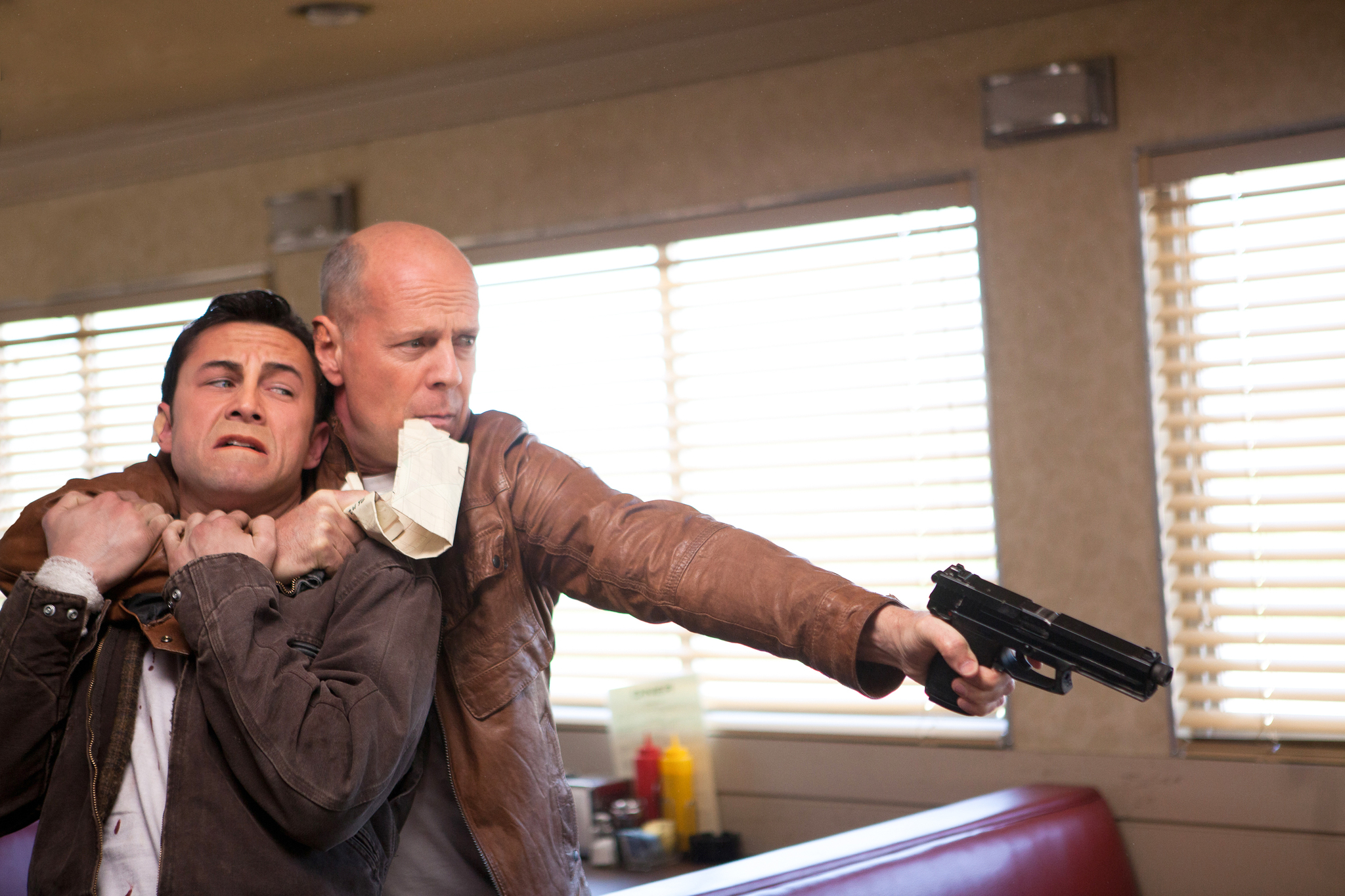
 Looper contains elements of time-traveling science fiction, neo-noir, and pained romance, but, as a chase film, nothing is as complicated as it seems. Yes, there is time travel. There’s also a mob conspiracy, copious drug usage, and the perception and memories of the people involved in these rackets are framed with fuzzy edges, but the elements that play into Looper and the characters involve are there to ground the viewer in an unbelievably plausible, fully-realized United States of America, which, in 2044, is almost irreparably broken—a patchwork quilt of vagrant gangs, men and women with retrograde telekinetic powers, and mafia-run cities ruled by weathered men from the future. If certain aspects of
  Looper. Directed by Rian Johnson. With Joseph Gordon-Levitt (Joe), Bruce Willis (Old Joe), Emily Blunt (Sara), Paul Dano (Seth), Piper Perabo (Suzie), Pierce Gagnon (Cid), and Jeff Daniels (Abe). Released September 28, 2012 by