
Katniss Everdeen has nightmares. This is important. This means something. Luke Skywalker blew up a space station that housed millions of men and women without shedding a tear. James Bond remembers the dozens of women slaughtered by association by naming martinis after them and glowering at the baccarat table. Bella Swan slurps blood from a Styrofoam cup. The Hunger Games: Catching Fire doesn’t allow its heroine much time to rest after her victory in the franchise’s titular organized bloodletting, but when it does, even her few moments of rest are shattered by memories of the Games. A nation believes they’ve gained a young star. In reality, they’ve rendered a young woman a hollow shell.
Having made history as the first ever co-winners of The Hunger Games, Katniss (Jennifer Lawrence) and Peeta Mellark (Josh Hutcherson) clearly suffer from PTSD. Twenty-two children were killed in the Games, and while they weren’t personally responsible for even the majority of them, they lived for months expecting knives in their backs, finding solace in the report of an unseen cannon. Back in District 12, they try to return to something like a normal life, but even if nobody from home treats them any differently for making it out of the arena, the state has relocated them to the district’s Victor’s Village, whose only other occupant is Haymitch Abernathy (Woody Harrelson), whose alcoholism probably makes a little more sense to them now. Though they barely know each other, Katniss and Peeta survived by convincing a nation that they were star-crossed young lovers. Thrust into the role of celebrity, they have to maintain that ruse before the cameras and the fawning millions in their living rooms. Both wonder if eating the poison berries that won them the Games would have been a kinder fate.
In victory, Katniss becomes a symbol, a sign to the downtrodden lower districts that they can rise up against the opulence of Panem, whose capitol houses the uber-wealthy who exploit the labor of the starving working class. President Snow (Donald Sutherland), who watched ambivalently as Katniss and Peeta upended the rules of his Games, takes a much more active role in Katniss’ life outside the arena. He meets her in District 12, threatening to kill her and her family and her actual boyfriend, Gale (Liam Hemsworth), if her act with Peeta isn’t convincing. Her happiness—or the perception of her happiness—may quell a brewing rebellion. This is a losing proposition. On the train to the Capitol, where a huge party is to be held in her honor, Katniss sees graffiti of the mockingjay symbol she’s become associated with and anti-government slogans. When she arrives in District 11, her and Peeta are unable to read the cards prepared for them by their PR rep, Effie Trinket (Elizabeth Banks), and instead give teary dedications to Rue, the little girl who died in their Games. An old man in the crowd whistles the call Katniss and Rue had and holds up a sign of the revolution. He is dragged before the stage and shot in the head. Katniss and Peeta read from the cards from that point on, but this scene continues to play itself out.
Catching Fire eventually makes its way back into the arena, but it and its predecessor are at their most interesting when exploring the kind of dystopia that would broadcast the life-or-death struggle of 24 well-armed children. While The Hunger Games only captured glimpses of the other districts, focusing largely on the Games themselves, Francis Lawrence finds the franchise’s heart beating in the districts. Lawrence, whose I Am Legend and Constantine were toothless sci-fi adaptations to whom the concept of mythmaking was alien, while not doing anything to rock the boat too hard, manages to craft a middle entry that does three things more expertly than many expensive sequels: feel larger than its predecessor, further define the characters, and improve upon what previously worked. Much of that is due to Jennifer Lawrence, whose Katniss is now a character and not an archetype. It’s still hard to believe that the star of these massive Hunger Games films and Oscar-baiting prestige ensembles like Silver Linings Playbook was in Winter’s Bone three years ago, and it’s something of an odd fortune that the trajectory of her career matches that of the character she’ll likely forever be identified as. In life, Lawrence gets Google news alerts when she steps out of the house with a new haircut. In Catching Fire, a pregnancy hoax involving her is nearly enough to end a seventy-five year tradition.
By involving Snow and featuring a new game maker (Philip Seymour Hoffman, playing himself as a D&D dungeonmaster with one of the series’ more ridiculous names), Catching Fire raises the stakes so high that the 75th Hunger Games’ twist—all of the competitors are surviving winners from Games past—feel trifling by comparison. Sutherland’s despotic President Snow is sniveling and arch in a way villains in movies this large no longer are allowed to be; watching him preen and glower like an evil, gay Santa Claus has been a highlight of the series. Hoffman’s Plutarch Heavensbee isn’t quite as dynamic, but he’s an upgrade over the original film’s focal point for Katniss Everdeen’s rage, who was mostly notable for his beard. Heavensbee is the architect of a plot to restore the districts to order by wiping out their symbols of hope. While it’s hardly subtle, watching him tell President Snow to broadcast speculation about Everdeen’s wedding dress and honeymoon location next to scenes of beatings and executions in the districts is the kind of specific, calculated evil action movies figure their audiences can’t handle. Here, the storm clouds never dissipate. If any sunshine is going to punch through, it’s sure taking its damn time.
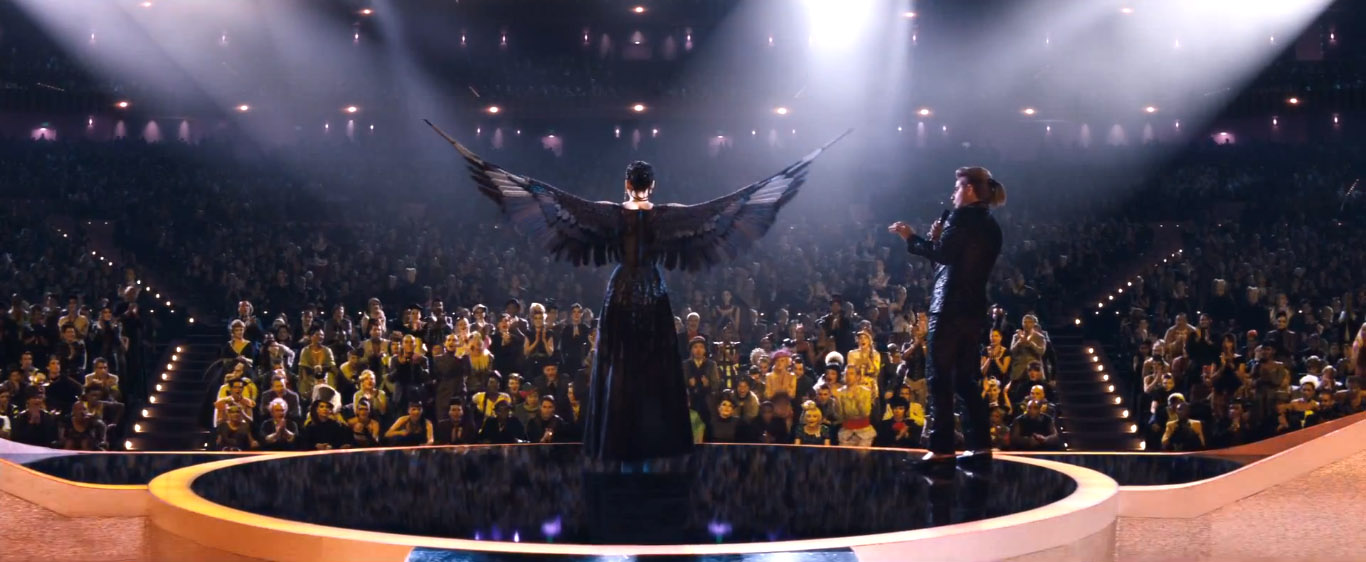
All of which is nice, but ultimately somewhat empty. Catching Fire is somewhat hamstrung by its obligations to young adult literature in a post-Twilight world, which necessitates a go-nowhere love triangle between Katniss, Gale, and Peeta. Beyond the state’s intervention, there’s never a moment when one of the men in her life controls her, and in the arena it’s usually Peeta who is in need of rescuing. This makes The Hunger Games the standard bearer for love triangles done pleasantly enough, if that’s a standard worth bearing, but I can’t help watching the scenes where Katniss and Peeta pretend to love one another with an editor’s eye, wondering if it would have been more dramatic had two actual lovers been forced into the Games twice instead of two people who have to pretend for the sake of a narrative. Stanley Tucci returns as Caesar Flickerman, the voice of that narrative, and while he’s charming and funny in his role as the ingratiating host of The Hunger Games, success has made his character something of an ironic statement, simultaneously mocking the hosts and unearned grandeur of reality television talent contests while occupying a significant amount of space in a major Hollywood movie being used to shill everything from Subway sandwiches to Covergirl makeup. Not that Catching Fire had to inspire revolution to work, but if a major film harps on the need for its audience to question authority while simultaneously shilling for the footlong creamy sriracha steak melt—a delicacy the denizens of District 12 would murder you for the right to look at, let alone consume—how successful can that film be in realizing its ambitions?
The answer, of course, is very. Catching Fire’s ambition is to make money, and it is doing so hand over fist. The film rarely falters or falls short of being entertaining spectacle, but it’s telling that for all the scorn it heaps upon the rich for enjoying the bread and circuses of the Games, it never stops long enough to ask the same question of the audience in the theater. Intrinsically, one knows that the ritualized slaughter of children is a horrible practice. Perversely, The Hunger Games franchise films these long sequences not as a horror, but an entertainment. The kills are quick and clean and leave no blood. When the show’s helicopter arrives to dispose of a body, it is hefted into the air striking a messianic pose to a theme commissioned just for the solemnity of the occasion. Those who die in the Games are offerings to the state, sure, but are they not also offered up to us? Are we not somewhat culpable?
The Hunger Games: Catching Fire. With Jennifer Lawrence (Katniss Everdeen), Josh Hutcherson (Peeta Mellark), Liam Hemsworth (Gale Hawthorne), Woody Harrelson (Haymitch Abernathy), Elizabeth Banks (Effie Trinket), Lenny Kravitz (Cinna), Philip Seymour Hoffman (Plutarch Heavensbee), Stanley Tucci (Caesar Flickerman), and Donald Sutherland (President Coriolanus Snow). Directed by Francis Lawrence and produced by Nina Jacobson and Jon Kilik. Screenplay by Simon Beaufoy and Michael deBruyn, based on the novel Catching Fire, by Suzanne Collins.

