Tag: Elizabeth Banks

  • Movie Review: The Hunger Games: Catching Fire (2013)

    Movie Review: The Hunger Games: Catching Fire (2013)

    hunger games catching fire

    Katniss Everdeen has nightmares. This is important. This means something. Luke Skywalker blew up a space station that housed millions of men and women without shedding a tear. James Bond remembers the dozens of women slaughtered by association by naming martinis after them and glowering at the baccarat table. Bella Swan slurps blood from a Styrofoam cup. The Hunger Games: Catching Fire doesn’t allow its heroine much time to rest after her victory in the franchise’s titular organized bloodletting, but when it does, even her few moments of rest are shattered by memories of the Games. A nation believes they’ve gained a young star. In reality, they’ve rendered a young woman a hollow shell.

    Having made history as the first ever co-winners of The Hunger Games, Katniss (Jennifer Lawrence) and Peeta Mellark (Josh Hutcherson) clearly suffer from PTSD. Twenty-two children were killed in the Games, and while they weren’t personally responsible for even the majority of them, they lived for months expecting knives in their backs, finding solace in the report of an unseen cannon. Back in District 12, they try to return to something like a normal life, but even if nobody from home treats them any differently for making it out of the arena, the state has relocated them to the district’s Victor’s Village, whose only other occupant is Haymitch Abernathy (Woody Harrelson), whose alcoholism probably makes a little more sense to them now. Though they barely know each other, Katniss and Peeta survived by convincing a nation that they were star-crossed young lovers. Thrust into the role of celebrity, they have to maintain that ruse before the cameras and the fawning millions in their living rooms. Both wonder if eating the poison berries that won them the Games would have been a kinder fate.

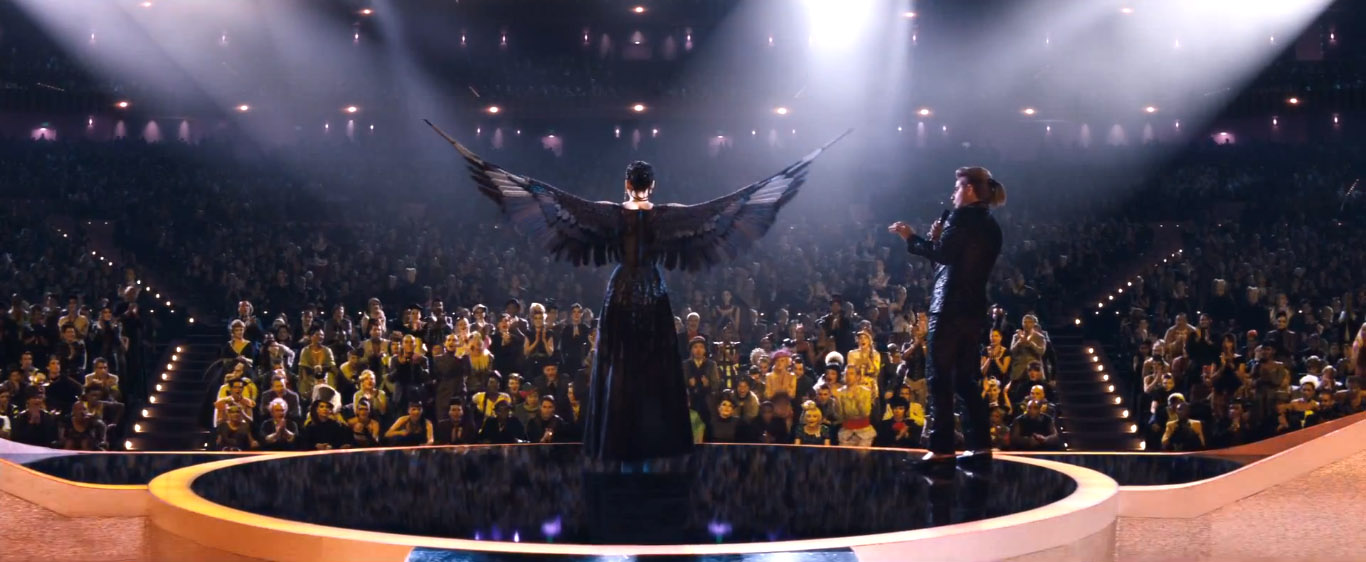
    In victory, Katniss becomes a symbol, a sign to the downtrodden lower districts that they can rise up against the opulence of Panem, whose capitol houses the uber-wealthy who exploit the labor of the starving working class. President Snow (Donald Sutherland), who watched ambivalently as Katniss and Peeta upended the rules of his Games, takes a much more active role in Katniss’ life outside the arena. He meets her in District 12, threatening to kill her and her family and her actual boyfriend, Gale (Liam Hemsworth), if her act with Peeta isn’t convincing. Her happiness—or the perception of her happiness—may quell a brewing rebellion. This is a losing proposition. On the train to the Capitol, where a huge party is to be held in her honor, Katniss sees graffiti of the mockingjay symbol she’s become associated with and anti-government slogans. When she arrives in District 11, her and Peeta are unable to read the cards prepared for them by their PR rep, Effie Trinket (Elizabeth Banks), and instead give teary dedications to Rue, the little girl who died in their Games. An old man in the crowd whistles the call Katniss and Rue had and holds up a sign of the revolution. He is dragged before the stage and shot in the head. Katniss and Peeta read from the cards from that point on, but this scene continues to play itself out.

    Catching Fire eventually makes its way back into the arena, but it and its predecessor are at their most interesting when exploring the kind of dystopia that would broadcast the life-or-death struggle of 24 well-armed children. While The Hunger Games only captured glimpses of the other districts, focusing largely on the Games themselves, Francis Lawrence finds the franchise’s heart beating in the districts. Lawrence, whose I Am Legend and Constantine were toothless sci-fi adaptations to whom the concept of mythmaking was alien, while not doing anything to rock the boat too hard, manages to craft a middle entry that does three things more expertly than many expensive sequels: feel larger than its predecessor, further define the characters, and improve upon what previously worked. Much of that is due to Jennifer Lawrence, whose Katniss is now a character and not an archetype. It’s still hard to believe that the star of these massive Hunger Games films and Oscar-baiting prestige ensembles like Silver Linings Playbook was in Winter’s Bone three years ago, and it’s something of an odd fortune that the trajectory of her career matches that of the character she’ll likely forever be identified as. In life, Lawrence gets Google news alerts when she steps out of the house with a new haircut. In Catching Fire, a pregnancy hoax involving her is nearly enough to end a seventy-five year tradition.

    By involving Snow and featuring a new game maker (Philip Seymour Hoffman, playing himself as a D&D dungeonmaster with one of the series’ more ridiculous names), Catching Fire raises the stakes so high that the 75th Hunger Games’ twist—all of the competitors are surviving winners from Games past—feel trifling by comparison. Sutherland’s despotic President Snow is sniveling and arch in a way villains in movies this large no longer are allowed to be; watching him preen and glower like an evil, gay Santa Claus has been a highlight of the series. Hoffman’s Plutarch Heavensbee  isn’t quite as dynamic, but he’s an upgrade over the original film’s focal point for Katniss Everdeen’s rage, who was mostly notable for his beard. Heavensbee is the architect of a plot to restore the districts to order by wiping out their symbols of hope. While it’s hardly subtle, watching him tell President Snow to broadcast speculation about Everdeen’s wedding dress and honeymoon location next to scenes of beatings and executions in the districts is the kind of specific, calculated evil action movies figure their audiences can’t handle. Here, the storm clouds never dissipate. If any sunshine is going to punch through, it’s sure taking its damn time.
    hunger games catching fire

    All of which is nice, but ultimately somewhat empty. Catching Fire is somewhat hamstrung by its obligations to young adult literature in a post-Twilight world, which necessitates a go-nowhere love triangle between Katniss, Gale, and Peeta. Beyond the state’s intervention, there’s never a moment when one of the men in her life controls her, and in the arena it’s usually Peeta who is in need of rescuing. This makes The Hunger Games the standard bearer for love triangles done pleasantly enough, if that’s a standard worth bearing, but I can’t help watching the scenes where Katniss and Peeta pretend to love one another with an editor’s eye, wondering if it would have been more dramatic had two actual lovers been forced into the Games twice instead of two people who have to pretend for the sake of a narrative. Stanley Tucci returns as Caesar Flickerman, the voice of that narrative, and while he’s charming and funny in his role as the ingratiating host of The Hunger Games, success has made his character something of an ironic statement, simultaneously mocking the hosts and unearned grandeur of reality television talent contests while occupying a significant amount of space in a major Hollywood movie being used to shill everything from Subway sandwiches to Covergirl makeup. Not that Catching Fire had to inspire revolution to work, but if a major film harps on the need for its audience to question authority while simultaneously shilling for the footlong creamy sriracha steak melt—a delicacy the denizens of District 12 would murder you for the right to look at, let alone consume—how successful can that film be in realizing its ambitions?

    The answer, of course, is very. Catching Fire’s ambition is to make money, and it is doing so hand over fist. The film rarely falters or falls short of being entertaining spectacle, but it’s telling that for all the scorn it heaps upon the rich for enjoying the bread and circuses of the Games, it never stops long enough to ask the same question of the audience in the theater. Intrinsically, one knows that the ritualized slaughter of children is a horrible practice. Perversely, The Hunger Games franchise films these long sequences not as a horror, but an entertainment. The kills are quick and clean and leave no blood. When the show’s helicopter arrives to dispose of a body, it is hefted into the air striking a messianic pose to a theme commissioned just for the solemnity of the occasion. Those who die in the Games are offerings to the state, sure, but are they not also offered up to us? Are we not somewhat culpable?


    The Hunger Games: Catching Fire. With Jennifer Lawrence (Katniss Everdeen), Josh Hutcherson (Peeta Mellark), Liam Hemsworth (Gale Hawthorne), Woody Harrelson (Haymitch Abernathy), Elizabeth Banks (Effie Trinket), Lenny Kravitz (Cinna), Philip Seymour Hoffman (Plutarch Heavensbee), Stanley Tucci (Caesar Flickerman), and Donald Sutherland (President Coriolanus Snow). Directed by Francis Lawrence and produced by Nina Jacobson and Jon Kilik. Screenplay by Simon Beaufoy and Michael deBruyn, based on the novel Catching Fire, by Suzanne Collins.

  • Movie Review: Movie 43 (2013)

    Movie Review: Movie 43 (2013)

    Movie 43Way out west they made this movie, a movie I want to tell you about, movie by the name Movie 43. At least that’s the handle its loving producers gave it. Movie 43 doesn’t have much use for the name, itself. This Movie 43, even though its about a deranged man (Dennis Quaid) who pitches a movie to some poor schmuck producer (Greg Kinnear) at gunpoint, never calls itself anything. That’s fine. Movies as bad as Movie 43 probably don’t wish to self-identify. There’s a lot about Movie 43 that doesn’t make a lot of sense to me, and a lot about where it was produced, likewise. But, then again, maybe that’s why I find that place so darned interesting.

    They call Los Angeles, “The City of Angels.” I don’t find it to be that, exactly. But I’ll allow, they make some nice movies there. Of course I can’t say I ever saw one where Hugh Jackman had testicles on his chin, or where Superman slicks his spit curl with his super sperm. And I ain’t never seen a cartoon cat violate itself with a toilet brush, as a fella says. But I’ll tell you what: after seeing Movie 43, this movie that I’m about to unfold, well, I guess I’ve seen something every bit as stupefying as you’d see in any other movie, and in color, too.

    Now this here movie I’m about to unfold took four years to make, just in the spare time its wildly overqualified cast had in-between other projects that people actually enjoy; movies and TV shows—many of them comedies—with some degree of critical and/or popular acclaim. I only mention this because sometime’s there’s a movie—I won’t say a film, because what’s a film?—but sometime’s there’s a movie—and I’m talking about Movie 43, here—sometime’s there’s a movie, well, a movie that’s absolutely the result of spare time. Hugh Jackman, Kate Winslet, Seth MacFarlane, Liev Schreiber, Naomi Watts, Anna Faris, Chris Pratt, Emma Stone, Richard Gere, Uma Thurman, Kristen Bell, Kate Bosworth, Chloë Grace Moretz, Halle Berry, Terrence Howard, Elizabeth Banks—they just fit it right in there, in their spare time. That’s Movie 43. Filmed in Los Angeles. And even if it’s a lazy movie—and Movie 43 is most certainly that, quite possibly the laziest movie filmed in Los Angeles County,which would place it high in the running for laziest worldwide—sometimes, there’s a movie. Sometimes, there’s a movie.

    Lost my train of thought here. Aw, hell. I’ve done introduced it enough.

    Movie 43 wastes no time, opening with a sketch wherein Kate Winslet goes on a blind date with Hugh Jackman, who, as mentioned, has a pair of testicles dangling from his chin. Winslet—who is, as Quaid’s pitchman describes her, smart and career driven—is the only person in the five star restaurant who can see Jackman’s pendulous scrotum, though if it’s because of Jackman’s money or Movie 43’s unfailing belief in women as shrill, howling she-beasts is unknown. This sketch—and most of the sketches contained here—is modeled off of the hair gel joke from There’s Something About Mary, a gross out gag designed to get people in the theater to go home and tell their friends about that one hilarious scene. Those who went to see There’s Something About Mary were rewarded with a complete film. Those who see Movie 43, on the other hand, will be seeing 90-minutes of sketch comedy that can be charitably described as “half finished.” Even Movie 43’s wrap-around sketch, the plot that’s meant to justify the rest of the movie, a segment that had four years to find a resolution, instead ends with Kinnear, Quaid, Common, and Will Sasso throwing up their hands and shrugging their way into the penultimate sketch, which is about how black people are really good at basketball.

    There’s nothing about Movie 43 worth praising, but hey, at least it’s out to offend everybody, right? Though twelve people directed bits and pieces of Movie 43, its preoccupation with race, gender, and sex suggest something of a hive mind mentality. Even if white people can’t jump and Asian men aren’t attractive to Halle Berry, the women of Movie 43 have it the worst. Their demands—like Anna Ferris’s wish for Chris Pratt to incorporate scat into their sex life—are unreasonable. Their behavior—like Emma Stone’s general filthiness and Elizabeth Banks’s abuse of an animated cat—is unconscionable. When Kate Bosworth points out that horny teenage boys are likely to stick their appendages into the moving parts of an iPod designed to look like a naked, catatonic woman, she’s regarded by the mostly-male board of an Apple-like conglomerate as a buzzkill. When Chloë Grace Moretz has her first period, not only do her boyfriend and Chistopher Mintz-Plasse freak out about the blood, but her father and Patrick Warburton regard her condition as, quote, disgusting. Even if you’re the sort of person able to mine pleasure from watching the incredibly famous humiliate themselves, Movie 43 has little to offer: as the blooper reel that plays during the credits handily illustrates, everybody involved is more in on the joke than you’ll ever be.

    Movie 43 was pretty clearly inspired by The Kentucky Fried Movie and Amazon Women on the Moon, though what genre it’s out to mock is beyond me. The targets, I suppose, are hacky, feel-good movies prone to rousing speeches, slow clapping, bro hugs, and passionate first kisses, but when a sketch mocking modern superhero movies ends in the BOOFs and POWs of the old Batman TV show, the result is something botched and horrible: a Frankenstein’s monster akin to Epic Movie or Meet the Spartans, but with the benefit of legitimately funny people like John Hodgman, Aasif Mandvi, and Jack McBrayer standing around with their dicks in their hands, as opposed to a gaggle of folks from central casting. Not every sketch movie gets to be Monty Python’s The Meaning of Life, but few make as succinct an argument against the genre as does Movie 43. As a fella wiser than me once said: sometimes you eat the bear, sometimes the bear, well, he eats you. Just pray that the bear doesn’t have testicles dangling from its jaw.


    Movie 43. With Dennis Quaid, Greg Kinnear, Hugh Jackman, Kate Winslet, Liev Schreiber, Naomi Watts, Anna Faris, Chris Pratt, Kieran Culkin, Emma Stone, Richard Gere, Kate Bosworth, Jack McBrayer, Aasif Mandvi, Justin Long, Jason Sudeikis, Uma Thurman, Kristen Bell, John Hodgman, Christopher Mintz-Plasse, Chloë Grace Moretz, Patrick Warburton, Gerard Butler, Seann William Scott, Johnny Knoxville, Halle Berry, Stephen Merchant, Terrence Howard, Josh Duhamel, and Elizabeth Banks. Directed by Peter Farrelly, Banks, Griffin Dunne, James Gunn, Bob Odenkirk, Brett Ratner, and 6 others and produced by Farrelly, Charles B. Wessler, Ryan Kavanaugh, and John Penotti. Screenplay by Gunn and 17 others

  • Movie Review: The Hunger Games (2012)

    Movie Review: The Hunger Games (2012)

    The Hunger Games is most startlingly successful in its opening thirty minutes, when surveying District 12 of Panem, a coal-mining center where dirty people do dirty labor to keep the lights on in the Capitol, a post-apocalyptic paradise built upon a crater lake. The denizens of District 12 are slightly cleaner than the men and women of Winter’s Bone, and compared to the Capitol’s visiting Effie Trinket (Elizabeth Banks), their situations are quite dire. Katniss Everdeen (Jennifer Lawrence), for example, has taken control of her household in the aftermath of a mining accident that killed her father, leaving her caring for both her mother and her younger sister. Jobs are scarce, so she’s been forced to take up hunting. She’s quite good at it, but big game, like deer, have become increasingly scarce in an environment that’s been scorched by war.

    War is very much in the fabric of The Hunger Games. Not only did it give rise to Panem, the massive, quizzically structured supercountry that arises sometime after the end of the United States, but a civil war between the districts and the Capitol were responsible for the creation of the games, which pit twenty-four young men and women, one of each gender from all twelve districts, in bloody, to-the-death conflict with each other. These twenty-four children, “Tributes,” as they’re called, serve two purposes. First and foremost, they’re a reminder to the twelve districts that supreme power lies with the Capitol, who participate in the Hunger Games by dressing-up and placing wagers. Secondly, the winner of the Hunger Games will bring fame and fortune to their district.

    It’s a broken system, but one can appreciate the “I Am the 99%” ishness of the film’s opening moments, wherein Effie stands before a crowd of slackjawed, horrified, poorly-fed children and, with the aplomb of Mitt Romney saying he has plenty of friends who own NASCAR teams, tells the group she looks forward to seeing them die; all in the spirit of competition, of course. When Katniss’ sister Primrose (Willow Shields) is chosen from the hat, Katniss volunteers for her and is thrown on a bullet train (funny how we get one of those in the post-apocalyptic future) with Peeta (Josh Hutcherson), a baker’s son who, according to his own mother, is as good as dead.

    Once Katniss and Peeta are on the train, The Hunger Games becomes significantly less interesting. The two are scrubbed down, becoming two more pretty people in a parade of pretty people, most of whom give little to go on in terms of character. We learn a little about some of the other districts—one and two have been churning out Hunger Games champions for most of their duration—and are introduced to a cast of characters who, depending on their allegiance to Katniss, are flamboyant and one-note, or somewhat nuanced. The people running the games include hosts Caesar (Stanley Tucci) and Claudius (Toby Jones), producer Seneca Cane (Wes Bentley), and President Coriolanus Snow (Donald Sutherland), who is exactly the sort of generic evil capable of manipulating things from the shadows across a franchise. Joining Effie in aiding Katness are Cinna (Lenny Kravitz)–a one man support group/fashion label—and Haymitch Abernathy (Woody Harrelson), a former Hunger Games winner who acts as District 12’s mentor. Of the characters here who aren’t Katness, Harrelson’s is the most well-drawn, a jaded man who finds no pleasure in the Hunger Games, but who nevertheless comes to like his charge.

    The Hunger Games themselves are effectively a long, drawn-out battle sequence, where most of the people involved end up slaughtered off-screen. Katniss has been advised to survive on her wits rather than join the mad rush for a weapon at the start of the games, and that’s exactly what she does, taking off for the woods with a backpack and a rope. She’s been cautioned that exposure and the lack of water and food are just as likely to kill her as the other children, but the weather’s temperate, water is plentiful, and nobody participating looks to be starving. The threats she faces in there are two-fold: The large hunting party that’s formed specifically in an effort to kill her (she’s the strongest one in the group), and the CGI machinations of Seneca Cane, who artificially generates a fire and sics mutated beasts on Katniss to keep the show rolling.

    Despite this, the Hunger Games portion of The Hunger Games feels momentum-less, hampered at turns by Katniss’ alliance with Rue (Amandia Stenberg), a little girl (seven or so) whose death sparks a riot in District 11, and a love triangle between Katniss, Peeta, and Gale Hawthorne (Liam Hemsworth), who is forced to watch the events play out on TV. Rue’s death, obviously, is meant to be a huge moment in the film, but beyond her looking practically angelic pre- and post-martyrdom, she simply isn’t developed well enough within the parameters of the movie. It’s sad to see her die like it’d be sad to see any child get a spear stuck through them. The love triangle seems, at best, a concession to those who find Edward/Bella/Jacob the enduring romance of our time. It is built upon quick pecks on the cheek by Katniss and Peeta—who may be playing the folks in TV land for donations of soup and salve—and distressed looks from Gale, who is stuck in District 12 watching Katniss’ family.

    What I like most about these scenes is the way director Gary Ross has decided to shoot them, in a style that straddles the line between old-school action cinematography and the currently in-vogue shaky-cam. The resulting scenes of violence are appropriately chaotic while remaining easy to follow. His pacing is off—at two hours and twenty minutes, parts of the film feel decidedly overstuffed while leaving other areas critically, frustratingly underdeveloped—but one gets the idea that many of The Hunger Games‘ decisions were made in an effort to appease the book’s massive fanbase. That’s not to say that the film is accessible only to fans of the novel. Unlike the Twilight series, which requires a person who hasn’t read the books to have either an almanac or a very knowledgeable friend, The Hunger Games is quite inclusive. It’s easy to see how some characters, particularly Rue, may benefit from the written word, but the film very consciously reaches out to new fans and does so successfully.

    Frustratingly, The Hunger Games isn’t tremendously ambitious in scope, despite playing in the same sandbox as movies like Blade Runner and Metropolis. While the comparison may not be fair, most dystopian films use their future regimes and the inherent divide between squalor and excess to examine a problem eating away at our society. Those concerns are at the fringes of The Hunger Games, its kill-or-be-killed ethos hardly a breath of fresh air. The film squanders every chance it has of being challenging material, not even stopping to ask what Katniss would do if her and Rue were the last two left standing, and the dynamics of Panem society—one infers a kind of loose caste system, based on district—are left wholly untouched. Even if future sequels delve into that subject and give Katniss some tough decisions, I suspect the franchise will still leave me with two questions: 1) Nuclear holocaust be damned, at what point in the future do we begin naming people after American Gladiators? 2) Where have all the ugly people gone? Starvation, after all, isn’t pretty.

    Rating:

    The Hunger Games. Directed by Gary Ross. With Jennifer Lawrence (Katniss Everdeen), Josh Hutcherson (Peeta Mellark), Woody Harrelson (Haymitch Abernathy), Elizabeth Banks (Effie Trinket), Stanley Tucci (Caesar), Toby Jones (Claudius), and Donald Sutherland (President Coriolanus Snow). Released March 23, 2012, by Lionsgate.