Tag: movie review

  • Movie Review: The Last Stand (2013)

    Movie Review: The Last Stand (2013)

    The Last StandThough botox, spray tans, and intense training regimens can try to reverse the ill-effects of time, even the most stalwart action hero will eventually succumb to the ravages of his old age. Though Channing Tatum, Sam Worthington, Gerard Butler, and Jason Statham are for one reason or another incapable of claiming the skull- and gun-hewn thrones of 80s titans Arnold Schwarzenegger and Sylvester Stallone, nearly every role the two have taken since Terminator 3 has acknowledged that their heads will eventually be unable to bear those heavy crowns. Of course, the empire the pair surveyed has shrunken considerably since the 1980s. While Stallone has been able to make hay by revisiting Rocky and Rambo and has made a small fortune with the Expendables movies, the kind of dumb, charming action movies he and Schwarzenegger used to make between tentpole movies like First Blood or Predator are no longer the cash cows they once were, nor do they make tentpole movies like First Blood or Predator anymore. After an extended dalliance with politics, Schwarzenegger makes his proper return to action films with The Last Stand but, instead of being hailed as a conquering hero, finds himself saddled with a January release date—typically the death knell for films that aren’t expanding Oscar contenders.

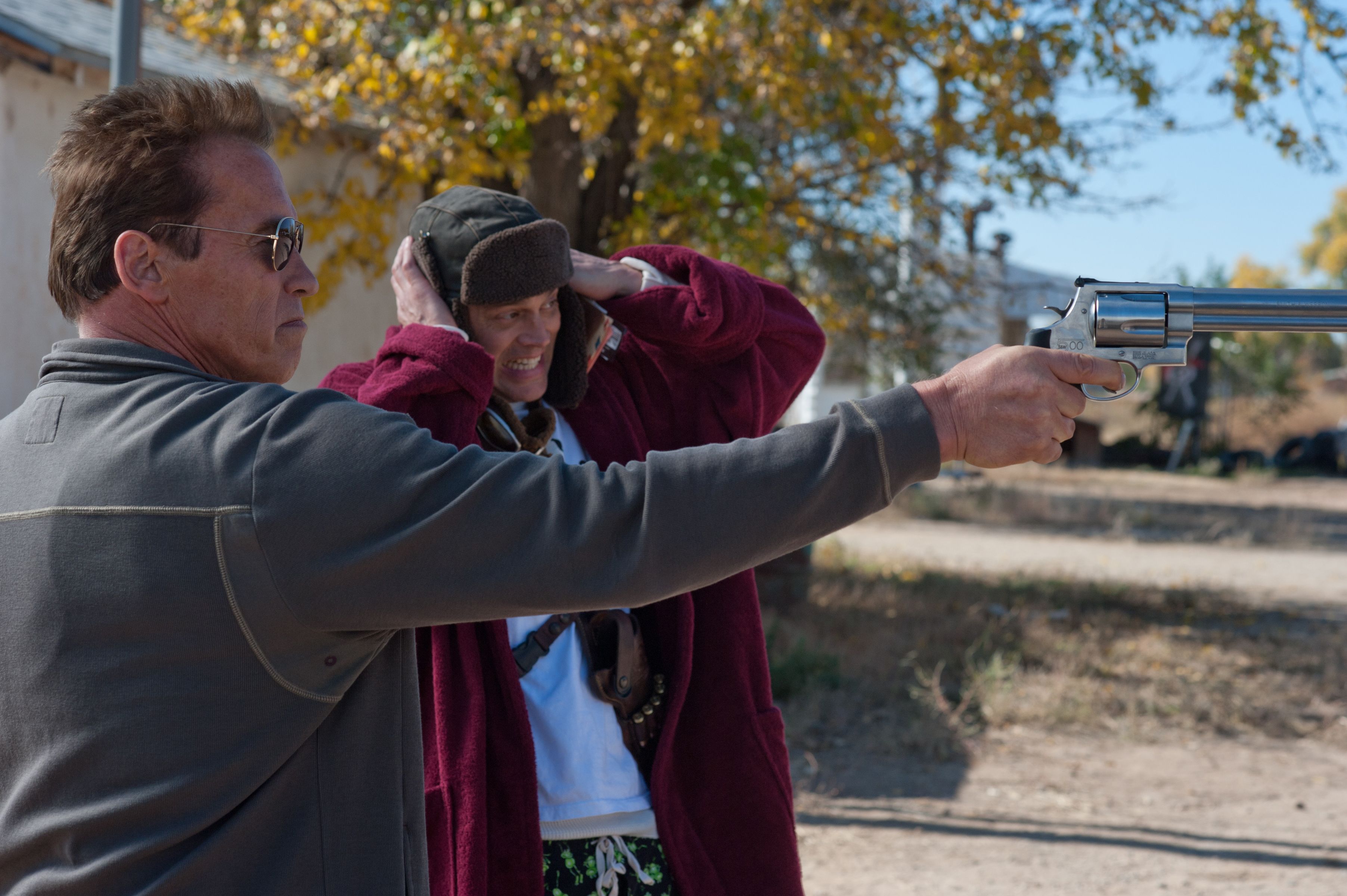
    Is this fate necessarily fair? Yes and no. The majority of The Last Stand, in making every accommodation for Schwarzenegger’s considerable rust, creaks and groans with its star as he goes through the motions. Even during his prime, that a movie would ask its audience to believe in Arnold Schwarzenegger, small town sheriff, is a stretch—something from a lazy sketch comedy show—and yet there he is, patrolling the dusty streets of an Arizona hamlet, teaching his bumbling deputies (Luis Guzmán, Zach Gilford, and Jaime Alexander) the finer points of police-work while bemoaning that the town’s war hero (Rodrigo Santoro) has become the town drunk. Things on patrol are so boring that most of Sheriff Ray’s deputies can hang out with local gun nut Lewis Dinkum (Johnny Knoxville) without missing a beat. Out in the big city, however, the FBI botches the transfer of a big-time Mexican drug kingpin (Eduardo Noriega) who takes an FBI agent (Génesis Rodríguez) hostage and takes off for the border in a souped up muscle car. With head agent John Bannister (Forest Whitaker) utterly powerless to stop that kingpin from slipping over the border, its up to Sheriff Ray and his skeleton crew to make a stand.

    This is the American debut of director Kim Ji-woon, whose versatility and appreciation for genre filmmaking makes him uniquely suited for a modern Schwarzenegger film. He’s hamstrung by a screenplay that divides its time between Whitaker’s bumbling pursuit of the bad guy and Schwarzenegger’s bumbling attempt to stop the bad guy’s henchmen (led by a wonderfully hammed-up Peter Stormare) from constructing a bridge that spans the ravine separating America and Mexico. Drug kingpin Gabriel Cortez almost smothers The Last Stand with his cheap suits and macho platitudes; every scene save his demise at the hands of Sheriff Ray is forgettable, though they try really hard to make something more of him. The FBI is also patently unnecessary save for your usual exchange between local law enforcers about how ticked that the FBI is coming to town to take over jurisdiction. In fact, The Last Stand is so overstuffed with inessential characters and details that its easy to miss out on the fact that Ji-woon is setting up for an impossibly pleasing final firefight in Sommerton Junction, abandoned for the weekend for an out-of-town high school football game.

    That battle—really the film’s third act—is one of the most satisfying bloodlettings a standard action movie has featured in awhile, using effective staging, a varied arsenal, and a car chase that sends two muscle cars through an endless cornfield before Sheriff Ray and Gabriel Cortez meet on the bridge for their final slugfest. Even that feels like a breath of fresh air: despite Schwarzenegger’s imposing physique, very few of his movies end in hand-to-hand combat. Here, both Ray and Cortez rely on an arsenal of brutal looking maneuvers adapted from professional wrestling and combat sports. It used to be that wrestlers and martial artists showed up in Schwarzenegger movies with guns and grimaces to serve as cannon fodder. That the man himself ends up in a triangle choke feels like a more genuine acknowledgement of changing tastes than Chuck Norris’s deployment in The Expendables 2 as a man dispensing seven-year-old internet memes.

    Were Stormare the main villain and the FBI left behind at the scene of their botched operation  it’d be possible to talk about The Last Stand in terms of it being a comeback vehicle. Instead, we’re given Schwarzenegger and a collection of incomplete characters creating chaos in the desert. Say this for the man: though Hollywood has strip mined his formula, he still manages an effortless charisma. He’s not much of an actor, but he’s still a hell of a personality, and within his genre, that counts for a lot. Movies like The Last Stand and men like Arnold Schwarzenegger may not prop up the industry like they did 20 years ago, but they’re also not a bad accompaniment for a tub of popcorn.


    The Last Stand. With Arnold Schwarzenegger (Sheriff Ray Owens), Johnny Knoxville (Lewis Dinkum), Forest Whitaker (Agent John Bannister), Peter Stormare (Burrell), Jamie Alexander (Deputy Sarah Lawrence), and Luis Guzmán (Deputy Mike Figuerola). Directed by Kim Ji-woon and produced by Lorenzo di Bonaventura. Screenplay by Andrew Knauer.
  • Movie Review: Silver Linings Playbook (2012)

    Movie Review: Silver Linings Playbook (2012)

    Silver Linings PlaybookDavid O. Russell was seemingly born to make movies about the modern American male. As codified in Three Kings, The Fighter, and now Silver Linings Playbook, an American man is intense, uncompromising, and without a filter. He is always underestimated. He is driven to conquer. In search of Kuwaiti gold, championship belts, or the satisfaction of winning a high stakes gambit, an American man never rests. To rest is to die. Patrick Solitano (Bradley Cooper) is unquestionably an American man. Told by his wife that he needs to lose weight, he dons a hoodie and a garbage bag and sprints through the neighborhood. Wishing to reconnect with her, he reads every book she assigns to her high school students. Told by doctors, friends, relatives, and the police that he can’t see his wife again, his mind races; he has to see her—the only question is how?

    Pat has recently been diagnosed as bipolar. As Silver Linings Playbook opens, his mother is signing the papers necessary for his release from a Baltimore mental institution. He was there because, upon finding his wife in the shower with another man, he nearly beat that man to death. Pat dedicates himself to overcoming his disorder, but he is unwilling to take medication, his friends and family treat him much differently than before, and his wedding song, which was playing when he found his wife in the shower with another man, is a trigger for his rage. One wonders if his release from the mental hospital was a good idea—not necessarily because it’s too soon, but because his support system isn’t exactly the world’s finest. His mother (Jacki Weaver) is nice enough, but his dad (Robert De Niro) is a case study in obsessive compulsive disorders and likely has a gambling addiction. Having taken up bookkeeping, he spends his Sundays watching Philadelphia Eagles games. He has three remote controls, all angled a certain way. He clutches and rubs his Eagles handkerchief. He intends to get his son in on his compulsion, but Pat. Jr. is always running, always reading, always trying to get his wife back.

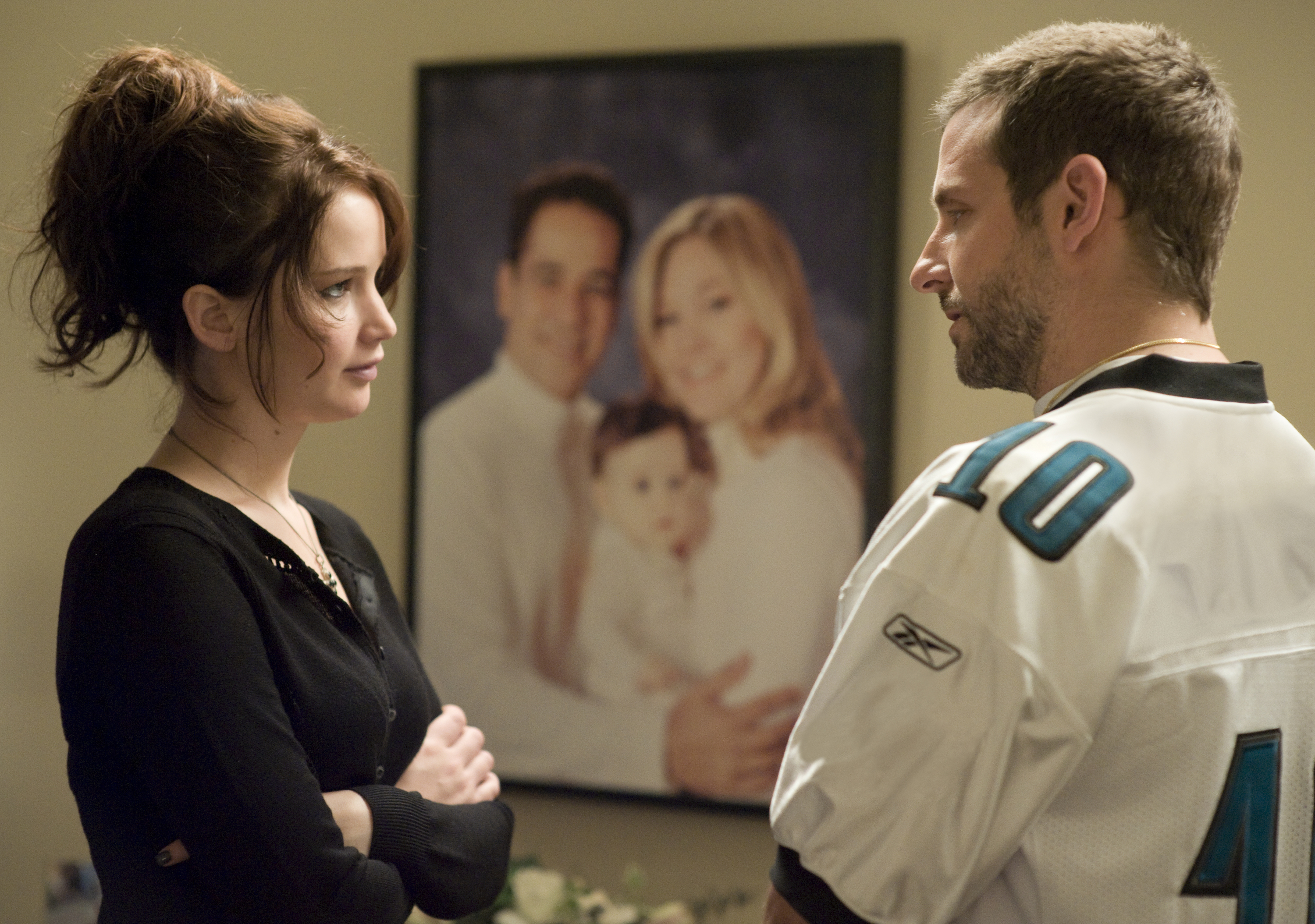
    He meets Tiffany (Jennifer Lawrence), a widowed woman whose coping mechanism is sex. Meeting each other for the first time, they compare medications. It’s clear that there’s something between them, but Pat doesn’t see it; eyes on the prize. Until Tiffany offers to circumvent the restraining order placed against him by his wife, she’s just somebody Pat can compare his ailments to, another crazy person. Pat wants to write a letter to his wife. Tiffany wants to enter a couples dance competition, but was never able to do it with her husband. With the specter of the letter hanging over Pat’s head, Tiffany is able to blackmail him into learning a dance routine. As the Philadelphia Eagles tortuously navigate their way towards the NFC Championship game, Pat and Tiffany grow into a cohesive unit.

    Silver Linings Playbook is structured like a standard romantic comedy and is replete with hang-ups, half truths, and quirky parents who just want the best for their son. The difference—really, the privilege of a David O. Russell rom-com—is not just a matter of talent: Bradley Cooper, Jennifer Lawrence, and Robert De Niro all have ability, and have leant it to a fair number of undeserving vehicles. Silver Linings Playbook—as is true of all of Russell’s films—not only plays on the strengths of his cast, but adapt them to suit the emotional response of the widest possible audience. Christian Bale, for example, had already bent his body into a grotesque horror-show for the purposes of The Machinist, but it was The Fighter that won him an Academy Award. Robert De Niro has been playing an aging tough guy for decades now, with the caveat that very few of those tough guys have been vulnerable. Here, De Niro’s character isn’t just suffering from his OCD and gambling problems, but from the very real possibility that he has failed his son. Though there have been bright spots here and there over the past few years, Silver Linings Playbook gives De Niro the most he’s had to work with in years, and watching him is every bit as invigorating as when he was at the peak of his power.

    Of course, the bulk of Silver Linings Playbook depends on the relationship between Cooper and Lawrence working, which it does. Though Lawrence has detoured post-Winter’s Bone into the much more lucrative world of comic book and young adult novel adaptations, she remains a phenomenally talented young actress. Though her age goes mostly unremarked upon, there’s something deeply unsettling about this young widow and the way she feeds on tragedy. Unlike most romantic comedy misunderstandings, the game she plays with Pat’s unshakable desire to reunite with his wife borders on cruelty. By the time her ploy reveals itself, however, Pat’s unstable brain chemistry—convincingly played by Cooper in a number of wrenching, early scenes—is no longer the often unconquerable monster of reality, but a movie illness. With the help of his family (De Niro and Jacki Weaver are one of the more convincing screen couples of recent years), his friends (Chris Tucker, John Ortiz, and, as his therapist, Anupam Kher), and a few well-applied montages, he’ll pull through.

    It’s easy to envision a darker, less comic version of Silver Linings Playbook, one that maintains the tone of its early scenes, where much about Pat is uncertain and those around him are almost queasy remembering what landed him in a mental institution. Indeed, that version exists on the cutting room floor, where De Niro is meaner and less understanding of his son’s condition, nodded at with the brief presence of Pat’s lawyer brother, who is quick to point out his successes and Pat’s failures. Instead, with its climactic dance sequence and what follows after, Silver Linings Playbook practically wills itself to be a saccharine sweet crowd-pleaser. It’s not the wrong instinct to follow, by any means; Silver Linings Playbook is an easy film to be won over by. That being said, the film also has a certain responsibility to the disorders it invokes, one it willfully ignores in its push to send the audience home grinning. Even with the film’s conscious decision to play as something nice and minor on the table, it’s one nudge too far.


    Silver Linings Playbook. With Bradley Cooper (Pat Solitano Jr.), Jennifer Lawrence (Tiffany Maxwell), Robert De Niro (Pat Solitano Sr.), Jacki Weaver (Dolores Solitano), Chris Tucker (Danny), Anupam Kher (Dr. Patel), John Ortiz (Ronnie), and Julia Styles (Veronica). Directed by David O. Russell and produced by Bruce Cohen and Donna Gigliotti. Screenplay by Russell, based on the novel The Silver Linings Playbook by Matthew Quick

  • Movie Review: Movie 43 (2013)

    Movie Review: Movie 43 (2013)

    Movie 43Way out west they made this movie, a movie I want to tell you about, movie by the name Movie 43. At least that’s the handle its loving producers gave it. Movie 43 doesn’t have much use for the name, itself. This Movie 43, even though its about a deranged man (Dennis Quaid) who pitches a movie to some poor schmuck producer (Greg Kinnear) at gunpoint, never calls itself anything. That’s fine. Movies as bad as Movie 43 probably don’t wish to self-identify. There’s a lot about Movie 43 that doesn’t make a lot of sense to me, and a lot about where it was produced, likewise. But, then again, maybe that’s why I find that place so darned interesting.

    They call Los Angeles, “The City of Angels.” I don’t find it to be that, exactly. But I’ll allow, they make some nice movies there. Of course I can’t say I ever saw one where Hugh Jackman had testicles on his chin, or where Superman slicks his spit curl with his super sperm. And I ain’t never seen a cartoon cat violate itself with a toilet brush, as a fella says. But I’ll tell you what: after seeing Movie 43, this movie that I’m about to unfold, well, I guess I’ve seen something every bit as stupefying as you’d see in any other movie, and in color, too.

    Now this here movie I’m about to unfold took four years to make, just in the spare time its wildly overqualified cast had in-between other projects that people actually enjoy; movies and TV shows—many of them comedies—with some degree of critical and/or popular acclaim. I only mention this because sometime’s there’s a movie—I won’t say a film, because what’s a film?—but sometime’s there’s a movie—and I’m talking about Movie 43, here—sometime’s there’s a movie, well, a movie that’s absolutely the result of spare time. Hugh Jackman, Kate Winslet, Seth MacFarlane, Liev Schreiber, Naomi Watts, Anna Faris, Chris Pratt, Emma Stone, Richard Gere, Uma Thurman, Kristen Bell, Kate Bosworth, Chloë Grace Moretz, Halle Berry, Terrence Howard, Elizabeth Banks—they just fit it right in there, in their spare time. That’s Movie 43. Filmed in Los Angeles. And even if it’s a lazy movie—and Movie 43 is most certainly that, quite possibly the laziest movie filmed in Los Angeles County,which would place it high in the running for laziest worldwide—sometimes, there’s a movie. Sometimes, there’s a movie.

    Lost my train of thought here. Aw, hell. I’ve done introduced it enough.

    Movie 43 wastes no time, opening with a sketch wherein Kate Winslet goes on a blind date with Hugh Jackman, who, as mentioned, has a pair of testicles dangling from his chin. Winslet—who is, as Quaid’s pitchman describes her, smart and career driven—is the only person in the five star restaurant who can see Jackman’s pendulous scrotum, though if it’s because of Jackman’s money or Movie 43’s unfailing belief in women as shrill, howling she-beasts is unknown. This sketch—and most of the sketches contained here—is modeled off of the hair gel joke from There’s Something About Mary, a gross out gag designed to get people in the theater to go home and tell their friends about that one hilarious scene. Those who went to see There’s Something About Mary were rewarded with a complete film. Those who see Movie 43, on the other hand, will be seeing 90-minutes of sketch comedy that can be charitably described as “half finished.” Even Movie 43’s wrap-around sketch, the plot that’s meant to justify the rest of the movie, a segment that had four years to find a resolution, instead ends with Kinnear, Quaid, Common, and Will Sasso throwing up their hands and shrugging their way into the penultimate sketch, which is about how black people are really good at basketball.

    There’s nothing about Movie 43 worth praising, but hey, at least it’s out to offend everybody, right? Though twelve people directed bits and pieces of Movie 43, its preoccupation with race, gender, and sex suggest something of a hive mind mentality. Even if white people can’t jump and Asian men aren’t attractive to Halle Berry, the women of Movie 43 have it the worst. Their demands—like Anna Ferris’s wish for Chris Pratt to incorporate scat into their sex life—are unreasonable. Their behavior—like Emma Stone’s general filthiness and Elizabeth Banks’s abuse of an animated cat—is unconscionable. When Kate Bosworth points out that horny teenage boys are likely to stick their appendages into the moving parts of an iPod designed to look like a naked, catatonic woman, she’s regarded by the mostly-male board of an Apple-like conglomerate as a buzzkill. When Chloë Grace Moretz has her first period, not only do her boyfriend and Chistopher Mintz-Plasse freak out about the blood, but her father and Patrick Warburton regard her condition as, quote, disgusting. Even if you’re the sort of person able to mine pleasure from watching the incredibly famous humiliate themselves, Movie 43 has little to offer: as the blooper reel that plays during the credits handily illustrates, everybody involved is more in on the joke than you’ll ever be.

    Movie 43 was pretty clearly inspired by The Kentucky Fried Movie and Amazon Women on the Moon, though what genre it’s out to mock is beyond me. The targets, I suppose, are hacky, feel-good movies prone to rousing speeches, slow clapping, bro hugs, and passionate first kisses, but when a sketch mocking modern superhero movies ends in the BOOFs and POWs of the old Batman TV show, the result is something botched and horrible: a Frankenstein’s monster akin to Epic Movie or Meet the Spartans, but with the benefit of legitimately funny people like John Hodgman, Aasif Mandvi, and Jack McBrayer standing around with their dicks in their hands, as opposed to a gaggle of folks from central casting. Not every sketch movie gets to be Monty Python’s The Meaning of Life, but few make as succinct an argument against the genre as does Movie 43. As a fella wiser than me once said: sometimes you eat the bear, sometimes the bear, well, he eats you. Just pray that the bear doesn’t have testicles dangling from its jaw.


    Movie 43. With Dennis Quaid, Greg Kinnear, Hugh Jackman, Kate Winslet, Liev Schreiber, Naomi Watts, Anna Faris, Chris Pratt, Kieran Culkin, Emma Stone, Richard Gere, Kate Bosworth, Jack McBrayer, Aasif Mandvi, Justin Long, Jason Sudeikis, Uma Thurman, Kristen Bell, John Hodgman, Christopher Mintz-Plasse, Chloë Grace Moretz, Patrick Warburton, Gerard Butler, Seann William Scott, Johnny Knoxville, Halle Berry, Stephen Merchant, Terrence Howard, Josh Duhamel, and Elizabeth Banks. Directed by Peter Farrelly, Banks, Griffin Dunne, James Gunn, Bob Odenkirk, Brett Ratner, and 6 others and produced by Farrelly, Charles B. Wessler, Ryan Kavanaugh, and John Penotti. Screenplay by Gunn and 17 others

  • Movie Review: Zero Dark Thirty (2012)

    Movie Review: Zero Dark Thirty (2012)

    Zero Dark ThirtyessentialThe most difficult aspect of Zero Dark Thirty, the Kathryn Bigelow/Mark Boal dramatization of the ten year search for Osama bin Ladin, is not that the film depicts torture as a tool utilized by the United States of America, but that torture was used in reality, necessitating its appearance in fiction. The myth of American innocence is inexplicably powerful given the bulk of American history, but the idea of this country as one that did not torture died in the years following 9/11 with the approval of the Bush Administration. However uncomfortable Zero Dark Thirty’s opening act plays, however brutal the film’s depiction of waterboarding, confinement, and humiliation, Bigelow’s interpretation of events are a facsimile; what really happened was much worse. That’s the general effect of Zero Dark Thirty. The hunt of Osama bin Ladin led America into wars and the darker places beyond war, but any attempt to draw something intellectual out of the War on Terror leads either to outrage or justification. Bigelow and Boal try very hard to walk the tightrope between the two—and, based on thousands of thinkpieces on the way torture is depicted here, they failed—and the result is a sometimes thrilling, sometimes laughably clichéd mollification of a difficult era in American history.
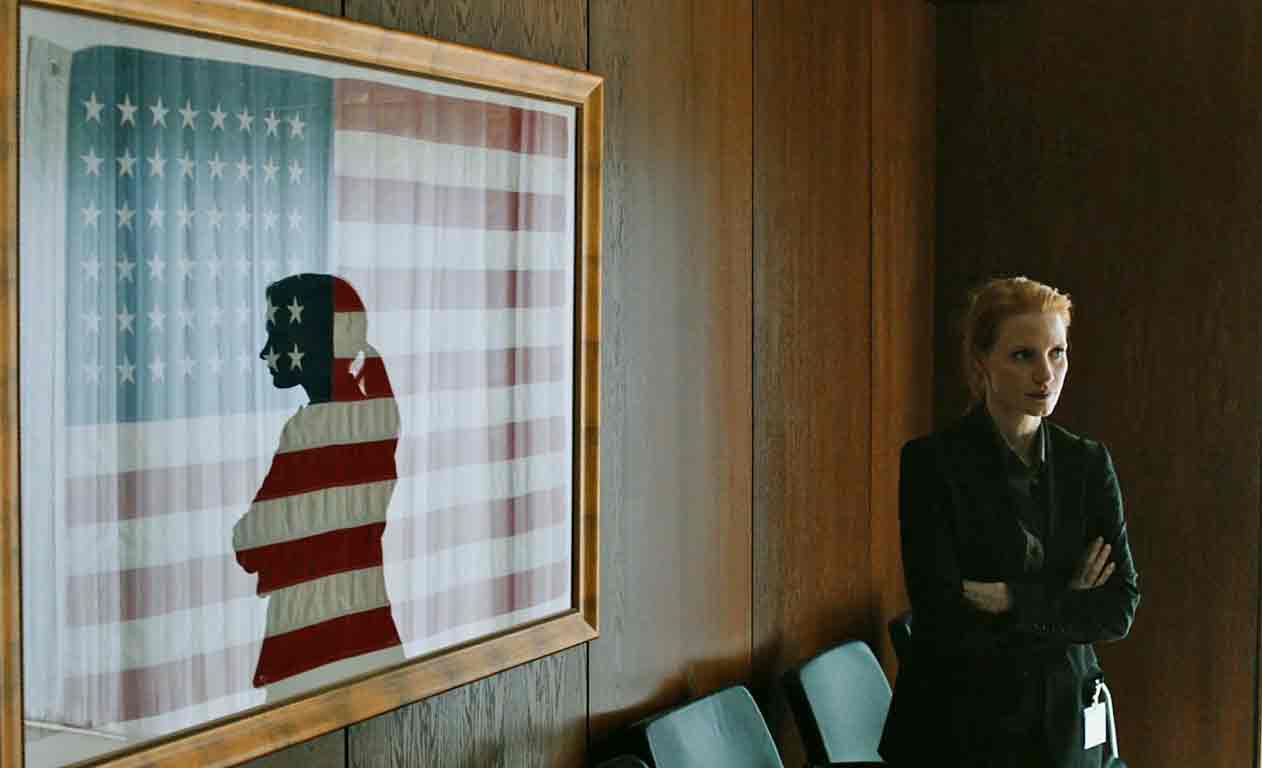
    To set the mood, Zero Dark Thirty begins with a 911 call from inside the World Trade Center playing over a blank screen. It’s exploitive, but also a chilling reminder of day and the nation’s lust for revenge that followed. Two years later, in an undisclosed CIA Black Site, Maya (Jessica Chastain) witnesses the torture of a detainee with links to Saudi terrorists. The interrogator, Dan (Jason Clarke), appears before his victims as the very picture of swaggering Americanism, shaggy haired and attired in jeans and band t-shirts. Maya watches him work the detainee over, humiliating and waterboarding him. If she’s initially horrified by what she sees, that horror quickly turns to passivity. There’s no moral outrage on her part here: torture is a tool, and tools can be quite useful. She picks up a lead suggesting that a man named Abu Ahmed is bin Ladin’s primary contact with the outside world and becomes obsessed with finding this man, hoping he’ll lead her to the top of Al Qaeda.

    The Abu Ahmed plot is Zero Dark Thirty‘s through-line, running beneath interludes of torture, hotel bombings, and political rest, but for much of the film Maya is a bystander, watching as her friends pursue their leads. Once Dan is reassigned to Washington (“I’ve seen to many dude’s penises,” he says), she mostly speaks to and plans operations with Jessica (Jennifer Ehle), who survives the Islamabad Marriott bombing with Maya and has high hopes that she can flip a Jordanian who claims to be one of bin Ladin’s doctors. Her belief leads her to insist that the soldiers at Camp Chapman dispense with their usual security measures. Camp Chapman is thus bombed. By the time Maya’s Abu Ahmed option remains the only practical one on the table, few within the CIA are as taken with the bin Ladin mission as she is.

    But Jessica’s death has a transformative effect on Maya. Recruited into the CIA out of high school for the specific purpose of hunting bin Ladin, the man is now not only responsible for 9/11 but also for the removal—through death or by other means—of Maya’s very limited network of friends. Through two acts of Zero Dark Thirty, her Abu Ahmed lead is put on the back burner. After the Camp Chapman bombing, finding this man is tantamount to an act of vengeance, which Maya pursues like a renegade cop avenging a fallen partner. She is the lone wolf, and bin Ladin is her prey. As good as Chastain is, and she has proven adept at being the calm center of an otherwise chaotic prestige film, lone wolf narratives have been worn out by thrillers of all stripes: by the time she discovers bin Ladin’s Abbottabad compound—and through old-fashioned detective work, no less—and takes to writing the number of days of CIA inactivity on her superior’s door, she’s no longer a recognizable human being. If her eventual acceptance and embrace of torture in her line of work can be chalked up to continuous exposure, much of Maya’s later actions can be explained much more simply: she’s a character in a movie, and things are progressing as they should.

    Maya’s journey from initiation to kill stands as a convenient metaphor of this country’s pursuit of vengeance, but it’s particularly disappointing that, save the film’s last shot, her journey is so similar to many that have been filmed before. For long stretches of time, Bigelow and Boal are able to effectively smokescreen this plot. The torture, the way Maya’s team tracks Abu Ahmed, the climactic raid on the Abbottabad compound—these sequences in particular are imbued with a peculiar kind of tension and, in the torture sequences especially, horror. In an age of WikiLeaks and unrestricted access, that the execution of bin Ladin works cinematically is nothing short of a testament to Bigelow’s skill as a craftsman. But Zero Dark Thirty is not the kind of film that invites one to marvel at its creation. At its best, Zero Dark Thirty makes digestible some of the more unbelievable events from the War on Terror. Its violence, dazzlingly executed, is awful to behold. Too often, however, Bigelow and Boal lack the strength of their protagonist. Their promised uncompromising take on a deeply flawed global manhunt is ultimately as compromised, as flawed, as the mission they document.

    Perhaps this remains secondary to concerns over the way torture is portrayed as that which brings bin Ladin down. Fine. Before Zero Dark Thirty’s release, when it was scheduled to debut before the election, the talk surrounding the film was that it would unfairly swing the election in favor of President Obama. In the aftermath of its release, the new controversy is that Zero Dark Thirty justifies the use of torture. Generally speaking, I agree with the sentiment that the author of a particular piece of artwork is the least well-equipped to speak of their intent, but I also agree with Bigelow, an avowed pacifist, when she says she would never seek to justify torture. A pro-torture apologist is unlikely to employ thirty minutes of torture as a means of justification. Those sequences of America at its lowest are Zero Dark Thirty‘s finest. If the statement Bigelow makes with her opening isn’t overtly political, then it at least asks the audience to take those scenes in and consider the reality of them. The rest of the film asks nothing quite so serious of anybody. It understands that those among the crowd who are thoroughly disgusted have been through quite the ordeal and offers, with clear eyes and a three act structure, to lead those poor, beleaguered filmgoers to safety.


    Zero Dark Thirty. With Jessica Chastain (Maya), Jason Clarke (Dan), Joel Edgerton (Patrick), Mark Strong (George), Jennifer Ehle (Jessica), Mark Duplass (Steve), and Chris Pratt (Justin). Directed by Kathryn Bigelow and produced by Bigelow, Mark Boal, and Megan Ellison. Screenplay by Boal.

  • Movie Review: Argo (2012)

    Movie Review: Argo (2012)

    Argo

    Was there ever a subject for a dramatization “Based on True Events” more ripe for the loving arms of Hollywood than the “Canadian Caper” that played out during the 1979 Iran hostage crisis? A spy thriller involving the movie industry can easily become a spy thriller about the movie industry, and amid report after endless report on the demise of filmgoing as a form of popular entertainment, few industries are as given to navel gazing as the one that produces motion pictures. Enter Argo, which is at least distinguishable from other military-grade propaganda pieces in that its the work of Ben Affleck, a director whose love of movies and whose skill at arranging gigantic casts assures that this one, at least, passes with a knowing smile.

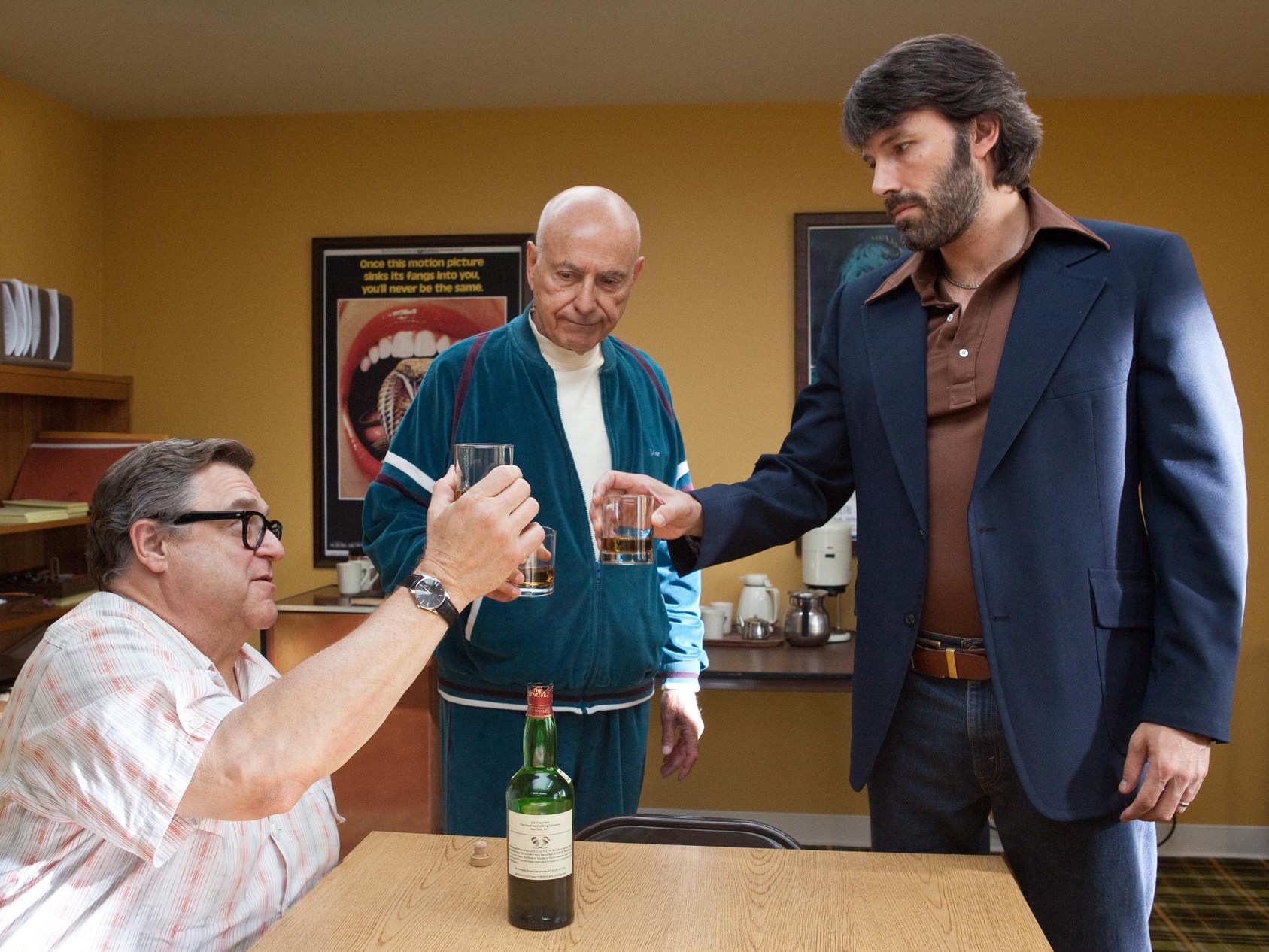
    It was a stroke of dumb luck that six U.S. ambassadors escaped from the embassy in Tehran, secreting themselves away under the floorboards of the Canadian ambassador’s home. Extracting them would be no mean feat, but then, extracting people from high risk areas is what Tony Mendez (Affleck) is an expert at. Competing against a litany of dud proposals at the CIA, Mendez gets the green light to pass the six escapees off as the crew of Canadian filmmakers in Teheran scouting for exotic locales upon which to stage a low budget Star Wars ripoff, Argo. In this, he is aided by producer Lester Siegel (Alan Arkin) and make-up artist John Chambers (John Goodman), who are as skeptical as Mendez’s supervisor (Bryan Cranston) about the odds of the mission’s success, but are willing to make some magic.

    Argo is all about prep-work, spending most of its time showing the set-up of the dummy Hollywood studio and Mendez’s preparation of the six escapees. Setting up the studio isn’t hard, but there’s an element of human error in crafting new identities for six scared human beings. Should one of them slip, they’ll all be killed. Mendez gives his charges fake passports and a folder full of false information and tells them to memorize all of it. Meanwhile, in the occupied U.S. embassy, an army of child laborers are at work finding and assembling stacks of shredded, confidential documents, among them the proper identification of the six people missing from their group of hostages.

    Argo works just fine as a race against the clock, but is undermined somewhat by the reality behind it. Though Mendez and his team’s “location scouting” trip to an Iranian bazaar is fraught with tension, it’s the only moment in the movie where things aren’t too easy for all involved. The situation is dangerous because Affleck and screenwriter Chris Terrio say it is, and because the men and women trapping our Americans in an alleyway are dark-skinned and yelling in another language.

    The Hollywood element also fails to rise above reality. As good as Arkin and Goodman are, their characters are Los Angeles stereotypes: gruff, likable cynics who wink and nod their way through press events and production meetings without really adding much to the narrative. Like The Town, Affleck’s 2010 ensemble crime movie that enjoys a popular consensus much more favorable than is merited, Affleck takes a situation imbued with a grey sense of morality and casts it in stark black and white. If The Town suffered because Affleck tried to make a paragon out of bank robbing liar Doug MacRay, Argo suffers because the Iranian Revolution is merely the backdrop for a spy thriller, its antagonists more zombie than human. The Iranians here shout, grope, and carry automatic weapons, but they’re still only obstacles for the shepherd to lead his flock around.

    2012 was a year that saw plenty of movies released that, in one way or another, involved the moral ambiguity of deep cover spy operations. All of them, even The Avengers, had more to say on the subject than Affleck’s film. The vast majority of investigative reporting here is done by the great newsanchors of the day, and while Good Night, and Good Luck (directed by George Clooney and written by Grant Heslov, who produced Argo) showed to tremendous effect the greatness to which the American media could rise and the darkness the American government is capable of wallowing in, Argo is just fine celebrating the success of a high-stakes gambit. Even more than Zero Dark Thirty, Argo posits itself as a feature length infomercial for the CIA, telling us that there are good guys and bad guys, and that the good guys listen to Led Zeppelin and worry about their kids back home. It’s finely done and entertaining enough, but certainly is not a film made for our jaded, information-glutted time.


    Argo. With Ben Affleck (Tony Mendez), Bryan Cranston (Jack O’Donnell), Alan Arkin (Lester Siegel), John Goodman (John Chambers), Tate Donovan (Bob Anders), Clea DuVall (Cora Lijek), Christopher Denham (Mark Lijek), Scoot McNairy (Joe Stafford), Kerry Bishé (Kathy Stafford), Rory Cochrane (Lee Schatz), Victor Gerber (Ken Taylor), and Kyle Chandler (Hamilton Jordan). Directed by Affleck and produced by Affleck, Grant Heslov, and George Clooney. Screenplay by Chris Terrio, based on the books “The Master of Disguise” by Antonio J. Mendez and “The Great Escape” by Joshuah Bearman.

  • Movie Review: The Hobbit: An Unexpected Journey

    Movie Review: The Hobbit: An Unexpected Journey

    The Hobbit

    Peter Jackson’s The Hobbit: An Unexpected Journey, attempts a rare trick, inflating the narrative of a relatively short novel to accommodate a studio’s need for a franchise. By revisiting his earlier Lord of the Rings movies, plumbing the depths of other Tolkien works, meandering, as The Fellowship of the Ring did, in the Shire, and through invention, Jackson has succeeded in his task—J.R.R. Tolkien’s The Hobbit, as interpreted by Jackson, Guillermo del Toro, and an army of writers, producers, actors, extras, and digital effects artists, will indeed fill the overlarge frame it’s been mandated. The question going into The Hobbit, and this is of particular importance following the bloat of the underrated King Kong and the nigh unforgivable The Lovely Bones, is whether or not Jackson would be able to pull back on his particular brand of bombast long enough to tell a good, engaging story about a band of outsiders questing to rid a mountain of a gold-loving dragon.

    Yes and no. At times, The Hobbit: An Unexpected Journey manages to recall the highest points of Jackson’s Lord of the Rings trilogy. The characters are warm, the landscapes vast and pristine, the CGI mostly an enhancement. In adapting a beloved book as a prequel to a beloved film franchise, Jackson invites nostalgia from the film’s opening moments, as Bilbo Baggins (played as an older hobbit by Ian Holm, and for the majority of the film by Martin Freeman) is shown writing an account of his life for the benefit of his nephew Frodo (Elijah Wood), himself a future adventurer. Gandalf the Grey (Ian McKellen), Elrond (Hugo Weaving), Galadriel (Cate Blanchett), Saruman (Christopher Lee), and Gollum (Andy Serkis) appear throughout, if not to propel the plot, then to gently remind viewers of the elements shared by this trilogy and the one from the recent past.

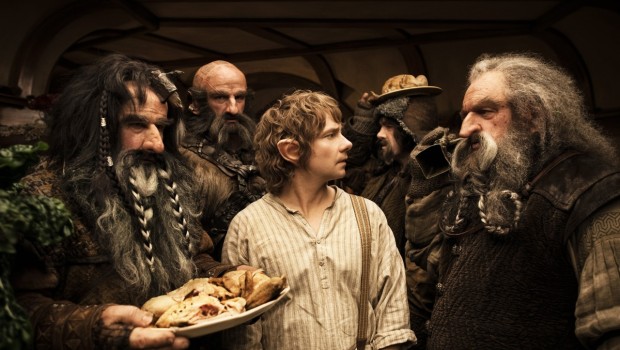
    The bulk of this chapter deals with the preparations made by Bilbo, Gandalf, and a company of dwarves—led by the brooding, kingly Thorin Oakenshield (Richard Armitage)—before attempting to infiltrate the former dwarven homeland, now occupied by a dragon named Smaug. Much has been made of how slowly the first hour of The Hobbit slogs through these details, and that’s true; however clever it seems to have the old Bilbo coyly writing his memoirs as Frodo waits for the arrival of Gandalf with his fireworks, one can’t help but feel cooped up in Bilbo’s den, especially when entering the film with the knowledge that Bilbo sets off on an adventure, finds a ring, gains the respect of his company, and so on. This is an inferiority complex unique to prequels, one that has damned many such efforts in the past, but once Jackson sets his company out into Middle Earth, things pick up considerably.

    The Hobbit also suffers from some of Jackson’s penchant for self-indulgence. I saw the movie in 2D, and while the vistas of New Zealand and its populace of CGI orcs, mountain trolls, and giant eagles looked mostly good, there were times, when panning through the goblin kingdom or over a vast mountain, when the visuals were noticeably less crisp than in any recent Jackson film, as if I were being punished for choosing not to see the film in 3D and at a higher framerate. In one of the film’s huge battle sequences, pitting the dwarves and Gandalf against a gleefully Dickensian goblin king (Barry Humphries) and his army, the disconnect between what’s real and what was filmed against a greenscreen becomes too much. It’s obvious that none of the dwarves will die, but they rack up the kills on the poor, witless goblin army like an expert video gamer in the early levels of a well-worn arcade game.

    Though he certainly tries, Jackson is unable to differentiate many of the dwarves tagging along with Bilbo and Gandalf on their journey. Some are fatter, older, or jollier than others, but, for the exception of the mopey, vengeful Thorin, they’re all mostly the same. The Hobbit: An Unexpected Journey relies upon Freeman and McKellen to carry the bulk of the film’s 169-minutes, which they’re quite capable of. When Gandalf the Grey is held back by a largely ominous, slow-moving discussion foreshadowing the conflict of the second film, Bilbo finds himself matching wits against Gollum. As Gollum, King Kong, Cesar the Ape, or Captain Haddock, few actors have meant as much to special effects spectacles as Andy Serkis, who could probably lend humanity to a broomstick. The tragedy of Gollum and the character’s madness, however, are two well-trod roads, and his game of riddles against Bilbo Baggins, though vital to series lore, never rises above being a witty aside. Compared to Gandalf’s conversation with Elrond, Galadreil, and Saruman, however, it’s pressing, kinetic stuff. Still, for all its down moments, The Hobbit: An Unexpected Journey is that rare creature: a good, mainstream fantasy film, a franchise-extending artifact that manages to find enough warmth to justify its existence.

    I’ll admit, when it comes to splitting book adaptations into an endless succession of questionable sequels, I’m a bit of a skeptic. It’s a recent trend, the franchise addendum, and begs an odd indulgence of its core audience, the fans of the book: pay for some now, and pay again for the rest later. Harry Potter did this. The Twilight Saga did this. Upcoming adaptations of The Hunger Games and 50 Shades of Grey will likely follow suit, with little question of the studio’s motive in releasing as many gigantic blockbusters as possible in successive years. But that’s decidedly not the tone of the coverage surrounding this particular adaptation. A relatively slim volume, especially compared to the tomes that contain the largely empty prose of E.L. James, Stephanie Meyer, or Suzanne Collins, the only precedent for turning Tolkien’s fantasy into a full-blown sojourn on the level of the Lord of the Rings trilogy are the expanded editions of those films, which further packed and padded a series of movies that were, at times, already overstuffed. For many fans of Harry Potter or Twilight, the added film served as an opportunity to bring the series to a fitting, properly epic conclusion. As a casual onlooker, I can’t say I agree with their enthusiasm. I try, as much as possible, to separate a book from the film based upon it, but, for me, the adaptations that work the best are the ones that pare down on the impulses a blank page grants an author, rather than eat-up more than an already considerable chunk of time trying to please every die-hard in the audience.

    What Jackson has done with The Hobbit is rare in that the decisions he’s made in adding to The Hobbit are decidedly not made for the benefit of his die-hard audience, who, to paraphrase the words of The Mountain Goats’ John Darnielle, want a one-film version of The Hobbit where a dragon is slain in the end. I won’t suggest that Jackson’s planned trilogy (who knows—maybe they’ll split the third film in two, like a magician with a saw) isn’t an opportunity for Warner Brothers, New Line Cinema, and MGM to fashion themselves a clutch of gold, but if any literary universe is capable of sustaining the sort of expansion the director and his writers have undertaken, its Tolkien’s. The horde of books, short stories, note cards, and outlines the author left is breathtaking, and the odds of any of that material making its way to the theatre on its own are slim. Some of Jackson’s additions, like Radagast the Brown (Sylvester McCoy)—a wizard who speeds his way through Middle Earth on a rabbit-driven sled, his goofiness in the face of world-ending danger a reminder of the sillier aspects of George Lucas’ Star Wars prequels—add nothing. A necromancer (Benedict Cumberbatch in name only—he appears momentarily as a CGI construct, bits and bytes over flesh and blood) from another Tolkien story serves to perhaps unnecessarily tie together events from this film and the Lord of the Rings. But the film’s main addition, the Pale Orc, is not only something created wholecloth for this film, but is a character whose quest to murder Thorin Oakenshield for the loss of his arm is more immediately relatable to on screen than, say, a pack of talking dogs or a flock of hyper-intelligent eagles. The stakes of prequel films, whose outcome is determined by prior movies whose success does not always equal interest in “the rest of the story,” are notoriously low. By playing with elements from Tolkien’s expanded Middle Earth, Peter Jackson has found a way to infuse his prequels with tension and suspense. In its best moments, The Hobbit: An Unexpected Journey easily meets the expectations of its pedigree. The Hobbit may not be either a perfect film or adaptation, but neither were those sainted films preceding it.


    The Hobbit: An Unexpected Journey. Directed by Peter Jackson. With Ian McKellen (Gandalf the Grey), Martin Freeman (Bilbo Baggins), Andy Serkis (Gollum), Richard Armitage (Thorin Oakenshield), Sylvester McCoy (Radagast the Brown), Hugo Weaving (Elrond), Cate Blanchett (Galadreil), Christopher Lee (Saruman), Ian Holm (old Bilbo), and Elijah Wood (Frodo).