Category: Reviews

  • Wrestling Review: WWE NXT (2/18/15)

    Wrestling Review: WWE NXT (2/18/15)

    NXT Rhyno

    After the excellence that was NXT Takeover: Rival, there’s nothing wrong with a show like this, a cooldown effort that exists largely to set the next month or two of storylines up. NXT General Manager William Regal (long may he reign) sets the tone early. Anybody concerned that Sami Zayn was cheated out of the NXT Championship at Rival should know that titles can change hands due to referee stoppage. Kevin Owens is well and truly the man, and tonight is a new era. To launch it, Kevin Owens will fight against the runner up in the NXT Championship #1 Contenders Tournament, Adrian Neville. Neville, still Zayn’s friend, is not happy with the (perfectly legal) way in which Owens won the belt, and is out for revenge. That’s a good match, and one that works with Regal’s declaration of a new era. Neville was the NXT Champion for a long time, from the origin of the WWE Network until Zayn was able to finally take it away. That’s an era. And Owens, whose brutality is unlike anything seen on NXT, represents a step up. Owens says as much when he tells the NXT Universe that Sami Zayn is in the past, and that the future is Finn Bálor. After stating once again that he fights for a better future for his family (what a mean dude!), he tells Bálor that he is ready whenever the #1 contender has a date in mind.

    The first representative of NXT’s new era is…Rhyno, a guy who was last seen on WWE television in 2005, on the ECW throwback pay-per-view One Night Stand. Rhyno hasn’t entirely disappeared from wrestling, as his physique shows, but between stints on TNA’s Impact Wrestling, Ring of Honor, and other independent promotions, the shock of his return, unlike the shock of a novelty return during the Royal Rumble, is real. The crowd loses their collective minds when the word RHYNO pops up on the ‘Tron, and the dude acquits himself so well that he is spared the ignominy of a “YOU’VE STILL GOT IT” chant. Beyond a few poorly chosen tattoos, Rhyno looks really good squashing Elias Samson with a belly-to-belly suplex and a Gore, an the fact that he’s going to be around for awhile is quite interesting. The announcers put over how NXT is frequently considered the future of the WWE, but that it might also serve as a proving ground for old warhorses with something left. As Finn Bálor talks about his future opportunity against Kevin Owens, he is interrupted by Rhyno, and I guess that’s a match we’re going to get out of this. I’m all for it. This is subtly a really smart use of an old veteran, as beyond the nostalgia pop he’ll get from the crowd, Rhyno was actually one of the best mid-card performers the WWE had during what may have been their in-ring peak from 2001 to 2003. NXT continues to signal that the future of the main WWE product lies within the boundaries of a wrestling ring, so having somebody who excelled at that working with the next generation can only be a benefit.

    NXT Solomon Crowe

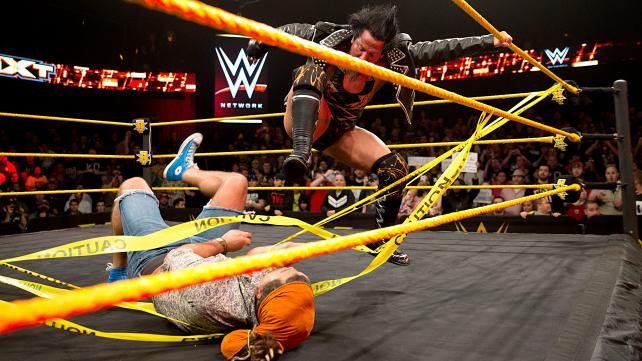
    The other indicator of a “new era” was the debut of Solomon Crowe, which has been hinted at through various small scale “hackings” of NXT’s promotional videos. He came out of nowhere to attack CJ Parker, the environmentalist character who takes a good beating and is frequently upset with how he is left off of NXT shows. He threatened to hijack NXT, to take over Takeover as it were, and went about stringing caution tape from post to post. Crowe blindsided him, put some of his aggro power moves on poor Parker, then allowed us to get back to our regularly scheduled programming. It was… not the best NXT debut I’ve ever seen? Crowe’s character is that he’s a hacker, and most of the pictures I’ve seen of him since he left the indies had him in a suit, toting around an iPad with a sticker on it. I’m glad that’s not how he looked here (he wore a scuzzy leather and pyramid-stud jacket and caveman singlet), but either Crowe is doing his hacking from a tanning bed and has gone mad from exposure, or somebody else is uploading his goofy graphics for him. Who knows if it will work, is what I’m saying. In front of this crowd? Probably. Beating up CJ Parker tells us absolutely nothing, though, so we’ll have to wait and see.

    Squash matches are the order of the evening, as challengers to championships need to be established, and new champions need to establish their reign. The Vaudevillains, once a formidable tag team, are easy pickings for Enzo Amore and Colin Cassady, who are something of a Jersey scumbag upgrade of the New Age Outlaws. Enzo is one of NXT’s more talented smack-talkers (in fact, he once claimed that his Jedi name was “Smacktalker Skywalker”) and Colin Cassady is able backup (though the audience does not like their lady third, Carmella, presumably because attractive women hanging around Enzo and Big Cass doesn’t fit the slashfic headcanon the straight male dudes booing her have authored), but man will it be interesting to see them in a match that’s longer than three minutes. Also, while I’m hardly a fan, it’s worth mentioning that the Vaudevillains have worked pretty hard at establishing their tag team schtick, and that it’s something of a surprise to see them get crushed so handily. Less surprising is the fate of Ol’ Blue Pants, known on the indies as Leva Bates, the surprisingly popular jobber to the stars who pops up so regularly that she has a TitanTron, a theme song (sung by Big Cass), and an entrance. Leva is hardly the most talented woman working the independents, but she’s able enough when required to take a beating, which she does. Sasha takes her out quickly with her knee drop in the corner and the Banks Statement (which is not a good name for anything), then tells the NXT Universe that everybody, especially the women she beat for her title, need to respect her. Based on video testimony from Bayley and Becky Lynch, it appears that they do.

    Oh, video testimony. At NXT Takeover: Rival, Sami Zayn was knocked out and declared unable to continue the match. It was a good, surprising finish to a great match, with the speculation being that Zayn would be “suffering from a concussion” while Owens made NXT his own. But the lead WWE Physician assures us that everything was fine with Sami after the match, just that things during the match made it seem like he was unable to defend himself. He’s off on the Abu Dhabi tour and will come back fine. That… hmm. I hate to review a wrestling show as if I’m counterbooking it, but saying that Zayn got powerbombed so hard that he pretty much went on vacation is much less effective than saying that he needs time to recover from nearly being beaten to death by a man he once thought of as his best friend. When Zayn comes back and is really angry about what Owens did (which was win a match legally), the question on my mind is going to be why he didn’t skip the Abu Dhabi tour to get him some revenge.

    NXT Kevin Owens vs Adrian Neville

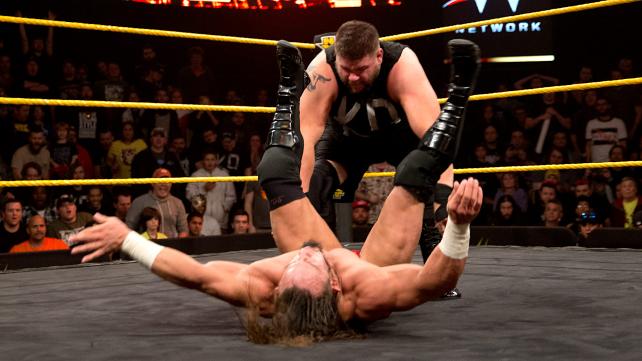
    Were it not for the fact that Adrian Neville has reason to be mad at Kevin Owens, the whole revenge angle to this week’s main event would have been shot, too. But Neville had the evil put on him by Kevin Owens two months ago in a match that ended in a draw, and a victory over the newly crowned champion would put him in line for a title shot. In one of his best interviews to date, Neville said that he felt more like a hunter this time around than the hunted, and he puts that old cliché to work as he jumps Owens before the bell. The champion is able to get on track briefly, catching Neville with an early gutbuster, but after a second attempt at the move leads to him getting spiked on his head with a DDT, it’s all Adrian Neville. Owens, try as he might, is unable to put some distance between himself and his opponent, unable to find the time to recover. Neville is on top of his game tonight, too. He’s quick with his strikes. He’s reckless with his high-flying moves to the outside, particularly with a 450 splash from the ring apron to the floor. His ability to lift Owens up and dump him on his head is quite impressive, as he not only scores a quick German suplex with the momentum of the ropes, but manages to deadlift his much heavier opponent from the canvas. Owens is able to get back into the match by throwing his weight at Neville, but for a long time here it looks like he won’t be denied. Neville counters Owens’ corner cannonball into a superkick and a reverse rana, but the ensuing two count and the time it takes to drag the champion into the corner for the Red Arrow allows Owens to roll out of the way. Neville tries to charge in after he recovers from the landing, but Owens catches him with the pop-up powerbomb, and in two weeks Kevin Owens has secured victories over two men who, more than any other, have come to define NXT.

    In its pre-taped, one hour iteration, NXT is a very good wrestling show. It has a number of stories to tell and is able to do so quickly and nimbly. But, like this week’s Raw, appreciating the way the pieces move on the board is not the same thing as enjoying the show. Rhyno’s return is worth watching in full, as is the main event. But unless squash matches or the characters in them are your thing, there is a lot about regular, weekly NXT that is inessential. Not that it isn’t good, because it very frequently is. But when a show ends with Kevin Owens thrusting his title in the air over a fallen ex-champion, I find myself wanting NXT to do that more than I want it to bum around with Blue Pants.

    Results

    1. Rhyno def. Elias Samson via pinfall. GRADE: C+

    2. Enzo Amore & Colin Cassady (w/Carmella) def. The Vaudevillains (Simon Gotch & Aiden English) via pinfall. GRADE: C

    3. Sasha Banks def. Ol’ Blue Pants via submission. GRADE: C

    4. Kevin Owens def. Adrian Neville via pinfall. GRADE: B+

  • Movie Review: Jupiter Ascending (2015)

    Movie Review: Jupiter Ascending (2015)

    Jupiter Ascending

    Calling Jupiter Ascending an original movie is perhaps disingenuous. While it is among those increasingly rare science fiction blockbusters that weren’t adapted from comic books, novels, video games, or television shows, it is, like Pacific Rim before it, a hulking labor of nostalgia for an incredibly specific genre of film, the technicolor fantasia of the space opera. A dazzling array of humans, aliens, and spaceships pass before the eye, each of them unique and carrying loads of often unexplained baggage, but there’s hardly one that doesn’t have a corollary in Star WarsStar TrekClose Encounters of the Third Kind, or something decidedly stranger, more off-beat. Andy and Lana Wachowski have always worn their influences on their sleeve, but here, with the gross domestic product of several small nations at their disposal, they are bearing their hearts, both of them glittering machinations assembled from the detritus of what used to be called nerd culture and what is now just culture. By making a film so decadent and doomed to failure, they seem to have laid claim to that tiny parcel of the collective imagination that is still yet unconquered by the spandex-clad horde.

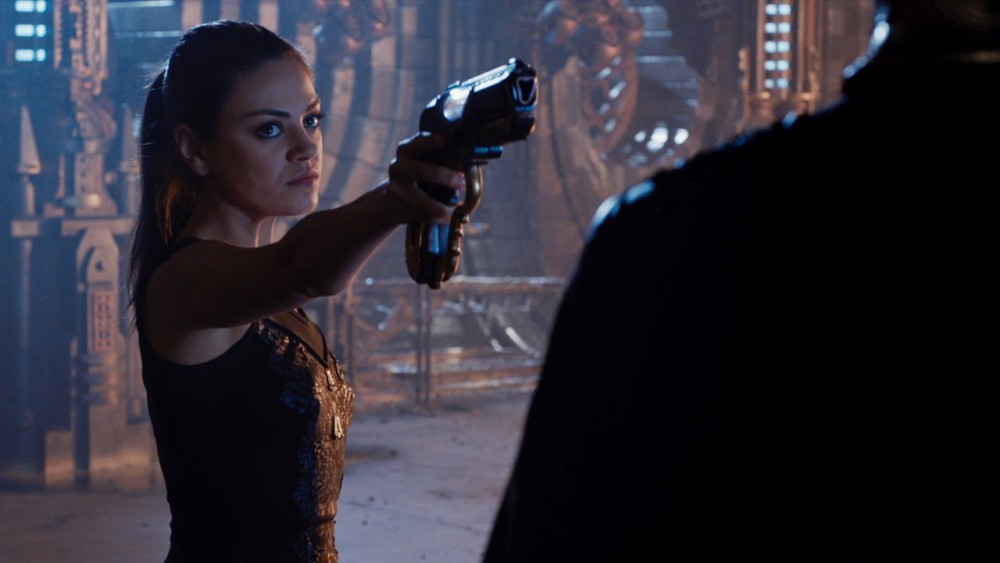
    None of this is to say that Jupiter Ascending is any good. In fact, most of it is very bad. An array of beautiful images crudely hacked apart and stitched back together in the editing bay, to describe any aspect of the plot here as presented is to sound like one is making assumptions of a very long film after catching the last five minutes on television. Here goes nothing. Jupiter Jones (Mila Kunis) is an undocumented Russian immigrant unsatisfied with her life cleaning toilets in Chicago. One day she is selling her eggs to a fertility clinic, which is surely a first in an action film. The next, she finds out that, through accident of birth, she is the exact genetic duplicate of the matriarch of clan Abrasax and the rightful owner of the planet Earth. This places Jupiter in the middle a family war between a hedonistic prince (Douglas Booth), an eternally young princess (Tuppence Middleton), and their ruthless industrialist of a brother (Eddie Redmayne), her only sure protection in the galaxy (which she will span in its vastness) being a soldier-turned-mercenary human/wolf/insect hybrid (Channing Tatum) first seen smelling her name on a sheet of paper at the clinic. There is a team of bounty hunters. There are little grey men. There are gigantic lizard men. There is the crew of the ship. There are robots and bureaucrats and the individual members of Jupiter’s family. All of them matter. Some are, it seems, audience surrogates, just as confused as we are about the world beyond our world that dances among the stars to an ancient song that can only be heard by those with access to its score.

    Luckily, the Wachowskis are keen to overshare. Large stretches of Jupiter Ascending exist just to fill in the details, coming so hard and heavy that even Jupiter, with her fate and the fate of the world on her shoulders, breaks down and says she doesn’t care about any of it. The other characters know so much and Jupiter so little that she frequently feels like a character without agency, falling for obvious ploys and needing constant rescue from Tatum’s Caine Wise, who has this neat trick where he is rescued from every conceivable deathtrap by the magic of coincidence and given all the credit. This is something of a disappointment, as Jupiter Ascending is, at times, nearly a Marxist, feminist manifesto shrouded by the glitter and doom of a summer blockbuster. Though doing so, I realize, is futile, I keep imagining Jupiter Ascending getting a summer release in a year that wasn’t overburdened with light, spectacle-driven sci-fi, having the billion-dollar success that was envisioned when the project was greenlit. Hundreds of thousands of men watch a woman struggle with the decision to sell her eggs, are enraged for her when her cousin negotiates a large cut of the profits. The working class grow angry with the film’s end boss, his speaking pattern belabored by a state of agonizing, near-constant orgasm as he lectures Jupiter about the need to convert humans into capital. A laugh is had as Jupiter negotiates the bowels of galactic bureaucracy with an over-taxed droid. A moment of silence is shared as a bottle of human goop—the liquid that allows the intergalactic ruling class their millennia-spanning lives—falls to the ground and is shattered.

    But I’ve mentioned a hoped for billion-dollar success, which spoils even my utopian ideal for the film. The larger engine at work throughout Jupiter Ascending is its naked desire for a sequel, the further adventures of Jupiter Jones in space or on Earth or wherever the focus group found itself most pleased. While my brain keeps twisting small moments in Jupiter Ascending into larger academic points (the CGI reconstruction of Chicago, just razed by a CGI spacechase, as a commentary on the vapid nature of such sequences, for example), the Wachowskis bumble about like Tobias Fünke, Yes, Anding themselves to the point of insanity. Jupiter is rescued from little grey men by a disgraced bounty hunter. Yes, and they fall in love. Yes, and their romance is complicated by issues of class. Yes, and there’s a marriage where one of the evil princes tries to marry an exact genetic replica of his mother. Yes, and that is spoiled by the bounty hunter, who was initially hired by the prince under the pretense that he would be reinstated to the military. Yes, and members of the military have wings! Yes, and, without his wings, the bounty hunter has these boots, these anti-gravity heelies that make it look like he’s tearing ass through the mall, even when his life is in danger. Yes, and, uhh, something about bees; an entire house covered in a honeycomb! Yes, and… uhh, wait, bees? Did you say bees? Yes! And, I dunno, maybe Jupiter’s scummy cousin buys a flatscreen TV?

    On and on and on, until the perfunctory action sequence brings us to the required Disney princess ending, which is some weird combination of The Secret and that old, classist pablum that one should be happy with what one has. Here, that means waking up at four in the morning to clean the toilets of the wealthy despite owning the deed to an entire planet, being okay with one’s place in a machine so large that even a Jupiter-sized refinery represents but one small cog within it. Recently, I saw a headline in my Google news feed that asked if Marvel could “save” the Wachowskis. Jupiter Ascending suggests not, as, despite its trappings, this is essentially their Marvel film, disguising the same mostly white, mostly male exceptionalism coded within the MCU with the same safe message that no, really, everybody can be special, the princess or the soldier (never both, and never something else). That’s a marketable idea, but not one the Wachowskis or their film seem to believe in. No, the heart of Jupiter Ascending, beating faintly under layer after layer of bloat, belongs to Terry Gilliam, sniggering maliciously as he affixes a rubber stamp to the deed that awards Jupiter Jones ownership of Earth. It’s a fine dream Jupiter has, of liberating her and her family. How easy, Gilliam’s appearance suggests, for that dream to become madness.


    Jupiter Ascending. With Mila Kunis (Jupiter Jones), Channing Tatum (Caine Wise), Sean Bean (Stinger Apini), Eddie Redmayne (Balem Abrasax), Douglas Booth (Titus Abrasax), Tuppence Middleton (Kalique Middleton), and Terry Gilliam (Seal and Signet Minister). Directed by Andy and Lana Wachowski, from a screenplay by the Wachowskis.

  • Wrestling Review: WWE Raw (2/16/15)

    Wrestling Review: WWE Raw (2/16/15)

    WWE Raw Daniel Bryan vs Roman Reigns

    Quietly, the WWE has done a very good job of building up to Fastlane, which they’re billing as a “new pay-per-view concept” though, really, it’s just a regular pay-per-view without the usual February Elimination Chamber main event. The lack of a Chamber match, I think, is the reason why Fastlane is so compelling. The WWE calendar is littered with pay-per-views that are branded by one kind of match or another that the matches themselves, no matter how violent or how good, feel more inevitable than special. Without the crutch of putting six guys in a goofy chain-and-plexiglass rig with the absent WWE Championship on the line, instead what we have is the supposed fast lane on the road to WrestleMania. Considering how slow that road has felt thus far, having a date on the calendar where everything will supposedly get back in gear feels like a blessing. “Quietly” in this case also means “glacially,” especially compared to the stretch between last year’s Royal Rumble and WrestleMania, when nearly every Raw had a standout match or segment. Raw will need to pick up the pace sooner rather than later, but, as the last show before a pay-per-view that looks, on paper, like the strongest card since SummerSlam, the WWE does a good enough job of getting everybody in place.

    That includes Rusev, who gets trucked by John Cena in the opening segment. This is not the first time a foreign monster has charged the 15-time WWE Champion with losing a step before Cena Rises Above Hate and proves him wrong. I doubt it will be the last. Since the beginning, it seemed like the endgame for Rusev was going to be a loss to John Cena, who, quite honestly, is going through the motions at the start of Raw. Every John Cena promo from 2007 forward is thrown in the blender. Cena loves the WWE. He loves when fans cheer him. He loves when fans boo him. He hates that there is a monster out there who isn’t from America and who can’t be beaten, and he promises to destroy him. This brings out Rusev and Lana, who are, really, a politicized make-over of the old Armando Estrada/Umaga pairing from 2008, an act that has risen above cartoon parody to become one of the most enjoyable aspects of a show that is frequently hard to enjoy. Lana in particular continues to evolve, relying less and less on the merits of Vladimir Putin and the Raw audience’s hatred of being told to shut up (by a lady who ain’t from here to boot!) and more on the merits of her freakish charge, who I also enjoy on the microphone. Rusev is a blunt object used to smash the opposition, a warhammer who only knows how to kill. John Cena’s gambit is that bringing Rusev down relies on taking the fight to him, which he does by charging up the ramp and hurling the burly Bulgarian into a panel of LED lights. Beyond some shoddy camerawork (really, why would you zoom in and out on bodies in motion?), the physicality of Cena vs. Rusev was quite satisfying. Cena proved his point about his strategy, but wrestling matches don’t work like street fights. Whether or not his plan will work when a referee calls for the bell is the story now, and it’s a good one. Rusev’s mystique isn’t compromised unless he’s pinned or he taps out to the STF. Only an idiot would pull the trigger on that at Fastlane.

    The rest of Fastlane‘s undercard was built solidly here, as well, with the exception of the upcoming match between Paige and Nikki Bella. That should be a good match (Nikki Bella is easily the most improved wrestler on the main roster over the past year), but its plot is stuck in the muck and mire of the past ten years of the Diva’s division. It was actually somewhat brilliant when the Bella Twins attacked Paige and spraytanned her, as Paige had been clinging to the frankly stupid notion that simply not looking like a model made her better than all the other Divas. But now we’re in the usual Bella Twin holding pattern where they’re “pranking” (read: assaulting or stealing from) Paige in a variety of ways designed to brag that they look better than her. This week, they steal Paige’s clothes, which forces her to wrestle a match against Summer Rae while dressed in a Rosebud’s clothes. Considering that Paige kills Summer Rae handily, it hardly matters. Women have also factored into the Tag Team Championship storyline between The Usos and Tyson Kidd and Cesaro, as a blown double date between Kidd and Jimmy Uso and their respective wives Natalya and Naomi (sample line: “I’m here trying to respect this dinner”) led to a husband and wife mixed tag team match. The mainstream format of such matches is really dated, but Kidd’s unwillingness to wrestle Uso leads to three good minutes between Natalya and Naomi. Naomi, as is standard in non-title Divas division matches, wins with a roll up, allowing The Usos to celebrate that they got one over on their rivals while continuing to build on the will-they-or-won’t-they saga that is the relationship between Kidd and Natalya. Right now, it wouldn’t be at all surprising if Kidd left Nattie and got an apartment uptown with his buddy Cesaro, but I’m probably just authoring mental slash-fiction. Probably. The tag team division has been a long-running quagmire, but the Usos vs. Kidd and Cesaro match looks enticing, and the Prime Time Players reunited when Titus O’Neil stormed to the ring to help his returning buddy Darren Young escape a whooping at the hands of The Ascension. With the Miz/Mizdow team slowly breaking up, The New Day entrenched in the wasteland that is their racist gimmick, and tonight’s official dissolution of the Rhodes Brothers/Stardust and Goldust, a full-time return of the Prime Time Players, who always seemed on the verge of making some noise in the division, is a good thing.

    Speaking of Stardust and Goldust, this Raw, like most, was built around promos. There was John Cena’s opening promo, Triple H’s Ric Flair-assisted promo about a confrontation (read: promo) with Sting at Fastlane, and the promise of Dusty Rhodes addressing the problems between his sons (not to mention the usual Seth Rollins interview). Only Dusty didn’t speak much and, of all the interviews, tonight, the one that most stole the show was Stardust’s declaration that Cody Rhodes was dead and never coming back. Dusty Rhodes’ are shoes no man can fill, but Stardust stood there, painted purple and silver and wearing a rubber suit, and delivered fire right in his father’s face. Stardust has, to this point, felt like a needless, pandering rip-off of Goldust, which was unfortunate given their role in the early iteration of the Authority storyline, but on Raw Stardust was given a purpose and a mission. It’s obviously impossible to separate the character from the Rhodes lineage, but it’s good heel motivation coming out of a brother/brother tag team, and this all should culminate in the Rhodes vs. Rhodes match that Goldust has been rather open about wanting to retire on.

    Dusty looked (and is) old, but still acquits himself rather well. That’s less true of his lifetime rival Ric Flair, who surprised Triple H mid-speech to remind him that Sting, ancient old man or not, is still Sting and needs to be respected. Flair sounded drunk, but getting drunk and talking about his glory days is pretty much his job now, so he did well enough that Triple H shoving him on his ass felt sad because The Game was disrespecting a legend he openly admires, not because Flair’s condition continues to darken his legacy. Fallout from Sting’s debut at Survivor Series continues to be the theme heading into Fastlane, as Dolph Ziggler and Seth Rollins seem to be moving into a singles program. Rollins’ promo, unnecessary though it was, signaled that he is being shifted away from the WWE Championship for the time being to focus on the Zigglers, Rybacks, and Rowans of the card.  Ziggler continues to be an unconvincing babyface on the microphone, (I’m not interested in white meat, I guess) but an incredible one in the ring. The match between Rollins and Ziggler was good. Not up to the pace they established at Survivor Series, but a good teaser for what the two should be able to do without distraction. They’ll wrestle on SmackDown! in this week’s Raw rematch, though another contest at Fastlane (and perhaps another at WrestleMania) isn’t out of the question.

    Beyond Rollins/Ziggler and the main event between Big Show and Daniel Bryan, most of the wrestling on Raw this week as an afterthought. Even a singles match between Dean Ambrose and Luke Harper, while solid, existed more to set-up a later contest than to tell its own story. There were plenty of good spots, but Harper is wandering aimlessly at the moment, and WWE doesn’t do a very good job of protecting big dudes who aren’t in an active storyline. Harper lost clean to Ambrose to establish Ambrose’s credentials against current Intercontinental Champion Bad News Barrett, who beat Damien Mizdow in a match that nudged forward the issue between Mizdow and The Miz. Barrett was fantastic when Ambrose ziptied him to the ringpost and forced him to sign the contract, screaming for a knife to cut himself free and how it wasn’t his signature on the sheet and that the contract wasn’t legal. Had they cut bait on a weird skit where Ambrose “auditioned for Weekend Update,” announcing that he’d make Barrett sign the contract, everything on this front would have been great. Barrett is an effective heel, and, well, if Ambrose is going to be a goofy dude whose popularity the writing team doesn’t understand or know how to harness, he’s best when his goofiness is channeled through a bit of menace, rather than a bad suit. The Intercontinental Championship is always on the verge of meaning something. What matters more than Barrett vs. Ambrose at Fastlane is whether or not the issue continues to build, or if the title reverts to its usual miserable pattern, where the champion loses every non-title match until he is required to defend the title.

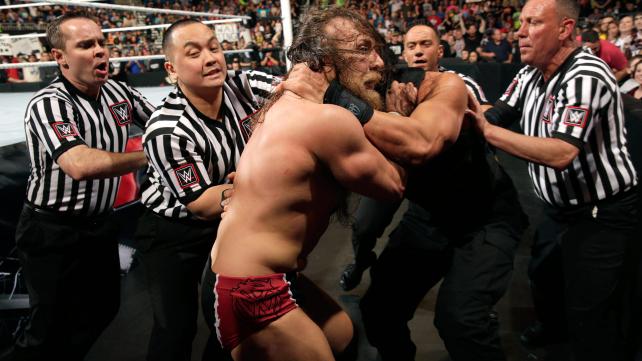
    The confrontation that will set up Sting vs. Triple H at WrestleMania is an important part of Fastlane. Bray Wyatt’s continued promos that are (vaguely) about The Undertaker (this week he hammered some nails into a coffin) continue to be important. Those are two of the marquee matches at WrestleMania. They are happening. There is no turning back. Less certain is the fate of the WWE World Heavyweight Championship, currently held by Brock Lesnar. He’ll be there, defending, but his opponent is yet to be decided. Roman Reigns earned a shot by virtue of winning the Royal Rumble. Daniel Bryan feels that he deserves one because he was stripped of the championship in 2014 without having lost it and, as he points out, made only one fewer defense of the championship. Reigns wrestled Kane and Bryan wrestled Big Show, but the matches and results were secondary to the simmering issue between the two men, which threatens to boil over into something personal in the main event of Fastlane. After an interview where Reigns questioned the manhood of Bryan for going about a championship match by asking for one instead of earning it, Bryan came to ringside for Reigns match and participated on commentary, where he did a very good job of making clear how slighted he felt by Reigns’ assessment of the situation. He thought there was mutual respect between the two, but there clearly wasn’t. When Reigns had an advantage over Kane, Bryan would stand and lead the Orlando crowd in a YES! chant, which succeeded in distracting his man. Reigns won the match, but not in his usual dominant fashion, and Bryan would later say that, if he wants to beat him, Reigns had better get used to the crowd being in Daniel Bryan’s pocket. During the main event match between Big Show and Bryan, Reigns sat at ringside and watched (he didn’t join the commentary team, for good reason). Reigns took to the crowd, signing autographs and giving away t-shirts, and this caused Daniel Bryan no end of distraction. An exchange near the announce table led Big Show to spear Reigns, who would recover and hit Show with the Superman Punch with Daniel Bryan perched on the top rope for a missile dropkick. With the match over, Bryan would instead hit Reigns with the dropkick, sparking a brawl that closed the show.

    This sequence was fantastic, a sprint around the ring and through the crowd that ended in a pull-apart with Reigns bleeding from the mouth and Bryan seething. Initially it looked as though they were going to do with Roman Reigns what they did with Batista last year, turning the hand-chosen WrestleMania main event guy into a heel due to the overwhelming popularity of Daniel Bryan, but this year is much more vague than last. Batista was universally despised from the moment it was clear that Daniel Bryan was not in the Royal Rumble, but Reigns plays pretty well in all but the hottest towns in wrestling. And where Batista had little reason to respect Bryan, Reigns has some respect for the former champion, not only for his in-ring accomplishments and what history they had together when The Shield clashed with Team Hell No, but for his resilience in the face of a career ending injury. But both men want to fight Brock Lesnar at WrestleMania, and it doesn’t look like there will be an opening for a third man in the main event, so that respect had to give way towards animosity with so much on the line. Daniel Bryan is a master at his craft, so the reemergence of his pre-rise mean streak has been subtle and brilliant. The wrinkle that they’ve added to Reigns’ story, that he’s trying to accomplish something not even the most legendary member of his family could achieve, is the most compelling angle Reigns has had since The Shield folded, and has managed to find some interesting space here, too (the t-shirts he was throwing to the crowd were Uso shirts, after all). What initially seemed like a capitulation on the part of WWE in the face of post-Royal Rumble fan revolt has turned into their best story since the SummerSlam domination of John Cena. The match at Fastlane will be telling in Reigns’ ability to become what the WWE so obviously wants him to be, but for now, the table is set. Sunday night will be an interesting one for a number of reasons, none moreso than this. For the WWE to pull itself out of the rut it has so clearly been stuck in since September, Fastlane is going to need to be that rare February pay-per-view that’s more about wrestling than WrestleMania. For once, the uncertainty surrounding a pay-per-view event feels like a good omen.

    Results

    1. Dean Ambrose def. Luke Harper via pinfall. GRADE: B-

    2. The New Day (Kofi Kingston & Xavier Woods w/Big E) def. Goldust and Stardust via pinfall. GRADE: C+

    3. Roman Reigns def. Kane via count out. GRADE: C

    4. Paige def. Summer Rae via pinfall. GRADE: C-

    5. Dolph Zigger def. Seth Rollins via disqualification when J&J Security interfered. GRADE: B

    6. Darren Young & Local Talent vs. The Ascension never officially started. GRADE: N/A

    7. Bad News Barrett def. Damien Mizdow (w/The Miz) via pinfall. GRADE: C

    8. Jimmy Uso & Naomi (w/Jey Uso) def. Tyson Kidd & Natalya (w/Cesaro) via pinfall. GRADE: C+

    9. The Big Show def. Daniel Bryan via disqualification when Roman Reigns interfered. GRADE: B-


  • Wrestling Review: NXT Takeover: Rival (2/12/2015)

    Wrestling Review: NXT Takeover: Rival (2/12/2015)

    essentialWhen Roman Reigns won the 2015 Royal Rumble and #CancelWWENetwork trended worldwide on Twitter, there seemed to be this hitch in the sentiment, a slight hesitation: There would be a new live NXT special, and it would feature Sami Zayn and Kevin Owens reprising a feud that, for many, ranks as the best in the history of the independents. More than CM Punk’s tumultuous rise and fall, and more than Daniel Bryan’s ascendence to the top of the card, the story of Sami Zayn vs. Kevin Owens is the most unexpected development in recent WWE history—that a skinnyfat (to steal a line) French Canadian who used to work under a mask and a normalfat French Canadian wrestling in basketball shorts and a tanktop would be deemed “the future of this business” by no less a scion than Triple H, and after the pair had been deemed worthless by former Ring of Honor booker Jim Cornette for being too indie for the most indie of indie feds, is truly incomprehensible. Those who were hoping for this generation’s Guerrero/Benoit WrestleMania XX moment from Punk and Bryan, some verification that the “wrestling” in World Wrestling Entertainment is of ultimate importance, were putting too much weight on what is ultimately an overblown pop-culture novelty that places more emphasis on Mania than anything else. Whatever book that gets written about Triple H’s “book that never ends” begins here, in the only environ that’s more constructed than WrestleMania, The NXT Arena at Full Sail University. If this is the future, then the WWE is in awfully good shape.

    Beyond Lucha Underground, there is no televised wrestling show that is more competently, completely booked than NXT. NXT Takeover: Rival featured five matches, and all five of them, regardless of their quality, had a reason for being on that show. Hideo Itami and Tyler Breeze, who opened the show, were in something of a battle of runner-ups in the NXT Championship #1 Contender’s Tournament. Baron Corbin and Bull Dempsey have been bullying each other for awhile now in an effort to establish themselves as the baddest big man in town. The Lucha Dragons were trying to avenge an upset loss of their NXT Tag Team Championships to the upstart tandem of Team Thick. And then there were the co-main events, a fatal four way for the NXT Women’s Championship and a one-on-one contest between Zayn and Owens for the NXT Title. Both feuds have long, extensive histories behind them, equally impressive in terms of what NXT’s writers are willing to do both with extra-WWE history (Zayn and Owens) and a women’s division whose championship feuds aren’t contested largely on grounds of petty jealousy, body-shaming, or the “bitches be crazy” mode of storytelling that is, depressingly, the one button the team writing Raw and SmackDown! know how to push. On “Stone Cold” Steve Austin’s podcast, Triple H said that writing that third hour of Raw is the most difficult creative task in WWE. While I hardly think that cutting that hour would fix all the problems, the NXT Takeover specials have proven to be a model for the kind of storytelling a compressed timeframe necessitates. With no time for a 30-minute speech to set up the night’s events, we’re given a dramatic recap video that’s as good as anything produced for the main event feuds on the main shows, our hellos from the announce team (Rich Brennan, Corey Graves, and Jason Albert), and head straight for the ring.
    NXT Takeover Rival Itami Breeze

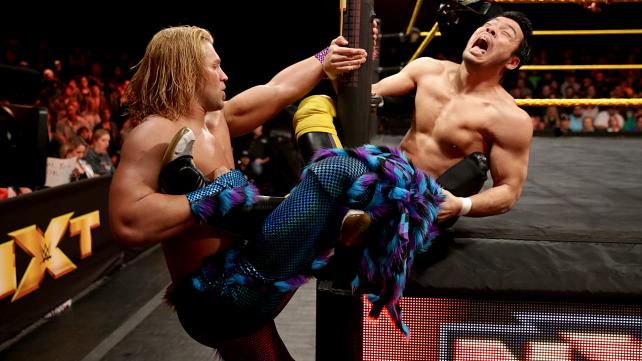
    The first contest will likely be the least buzzed about in the months that follow, but Hideo Itami vs. Tyler Breeze is proof that the NXT system is working in more ways than one, both in developing “WWE guys” (Breeze) and in working out the kinks of wrestlers who are coming in from different systems (Itami). Hideo Itami was one of the most respected professional wrestlers in Japan, where he competed as KENTA, but his initial transition to the WWE and its in-ring style has been somewhat of a non-starter. His debut was the platform from which Finn Bálor launched himself, and, beyond a few flashes of brilliance, he’s yet to really have a signature match. Of the group including him, Bálor, Adrien Neville, Sami Zayn, and Kevin Owens, Itami faces the hardest transition, both in terms of style and culture. As for Breeze, he was the star of the main event of NXT Takeover: Fatal Four-Way, but saw his position on the card slip as more renowned talent from the independents and Japan made their debuts. He’s a tremendous talent who works his gimmick (“part man/all model” as the theme song goes) so well that it would actually be a shame to see him transition over to Raw, where 15,000 fans and three disinterested announcers wouldn’t give it the time of day. Here in NXT, things like a fuzzy selfie stick and a screaming ladyfan getting too grabby are worthwhile touches to an already masterful piece of characterwork. Itami tries to start out by kicking the pretty out of Breeze in retaliation for an attack backstage, but Breeze maneuvers his way behind the referee and uses that diversion to take advantage early. Avoiding Itami’s kicks is Breeze’s angle here, but he can’t hope to do so as Itami is at least as quick as Prince Pretty, if not quicker. Before long, Itami has Breeze on the mat and lights him up with a scintillating kick to the chest—either Itami is putting extra oomph into them in his first live singles match or he’s figured out how to slap his knee, as is the fashion. Whatever. Some things are still magic to me. The sound of flesh slapping on flesh, for instance. Breeze, meanwhile, does a superhuman job of selling those kicks and Itami’s momentum. His character has also undergone a very subtle change in ring, moving from a psychological need to preserve his looks to a desire to finally clinch the NXT championship. As such, his wrestling is much meaner than it used to be, the way he takes advantage more wily than in the past. Hideo Itami has more experience than Tyler Breeze, but Breeze has more experience in the WWE style, which, in NXT, is paramount. The resulting match isn’t a clash of two styles, but a story of one hugely hyped international prospect finally figuring out the learning curve against a guy who feels like he’s been looked over in favor of shiny new signings. That’s a solid foundation for a wrestling match, and what they build on top of it is really quite impressive.
    NXT Takeover Rival Team Thick Lucha Dragons

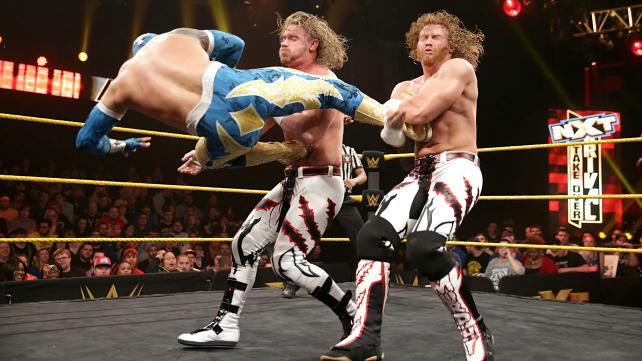
    The rest of the first half is not good. NXT is frequently great, but it is still an extension of WWE’s development program, an effort to get their young workers camera ready while simulating the pressure of a main roster show. Some guys, like Bull Dempsey, are competent enough but just have nothing going for them. Others, like Baron Corbin, have a long way to go before they’re camera-ready, but are there because of their size. Dempsey was formerly the bully of the roster, taking down chumps left and right in “impressive” fashion, but then Baron Corbin hit the scene with his height, his ability to brood, and a fake biker/wolfman aesthetic, and now its his job to beat people in less than a minute. That got Dempsey envious enough to cost Corbin in the #1 Contender’s Tournament after two decisive losses, setting up this no-disqualification match. Corbin is terrible, pretty much all size, so it’s on Dempsey to lead the match. He does a capable job until its Corbin’s turn to take over, blowing a spot so badly that the happy-go-lucky, mostly self-involved NXT Universe actually boo them. Corbin can barely lift Dempsey for his finishing move, The End of Days, which, in addition to being a terrible Arnold Schwarzenegger movie, is also a terrible-looking thing to do in a wrestling ring. Following that is a match for the NXT Tag Team Championships between The Lucha Dragons, who have the worst official tag team name in wrestling, and Buddy Murphy and Wesley Blake, who, having once been called “Team Thick,” have the worst unofficial tag team name in wrestling. Kalisto and Sin Cara, the Dragons, are both capable high fliers, but both men are off tonight, and Murphy and Blake—two ex-cowboys who retired their cowboy hats when they heard about this new dubstep thing everybody seems to like—aren’t able to help them. The two teams keep exchanging moves, reversals, and blown, awkward spots with one another until it’s over. I can’t tell if the two teams were working too fast or if they were trying to work to fast and just couldn’t hit the pace they were looking for, but there was very little to like about this beyond the closing sequence. If there’s one thing that’s consistent across every WWE brand, it’s the irrelevance of the tag team division. Whether or not they’re able to build something around these two teams remains to be seen.
    NXT Takeover Rival Bálor Neville

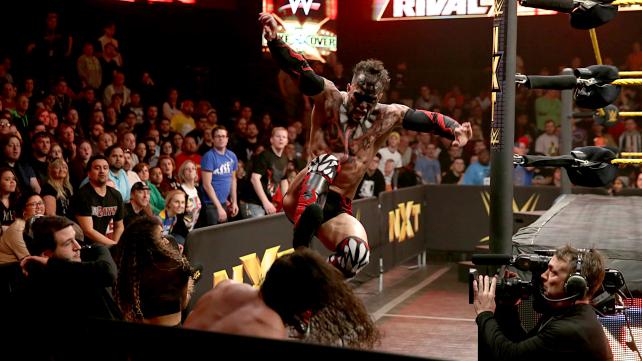
    After that, though, this NXT Takeover special is hot fire for about 90 minutes. It never stops. It never lets up. The first contest is simplicity itself, a match to determine who the next challenger for the NXT Championship will be. Finn Bálor and Adrian Neville went through an eight-man single elimination tournament to get here. They also have a history against each other in Japan and bring an extensive knowledge of each other’s game with them to the NXT arena.Kevin Owens weaseled his way into a championship match, but after him there were no clear contenders. Neville had his chance to regain the gold. Bálor, like Owens, is too new to the scene to demand that he has a shot. But the tournament has established that the two are in a different class. Better than Baron Corbin. More “ready” than Hideo Itami. The NXT Championship feels like one of the most important titles in wrestling because of simple, effective storytelling like this, an undercard that is constantly gunning to be the top man on the best wrestling show in North America. On the live specials, Bálor takes it to the next level with his entrance, putting on body paint and Predator dreads and really soaking in the adulation of the crowd. It worked really well in New Japan Pro Wrestling and will probably work really well on WWE pay-per-views, but his special entrance really makes the arena look small, and, in front of the same people who see it every few weeks or so, less special than it should be. I was more into the show Adrian Neville made of putting in his mouthguard, even if mouthguards are, like protective cups, the antithesis of professional wrestling. The two really take their time in building this match up from its entrances to its finish. At first, much is made about how both are wrestling a slower match than anticipated, as both are known for their flying finishing moves, but it’s not so much a “race to the top rope” as it is a test of will an conditioning. Bálor actually hits a double stomp to the back of Neville’s head really early, a killing blow in most matches, but not all plans are fated for success. Once Neville hits one of his big moves (a corkscrew splash from the second turnbuckle, which is unreal), he shows his frustration by taking out his mouthguard and hurling it to the canvas. But that lets Bálor get back into the match with a slingblade clothesline (to the mouth!), which is why you wear your mouthguard. Nice bit of in-match storytelling. The finishing sequence is absolutely breathtaking, with Bálor countering the Red Arrow with knees to the gut, which he transitions into a small package. Bálor follows with his dropkick into the corner, which is being built as the dropkick to end all dropkicks, and crushes Neville with a double stomp to the gut. If this match is indicative of what it means to be in line for a shot at the NXT Championship, then it follows that any match for the NXT Championship should/must be better. In a WWE ring, though, it doesn’t get much better.
    NXT Takeover Rival Banks Charlotte Bayley Lynch

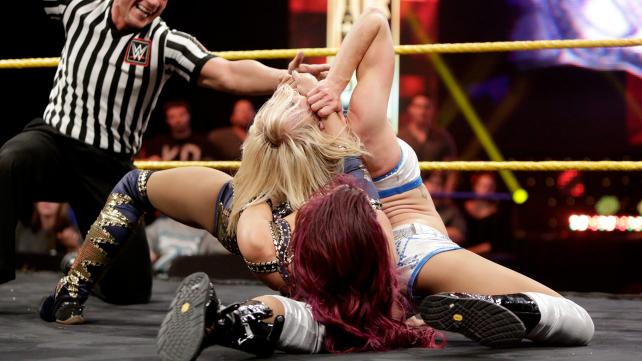
    The NXT Women’s Championship match was built entirely upon in-WWE history, a fairly complex weaving of characters and storylines that is unlike anything the company has ever done with any permutation of a women’s championship. On Raw and SmackDown!, feuds for the Diva’s Championship, a hideous panoply of rhinestones and butterflies and reproductive organs, feuds are normally based on looks (“Look at Mickie James—she is so fat!” or “I don’t look like a typical diva, so I’m better than all of them!”), romantic ties to men, or the “bitches be crazy” school of thinking that it’s tempting to say that the people in charge of that show, despite the strong game they talk about having strong female role models, don’t see women as individuals worthy of much attention. I remember when the women’s spot at WrestleMania 29 was cut, the argument being “Well, would you have a Bella Twins match at WrestleMania at the expense of seven or eight minutes of John Cena vs. The Rock?” Maybe not, but there’s probably always room for women’s wrestling on a card that features a mini-concert by Puff Daddy. That’s how women are treated on the WWE cards that everybody sees. In NXT, they get this rich tapestry where the Women’s Championship is about on par with the NXT Championship. Charlotte, the daughter of Ric Flair, is the dominant champion of the division. Sasha Banks has been nipping at her heels since the dissolution of their stable, gaining confidence in herself (and her character) with the passage of time. Becky Lynch joined up with Sasha Banks, feeling that she needed a change of attitude in order to be successful, but isn’t the obedient foot soldier Banks demands. Bayley, having come up short in her effort to capture the championship, has realized that success is more important than being friends with people who constantly take advantage of her, and has been more aggressive in chasing her dream without compromising who she is. She’s the dark horse in this match, talking about “having her Sami Zayn moment” where she redeems herself by finally winning the big one, and she has something of a Sami Zayn moment in this match when she slides under the turnbuckles to land a kick on Becky Lynch. Before that, though, there’s a lot of storytelling to get through. Lynch and Banks team up, dividing and conquering Bayley and Charlotte. They eliminate Charlotte from the match for awhile by throwing her into the side of the ring, where one of the dumb LED panels that have no place on a wrestling ring blinks off to signify how brutal the impact was. I’m not a fan of that kind of stuff. Wrestlers are good enough at selling pain to do it without special effects. But it’s a minor thing, because Charlotte gets back into the match without the usual big production of ringside physicians and stretchers and all that.

    This is a very good match, full of impressive double and triple team moves that look brutal. Bayley, whose character has always grated on me, was particularly impressive. There was a Fatal Four Way match on an earlier NXT Takeover special where Tyler Breeze, goofy supermodel, surprised a lot of people by being the star of the match. That’s where I was here with Bayley, person who likes to hug everybody. She doesn’t wrestle mean (like Breeze did), but she wrestles like she’s determined to win, less for the fans and more for her. It’s this nice, subtle character arc that should pay off even bigger in a singles match. But the story here is Sasha Banks, who has been blowaway fantastic, and her quest to prove that she is better than Charlotte, who is probably the best product yet produced entirely by the WWE Performance Center. Charlotte is wrestling from behind after getting thrown against the ring, humanizing her somewhat, and the element of chaos added by two other competitors is too much for her. Sasha Banks is never without a plan, zeroing in on Charlotte’s ribs, making it hard for the champion to breathe. When the crossface she has Charlotte in doesn’t work and she finds the champ inching towards the ropes to break the hold, she’s got enough faith in the damage she’s done to transition her submission into a roll-up, which secures the victory. It’s this big, emotional moment for Banks, showing that the seemingly evil “Bo$$” of NXT has a heart, but she largely proved her point, beating the champion and her two top contenders in one fell swoop. She shoos away Charlotte after the former champion hugs her, less interested in a supposed passing of the torch than she is in relishing in her moment. This is the best women’s match on a WWE show since the division was largely imported talent from Japan. It’s also either the best fatal four way match or second best depending on how you feel about the other NXT go at this format, which is usually a boring, convoluted mess. There has always been the potential for a good story here. Finally, away from the bright(er) lights and big(ger) arenas of the WWE’s touring act, they’ve figured out how to tell them.
    NXT Takeover Rival Sami Zayn Kevin Owens 1

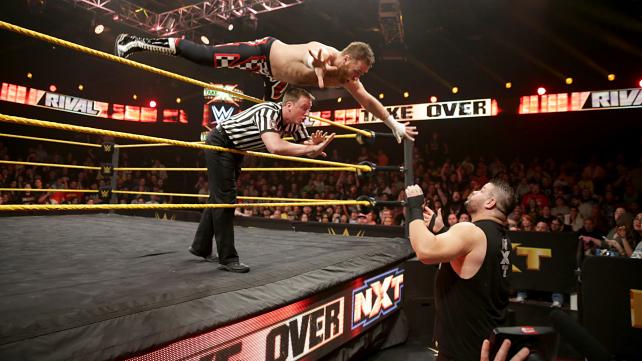
    The main event, too, has a nice story to it, both in the way WWE is telling it (fourteen years of friendship for nothing) and in the reality of the situation, which is that Kevin Owens and Sami Zayn have been inextricably linked throughout their professional lives as partners and as rivals. Even without that past history in the mind, the story leading up to this match made it clear that it was going to be unlike any Sami Zayn match thus far, that all of the fun of his rise was out the window, and that his post as the defender of NXT from the likes of Curtis Axel and Titus O’Neil was all for naught, as Kevin Owens doesn’t care about fun and he doesn’t care about NXT. He’s such a weird, engaging presence as a heel on this program, as he says that he’s been working his entire life to get to this point and that winning the championship means a better life for his wife and children. It’s Sami in the promo videos who sounds like the bad guy, saying that Kevin “changed” when he got married. But in the ring, Owens is a brutalizer, a man whose only desire is to punish whoever is set in front of him, and if it’s a guy who he figures bailed on their plans to make it into WWE together, so much the better. Owens is, in an odd way, being built as the Brock Lesnar of NXT. A cold, relentless throwback to an era that would have laughed at the concept of “sports entertainment.” Here’s a dude who nearly had his nose shoved into his brain in his debut match, who still has that scar, who looks like he wouldn’t mind bleeding some more. He should be set across from Bruiser Brody or Terry Funk or Abdullah the Butcher, but he’s there with Sami Zayn, god help the poor champion, with fourteen years of history and fourteen years of being told that the WWE wouldn’t want a chubby dude in basketball shorts and a tank top.

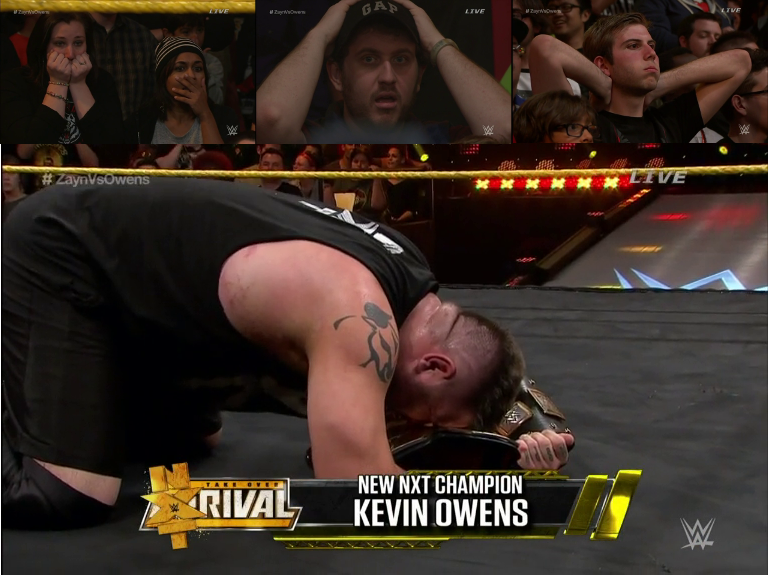
    The announce team compares this match early to the tone of John Cena and Brock Lesnar’s main event at SummerSlam, as it’s all Owens dominating Zayn. But where Lesnar took Cena apart piece by piece, suplex by suplex, there was nothing personal about it. Even with their history, Lesnar was just there to win a title and sit upon his throne of human skulls. Owens takes it to Zayn with strikes. Punches. Kicks. Chops that issue with the concussive force of a shotgun blast. Zayn is the absolute best in the world when it comes to selling, so even Owens’ most basic stuff seems deadly. When he cranks it up, man, it’s like nothing I’ve seen in the WWE in years, even in a Brock Lesnar match. With Lesnar, it’s a matter-of-fact brutality, a neanderthal man overwhelming his opponent through sheer natural ability. Kevin Owens, on the other hand, learned how to be this way, how to turn his girth and his ambition and his spite into weapons. Brock Lesnar is a hateful man. Kevin Owens has hate in his heart. And Sami Zayn isn’t John Cena, who is himself a test-tube freak. Zayn fought and bled and sweat for fourteen years, too, only his experience made him resilient. It taught him to love wrestling and the people who love it. It makes these two perfect foils, Owens as the monstrous bully and Zayn as the heartbroken babyface who refuses to die as a personal point of pride. All Zayn needs is an opening and he can catch Owens with his suplexes and kicks, which are too fast for anybody to stop. Zayn’s offense, to that point, is beautiful. There’s a Rey Mysterio Jr. over-the-referee dive to the outside, a slower, meaner Blue Thunder Bomb, big suplexes. Every time he counters one of Owens’ bombs or kicks out, it feels huge. But he is the victim of circumstance, banging his head on the entrance ramp after catching Owens with a springboard moonsault. Zayn, from that point, is (storyline) concussed. He loses his footing going for a clinching Helluva Kick, and Owens takes over. He is not shy about punching his defenseless “friend” in the head as many times as it takes, nor does he spare him any powerbombs. But Zayn keeps kicking out, won’t quit. Doctors come to the ring to check on Zayn, but it’s Owens who wants to end the match, so he keeps powerbombing Zayn until the referee calls for the bell, stopping the match on account of the champion’s inability to defend himself.
    Kevin Owens new NXT Champion

    I often find myself unable to engage with NXT as much as I would like. The wrestling is great, world-beating even, and the storylines and writing are frequently so good that it’s hard to believe that the same company behind NXT does such a poor job with Raw and SmackDown! for roughly three-quarters of the calendar year, but I am, generally speaking, not for the “bubble universe” that filming shows in the same venue every single show engenders on a globally-televised product. It’s easy to tell when a crowd that has sat through four tapings of wrestling has become tired and cranky, sick of even their own inside jokes, and when an audience cheers for everything, it’s hard to get an idea of what will actually work on the main WWE stage. The live specials mitigate that somewhat, though chanting things like “HUG IT OUT” at Finn Bálor and Adrian Neville during a tense post-match showdown, or “Z-PAK” while doctors are checking Sami Zayn for a concussion makes me wonder if the people who get to see this stuff live are there for the wrestling or if they are Smart Internet Fans Who Listen to Podcasts and are there just to chant. I want NXT to tour in the worst way. I think that’s the next phase of this experiment, to test out how a guy like Sami Zayn will do in Iowa or North Dakota, where there are independent wrestling fans but not an arena full of them, all in a constant state of orgasm. When I watch NXT, I’m watching to see if these supremely talented men and women can rise above an audience trying its damnedest to turn every match into an instant classic, or if the studio audience is something of a crutch. NXT Takeover: Rival was an event where the majority of the card rose above the noise which so frequently reminds me that, in 2015, it is not possible to watch wrestling without also watching how others watch wrestling. With the exception of two very underwhelming matches, Rival was an instant classic show from the opening bell, capped by a match that rose to the challenge of meeting and exceeding not only a long, storied history of contests between its participants, but by a year that is already heavy with great professional wrestling. Those Smart Internet Fans reacted to Kevin Owens destroying Sami Zayn and the NXT Universe as if they had just seen The Undertaker lose at WrestleMania. People were crying. And Kevin Owens, once told that he didn’t fit the mould, stifled his own tears long enough to hold his newly won championship triumphantly over the corpse of a man he called a friend. Wrestling, especially at its most brutal, is beautiful.

    NXT Takeover Rival Sami Zayn Kevin Owens 2

    Results

    1. Hideo Itami def. Tyler Breeze via pinfall. Grade: B+

    2. No Disqualification Match: Baron Corbin def. Bull Dempsey via pinfall. Grade: C-

    3. NXT Tag Team Championships: Wesley Blake and Buddy Murphy (champions) def. The Lucha Dragons (Sin Cara and Kalisto) via pinfall. Grade: C-

    4. Finals of the Tournament to Decide the #1 Contender for the NXT Championship: Finn Bálor def. Adrian Neville via pinfall. GRADE: A

    5. NXT Women’s Championship: Sasha Banks def. Charlotte (champion), Bayley, and Becky Lynch via pinfall to win the championship. GRADE: A

    6. NXT Championship: Kevin Owens def. Sami Zayn (champion) via referee’s decision to win the championship. GRADE: A+
  • Movie Review: American Sniper (2014)

    Movie Review: American Sniper (2014)

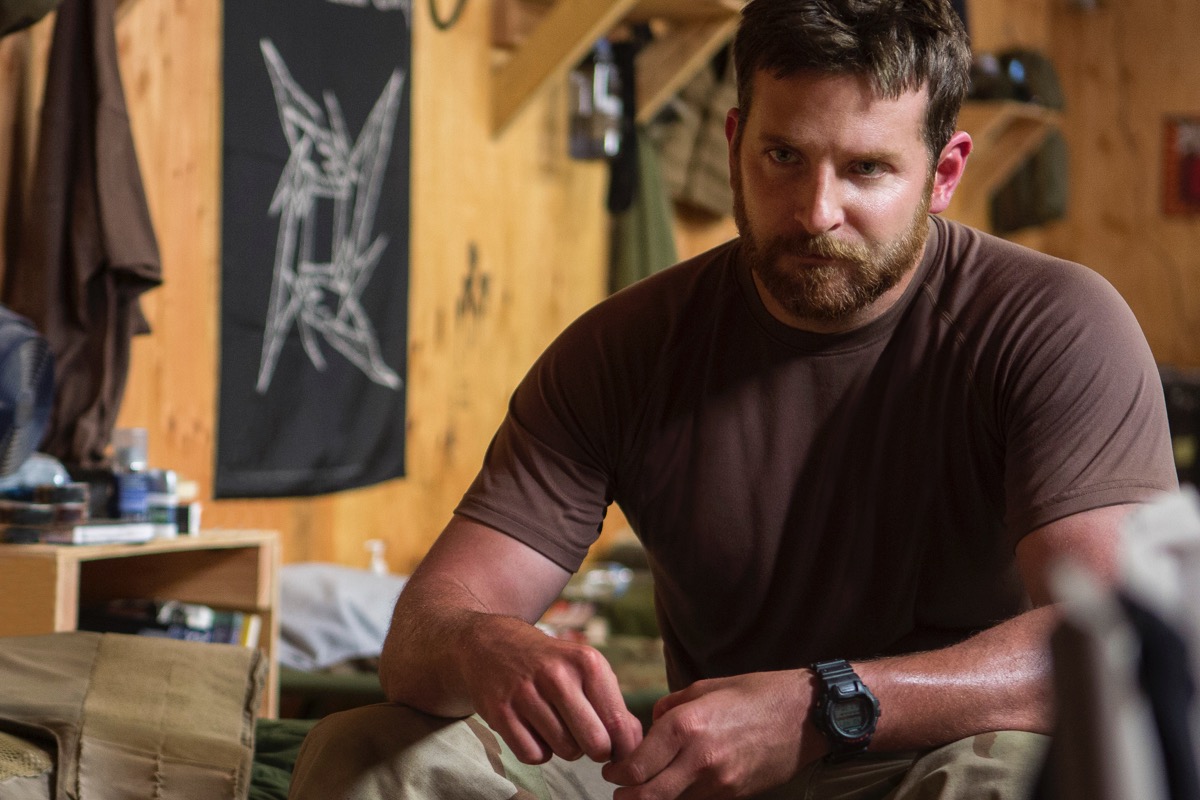
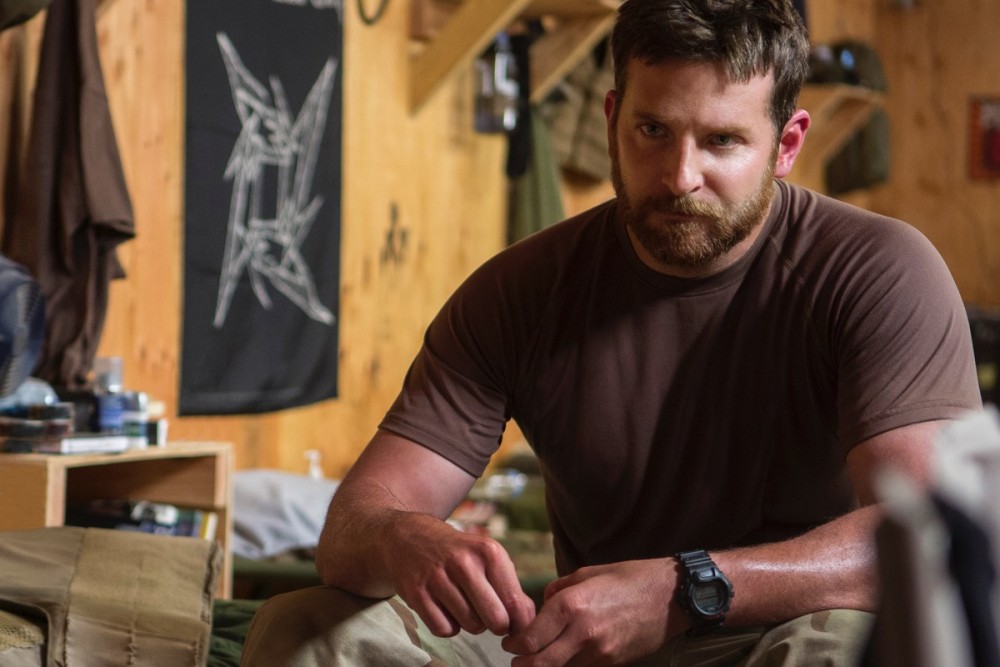
    American Sniper

    There are other movies out right now—better ones, too—but I chose to see American Sniper because it is the film everybody has an opinion on right now, and I guess I felt like I needed to formulate one of my own. The memoir that this serves as an adaptation of is likely something I will never read, so I can’t comment on Clint Eastwood and screenwriter Jason Hall’s ability to bring Chris Kyle’s story to the screen as Kyle told it. I know that he uses the word “savage” to describe Iraqis, and I know he later falsely claimed to’ve punched out Jesse Ventura at a bar for mocking veterans. I also know that Kyle said he was responsible for more kills than the Navy SEALs will confirm, and that the government parked him atop the Superdome in New Orleans during Hurricane Katrina, where he allegedly shot and killed “dozens” of American citizens. I don’t know Chris Kyle, but he sounds like a complex, flawed, dangerous fraud, the fabled Good Guy with a Gun who exists only in the collective fantasy of the American right whose life is worth reflecting upon as a means of deconstructing such myths. Clint Eastwood, however, is not the man for such a job. A man who is given to lecturing invisible Barack Obamas on the significance of America and her ideals, Eastwood sees his protagonist as a man wearing a white hat though stranded on a black sea. The war isn’t just something that happens; it’s something that happens to him. Kyle’s story, in the hands of a director more interested in the fact of a hero than his psyche, is as complex as a bologna sandwich.

    American Sniper, rather than linger in the details or fret about the larger implications of what Chris Kyle (Bradley Cooper) does for a living, is largely desensitized to the brutalities he perpetuates and has perpetuated upon him. Exactly one kill shown here has any weight, his first, and that is largely because, as cut for the trailer, it’s a rather compelling microfilm about the weight of one’s choices. That the choice being made here is a white man’s decision to kill or not kill an Arabic woman and her son is shown to be largely irrelevant—it’s not how Kyle imagined his first time pulling the trigger, but he stopped a pair of suicide bombers from wiping out a patrol of Marines. Mission accomplished, end story.

    Between his placing a finger on the trigger and his pulling it, there’s a rather lengthy bit of exposition explaining the kind of person Kyle is. In short, he’s a red-blooded American, an honest-to-God cliché. He loves his country and he loves his woman. The first three images of American life shown in this film involve hunting rifles, bibles, and a football. The suburb Kyle grew up in is shot as beige and featureless as the Iraq he will later occupy. He has sex with the woman who will become his wife (Sienna Miller) and wakes up to live footage from New York City on September 11th, 2001. Both the sex and the act of war inspire Kyle to get better at his job. He says he’s protecting his country. He says his country is the greatest on earth. It’s all been said before, but Chris Kyle is a real man with a real (if embellished) record, a soldier whose funeral filled a football stadium, so coming from the actor occupying him, I suppose all of that’s supposed to lend the script’s bumper sticker platitudes the kind of gravity repeated sequences of bodies spasming, geysering blood, and collapsing dead just can’t earn these days.

    Given a relatively straightforward script and Eastwood’s by-the-numbers direction, Bradley Cooper isn’t exactly taxing himself as Kyle. Without the real man’s penchant for dehumanizing language, all Cooper has to do is set his jaw firm and speak with a slight drawl. Even when he’s under fire, taking shots from elite enemy snipers—one of whom is described as a former Olympic medalist fiercely loyal to bin Ladin—Cooper’s Kyle doesn’t seem too stressed. His wife can hear gunfire and other soldiers shouting over their cell phone connection, but Kyle always seems to be a readjustment away from leaving the battlefield with his life and a few more notches on his belt. When a sandstorm kicks up over a late-film op, it’s merely one more shade of beige.

    Plenty has been made of the fake babies used to simulate Chris Kyle’s newborn children, which betrays that there’s really not much to American Sniper that’s worth discussing. There’s the political angle and the race-baiting of Kyle’s memoir, but Eastwood seems decidedly uninterested in why we’re at war and what Kyle thinks of the people he is shooting. That’s a problem perhaps, but one of adaptation and not morality. It’s been impossible to log in online without seeing dozens of tweets from morons who saw this film and said how it made them want to kill Arabs, but I suspect the folks responsible for those missives harbored their racist feelings before seeing American Sniper, just as I suspect that the editors responsible for publishing those tweets on every website that leans even slightly left know that morons on Twitter draw a lot of clicks. But I’m a white guy myself, and all I know about movies like this is that it takes a really good one or a really offensive one to get my attention. That’s a failing on my part, I know, but I thought I was going to leave this film convinced of its evils. Instead, I’m at something of a loss. What this film should have done with its subject matter is a matter for debate until the next film about war during the Bush presidencies is made. What it did, however, is nothing.

    American Sniper is further evidence that Eastwood is continually regressing as a director, or that time has finally passed him by and is no longer as interested in the merits of American muscle as he is. I don’t think that filmmakers are necessarily obligated to create pictures that take a hardline stance on the War on Terror, but that this is the story Eastwood has chosen to present as a somber occasion set to taps is disingenuous to all parties involved, including Kyle. Cooper plays him as a man who is somewhat uncomfortable with his notoriety, but Eastwood is set on making him a paragon. So be it. There are better films about this war out there, and still more yet to be made. In terms of fiction, Kathryn Bigelow’s The Hurt Locker and Zero Dark Thirty diptych remain the best place to start.


    American Sniper. With Bradley Cooper (Chris Kyle), Sienna Miller (Taya), Luke Grimes (Marc Lee), and Kyle Gallner (Goat-Winston). Directed by Clint Eastwood from a screenplay by Jason Hall, based on the memoir American Sniper by Chris Kyle, Scott McEwen, and Jim DiFelice.

  • Movie Review: The Interview (2014)

    Movie Review: The Interview (2014)

    The Interview

    I watched The Interview on Christmas. I was alone, away from my family on the holiday for the first time. But even had I been in Detroit with my mom and my sister, I probably would have seen The Interview, because we’re bad Catholics and non-Catholics, my family, and once the Christmas portion of Christmas has concluded, we venture out to the multiplex to see whatever’s playing. Of course, the big deal about The Interview is that it wasn’t playing at so many multiplexes, yanked from the slate of Christmas releases by fear and paranoia that North Korea, the supposed perpetrator of the cyberattack that so hobbled and embarrassed Sony Pictures, might up the ante by bombing any theater that dared screen the film. The Interview stopped being a Seth Rogen/James Franco comedy and became a free speech issue. It was one of the highest rated films on IMDB, a constant source of Facebook chatter, and an issue large enough for President Barack Obama to voice his displeasure over. It became our duty, as Americans, to see this dumb movie about dumb people attempting to assassinate a dumb dictator. Or it was our duty, as Americans, to remind other Americans that it was nobody’s duty to see anything.

    Well, I saw this movie. I saw it on Christmas, as I said, and I read a number of very good articles about why The Interview, as a bastion of free speech, was problematic at best. I also saw Seth Rogen reply to earnest, well-intentioned, well-written criticism of an otherwise forgettable film by pouting and tweeting “Go fuck yourselves” at websites like The Verge. All of it seemed surreal and stupid, and I felt pretty good about my decision to not write about The Interview because it is a very dumb movie, which is fine because it had no aspiration to be anything else, at least not until the rest of the world started to address it as a capital-I Issue. Watching this movie with my dog curled up in my lap, I felt very ill-prepared to talk about The Interview as an Issue or as a misfire by a comedic team whose work I frequently enjoy. I feel very ill-prepared now, but I will try, I suppose, to say something.

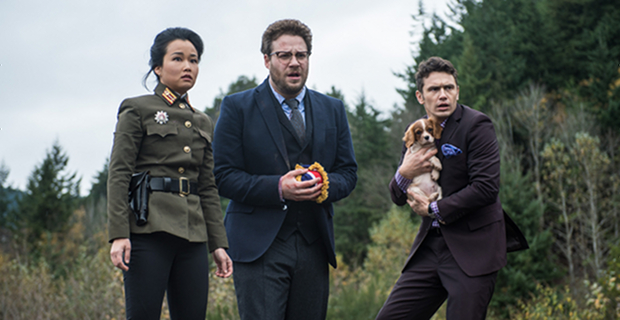
    The particulars of The Interview are common knowledge, but here they are: David Skylark (James Franco) is the host of Skylark Tonight, a popular-but-empty Hollywood talk show on the order of Extra or Entertainment Tonight. Still, he has an uncommonly good rapport with his guests. Rob Lowe is willing to come out as bald on his show, and Eminem tells the world that he’s gay like it’s no big thing. This is big money stuff in entertainment journalism and “real” journalism, which are often the same thing, but Skylark Tonight is looked down upon by more respectable media establishments, and this eats at its producer, Aaron Rapaport (Seth Rogen). When the two hear that North Korea’s Kim Jong Un (Randall Park) simply loves Skylark Tonight, they drunkenly send a flier out to his camp to see if he might want to appear on the show, lending them the serious journalistic credibility Rapaport has always wanted. When it turns out that, yes, Kim Jong Un would like to appear on American television, they are roped into a CIA plot to assassinate the dictator, thus liberating the state from the tyrannical reign the Kim family has long enjoyed.

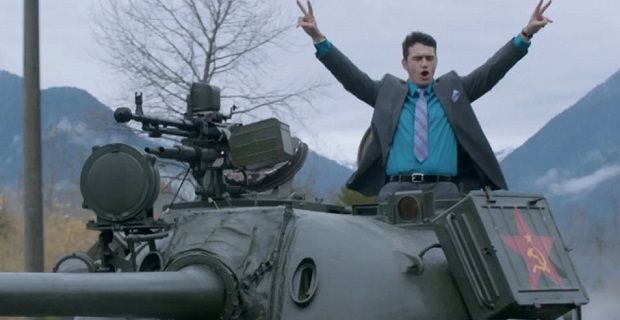
    To Rogen and co-director/writer Evan Goldberg’s credit (I suppose), The Interview pays lip service to the idea of America as an agent of democracy, and to Hollywood’s interest/involvement in traumatic global crises. It also stands firm and states that enjoying margaritas does not make a man gay. Beyond that, however, and beyond whatever pleasure there is in the notion of riding around in a Soviet tank that is blasting Katy Perry’s “Fireworks,” The Interview seems content to laugh at North Korea from a safe distance, taking the same shots at the country, its leadership, and its people that the American media has taken for decades. Part of the hysterical response to the Sony leak, I’m convinced, was the latent fear that an aggressive, fear-mongering country might not be the hapless cartoon our own media built in the collective consciousness.

    The-Interview-Franco

    If North Korea is responsible for the Sony leak, and if they did it in response to this film, that ultimately changes nothing about its merits, which are few and fleeting. Having journeyed far and wide with their bro comedy tropes, from high school to the apocalypse, Rogan, Franco, and Goldberg elevating them to an international stage doesn’t suddenly validate their material. Rape jokes are rape jokes. Gay panic is gay panic. Asian stereotypes remain Asian stereotypes. In any other context than the one conjured up by the hacking of a multibillion dollar entertainment company, all of this is obvious. I’m not saying anything new here, I know, but I feel like I need to repeat this in my own voice, to hear how it sounds coming from me.

    The Interview is an issue of free speech because it is a film created by straight, white men at the expense of an oppressed people who do not have the right to free speech. This film is an issue of free speech because it is easy for us, as a nation dominated by straight, white men, to look at something like the release or censure of a stoner comedy produced and made by millionaires as a test of our moral turpitude, to see whether or not our country will stand up to a menace whose only definition, for the majority of us at least, is that it is not-white in origin. This film is an issue of free speech in the same way that, say, erecting a “Pants Up, Don’t Loot” billboard is an issue of free speech, only many of us decry the billboard because the trauma it mocks is local while The Interview is quite harmless because it’s only North Korea, whose traumas aren’t even ours, let alone local. So we stood up, valorized this movie and those who made it, spent weeks rallying around the flag. That it was pig-headed and frequently racist wasn’t an issue. This was an American movie, and it was our right as Americans to see and forget about it in any fashion we chose.

    Sure. I agree. And I also agree that this film should have been released as originally planned, in as many theaters as could be booked to play it. That The Interview came, went seen or unseen, and slipped quietly onto home video would have been a blessing. Circumstances dictated that we were to be given something else on Christmas, something precious and in need of protection. That’s fine, too. But now we’re in a situation like 2012, when we spent the summer debating whether or not it was okay for victims of rape to be offended by rape jokes, or right now, when we’re blindly posting Jui sui Charlie on our Facebook walls as if it’s impossible for a progressive publication to also be horrifically racist. Soon, we’re going to have to come to the realization that the “free speech” we’re so thoughtlessly protecting is only free because of its gender, race, and class status. But that requires thinking inwardly. It requires a satire willing to punch upwards instead of at those who are already down. Finding someone who supports the idea of satire is easy. Where are the people who are dedicated to making it?


    The Interview. With James Franco (David Skylark), Seth Rogen (Aaron Rapaport), Lizzy Caplan (Agent Lacey), Randall Park (President Kim), and Diana Bang (Sook). Directed by Rogen and Evan Goldberg, from a screenplay by Rogen, Goldberg, and Dan Sterling.