Author: Colette Arrand

  • Movie Review: The Hunger Games: Catching Fire (2013)

    Movie Review: The Hunger Games: Catching Fire (2013)

    hunger games catching fire

    Katniss Everdeen has nightmares. This is important. This means something. Luke Skywalker blew up a space station that housed millions of men and women without shedding a tear. James Bond remembers the dozens of women slaughtered by association by naming martinis after them and glowering at the baccarat table. Bella Swan slurps blood from a Styrofoam cup. The Hunger Games: Catching Fire doesn’t allow its heroine much time to rest after her victory in the franchise’s titular organized bloodletting, but when it does, even her few moments of rest are shattered by memories of the Games. A nation believes they’ve gained a young star. In reality, they’ve rendered a young woman a hollow shell.

    Having made history as the first ever co-winners of The Hunger Games, Katniss (Jennifer Lawrence) and Peeta Mellark (Josh Hutcherson) clearly suffer from PTSD. Twenty-two children were killed in the Games, and while they weren’t personally responsible for even the majority of them, they lived for months expecting knives in their backs, finding solace in the report of an unseen cannon. Back in District 12, they try to return to something like a normal life, but even if nobody from home treats them any differently for making it out of the arena, the state has relocated them to the district’s Victor’s Village, whose only other occupant is Haymitch Abernathy (Woody Harrelson), whose alcoholism probably makes a little more sense to them now. Though they barely know each other, Katniss and Peeta survived by convincing a nation that they were star-crossed young lovers. Thrust into the role of celebrity, they have to maintain that ruse before the cameras and the fawning millions in their living rooms. Both wonder if eating the poison berries that won them the Games would have been a kinder fate.

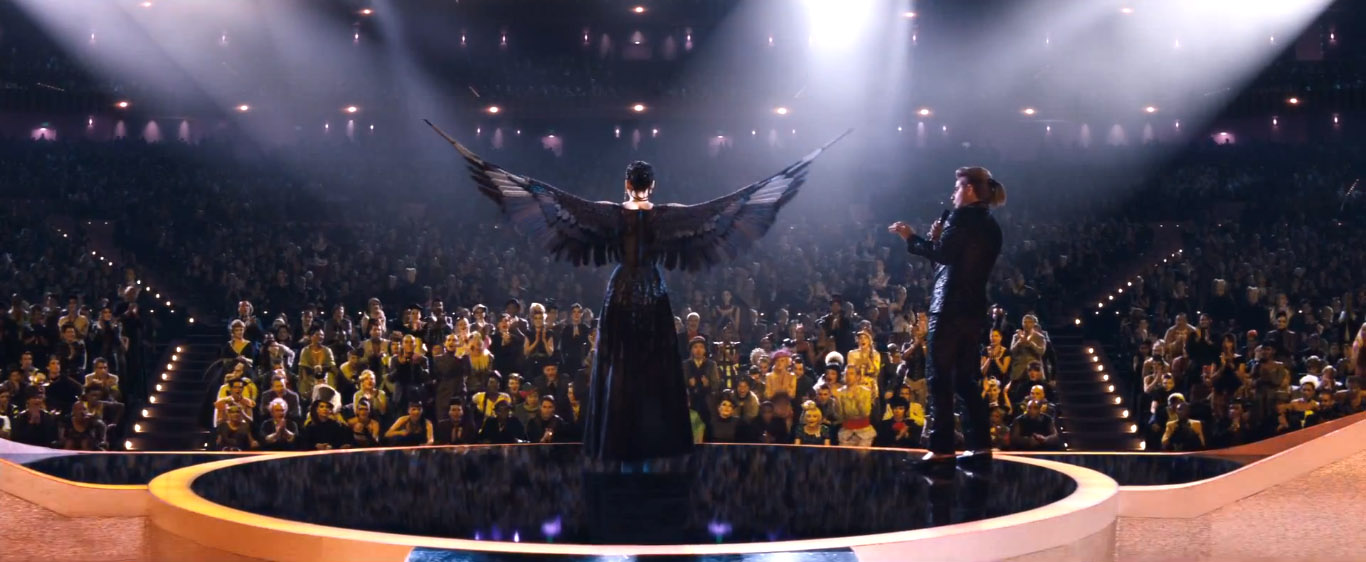
    In victory, Katniss becomes a symbol, a sign to the downtrodden lower districts that they can rise up against the opulence of Panem, whose capitol houses the uber-wealthy who exploit the labor of the starving working class. President Snow (Donald Sutherland), who watched ambivalently as Katniss and Peeta upended the rules of his Games, takes a much more active role in Katniss’ life outside the arena. He meets her in District 12, threatening to kill her and her family and her actual boyfriend, Gale (Liam Hemsworth), if her act with Peeta isn’t convincing. Her happiness—or the perception of her happiness—may quell a brewing rebellion. This is a losing proposition. On the train to the Capitol, where a huge party is to be held in her honor, Katniss sees graffiti of the mockingjay symbol she’s become associated with and anti-government slogans. When she arrives in District 11, her and Peeta are unable to read the cards prepared for them by their PR rep, Effie Trinket (Elizabeth Banks), and instead give teary dedications to Rue, the little girl who died in their Games. An old man in the crowd whistles the call Katniss and Rue had and holds up a sign of the revolution. He is dragged before the stage and shot in the head. Katniss and Peeta read from the cards from that point on, but this scene continues to play itself out.

    Catching Fire eventually makes its way back into the arena, but it and its predecessor are at their most interesting when exploring the kind of dystopia that would broadcast the life-or-death struggle of 24 well-armed children. While The Hunger Games only captured glimpses of the other districts, focusing largely on the Games themselves, Francis Lawrence finds the franchise’s heart beating in the districts. Lawrence, whose I Am Legend and Constantine were toothless sci-fi adaptations to whom the concept of mythmaking was alien, while not doing anything to rock the boat too hard, manages to craft a middle entry that does three things more expertly than many expensive sequels: feel larger than its predecessor, further define the characters, and improve upon what previously worked. Much of that is due to Jennifer Lawrence, whose Katniss is now a character and not an archetype. It’s still hard to believe that the star of these massive Hunger Games films and Oscar-baiting prestige ensembles like Silver Linings Playbook was in Winter’s Bone three years ago, and it’s something of an odd fortune that the trajectory of her career matches that of the character she’ll likely forever be identified as. In life, Lawrence gets Google news alerts when she steps out of the house with a new haircut. In Catching Fire, a pregnancy hoax involving her is nearly enough to end a seventy-five year tradition.

    By involving Snow and featuring a new game maker (Philip Seymour Hoffman, playing himself as a D&D dungeonmaster with one of the series’ more ridiculous names), Catching Fire raises the stakes so high that the 75th Hunger Games’ twist—all of the competitors are surviving winners from Games past—feel trifling by comparison. Sutherland’s despotic President Snow is sniveling and arch in a way villains in movies this large no longer are allowed to be; watching him preen and glower like an evil, gay Santa Claus has been a highlight of the series. Hoffman’s Plutarch Heavensbee  isn’t quite as dynamic, but he’s an upgrade over the original film’s focal point for Katniss Everdeen’s rage, who was mostly notable for his beard. Heavensbee is the architect of a plot to restore the districts to order by wiping out their symbols of hope. While it’s hardly subtle, watching him tell President Snow to broadcast speculation about Everdeen’s wedding dress and honeymoon location next to scenes of beatings and executions in the districts is the kind of specific, calculated evil action movies figure their audiences can’t handle. Here, the storm clouds never dissipate. If any sunshine is going to punch through, it’s sure taking its damn time.
    hunger games catching fire

    All of which is nice, but ultimately somewhat empty. Catching Fire is somewhat hamstrung by its obligations to young adult literature in a post-Twilight world, which necessitates a go-nowhere love triangle between Katniss, Gale, and Peeta. Beyond the state’s intervention, there’s never a moment when one of the men in her life controls her, and in the arena it’s usually Peeta who is in need of rescuing. This makes The Hunger Games the standard bearer for love triangles done pleasantly enough, if that’s a standard worth bearing, but I can’t help watching the scenes where Katniss and Peeta pretend to love one another with an editor’s eye, wondering if it would have been more dramatic had two actual lovers been forced into the Games twice instead of two people who have to pretend for the sake of a narrative. Stanley Tucci returns as Caesar Flickerman, the voice of that narrative, and while he’s charming and funny in his role as the ingratiating host of The Hunger Games, success has made his character something of an ironic statement, simultaneously mocking the hosts and unearned grandeur of reality television talent contests while occupying a significant amount of space in a major Hollywood movie being used to shill everything from Subway sandwiches to Covergirl makeup. Not that Catching Fire had to inspire revolution to work, but if a major film harps on the need for its audience to question authority while simultaneously shilling for the footlong creamy sriracha steak melt—a delicacy the denizens of District 12 would murder you for the right to look at, let alone consume—how successful can that film be in realizing its ambitions?

    The answer, of course, is very. Catching Fire’s ambition is to make money, and it is doing so hand over fist. The film rarely falters or falls short of being entertaining spectacle, but it’s telling that for all the scorn it heaps upon the rich for enjoying the bread and circuses of the Games, it never stops long enough to ask the same question of the audience in the theater. Intrinsically, one knows that the ritualized slaughter of children is a horrible practice. Perversely, The Hunger Games franchise films these long sequences not as a horror, but an entertainment. The kills are quick and clean and leave no blood. When the show’s helicopter arrives to dispose of a body, it is hefted into the air striking a messianic pose to a theme commissioned just for the solemnity of the occasion. Those who die in the Games are offerings to the state, sure, but are they not also offered up to us? Are we not somewhat culpable?


    The Hunger Games: Catching Fire. With Jennifer Lawrence (Katniss Everdeen), Josh Hutcherson (Peeta Mellark), Liam Hemsworth (Gale Hawthorne), Woody Harrelson (Haymitch Abernathy), Elizabeth Banks (Effie Trinket), Lenny Kravitz (Cinna), Philip Seymour Hoffman (Plutarch Heavensbee), Stanley Tucci (Caesar Flickerman), and Donald Sutherland (President Coriolanus Snow). Directed by Francis Lawrence and produced by Nina Jacobson and Jon Kilik. Screenplay by Simon Beaufoy and Michael deBruyn, based on the novel Catching Fire, by Suzanne Collins.

  • Movie Review: Thor: The Dark World (2013)

    Movie Review: Thor: The Dark World (2013)

    Thor-The-Dark-World

    Thor: The Dark World is the year’s fifth superhero movie. That’s five different films where spandex-clad men bash in the brains of other spandex-clad men. Five films featuring speeches on subjects like truth, justice, and doing the right thing. Five films where one major city or another—sometimes fictitious, sometimes not—is turned into a smoking cinder by the gods who use it as an arena. The Thor films—counting The Avengers, whose villain Loki is central to the narrative of the entire Marvel cinematic universe, there have been three—have a decided advantage over other movies in the genre. In Thor, director Kenneth Branagh was able to find a nice balance between fish-out-of-water humor and action largely indebted (though unfortunately not monetarily so) to Jack Kirby. Thor: The Dark World director Alan Taylor wisely decides to spend much of his time exploring Thor’s celestial homeworld of Asgard. It’s a nice change of pace from a Marvel film’s usual focus on large, clean military installations and glittering R&D research laboratories, but even the best aspects of this movie aren’t enough to distract from what is now a very shopworn formula.

    But if long-running network sitcoms and The Avengers franchise have proven anything, it’s that people like hanging out with their favorite characters, even if nothing truly significant happens. Thor: The Dark World does more with the fallout from The Avengers than Iron Man 3, did, sending Thor (Chris Hemsworth) planet-hopping with his warrior friends to quell the revolts stirred in the wake of Loki’s (Tom Hiddleston) rebellion against Odin (Anthony Hopkins) and his near-conquest of Earth. Odin’s helpful narration reveals that there’s a threat much greater than these rebellions, a long-lost cosmic weapon created by a race of dark elves upset that the Big Bang turned all the lights of the universe on. The opening scene—Norse gods crossing their swords and shields against the space lasers and gravity grenades of their elven enemies—is a highly polished mash-up of pulp sci-fi and hard fantasy paperback covers, but there’s nothing particularly creative or threatening about this largely faceless horde. Even their weapon—The Aether, which threatens to turn the lights off again—inspires a shrug of the shoulders. But when Thor’s girlfriend Jane Foster (Natalie Portman) finds herself the vessel of this cosmic power, the God of Thunder hastily arrives on Earth to whisk her away to the halls of Asgard, hopeful for a cure.

    Of course, there isn’t one. Odin, clearly the most pragmatic man on a floating rock connected to the rest of the universe by a rainbow bridge, suggests that Jane’s malady is evidence of the difference between the fate of an Asgardian and the fate of a human, imploring his son to maybe fall in love with someone more suitable as Queen of the realm; Sif (Jaimie Alexander), for instance. But Thor: The Dark World doesn’t fool around with love for long. The Aether is something of a homing beacon, and its inhabitance of Jane Foster’s body sends a signal to the dark elves, who’ve long been asleep at the fringes of the universe. They storm Asgard furiously, laying waste to the city and killing Frigga (Rene Russo), the Queen. Odin vows to quash the elves, even at the cost of his realm. Thor, however, has other ideas. Hoping to save his people and Jane Foster, he reaches out in desperation to Loki, serving out a life-sentence in a rather nice-looking jail cell for his crimes, and plots a sneak attack on the elf Malekith (Christopher Eccleston) and his few compatriots who remain from the prelude’s long-ago war.

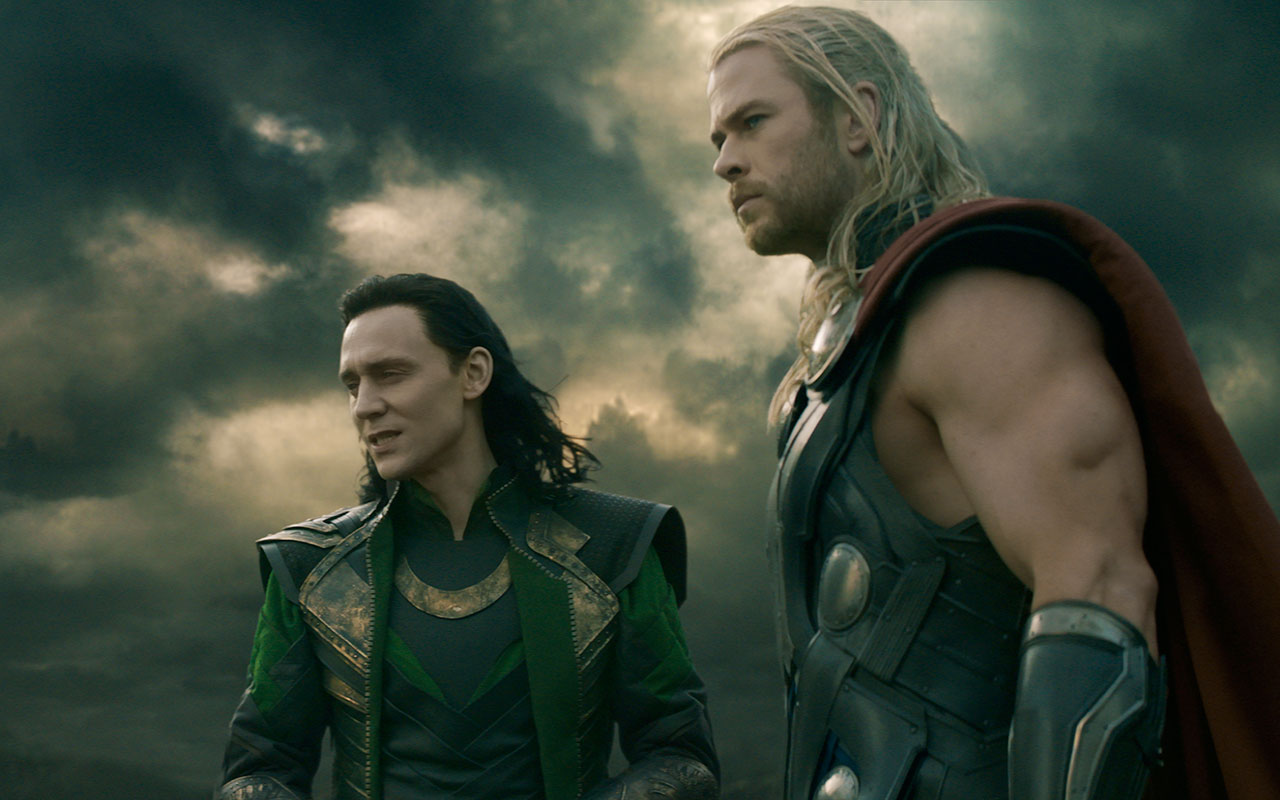
    Of course, the real draw here is Hiddleston’s Loki, who is once again the most compelling, entertaining aspect of a Marvel film. This is causing something of a problem, narratively speaking, as all of the movies in this franchise have largely used even their heroes most iconic villains as one-off castaways, focusing instead on whatever piece of world-destroying technology they happen to possess. Loki’s popularity, which is potentially greater than that of any of the Avengers save Iron Man, virtually guarantees that he’ll continue to be part of the narrative, even as phases two and three of the Marvel cinematic universe provide ever-diminishing space for him. Thor: The Dark World flirts with making Loki something of an anti-hero. Sure he destroyed an entire town in New Mexico and most of Manhattan in a fit of jealousy, but he was pithy and funny while he did it, and he is burdened with issues of identity, purpose, and godhood in a world where he may be the only person smart enough to qualify as a psychoanalyst. While plotting his jailbreak, every character (and the audience) knows for a fact that any Loki/Thor team-up is doomed to end in betrayal, but they (and we) go along with it. For Asgard, Loki serves as an unlikely last hope. For the audience, the ambitious terrorist of the cosmos happens to be written in such a way that he seems like the most fun guy to have a drink with.

    Thor the dark world loki

    As for the film’s human ciphers—Foster, Erik Selvig (Stellan Skarsgard), and Darcy Lewis (Kat Dennings)—they’re largely inessential, shoehorned in because the final battle needs some recognizable faces running around in panic while the world burns. Portman, as Jane Foster, does her usual capable job, and a scene where she goes on a dinner date with some guy but can’t think of anybody but Thor is one of those fleeting instances where these movies actually address what it’d be like to be a normal human being in a world occupied by gods and monsters, but even with a cosmic entity flowing through her veins she’s little more than a combination damsel in distress/MacGuffin. The Selvig character has the most to do with the continuing story of The Avengers, though his function here as the world’s most brilliant man to have stripped nude at Stonehenge while muttering incoherently about Ragnarok is largely that of comic relief. Skarsgard and Dennings are given the film’s snappiest non-Loki dialog, but the film just isn’t as interesting when focusing on its earthbound characters, which, if anything, is an indication of how fully-realized Asgard has become, almost by accident. Jane Foster’s visit and the dark elf raid necessitates that a good deal of Thor: The Dark World‘s runtime takes place on Asgard, which, fantasy tropes aside, manages to feel like a real place. The plot doesn’t allow for much exploration of the realm’s tertiary Asgardians, which is something of a shame.  I have a rough idea of what a political science major does, but a character like Heimdall (Idris Elba), who can see some ten trillion souls, probably deserves a better fate than serving as Thor’s Facebook app or failing at his job as gatekeeper.

    Thor: The Dark World was perfectly enjoyable; not only was it the best superhero film of the year, it may be the best of The Avengers series. But these movies have quickly become a succession of James Bond adventures, right down to the credit text assuring viewers that THOR WILL RETURN in a year or so, whenever the next production requiring a blonde-haired, hammer-wielding meathead is mounted. The difference is that Thor is part of something larger and ultimately more organized than Bond or any other long-running franchise, and coming at a two- or three-a-year pace as these Marvel movies do, there’s less opportunity for Thor to distinguish himself from Captain America, let alone allowing Thor: The Dark World to stand apart from Thor. For now, audiences seem contented by these opportunities to sit down and catch-up with their favorite superheroes and villains. Manhattan may still be smoking, and Liverpool may lie in ruins, but nothing about Earth is fundamentally altered. There’s comfort in that, I suppose, but it’d be nice if a Marvel movie shocked the world by growing up a little, maybe by being something more than not terrible.


    Thor: The Dark World. With Chris Hemsworth (Thor), Tom Hiddleston (Loki), Natalie Portman (Jane Foster), Anthony Hopkins (Odin), Christopher Eccleston (Malekith), Jaimie Alexander (Sif), Rene Russo (Frigga), Idris Elba (Heimdall), Stellan Skarsgard (Erik Selvig), and Kat Dennings (Darcy). Directed by Alan Taylor and produced by Kevin Feige. Screenplay by Christopher Yost, Christopher Markus, and Stephen McFeeley, based on the comic book Thor, created by Stan Lee, Larry Lieber, and Jack Kirby.

  • Television Review: On Death Row (Season 1: 2012)

    Television Review: On Death Row (Season 1: 2012)

    Herzog on death row


    essentialClocking in at about the length of an ambitious arthouse film, it is perhaps generous to consider the act of watching the four episodes of Werner Herzog’s On Death Row “binge-watching,” but Herzog’s shortform meditation on the American justice system and its use of capital punishment is nevertheless an act of attrition. Hidden away from the world by the machinations of the prison-industrial complex, it isn’t until cameras are brought to bear on the men and women of death row that the implications of their sentence truly resonate. Articulate, impassioned, and more knowledgeable about the American justice system than the average true crime junkie, the subjects of these interviews (and those of Herzog’s companion film, Into the Abyss) are fascinating not because of the crimes they’ve been convicted of committing, but because, like many of the individuals Herzog focuses his camera on, they live in pockets of the universe too uncompromising and barbarous to be properly rationalized.


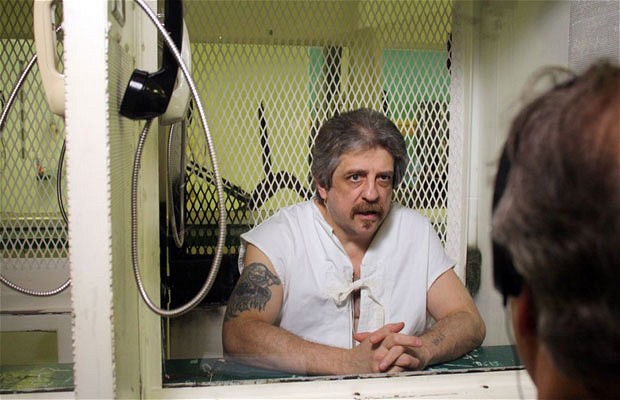
    On Death Row profiles five men and women whose lives are consumed  by their long wait for execution. Though Herzog is the one who conducts interviews with the convicted and those involved with the case, he never appears on camera, instead shooting his subjects in such a way that they speak directly to the viewer. Were this any other project, such a set-up might inspire pleas of innocence to a sympathetic ear. Though Herzog cannot see the case for capital punishment, his is not a forum for exoneration. “Sympathizing with your quest to have procedural injustices corrected in your case does not necessarily mean that I have to like you,” he tells James Barnes, a Florida man convicted of murdering his estranged wife. After converting to Islam, Barnes was compelled to confess to an infamous unsolved murder, which saw him sentenced to death. His conversations and letters with Herzog would later prompt Barnes to confess to two additional unsolved cases. With this revelation, however, Herzog must consider if Barnes is being truthful, or if his confessions are a ruse meant to prolong his life.

    Barnes is unquestionably guilty of the two murders he’s previously confessed to, and George Rivas, the leader of the Texas Seven, a gang of inmates who led the largest jailbreak in Texas history, carries the burden of knowing that he shot and killed a police officer on Christmas Eve. His other interviewees, Linda Carty and Hank Skinner, find themselves caught in impossibly complex legal situations. Carty is a British citizen who claims to have been an undercover informant for the DEA. Skinner, on death row for the murder of his girlfriend and her two sons, was only minutes away from his execution when he received a stay from the U.S. Supreme Court, who found that he could successfully sue for the right to have unused evidence from his trial tested for DNA. Joseph Garcia, one of the Texas Seven, is awaiting execution despite not having fired a shot at the slain police officer; Texas law has it that accomplices to crimes are culpable to the same degree as the perpetrators, so his sentence was the same as Rivas’.  He joined the Texas Seven because he was sentenced to life in prison for a murder he claims was self-defense. His conviction to that end was so strong that he refused to take a plea bargain of fifteen years. His testimony—which involved a demonstration of his skills with a butterfly knife—could not have gone more disastrously.

    Herzog on death row 2

    The circumstances of On Death Row‘s production—Herzog’s interviews were limited to an hour, and repeat visits were permitted months apart—and Herzog’s rather blunt way of telling the inmates that his interest in their case does not indicate a wish to be friends makes the resulting intimacy of each episode something of a surprise. One senses that Rivas, despite being guilt-ridden over the murder of Officer Aubrey Hawkins, is proud of his achievements, not only his ability to coordinate a jailbreak and evade capture for so long, but in the sheer cleverness of his many heists. Skinner is a natural-born storyteller, and if one is willing to suffer his excursions into Templar history and the connectedness of all things, he has one hell of a story to tell. What the mini-series makes clear is how remarkable an interviewer Herzog is. A German national with a deliberate way of speaking, he’s able to draw from James Barnes’ twin sister a heartbreaking portrait of being raised by their father, a strict disciplinarian who forced his children to whip James when he misbehaved, which was frequently. He manages to push Skinner beyond the realm of coincidence and into the mindset of a man who has been served his last meal. The attorneys he speaks to, of course, are more than willing to talk, but he hardly allows them to use his camera as a bully pulpit. When the prosecuting attorney in the Linda Carty case warms against humanizing Carty, Herzog replies “I do not make an attempt to humanize her. She is simply a human being, period.”

    When thinking of a partner for Herzog to present a TV miniseries about death row inmates, Investigation Discovery seems the least likely option. The network’s bumper, an insidious voice whispering “investigate” in a manner shrill enough to haunt dreams, is more of piece with the network’s regular offerings, shows like Who the (Bleep) Did I Marry? and I (Almost) Got Away With It. Scanning through these shows on Netflix, Herzog’s presence among them is the only thing separating something like Stalked: Someone’s Watching  from John Beard’s To Entrap a Local Predator: Orange County Edition: Super Creeps; a calm, contemplative voice in a room crowded with lunatics. Investigation Discovery somewhat mitigates this by bringing in Paula Zahn as a “presenter.” This role sees her standing imperiously next to the words “ON DEATH ROW,” which are presented in an austere typeface in Herzog’s film but are bold and oppressive otherwise, fading into a grungy Photoshop filter to emulate dirt that won’t wash out. Zahn does little more here than issue the usual rhetoric about “hardened criminals” and “brutal murders,” and her presence eventually diminishes to the point that her overly simplistic case notes amount to little more than minor annoyance. The experience of these people and their account of the crimes they either confess to committing or fight vehemently against are far beyond the bounds of rote description.

    This is a remarkable project which, along with Into the Abyss, comprises two four-episode seasons, one film, and, one assumes, plenty of unpublished literature. In keeping his focus on the inmates and their circumstances, Herzog is able to avoid the pitfall of much true crime programming, which is to lionize both the circumstances of the crime and the punishment meted out. Though these men and women live in cages so small that facial hair is a privilege and dreams of avocados are treasured, it is those privileges and dreams Herzog is fascinated with, that inspire him to a conclusion worthy of one of his most heralded films. Driving the same 40-mile route the Texas Department of Corrections  uses to transport convicts from the Allan B. Polunsky Unit, where death row inmates are housed, to the Huntsville Unit, which contains Texas’ death house, Herzog observes “the landscape, bleak, forlorn. And yet everything there all of the sudden looked magnificent. As if entering the holy land.” It’s a strange path Herzog cuts through the world, much of it maudlin and courting insanity. He is the same as the mannequins he discovers between the Polunsky and Huntsville units, an apostle on the road to death. His subjects may not deserve the freedom they fitfully dream of, but neither do they deserve the torment of knowing when and how that road terminates.

  • Movie Review: Happy People: A Year in the Taiga (2010)

    Movie Review: Happy People: A Year in the Taiga (2010)

    happy people a year in the taiga

    essentialThere are no filmmakers quite like Werner Herzog, who has been so prolific over the course of his career that it’s hard to fathom how his every move construes a passion project of some kind. Working in fiction or documentary, in books and lectures, in scripts and plays, Herzog’s is a voice so indelible, so distinct, that not even the strictures of a three-part miniseries on the sensationalist true crime cable network Investigative Discovery could hope to suppress him. Happy People: A Year in the Taiga finds Herzog editing and narrating a series of documentaries by videographer and “co-director” Dimitry Yasyukov, and the result is something of an inverse Grizzly Man. Herzog is clearly enamored with both subjects, but where he couldn’t understand (and was even somewhat frustrated by) the life of Timothy Treadwell, he looks upon the fastidious men of Siberia as if there’s was a life he could settle into. Here, he’s looking into another kind of abyss, but returning with something warm.

    Of course, when speaking of “warmth” in a Werner Herzog film, that quality is relative to the environment. Even beyond the snow-crusted, freezing forests of Siberia and Encounters at the End of the World‘s Antarctic wastes, those environments are universally extreme, cruel, and fit to be occupied only by the world’s most clever—and most stubborn—human beings. The fur-trappers who live in Siberia, who have lived in Siberia since the government dropped them from a helicopter in the 1970s with a rifle and a weak promise to return with food and supplies, aren’t phased by the conditions, nor are they particularly philosophical about their place in the world. Yasyukov’s cameras capture them at work building huts and crafting skis, fetching driftwood from the river so the village will have fuel for the winter, and Herzog makes reference at several points to the modern tools the trappers allow themselves—snowmobiles, mostly—but what looks backwards to an westernized city-dweller is a necessity of the Taiga. Modern tools and methodology aren’t built with a fur trapper’s use in mind.

    Happy People: A Year in the Taiga is as methodical in its approach to the life of a trapper as its subjects are to the business of trapping. Each man has a tract of land in the Taiga, and each spends an entire year preparing that tract for the winter’s hunt, which is performed in utter solitude. In spring, summer, and early fall, the 300-person village of Bakhtia prepares for the season in the same way, planting, fishing, building dug-out canoes, baking bread, getting ready for the business of survival in a region where, beyond the snowmobiles and chainsaws employed by the trappers, the only hint of the outside world is the Pokemon t-shirt a child wears. Later, before the river freezes over for the year, a politician visits on a luxury boat bearing sacks of grain and a karaoke machine. The village’s children dance along to the music, but the adults wordlessly load the politician’s gift into the truck and drive it away without listening to his pledge to rid Russia of corruption. There’s no corruption in Bakhtia, just work.

    HAPPY PEOPLE - A YEAR IN THE TAIGA

    And the trappers are exceedingly good at their work, otherwise the merciless Taiga (or its bears, who make fleeting cameo appearances at the fringes of Yasyukov’s camera) would’ve had its way with them decades ago. The documentary’s central hunter, at rest, tells Yasyukov a few stories from his decades in the region. The partner the Soviet government left him with? He didn’t make it through the first winter. His favorite dog? Eviscerated by a bear. This second event, he says, caused him emotional distress, but the dog did her duty, she was a useful tool. Late in fall, he and the other trappers head back into the forest. “These are happy people,” Herzog intones, in his way. Somehow, it’s hard to disagree.

    If Happy People is flawed, it’s in that the film is only partially Herzog’s. He edited and narrated this finished product, but it was stitched together from four complete documentaries, and, unlike Grizzly Man, the questions Herzog is answering are not his own, but Yasyukov’s. Over the last decade, Herzog’s camera has grown into something more than an extension of the director—it’s as though the camera is a person the director is in conversation with, as if both beings are contemplating the same vast unknown. The images Yasukov captures are startling in their beauty, but are more interested in recording fact than theory. The film never feels more like a Werner Herzog film than when the camera comes to rest on the trapper’s dogs, for whom Herzog’s voice is a wonderful medium. Leaping from their masters boat to swim after a moose or running behind a snowmobile for 150 kilometers between camp and the village, Herzog is as awed by their determination as he is by the trappers’. The master, Herzog says, leaves the village and is able to contemplate space and solitude. The dog is afforded no such luxury, but, finding an animal in a hollowed out tree, is able to provide for himself and the trapper. For this, he is rewarded. There’s a measure of happiness in that act, too.


    Happy People: A Year in the Taiga. Directed by Werner Herzog and Dimitry Yasyukov. Produced by Herzog and Timur Bekmanbetov. Screenplay by Herzog, Yasukov, and Rudolph Herzog.

  • Movie Review: Antichrist (2009)

    Movie Review: Antichrist (2009)

    antichrist2

    essentialLars von Trier’s Antichrist is a film as beautiful as it is horrifying, its beautiful compositions juxtaposed against emotional and physical brutality. Its leads, Charlotte Gainsbourg and Willem Dafoe, are given occupations rather than names, and it is the weight of those occupations, as well as the weight of their grief, that crushes them both. She is an academic. He is a therapist. While making love one afternoon in the winter, their son manages to escape his cradle, climb out onto the window-ledge, and fall to his death. During the funeral, She faints and is placed in a hospital for psychiatric evaluation. He, being a therapist, believes himself more capable of treating his wife than the new doctor she’s been assigned and, proscribing a course of exposure therapy, removes the two to their cabin in the forest, which, without irony, the two call Eden.

    von Trier, who declared himself the world’s greatest director after Antichrist‘s contentious showing at the Cannes Film Festival, has said that the film began as an exercise in making a horror picture, and elements of the genre certainly inform Eden’s trappings. The couple take a train and a rented Jeep out to the woods, where they must hike through the woods to their cabin, which is every bit the genre’s typical rickety shack, with secrets hidden in the attic and beneath the floorboards. When the two sleep, acorns rain from the sky as though trying to soften the resolve of an obstinate Pharaoh. He leaves his hand hanging from an open window and wakes to find it covered in fungus. These are Biblical trials, made no easier by the appearance of “Three Strangers,” but they pale in comparison to the psychological horror Eden represents for the therapists wife, and the physical manifestations of that fear that she will later visit upon him.

    Antichrist is a movie with witchcraft in its heart. Though She casts no spells and He isn’t under any but the pull of his own ego, the reason for their trip to Eden ties back to her attempt to finish a thesis on gynocide; notebooks He finds in the attic are covered in with-hunt imagery and handwritten notes that grow more erratic as she becomes unbalanced. What’s clear is that she not only came to believe that women were inherently evil, but that she came to practice as a witch, in essence becoming her double. Until ramping up the violence in its final act, Antichrist plays on witch imagery are subtle, but there: child endangerment, insatiable libido, desire to commune with the impenetrable will of nature. He is so off-put by his surroundings—a deer with a stillborn fetus hanging from its vulva, a decomposing fox—that her behavior passes as part of the grieving process until it’s far too late.

    Charlotte Gainsbourg’s performance as She is brutal and uncompromising. Antichrist doesn’t make her the villain, but she is a puzzle Dafoe’s character must solve, and her resolute sadness over the death of her son creates a mask that’s impossible for that character to permeate, but one that nevertheless engages the viewer. Antichrist—written by von Trier as he was coming out of a bout of depression that he believed would be his undoing as a filmmaker—is sly in arranging the puzzle pieces; the viewer and Dafoe are given the key piece of information that fits everything together at the exact same time. The result is the creation of two viewing experiences, one in which the audience fumbles around in the forest as lost as Dafoe, and one with all the facts in evidence; one film about depression, the other about a demonic vessel.

    Throughout both versions of the film, it is Gainsbourg, not Dafoe, who is our hero. Never mind the torture she employs to his anatomy, Antichrist is first about a grieving mother, second about a woman’s power. Both are considered from the point of view of the film’s male character—and thus rendered abstract—and both happen to be more terrifying than the compelling bits of body horror von Trier conjures. In grief or in thrall to the devil, Gainsbourg’s character is the same: without God, or, put secularly, living in the absence of mercy. There’s certainly an element of horror to what von Trier puts Dafoe through, but that’s just window dressing. Hers is the struggle, and with such futility: chaos has already reigned over Eden so long.


    Antichrist. With Willem Dafoe (He) and Charlotte Gainsbourg (She). Directed by Lars von Trier and produced by Meta Louise Foldager. Screenplay by von Trier.

  • Movie Review: Riddick (2013)

    Movie Review: Riddick (2013)

    Riddick

    Though I’d certainly like to, there’s no denying the pleasure of a movie like Riddick—a meat-and-potatoes sci-fi brawler that’s light on the kind of moral hand-wringing weighing down its contemporaries. After a summer of apocalyptic confrontations and destroyed worlds, Riddick‘s uncomplicated plot—a simple, man vs. monster narrative—is something of a breath of fresh air. There are problems—significant problems—as the film attempts to zoom out from its protagonist’s quest to survive a desolate, hostile planet, but if writer/director David Twohy and Vin Diesel’s stalled saga becomes the franchise the two have always envisioned, there’s just enough here to suggest Richard Riddick’s journey home as worthwhile of a few summers as the adventures of, say, Thor or Superman.

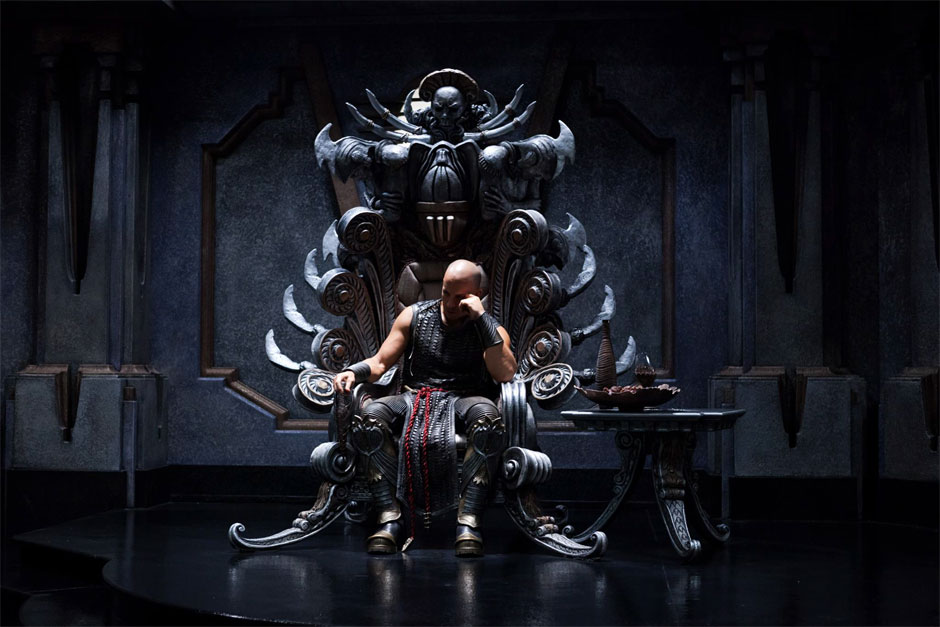
    Largely without dialogue beyond a gruff Diesel voiceover, the first third of Riddick functions as one of the more compelling features of an otherwise dull summer. A king at the conclusion of The Chronicles of Riddick, Diesel’s titular one man army finds himself exiled on a planet that was barely discovered before its human occupants decided abandonment a better course of action. Beyond air and water, everything Riddick encounters is hostile. Dog-like creatures hunt him in packs, and worse creatures lurk in the shadows and muck, standing between the man and his sustenance. It’s an odd path for an action movie to take, but in its spare, brutal shorthand, Riddick lets the audience know that this is a film about the unequivicated power of masculinity.

    Because the movie can’t be 90-minutes of Vin Diesel talking to a CGI dog, Riddick finds a mercenary outpost and pulls an emergency beacon. This hails two squads to descend upon the planet. One, a rag-tag bunch of ill-equipped thugs (led by Jordy Molla and seconded by Dave Bautista), is there merely to collect Riddick’s head in a box. The other is an incredibly professional, well-appointed outfit. Their leader, Boss Johns (Matthew Nable), doesn’t care much for the price on Riddick’s head—he wants to find out what happened to his son, last seen in Pitch Black. His lieutenant, Dahl (Katee Sackhoff), is the group’s muscle. But, as is the theme of all Riddick movies, women aren’t taken seriously even when their machismo outpaces that of the men in the room. The leader of the two-bit mercenaries, head-box in hand, tells Dahl that he’s going to have sex with her. “I don’t fuck guys,” she snarls, busting the guy’s lip open with one solid shot.

    This line serves two important purposes, neither of which have to do with Dahl defending herself from multiple attempted rapes. As a scuttling horde of beasts trap both mercenary teams and Riddick in the same room, it’s clear that for all his “head in a box!” bravado, Molla’s Santana character is a secondary threat at best, a villain to be laughed at and discarded when things get tense. And, as Sackhoff’s character is the one who so effectively neuters Santana, her declarative sets the character up as both a Strong Female Character in the pejorative sense—a real cool lady with guns and breasts!—and a sexual challenge for Riddick. Chained up and awaiting execution, Riddick laughs and tells the room the exact plot of the third act, including that he’s “going to go balls deep” in Dahl, but only after she asks because Riddick, killer or not, is at least willing to wait for consent.

    As an unabashed fan of 1980s action movies, I’m willing to forgive a lot of Riddick‘s flaws in the name of bloody, mindless fun. Over a dozen men chase Riddick to the gates of hell for a piece of the bounty, yet none of them are developed much beyond the fact that they’re all bad asses, with Dahl’s woman warrior and some punk kid’s nervous preacher thrown in for variety, I guess. I didn’t expect nuance from the film, but I also didn’t expect it to have an understanding of sexuality cribbed from a sexually frustrated session of Dungeons & Dragons. Beyond her saying that she doesn’t fuck guys, there’s nothing in the film suggesting that Dahl wouldn’t. But in an action movie you tend to take people by their words, their wardrobe, and the size of their gun. She’s got the biggest of the bunch, and there’s no evidence from the others in her crew that she’s lying when she says, to a room full of dudes, that she doesn’t fuck guys. “I’m gonna go balls deep” is something a teenager says before rolling to score with a rescued princess, not the password required to flip a woman’s switch from gay to straight. There is no switch, and it’s strange to see a movie in 2013—the third installment in a series that’s featured progressive depictions of women before—wheel out this old, depressing trope in the name of adding one more notch to its alpha’s belt.

    Almost as soon as Dahl is called out for and reassigned to her gender, she is put in the spaceship with the nervous kid and told to chill out while the men kill the aliens and recover the lost power cells necessary for everybody to escape. She does, and she fucks Riddick because he survives the night without being eaten alive. And though this is an R-rated film, replete with gore and cursing and breasts, Riddick can’t even do its characters a solid and show them enjoying or even engaging in sex. “Tell Dahl to keep it warm for me,” Riddick says, keeping it macho to the end. It’s a bitter coda to an otherwise uncomplicated, accomplished riff on monsters and mayhem. There’s potential here, especially if Sackhoff returns to a future installment and is given more to do than sit around waiting. But if Riddick is proof of anything, it’s that few things in a film are as frustrating as unrealized potential.


    Riddick. With Vin Diesel (Riddick), Jordi Molla (Santana), Matthew Nable (Boss Johns), Katee Sackhoff (Dahl), and Dave Bautista (Diaz). Directed by David Twohy and produced by Diesel, Ted Field, and Samantha Vincent. Screenplay by Twohy, based on characters created by Jim Wheat and Ken Wheat.