Tag: WWE

  • The Ultimate Warrior

    The Ultimate Warrior

    Ultimate Warrior

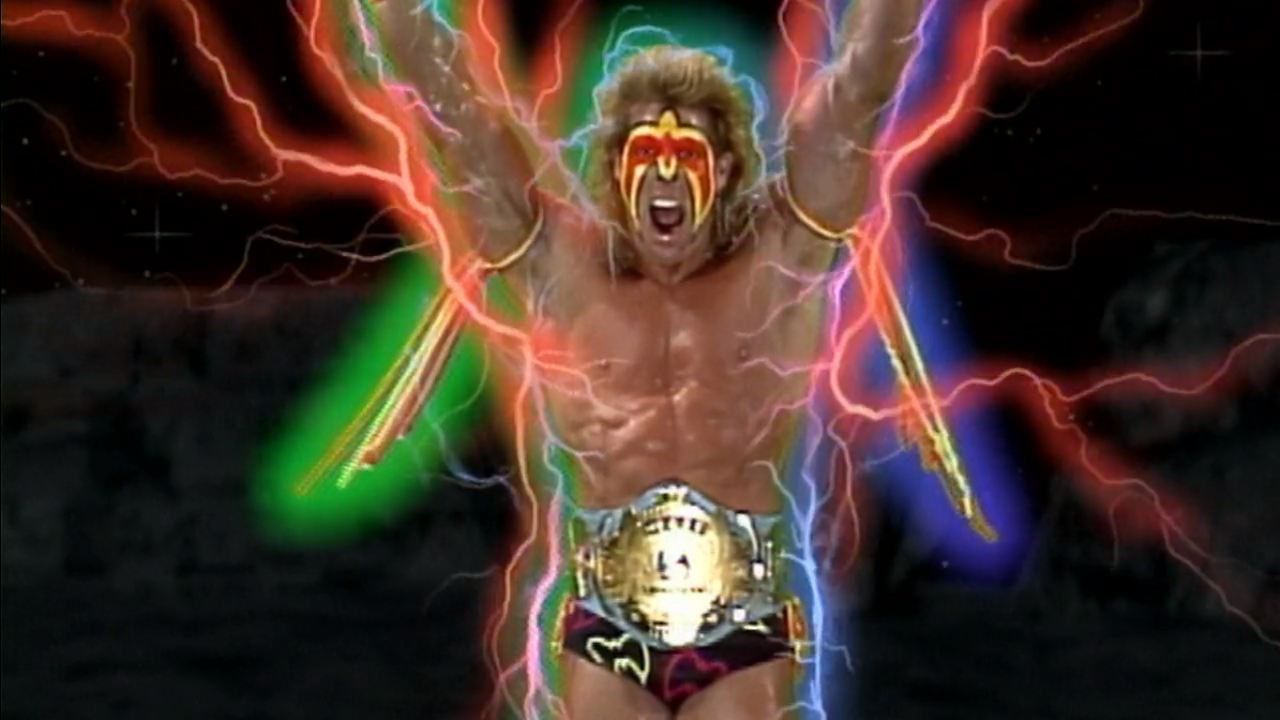
    I’ve been thinking a lot about The Ultimate Warrior lately. I’ve also been thinking a lot about the man, Warrior (or Jim Helwig, if you’re not into calling people by the names they choose to self-apply). I was at WretleMania XXX in New Orleans, and despite everything on the card being custom-designed to appeal to my lizard brain, there was no bigger reason for my being there than the promise that The Ultimate Warrior’s music would play, he would charge down to the ring in full gimmick—face paint and airbrushed duster—and shake the ropes a bit before once again disappearing into the recesses of my memory, where he exists in an odd liminal zone I’ll eventually come around to discussing. His music played, and what emerged was a middle-aged man in a tuxedo. I would have to wait until I was at home on Monday, watching Raw, to see The Ultimate Warrior. He shook the ropes a bit. He put on a plastic mask that approximated his famous warpaint (but wasn’t half as satisfying). He cut a promo about his legacy that, in all honesty, ranked among his absolute best even without its later context. He left the ring. He went home. He died.

    The Ultimate Warrior has always been in my life, even in the spaces that are filled in largely by old photographs or memories that may have actually been dreams. There’s a picture of my sister and I from one Christmas. I was four, I think, and she three. We’re tearing open our gifts. Mine is a WWF Brawling Buddy of Hulk Hogan. Her’s is The Ultimate Warrior. My mom would put us in a crib with these things, me an avid Hulkamaniac and wrestling lunatic even that young, her accepting the Warrior because he had make-up on his face and tassels on his arms, and we’d put on impromptu steel cage matches.The first wrestling event I can remember seeing is WrestleMania VI, The Ultimate Challenge, on a bootleg tape at my babysitter’s house. Warrior won the WWF Championship from Hulk Hogan that night and every weekend thereafter, until I learned that there was such a thing at new wrestling on TBS. But there was always the Warrior. Always his music, his sprinting, his paint, his tassels, his shaking the ropes. Forever.

    I was disappointed that Warrior—this is the man I’m talking about, now—didn’t appear at WrestleMania XXX in The Ultimate Warrior’s face paint because I’m petty, maybe, and because I expect nostalgia acts to play their part in my satisfaction. But Warrior wasn’t there for nostalgia’s sake. He was there to settle old scores. I don’t care about long-held grudges in wrestling and just don’t have much use for Warrior beyond nostalgia, so no number of DVD releases, tell-all interviews, or motivational speeches would have made up for his appearing at WrestleMania as Warrior, husband and father and inspiration, and not the character that allowed him to do this. Still, I found it hard to be too bitten by this—The Ultimate Warrior was always something of an enigma; unlike Hulk Hogan or Randy Savage or Bret Hart or Jake “The Snake” Roberts, he was a figure from the tapes I devoured who came and went as he pleased, too frequently for me to attach the role of childhood hero to. I wanted that face paint—I needed that face paint—because anything else was a reminder that The Ultimate Warrior was just a man, just Warrior, and Warrior wasn’t enough.

    Looking up to wrestlers as a kid, I think, taught me a valuable skill. It taught me to distinguish a human being from their work, the art from its artist. Most of my childhood heroes are dead now. One of them died having murdered his family. It isn’t easy, going back and watching these men work, knowing what I now know about the body, the brain, why it’s a bad idea to take a steel chair to one’s face. But this doesn’t stop me. It’s difficult art that I appreciate the most. Difficult artists, however, I can do without. Warrior, the man, was a difficult artist. I don’t mean that in the sense that I watched WWE’s hatchet-job DVD The Self-Destruction of The Ultimate Warrior and thought “Wow, this guy was an asshole.” I mean that he was a difficult artist in that he was a homophobe in an extremely public manner, taking money to give lectures about how “queering doesn’t make the world work,” and penning missives about how Heath Ledger’s child was better off without a father who’d stoop to playing a faggot cowboy in some Hollywood film with a queer liberal agenda. This from a man who, in 1989, participated in an angle where his opponent was rubbed down with oil in front of 15,000 men who were asked to vote, with their full-throated cheers, for the wrestler they believed to possess the better physique.

    I tend to cry when wrestlers die. At least the ones from my childhood. The ones who’ve always been there. The video package for “Macho Man” Randy Savage that played the Monday after his passing is the last thing that made me weep openly. The Chris Benoit tribute episode of Monday Night Raw, the one for Eddie Guerrero, the one for Owen Hart—each one had me inconsolable. With the exception of Benoit, whose transgressions became public during the course of the event held in his honor, I think what unified these men, what made their passing significant for me, was that I didn’t know them as human beings, but as something more than human. I knew them as wrestlers. The Ultimate Warrior I know as a wrestler. Warrior I know as a man. I’m able to separate the two, and, given Warrior’s attempt to launch a reality show where he yelled at swoop-haired nu-metal bands about not being in shape and enjoying alcohol too much to be “real men,” I can even appreciate what the lesser being had to offer. But Warrior was a man, a public figure who I knew through shoddy videos of him saying one thing or another that I didn’t merely disagree with, but that violated some part of me, or would have, could something like a viral video violate my autonomy as a queer man. The Ultimate Warrior exists in too many hours of archival footage to truly die. Warrior is dead, and it’s only a little weird because I was there, occupying the same space as him. I watched him at the Hall of Fame ceremony. I saw him at WrestleMania. I listened to him on Raw. He seemed fine, if a bit wounded. Then he simply wasn’t.

    This is fate, of course. As he said, every man’s heart one day beats its final beat, his lungs breathe their final breath. And I owe the man, Warrior for being the man inside The Ultimate Warrior, who was no small part of my early infatuation with professional wrestling, which was the beginning of my infatuation with words. His words. Ric Flair’s words. Paul Bearer’s words. Randy Savage’s. Mine. When a wrestler dies, there is generally the temptation to burnish the legacy of the man who occupied that wrestler. This is something that I have been guilty of in the past, and will probably be guilty of in the future. But I’ve been thinking a lot about The Ultimate Warrior lately, and I find myself unable to do the same for him. Because I can’t think about the man too much. Because I won’t. So instead, I’ll think about wrestling. I’ll speak to it and of it and for it. Because there is nobody there to speak to. Because he wouldn’t listen were he there.
  • Free Wrestling: Repo Man vs. Randy Savage (1/25/1993)

    Free Wrestling: Repo Man vs. Randy Savage (1/25/1993)

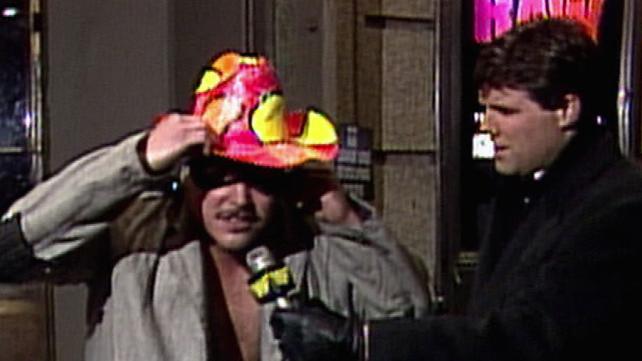
    Background: The Repo Man—one of Barry Darsow‘s many faces once the Demolition well ran dry—is, in my humble opinion, one of the great bad gimmicks of all time. (For the record, Darsow’s stint as angry golfer “Hole in One” Barry Darsow on WCW Saturday Night is another.) During this time, with Vince McMahon fresh from federal trial and casting aside the notion that wrestling was a legitimate sport to throw off the yoke of state athletic commissions, it wouldn’t be farfetched to accuse the chairman of having a persecution complex, and the things McMahon hates, loves, or finds funny often manifest themselves in his product. So in the early 1990s, he had two men running around stealing things from his good-hearted fans: I.R.S., who’d take your money, and The Repo Man, who’d take your ride. This wonderful clip should explain Repo Man’s motivations quite nicely:

    Where most bad WWF gimmicks of this period (Bastion Booger, Mantaur, Phantasmo, and so on) came and went before developing a catchphrase or receiving a theme song, Repo Man came to the WWF fully formed with a truly great Jim Johnston theme song and the kiss-off line of “What’s mine is mine, and what’s yours is mine!” Also unlike the majority of goofball jobbers the WWF would come to feature, Repo Man actually had a televised feud with “Macho Man” Randy Savage, notable for its sheer weirdness. Savage had been around the WWF block a few times by 1993, and everything he could possibly feud with another wrestler over, he’d already done. Miss Elizabeth, Queen Sherri, crowns, and championship belts were meaningless to Repo Man, who had his heart set on hooking his towing claw into the one thing he really couldn’t be without: his hat.

    The best thing about this mini-feud, beyond how passionate Macho Man is about his hat, is Repo Man’s insinuation that the sequined monstrosity required multiple payments that Savage was somehow delinquent on. Boiled down, the two-week program is a familiar one, where the unappreciated mid-card guy gets a shot at somebody way above his pay-grade because he destroyed their property. Think Kofi Kingston wrecking Randy Orton’s NASCAR, or Paul Heyman stealing The Undertaker’s urn and forcing the Deadman to wrestle The Dudley Boys and bury Paul Bearer in a concrete tomb. The difference, of course, is that Repo Man is a cackling, C-level Batman villain riding shotgun in a tow truck, and Randy Savage is God. Nothing about this can end well.

    http://www.youtube.com/watch?v=g2M61oURweM

    The Match: Savage is so angry that Repo Man enters the ring wearing his hat that he bombards the poor bastard without so much as being introduced, which is too bad considering how infrequently “Pomp and Circumstance” played on Raw. He is all over Repo Man from the opening bell, beating him up so badly that Repo Man tries high-tailing it out of the Manhattan Center, which, of course, Randy Savage does not allow.

    In Rob Bartlett news, pay attention to the commentary when Repo Man takes over. The guy was a hack comedian and a worse broadcaster, which becomes increasingly obvious as he makes fun of Savage’s bald spot, something a face commentator would never do. McMahon covers for him as best as he can until, finally, Bobby Heenan asks Vince where he found the schmuck. Sure, it goes along with Heenan’s character to be exasperated with Bartlett, but his exasperation seems genuine and is something a heel commentator generally gets away with. Vince McMahon is somewhat infamous for the way he dresses down his commentary team during broadcasts—an entire chapter of Mick Foley’s Countdown to Lockdown is dedicated to the subject—and Heenan and Jim Ross have told stories about how Gorilla Monsoon, who produced segments backstage, could pick out bad announcers and tell the regular crew “not to remember his name” almost immediately. Bartlett only lasted 13 weeks—long enough for him to roll out various match- or show-length impersonations of Mike Tyson, Elvis, and Vince McMahon—but his last few weeks with the company were spent mostly being the butt of jokes. Years later, the WWE would make the mistake of hiring another guy ill-suited to professional wrestling to fill the shoes of Joey Styles and Jim Ross before cutting him loose, but at least Mike Adamle was funny.

    http://www.youtube.com/watch?v=YAfTuhC8FJA

    Repo Man maintains his advantage for awhile, but it isn’t long before Savage gets the better of him, nails the flying elbow drop, and puts Repo Man away, reclaiming his hat and his manhood. Like the match between Shawn Michaels and Max Moon, this is another example of what Raw did very well in its early days: the showcase bout. Repo Man manages to look like a legitimate threat for awhile, much like Max Moon made a brief bid to take Michaels’s Intercontinental Championship, but he’s eventually put in his place and forgotten about so Savage can go on to train his buddy Crush for a WrestleMania clash against Doink the Clown.

    Guys like Barry Darsow aren’t fixtures on television anymore, and that’s too bad. Not that Darsow was the most brilliant wrestler, but as he shows here and in his 1994 feud against Dustin Rhodes in WCW, he makes for an able foil, and manages to look good even in a losing effort. The advent of the Monday Night War did away with Darsow’s role on flagship programming, as the need for marquee matches led to matches like Arn Anderson vs. Hulk Hogan or Randy Savage vs. Ric Flair being given away for free instead of being used to sell pay per views. WWE didn’t start giving away marquee matches until the end of the brief Invasion era that followed their buyout of WCW, but when 225,000 people purchase a pay per view and four million watch Raw, it’s perhaps understandable why Alberto Del Rio wrestles The Big Show on a weekly basis.


  • Wrestling Worth Watching 10/22/12 – 10/28/12

    Wrestling Worth Watching 10/22/12 – 10/28/12

    Welcome to the new, hopefully improved edition of Wrestling Worth Watching. Back when Fear of a Ghost Planet started, this post was a way of looking at everything that happened in the world of televised wrestling that was good, from Chris Jericho trolling the crowd to Brodus Clay debuting as a funk-loving tubbo from outer space to a decent match on some indie fed’s YouTube channel. It was an ambitious project, and one that ultimately failed. In 2012, there is just too much wrestling out there to keep track of it all as it happens. So I’ll be forward and honest from the start of this new project: I don’t watch Impact Wrestling, as they don’t make an honest effort to make their shows available beyond airdate, and Ring of Honor doesn’t air where I live, though I’ll try to catch it whenever possible. These posts may seem like they’re dominated by the WWE, but that’s the reality of nearly every wrestling fan’s situation: the promotion who airs the most free wrestling is the one that gets watched the most. If you’d like to chime in with matches from elsewhere that should be noted, hit me up in the comments section.
    Monday Night Raw (8/22/12)

    Team Rhodes Scholars vs. Rey Mysterio & Sin Cara: For a month now, the WWE has done everything in its power to revitalize its tag team division, waking the dead by calling a time-tested audible in the long-running Daniel Bryan/Kane feud by pairing the two up and giving them the Tag Team Titles, running an angle where a rival team formed as a result of the champions’ dysfunction, then having a month-long tournament featuring several new teams. The only team that’s broken up as a result of not winning the tournament was the one pairing Kofi Kingston and R-Truth, the previous champions. Now there’s a power tag team (Primetime Players), a team of brothers (The Usos), a high-flying tag team (Justin Gabriel and Tyson Kidd) and these two teams, the most popular/hated and established of the bunch. Theirs was the best tag team match of the week, setting up the long-anticipated slight-letdown of a match between the Rhodes Scholars (I think putting “Team” in front of everything has been the worst part of the division’s rebuild. Team is implied!) and Team Hell No (the exception to the rule, as “team” is meant pseudo-ironically, though “Team Friendship” will forever be the better name). The only reason this wasn’t the best match on Raw is because Dolph Ziggler and Daniel Bryan would later take the floor for 15 minutes.

    Daniel Bryan vs. Dolph Ziggler: For a long time, the only person the Money in the Bank briefcase turned into a star was Edge, and really all his surprising title victory over John Cena did was solidify his place as a top-tier talent. The second person to benefit from the odd bump the briefcase provides was C.M. Punk, though it took two tries—and an incredibly good feud against Jeff Hardy—to get it right. Everybody else either wasn’t ready, or wasn’t given something beyond that moment of glory, but in Edge and Punk, the briefcase has found purpose: either a crafty, dickish heel cashes it in and proves himself, or a mawkish good guy cashes it in and quickly turns evil. Dolph Ziggler and Daniel Bryan are the next generation of men who’ve somehow taken that gaudy briefcase and turned it into a platform from which better careers are launched, Ziggler by taking Edge’s role, and Bryan by taking to Punk’s. While both remain a title reign away from true greatness, their match Monday on Raw was a gift from the ghost of WWE’s future, a thrilling contest teasing at the possibilities a full-blown rivalry between the two contain. The point of this was to reestablish the dysfunction between Bryan and his tag team partner Kane, and while that mission was accomplished and the work those two have done together has been very good, matches like this mean I can’t wait much longer to see Bryan on his own again, a mean little man with a nasty beard and a worse submission hold.

    C.M. Punk vs. Sheamus: Though they didn’t mention it, there was a nice synergy to this contest, the 30 or so men around the ring not only serving as flesh-and-blood metaphor for the inescapability of the Hell In a Cell structure, but as closure to the mini-issue between Punk and Sheamus that started at the Raw in Chicago, when Punk bolted on a slated title vs. title match to eat at The Wiener’s Circle and hang with Paul Heyman. I haven’t seen every Lumberjack Match ever, but I feel pretty confident in claiming this as one of the best. The match is a throwback to a time when a sheer mass of humanity was enough to pique a crowd’s interest, and lately has been relegated to the typical blow-off match between Divas, the lumberjill match, if you will. Anymore, they’re confusing affairs, the lumberjacks rarely doing their job—containing the action in the ring—and instead clubbering on any poor bastard who ends up on the floor. So it was a sigh of relief when C.M. Punk landed on the floor, in a sea of humanity, and was merely tossed back into the ring. And it was surprisingly O.K. when Sheamus was thrown out there and got beat up, because he landed amongst a crowd of heels and wound up brawling back. Barroom brawls are an environment Sheamus thrives in, and lumberjack matches are a situation where crafty bad guys have to be their most cunning. C.M. Punk was just that, Sheamus was in his element, and the result was the most satisfying Raw main event in some time. The stuff with Ryback I covered last week, but having 30 men around the ring, overkill in any other match, was worthwhile just to see them split when the dude’s music hit.

    WWE Main Event (8/24/12)

    Dolph Ziggler vs. Ryback: There’s really no better opponent for Ryback than Dolph Ziggler, a wrestler who is, in every aspect, the second coming of “Mr. Perfect” Curt Hennig. If you’ve ever seen Hennig pinball around the ring for a larger, more muscular opponent, then you know what I’m talking about. Ryback’s an act only the most cynical wrestling fan doesn’t like, a monster in the Goldberg fashion who steamrolls through opponents with a variety of ridiculous power moves and stiff-looking strikes. Ziggler flopped around the ring for Ryback’s routine like a mad-man, putting over the legitimate danger presented by the monster while also showing that there’d be no escape for C.M. Punk on Sunday, even without the presence of a gigantic steal cage. The match did its job very well without tanking Ziggler. Credit for that goes to the length of the match—thus far the longest match of Ryback’s run—and to The Miz’s commentary, which pointed out that, against Ryback, everybody is off their game.

    WWE Hell In A Cell (8/28/12)

    The Miz vs. Kofi Kingston: The third match between these two in as many weeks, and, in many ways, the best of the bunch. Hard to believe that their issue began when Larry King’s wife threw a cup of water in The Miz’s face, but I’ve come away from their series as a fan of both men, when before I was ambivalent towards both of them. The opening two minutes or so were great, Miz and Kingston both fighting and failing to apply their finishing maneuvers, the fact that spots from previous matches evolved and became something else was a very nice touch, and the finishing struggle between the two, with Miz keeping the full nelson he uses in the Skull-Crushing Finale on as the two rolled to the ring and got back up to their feet, was tremendously exciting. Lately, Kofi’s Trouble in Paradise kick has been a devastating-looking, come-from-nowhere move akin to Shawn Michael’s Sweet Chin Music. That’s worked a lot better than the old set-up, where Kofi stands in the corner and tries to pump the crowd for it, much like Michaels did for his kick. And while you wouldn’t know it from the anemic crowd, the last three or four minutes of the match, from when Miz started targeting Kofi’s leg with a weird-looking, over-the-shoulder knee-breaker to the finish, was tremendously compelling stuff. Knee braces and leg casts are things the heel usually removes on an injured opponent, but they took things a step further here, with Miz injuring Kofi’s leg mid-match and stripping his boot and knee pad to further exploit the injury. I loved everything about it, even The Miz’s awkward execution of the half-crab.

    The Big Show vs. Sheamus: For me, this was the match of the week, but I’m a big fan of Hoss vs. Hoss battles, something they featured plenty during the championship run of Mark Henry, and not enough during Sheamus’s time with the belt. Built up as a showdown between two knockout blows—The Big Show’s Knockout Punch and Sheamus’s Brogue Kick—the story of this contest wound up being much more complex, with Sheamus withstanding a number of Big Show’s past and present finishing moves, including the giant punch, and Big Show kicking out of the Brogue Kick, becoming the first man to do so in the process. The crowd—dead most of the evening—came alive when Sheamus picked up The Big Show and dropped him with a perfect-looking White Noise, and for good reason: however good Sheamus’s matches as champion have been (and however much he’s been built as the best champ in 10 years), they’ve lacked effective spectacle. The only other guy on the roster who has picked a guy like Show up on his shoulders is John Cena, but you expect that from him. This was built as blow vs. blow, a straight brawl, but that maneuver, more than Sheamus’ triumph over Daniel Bryan at WrestleMania, will be the defining moment of his championship reign. The finish, which saw Show sidestep a second Brogue Kick while throwing a K.O. Punch the champion’s way, was the best moment of the week, two semi-trucks playing chicken in the rain, only one driving away without jackknifing. This one wasn’t pretty, but boy was it effective.

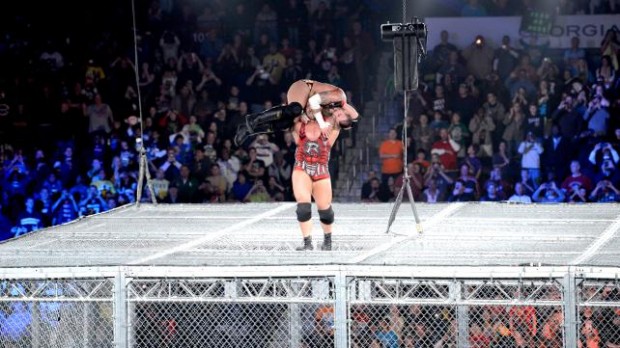
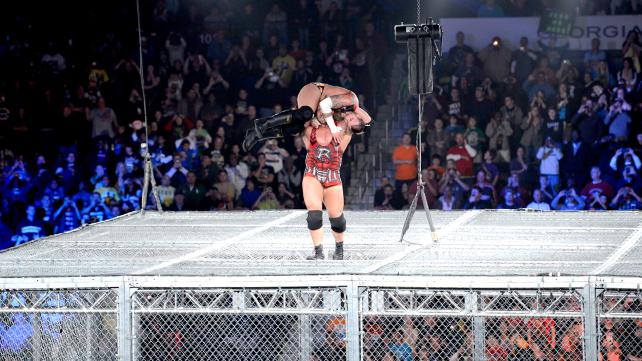
    C.M. Punk vs. Ryback: The most controversial match of the year, as even anti-Ryback partisans realized the risk of this match: Ryback loses the “wrong way,” and the WWE is out one potential game-changing superstar. Popular wrestling journalist (a three-word oxymoron, if ever there was one) Dave Meltzer says that he read through dozens of bad-to-middling ideas for the finish of this match, and that all of them were better than the one chosen here. Whatever. In 1998, Ryback’s ancestor Bill Goldberg defeated Hulk Hogan in the Georgia Dome in Atlanta, ushering in what many felt was a new era in WCW. He was undefeated. He was slightly green. But he was at the apex of his popularity and ready for the championship. At Starrcade that year, he was defeated by Kevin Nash, who was aided by long-time running buddy Scott Hall, who used a taser to put “Da Man” (Bobby Heenan’s spelling, not mine) down for the count. It was an awful finish, an anti-climax that didn’t make a whole lot of sense (Hall and Nash were feuding, Goldberg was on the verge of reaching Hogan-esque levels of global fame), and Goldberg—and WCW—never quite recovered. The finish to the Hell in a Cell match between Punk and Ryback is similar in a way—Ryback was screwed over—but the circumstances are different. It doesn’t matter if the “GOLDBERG” chants that follow Ryback are now affectionate, if the same people who chant that stop to join the rest of the crowd in Ryback’s WWE-mandated “FEED ME MORE” chant, Ryback was not ready for the WWE Championship. To my recollection—hardly a useful tool, but one that probably feeds the WWE machine better than a photographic memory of every Ryback match—the man hadn’t bumped for move one of any opponent he faced before this match, from the jobbers named after presidents to the duet of former champions he faced leading into his main event this week. Here’s what Punk needed in order to win: the most biased official in wrestling history. Brad Maddox, last seen close to a month ago missing C.M. Punk’s foot on the ropes, stopped Ryback while he was marching around the ring with Punk on his shoulders. He low-blowed the man, slipped behind him, and quickly counted to three as soon as Punk pushed him over the ref and made the cover. I don’t want to say that it was brilliant, but it clearly shows that someone in the back learned from the essential mistake of the Nash/Goldberg issue, which was never successfully resolved. This was a FIRST TIME ENCOUNTER. That it happened in one of WWE’s most legendary matches was something of a head-scratcher, a calendar-based necessity, but really, it’s the only place it should have happened. Ryback’s destructive ways aided and got in the way of his goal. The cage provided a place where he could look momentarily weak, but also like the freaking monster he is. It allowed Paul Heyman to be at his panicked best. It meant that Punk and the referee would be unable to escape swiftly into the night. It meant Ryback would get his revenge. And he did so memorably, tossing Maddox into the cage as if he were Bam Bam Bigelow and the poor referee his Spike Dudley before chasing Punk up the cage and delivering Shellshocked 20-feet in the air. The show ended with Ryback nodding his head to his own music, foot planted firmly on Punk’s chest. Those who don’t think Ryback got his due last night, that his star was aborted rather than born, aren’t paying attention. The focus of this match, after all, was Punk establishing his legacy, finally gaining the respect of the WWE Universe. Punk is an asshole. A dick of the highest order. His legacy is that of a great, long-tenured heel champion. He stands in defiance of what the fans want to see. He makes those fans want to see his comeuppance even more. He finds and exploits the loophole and expects you to respect him for it. I’m going to come just short of calling this match brilliant, but it’s another example of why Punk’s run as WWE Champion, of late, has been one of the most effective such runs in memory. You wanted Ryback to win? You’re upset with the finish? That’s exactly how WWE wants you to feel. Tune in tonight on Raw to see that snide jerk get what’s coming to him.


  • Wrestling Review: CM Punk: Best in the World (2012)

    Wrestling Review: CM Punk: Best in the World (2012)

    If you’re even remotely familiar with World Wrestling Entertainment, just one look at CM Punk on a Monday Night Raw telecast will tell you everything that makes his narrative so compelling: in an industry built upon and carried by Herculean physiques, CM Punk doesn’t fit the mould. If you are familiar with WWE, familiar enough, perhaps, to’ve seen one of their many retrospective documentaries, then the difference between Punk and men like Dwayne “The Rock” Johnson, “Stone Cold” Steve Austin, and John Cena are even more clear cut.

    The documentaries chronicling the rise of your typical ten-time world champion all make the same point: becoming a legend in professional wrestling from the outset of one’s career is as unlikely for Ric Flair as anybody else. But many of the narratives pushed by the WWE are remarkably similar, involving men of uncommon drive and ambition who were standout college athletes, second- or third-generation performers, or who had the luck and good fortune to see the workaday, bingo hall grind of territory day wrestling pay off in the most unimaginable, improbable way. They all say something along the lines of “I wasn’t supposed to make it,” but, for whatever polish a man like John Cena lacked upon his debut in the big time, it’s hard to not look at his story—and most stories like it—with a sense of inevitability. Some men were born to be superstars.

    A particular subset of wrestling fans will tell you that CM Punk was destined to be a superstar, and to some extent, that’s true. Wrestling has shrunk and grown, grown and shrunk, and otherwise mutated since Vincent Kennedy McMahon ended the territory system by taking the World Wrestling Federation national on the back of Hulk Hogan, but the cyclical nature of wrestling almost dictated that the territories would come back. They have in the form of independent wrestling, and if CM Punk had never been signed by the WWE, he’d almost indisputably be the biggest wrestler in the world not employed by McMahon’s corporate juggernaut (a slot currently occupied by Punk’s best friend, Colt Cabana), the best independent wrestler in the world. But the WWE is given to signing buzzed-about talent, and in 2005, few men had as much buzz as CM Punk. His story would be unusual enough were it to end there, the land of giants inviting a small, scrappy punk into its fold, and had anybody with the power to hire wrestlers to contracts known what they were getting into with Punk, it’s likely that his story wouldn’t have made it that far. But Punk’s an odd character, a man driven to make it despite his apparent flaws, a man confident enough in his abilities to recognize those flaws as a potential strength. Punk doesn’t fit the WWE’s mould, and he’s just fine with that.

    Best in the World plays a lot like a typical WWE DVD release, with a documentary feature on the superstar in question and a collection of his best matches spanning two discs. The difference here, however, is that Punk did not come up through the modern WWE Superstar’s usual channel (the various promotions WWE has used to develop its future talent), nor are any of his classic independent matches part of the WWE’s mammoth video library. In direct contrast to the company’s “Don’t Try This” PSAs, Punk began his career in a friend’s backyard, a kid with a shameless DIY aesthetic that led him to become one of Chicago’s most successful independent wrestling promoters before seeking proper wrestling training. The nature of Punk’s career and the WWE’s obsession with charting the rise of its most bankable stars necessitates the video libraries of entities like IWA: Mid-South and Ring of Honor—promotions most members of the WWE Universe would be forgiven for not knowing—and interviews with indie wrestling luminaries Ace Steel, Colt Cabana, Bryan Danielson, and Chris Hero, not to mention WWE personel, midcard fixtures, Punk’s friends and surrogate family, and punk musician Lars Fredrickson. That Punk’s early story is supplemented with footage of his contests against Cabana, Hero, and Samoa Joe is an unexpected bonus, something that has the potential to open a WWE fan’s world to a different kind of wrestling in a way that never existed before now.

    It’s a unique line-up of talking heads, all of whom do an exceptional job of telling the story of WWE’s least-likely company figurehead. The “wrestler who wasn’t supposed to make it” storyline is personified by Punk to the point that it should forever be retired. Here’s a guy who is too small and too different to make it (his Pepsi and G.I. Joe tattoos are regularly left off his action figures and video game likenesses), but a man who is nevertheless too vocal, too passionate to submit to a role less than the one he currently occupies. Though Vince McMahon does not appear on this DVD (the Chairman is likely being saved for a a sequel somewhere doen the line), he is very much the authority Punk rages against, even if it’s clear that Punk’s eventual breakthrough in 2011 was good for his company’s bottom line. The WWE version of the Summer of Punk—the 2011 saga that saw Punk give unbelievable speeches about the state of the WWE, threaten to beat John Cena for his WWE Championship on Punk’s final night with the company, then leave with the title—was largely borne from Punk’s frustration with his position on the card and the overall direction of the WWE, a theme that’s being revisited even now as Punk angles his way towards yet another confrontation with Cena over the title the two have come to define.

    If Punk has beaten the odds placed before him—and WWE creative and corporate figures like Michael Hayes (of 1970s and 80s Freebirds glory) and Triple H will be the first to tell you that he has—it’s due to his willingness to barge into McMahon’s office and ask (or demand) for something better. It’s not surprising to learn that the Straight Edge Society—Punk’s messiah-like play on cults and his own straight edge lifestyle—was his idea, but it’s practically unheard of for a wrestler to drop 14 weeks of television on the boss’ desk, even rarer for that plan to be carried even partially to fruition. Best in the World shows Punk at his best in the ring, but its greatest pleasure is in detailing the way CM Punk thinks about the business. To that end, Best in the World doesn’t mythologize its subject, as most WWE documentaries attempt to. This is a quieter, more intimate portrait of a wrestler, something along the lines of WWE’s recent Steve Austin documentary and its earlier efforts focusing on Chris Benoit and Eddie Guerrero. It doesn’t offer much for those who aren’t wrestling fans, but for those who are, it’s an impressive look at one of the medium’s smartest, most gifted performers, a surprisingly strong argument in favor of viewing professional wrestling as art.

    Rating:

    CM Punk: Best in the World. Directed by Kevin Dunn. A documentary featuring CM Punk, Colt Cabana, Chris Hero, Daniel Bryan, John Cena, Triple H, Michael Hayes, Paul Heyman, and others. Released October 9, 2012, by WWE Films. Extras include documentary footage and matches across Punk’s career.
  • Hulk Hogan vs. Stan Hansen (4/13/90)

    Hulk Hogan vs. Stan Hansen (4/13/90)

    [youtube http://www.youtube.com/watch?v=jQZwqNiTN1E]

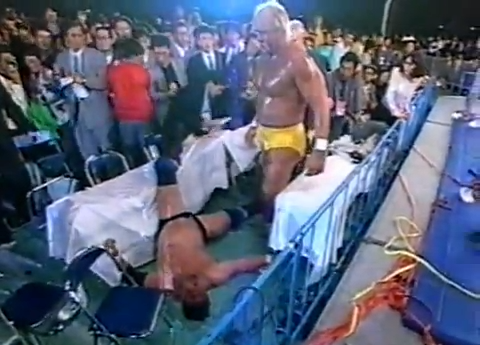
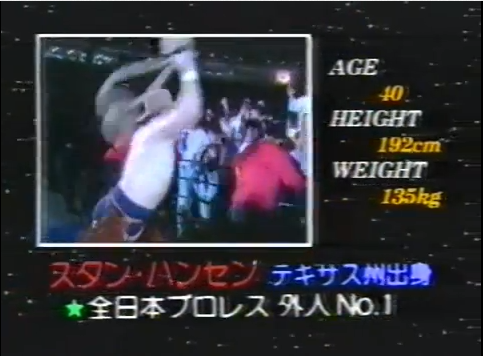
    Almost without question the best match Hulk Hogan had after losing the WWF Championship to the Ultimate Warrior at WrestleMania VI a mere 12 days earlier, this encounter between Hogan and Stan “The Lariat” Hansen has a major advantage over most Hulk Hogan matches—from that era or otherwise—in that it takes place in Japan. I’ve written a little bit about the curious effect Japan had on Hulkamania, but this goes deeper than the Japanese expecting more than routine, about their wanting to see the Axe Bomber lariat and not the Atomic Leg Drop. See, in Japan, Stan Hansen was the living, breathing embodiment of America at its meanest, at its toughest, at its worst. Stan Hansen was worse than any ol’ monster Hulk Hogan had chopped down in America. He was a tobacco chewing, bullrope twirling bully, an American Godzilla.

    That’s important, because in any other country but Japan, Stan Hansen in a WWF ring is a cartoon cowboy. Oh, maybe not when he broke Bruno Sammartino’s neck in 1976, but plenty had changed in the intervening 15 years. Heck, 10 years after Hansen and Bruno’s feud, Terry Funk came to the WWF as fodder for Hogan’s budding WWF Championship reign and was portrayed as a cartoon cowboy. A middle-aged and crazy cartoon cowboy, which was actually a good contrast for Hogan, but not quite the Terry Funk 1985 needed. In Japan, Terry Funk is Terry Funk. Stan Hansen is Stan Hansen. He’s a bully. The bad man from Borger. And everything about his ring entrance tells you just that.

    Here he is whipping a fan with his bullrope.
    Here he is checking the ring announcer to the canvas.
    And here’s Hulk Hogan, presumably terrified.

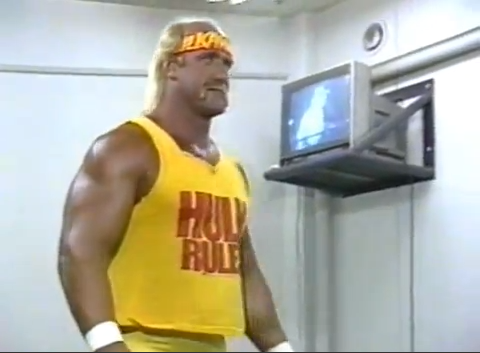
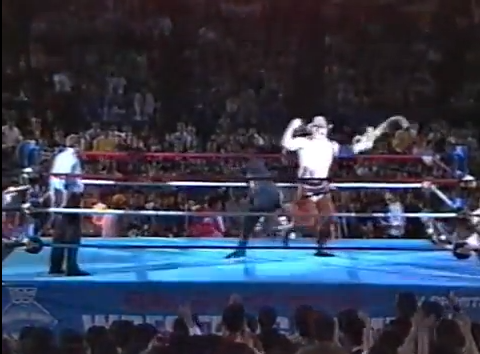
    The pre-match segment, with Hogan standing around in his locker room stretching, ignoring the Japanese interviewer, and watching Hansen make his way to the ring, is one of my favorite parts of this match. There’s something to be said for WWE-style ring entrances and what they accomplish, but nobody knew how to create an atmosphere for a wrestling match quite like the Japanese. With Hansen out in the ring whipping every thing in sight and Hogan in the back, silently watching, it was pretty obvious that something special, something living up to the “SPECIAL DREAM MATCH” bulling was about to go down. Hogan and Hansen were two bombs, set to explode.

    What’s amazing, at least to me, is that Hansen was a last-minute replacement for Terry Gordy, the All Japan Pro Wrestling Triple Crown champion. A loss to Hogan, Gordy figured, would do him more harm than good. The resulting match, however, has a sense of destiny to it. Hogan teamed with Hansen during Hogan’s time in Japan. He’d grown to be this big, shouty, American teddy bear, a nice enough dude, but somebody Hansen would be deeply ashamed to associate with. Instead of one of those cutesy American matches between former tag team partners—you know, where one man knows the other’s move “almost before it happens!”—things escalate very quickly from Hogan’s mat wrestling display (those who’ve long bemoaned Hogan’s five moves of doom should pay attention to his STF, his cravate, his drop toe-hold, and so-on) to a Hansen-style brawl. Both men throw punches. Both men shed blood.  Hogan, in a decidedly anti-Hogan twist, bodyslams Stan Hansen onto an unbreakable Japanese table. Beyond Hogan’s yellow trunks and his willingness to cheat, he’s almost unrecognizable.

    That’s what I appreciate the most about Hogan’s one-off appearances in Japan, that they represent something utterly different from what I’m used to. I recently listened to Colt Cabana’s interview of William Regal (one of my top five favorite wrestlers), and Regal said something that reminded me to look up this match. He said that, too often, wrestlers (and people involved elsewhere in the industry) get too caught up in the finer details of their craft and forget what interested them as children. For me, it was Hulk Hogan. Sure, I also loved Randy Savage, Bret Hart, Ultimate Warrior, and Jake Roberts, but it was Hogan who got me in the door and, later, Hogan who I most bitterly complained about.

    It’s not my place to talk about Hulk Hogan the person or Hulk Hogan the backstage politician, but Hulk Hogan the wrestler existed, and was not just a figment of my imagination. Beneath his routines, beneath his catch phrases, and beneath his pre- and post-match posedowns there existed a Hulk Hogan who could really go in the ring, but wasn’t called upon to except on the rarest of circumstances. When I watch a Hogan match like this, I think of all the good-to-great John Cena matches I’ve seen, all of the Randy Orton matches I’ve enjoyed despite not really liking Randy Orton, and the divide that exists between people who love those two wrestlers and those who hate them. It’s a wide gulf, one unlikely to be bridged, but take a look at this match and realize that, for 13-minutes, Hogan and Stan Hansen are equals. Then watch John Cena vs. C.M. Punk or Randy Orton vs. Christian and tell me, with a straight face, that one carried the other. I don’t think I’m revealing anything when I say that wrestling, at its core, is a partnership. If the two partners aren’t somehow equal, the match fails. There’s a wealth of Hulk Hogan matches following this one that only proves this point. Wonderfully, none of them take place in Japan.

  • Bobby “The Brain” Heenan vs. The Ultimate Warrior (6/25/88)

    Bobby “The Brain” Heenan vs. The Ultimate Warrior (6/25/88)

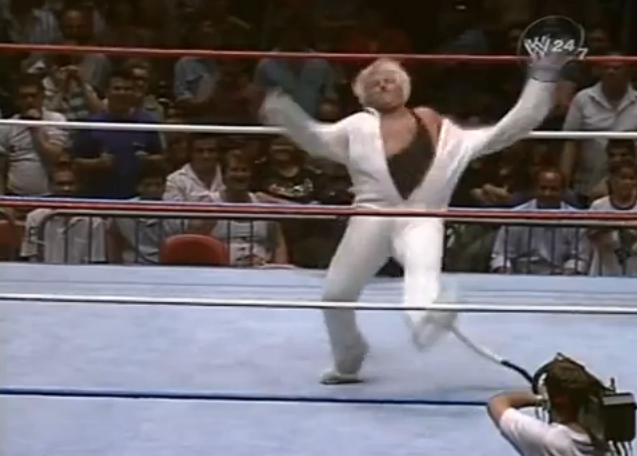
    Bobby “The Brain” Heenan is almost unquestionably the best manager of all time. He’s almost unquestionably the best color commentator of all time. He was never much of a wrestler, but he was so good at the other two roles that the audience clamored for his comeuppance in the ring. The role of the manager in the WWF was somewhat different than in the gritty, southern NWA—Slick, Jimmy Hart, Mr. Fuji, Kim Chee, Harvey Whippleman, The Coach, and the rest of the WWF’s ringside talent got involved with their words, their ability to distract others, and their tendency to employ the cheap shot during a match, but in the N.W.A., James J. Dillon, Paul Ellering, and James E. Cornette were sometimes forced to step into the ring, fight within the confines of a steel cage, or to scale an intimidatingly high scaffold, where, it was virtually promised, justice would be served. It was this difference that made Bobby Heenan’s rare in-ring excursions so exciting to WWF fans. Sure, Heenan had experience as the third tag team partner of The Blackjacks in the NWA, and in the WWF as the third man in a Heenan Family trio that included King Kong Bundy and Big John Studd, who warred against The Machines (Andre the Giant, Blackjack Mulligan, and/or Demolition Ax, under masks and managed by Captain Lou Albano) in 1986. But his series of “Weasel Suit” matches against The Ultimate Warrior in 1988 took the manager vs. wrestler trope one step further. Heenan worked alone in these contests, a set-up that promised fans the complete and utter destruction of The Brain, who unquestionably has it coming. (more…)