In A Good Day to Die Hard, John McClane emerges from a taxi cab in Moscow as a man finally transformed into an action movie caricature. Sure, the three installments standing between this film and the 1988 original have done their part to dehumanize their hero, but even Live Free or Die Hard, where the boozing, troubled detective launches a cop car into a helicopter like a kid seeking an achievement trophy on the X-Box 360, knows its protagonist well enough to put something of his—a daughter—up as stakes against the megalomaniacal villain of the moment. Not here. As soon as McClane lands in Russia, he’s running and jumping and shooting through a procession of grey, vaguely Russian sets with his son, who has grown up to be a CIA superspy. John McClane in 1988 winces as he walks barefoot across a sea of broken glass. John McClane in 2013 leaps from a tall building and pinballs through chutes and girders, miraculously dodging machine gun fire from a helicopter before landing on the ground, where he pulls a hunk of rusted metal from his son’s abdomen without so much as a hint of concern. Read more
The only explanation for a movie like A Glimpse Inside the Mind of Charles Swan III is that America loves a good rehabilitation story, and few in that vein have been juicier than Charlie Sheen’s. For all the attention garnered by his very public firing from Two and a Half Men and the meltdown that followed, Sheen’s path back to respectability—whatever that means to him—is very different from that which has been encouraged by reality television. Instead of signing up for a session with Dr. Drew and engaging in public bloodletting, Sheen returned to work. He created and produced a one man show and toured around the country. He signed on to a new sitcom, Anger Management, and went on a marathon binge of filming, creating 90 episodes where once there was but a whisper of a show about a Charlie Sheen like character attending anger management courses. And now, with Charles Swan III, Sheen has made his long-promised return to film. He should have stayed away. Read more
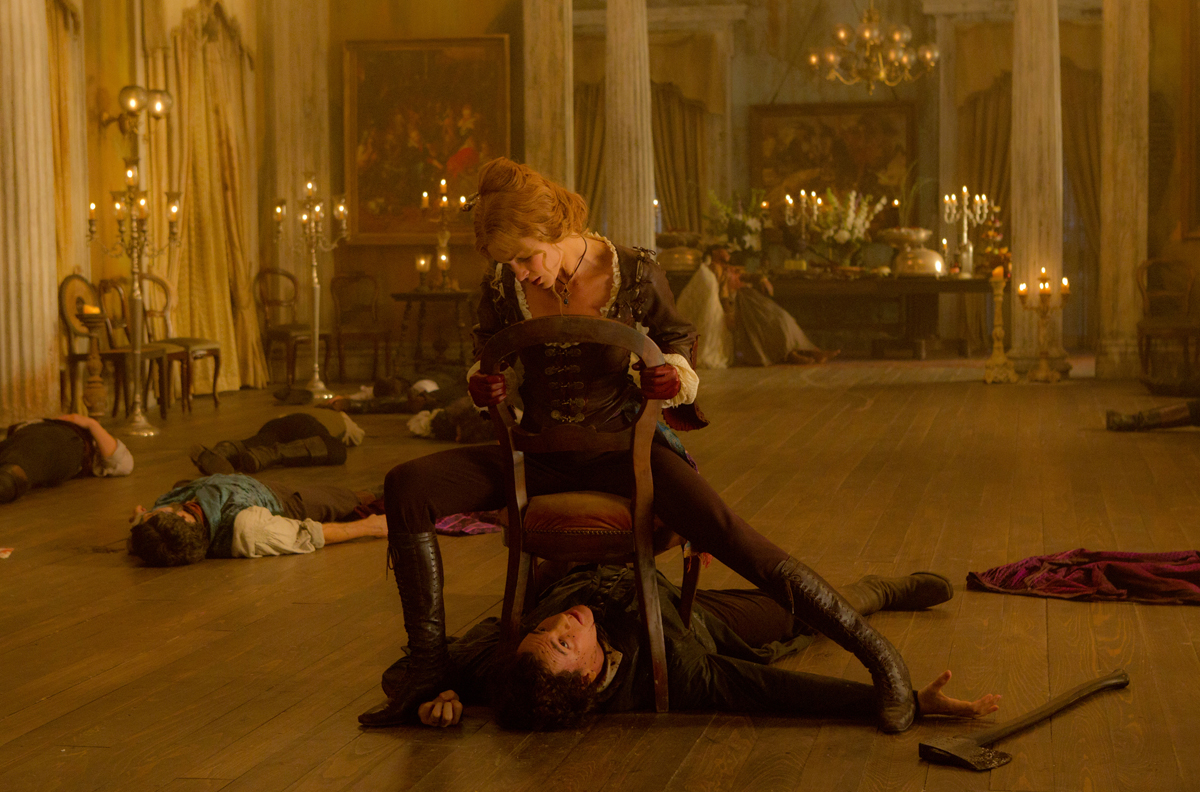
Abraham Lincoln: Vampire Hunter, like Snakes on a Plane, tells you everything you need to know about it in the four words comprising its title. Timur Bekmambetov’s film gains or loses an audience based on how cool one perceives the sight of Abraham Lincoln chopping down wave after wave of CGI vampires down with a silver-lined ax as being. Whereas Snakes on a Plane suffered from bowing too much to the internet meme culture that got so much from the movie’s premise that they didn’t feel the need to see the actual film, Abraham Lincoln: Vampire Hunter is so dry and mirthless one wonders what the point is. Dour films about CGI bloodsuckers are released two at a time. One featuring a kick-ass, kung-fu president almost can’t help standing out among the crowd. Despite those easy expectations, Bekmambetov—whose Wanted neutered a comic book about a world overrun by Batman villains by becoming an uninspiring Matrix clone—does almost everything in his power to disappoint. In this, he succeeds. Read more
Forget, for a moment, that The Thing is a prequel/none-too subtle remake of John Carpenter’s 1982 The Thing, which was a masterpiece of latex and animatronics. The Thing, after all, was a remake of Howard Hawks’ 1951 The Thing From Another World, a McCarthian allegory for the secretly infectious capabilities of communism that had, at it’s source, the 1931 novella Who Goes There?, the elements of which have been mined again and again, often to rousing success. Yes, it’s moderately upsetting that, in a year where everything from Conan the Barbarian to Johnny English got a remake or a sequel, John Carpenter and Howard Hawks couldn’t escape unscathed, but if we want these things to remain sacred, we’re going to need to burn Hollywood to the ground. We can’t learn anything from that mindset.
Instead, let’s note how The Thing is representative of the nadir in American horror films, the product of some 30 years of devolution due to the mistaken belief that the isolation at the heart of terror wasn’t what moved viewers to the edge of their seats, but buckets of blood, focus-tested plot machinations and, oh yeah, ear-piercingly loud spikes in the music. All of these things happen in The Thing, to the point where it’s a relief when the film, already under the impression that everything old is new, moves into the kitchen of the besieged Antarctic research station, where the Thing stalks its prey as if it’d morphed into a velociraptor. For two minutes, it was nice be reminded that, yes, movies have the capacity for real fear.
Here, the discovery of an alien specimen and his (it’s never “her” in these instances) spacecraft below two miles of Antarctic ice is greeted with the sort of warm enthusiasm one expects from a classroom of bored students in the middle of a PowerPoint presentation. Kate Lloyd (Mary Elizabeth Winstead), an American paleontologist, is asked along on a mission to the site by Dr. Sander Halverson (Ulrich Thomsen), who is unnecessarily built up as an unethical, slightly villainous dude with designs on unending fame for “his” discovery. You’d think that a movie aiming to massacre a group of people one by one in ways grotesque wouldn’t need a bad guy beyond the monster, but The Thing wants us to root hard for the American girl and the pack of misfits surrounding her, so Halverson is first a headstrong jerk, then a floating head awkwardly photoshopped onto a CGI conglomeration of limbs, stingers, and teeth. It is hard to register even a blip of sympathy for the men and women trapped in Antarctica; no matter how much blood flies: The word “prequel” renders the whole story non-essential, no matter which scientist is the megalomaniac with a questionable grasp on the scientific method. In fact, The Thing makes a strong case for The Thing as it’s hero. After crash-landing and taking a 1,000 year powernap, his crankiness at being woken up by an electric drill is nothing short of understandable.
There’s really not much to discuss when it comes to The Thing. Winstead is able as the plucky paleontologist, and some of the scenes, under different circumstances, would have been quite tense. Most of the movie, though, is spent deep frying The Thing, or on second guessing party members who don’t quite understand each other. I’ve read that Winstead’s character was inspired by Ripley, from Alien, but that transformation doesn’t take place until the very end of the movie, when we’re good and ready to see the baton passed to Kurt Russell’s gang. The movie’s two most effective scenes happen right at the end. Unfortunately, they’re among the film’s most inconsequential.
That’s a small part of why The Thing, despite the fact that it is by no means a terrible movie, represents the nadir of American horror movies. I suspect a large part of my misgivings ultimately has to do with my inability to separate The Thing and The Thing in one major department: The special effects. In a movie like this, special effects do the heavy lifting. In 1982, The Thing set a high watermark for special effects, and everything in that movie is more visceral, more convincing than what’s on display here. Having read a review or two, there seems to be the consensus that special effects today are better than they were in the 80s because of the advancements in computer technology, which has effectively rendered whole segments of special effects making useless.
I think the people who say that the special effects are better now are wrong, for one big reason: Special effects aren’t special anymore. This has been the argument since the special edition re-releases of Star Wars, and while I appreciate the hard work and dedication that goes into rendering a monster like The Thing, I’m less impressed by the ability to point and click something into existence than by the effort exerted to make that thing exist in real time and space. You can argue that a filmmakers’ imagination is no longer shackled by physical or monetary restraint, and, to an extent, that’s true. But movies like The Thing were special because filmmakers like Carpenter refused to let what was possible get in the way of his vision. You give a team of guys a computer and no limits, and what do you get? A wriggling, incomprehensible being assembled from spare, gooey body-parts; a creature who looks incapable of even a facsimile of life.
But this is where we’re at now. We’re over-saturated and overstimulated. Instead of doing something new, George Lucas has spent the better part of a decade adding bodies into crowd scenes and erasing puppets from his film prints. Instead of making his debut with something new and original, director Matthijs van Heijningen Jr. has sucked the marrow out of something he idolizes, because old horror movies are the only ground studios are willing to allow new faces to tread on. And yet we, the audience, apparently clamor for more of this sort of thing, eating regurgitation after regurgitation, sometimes the regurgitation of a regurgitation. It’s like they see us, too, as The Thing, as if they’ve deemed us incapable of digesting organic material. Maybe they’re right.
Rating:
The Thing. Directed by Matthijs van Heijningen Jr. With Mary Elizabeth Winstead (Dr. Kate Lloyd), Joel Edgerton (Sam Carter), Ulrich Thomsen (Dr. Sander Halversen), and Eric Christian Olsen (Adam Goodman). Released October 14, 2011, by Universal Pictures.
As you may have guessed from the commercials, Scott Pilgrim vs. the World is about a guy named Scott Pilgrim who falls in love with a girl named Ramona Flowers who has something like seven evil exes who are all jealous enough of Scott that they’re willing to converge upon Toronto in an effort to kill him. What might not come across, at least not immediately, is that Scott Pilgrim is also a film about false, manufactured cool, being stuck in the ruts, and throwing off the post-collegiate slacker malaise that haunts more than a few 22-year-olds who spent school digging through crates of vinyl and rifling through the racks at Goodwill. It’s about life, man, which is a hard enough thing to capture on film, let alone a film whose source material is a series of graphic novels influenced by ADHD, 90s indie rock music, and old coin-op arcade games.
Luckily Scott Pilgrim (Michael Cera), aimless though he is, leads quite the life. He was once the member of a band who signed to a huge record deal the second they dumped him. The leader of that band was his girlfriend, now She Who Will Not Be Spoken Of. After a year’s worth of moping, Scott goes out with Knives Chau (Ellen Wong), a 17-year-old Chinese girl in Catholic high school who likes playing arcade games and talking Scott’s ear off about yearbook club and high school drama. Then Ramona (Mary Elizabeth Winstead) roller skates through his dreams. Then she shows up at the library. Then she’s at this party Scott goes to. Then she’s at Scott’s front door, delivering the CDs he’d ordered from Amazon.ca in the hope that she’d be the one delivering them.
Serendipity, right? One thing leads to another, Scott and Ramona end up going on a first date, and shortly thereafter, Scott is visited upon by the League of Evil-Exes, each member tougher and more powerful than the last. Things are more complicated than that, given the presence of a jilted Knives Chau, but a more detailed description of the plot is unnecessary.
Let’s go back to the themes. Jealousy. Heartbreak. Scott’s heart is broken by Envy. Scott breaks the heart of both Knives and Kim Pine (Alison Pill), the drummer in his band, the Sex Bob-Ombs. Ramona breaks the hearts of her seven evil exes, none of whom were terribly evil until Ramona, fickle of heart and hair color, dumped them. Scott tries to avoid Envy, believes that things are fine with Kim, ignores Knives. Ramona runs to Toronto to escape the seventh evil ex. None of this works though. Nobody is as oblivious as Scott, and Gideon (Jason Schwartzman) may just be legitimately evil, forcing erstwhile indie music acts to sell their souls and blowing off Scott as if sending six other guys to Toronto to kill him was no biggie.
By fighting the seven exes in a way that more accurately captures the spirit of a good fighting game than any film adaptation of a fighting game, Scott and Ramona are able to physically dump the ghosts that have been haunting them. Ramona calls her exes out for their shallow obsessions. Scott headbutts the guy Envy left him for so hard that he bursts into change. Scott learns about love and self-respect through bloodletting, the way one of Tarrantino’s heroes would, and laughs it off with his friends, the way the protagonist of a sitcom would. As for the poseurs? The guys who dress like pirates and don’t eat meat and hire a bunch of stunt doubles to look cool, sound cool, act cool? Next to Scott, their routine seems forced. Stale. Artificial. Presumably, they want Ramona to cement their status as the coolest guy from that period of her life. Presumably, Ramona is past the point in her life where cool matters, which is what makes Scott an attractive choice of boyfriend: He isn’t cool, and he doesn’t pretend to be.
Edgar Wright, who helmed the brilliant genre send-ups Shaun of the Dead and Hot Fuzz, simultaneously celebrates and takes the piss out of a generation raised by MTV and Game Boys by way of brilliant, colorful pastiche, veering from music video to romantic interlude to fight scene to Seinfeld, holding it together by moving at breakneck pace and not pausing to wonder at the details. It jumps from frame to frame like a comic book, capturing the most important moments and leaving the rest to imagination. The cast? Don’t worry about the cast. The cast is fine. Perfect. Unquestionable.
It is becoming exceedingly rare that movies this fresh, vibrant, and original are funded and produced by a Hollywood studio. Sadly, it is becoming even more rare that audiences, cowed by years and years of flavorless blockbuster movies, are willing to take a chance on something new and invigorating. Here is a movie that engages its audience, excites on all levels. If it doesn’t quite prove that video games are art, it proves that video games can at least inspire art. It goes ignored now, but once the dust has settled and 2010 is a distant memory, Scott Pilgrim vs. The World will find an audience that loves and appreciates it as much as it deserves. See Scott Pilgrim, America, then see it three more times. Consider it karma for the millions you’re going to shower on Transformers.
Rating:
Scott Pilgrim vs. The World. Directed by Edgar Wright. With Michael Cera (Scott Pilgrim), Mary Elizabeth Winstead (Ramona Flowers), Ellen Wong (Knives Chau), Alison Pill (Kim Pine), Mark Webber (Stephen Stills), Kieran Culken (Wallace Wells), Anna Kendrick (Stacey Pilgrim), Aubrey Plaza (Julie), Chris Evans (Lucas Lee), Brie Larson (Envy Adams), Brandon Routh (Todd Ingram), and Jason Schwartzman (Gideon). Released August 13, 2010, by Universal Pictures.