Over at The Analytical Couch Potato, I’ve written an essay about Louie, which, for my money, is the best show on television. It’s a minor pity that FX and Louis C.K. have announced that the show will not be returning until 2014, but hopefully its year-plus hiatus will give C.K. a chance to reenergize his batteries (while simultaneously touring the country with a new stand-up show) and give the show an opportunity to build its audience Arrested Development-style, via discovery on Netflix.
On my end, Louie‘s extended hibernation will give me an opportunity to experiment with the television recap form, and for a television show that’s actually still relevant. Starting next week, Fear of a Ghost Planet will begin offering weekly re-caps of Louie and Arrested Development in preparation for the return of both shows, WWE Monday Night Raw and Parks and Recreation because both shows are currently on the air, and 1966’s Batman because I feel like it. Here’s a snippet of my ACP article on Louie. A link follows.
In 20-minutes, Louie sees his daughters off, declines an invitation to visit his sister, meets an old flame, watches her die, and visits China because, when reading a book to his daughter, the two agreed that the Yangtze River would be a nice place to live. That’s a gross oversimplification of an episode that manages to contrast both the joy of children on Christmas with the agony of the parent who gives all credit to Santa Claus and the joy of a group of hospital employees when the clock strikes midnight on New Year’s Day with the agony of someone who has just witnessed an acquaintance die, but Louiegoes places—literally and figuratively—most comedies would be unable to locate on a map. Those turns are often dark and almost always absurd, but the leaps of faith Louietakes routinely reward the viewer. When a regular comedy goes for a big, sentimental cliffhanger, it feels cloying. When Louiegoes for one, there’s a sense of relief. The world hasn’t crushed the poor bastard yet.
At times, last night’s episode of WWE Raw felt like it was being piped in from several alternate universes, which, I suspect, is just the nature of the “family reunion” style of show the company is fond of putting on when it meets and eclipses certain milestones. If, like me, you have an oddly (sadly) precise memory for the goings-on of World Wrestling Entertainment, things like the Degeneration X reunion—which saw Triple H and Shawn Michaels join forces with X-Pac and the New Age Outlaws for fifteen minutes of passable, PG jokes about how old the quintet has become—are head-scratching affairs due to giant, gaping holes in continuity. Yes, the Triple H/Shawn Michaels configuration of the group wore the same t-shirts as the Triple H/X-Pac/New Age Outlaws iteration, but Michaels had considerable beef with those dudes once he was ousted from the group, and said beef was never satisfactorily resolved. (more…)
Every year, it’s the same thing: Somebody is tapped to play the Super Bowl halftime show, and everybody hates it. While it’s true that you can’t satisfy everybody, in the Internet age, the noise people make about a 15 minute chunk of a four hour spectacle devoted to men making more money we can dream of and the cars only they can afford to drive is nothing short of deafening, almost willfully looking over the following facts:
It’s a free, fifteen minute concert.
The artist involved has to pare down years of hits into this frame of time, rehearsing snippets of songs in new configurations and, depending on what kind of music the artist does, structured around a million-plus dollar sound and light show involving hundreds (if not thousands) of people the band has never worked with before, dance moves that will be learned and promptly discarded, and, in a post Janet Jackson world, wardrobe changes that reveal nary an inch of flesh.
The nature of the Super Bowl dictates that only acts as huge and overblown as the Super Bowl itself get to interrupt the near constant stream of E*TRADE baby, Coca-Cola polar bear, and Budweiser Clydesdale ads that interrupt the announcers, desperately trying to insist that a) the game is why you’re tuned in and b) the game is as great as all the other Super Bowls, perhaps even better.
Madonna, by any reasonable standard, did well at halftime last night, but my opinion is essentially meaningless because I’m a Madonna fan and because, as somebody who obsesses over the past, my brain carries faint flickerings of the Aerosmith/Britney Spears/N*Sync three-headed monster that once constituted the evenings brief respite from heavily padded gladiatorial combat. For many, I suspect that Madonna will rank among that halftime show (and, indeed, the Janet Jackson one) as a great misfiring from the home office, the NFL not understanding what “football music” is.
Before anybody calls that crowd sexist, those same people, given “football music” (I assume Bruce Springsteen and The Who qualify) find another way of complaining, claiming that those acts are simply “too old.” It doesn’t really matter how good (Springsteen, Prince, etc.) or bad (The Who) a halftime show is; we only watch it to complain. If that’s what we’re going to do regardless of who plays, the NFL and Bridgestone Tires should do away with all pretenses of entertainment and just do what they did in 1989: Run out the most awkward, depressing act they can find, and present the whole thing as part of a themed night, bringing together the magic of television, advertisement, and showmanship.
The modern Super Bowl era started in 1991, when New Kids on the Block performed their tribute to 25 years of the Super Bowl. Before that, the event came and went with little fanfare. Marching bands performed tributes to Duke Ellington, and something called Up With People performed four times a record only Justin Timberlake, Aerosmith, and the Miami Sound Machine come close to matching.
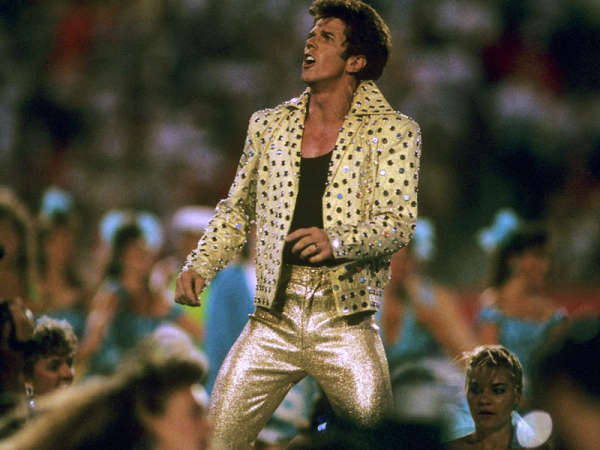
The transition from one era to the next was marked using the only technology that made sense: 3D. In 1989, the world was to be ushered into the future. Coke promised the world the first 3D commercial, giving away free 3D glasses at convenience stores, and, tying in to this auspicious occasion, the NFL presented “Be-bop Bamboozled,” a singing, dancing tribute to the 1950s, featuring Elvis impersonator and magician Elvis Presto, who would attempt the world’s largest card trick, in three dimensions!
Make no mistake about it, the Presto idea was a terrible one. In the middle of a great game between the 49ers and the Bengals, Presto took the stage and sung exactly zero Elvis songs, likely because nobody was much interested in paying the rights fees needed. The “card trick” itself was about as gimmicky as possible, too, with Presto attempting to guess the card underneath the seats at Joe Robbie stadium via the time-tested applause-o-meter. Though he doesn’t notice it (and despite YouTube footage being too grainy for a good look in 2012), Presto failed to guess correctly. Having been apart of a few card stunts myself, I can tell you exactly why: There are always a few thousand assholes looking to make somebody look like an idiot. Here, for the record, is the entirety of that halftime show, complete with the Diet Coke commercial:
Granted I was one at the time, but I suspect the reaction to Be-bop Bamboozled was such that America needed two decades of recovery in order to accept 3D again. The Diet Coke ad proved, twenty years ahead of its time, that 3D was an unnecessary gimmick, and Elvis Presto faded into obscurity. The best part of this show, other than that some firm named “MagicCom” was once affiliated with the now unavoidable marketing giant that is the NFL, is Bob Costas making fun of the whole thing, distancing himself just enough so its stench doesn’t cling to him.
But this is the way halftime shows were, largely because, in 1989, we were foolish enough to believe that the Super Bowl was about football. Sure marching bands were often involved, but before New Kids on the Block set the precedent we’ve been living with for 22 years, halftime shows were either an awkward pageant put on by a charity, or an awkward magician doing his best to entertain an unimpressed crowd.
In Elvis Presto’s world, Nipplegate is no longer possible, the biggest bands in the world make due not playing free concerts, and internet dweebs debate the merits of “football magic.” This, obviously, is what we should go back to; awkward shows actually worthy of derision. It might not be the Super Bowl halftime show America wants, but it’s clearly the one America deserves. Madonna, she did good last night. Historically great, given the majority of the competition. If Super Bowl viewers are really that offended that a woman gets to do the halftime show once every ten years, they deserve a lifetime of Presto, Up With People and Paul McCartney’s “Freedom.” Then they, like the city of Detroit when saddled with Nickleback, will know the true meaning of suffering.
It’s a little late to be writing about It’s the Great Pumpkin, Charlie Brown, but, like A Nightmare Before Christmas, the film that uprooted the Great Pumpkin from its place as Halloween TV event de rigueur, Charlie Brown & Co. are better after the holiday they’re meant to celebrate, once the hype has gone down and the world settles back into its routine. As much as Great Pumpkin is about the madness of candy-high children, its true focus is the agony and ecstasy of anticipation.
Forget about Charlie Brown for a minute. It’s the Great Pumpkin, Charlie Brown is all about Linus. Linus and his security blanket. Linus and his undying faith that there is a Great Pumpkin and that his pumpkin patch is the most sincere, the most worthy of the Great Pumpkin’s attention. There’s something bittersweet about Linus’ belief in the Great Pumpkin. He only comes from the pumpkin patch that is the most sincere. Presumably, he only gives presents to the good boys and girls in the area immediately surrounding said sincere pumpkin patch. The rules Linus drafts for his holiday deity are decidedly low-key, rigid in their lack of true wonder. In the letter he writes to the Great Pumpkin, the only thing he asks is that the Great Pumpkin not tell him he’s a phoney if he indeed is one. The other children make fun of him because they believe in Santa Claus, a gift-giver with better publicity, but his disappointment on November 1st is a slightly magnified, slightly more existential problem than the one they’ll face on December 26th: Not only does Linus get nothing on Halloween (as opposed to maybe not getting everything on a Christmas list), but every year Linus waits in his pumpkin patch, staring down the reality that his sentient pumpkin doesn’t just fail him, but might not exist.
Linus-as-everyman is overshadowed tremendously by Charlie Brown, and it’s not hard to understand why. Here, as he does in every TV special and once or twice every fall in perpetuity, he tries to kick Lucy’s football, having been presented a signed (but not notarized) document promising that it will stay put. The confidence in Charlie Brown’s approach is heartrending–“This year, I’m really going to kick that football!” might just be one of the most hopeless sentences the English language can muster. It seems like Charlie Brown only gets one chance every year to kick that football, and that he’s never going to find out if he’s any good. That scene seems to have been added outside It’s the Great Pumpkin, Charlie Brown‘s larger plot, a greatest hit added to please a fanbase always ready to laugh at poor Charlie Brown, but he fares no better on Halloween. He is invited to a party by mistake. He can’t make a proper ghost costume. He gets nothing but rocks when he goes out for trick or treating. We laugh at Charlie Brown, but only because we so deeply identify with him.
“I don’t mind the dishonesty half as much as I mind your opinion of me.”
But, compared to Linus, Charlie Brown is the king of the world. He ruins Sally’s Halloween, stays out in the pumpkin patch all night long, and is eventually dragged inside by his put-upon sister. Linus isn’t the Peanuts’ magnet for sympathy, but here, his connection to the viewer is deeper than most cartoon/comic strip characters ever achieve. Standing on the bridge with Charlie Brown, he vows that the Great Pumpkin is real, that he’ll come around next year, that we’ll all see what he’s talking about. Linus is the bum year, the bad holiday, the lost bet, the believer of absent gods. Charlie Brown may be us at work, at school, in public, but Linus is who we are at home, in private, doors shut and windows shuttered. We continue to believe in the ridiculous, and there is always, always next year.
For It’s the Great Pumpkin, Charlie Brown to work as holiday TV, it needs to have sweetness at its core, and that sweetness is Linus’ unending faith, naive and unshakable. The Peanuts, popular as they were (are?) with children, were never really a commentary for or about them, but about adults, seen here dropping rocks into Charlie Brown’s bag, and adult lives. The Peanuts lead their lives largely without the influence of anybody older than them, and, precocious as any of their actions or beliefs are, they largely mirror our own. Life tells us to stop believing in the impossible. Life pulls the football away when we go to kick it. Life gives us rocks. We continue to go trick or treating. We keep waiting in the pumpkin patch. We hope ours is the most sincere.
* America is currently obsessed with her shameful pop-culture past, reviving everything from Charlie’s Angels (TWICE) to Polly Pocket. Bring It Back humbly suggests bringing back these formerly hip fads, zombified and ready to destroy culture.
Before we start, yes, I know that there’s a thing called Monster Jam, and that it technically is run by the United States Hot Rod Association. I went to a monster truck rally in January and, shock of shocks, it was a lot of fun. But, sadly, it wasn’t the sort of fun I had as a kid. No quad racing, no dirtbikes, no 30-foot tall car-eating metal dinosaur. Just giant trucks, racing in a circle. Cars were only smashed on accident at Monster Jam, and this logo, like Bigfoot (the truck), had vanished:
That logo tells you everything you needed to know about the USHRA: As an outfit, they were only about victory, America, and giant goddamn tires. Like a huge, automotive circus, the USHRA traveled from NFL Stadium to NFL Stadium in the 80s and 90s, doing everything and anything to get people into a seat. Didn’t like monster trucks? They had dirtbikes. Not a fan of dirtbikes? There’s a dude sitting on a lawnmower that’s got a rocket strapped to it–go watch him. A veritable orgy of motors, trucks and machines, the USHRA should be brought back onto our television sets the way God intended: Big. Bad. Bold. (And possibly on VHS.)
I know what you’re thinking: Those bikini clad chicks are lip-synching the words “big,” “bag,” and “blow,” which probably marks its decade much better than pointing out that this is one in a seemingly endless series of pro-athlete music videos that ripped off the Super Bowl Shuffle. And yes, that is America’s heavyweight wrestling champion Sgt. Slaughter pretending to play a Budweiser guitar. You astute viewers may even notice that the tape is nearly worn-out where one of the women, demanding a big bag of blow, polishes a chrome pipe. Based on this video, why should we bring back the United States Hot Rod Association?
Because it’s in our blood. Because TV has been missing something since things like the Wide World of Sports went off the air, and having a variety hour dedicated to giant machines and rednecks smashing things up while scantily-clad, questionably attractive women shake their moneymakers seems like a good remedy for what ails us as a people. I, for one, can’t help but feel an enormous swelling of pride as a funny car pulls a tractor loaded with giant Budweiser cans down a quarter-mile of sand, nor can I help but feel it when the tape’s narrator proclaims that Bigfoot has saved the day…from another man driving a smaller truck. The glory days of monster truckin’ were not all that much unlike those of pro-wrestling, and that’s what needs to come back. I want pomp and circumstance. I want mud-bogging, sand-dragging, quad racing, dirtbike jumping and Truckasarus.
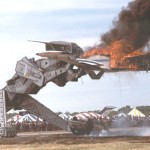
Truckasarus needed to be on my TV yesterday, preferably instead of MANswers or the day’s third repeat of A View to a Kill. If the relaunch of Motor Madness is successful, Truckasarus could be given a spin-off sitcom where he works as a mechanic despite his unending hunger for nuts and bolts, and that would be great, too. In addition to Truckasarus, monster trucks should be given a sense of character again. Yes, Gravedigger and Monster Mutt (a truck with big, floppy ears) exist, but there’s no real sense of rivalry amongst drivers or cars anymore. Before this year, the last Monster Truck rally I attended had Gravedigger, trucks modeled off of Hulk Hogan and Bill Goldberg, and Bigfoot. And Truckasarus. I can chant all day for Bigfoot, but I’ll be damned if you catch me screaming my head off for Tom Meents, driver of Maximum Destruction, because I don’t care about the driver. In the battle of Man vs. Machine, the machine has more charisma.
Speaking of Bigfoot, he hasn’t competed in USHRA events since 1998. Along with bringing the USHRA back to its former prominence, bring back Bigfoot and tear a page from pro-wrestling by selling me the story of Bigfoot trying to regain his supremacy in vehicular thunderdome after 13 years in the minor leagues. And if you want to bring in the human element, that’s fine. Book a man vs. machine angle, where men and women compete against the dominant monster truck in a deadly game of tug-o-war. Sgt. Slaughter will demonstrate how this works:
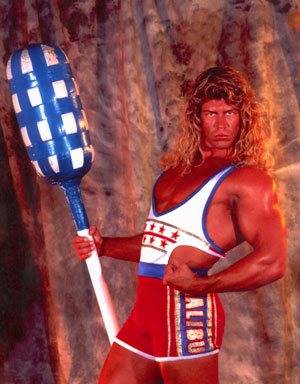
Granted, you probably want something a little more exciting than what goes on here, but it’s been 27 years since Slaughter led his battle battalion to a draw against Big Foot, and we can do a lot better than unknowingly-flamboyant musclemen throwing their weightlifting gloves at Bigfoot’s driver.
This vs. Bigfoot would sell out arenas worldwide.
It’s time America got in touch with her (questionably) masculine past. Grow out those mustaches. Break out them socket wrenches. Scarf down some nachos. You may pay $15 for a seat, but my friend, you’ll only need the edge. Put the United States Hot Rod Association back on TV, the way it was meant to be. Everyday should feel like Sunday, Sunday, Sunday.

 Over at The Analytical Couch Potato, I’ve written an essay about Louie, which, for my money, is the best show on television. It’s a minor pity that FX and Louis C.K. have announced that the show will not be returning until 2014, but hopefully its year-plus hiatus will give C.K. a chance to reenergize his batteries (while simultaneously touring the country with a new stand-up show) and give the show an opportunity to build its audience Arrested Development-style, via discovery on Netflix.