Category: Film

  • Movie Review: Jupiter Ascending (2015)

    Movie Review: Jupiter Ascending (2015)

    Jupiter Ascending

    Calling Jupiter Ascending an original movie is perhaps disingenuous. While it is among those increasingly rare science fiction blockbusters that weren’t adapted from comic books, novels, video games, or television shows, it is, like Pacific Rim before it, a hulking labor of nostalgia for an incredibly specific genre of film, the technicolor fantasia of the space opera. A dazzling array of humans, aliens, and spaceships pass before the eye, each of them unique and carrying loads of often unexplained baggage, but there’s hardly one that doesn’t have a corollary in Star WarsStar TrekClose Encounters of the Third Kind, or something decidedly stranger, more off-beat. Andy and Lana Wachowski have always worn their influences on their sleeve, but here, with the gross domestic product of several small nations at their disposal, they are bearing their hearts, both of them glittering machinations assembled from the detritus of what used to be called nerd culture and what is now just culture. By making a film so decadent and doomed to failure, they seem to have laid claim to that tiny parcel of the collective imagination that is still yet unconquered by the spandex-clad horde.

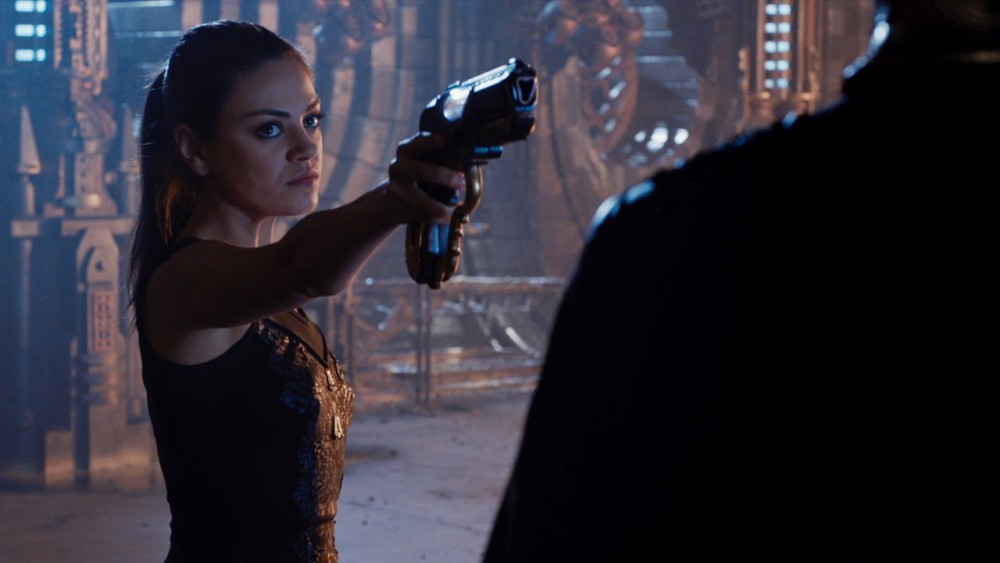
    None of this is to say that Jupiter Ascending is any good. In fact, most of it is very bad. An array of beautiful images crudely hacked apart and stitched back together in the editing bay, to describe any aspect of the plot here as presented is to sound like one is making assumptions of a very long film after catching the last five minutes on television. Here goes nothing. Jupiter Jones (Mila Kunis) is an undocumented Russian immigrant unsatisfied with her life cleaning toilets in Chicago. One day she is selling her eggs to a fertility clinic, which is surely a first in an action film. The next, she finds out that, through accident of birth, she is the exact genetic duplicate of the matriarch of clan Abrasax and the rightful owner of the planet Earth. This places Jupiter in the middle a family war between a hedonistic prince (Douglas Booth), an eternally young princess (Tuppence Middleton), and their ruthless industrialist of a brother (Eddie Redmayne), her only sure protection in the galaxy (which she will span in its vastness) being a soldier-turned-mercenary human/wolf/insect hybrid (Channing Tatum) first seen smelling her name on a sheet of paper at the clinic. There is a team of bounty hunters. There are little grey men. There are gigantic lizard men. There is the crew of the ship. There are robots and bureaucrats and the individual members of Jupiter’s family. All of them matter. Some are, it seems, audience surrogates, just as confused as we are about the world beyond our world that dances among the stars to an ancient song that can only be heard by those with access to its score.

    Luckily, the Wachowskis are keen to overshare. Large stretches of Jupiter Ascending exist just to fill in the details, coming so hard and heavy that even Jupiter, with her fate and the fate of the world on her shoulders, breaks down and says she doesn’t care about any of it. The other characters know so much and Jupiter so little that she frequently feels like a character without agency, falling for obvious ploys and needing constant rescue from Tatum’s Caine Wise, who has this neat trick where he is rescued from every conceivable deathtrap by the magic of coincidence and given all the credit. This is something of a disappointment, as Jupiter Ascending is, at times, nearly a Marxist, feminist manifesto shrouded by the glitter and doom of a summer blockbuster. Though doing so, I realize, is futile, I keep imagining Jupiter Ascending getting a summer release in a year that wasn’t overburdened with light, spectacle-driven sci-fi, having the billion-dollar success that was envisioned when the project was greenlit. Hundreds of thousands of men watch a woman struggle with the decision to sell her eggs, are enraged for her when her cousin negotiates a large cut of the profits. The working class grow angry with the film’s end boss, his speaking pattern belabored by a state of agonizing, near-constant orgasm as he lectures Jupiter about the need to convert humans into capital. A laugh is had as Jupiter negotiates the bowels of galactic bureaucracy with an over-taxed droid. A moment of silence is shared as a bottle of human goop—the liquid that allows the intergalactic ruling class their millennia-spanning lives—falls to the ground and is shattered.

    But I’ve mentioned a hoped for billion-dollar success, which spoils even my utopian ideal for the film. The larger engine at work throughout Jupiter Ascending is its naked desire for a sequel, the further adventures of Jupiter Jones in space or on Earth or wherever the focus group found itself most pleased. While my brain keeps twisting small moments in Jupiter Ascending into larger academic points (the CGI reconstruction of Chicago, just razed by a CGI spacechase, as a commentary on the vapid nature of such sequences, for example), the Wachowskis bumble about like Tobias Fünke, Yes, Anding themselves to the point of insanity. Jupiter is rescued from little grey men by a disgraced bounty hunter. Yes, and they fall in love. Yes, and their romance is complicated by issues of class. Yes, and there’s a marriage where one of the evil princes tries to marry an exact genetic replica of his mother. Yes, and that is spoiled by the bounty hunter, who was initially hired by the prince under the pretense that he would be reinstated to the military. Yes, and members of the military have wings! Yes, and, without his wings, the bounty hunter has these boots, these anti-gravity heelies that make it look like he’s tearing ass through the mall, even when his life is in danger. Yes, and, uhh, something about bees; an entire house covered in a honeycomb! Yes, and… uhh, wait, bees? Did you say bees? Yes! And, I dunno, maybe Jupiter’s scummy cousin buys a flatscreen TV?

    On and on and on, until the perfunctory action sequence brings us to the required Disney princess ending, which is some weird combination of The Secret and that old, classist pablum that one should be happy with what one has. Here, that means waking up at four in the morning to clean the toilets of the wealthy despite owning the deed to an entire planet, being okay with one’s place in a machine so large that even a Jupiter-sized refinery represents but one small cog within it. Recently, I saw a headline in my Google news feed that asked if Marvel could “save” the Wachowskis. Jupiter Ascending suggests not, as, despite its trappings, this is essentially their Marvel film, disguising the same mostly white, mostly male exceptionalism coded within the MCU with the same safe message that no, really, everybody can be special, the princess or the soldier (never both, and never something else). That’s a marketable idea, but not one the Wachowskis or their film seem to believe in. No, the heart of Jupiter Ascending, beating faintly under layer after layer of bloat, belongs to Terry Gilliam, sniggering maliciously as he affixes a rubber stamp to the deed that awards Jupiter Jones ownership of Earth. It’s a fine dream Jupiter has, of liberating her and her family. How easy, Gilliam’s appearance suggests, for that dream to become madness.


    Jupiter Ascending. With Mila Kunis (Jupiter Jones), Channing Tatum (Caine Wise), Sean Bean (Stinger Apini), Eddie Redmayne (Balem Abrasax), Douglas Booth (Titus Abrasax), Tuppence Middleton (Kalique Middleton), and Terry Gilliam (Seal and Signet Minister). Directed by Andy and Lana Wachowski, from a screenplay by the Wachowskis.
  • Movie Review: American Sniper (2014)

    Movie Review: American Sniper (2014)

    American Sniper

    There are other movies out right now—better ones, too—but I chose to see American Sniper because it is the film everybody has an opinion on right now, and I guess I felt like I needed to formulate one of my own. The memoir that this serves as an adaptation of is likely something I will never read, so I can’t comment on Clint Eastwood and screenwriter Jason Hall’s ability to bring Chris Kyle’s story to the screen as Kyle told it. I know that he uses the word “savage” to describe Iraqis, and I know he later falsely claimed to’ve punched out Jesse Ventura at a bar for mocking veterans. I also know that Kyle said he was responsible for more kills than the Navy SEALs will confirm, and that the government parked him atop the Superdome in New Orleans during Hurricane Katrina, where he allegedly shot and killed “dozens” of American citizens. I don’t know Chris Kyle, but he sounds like a complex, flawed, dangerous fraud, the fabled Good Guy with a Gun who exists only in the collective fantasy of the American right whose life is worth reflecting upon as a means of deconstructing such myths. Clint Eastwood, however, is not the man for such a job. A man who is given to lecturing invisible Barack Obamas on the significance of America and her ideals, Eastwood sees his protagonist as a man wearing a white hat though stranded on a black sea. The war isn’t just something that happens; it’s something that happens to him. Kyle’s story, in the hands of a director more interested in the fact of a hero than his psyche, is as complex as a bologna sandwich.

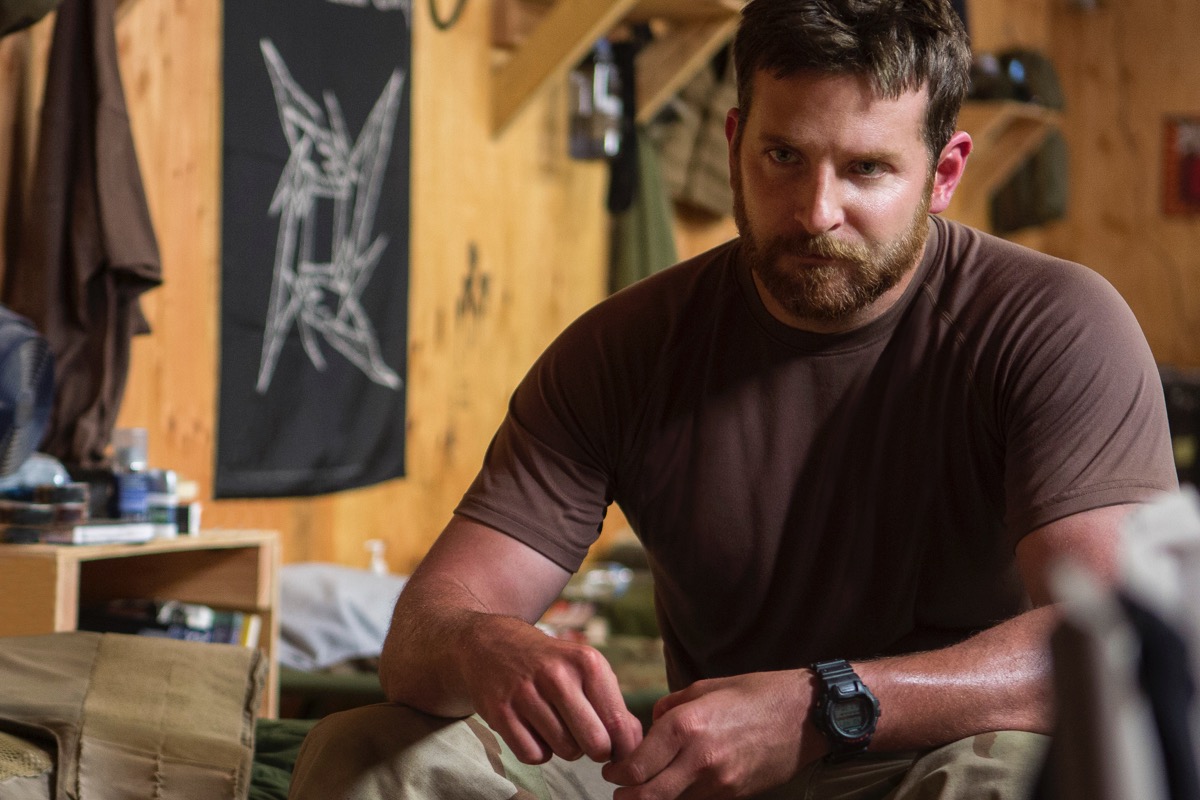
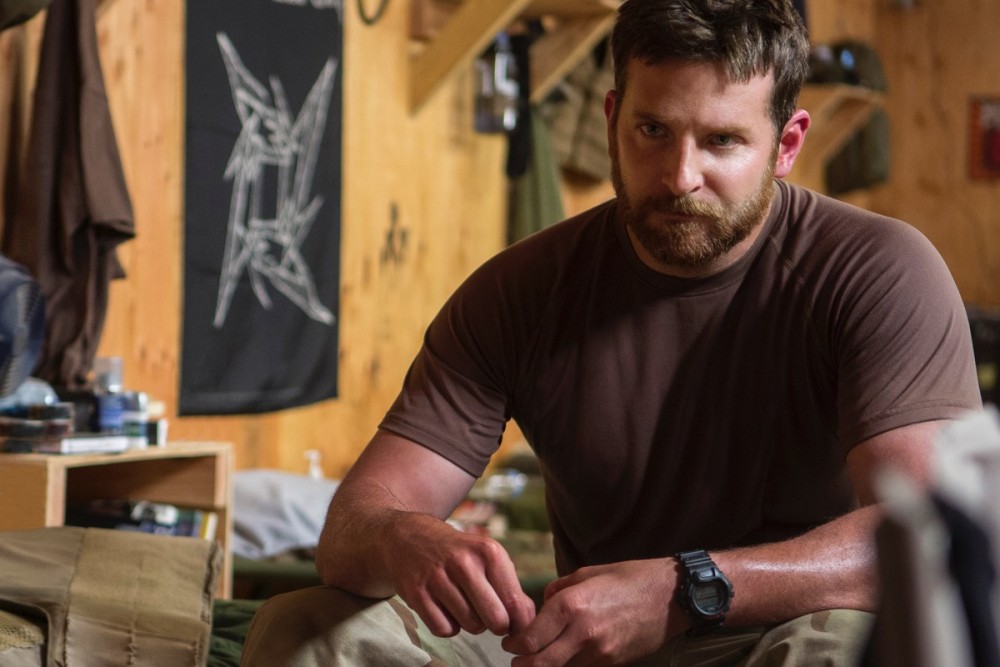
    American Sniper, rather than linger in the details or fret about the larger implications of what Chris Kyle (Bradley Cooper) does for a living, is largely desensitized to the brutalities he perpetuates and has perpetuated upon him. Exactly one kill shown here has any weight, his first, and that is largely because, as cut for the trailer, it’s a rather compelling microfilm about the weight of one’s choices. That the choice being made here is a white man’s decision to kill or not kill an Arabic woman and her son is shown to be largely irrelevant—it’s not how Kyle imagined his first time pulling the trigger, but he stopped a pair of suicide bombers from wiping out a patrol of Marines. Mission accomplished, end story.

    Between his placing a finger on the trigger and his pulling it, there’s a rather lengthy bit of exposition explaining the kind of person Kyle is. In short, he’s a red-blooded American, an honest-to-God cliché. He loves his country and he loves his woman. The first three images of American life shown in this film involve hunting rifles, bibles, and a football. The suburb Kyle grew up in is shot as beige and featureless as the Iraq he will later occupy. He has sex with the woman who will become his wife (Sienna Miller) and wakes up to live footage from New York City on September 11th, 2001. Both the sex and the act of war inspire Kyle to get better at his job. He says he’s protecting his country. He says his country is the greatest on earth. It’s all been said before, but Chris Kyle is a real man with a real (if embellished) record, a soldier whose funeral filled a football stadium, so coming from the actor occupying him, I suppose all of that’s supposed to lend the script’s bumper sticker platitudes the kind of gravity repeated sequences of bodies spasming, geysering blood, and collapsing dead just can’t earn these days.

    Given a relatively straightforward script and Eastwood’s by-the-numbers direction, Bradley Cooper isn’t exactly taxing himself as Kyle. Without the real man’s penchant for dehumanizing language, all Cooper has to do is set his jaw firm and speak with a slight drawl. Even when he’s under fire, taking shots from elite enemy snipers—one of whom is described as a former Olympic medalist fiercely loyal to bin Ladin—Cooper’s Kyle doesn’t seem too stressed. His wife can hear gunfire and other soldiers shouting over their cell phone connection, but Kyle always seems to be a readjustment away from leaving the battlefield with his life and a few more notches on his belt. When a sandstorm kicks up over a late-film op, it’s merely one more shade of beige.

    Plenty has been made of the fake babies used to simulate Chris Kyle’s newborn children, which betrays that there’s really not much to American Sniper that’s worth discussing. There’s the political angle and the race-baiting of Kyle’s memoir, but Eastwood seems decidedly uninterested in why we’re at war and what Kyle thinks of the people he is shooting. That’s a problem perhaps, but one of adaptation and not morality. It’s been impossible to log in online without seeing dozens of tweets from morons who saw this film and said how it made them want to kill Arabs, but I suspect the folks responsible for those missives harbored their racist feelings before seeing American Sniper, just as I suspect that the editors responsible for publishing those tweets on every website that leans even slightly left know that morons on Twitter draw a lot of clicks. But I’m a white guy myself, and all I know about movies like this is that it takes a really good one or a really offensive one to get my attention. That’s a failing on my part, I know, but I thought I was going to leave this film convinced of its evils. Instead, I’m at something of a loss. What this film should have done with its subject matter is a matter for debate until the next film about war during the Bush presidencies is made. What it did, however, is nothing.

    American Sniper is further evidence that Eastwood is continually regressing as a director, or that time has finally passed him by and is no longer as interested in the merits of American muscle as he is. I don’t think that filmmakers are necessarily obligated to create pictures that take a hardline stance on the War on Terror, but that this is the story Eastwood has chosen to present as a somber occasion set to taps is disingenuous to all parties involved, including Kyle. Cooper plays him as a man who is somewhat uncomfortable with his notoriety, but Eastwood is set on making him a paragon. So be it. There are better films about this war out there, and still more yet to be made. In terms of fiction, Kathryn Bigelow’s The Hurt Locker and Zero Dark Thirty diptych remain the best place to start.


    American Sniper. With Bradley Cooper (Chris Kyle), Sienna Miller (Taya), Luke Grimes (Marc Lee), and Kyle Gallner (Goat-Winston). Directed by Clint Eastwood from a screenplay by Jason Hall, based on the memoir American Sniper by Chris Kyle, Scott McEwen, and Jim DiFelice.

  • Movie Review: The Interview (2014)

    Movie Review: The Interview (2014)

    The Interview

    I watched The Interview on Christmas. I was alone, away from my family on the holiday for the first time. But even had I been in Detroit with my mom and my sister, I probably would have seen The Interview, because we’re bad Catholics and non-Catholics, my family, and once the Christmas portion of Christmas has concluded, we venture out to the multiplex to see whatever’s playing. Of course, the big deal about The Interview is that it wasn’t playing at so many multiplexes, yanked from the slate of Christmas releases by fear and paranoia that North Korea, the supposed perpetrator of the cyberattack that so hobbled and embarrassed Sony Pictures, might up the ante by bombing any theater that dared screen the film. The Interview stopped being a Seth Rogen/James Franco comedy and became a free speech issue. It was one of the highest rated films on IMDB, a constant source of Facebook chatter, and an issue large enough for President Barack Obama to voice his displeasure over. It became our duty, as Americans, to see this dumb movie about dumb people attempting to assassinate a dumb dictator. Or it was our duty, as Americans, to remind other Americans that it was nobody’s duty to see anything.

    Well, I saw this movie. I saw it on Christmas, as I said, and I read a number of very good articles about why The Interview, as a bastion of free speech, was problematic at best. I also saw Seth Rogen reply to earnest, well-intentioned, well-written criticism of an otherwise forgettable film by pouting and tweeting “Go fuck yourselves” at websites like The Verge. All of it seemed surreal and stupid, and I felt pretty good about my decision to not write about The Interview because it is a very dumb movie, which is fine because it had no aspiration to be anything else, at least not until the rest of the world started to address it as a capital-I Issue. Watching this movie with my dog curled up in my lap, I felt very ill-prepared to talk about The Interview as an Issue or as a misfire by a comedic team whose work I frequently enjoy. I feel very ill-prepared now, but I will try, I suppose, to say something.

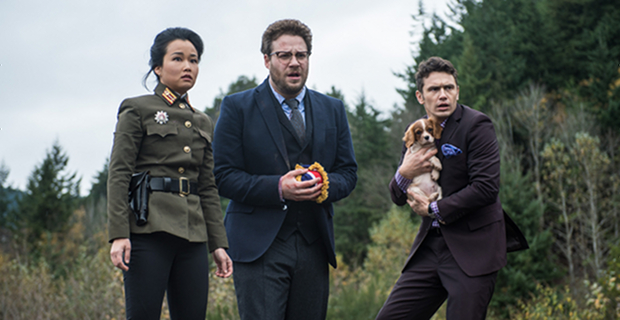
    The particulars of The Interview are common knowledge, but here they are: David Skylark (James Franco) is the host of Skylark Tonight, a popular-but-empty Hollywood talk show on the order of Extra or Entertainment Tonight. Still, he has an uncommonly good rapport with his guests. Rob Lowe is willing to come out as bald on his show, and Eminem tells the world that he’s gay like it’s no big thing. This is big money stuff in entertainment journalism and “real” journalism, which are often the same thing, but Skylark Tonight is looked down upon by more respectable media establishments, and this eats at its producer, Aaron Rapaport (Seth Rogen). When the two hear that North Korea’s Kim Jong Un (Randall Park) simply loves Skylark Tonight, they drunkenly send a flier out to his camp to see if he might want to appear on the show, lending them the serious journalistic credibility Rapaport has always wanted. When it turns out that, yes, Kim Jong Un would like to appear on American television, they are roped into a CIA plot to assassinate the dictator, thus liberating the state from the tyrannical reign the Kim family has long enjoyed.

    To Rogen and co-director/writer Evan Goldberg’s credit (I suppose), The Interview pays lip service to the idea of America as an agent of democracy, and to Hollywood’s interest/involvement in traumatic global crises. It also stands firm and states that enjoying margaritas does not make a man gay. Beyond that, however, and beyond whatever pleasure there is in the notion of riding around in a Soviet tank that is blasting Katy Perry’s “Fireworks,” The Interview seems content to laugh at North Korea from a safe distance, taking the same shots at the country, its leadership, and its people that the American media has taken for decades. Part of the hysterical response to the Sony leak, I’m convinced, was the latent fear that an aggressive, fear-mongering country might not be the hapless cartoon our own media built in the collective consciousness.

    The-Interview-Franco

    If North Korea is responsible for the Sony leak, and if they did it in response to this film, that ultimately changes nothing about its merits, which are few and fleeting. Having journeyed far and wide with their bro comedy tropes, from high school to the apocalypse, Rogan, Franco, and Goldberg elevating them to an international stage doesn’t suddenly validate their material. Rape jokes are rape jokes. Gay panic is gay panic. Asian stereotypes remain Asian stereotypes. In any other context than the one conjured up by the hacking of a multibillion dollar entertainment company, all of this is obvious. I’m not saying anything new here, I know, but I feel like I need to repeat this in my own voice, to hear how it sounds coming from me.

    The Interview is an issue of free speech because it is a film created by straight, white men at the expense of an oppressed people who do not have the right to free speech. This film is an issue of free speech because it is easy for us, as a nation dominated by straight, white men, to look at something like the release or censure of a stoner comedy produced and made by millionaires as a test of our moral turpitude, to see whether or not our country will stand up to a menace whose only definition, for the majority of us at least, is that it is not-white in origin. This film is an issue of free speech in the same way that, say, erecting a “Pants Up, Don’t Loot” billboard is an issue of free speech, only many of us decry the billboard because the trauma it mocks is local while The Interview is quite harmless because it’s only North Korea, whose traumas aren’t even ours, let alone local. So we stood up, valorized this movie and those who made it, spent weeks rallying around the flag. That it was pig-headed and frequently racist wasn’t an issue. This was an American movie, and it was our right as Americans to see and forget about it in any fashion we chose.

    Sure. I agree. And I also agree that this film should have been released as originally planned, in as many theaters as could be booked to play it. That The Interview came, went seen or unseen, and slipped quietly onto home video would have been a blessing. Circumstances dictated that we were to be given something else on Christmas, something precious and in need of protection. That’s fine, too. But now we’re in a situation like 2012, when we spent the summer debating whether or not it was okay for victims of rape to be offended by rape jokes, or right now, when we’re blindly posting Jui sui Charlie on our Facebook walls as if it’s impossible for a progressive publication to also be horrifically racist. Soon, we’re going to have to come to the realization that the “free speech” we’re so thoughtlessly protecting is only free because of its gender, race, and class status. But that requires thinking inwardly. It requires a satire willing to punch upwards instead of at those who are already down. Finding someone who supports the idea of satire is easy. Where are the people who are dedicated to making it?


    The Interview. With James Franco (David Skylark), Seth Rogen (Aaron Rapaport), Lizzy Caplan (Agent Lacey), Randall Park (President Kim), and Diana Bang (Sook). Directed by Rogen and Evan Goldberg, from a screenplay by Rogen, Goldberg, and Dan Sterling.

  • Movie Review: Life Itself (2014)

    Movie Review: Life Itself (2014)

    Life Itself

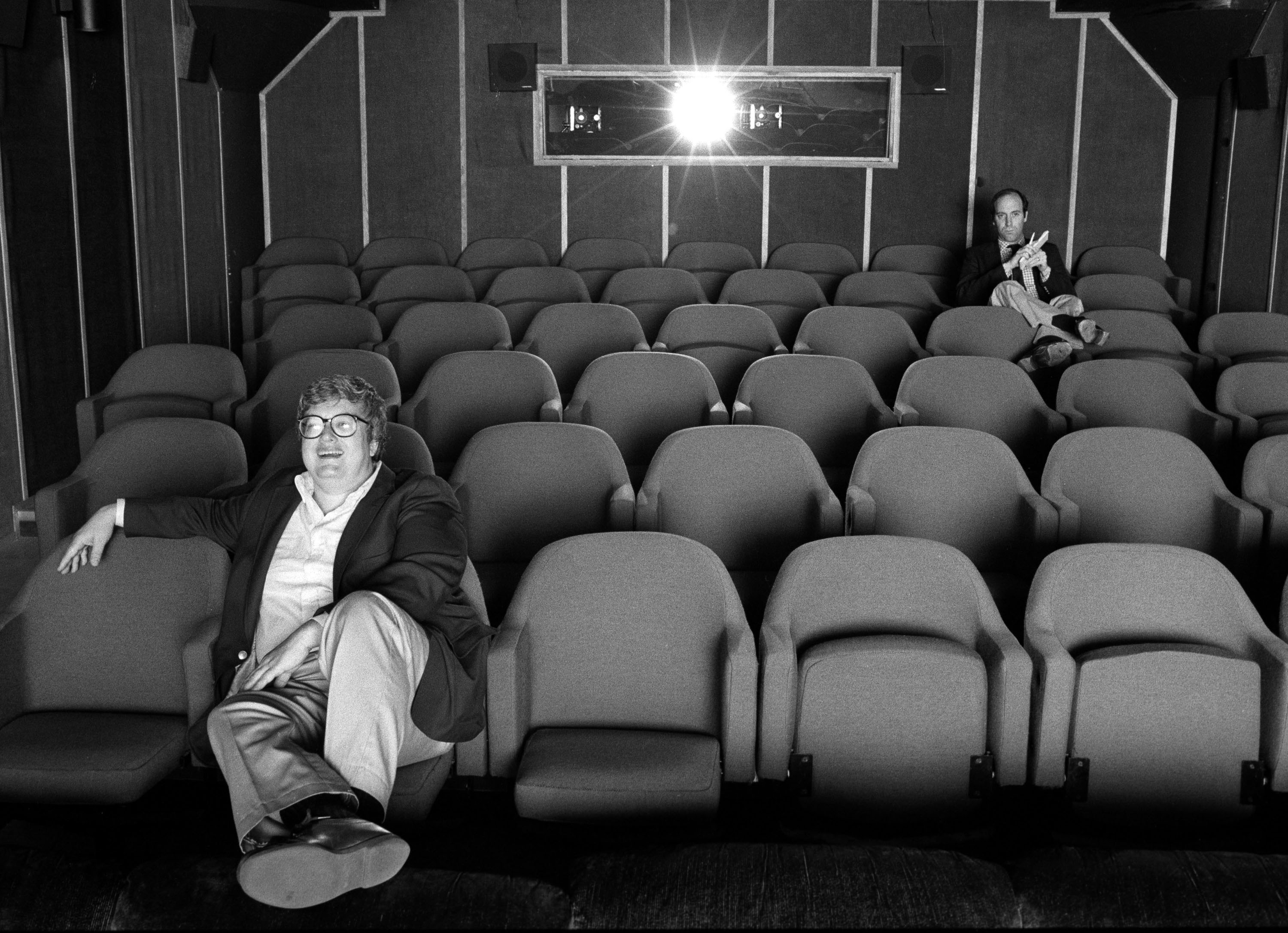
    essentialI’ve been avoiding Life Itself for a long time, as a book and as a film. A paperback copy of Roger Ebert’s memoir is there on my coffee table, between my chair and the screen I watch movies on. I know that cover intimately: The red velvet of the movie theater seats, his black silhouette before an endless screen that could not exist in any reality but one liberally embellished by the mind. I’ve seen movies in the same theater as Ebert, eaten a meal in the same room as him, too. In this documentary, Time Magazine‘s Richard Corliss says that Roger Ebert had been writing about film for half of its existence. He’d been writing about film for the whole duration of my life, was a fixture on T.V. every Friday. He’s been part of my life as a filmgoer and as a writer for as long as I’ve seriously been either of those things, and yet Life Itself loomed ominously, its mere existence a threat. But to what, I wondered, pulling myself through Steve James’ documentary.
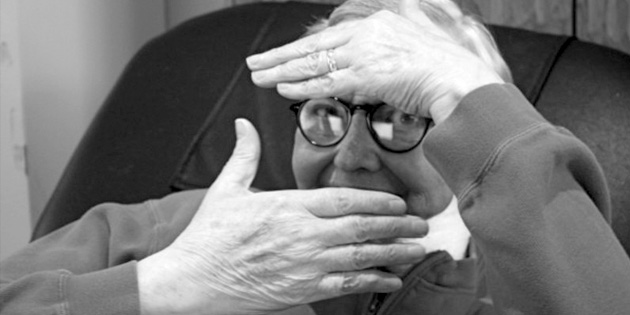
    There’s very little about Roger Ebert that isn’t already public record. As an extension of the speaking voice he lost through several surgeries related to thyroid cancer, he launched Roger Ebert’s Journal in 2008 and began blogging regularly in addition to his duties as the film critic of the Chicago Sun-Times. At first, the blog was mostly a supplement to his reviews. There were bits about his status as the only film critic who liked the new Indiana Jones film, his distaste for 3D, and so on, but every now and again there’d be an essay about science fiction or his childhood obsession with the news, something about his life, and it became very clear that Roger Ebert’s Journal wasn’t going to be a typical blog for very long. Once, he wrote that his wife Chaz was bugging him to start writing a memoir. Then his blog began exploring his life in admirable detail: His childhood, his relationship with Russ Meyer, his alcoholism, his marriage. He was writing a working draft of Life Itself the whole time, from 2008 to the publication of the memoir. It was an admirable project, one, he said, that marked the final stage of his life.

    I suppose that’s what I feared: Closure. Which, I realize, is an odd thing to seek from an online relationship between a blogger and a member of his commentariat. But he had an odd way of making such a small relationship seem important. I read Ebert’s website every day for years, trying to better myself as a critic. I dropped comments here and there. Sometimes Ebert would comment back, which was thrilling stuff to a know-nothing college undergraduate whose own blog was a repository of snark and near-opinion on whatever I’d spent the weekend assaulting my brain with. When one of his blog posts became a cookbook, several of my comments were included, and suddenly I was a published author. I put this on my CV, sent it to a few colleges, and all of the sudden I was a graduate student. This was life-changing stuff for me, though it was probably nothing for him. My family still talks about it. Still. When this documentary was on CNN the other day, I got text messages from my mother. It was all I saw on Twitter. For a long time, closure meant acknowledging that whatever project Roger Ebert had embarked on was finished. Watching Life Itself, it quickly became clear how wrong I was.

    Steve James’ documentary is Ebert’s conscious attempt at adapting his book into a film. Initially, that’s how the project is framed: James interviewing the living subjects of the book about Ebert and their role in his life, and interviewing the film critic to dig a little deeper into certain sections of his story, be that his connection with the city of Chicago or his debate with Corliss in the pages of Film Comment or the future of film criticism as the Internet continued to grow, presumably shrinking the influence of the daily newspaper in the process. But as Life Itself opens, Ebert is back in the hospital for a hairline fracture of his hip. Soon, he will realize that the fracture was caused by metastasized tumors, a return of cancer. He will go on as long as he can, but he is frequently too tired for filming or to answer James’ questions, so the director must go back to the book, fleshing out this story he’s stumbled onto, of a beloved literary figure who, for so long, has refused to die.

    Again, there’s little that Ebert has left out of the public eye, so for a reader of his blog or memoir, there’s little new information to be parsed. The inclusion of Ebert’s friends and family, his wife and old drinking buddies like John McHugh, the women who produced his television show and Gene Siskel’s wife Marlene Iglitzen all serve to add perspective to the singular voice of the memoir. The expected things are covered: His was a wide experience, fondly remembered. If he could be difficult, then it was for the betterment of whatever he was working on, or because he had a competitive edge that raised the game of those he worked with. The rehab sessions James witnessed were taken from his fifth visit to the clinic. He was relearning how to walk again, indefatigable. He seemed genuinely excited when James was there capturing that process, or, even better, when the camera was on to see a nurse suctioning his G-tube. A scene where Ebert is fumbling with his computer speakers while the nurse and Chaz wait around impatiently to get the suction over with becomes strange and beautiful when he manages finally to plug the jack in. The song is Steely Dan’s “Reeling in the Years,” and though what he’s enduring can’t be comfortable, he looks relieved, blissful even, as if he knows the music means James got a better shot.

    Life Itself Film 02

    As for the question of how to make a film about a film critic, James lets Ebert’s writing and the films he wrote about do the bulk of the work, utilizing clips from Bonnie and ClydeEl Norte, and other films Ebert gave glowing reviews to while voice actor Stephen Stanton reads the review. Moreover, Ebert’s words appear captioned on the screen, giving new life to old film reviews while showing the intimate relationship art might enjoy with art criticism were the two to be treated with equanimity. Of late (and due, perhaps in part, to the large influence of Siskel & Ebert, which was never intended as serious criticism but was frequently treated as such), it seems like film and film criticism are moving farther and farther apart. A bad review of a popular film is said to be written for attention. The influence of a popular film critic means less now than it did when Siskel and Ebert spent a year stumping for Gates of Heaven on national television.

    But this is the project Ebert had undertaken in the very last days of his life, the expansion of his online reach and the opening of a new channel for young, unknown critics to develop their skills and make their voices heard. After years of breaking filmmakers like Scorcesse, Herzog, Bahrani, and James, his final project was a way of saying that the work is never done. James’ camera shows Ebert scrolling down the contributors’ page of his then yet-to-be-launched website. So many of those faces belonged to women or persons of color. All of them were of people he had influenced, in some way, to write about film. It’s a stunning gesture, allowing his name to amplify the voices of so many others, but he seemed to regard the Internet as the future of film criticism rather than its end. That isn’t closure, but a new frontier. His work continues, though not under his byline. He wrote of movies as a machine that generates empathy. By giving of himself so fully to this one, he ultimately proved his point.


    Life Itself. A documentary, directed by Steve James. Based upon the memoir Life Itself, by Roger Ebert.

  • Movie Review: The Hobbit: The Battle of the Five Armies (2014)

    Movie Review: The Hobbit: The Battle of the Five Armies (2014)

    The Battle of the Five Armies 01

    If ever there was a reason for Peter Jackson to split his adaptation of The Hobbit into three movies, this, I presume, is it: All-out war between dwarves, elves, men, and orcs. Forgetting how slim J. R. R. Tolkien’s novel is for a moment, the progression of this trilogy makes plenty of sense. A party of travelers leave The Shire for The Lonely Mountain, where there is a great trove of treasure and a long-dead dwarven kingdom where lies the dragon who rent it asunder. The mountain must be journeyed to, the dragon must be dealt with, and, with the dragon slain, the fate of the mountain must be decided. Of those three movements, The Hobbit: The Battle of the Five Armies is, thankfully, the installment with the least amount of fat.

    The first piece of business this film attends to is the slaying of the dragon who necessitated the quest. Smaug, after surviving the dwarves’ attempt to kill him with molten gold, flies off to destroy Laketown, forcing his enemies to witness the destruction of their friends and allies from afar. Laketown is so much kindling to the dragon, who sets most of the village on fire in one pass. There is much wailing and gnashing of teeth as the town tries to evacuate. Bard (Luke Evans) breaks out of prison and is the only man who tries to defend the town, firing arrows at Smaug in futility until he is given one that works. Smaug falls dead, but the town is ruined and winter is coming. The survivors decamp to the Lonely Mountain to ask for their share of the dragon’s horde, so that they might rebuild. News of the dragon’s death also reaches the woodland elves, who set out to reclaim some elven heirlooms.

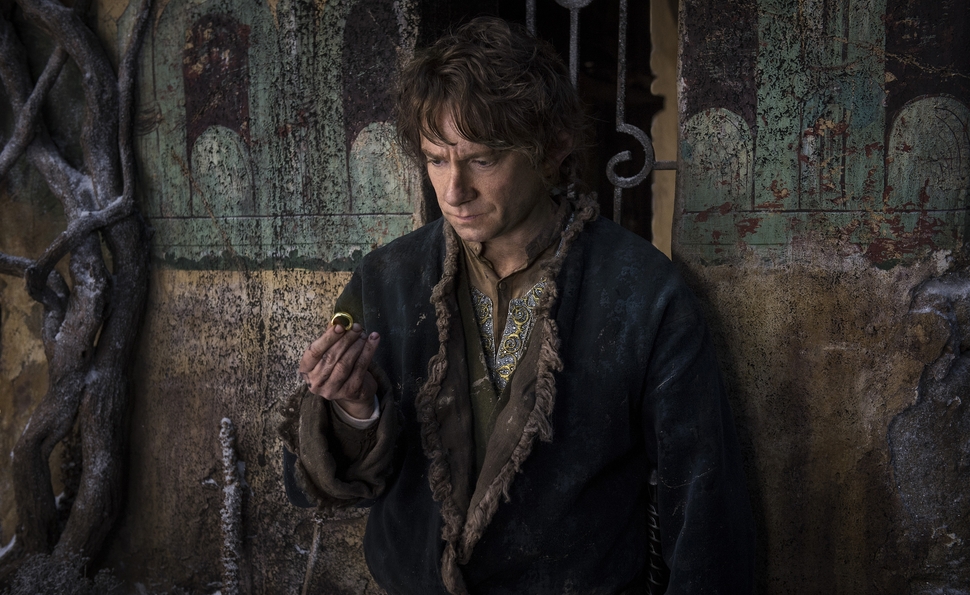
    In the Lonely Mountain, however, Thorin Oakenshield (Richard Armitage) is overcome by his lust for gold, glowering and mad with desire for the Arkenstone, the crown jewel of the king of the dwarves. This stone is in the possession of Oakenshield’s burglar, Bilbo Baggins (Martin Freeman), who has claimed it as his 1/14th of the keep. When Bilbo sees that his friend is so lost that he would go to war over gold, he parlays with Bard and the elf king Thranduil (Lee Pace), giving them the Arkenstone so that they might ransom it, averting war. It so happens that war is coming regardless of what happens, because the two unaccounted for armies, both of them Orc hordes, can’t be reckoned with.

    The Battle of the Five Armies 02

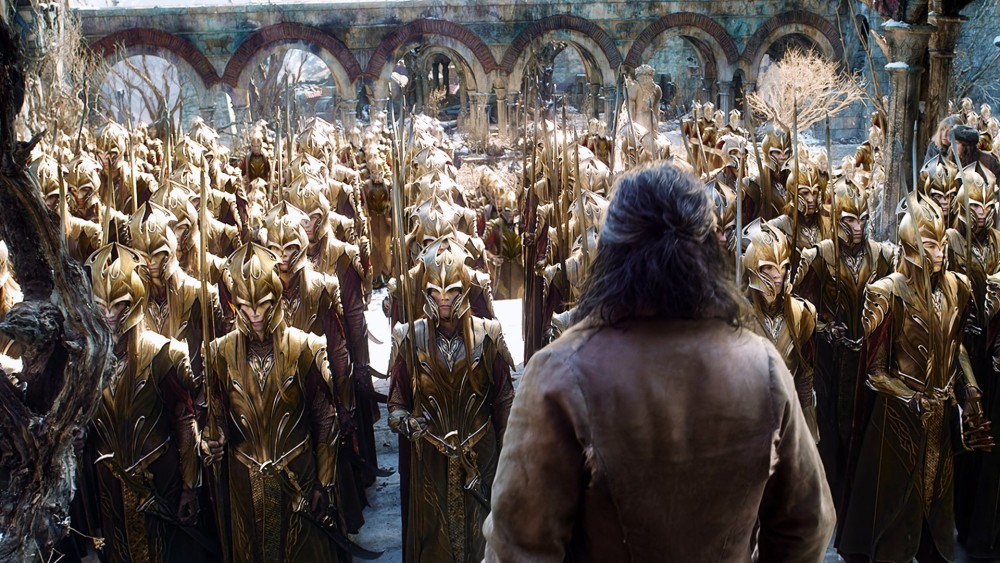
    When the battle actually starts, it’s like Jackson is finally expelling all the breath he’s been holding since the outset of The Hobbit: An Unexpected Journey. Jackson and cinematographer Andrew Lesnie use the series’ trademark sweeping long shots to show the movements of huge blocks of elves, dwarves, and orcs across the valley at the foot of the Lonely Mountain, and they are as breathtaking and spectacular as ever. The camera revels in the glint of elvish armor and the iron of dwarven shields, the blocking of bodies and the breaking of ranks. In close quarters, however, the fighting only works to show how thin Jackson’s conception of the novel as three films was. A dragon lays waste to a city, armies clash, but when a sequence focuses on a man or a dwarf or an elf or an orc as a singular entity, they’re as wraith-like as the Nazgul, apparitions of little substance because they’re meant only to serve as preamble to something else.

    And while it’s so often fruitless to complain about the problem with prequels and adaptations, that so much of The Battle of the Five Armies serves to set up The Fellowship of the Ring often leaves poor Bilbo Baggins standing around with Gandalf, waiting for his inevitable happy ending in the Shire. That’s a shame, too, as the best sequences of The Hobbit, like Jackson’s Lord of the Rings before it, have so often been the ones that show how stout its little protagonist is in the face of problems that are too large even for the gods and immortals whose company he keeps. Martin Freeman, as Bilbo, is as engaging as ever, and the scenes where he speaks with or for Thorin Oakenshield are the best of this film. They’re quiet. They’re meaningful. They aren’t undercut by odd bits of comedy. This, however, is not a film about Bilbo Baggins. Rather, it’s the one that leaves him behind, old and doddering, so that his younger relations can go off and deal with necromancers, rings of power, and the return of a certain king. There has never been a moment where The Hobbit didn’t feel subordinate to The Lord of the Rings, and that, more than bloat or pacing or anything else, is what’s so bothersome about this film in particular. Like a relative who has already finished the book, The Hobbit is always tittering excitedly about what’s going to happen next instead of appreciating the story being told.


    The Hobbit: The Battle of the Five Armies. With Martin Freeman (Bilbo Baggins), Ian McKellan (Gandalf the Grey), Richard Armitage (Thorin Oakenshield), Orlando Bloom (Legolas), Evangeline Lilly (Tauriel), Lee Pace (Bard), Christopher Lee (Saruman), Hugo Weaving (Elrond), Cate Blanchett (Galadriel), and Benedict Cumberbatch (Smaug/Sauron). Directed by Peter Jackson from a screenplay by Jackson, Fran Walsh, Philippa Boyens, and Guillermo del Toro. Based on the novel The Hobbit, by J. R. R. Tolkien

  • Movie Review: Pride (2014)

    Movie Review: Pride (2014)

    I’m going to be honest here: The same thing that drew me to Pride had me dreading my experience of the film. Dreading it. I saw a set of .gifs on Tumblr, a showy scene where a queer activist tells a mostly closeted kid that a big part of queer history was reclaiming the slurs used against the community and using them against the oppressor. True, I suppose… but for a bunch of activists holed up in an apartment above a gay book store, everybody seemed so clean. They looked like characters from an ensemble comedy, or “punk” retrospectives like CBGB, where even the most strung out and miserable dregs of the scene were presented like automatons from a ride at Walt Disney World. I thought, based entirely on a series of images that’d been taken out of context, that I was in for a glib view of history, a film informed by the Vaseline-smeared lens of cinematic uplift.

    And I wasn’t entirely wrong. Pride is big and showy, an ensemble drama that’s more about culture clash than it should be, because that’s what happens with the passage of time: Corporations decide to fund and distribute a film about a socialist movement, the brief and unlikely union of red queers and mining unions, and a big deal must be made of gay vs. straight, London vs. Whales, young vs. old. Before a camera, with the issue’s many moving parts streamlined to make it all fit within the confines of a single motion picture, the people who were part of the movement become larger than what they stood for. It’s easy, after all, to talk about heroes. It’s uncomfortable, however, for a state-funded film to speak of revolution. A film like this has to frame the battle as won. A film needs resolution, and a film about queer and worker politics needs a resolution that says things got better so we can feel better about the world we live in when we leave the theater.

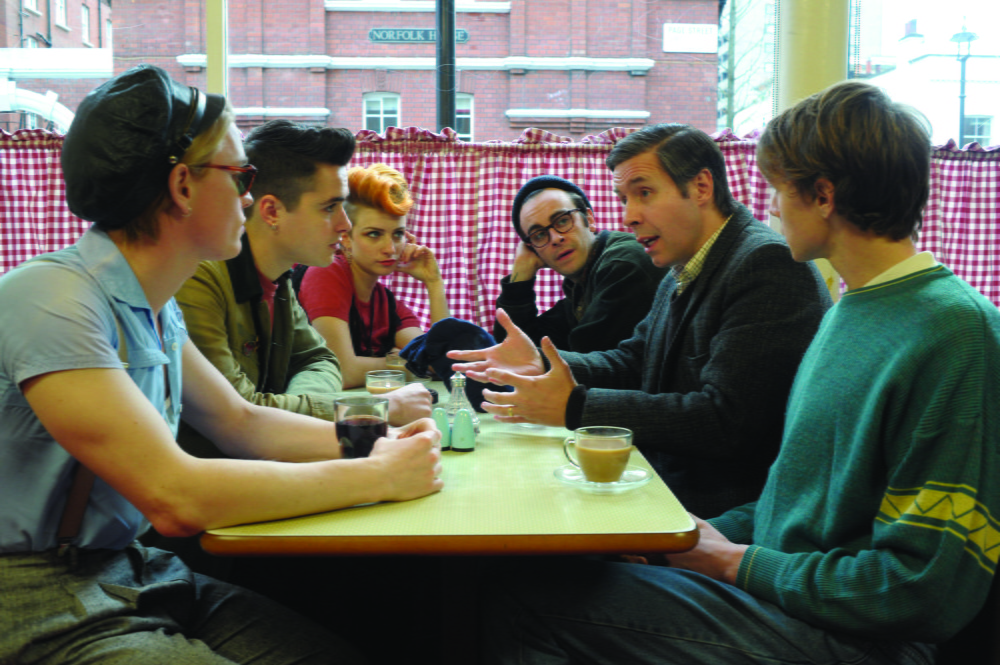
    So Pride isn’t about revolution or politics, despite its trappings. A group of lesbian and gay activists, seeking to stick it to Margaret Thatcher, figure out that governmental policies effecting Welsh miners are just as oppressive as the policies they face at the outset of the AIDS epidemic. Mark Ashton (Ben Schnetzer) forms the Lesbians and Gays Support the Miners campaign and, along with his comrades at the book store, starts raising money for the strike fund of the first miner’s hall that will welcome them. A garbled connection over the phone sends LGSM to the village of Onilwyn, where they are begrudgingly accepted because they’ve come with a good bit of coin. LGSM starts winning over the majority of the miners with the support of union leaders Cliff (Bill Nighy) and Dai Donovan (Paddy Constantine), miner’s wives (led by Jessica Gunning), and their dancing. But there’s a homophobic faction of villagers who are willing to damage their own cause so long as it sends the gays and lesbians back to London where they belong.

    Pride 2014 leather bar

    The year-long strike and its inner-workings are Zola’s Germinal brought to life, but Zola is dour and sad and suggests that coal miners—all workers, really—will be crushed endlessly under the boot heel of the bourgeois. Pride is a crowd-pleaser, though, all big hair and synth-driven soundtrack, punctuated by the occasional protest song or bit of danger. The first thirty minutes or so feature a lot of hard looks and hocked loogies from the breeder set. Bill Nighy gives a walking tour and recites poetry. Dominic West has an elaborate dance number where he leaps onto a table and shouts about how he misses disco. The old women of the village have a hell of a time learning about gay culture. There are two coming out narratives and two AIDS narratives, all of which suggests a story better suited to a TV miniseries. But while the whole enterprise should feel overstuffed and exhausting, Pride manages to be very fun, a heaping spoonful of sugar to go along with the biter knowledge that the 1980s weren’t all that enjoyable, music and fashion and community aside.

    That fun is tempered by Pride’s treatment of history as a closed book with some of its chapters excised. In the opening information dump, a newscaster mentions Thatcher’s plans to cut jobs, but goes into no detail about how a general strike works or what it entails. It looks like a long game of bingo over a few pints. Thatcher’s anti-gay policies are also at the fringes of the film, but here we’re operating with the blind faith that LGSM’s handshake deal with the miner’s union will pay off somehow. Everybody but LGSM, it seems, is living it up, as if government oppression was a thing only seven or eight queer people in all of London wanted to deal with. There again is the problem of framing this material as a film and not something longer and looser, a thing that can contract and expand and breathe. Nowhere is this more apparent than how the film presents feminist issues as an odd collection of notions to be laughed at (what, worry for your safety as a gay woman in a town full of leering miners?) or nodded to in knowing solidarity (yes, yes, sex can be enjoyable for women!). Also odd is the miners’ stated goal of getting everything back to normal, but that’s a movie revolution for you: All of the red propaganda filling the screen is a prop, “authentic,” but not authentic.

    While there’s nothing particularly striking about the visuals of Pride, I’m a union baby through and through—I was raised singing “Solidarity” and get misty-eyed when I see large-scale demonstrations in the movies, even if the people marching are too clean to suggest the kind of real-life suffering that engenders public action. It’s not much of a spoiler to say that Pride ends at the 1985 London Pride Parade, where LGSM are told they’ll have to march in the back. Nobody wants politics anymore. Everybody wants to party. Mark cries bullocks into his megaphone, but the attitude of the parade organizers and the film they appear in are the same, at heart. All of that political stuff is hard to handle. Can Bill Nighy recite another poem, please?


    Pride. With Bill Nighy (Cliff), Imelda Staunton (Hefina Hedon), Dominic West (Jonathan Blake), Paddy Constantine (Dai Donovan), Andrew Scott (Gethin Roberts), George MacKay (Joe Copper), Ben Schnetzer (Mark Ashton), and Jessica Gunning (Siån James). Directed by Matthew Warchus, from a screenplay by Stephen Beresford.