Category: Film

  • Movie Review: Restless (2011)

    Movie Review: Restless (2011)

    It isn’t until the end of Gus Van Sant’s Restless that I feel anything for its protagonist, who begins the film as a petulant funeral crasher, a stranger in a land reserved for those with an intimate knowledge of the dead. He has his reasons for dressing in black and sitting in on services, but I suspect most of us have our reasons for most of the things we do, known only to us. For everybody else, our intent is hidden behind a brick wall.

    Enoch Brae (Harry Hopper) is said funeral crasher, and it is at one of these funerals that he meets Annabel Cotton (Mia Wasikowska), who recognizes him as an outsider immediately. She doesn’t seem to mind his presence at the funeral. Matter of fact, she seems interested in Enoch, who is by no means a normal boy. He walks around like the disheveled, moribund hero of a 90s arthouse film. Why? That’s a mystery to her and everybody else who comes into contact with Enoch, but it’s one she sets out to solve.

    The caveat is that Annabel has cancer, an inoperable brain tumor that gives her, at best, three months to live. Her friendship with Enoch blossoms into a young romance, but it is obviously doomed. She’s determined not to let it get her down. He’s ambivalent, at times joking, at times not wanting to talk about her impending death, the march of time. They tiptoe through graveyards, childlike, trying to ignore the encroaching darkness.

    But Enoch, as I said, is moribund. Depressed. He’s got issues that he’s yet to deal with, and a dying girlfriend isn’t going to help.  His aunt (Jane Adams) suffers caring for him after the death of his parents, and he’s apparently haunted by a ghost named Hiroshi (Ryo Kase), a World War II Kamikaze with a passion for Battleship. Enoch blames his aunt for the fact that his parents are dead, and, as his relationship with Annabel deepens, he begins pushing away Hiroshi, who doubts that dating a girl on the verge of death is healthy.

    There’s a lot on the fringes of Restless. It is implied that Enoch may have tried to commit suicide. Hiroshi may be a figment of his imagination. He doesn’t go to school. He’s prone to outbursts. All of this is quite overwhelming, an avalanche of emotional detail not usually contained by a single movie. Annabel is his center, but that, as they say, cannot hold. She’s a girl interested in ornithology and Darwin, not ready to die but aware that she can’t go on. She’s told by the staff at the cancer ward that she’s brave for going through her ordeal and wonders what the cancer patients who aren’t brave must be like.

    It’s a fair question, and a somewhat tacit incitement of film characters with terminal illnesses, who are almost always flawless paragons of virtue, waiting for death to canonize them. Annabel Cotton, too, is one of these flawless sufferers—she certainly doesn’t look like cancer’s ravaging her, doesn’t often appear to be in pain—but she’s optimistic and steadfast where other films would paint her as the cloying stereotype. Given three months to live, she lives them quietly, with resolve. She doesn’t climb a mountain. She doesn’t abandon ship. She isn’t enshrined by those around her. She’s selfish, sometimes, and always human. Sad as it is to say, that’s a pretty big accomplishment for a movie with terminal illness at its center.

    Wasikowska is the most compelling aspect of the film, as she finds a way to navigate the shark-filled waters of her role without being mauled. She’s a waif and a manic pixie girlfriend in equal measure, and she’s good in that role, but the moments where she’s determined to not be Enoch’s coping mechanism are surprising in their weight and authenticity. Unfortunately, she’s destined to be just that, like the equally-interesting Hiroshi—a compelling character in the corners of another, less compelling life. Enoch’s circumstances are unfortunate, true, but even tugging at the heartstrings with all his might, he fails to earn any sympathy.

    Despite that, Restless manages to be a compelling, fresh movie. I wonder at what would have resulted had Annabel not been sick, or had her tumor factored into the plot as more than the film’s ticking time bomb, and I’m appreciative if a film manages to stir-up wonder. Though quiet, at the film’s core runs the intense machinery of desire. Like time, it never stops marching.

    Rating:

    Restless. Directed by Gus Van Sant. With Harry Hopper (Enoch Brae), Mia Wasikowska (Annabel Cotton), Ryo Kase (Hiroshi), Jane Adams (Mabel), and Schuyler Fisk (Elizabeth Cotton). Released September 16, 2001, by Sony Pictures Classics.

  • Movie Review: Abduction (2011)

    Movie Review: Abduction (2011)

    A quick spoiler for those of you considering putting down your hard earned money on Abduction: Nobody in it gets abducted. Guns are fired, people are murdered, others are beaten up, and spies from the CIA battle a rogue Russian black-ops agent looking to regain some stolen files, but the only people who get kidnapped here are Alfred Molina, Sigourney Weaver and Michael Nyqvist, who were apparently blindfolded and shoved into a van headed to Pittsburgh. There, they were forced, likely at gunpoint, to recite 20-years worth of teen action movie cliches as Taylor Lautner smiled or grimaced at them, depending on the scenario.

    There happen to be two scenarios. In the first, Nathan (Lautner), is a typical high school kid. He crushes on the girl next door (Lily Collins), gets wasted at a party, gets busted by his dad and, like your normal American high school kid, is beaten up by him in the backyard of their fantastic mansion. Lautner is all smiles here, other than when he’s about to deck his crush’s boyfriend or when he’s at therapy, where his shrink (Weaver) leads him by the hand through some angsty boilerplate. Despite the fun he has playing beer pong and riding his motorcycle, he feels weird, like he doesn’t belong at the school or with his family…a stranger in his own skin.

    If that’s not familiar enough, there’s scenario two, where Lautner discovers that his parents aren’t his parents, that he’s been trained by world-class martial artists, and that he has a Russian hit squad coming after him for unknown reasons. He finds this out because, conveniently, he was assigned a paper on missing persons, and a missing persons site had some software that aged an old baby photo of his into a shockingly accurate future-him. The girl he’s crushing on, Karen, immediately jumps to the most alarmist conclusion: “Like, ohmigod Nathan, your parent’s totally aren’t your parents! They, like, abducted you or something!”

    Only they didn’t abduct him, and they’re soon shot dead by the Russians. The CIA gets involved, and Nathan and Karen run from both groups, traveling in teen-friendly vehicles like 2011 BMWs and Amtrak trains as CIA man Burton (Molina) and the rogue Kozlow (Nyqvist) chase him down. The rest of the movie consists of standard chase scenes, punctuated briefly by bits of dialog so awkward, Sir Laurence Olivier would struggle in lending them gravitas.

    “I’m not dying here,” A man says, trying to fend off Lautner’s blows. “I’ll tell you everything you need to know. There’s a bomb in the oven.”

    And then Lautner goes to the oven, discovers that there is indeed a bomb in it (a decidedly old-school looking one that must have been placed and set magically), and manages to drag his panic-stricken future girlfriend to safety, even though the digital readout is at a comically short seven seconds. This, of course, means that the man who swore he wasn’t dying there dies, which would be sad were he not inept at his job. Later, in recounting the day’s tragedy, Lautner grimaces and deadpans “I just saw my parents get murdered in front of my eyes.”

    And that’s just it…his parents did get murdered, right in front of his eyes even, and his loss just flat does not register. Yes, I understand that he’s an “action hero” and I get that he’s got “rage issues.” But rage is an emotion, and it’s the one action heroes need. First Blood, for example, would be nothing without Stallone breaking down and crying into Richard Crenna’s arms at the end of the movie, and half of Schwarzenegger‘s best stuff would similarly be wasted were he not enraged that somebody killed/kidnapped/threatened his wife/child/Christmas cookies. Neither Schwarzenegger or Stallone were particularly known for pathos, but, bulletproof though they were, they reacted to danger as if it were dangerous. Here, in an empty PNC Park, Lautner puts his arm around his girl and cracks wise about how exciting their first date was, despite missing the Pirates game.

    Yeah bro, but your parents are still dead. Maybe you ought to work through those issues before sliding into second base.

    Rating: 

    Abduction. Directed by John Singletary. With Taylor Lautner (Nathan), Lily Collins (Karen), Alfred Molina (Agt. Burton), Michael Nyqvist (Koslow), and Sigourney Weaver (Dr. Bennett). Released September 23, 2011, by Lionsgate.

  • Movie Review: Contagion (2011)

    Movie Review: Contagion (2011)

    The horror of Contagion isn’t the disease itself, the end result of the disease or the social unrest the disease causes. The film begins with the sound of a woman coughing. That woman dies, her son dies and the people who’ve come into contact with them start getting sick, too, but the film, which takes great pains to show simple human-to-human contact–hand shaking, money exchanging, drink serving, hand holding–has a larger point: We are living in the Lysol commercial from Hell. Germs are everywhere, and while we may eventually be able to isolate, reproduce and “cure” what ails us, we’re only really able to buy into placebos (Lysol, hand sanitizer) and hope for the best. The phrase “99% effective” is the world’s largest loophole: You can’t see these things coming, and you can’t see them die.

    We can, however, see the effects of a virus play out on the people around us. The woman coughing, for instance, is Beth Emhoff (Gwyneth Paltrow), whose husband Mitch (Matt Damon) follows her to the hospital. After her death, on his way home, Mitch receives a panicked call from the babysitter: his son has had a seizure. He finds his son dead. In the larger world beyond Minnesota, the Centers for Disease Control and the World Health Organization  try to get a grip on the situation, sending out disease intelligence agents in the Midwest and China to track Beth’s movements, trying to figure out how a businesswoman could have gotten people sick in China, Chicago and Minneapolis. It’s not hard to figure out: she was in a crowded room. She was on an airplane. As we travel, so too do the germs we carry.

    The real joy (if you can call it that) of this movie is watching how director Steven Soderbergh juggles the large and small scale dramas contained by Contagion. There’s Damon’s arc, where, in riot-ravaged Minnesota, he tries to protect his daughter from the virus and from other people. There’s the CDC arc, where Dr. Ellis Cheever (Laurence Fishburne) tries to coordinate the investigation of Dr. Erin Mears (Kate Winslet) while protecting his future wife, providing for the research of Dr. Ally Hextall (Jennifer Ehle)  and fending off the vitriol of popular conspiracy blogger Alan Krumwiede (Jude Law), who may have found an over-the-counter cure. In China, Dr. Leonora Orantes (Marion Cotillard) is kidnapped and held hostage until a village is given the vaccine.

    Not everything holds up. Once Dr. Orantes is kidnapped, she disappears. Mitch, who has done everything he can to avoid breaking down in front of his daughter, has to put up with her as she goes from understanding to typical, complaining of being locked in a prison while the outside world goes crazy. Perhaps most disappointing is Krumwiede, who begins the film as a small-time blogger unable to get traction with the San Francisco Chronicle to a massively popular individual with 12-million unique views and a four-million dollar profit coming his way thanks to the boom in sales to his homeopathic cure. He is Sarah Palin’s image of the blogosphere–unwashed, unsexed and unhinged–and he eventually disappears into the ether without the film giving us a sense if he believes what he’s selling, or if he’s just in it for the money. Jude Law plays Krumwiede as a firebrand, which is about right, but he’s a firebrand without focus.

    Beyond that, Soderbergh manages to keep everything aloft. I wondered, a little, how a world in crisis managed to keep the power and internet running, and I wish more was made of the film’s two or three governmental sub-plots, but by resisting the urge to sensationalize any given aspect of a global epidemic (when you think about it, 12 million worldwide visitors listening to a whackjob blogger is pretty marginal) Contagion manages to do what most films marketed as horror are unable to: scare its audience. A man in the theatre coughs. A woman sneezes. Everybody is touching their face with their hands that have touched the theatre seats, drink cups and popcorn bags that have, of course, touched other people who have touched other things. We all cringe, busy with the business of dying.

    Rating:


    Contagion. Directed by Steven Soderbergh. With Matt Damon (Mitch), Jude Law (Alan Krumwide), Laurence Fishburne (Dr. Cheever), Gwyneth Paltrow (Beth), Kate Winslet (Dr. Mears), Marion Cotillard (Dr. Orantes), Jennifer Ehle (Dr. Hextall) and Elliot Gould (Dr. Sussman). Released September 9, 2011, by Warner Bros.

  • SPECIAL ATTRACTION: Troll 2 (1990)

    SPECIAL ATTRACTION: Troll 2 (1990)

    I’ve got a theory about Troll 2 that goes beyond its being a quick cash-in sequel to a horror movie that never got made. Any yokel with a dial-up modem can tell you about the film’s special effects, its acting, its camera angles, but I’ve got the facts, man–the real reason Troll 2 was made and why basement-dwelling nerds like myself continue to stream it instantly over Netflix, knowing full well that nothing good will come of it: Troll 2 is the world’s first and only pro-meat horror film.

    Think about this for a second. Most horror films, at least back when horror films mattered, came with a moral to smooth out the violence. Sleepaway Camp, for example, would have you not bullying people because of their looks, Friday the 13th warns against the dangers of child negligence by insinuating that the child you let drown today could be the undead, machete-wielding manbaby of tomorrow, and A Nightmare on Elm Street is as anti-vigilante as the Gotham City Police Department around quarterly evaluations. Not that there are a ton of horror films made about 1) the environment or 2) the horrors of eating meat (maybe the Texas Chainsaw Massacre and other cannibal-centric films), but Troll 2 nevertheless makes its stand on the issue: Meat good. Veggies bad.

    The story, for those of you unfamiliar with Troll 2’s haphazard near-brilliance, is this: Two families, one from the city and one from the middle of nowhere, agree to swap houses so they can experience each other’s life. The youngest of the city folk can speak to his recently deceased grandfather, and like guests of Lando Calrissian, the pair have a bad feeling about rural hospitality. They arrive to a giant banquet, cooked up by the slack-jawed, grumbly locals, only for the grandfather and the little boy to deduce that the food, if eaten, will turn the eater into a tree, trees being the chief sustenance of trolls goblins.

    So the little boy is tasked with saving his family from the “delicious” looking food, which is a weird variety of cakes and porridges and other assorted green things. Meanwhile, on the other side of the town of Nilbog (one of the great horror movie town names), an RV of horny teens unaware of the situation are waiting to be made into plant food. They’re easily seduced by a witch, who offers them food and sex, pretty much at the same time.

    This, naturally, leads to popcorn.

    The truth of the matter is that there’s a pretty decent movie lurking behind Troll 2’s low budget awfulness, and this is the kind of movie that hypothetically begs to be remade: There are enough fans of Troll 2 who’d see a remake that a (small) audience is built in, and the people who come to it blind might go off and watch the original on Netflix, where they’d pretty much get trolled. If Fright Night and every other horror movie ever made can get the remake treatment, I don’t see why, in 2013 or so, I can’t go to a movie theatre and expect a father to ground his son for literally pissing on hospitality.

    Yes, there’s some real potential in food horror, particularly in an America where half the people in it are obese and at-risk for diabetes. You make the city folk a troupe of fast food munching, soda slurping suburban slugs and the yokels a group of Eric Northman level hunks, and I’d say you’ve got something. It’d be a weird dichotomy, I suppose, because the hunky rural folk are trying to get the fat slobs to eat their vegetables, but that’s an easy fix: Make everything corn. Americans, myself included, already eat more corn than what’s logical, and there’s an obvious tie in to high fructose corn syrup.

    “Gross!” the little boy would say. “I hate corn!”

    “Aww,” his father responds, “it’s not that bad. Corn is good for you!”

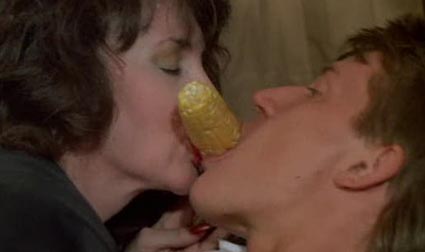
    Meanwhile, in the RV, the witch and the horndog are making popcorn (woe to the screenwriter who leaves that scene out), and the goblins of Nilbog gather around their giant campfire to make a roasted ear of human/corn. Heck, I’m getting shivers just picturing the kid breaking into the witches house, pealing back the leaf and revealing a desiccated, unnaturally yellow teenager. Hospitality’s not the only thing he’ll be pissing on.

    As for the reason I’d play this in my hypothetical rep theatre, just check out the above clip: Troll 2 has everything I want from a bad movie–poor acting, unintentionally great lines and a ridiculous plot. Oh sure, people would come just to laugh at Troll 2, and that’s fine. But Troll 2, in its way, is laughing at them: eating popcorn, drinking soda, sex-obsessed and sedentary. That’s just how the goblins want you.