

 Wes Anderson’s Moonrise Kingdom, like many of his films, functions as a nostalgist’s guide to childhood and the weightiness of romance. The difference here is that Anderson focuses on two children, children who, unlike Rushmore‘s Max Fisher, are actually children. They don’t approach love in Fisher’s clinical, precise way, nor do they regard life as a bitter procession of tragic events, as do the man-children of The Life Aquatic, The Royal Tenenbaums, and The Darjeeling Limited. Their way is more innocent, one ignorant of societal norm and responsibility, but still couched in the grim truths of reality. Considering how movies now try to appeal to children through the liberal use of rainbow wigs and catchphrases, this attitude, and the intelligence of Moonrise Kingdom, seems reliquary, lost to the past.
In the summer of 1965, Sam (Jared Gilman) and Suzy (Kora Hayward) run away together, into the secluded New England wilderness of New Penzance, an island Suzy and her family live on which is only accessible by plane or ferry. The pair spent an entire year plotting their escape, beginning with a chance meeting between the two while performing in a school play, and continuing through a series of business-like correspondences. Sam is an orphan and a Khaki Scout. Suzy is the record- and book-collecting daughter of wealthy parents who are strangers to each other. Same brings with him camping equipment and the ability to read maps. Suzy has her records, her books, her binoculars, and her cat. They are decidedly ill-prepared for the coming journey.
Their plot discovered, Sam and Suzy’s flight brings together the disparate members of the small community. Walt (Bill Murray) and Laura Bishop (Frances McDormand)—Suzy’s parents—Captain Sharp (Bruce Willis)—the island’s lone police officer—and Scout Master Ward (Edward Norton)—the meticulous leader of New Penzance’s pack of Khaki Scouts—spread out and go looking for the kids. The remaining Khaki Scouts, having long considered Sam a weirdo, hunt for him like he’s an animal they want to mount on the treehouse wall. When they’re found, it’s in a beachfront kingdom they’ve made for themselves. It’s just them, the cat, her records and books, a campfire, and the moon. It’s a perfect kingdom—an idyllic place right out of the books Suzy carries—but, like all utopias, Sam and Suzy’s piece of land is doomed from the start.
Walt and Laura Bishop, ever the reactionary, mostly absent parents, expressly forbid their daughter from seeing that strange boy again. Sam’s foster parents decided they can’t handle the responsibility anymore, so Captain Sharp takes him in while Social Services (here represented by Tilda Swinton) flies to the island so Sam can be shipped off to a juvenile refuge. The Khaki Scouts, meanwhile, having learned a valuable lesson about friendship and impressed with Sam’s resiliency decide to spring the couple and get them to the mainland, that wild, unspoiled stretch of earth to large and secretive for even the most obsessive parents and public servants to uncover them.
That the relationship between Sam and Suzy never wears thin is Moonrise Kingdom‘s most considerable accomplishment. The threat of precociousness looms large over every story about a couple of crazy kids, but Anderson manages to exercise restraint, stopping just short of letting his children run amok in the woods. Again, there’s something to be said here about the difference between Anderson and Roman Coppola’s script in comparison that of any other recent children’s entertainment: say what you will about Anderson’s appreciation for and liberal application of whimsy and hipster quirk, but his characters don’t abandon their parents so they can gulp soda, gobble candy, and have endless and endlessly merchandisable fun. Nobody sits Suzy down for some big, lame speech about morals, and halfway through the one he delivers to Sam, Captain Sharp realizes how stupid, futile, and condescending he’s being and pours out a little beer for the sad kid whose dreams have been wrecked. The adults at the corners of this film are more than vacuous governors of joy. They bring their own problems to the island. They’re as ill-prepared to face them as their runaways.
The most obvious problem is that Laura is cheating on Walt with Captain Sharp. Beneath the unhappiness of this particular damaged relationship, there’s a subcontinent of grief. The Bishops, of course, remain together for their children. Captain Sharp, living alone in a trailer on the island, is by no means a bad person. Neither, for that matter, is Laura. He is driven to her by loneliness, she to him because he represents something wholly different—and thus more exciting—than the family she knows. Theirs is a relationship running parallel to Sam and Suzy’s. Where the Bishops would seek to end it, Sharp comes to see himself in the orphan, seeking a way to keep him out of the system.
The outlier here is Scout Master Ward. As tempting as it is to lump him in with Anderson’s stable of man-children, few of his characters live as meticulously or selflessly. He, like many adults, is oblivious to the inner-workings of the children he looks after. When he realizes this, he becomes Moonrise Kingdom‘s most vulnerable character. He considers himself a failed scout master when Sam runs away, is depressed when Sam tenders his resignation from the troop, and is largely helpless before Social Services. He begins the film as a man as well-manicured as any number of Anderson’s dollhouse sets. Like New Penzance, the Belafonte, Rushmore, and the Darjeeling Limited, Ward’s put-togetherness is a facade, something that’s beginning to crack and fissure.
Moonrise Kingdom is Anderson’s eighth film, and hardly the first to deal with dysfunction and longing. He’s no chameleon—even the claymation of The Fantastic Mr. Fox looked, felt, and sounded like something distinctly of his brand—but Anderson continues finding subtle ways to express his themes differently. Here, it’s the intersection of Sam and Suzy’s dream with the reality of the adults who watch over them. The lives led by the Bishops, Captain Sharp, and Scout Master Ward are fractured and sometimes terrible. However well they think they’re hiding this, however much they assume their children remain oblivious, the two understand the problems of the real world, perhaps better than their wards. That the unknown holds so much potential is why they run away. But potential is often not realized, and is rarely perfect. Their utopia, the Moonrise Kingdom, lies at the edge of the sea. Storm clouds are gathering. Look at their empire. How easily the ocean could sweep it away.
Moonrise Kingdom. With Jared Gilman (Sam), Kara Hayward (Suzy), Bruce Willis (Captain Sharp), Edward Norton (Scout Master Ward), Bill Murray (Walt Bishop), Frances McDormand (Laura Bishop), Tilda Swinton (Social Services), Jason Schwartzman (Cousin Ben), and Harvey Keitel (Commander Pierce). Directed by Wes Anderson from a screenplay by Anderson and Roman Coppola.
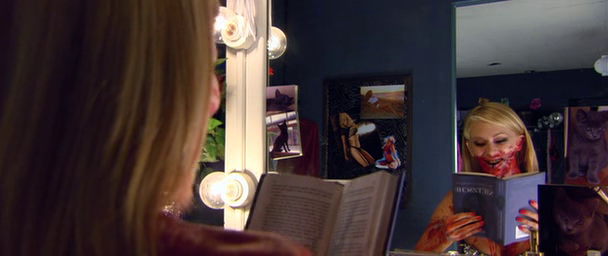
 Cultish devotees of film often celebrate failure, box office, critical, or otherwise. By designating awards to the year’s worst movies, organizing midnight screenings of a film on the fringe, and writing endlessly about one flop or another, bad movies have a way of sticking around well beyond their typical cultural sell-by date. The phrase “so bad it’s good” is often ascribed to these movies when, in a pre-Internet, pre-Mystery Science Theatre 3000 world, they used to be considered so bad, they’re virtually forgotten. In Best Worst Movie, or Worst Movie? Fear of a Ghost Planet takes a good, hard look at the supposed jewels hiding in a cinematic junk heap. This week, it’s 2008’s strippers-and-zombies epic, Zombie Strippers.
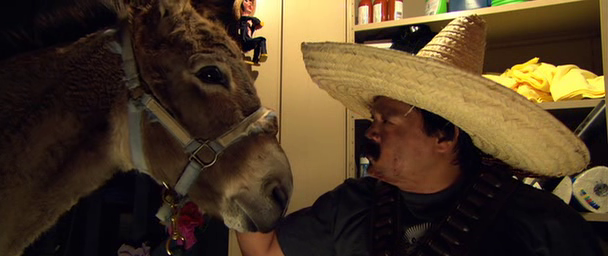
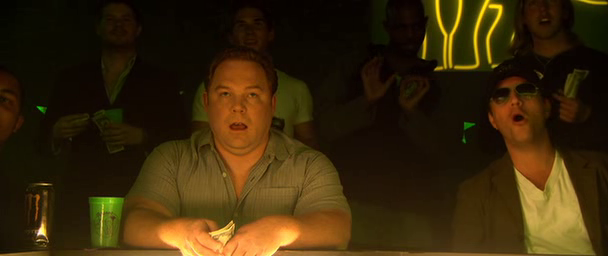



 V/H/S is a horror anthology presented as one complete story, the tale of a gang of thugs who break into a house to recover a specific video cassette for an unidentified employer. They break into a seemingly empty house, scouring it for the cassette, and make two discoveries: a pile of tapes in the basement, and a room with a dead body slumped in a chair. The dead man has apparently been watching some cassettes, so one member of the crew is tasked with watching what’s already loaded into the VCR. Like a child invoking the Candyman in the bathroom mirror, the thought of pressing play and glimpsing whatever the dead guy watched proves irresistible, and, thanks to a cadre of tapes directed by a constellation of indie horror filmmakers, the loop binding together this anthology is closed. Not logically, and not so far as it bears on the plot of the wraparound feature, but it’s closed.
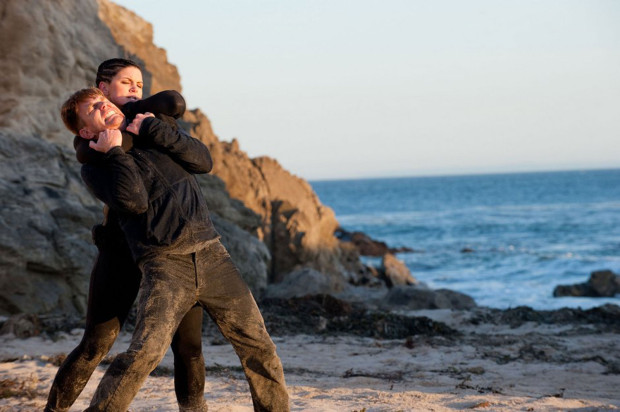

 Seven Psychopaths is a movie about making movies. More specifically, it’s a movie about writing movies, putting it in the same ballpark as Barton Fink and Adaptation, but with a few crucial differences. Its protagonist, for example, never holds himself up as some great artist, and once he gets into his story, he approaches his characters with zeal, if not a true sense of where those stories are going. Where Barton Fink and Adaptation (and Charlie Kaufman’s Synecdoche, New York, which was technically about a playwright) are darkly comic, psychologically-intense mirrors of the men who wrote them, Seven Psychopaths leaves darkness out of the equation. There’s scores of violence here, buckets of blood and more than a few charred corpses, but never a sense that it’s weighing too heavily on the writer’s mind. He puts pen to paper, unconscious of the fact that he’s part of his story’s tapestry.
 Seven Psychopaths. Directed by Martin McDonagh. With Colin Farrell (Marty), Sam Rockwell (Billy), Christopher Walken (Hans), Woody Harrelson (Charlie),