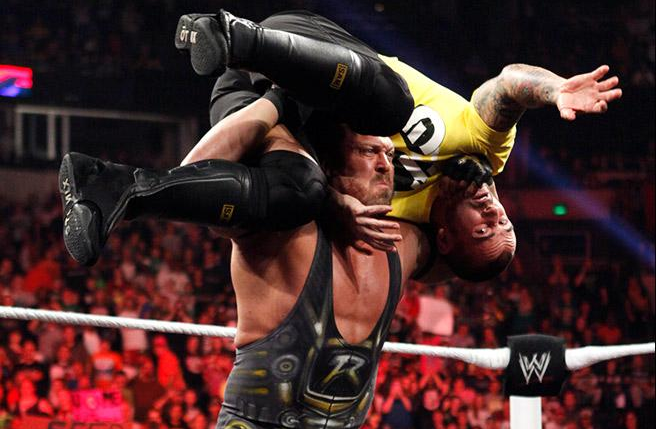
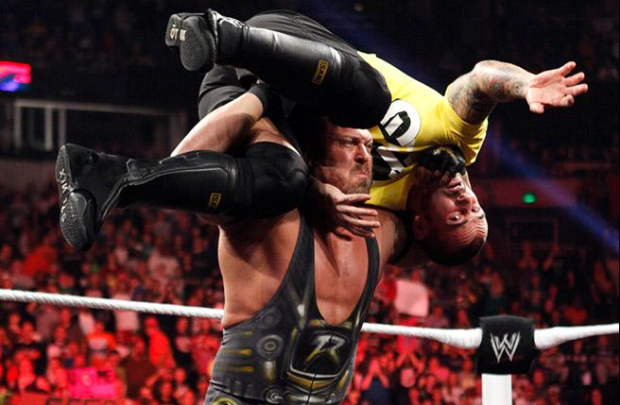
 For weeks now, the narrative of WWE Monday Night Raw has been this: to cement his legacy as an all-time great champion, CM Punk would need to defeat John Cena within the confines of Hell in a Cell, WWE’s steel cage warzone that’s seen its fair share of company defining moments. On one level, this makes sense: many of the company’s top feuds, from The Undertaker’s battles with Shawn Michaels and Mankind to Triple H’s beefs with Chris Jericho and Cactus Jack, have wound up there, and Cena/Punk is certainly worthy. On another, it’s a complete mystery: Punk’s been involved in two Hell in a Cell matches and hasn’t outright lost to John Cena since before last year’s WrestleMania. The cell has mostly loomed in the background as another specter of WWE past, taunting the long-tenured WWE Champion like Bret Hart, Mick Foley, Jim Ross, and Vince McMahon have over the past few weeks. Tonight was billed as the night CM Punk chose between John Cena and Ryback as his eventual challenger, and also as an evening during which Vince McMahon would potentially choose Punk’s opponent. In a move unsurprising to folks who follow injury reports but inconsistent in terms of overall narrative, neither Punk nor McMahon chose who would be stepping into Hell in a Cell, but John Cena, who abdicated the ring and led the audience in Ryback’s chant of “FEED ME MORE.”
This swerve came despite Cena telling Vince McMahon that he was ready, if need be, for the challenge of the Cell. Despite weeks of him telling Punk that respect and a lasting legacy would only be his if he agreed to the match. Obviously, Cena’s elbow is still an issue, but stepping away from a fight he was previously begging for is something completely outside his character, even when he was a white rapper of questionable associations nearly a decade ago. Ryback, fortunately for the WWE, is an able substitute. Listen to the response he gets, even after failing to lift up the monstrous Tensai for his finishing maneuver a week ago. There is no hotter act in wrestling. The only thing the WWE has to fear is that Ryback’s luster is diminished by a loss, or that a championship victory is too much, too soon. It’ll hurt the narrative a little, but not enough to seriously damage Vince McMahon’s unsinkable ship.
Ryback, love him or hate him (I’m a fan), is the best example of the WWE’s seemingly newfound ability to turn its new stars from awkward newcomers into characters worth investing time into over a short period of time. The law of diminishing returns has effectively caused the Funkasaurus to go extinct, but acts like Damien Sandow and Antonio Caesaro have done well for themselves; Kofi Kingston, The Miz, Cody Rhodes, and Sin Cara have gotten a new sense of purpose; and the much maligned Tag Team and Divas divisions have had an energy to them that has been largely absent for years.
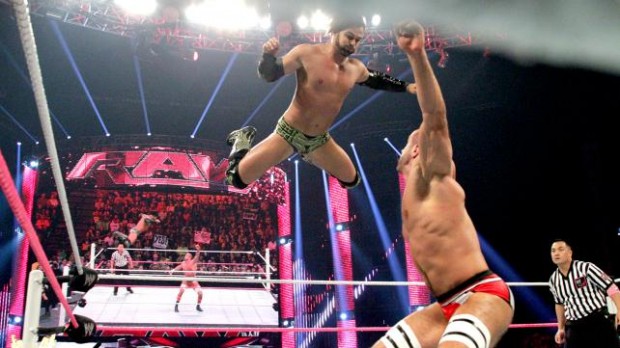
A lot of this, oddly, has been a side-effect of Jerry “The King” Lawler’s heart attack and subsequent hiatus from the broadcast position. That night forced play-by-play announcer Michael Cole to drop his evil ways and return to simply reporting on matches, rather than actively picking favorites. He’s been joined at the table by Jim Ross and John Bradshaw Layfield, both of whom are gifted analysts with whom Cole has tremendous chemistry. Layfield was not on Raw tonight, but Ross has a way of connecting with wrestling fans that, as an announcer myself, is both enviable and hard to describe. Cole, sitting beside him, is tremendously effective in making Ross’s points digestible to the WWE’s young demographic. If the aim of broadcasting this format is to make the wrestlers in the ring look as good as possible, few recent matches have befitted as much as the one between Kofi Kingston and The Miz, which was meant to hype a title fight between the two on WWE’s new Wednesday night show. I’ve been disinterested in Kofi Kingston for some time and have never really been a fan of The Miz, but listening to Ross talk about Kingston’s history and Cole put over The Miz’s accomplishments, it really felt like their match meant something. Considering that the issue sprung from an incident where Larry King’s wife through water in The Miz’s face, that’s saying a lot about both the commentary and the match itself.
Similarly, the WWE has found a way to make The Big Show a compelling character again: a disgruntled carnival strongman with a right hand that’s literally lethal, facing down a grinning goofball Irishman whose most compelling argument for success is that a mutual opponent once beat Show in 45 seconds. Tonight, The Big Show demanded to face Daniel Bryan in a match so he could “erase the memory” of his 45 second title reign and handily defeated the WWE Tag Team Champion. The match achieved the dual purpose of establishing Show as a legitimate threat (something that’s proven hard in the past, despite the man’s size) and further gelling the team of Bryan and Kane, the unlikely champions who belittle each other but are growing into a semi-functional unit. The odd man out here is World Heavyweight Champion Sheamus, who would probably be one of my favorite wrestlers were he not involved in a mind-boggling amount of lame sketches that’ve resorted to bullying, racial stereotyping, and grand theft auto, none of which have utilized his natural charisma, nor the size and strength that make him so impressive.
The result of this episode of Raw is that the Hell in a Cell pay-per-view is now much more full, though it remains unclear as to what matches will actually end up in the cage. There’s Punk and Ryback, as mentioned by Vince McMahon, and I presume Big Show and Sheamus will also end up there. Daniel Bryan and Kane may face the winners of next weeks Rey Mysterio/Sin Cara vs. Damien Sandow/Cody Rhodes encounter in Hell in a Cell, but that’d be three first-time matches taking place in a structure formerly reserved for the end of a long-standing conflict.
In this regard, give CM Punk and manager Paul Heyman most of the credit for selling the upcoming show. Punk, as always, has really taken to the role of smarmy jerk, and if anybody deserves to go through the crucible of Hell in a Cell, it’s him. Punk has been through two such matches, as previously mentioned, but neither of them were classics. Paul Heyman, though, was a big part of one of WWE’s best such brawls, a bloodbath between his client Brock Lesnar and Hell in a Cell staple The Undertaker. He may be pivotal two weeks from now, worrying outside the cage as his man stares across the ring at a young challenger with nothing to lose, unheard of momentum, and an unbeaten record. The vitriol aimed at Punk since he attacked Dwayne “The Rock” Johnson on the thousandth episode of Raw crossed into the realm of reality last week, when Punk punched a fan, retaliating to a hostile crowd trying to push him down a flight of stairs. The WWE Universe is out for his blood, meaning that there was no bad choice for Hell in a Cell. If only that choice had followed the WWE’s already established logic.
Rating:
 Stray Observations:
- Raw General Manager A.J. Lee has become less and less essential to the show since she was given power and granted a last name, but they’re still portraying her as an emotionally unstable woman who doesn’t like the word “crazy.” This resulted in an odd verbal gaffe by Michael Cole, who noted that he shouldn’t “call A.J. the ‘C-word.’” That’s a basic rule of thumb for all women, Mr. Cole.
- Vince McMahon’s reply when Ryback said “FEED ME PUNK?” “I’ll take it under consideration.”
- Paul Heyman is perhaps the greatest slimeball manager in wrestling history. The way he tries warming up to Vince McMahon while also setting him up for a match against Punk was great. His response to Vince when McMahon said he’d only take a match against Heyman (“That’s not what I pitched! That’s not what I pitched!”) was golden.
- I like Wade Barrett a lot, but I can never tell if he has a new theme song, or if they’ve just given him something that bland and generic. Considering how many times they changed Barrett’s music when he was a member of Nexus and The Corre, I wouldn’t be surprised if they just haven’t settled on one generic rock song or another. Entrance music is a big part of professional wrestling (for one, it lets the audience know exactly how to respond the moment a wrestler enters the arena), and Barrett’s considerable mystique would only be enhanced by something recognizable.
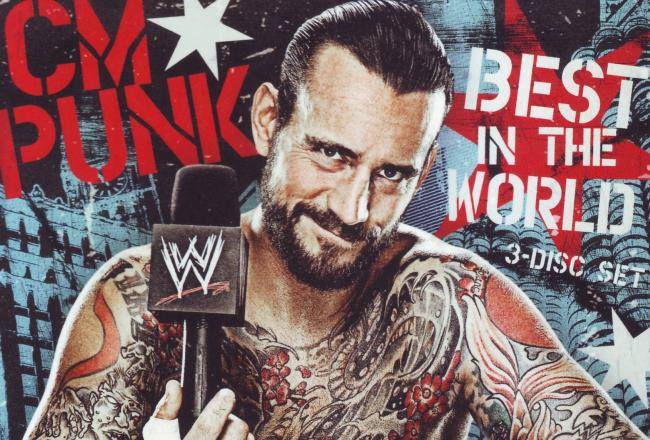
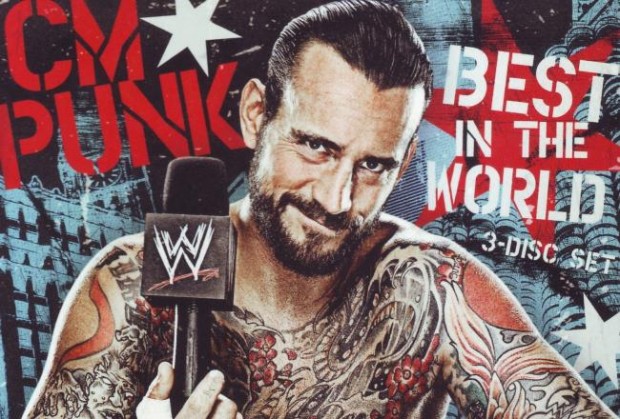 If you’re even remotely familiar with World Wrestling Entertainment, just one look at CM Punk on a Monday Night Raw telecast will tell you everything that makes his narrative so compelling: in an industry built upon and carried by Herculean physiques, CM Punk doesn’t fit the mould. If you are familiar with WWE, familiar enough, perhaps, to’ve seen one of their many retrospective documentaries, then the difference between Punk and men like Dwayne “The Rock” Johnson, “Stone Cold” Steve Austin, and John Cena are even more clear cut.
 CM Punk: Best in the World. Directed by Kevin Dunn. A documentary featuring CM Punk, Colt Cabana, Chris Hero, Daniel Bryan, John Cena, Triple H, Michael Hayes, Paul Heyman, and others. Released October 9, 2012, by WWE Films. Extras include documentary footage and matches across Punk’s career.