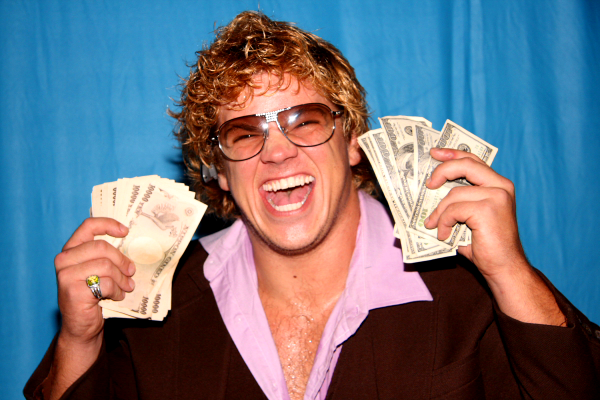
It’s been a year since the tragic passing of “Sweet and Sour” Larry Sweeney. If you’re not familiar with the man’s work—and, to be honest, I wasn’t until a year ago—Sweeney was the best kind of indie wrestler, a dude who was great at all aspects of the craft, able to speak intelligently and wrestle compellingly, a guy who very clearly loved what he was doing. Though he was a career heel, it’s next-to-impossible to not love Sweeney back. His gimmick, if you want to call it that, was brilliant—a throwback to “Hotstuff” Eddie Gilbert and other territorial champions who were too cool for their territory and their opponents, who ran huge super-stables in an effort to put as many roadblocks between himself and his opponent as possible. (more…)
Tag: wrestling matches
-
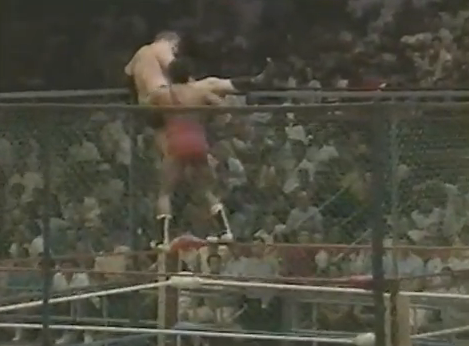
Carlos Colon vs. Stan Hansen (??/??/87)
The WWE has an odd (if understandable) fetish for second generation wrestlers, and while it certainly counts for something to be a DiBiase or a Rhodes or, heaven help you, a Hart, the poor Colon family—which has been visible on WWE television since the debut of Carlito Caribbean Cool—despite the moderate success of Carlito and the current championship team of Primo and Epico, may as well be anomalous beings from Parts Unknown. Being Rikishi’s son, it seems, carries more weight. But family patriarch Carlos was mentioned almost arbitrarily this past Monday on Raw, perhaps to ameliorate some of the damage done to the credibility of the current tag team champions via a quick loss-and-chokeslam segment, the function of which was to build the Big Show up before his match at Wrestlemania. If one’s only experience of the Colon family is the apple spitting, perpetually frustrating Carlito or the WWE’s quizzical handling of its tag team division, it’s time to fire up YouTube.
Granted, I can’t blame you if you’ve yet to see a Carlos Colon match. Colon may be most familiar to modern fans as the owner of the WWC, a sort of watered-down sports entertainment entity in Puerto Rico that brings in guys like Scott Steiner and Scott Hall in an effort to pop a once-rabid crowd. At one time, however, the WWC was as good, as hot as any other territory, and while their American counterparts were folding-up shop or consolidating, WWC remained a fairly strong territory until becoming part of the WWE machine, having a roster of home-grown talent buoyed by gringos who didn’t fit the Rock ‘n Wrestling mold/didn’t feel like laying down roots in the NWA. Guys like Bruiser Brody and Abdullah the Butcher were frequent visitors and, when thinking of men who don’t fit the WWF or WCW of the time, it’s little surprise that Stan “the Lariat” Hansen wound up embroiled in a feud against Carlos, the godfather of Puerto Rican wrestling. He wasn’t a Rock ‘n Wrestler, and he wasn’t to become part of JCP/NWA/WCW until 1990, when he engaged in a brief feud with Lex Luger (of all people!) for the NWA United States Championship. He was, however, a recent AWA champion, but was close to the point in his career where Japan became his near-exclusive focus. Since I last wrote about him, Hansen’s become one of my all-time favorite wrestlers. This has a lot to do with his wrestling, which was as simple as it was brutal, but also because Hansen may just be the most realistic professional wrestler of all time. Listen to this man talk:
The way he tells it, Hansen’s got a personal issue with everybody walking the face of the planet, and that’s exactly the kind of nastiness he brought to Puerto Rico. So while I can’t blame you if you haven’t seen a Carlos Colon match before (this one is my first, too), if you’ve never seen a match from Puerto Rico before, there are few better introductions than a cage match featuring the bad man from Borger, Texas. This, simply, is a violent match: Two people brawling and bleeding before a near-riotous crowd. The only commentary you’ll hear throughout is the sound of an airhorn bleating nearly every time Colon lands a punch. Towards the end of the match, what looks like (but isn’t, obviously) a real riot breaks out among the wrestlers supporting Colon and Hansen in that giant, empty area surrounding the ring.
It’s tough not to love this match. You’ve got Colon, who is almost cartoonish in his enthusiasm when he gets on a roll, as the superman face. Hansen, for a change, plays the cowardly heel, trying his damnedest to create space between him and his adversary. The cage itself looks ugly and brutal, an odd combination of the NWA’s cage, which allowed for no interference, and the WWF’s cage, the object of which was to escape. That the cage is on the floor means that one has to incapacitate his opponent before leaving the cage. Hansen’s objective is never quite clear, though one suspects it involves the lariat, but Colon’s insistence upon the figure four leglock is tremendous, as is Hansen’s resolve to fight his way out of it. When Colon locks that sucker on, the response from the crowd is as loud and passionate as anything you’ll hear in the United States. I would say that the match is worth watching, but hopefully by this point you already have.
-
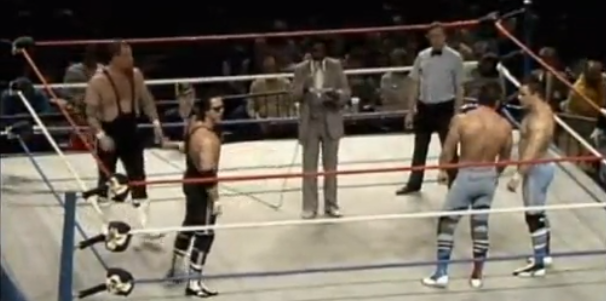
Hart Foundation vs. British Bulldogs (11/8/85)
I’m not saying this as a way of saying that the WWE tag team division is never going to get better. They’re a few teams away from really having something, but, just the same, things will probably never be the way they were when tag team wrestling served as a platform for new wrestlers to hone their craft and get comfortable in front of an audience. Point in case, this match right here. You might not realize it, looking at the men in the ring before most of them had established their personalities and chisled their physiques, but two of the participants in this contest — Bret Hart and Davey Boy Smith — would go on from their respective teams and be main eventers for much of the 90s. The other two went down completely different roads — Neidhart was, for lack of a better term, a career tag team specialist (say what you will about the New Foundation, but Owen Hart was a star shortly thereafter), and the Dynamite Kid, who was at this point already the godfather of lightheavyweight wrestling, wound up mentally and physically ravaged and was mostly out of the business by the early 90s.
But forgetting all of that, what this match, what the WWF tag team division had that it currently lacks, are teams with a) a sense of continuity and b) personality. You look at the Bulldogs and the Harts, and you’re looking at two of the best teams ever, two teams who seem to have been built to their partner’s specifications. Hart was small, still nervous on the microphone. Neidhart was large and charismatic. Davey Boy was powerful. Dynamite Kid was lightning quick. Tag teams used to compliment each other. Now they’re thrown together because two dudes had nothing better to do.
Not only were the Harts and Bulldogs great tag teams, they were great opponents. They feuded for much of the time the Bulldogs were in the WWF, and each match felt fresh and unique, regardless of time or place. The Bulldogs and the Foundation would later compete over the WWF Tag Team Titles, but here they’re merely in it to win it, two teams testing each other and trying to prove to each other who the better men are. Few tag team divisions in history were well-stocked enough to handle a feud of this magnitude concurrent to what the champions were doing, but both the WWF and the NWA/WCW had that going for years. Moreover, the tag teams of that era were just as over as some of the singles stars. Listen to the reaction the fans have for this match. Realize that the Road Warriors are one of the best draws of all time, that a feud like the Midnight Express could have a 15 year run without growing stale.
It’s true, both the Hart Foundation and the British Bulldogs broke up, but they left an indelible mark on wrestling before splitting up, so much so that you could argue for their inclusion in any reputable pro-wrestling hall of fame without Bret Hart’s magnificent run as a top singles star, or the height of Davey Boy’s popularity, or Dynamite Kid’s series against Tiger Mask. The problem with the WWE tag team division today isn’t so much a lack of focus, but that the tag teams that might draw people’s interest are so often temporary pairings. It’s a near-miracle that a combination like Big Show and Chris Jericho went on as long as it did, and who knows how long Air Boom were meant for this world. Until the powers that be decide to find a few more teams like the Usos and Primo and Epico, teams that wouldn’t rightly function with anybody else at the helm, teams made up of something more than interchangeable parts, the division will continue to flounder, and the best examples of great tag team wrestling will continue to be the past, Japan, and the independent scene, where a good tag team or a good match can still draw a response like the one the Bulldogs and the Foundation got above.
-
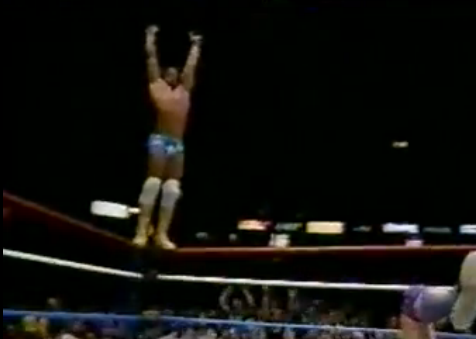
“Macho Man” Randy Savage vs. Harley Race (9/18/87)
It strikes me odd that I’ve never seen fit to write about Harley Race before, though I suspect that mostly has to do with the way I’m familiar with him, which is as the burly, tough-as-nails old man who used to accompany Big Van Vader to the ring in WCW. Harley, in brief, is one of the greatest wrestlers of all time. Sadly, being one of the greatest of all time didn’t really mean much in the Rock ‘n Wrestling Era, where the leisure-suited Race of the 70s and 80s (a gruff, mean precursor to Ric Flair’s slicker, smoother style) would have been laughed out of the building despite the years he spent atop the NWA, terrorizing the world with his majestic afro, his stiff punches, and his crisp execution of just about everything, from knee drops to piledrivers. Harley is still active in wrestling, as a trainer of good repute. His handiwork can be seen on WWE TV in the persons of Ted DiBiase and Michael McGuillicutty, and he’s also the trainer of several other second and third generation stars, including Mike DiBiase, Reid Flair, Amy Hennig, and Ricky Steamboat Jr. When the DiBiases, the Flairs, the Hennigs, and the Steamboats of the world are sending their progeny to you, that’s respect. Like I said though, that didn’t quite translate to Race’s WWF career, where they billed him as “The King” of professional wrestling. Race won the second King of the Ring tournament in WWF history in 1986, back when the tournament was not televised, and became the first man to parlay victory in the tournament into a gimmick, as evidenced by the crown, the robe, and the royal purple trunks, adorned with another crown. Race’s crown was the official one in the WWF for some time, passing from him to Haku to Jim Duggan to Randy Savage, who made perhaps the best use of the gimmick as the “Macho King.” Race, however, was in the twilight of his career during the whole “King” thing, which did see him feud against Hulk Hogan, which is about as high profile as wrestling for Vince McMahon in the 1980s got. Sadly, he suffered a hernia in a match against Hogan, and after a brief comeback, was let go. His last match as an active competitor was in 1991, at which point he was hired to be a manager in WCW.
But what made Race so great was still evident during his run as King, even though his reign as king served as a precursor to other King of the Ring wins that did nothing for the new regent. Granted he’s in the ring against the freaking Macho Man, but Race here is the rare wrestler who doesn’t prove the announcer a fool when talking about “ring experience” and “ring positioning.” Race takes a few of Savages best shots–the bionic elbow and top rope double axe-handle combo at around the 10-minute mark–and calmly, naturally puts his feet on the ropes. Too often, a wrestler’s leg shoots up for the ropes at the last second, using the same amount of energy it’d take to kick out. When Savage goes to pin Harley after the double axe-handle, Race lets Savage’s own momentum swing his leg over the rope. Simple. Effective. Smart.
I’ve written a ton of nice things about Savage on this blog in the past, and there’s no need to reiterate much of it. This, for historical purposes, was during his transition to a full-blown face. Gorilla Monsoon mentions the Honky Tonk Man’s ill-intentions towards Elizabeth at the start of the contest, and it was that feud, not the association with Hulk Hogan, that won the fans over to the Macho Man’s side. People don’t often compliment on Elizabeth much beyond her beauty, but her ability to engender sympathy was truly second to none. She single-handedly turned Savage face not once, but twice, and both under amazing circumstances. She might not have been a great manager the same way a guy like Bobby Heenan was, but in terms of performing a useful function, Elizabeth was one of the WWF’s most reliable ringside presences.
-
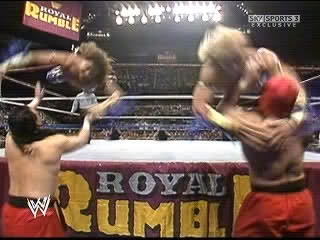
The Rockers vs. The Orient Express (1/19/91)
For all the nice things I’ve been saying about current WWE Tag Team Champions Air Boom (note: I’ve never complimented their name), nothing they’ve done so far in “rejuvenating” the WWE tag team division has so far pushed any of the American tag team wrestling that set the standard for the genre way back in 1991. This isn’t necessarily the fault of Kofi Kingston and Evan Bourne, who get along well and sometimes wear matching trunks, but due to an overall lack of depth in the tag team ranks, depth that isn’t going to be rebuilt overnight. We’ve got the Usos, C. Reks, the Sharecroppers, Swaggler and the New Mega Powers of Cena and the Rock, but in the early 1990s, the WWF featured the Hart Foundation/New Foundation, the Legion of Doom, Demolition, The Powers of Pain and the Rockers, to name a few. Guys were “tag team specialists” and, when faced with singles matches, tended to struggle without having a partner in his corner. That’s the way things were in the 1990s, and, if this match is any indication, there’s a lot of work that’ll need to be done before the fans start caring as much about tag team wrestling as they used to. Now, comparing Shawn Michaels and Marty Jannetty to Evan Bourne and Kofi Kingston isn’t fair to the erstwhile lads in Air Boom. Michaels went on to have a Hall of Fame career and Jannetty, despite his name being synonymous for tag team postpartom failure, is one of the most underrated wrestlers of the 1990s, a guy capable of having a good match with anybody–hell, a guy still having good matches with people, as his 2005 bout against Kurt Angle and a recent match against Tyler Black have shown. The success of the Rockers is that both men were unique, both men brought something new and exciting to the musclebound WWF, and that’s on display early and often in this match. How many other wrestlers in 1991 WWF were hitting moonsault presses and suicide dives? How many went at this level?
But the Rockers, despite their obvious popularity, were never the WWF’s top tag team. In fact, Jannetty and Michaels never won the WWF Tag Team Titles, despite several great matches the pair wrestled in for the belts. This was how deep the WWF tag team division was: There was a tag team midcard, and Shawn freaking Michaels was mired in it. Not to worry though, as there were other great tag teams in the midcard, like the Orient Express, which, here, is the duo of Paul Diamond (under a mask as Kato) and Pat Tanaka (also not of the Orient), who, in the AWA, were known as Badd Company. They, too, were a great tag team. If you put two great tag teams together, you get a great tag team match.
But Rockers/Express at Royal Rumble 1991 had an advantage that even most matches featuring two great tag teams didn’t: Both teams were experienced facing each other, as Badd Company once feuded with the (Midnight) Rockers way back in 1988. That level of intimacy is obviously very important to this match, which is equal turns wrestling, gymnastics and, above all, performance art. They know each others tricks and work them in well. They’re aware of small, incidental details (the black belt that comes into play towards the end) and use them extremely well. There’s an unexpectedly hot crowd, good commentary from Gorilla Monsoon and Roddy Piper, and the nefarious Mr. Fuji “relaying orders” at ringside, and while a few hiccups are noticeable, this is a deliriously good tag team contest–the sort of match others model off of. Apparently Michaels and Jannetty were so pleased that they went backstage and said “Top that!” which landed them in a whole lot of trouble (I imagine wrestler’s court isn’t kind to braggarts). It’s been twenty years. The Rockers and the Orient Express are still waiting to be topped.
-
Bryan Danielson vs. Kamala (9/30/06)
Where else but a high school gym would one expect Bryan Danielson, future WWE Superstar, to defend the highly respected ROH World Title against the man, the myth, Kamala? This is the secret hidden potential of independent wrestling: That some promoter will get the bright idea to toss together a legend and an indy darling for the viewing pleasure of the fifty or so people who paid to be there. This is the secret hidden potential of the internet: That a match like this somehow makes it onto YouTube, where an audience forty times that size can see it, too. As an added bonus, Liberty City Wrestling has no announcers, so not only does one get to hear Danielson yelling at Prince Nana for screwing with the pinfalls, but you get to hear the awkward fellow who has the distinction of being the only guy in the building who thinks that the American Dragon is overrated air his opinions in a public forum. This is by no means a great match, and I don’t really know if you can call it good, in the strictest sense of the word. Danielson, as anybody who knows his work might guess, is what makes this match go. Not only does he sell Kamala’s gimmick better than anybody has in the past twenty or so years, but he keeps the match moving where other people in his shoes would have left a lot of dead air for Kamala’s grunting and stomach slapping routine. There’s also the issue of Prince Nana, who has one of the better gimmicks on the independent scene. He’s (legitimately) a Ghanian prince, so he uses the tax money he collects to hire wrestlers to be in his stable (The Embassy) and do his dirty work. I can’t tell if he’s hired Kamala to win the ROH Title for him or not, but he certainly doesn’t want Danielson pulling one over on the Ugandan Giant.
Speaking of Kamala, it’s almost heartwarming to see him still headhunting for his first World Title. 28 years after his debut. Kamala, obviously, is way past his prime, though he can do a lot more than you’d guess from the string of bookings he’s taken with WWE over the past few years. There’s a little bit of his old self in here, when Danielson is selling his gimmick and when the two are brawling around the spacious ringside area, but there’s little doubt that the ROH strap won’t be going with him to Uganda. That’s what I like most about this match–Kamala’s been hunting for a World Title so long, often in big territories, that it almost makes sense that he’d go after Danielson. Imagining Kamala winning and going against some of the best ROH had to offer at the time is also a wonderful thought. Picture him at their shows before belltime, trying to sell fans copies of his self-recorded album, The Best of Kamala: Volume 1 and tell me his being champion wouldn’t have ruled. Alas, the match ends in a schmozz, so the closest Kamala will ever get to the recognition he and Kim Chee so clearly deserved is this tremendous magazine cover, from 1987:
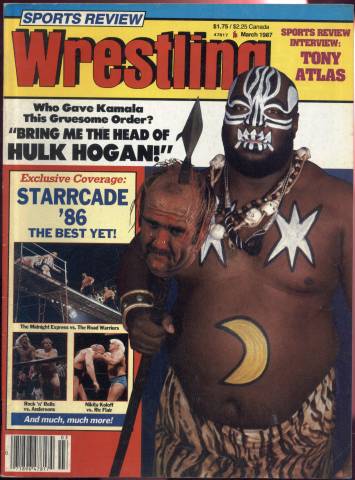
Oh well. If the World Title hunt doesn’t pan out, at least Kamala can fall back on his second love: Bowling.
Kamala vs. Doink the Clown