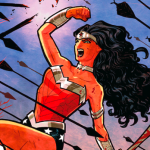
I may have fallen shy of my goal to read every new series DC Comics published as part of its New 52 initiative, but one of the books I did not miss, that I’m very glad to have not missed, was Wonder Woman. I’m a huge fan of the character, and I am always, always happy to see her done well. Unfortunately, with the exception of three recent bright spots, it seems like DC Comics are content to do things with the character that, in 2012 (or 11, or 10, or 09, and so on), seem less forward-thinking than they are head-scratching — making the call to change costumes to get the character on TV and then making a pilot so averse to networks that it’ll be years until anyone touches her, making her origins less Greek, handing her over to writers who, in turn, either didn’t do much with her or made her book unreadable, for any number of reasons — and this, in turn, has led to the current DC Comics landscape, where the DC Trinity consists of Batman, Superman, and Green Lantern, who is so whitebread that Hulk Hogan’s “Real American” may as well be blasting from the pages of the book whenever the guy does something remotely heroic.
The best thing about the New 52 is that Wonder Woman hasn’t been this good since Greg Rucka’s run on the book. I didn’t expect this from a rebooted universe where a character popular with 20 million children was recast as an intergalactic hooker, but good things are happening with my favorite fictional character, so, for now, I am happy enough to give DC Comics my money.

But now DC is going through with a “second wave” of New 52 books, “introducing” Earth-2, a needlessly complicated system of parallel world-building that made sense 40 years ago when Superman was gaining new, ridiculous powers every week and Bruce Wayne needed to face the consequences for his playboy lifestyle, but now, in 2012, months removed from literally creating a whole new world that was meant to put to rest all of the nerdy problems that resulted from so many parallel planets, feels forced; a way for the company to try to keep up with Marvel despite having just one property (Batman) capable of competing with the heavy hitters of the other line.
The accepted, science-fictional standard for parallel worlds is that, often, the timeline on the other planet diverged at some point, resulting in fundamental changes from the planet we’re familiar with. Say Joe Chill was suffering from the flu the night he murdered Batman’s parents. On Earth 1, he figures he could use the dough to buy flu medication, wanders off to the movie theatre in Crime Alley, murders him some millionaires, and we’ve got ourselves a Batman. On Earth 2, Chill decides to roll over and go back to sleep. Bruce Wayne is healthy and well-adjusted and never gets the idea to fight crime dressed up as a bat, instead having grown-up to be a prime piece of kidnap bait. That kind of fundamental change, however, rarely comes from Earth 2 situations in comic books for one, simple reason: You take away Batman or Superman, and you take away a fan’s reason to read. That’s fair, though, as only the most die-hard of die-hards can be expected to work themselves up over the alternate origins of Matter-Eater Lad.

No, when it comes to modifying the origins of a superhero for the purposes of an alternate world, you need to do something radically different while keeping the character fundamentally unchanged. For Wonder Woman, this has meant any number of things: Making her less or more mythological, going back to her first encounter with “Man’s World,” taking away her powers and costume and making her a kung-fu fighter, giving the title of “Wonder Woman” to somebody completely different, and so on. This time out, however, Earth 2 writer James Robinson promises the following for the character:
Due the events that open the saga of EARTH 2, Wonder Woman is already the last Amazon of this world and she is determined to avenge her sisters…at whatever cost.
This is conjecture, but if my powers of intuition are correct, Earth 2 promises to slaughter all but one resident of Themyscira. It’s not uncommon for comic books to slaughter an entire race, minus one — this, after all, being the origin of Superman — but the fundamental difference between Earth 2 and “Doomed planet. Desperate scientists. Last hope. Kindly couple.” is that Krypton’s destruction, at least, was gender neutral.
This is where things get contentious, see, because the conversation surrounding comics lately — a conversation made heated by AMC’s Comic Book Men (emphasis on “Men”), the aforementioned up-sexying of not only Starfire, but Suicide Squad‘s Amanda Waller and Catwoman‘s Selena Kyle, and DC Comics releasing a poll that, boiled down, claims that women don’t read comics — has shifted from the long-dated “Comics ain’t just for kids!” mode of thinking to the much more charged “Comic books are inherently, reprehensibly sexist.” Say what you will of this argument and its supposed extremism — Cracked.com readers, in response to a simple article about sexist superheroine costumes, already have — but Earth 2 promises two things: Gendercide, and a cold, mirthless Wonder Woman.

This, I realize, might not appear to be a problem. They’re not grossly oversexualizing Wonder Woman, and they’re promising to do something major with a major character who is often left out of the loop when DC does major events. If you believe, as the company does, that women don’t read comic books, it may follow that the impending slaughter (or whatever) of the Amazons is, in fact, no big deal. It’s all part of a larger story, a mystery. It’s something we’re meant to unravel, something that’ll make Wonder Woman “interesting” and “relevant” and “marketable” and all those other things the character already is, but that DC has, almost comically, been unable to realize for decades. Here’s Earth 2 editor Pat McCallum to tell us how different this brave new world will be:
While there will be recognizable faces and settings on EARTH 2, don’t for a moment think you’re on familiar ground. Do that, and you let your guard down…and then you’ll end up like the rest of the Amazons.
This all sounds decidedly familiar. Granted I’m no comics historian, and I can’t claim to have read every Wonder Woman story to have ever seen print, but here’s what I’ve gleaned about the denizens of Paradise Island throughout the years:
- When it comes to men, the Amazons are painfully naive, so much so that they need to send a representative to “man’s world” to report back on them.
- With the exception of Wonder Woman herself, there isn’t a single Amazon capable of showing an emotion beyond anger.
- The Amazons are a bloodthirsty race, capable of two things: Warring on “man’s world” and showing a deep distrust of it.
- Inevitably, the Amazons will turn on Wonder Woman, presumably because she, in living among men, has come to accept and perhaps enjoy their company.

The Wonder Woman of Earth 2 will probably be some combination of the above traits: Naive, angry, bloodthirsty and distrusting. This, at least in my opinion, is the worst permutation of Wonder Woman possible, an uninteresting, stock babe in a swimsuit, hacking and slashing her way through those she feels wronged her until somebody (likely a dude) stops her. She’ll end up fighting with the group of heroes who presumably let her whole society perish, this despite Themyscira having a surplus of women in refrigerators. Eventually, there’ll be a survivor, and her and Wonder Woman will be forced to fight. That’s because, no matter how cool or great or iconic Wonder Woman is, she’ll always end up in gender war stories, and sure as every other old-school Wonder Woman cover had Diana bound by her own weapon, you can bet on two things:
- Wonder Woman will side with the boys.
- The boys will always win.
This goes back to the belief that only men read comic books, the feedback loop that says that, since that’s the case, it’s OK for comic books to maintain a somewhat (or, in some cases, a full-blown) sexist worldview, presenting, in 2012, a shockingly bankrupt take on a society free from the input of men, one wherein the gaggle of man-hating lesbians are invaded and conquered by their supposed betters. Earth 2 could have done something completely different, something completely un-comic book, but going against the grain, reaching across gender boundaries, and attempting to hook new readers are all goals less important than appeasing an ever-dwindling market and holding out for that rarest of rarities: A profitable film/TV show.

Sadly, nobody involved seems to get Wonder Woman’s mythology, which is perhaps the most fascinating in comics. Nobody seems to care about the idea of an immortal race of women who, left alone for centuries, developed their own customs, technology, and skills. As long as we maintain our view of comic books as the stuff of testosterone-laden fantasy, the women appearing on those four-color pages will remain, by and large, either Cool Female Buddies or The Other, likely a combination of both, that intangible mix of fascination and fear. As long as we’re cool with the idea of female genocide for entertainment, not only will a vast, mostly-untapped demographic remain uninterested (or continue to be portrayed as uninterested), but the idea of comic book reader as basement dwelling, angry virgin will persist. We will remain hiding among our longboxes, afraid that Amazons may yet attack.