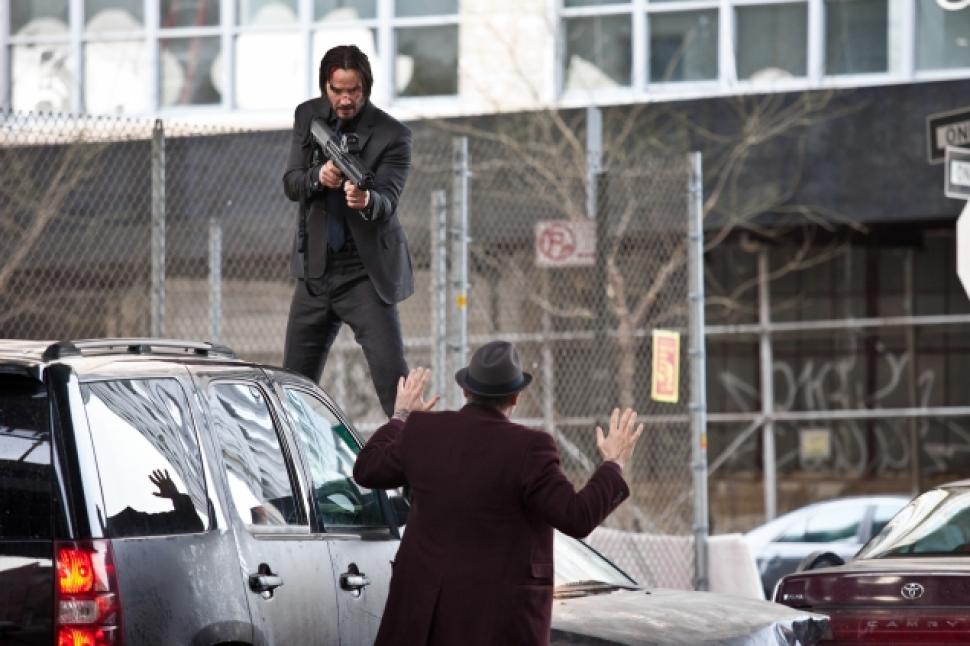
John Wick is an anachronism, a stylish action thriller whose fight choreography chops are legit to the point that the usual gamut of camera and editing tricks used to create motion where none exists are largely put away. There’s a good bit of background mythology, too, an underworld of contract killers who operate on respect and gold coins, who have pasts they are either proud of or are trying to leave behind. Were it released ten years ago, and had Lionsgate a better sense of how to market a film where a man in a suit kills dozens of men wearing suits, it’s not hard to imagine the dorm rooms I frequented in college having a John Wick poster up on the wall, right next to The Boondock Saints, the Baba Yaga of this film standing shoulder to shoulder with the MacManus brothers in the bro canon.
I feel a little bad writing that, because I actually enjoyed John Wick a good deal. In 2014, it seems like films leaning heavily upon the aesthetic of early Woo and Tarantino efforts have finally managed to quell the rampaging hormones that soured stylish killers to the point of queasiness. Here, Keanu Reeves is the titular hero, a former hitman of legendary proportion who up and walked away from the game one day. He got married. His wife died. Knowing her husband would be distraught and purposeless without her, she arranged for a puppy to be delivered to John. Before long, a crew of Russian gangsters break into John’s house, looking to steal a car he had earlier refused to sell. They knock John out. They kill the dog. They leave it there for John to find when he comes to. None of them know John Wick’s reputation. They will, soon enough.
The revenge plot here is what it is, and it ends as it must. What’s more interesting about John Wick is its underworld, and how Reeves navigates it the way a ghost would, his surroundings both familiar and strange. After stopping an assassination attempt singlehandedly, Wick decamps to The Continental, a full-service hotel/bar/hospital/spa/brothel for men and women of his former profession. If you’ve got a gold coin on you, anything is a phone call away. The Continental has rules—no noise, no violence, no business of any kind. It’s perfect for Wick’s needs, as he has an account and has drawn the ire of Viggo Tarasov (Michael Nyqvist), whose son (Alfie Allen) killed Wick’s dog. Tarasov once worked with Wick, and he knows that it is hopeless to plead mercy on his son’s behalf. So he puts out a bounty for two-million dollars, four if anybody is willing to break The Continental’s strict rules. Wick, when he isn’t perforating Tarasov’s faceless heavies, is hunted by the young, ruthless Perkins (Adrianne Palicki), and protected by Marcus (Willem Dafoe), who always seems to be on the right roof with a sniper rifle. Wick knows all of these people, and others who populate the world-within-a-world that is John Wick‘s playground. It’s a vague, barely sketched out premise, and the fact that it works is a result of a smartly chosen cast meeting ideas that are interesting enough, if not thought about for too long.
But the mythological aspects of John Wick are what directors Chad Stahelski and David Leitch are hoping to build a cult around. The selling point of this film are its action sequences and its way with gunplay. Stahelski and Leitch were Reeves’ stunt doubles in the past, and the clarity of the carnage throughout is quite satisfying. Reeves moves through a rave or his mansion, tracking and killing every man that stands between him and his ultimate goal, and the camera right along, content with whatever rust there might be on its aging hitman’s bones. There’s a seeming effortlessness to it all, a cool beyond the overly-cool blues that the film is washed in, and it makes Wick a more engaging figure than all of Nyqvist’s growling about his boogeyman, back from retirement. As a veteran of countless Schwarzenegger and Stallone movies about hulking men trying to put some wife-related misery or death out of their minds, my ability to engage with gun-toting men in mourning has withered, and my capacity to appreciate the puddle deep philosophies of those genre pictures that take themselves too seriously is at its end. On some future rainy afternoon, though, it’ll be tough to refuse the proposition of John Wick on cable, with limited commercial interruption. That’s a kind of success, too. Not a poster on a dorm room wall, but something.
John Wick. With Keanu Reeves (John Wick), Michael Nyqvist (Viggo Tarasov), Adrianne Palicki (Perkins), Ian McShane (Winston), John Leguizamo (Aurelio), and Willem Dafoe (Marcus). Directed by Chad Stahelski and David Leitch, from a screenplay by Derek Kolstad.

 Lars von Trier’s Antichrist is a film as beautiful as it is horrifying, its beautiful compositions juxtaposed against emotional and physical brutality. Its leads, Charlotte Gainsbourg and Willem Dafoe, are given occupations rather than names, and it is the weight of those occupations, as well as the weight of their grief, that crushes them both. She is an academic. He is a therapist. While making love one afternoon in the winter, their son manages to escape his cradle, climb out onto the window-ledge, and fall to his death. During the funeral, She faints and is placed in a hospital for psychiatric evaluation. He, being a therapist, believes himself more capable of treating his wife than the new doctor she’s been assigned and, proscribing a course of exposure therapy, removes the two to their cabin in the forest, which, without irony, the two call Eden.