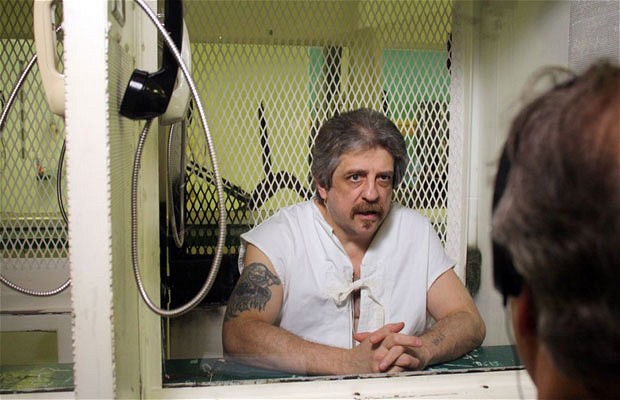
 Clocking in at about the length of an ambitious arthouse film, it is perhaps generous to consider the act of watching the four episodes of Werner Herzog’s On Death Row “binge-watching,” but Herzog’s shortform meditation on the American justice system and its use of capital punishment is nevertheless an act of attrition. Hidden away from the world by the machinations of the prison-industrial complex, it isn’t until cameras are brought to bear on the men and women of death row that the implications of their sentence truly resonate. Articulate, impassioned, and more knowledgeable about the American justice system than the average true crime junkie, the subjects of these interviews (and those of Herzog’s companion film, Into the Abyss) are fascinating not because of the crimes they’ve been convicted of committing, but because, like many of the individuals Herzog focuses his camera on, they live in pockets of the universe too uncompromising and barbarous to be properly rationalized.
On Death Row profiles five men and women whose lives are consumed by their long wait for execution. Though Herzog is the one who conducts interviews with the convicted and those involved with the case, he never appears on camera, instead shooting his subjects in such a way that they speak directly to the viewer. Were this any other project, such a set-up might inspire pleas of innocence to a sympathetic ear. Though Herzog cannot see the case for capital punishment, his is not a forum for exoneration. “Sympathizing with your quest to have procedural injustices corrected in your case does not necessarily mean that I have to like you,” he tells James Barnes, a Florida man convicted of murdering his estranged wife. After converting to Islam, Barnes was compelled to confess to an infamous unsolved murder, which saw him sentenced to death. His conversations and letters with Herzog would later prompt Barnes to confess to two additional unsolved cases. With this revelation, however, Herzog must consider if Barnes is being truthful, or if his confessions are a ruse meant to prolong his life.
Barnes is unquestionably guilty of the two murders he’s previously confessed to, and George Rivas, the leader of the Texas Seven, a gang of inmates who led the largest jailbreak in Texas history, carries the burden of knowing that he shot and killed a police officer on Christmas Eve. His other interviewees, Linda Carty and Hank Skinner, find themselves caught in impossibly complex legal situations. Carty is a British citizen who claims to have been an undercover informant for the DEA. Skinner, on death row for the murder of his girlfriend and her two sons, was only minutes away from his execution when he received a stay from the U.S. Supreme Court, who found that he could successfully sue for the right to have unused evidence from his trial tested for DNA. Joseph Garcia, one of the Texas Seven, is awaiting execution despite not having fired a shot at the slain police officer; Texas law has it that accomplices to crimes are culpable to the same degree as the perpetrators, so his sentence was the same as Rivas’. He joined the Texas Seven because he was sentenced to life in prison for a murder he claims was self-defense. His conviction to that end was so strong that he refused to take a plea bargain of fifteen years. His testimony—which involved a demonstration of his skills with a butterfly knife—could not have gone more disastrously.
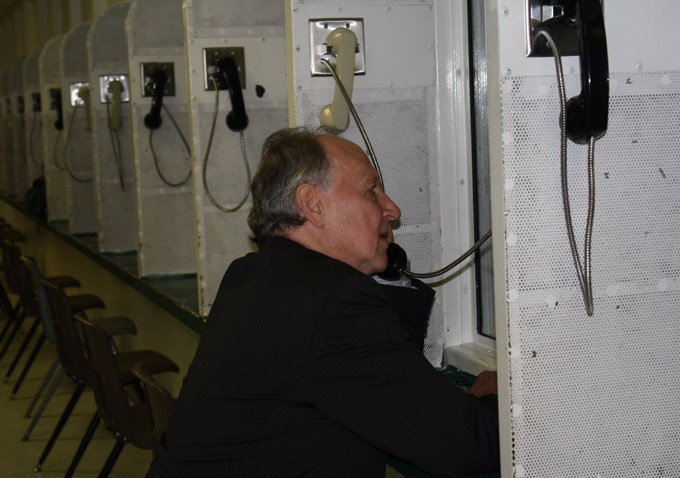
The circumstances of On Death Row‘s production—Herzog’s interviews were limited to an hour, and repeat visits were permitted months apart—and Herzog’s rather blunt way of telling the inmates that his interest in their case does not indicate a wish to be friends makes the resulting intimacy of each episode something of a surprise. One senses that Rivas, despite being guilt-ridden over the murder of Officer Aubrey Hawkins, is proud of his achievements, not only his ability to coordinate a jailbreak and evade capture for so long, but in the sheer cleverness of his many heists. Skinner is a natural-born storyteller, and if one is willing to suffer his excursions into Templar history and the connectedness of all things, he has one hell of a story to tell. What the mini-series makes clear is how remarkable an interviewer Herzog is. A German national with a deliberate way of speaking, he’s able to draw from James Barnes’ twin sister a heartbreaking portrait of being raised by their father, a strict disciplinarian who forced his children to whip James when he misbehaved, which was frequently. He manages to push Skinner beyond the realm of coincidence and into the mindset of a man who has been served his last meal. The attorneys he speaks to, of course, are more than willing to talk, but he hardly allows them to use his camera as a bully pulpit. When the prosecuting attorney in the Linda Carty case warms against humanizing Carty, Herzog replies “I do not make an attempt to humanize her. She is simply a human being, period.”
When thinking of a partner for Herzog to present a TV miniseries about death row inmates, Investigation Discovery seems the least likely option. The network’s bumper, an insidious voice whispering “investigate” in a manner shrill enough to haunt dreams, is more of piece with the network’s regular offerings, shows like Who the (Bleep) Did I Marry? and I (Almost) Got Away With It. Scanning through these shows on Netflix, Herzog’s presence among them is the only thing separating something like Stalked: Someone’s Watching from John Beard’s To Entrap a Local Predator: Orange County Edition: Super Creeps; a calm, contemplative voice in a room crowded with lunatics. Investigation Discovery somewhat mitigates this by bringing in Paula Zahn as a “presenter.” This role sees her standing imperiously next to the words “ON DEATH ROW,” which are presented in an austere typeface in Herzog’s film but are bold and oppressive otherwise, fading into a grungy Photoshop filter to emulate dirt that won’t wash out. Zahn does little more here than issue the usual rhetoric about “hardened criminals” and “brutal murders,” and her presence eventually diminishes to the point that her overly simplistic case notes amount to little more than minor annoyance. The experience of these people and their account of the crimes they either confess to committing or fight vehemently against are far beyond the bounds of rote description.
This is a remarkable project which, along with Into the Abyss, comprises two four-episode seasons, one film, and, one assumes, plenty of unpublished literature. In keeping his focus on the inmates and their circumstances, Herzog is able to avoid the pitfall of much true crime programming, which is to lionize both the circumstances of the crime and the punishment meted out. Though these men and women live in cages so small that facial hair is a privilege and dreams of avocados are treasured, it is those privileges and dreams Herzog is fascinated with, that inspire him to a conclusion worthy of one of his most heralded films. Driving the same 40-mile route the Texas Department of Corrections uses to transport convicts from the Allan B. Polunsky Unit, where death row inmates are housed, to the Huntsville Unit, which contains Texas’ death house, Herzog observes “the landscape, bleak, forlorn. And yet everything there all of the sudden looked magnificent. As if entering the holy land.” It’s a strange path Herzog cuts through the world, much of it maudlin and courting insanity. He is the same as the mannequins he discovers between the Polunsky and Huntsville units, an apostle on the road to death. His subjects may not deserve the freedom they fitfully dream of, but neither do they deserve the torment of knowing when and how that road terminates.