Navigate / search

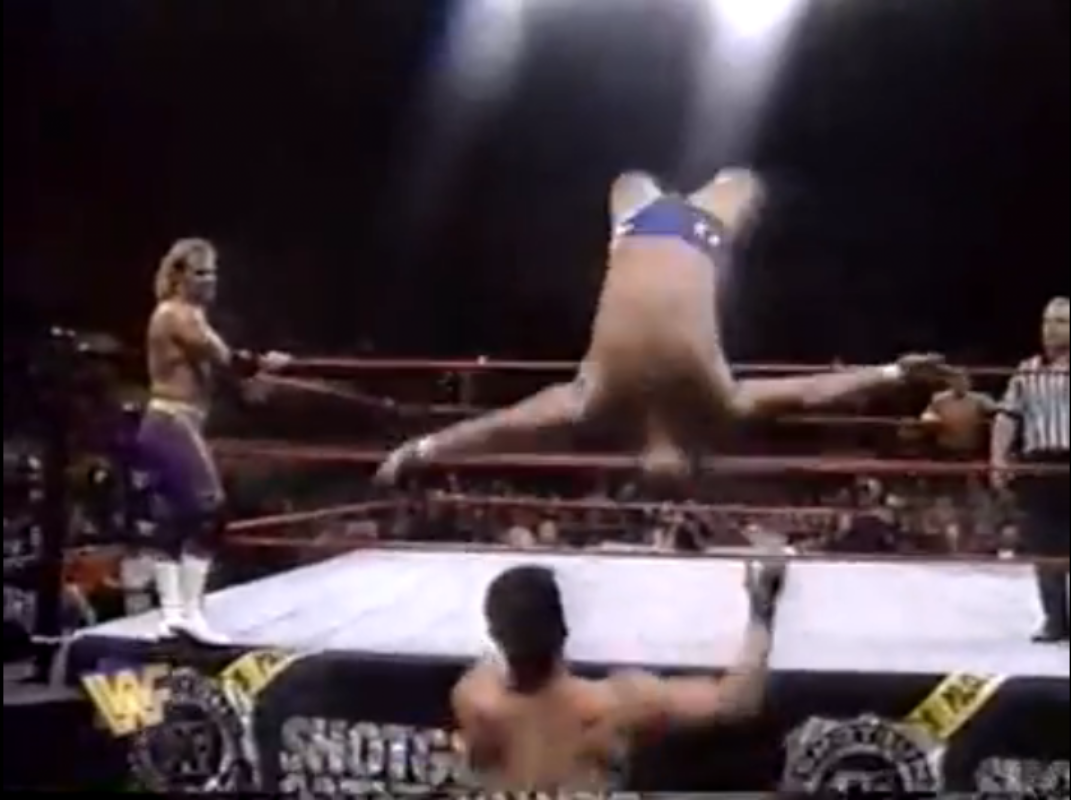
TAKA Michinoku and Scott Taylor vs. Tajiri and Brian Christopher (1/11/97)


I think it’s unlikely that you’ll find a more fundamentally weird tag team match that aired on WWF television during the Attitude era than this. First, there’s Tajiri (I love how Jim Ross pronounces it). He’s two years away from making his ECW debut, working the Japanese independent scene (he was a regular for Big Japan Pro Wrestling at the time). Here, he teams with Brian Christopher, who, at this time, was using the most annoying gimmick in wrestling history–”not” being Jerry “The King” Lawler’s son. The gulf between Tajiri’s Japanese style and Christopher’s Memphis leanings was immense, only matched by the clash between TAKA Michinoku–the designated leader of the WWF’s new Light Heavyweight Division–and Scott Taylor who, though you wouldn’t know it from his rockin’ mullet, would one day look like this:

The thing about Scott Taylor is that he’s actually a pretty good worker. He and Christopher would eventually form a long-running tag team, first as the Memphis heel duo Too Much, then as the kid friendly dance crew Too Cool (featuring Rikishi), where he’d see his greatest success (and, incidentally, take part in one of the best matches in Monday Night Raw history), but when Christopher and Rikishi were eventually cut, Taylor hung on and did some good work in WWE’s retooled Cruiserweight division. A shame about the Worm, though–of all the lame taunt/attacks in wrestling, the Worm is the worst.

I wouldn’t be surprised, however, if you weren’t at all interested in the exploits of Too Cool, and were to watch this video just for Tajiri and (if you were smart) TAKA. The WWF Light Heavyweight Division could have been really interesting, but for some reason it failed to pick up steam. True, WCW had the market cornered on Mexican lucha libre, and their homegrown cruiserweights, like Chris Jericho (not technically homegrown) and Billy Kidman, were way more interesting/better than Christopher, Taylor, or an early Christian (oh, frilly-shirted Christian), but the division’s importance was undermined by circumstance. Consider this: The WWF didn’t even know that they HAD a pre-existing Light Heavyweight title until they started putting together the division. It was part of the J-Crown, a mad amalgam of belts that could take your ordinary, run of the mill Ultimo Dragon and make him look like this:

Dragon, if you may recall, was a WCW wrestler, and he actually defended the J-Crown in WCW, most notably against Rey Mysterio Jr. Had the WWF not found out about their title being overseas, had they not demanded its swift return, a WWF Title would have been defended on a WCW Pay Per View. Granted, I highly doubt anybody important in WCW would have noticed to make a point of it and, granted, it would have been a title that technically had never been an official WWF title, but it still probably would have been a little embarrassing.

The other thing about the Light Heavyweight division that went awry is that the Great Sasuke was supposed to be involved. Sasuke was actually supposed to win the tournament crowning the first “official” champion, but he went on Japanese TV and said that 1)he’d only defend the title in Japan and 2)he’d refuse to lose the title on WWF TV. So the WWF fired Sasuke and pushed TAKA as the face of the division. What sucked about that is that (I presume) Vince Russo was booking things on Raw, and if there’s one thing Vince Russo doesn’t understand about wrestling (and there are hundreds of things Vince Russo doesn’t understand about wrestling), it’s how to book guys who don’t speak a lot of English.

So Michinoku, instead of having a series of great matches (like, say, against any given guy on WCW’s cruiserweight roster) was paired with Bradshaw for awhile, feuding with Kaientai. Kaientai–which included the incredible Dick Togo and the silky-smooth Funaki–were just as criminally wasted as TAKA, who eventually joined Kaientai in their effort to chop off Val Venis’ big American penis (I know Val’s Canadian, but still). TAKA stuck around for awhile, as did Funaki, and the two became a pretty popular midcard tag team with the gimmick that their promos were poorly dubbed in English. That gimmick was pretty entertaining, but a waste. Unsurprisingly, when Russo went to WCW, he tried the exact same thing with La Parka. It didn’t work, and Parka, like Michinoku, left the United States for his home country and did well for himself.

So really what I’m trying to say is to enjoy this match, which represents an incredibly odd glimpse of how brilliant WWF’s Light Heavyweight division had the potential to be, if only the WWF knew and knew how to capitalize on said potential brilliance. It’s matches like this that show just how weird wrestling really was during the Monday Night War. Anything to get an advantage over the other guy, right?

Tajiri vs. Kana (12/24/10)

I’m somewhat fascinated by this match, if only because Tajiri appears to be the face. That makes sense, considering that SMASH is his promotion and he’s pretty much awesome, but Kana, a member of the villainous Triple Tails organization, has a point: SMASH keeps booking foreign workers (like Serena Deeb), when they’ve got a perfectly acceptable group of women wrestlers to showcase. Kana and the Shirai sisters have beef, and Tajiri’s not averse to confronting troublemakers. I really like the pre-match press conference. Kana is utterly serious, Tajiri blows Kana off, and all the sudden Kana is PISSED, slapping Tajiri and kicking him. Stuff like that, as simple as it is on paper, transcends the language barrier. And I dig that SMASH does press conferences in college classrooms.

The match itself. Well…it’s pretty good. I don’t know if I’ve mentioned this before, but I love me some Tajiri, and since returning to wrestling in 2007 after a two year hiatus, he’s had good runs in NJPW, HUSTLE and his own SMASH, all of which have done a much better job showcasing his skills than, say, a match on Sunday Night Heat. Again, if I had to guess without context, he’d appear the be the heel here–an Andy Kaufman type with actual wrestling skills who isn’t afraid to kick a woman in the mouth.  The YouTube comments on this video complain about Tajiri toying with Kana, but I’ve got no problems with that: He’s the owner of the promotion, an experienced hand, and he’s facing an opponent who comes into the match with a chip already on her shoulder. It could have gone like this:

But, ultimately, Kana’s too good for that. She gets her licks in on Tajiri when he’s playing to the crowd, and towards the end of the match, it looks like she’s going to put him away with a series of armbars. I’m just now starting to watch recent Japanese puro and joshi, and thus far I’m digging Kana. Intergender matches are, to the best of my knowledge (I say this quite a lot when it comes to Japanese wrestling, don’t I?), not common, but she brings it here, and now she and the Shirais are pretty much the focal point of the group, sending death threats to Tajiri while kicking all the ass:

It might be that I don’t speak Japanese or see stuff from there on a regular rotation, but Triple Tails are, right now, probably my second favorite ongoing storyline in wrestling.

Tajiri vs. Super Crazy (12/30/99)


ECW.30.12.1999 – Super Crazy Vs Tajiri
Uploaded by dido67. – Basketball, baseball, pro wrestling and more sports videos.
Paul Heyman’s ECW is often held up by fans as being pro wrestling’s American utopia. It was a damn shame it closed, people always say, and worse that WWE resurrected the brand and, after Heyman left the company, turned it into an hour-long showcase of young, up-and-coming talent. I’m of the opinion that ECW fans probably put too much stock into the company. Yes, it was a brilliant example of on-the-fly booking. Yup, Paul Heyman knew how to compensate for WWF and WCW stealing his talent and his ideas. And yeah, it was where America got its first real taste for Mexican lucha libre, Japanese super junior and what would become Vince McMahon’s attitude, but for all the good stuff ECW did, they’ll likely be remembered more for guys like The Sandman and Sabu (guilty pleasures, but hey), glass-fist death matches, and the fact that nearly every “classic moment” you see on any given ECW highlight reel  was either a botch or legitimately threatened the health of the wrestlers involved.

Regardless, ECW did have a lot going for it. In the early 90s, guys like Mick Foley, Rey Mysterio, Eddie Guerrero and Chris Benoit and Chris Jericho made stops in their Phillidelphia sweatbox before being picked up by WCW or WWF, and the stuff they did is part and parcel of why ECW is so fondly remembered. But when those guys left, and later in the 90s when Raven, Shane Douglas, Taz, Public Enemy, Mike Awesome and the Dudley Boys would leave for six-figure contracts elsewhere, Paul Heyman had to scramble for talent. He found guys like Steve Corino, Jerry Lynn, Justin Credible and Rhino. The fact that Heyman was able to make stars out of guys like Lynn and Credible, who spent significant amounts of time jobbing under masks in WCW and WWF, was incredible. More incredible is that the quality of ECW’s shows never really dipped. Matter of fact, they might have been more solid than ever, thanks to wrestlers like Super Crazy and Tajiri.

Super Crazy and Tajiri’s popularity with ECW’s fans was testament to the fact that you didn’t need to be a big, muscly dude (like Vince McMahon thought) or a washed-up 80s icon (like Eric Bischoff thought) to get over with a crowd. Granted that Paul Heyman wasn’t trying to sell his product to children or casual adult fans, but in a lot of ways, selling your product to die-hard, jaded, adult wrestling fans is a lot harder, since they came to be entertained primarily by what went on in the ring. Crazy, one of the last luchadores to be signed by a major promotion, and Tajiri, whose kicks could be felt in the cheap seats at even a large WWE venue, were two wrestlers who gave the ECW fans everything they wanted–fast-paced, death-defying and, at times, bloody wrestling. They had a pretty damn good feud throughout the year that’ll eventually be posted in full, including balcony dives and Mexican deathmatches. This match, from an episode of the short-lived ECW on TNN (part of the Friday Night Thrillzone, baby), is a little bit of a teaser. Stiff kicks, lucha moves, and big spots. Seamless.

Rey Mysterio vs. Tajiri (1/1/04)


Smackdown 1/01/2004 Rey Mysterio vs Tajiri
Uploaded by Theragman72. – Check out more sports and extreme sports videos.
WWE’s Cruiserweight division might just be the most underrated thing about the company, post-Attitude Era. It was a vital part of SmackDown! and made Rey Mysterio one of the company’s most bankable stars, sure, but 15 minute matches like this were a sign that the company wasn’t going to repeat the same mistakes WCW did and let their stacked division flounder in meaningless five minute matches. Cruiserweight feuds were treated as if they mattered, and here the belt had prestige and was something fans were excited about. Of course, they’d always be excited about Mysterio, but Tajiri is no slouch.

Previously a fan favorite as the executive assistant to William Regal, the WCW/ECW Alliance angle saw him rise through the ranks. If you listen to his kicks, you might understand what fans found so appealing about him. He eventually turned heel and gained a few Yakuza-like associates, but they didn’t hinder his ability to put on good matches. If anything, he wrestled better, returning to the heelish style he’d perfected in ECW, where he was a small, Japanese version of Terry Funk. Tajiri retired from the WWE in 2005 and returned to Japan, where he wrestled for the absolutely insane HUSTLE promotion and became a legitimate contender to the IWGP Heavyweight Championship in New Japan Pro Wrestling, one of the most prestigious titles in the game. He’s more tame than he was as a heel in ECW, but matches like this are what was possible with WWE took him seriously.