 Way out west they made this movie, a movie I want to tell you about, movie by the name Movie 43. At least that’s the handle its loving producers gave it. Movie 43 doesn’t have much use for the name, itself. This Movie 43, even though its about a deranged man (Dennis Quaid) who pitches a movie to some poor schmuck producer (Greg Kinnear) at gunpoint, never calls itself anything. That’s fine. Movies as bad as Movie 43 probably don’t wish to self-identify. There’s a lot about Movie 43 that doesn’t make a lot of sense to me, and a lot about where it was produced, likewise. But, then again, maybe that’s why I find that place so darned interesting.
They call Los Angeles, “The City of Angels.” I don’t find it to be that, exactly. But I’ll allow, they make some nice movies there. Of course I can’t say I ever saw one where Hugh Jackman had testicles on his chin, or where Superman slicks his spit curl with his super sperm. And I ain’t never seen a cartoon cat violate itself with a toilet brush, as a fella says. But I’ll tell you what: after seeing Movie 43, this movie that I’m about to unfold, well, I guess I’ve seen something every bit as stupefying as you’d see in any other movie, and in color, too.
Now this here movie I’m about to unfold took four years to make, just in the spare time its wildly overqualified cast had in-between other projects that people actually enjoy; movies and TV shows—many of them comedies—with some degree of critical and/or popular acclaim. I only mention this because sometime’s there’s a movie—I won’t say a film, because what’s a film?—but sometime’s there’s a movie—and I’m talking about Movie 43, here—sometime’s there’s a movie, well, a movie that’s absolutely the result of spare time. Hugh Jackman, Kate Winslet, Seth MacFarlane, Liev Schreiber, Naomi Watts, Anna Faris, Chris Pratt, Emma Stone, Richard Gere, Uma Thurman, Kristen Bell, Kate Bosworth, Chloë Grace Moretz, Halle Berry, Terrence Howard, Elizabeth Banks—they just fit it right in there, in their spare time. That’s Movie 43. Filmed in Los Angeles. And even if it’s a lazy movie—and Movie 43 is most certainly that, quite possibly the laziest movie filmed in Los Angeles County,which would place it high in the running for laziest worldwide—sometimes, there’s a movie. Sometimes, there’s a movie.
Lost my train of thought here. Aw, hell. I’ve done introduced it enough.
Movie 43 wastes no time, opening with a sketch wherein Kate Winslet goes on a blind date with Hugh Jackman, who, as mentioned, has a pair of testicles dangling from his chin. Winslet—who is, as Quaid’s pitchman describes her, smart and career driven—is the only person in the five star restaurant who can see Jackman’s pendulous scrotum, though if it’s because of Jackman’s money or Movie 43’s unfailing belief in women as shrill, howling she-beasts is unknown. This sketch—and most of the sketches contained here—is modeled off of the hair gel joke from There’s Something About Mary, a gross out gag designed to get people in the theater to go home and tell their friends about that one hilarious scene. Those who went to see There’s Something About Mary were rewarded with a complete film. Those who see Movie 43, on the other hand, will be seeing 90-minutes of sketch comedy that can be charitably described as “half finished.” Even Movie 43’s wrap-around sketch, the plot that’s meant to justify the rest of the movie, a segment that had four years to find a resolution, instead ends with Kinnear, Quaid, Common, and Will Sasso throwing up their hands and shrugging their way into the penultimate sketch, which is about how black people are really good at basketball.
There’s nothing about Movie 43 worth praising, but hey, at least it’s out to offend everybody, right? Though twelve people directed bits and pieces of Movie 43, its preoccupation with race, gender, and sex suggest something of a hive mind mentality. Even if white people can’t jump and Asian men aren’t attractive to Halle Berry, the women of Movie 43 have it the worst. Their demands—like Anna Ferris’s wish for Chris Pratt to incorporate scat into their sex life—are unreasonable. Their behavior—like Emma Stone’s general filthiness and Elizabeth Banks’s abuse of an animated cat—is unconscionable. When Kate Bosworth points out that horny teenage boys are likely to stick their appendages into the moving parts of an iPod designed to look like a naked, catatonic woman, she’s regarded by the mostly-male board of an Apple-like conglomerate as a buzzkill. When Chloë Grace Moretz has her first period, not only do her boyfriend and Chistopher Mintz-Plasse freak out about the blood, but her father and Patrick Warburton regard her condition as, quote, disgusting. Even if you’re the sort of person able to mine pleasure from watching the incredibly famous humiliate themselves, Movie 43 has little to offer: as the blooper reel that plays during the credits handily illustrates, everybody involved is more in on the joke than you’ll ever be.
Movie 43 was pretty clearly inspired by The Kentucky Fried Movie and Amazon Women on the Moon, though what genre it’s out to mock is beyond me. The targets, I suppose, are hacky, feel-good movies prone to rousing speeches, slow clapping, bro hugs, and passionate first kisses, but when a sketch mocking modern superhero movies ends in the BOOFs and POWs of the old Batman TV show, the result is something botched and horrible: a Frankenstein’s monster akin to Epic Movie or Meet the Spartans, but with the benefit of legitimately funny people like John Hodgman, Aasif Mandvi, and Jack McBrayer standing around with their dicks in their hands, as opposed to a gaggle of folks from central casting. Not every sketch movie gets to be Monty Python’s The Meaning of Life, but few make as succinct an argument against the genre as does Movie 43. As a fella wiser than me once said: sometimes you eat the bear, sometimes the bear, well, he eats you. Just pray that the bear doesn’t have testicles dangling from its jaw.
Movie 43. With Dennis Quaid, Greg Kinnear, Hugh Jackman, Kate Winslet, Liev Schreiber, Naomi Watts, Anna Faris, Chris Pratt, Kieran Culkin, Emma Stone, Richard Gere, Kate Bosworth, Jack McBrayer, Aasif Mandvi, Justin Long, Jason Sudeikis, Uma Thurman, Kristen Bell, John Hodgman, Christopher Mintz-Plasse, Chloë Grace Moretz, Patrick Warburton, Gerard Butler, Seann William Scott, Johnny Knoxville, Halle Berry, Stephen Merchant, Terrence Howard, Josh Duhamel, and Elizabeth Banks. Directed by Peter Farrelly, Banks, Griffin Dunne, James Gunn, Bob Odenkirk, Brett Ratner, and 6 others and produced by Farrelly, Charles B. Wessler, Ryan Kavanaugh, and John Penotti. Screenplay by Gunn and 17 others

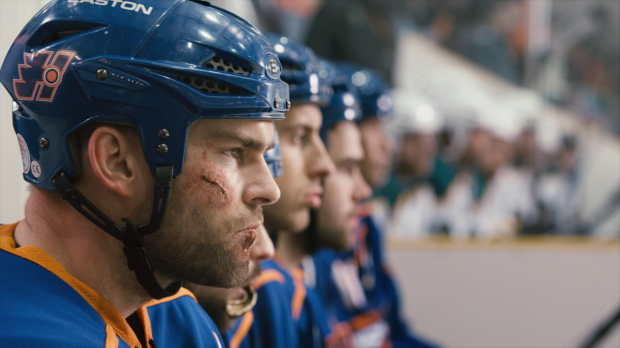
 Given the National Hockey League’s flirtation with work stoppage-induced disaster, Goon plays like an unrequited love letter to a sport whose heart is three sizes too small. The hockey immortalized here—the slow, bone-crunching, blood curdling style of play where one or two men on every squad was hired more for their fists than their abilities with a stick—has been on the endangered list for some time now, first as a consequence of the League’s desire for a faster game, then as concerns over concussion-related brain damage rose, but that doesn’t matter. The hockey of Goon is that of pop-culture past, three twenty-minute periods of blood, mullets, and dirty-minded foreign players. Those wondering how hockey could engender such a devoted, wounded fan base would find their answer here.