Tag: Scott Snyder

  • The New 52: Demon Knights #1, Frankenstein – Agent of S.H.A.D.E. #1, Resurrection Man #1, Swamp Thing #1, Voodoo #1

    The New 52: Demon Knights #1, Frankenstein – Agent of S.H.A.D.E. #1, Resurrection Man #1, Swamp Thing #1, Voodoo #1

    Demon Knights #1

    Writer: Paul Cornell / Artist: Diogenes Neves

    Yes, yes, yes, yes. When I heard that DC was relaunching their whole line, that they were going to be re-contextualizing much of their stilted universe, a comic book like Demon Knights #1 was exactly what I was hoping for, not the shoehorning-in of extra characters and teams whose revitalization wasn’t tantamount to artistic or commercial success. While I highly doubt Demon Knights is the sort of comic that’ll ever crack the top 20 monthly sales charts, it is a well-written, gorgeously drawn book that grounds some of the more magical elements of the DC universe in the Dark Ages, effortlessly blending in the story of Etrigan the Demon, Madame Xanadu, the Shining Knight, and King freakin’ Arthur and the fall of Camelot in one issue.

    Etrigan is somewhat liberated from his ridiculous gimmick of rhyme, which only the best comics scribes were able to do without coming off ridiculous, as it’s revealed that he’s a demon held captive by the wizard Merlin, who watches helplessly as Camelot is overrun by an attacking horde. In his last act before disappearing, Merlin joins Etrigan to the body of Jason of Norwich, a young knight now cursed to harbor a demon inside him. After the fall of Camelot, the world plunges into the dark ages. At a tavern, Jason and Madame Xanadu meet the berserker Vandal Savage, the Shining Knight, an Amazonian (I think), and a few others before the tavern is attacked by a horde claiming to be emissaries of the queen.

    If this sounds like the set-up to a role-playing game, well, it is. Obviously, your mileage will vary, but this set-up is one that I’d probably pay $60 to play, excitedly. As the first issue in a series, it’s got everything that I’m looking for. The plot interests me. The characters, known and unknown, are a good mix of personality and gimmick. The art, which usually doesn’t matter much to me, is perfectly evocative of this slightly twisted world. Demon Knights represents the first real slam dunk of the New 52, a book that starred into the abyss of a rebooted universe and decided to roll the dice. I’m in until low sales see it cancelled (this always happens), then I’m in on the petition to bring it back.

    Frankenstein: Agent of S.H.A.D.E. #1

    Writer: Jeff Lemire / Artist: Alberto Ponticelli

    Given that I was a big fan of Grant Morrison’s Seven Soldiers project, I’m genuinely happy to see some of its elements make themselves apparent in the new DC universe. S.H.A.D.E., his T.H.U.N.D.E.R. Agents tribute from the Seven Soldiers: Frankenstein miniseries gets its own ongoing, and, within a few pages, it looks like its borrowed more than a few things from Mark Millar’s The Ultimates, which envisioned the Avengers as a government led and funded super-organization dedicated to stopping world-level threats. What Frankenstein: Agent of S.H.A.D.E. has on The Ultimates is characters that are genuinely interesting beyond being Captain America…but different, and the characters are so C and D list that literally anything is possible.

    That all sounds like a backhanded compliment, but it isn’t supposed to be. Father Time, the leader of S.H.A.D.E., is one of those ruthless, insane leader-types, willing to underwrite projects where scientists turn themselves into gillwomen and whole cities are shrunken to fit inside a steel sphere three inches in diameter. Frankenstein, whose origins are what you’d think, is a late-period John Wayne, regarding all this technological muck knowingly, trudging through it because he must. He’s got a lot to deal with, too. The gillwoman is the leader of a team comprised of many human/Universal monster hybrids–a werewolf, a vampire (sadly not a Dracula), and an honest-to-God mummy. They’re put together because Frankenstein’s wife (yup!) was sent to stop an invasion of Lovecraftian monsters from wrecking a small town, only to disappear.

    I really dug this issue, but it’s pretty much a mash-up of everything I love, with a brief discussion on Milton and Keats thrown in to make sure I’d sing its praises. Jeff Lemire, whose DC Comic’s work has skewed towards science fiction, riffs on its inspirations that feels more inspired than insulting, and Alberto Ponticelli’s rough-hewn pencils lend the proceedings the grit and character necessary for a comic book about the end of the world. Frankenstein: Agent of S.H.A.D.E. promises to explore some of the weirder corners of the DC Universe, but it is a weird universe, and it’s good that the big, green, undead guy exploring it is cut from the same cloth.


    Resurrection Man #1

    Writers: Dan Abnett & Andy Lanning / Artist: Fernando Dagnino

    When I worked at the Pack Shack, I was always under the impression that Abnett and Lanning were the Lennon/McCartney of mundane DC Comics books that I’d never in a million years crack the spines of, mostly because the Legion of Superheroes is, literally, the most confusing idea in the history of comic books, and that’s what they wrote. Unfortunately, Resurrection Man #1 does little to dispel my ill-informed beliefs, even though Abnett and Lanning are working with their own character, on a completely blank slate.

    It’s not that the idea itself is bland. In a world where the only dead walking the earth are doing so to hunt human flesh, it’s nice if there’s a guy or two who dies, comes back, and is relatively normal. Resurrection Man, being a disposable, reusable superhero, isn’t exactly normal, but coming back to life with the power of magnetism makes for more interesting dinner conversation than “BRAAAAAAAAINS!” It seems that each time Resurrection Man resurrects, he comes back with a power suitable for the task he finds himself against, making him stunningly useful for a guy who dies a lot. That being said, Resurrection Man’s been overdue for a stay in heaven/hell, so the forces of some shady gray area are after him, trying to stop him from coming back.

    This kind of cat-and-mouse can be pretty compelling, but Resurrection Man #1 just isn’t, failing in the worst way high concept ideas can fail: by being satisfied with the concept. If things were happening, if Resurrection Man was trying to stop the world from ending/his girlfriend from getting killed, his car from getting repoed, but he couldn’t because he kept dying and coming back, losing valuable time/money/sanity, then something would be happening. As it stands, he dies and comes back, ready to continue the chase. He’s the ghosts from Pac Man, if they had their own ongoing series. Even though that sounds awesome, if the result of failure is a do-over, what’s the point?


    Swamp Thing #1

    Writer: Scott Snyder / Artist: Yanick Paquette

    On the subject of integrating Vertigo characters back into the DC Universe, I’m for it as long as it’s done well. A character like Swamp Thing, after all, has a long history apart from your Supermen, your Batmen, and your Aquamen, so just hurtling the character from one continuity to the other all haphazardly would be a disservice both to what came before and potential new readers. Luckily, Swamp Thing #1 is gradually reintroducing its titular monster to the DC Comics fold, explaining who Swamp Thing was for the benefit of those who thought buying 52 new comics sounded like a grand idea while realizing that there’s room for Swamp Thing’s utter weirdness among DC’s heavy hitters.

    The long and short of Swamp Thing #1 is this: The world is dying, and in ways the Justice League can’t help or figure out. Dr. Alec Holland, the former Swamp Thing, knows this, but is seemingly uninterested in solving the problem. He’s down and out after his stint as the monster, convinced that plants are more violent than we give them credit for, that, for all his brilliance as a scientist, he simply doesn’t have what it takes to solve the world’s problems anymore. Meanwhile, a group of shady looking customers look for something out in the wastelands and, in the most grisly scene I’ve seen in any of the new #1s, are compelled to snap their necks and walk around with their heads on backwards.

    It’s a little gross and a little weird, and the proceedings are certainly meditative, but that’s what I expect from Swamp Thing. It’ll be interesting to see how much room DC Comics gives this title. Yanick Paquette, for instance, is a superstar artist on a book that isn’t going to sell enough copies to justify a superstar artist. How short is his leash? Who replaces him? How long does Snyder have to make his vision stick? Swamp Thing #1 gives me a lot of hope, but when the hype dies down and we’re reading issues 10, 11, and 12 of the New 52, I wonder at his ability to survive in the marketplace. I’m willing to put aside any Alan Moore comparisons until that point, so here’s hoping Swamp Thing has a long, prosperous shelf-life.


    Voodoo #1

    Writer: Ron Marz / Artist: Sam Basri

    I’d love to give Voodoo #1 the benefit of a doubt. After all, it’s one of a few female solo books DC has decided to launch in an effort to reach out to new readers, and, more, it’s an effort to integrate an interesting (if ripped from They Live) idea from the clutches of the 90s comics that birthed it. But Voodoo, whose solicits ask the reader if she’s hero/villain/both, is a stripper whose tattoos murder people, and that appears to be it. Taken on it’s own, it’d be a disappointing, lifelessly drawn comic with potential but for the poor execution (DC’s own Witchblade, which, surprise, Ron Marz spent time writing), but Voodoo spends so much time stripping, changing clothes, and stripping that the comic quickly devolves into self-parody, which, to be honest, was evident from the issue’s come-hither cover. Voodoo #1 isn’t a good comic book by any stretch of the imagination. Even if you’re looking for a decent cheesecake comic, there are better ones available. I’ve seen Zack Snyder movies more capable of recognizing women as something greater than a fetish object, and he’s the guy who thought Watchmen needed more rape.
  • The New 52: Batman #1, Batman and Robin #1, Batman: Dark Knight #1, and Detective Comics #1

    The New 52: Batman #1, Batman and Robin #1, Batman: Dark Knight #1, and Detective Comics #1

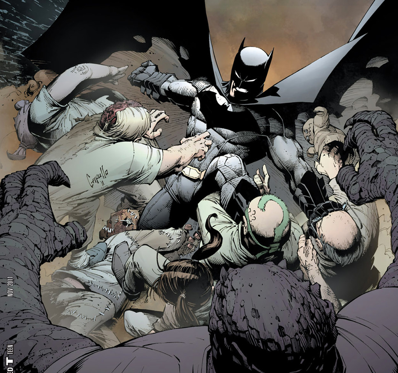
    To be honest, I sometimes worry about things like Batman. I know that in a world plagued with real problems, it is mostly ridiculous to care about the portrayal of a comic book character, but if comic books are one of the ways I choose to escape the kung-fu grip of reality, I will likely find myself worrying about my unreality. The way things were in 2006, when I stopped reading comics regularly, my unreality was in a shambles. Batman, my barometer for all things mainstream comic book, had been brought low by the events of Identity Crisis and, in DC’s mad scramble to create another Hush, he’d been pushed through some pretty lame storylines across his own books. In Detective Comics, he stopped detecting. In Batman, he did more brooding over ancient history than punching the crap out of crime. Jason Todd was coming back. Bruce Wayne was going to die or be zapped to the past or something. His mind had been erased. There were chinks in the armor. It was too much to truly care about. But nothing will attract my attention quite like promising a line-wide relaunch, so here I am, reviewing all 52 of DC’s new number ones while the company presses on, this month releasing issue #3s and, for the first time in quite awhile, actually eating into Marvel’s previously unchallenged marketshare. Once again, I find Batman to be my barometer. If the Bat books are shaky, with this much on the line, why bother? I’m racing to catch up with the DC Universe, so today, and until I’ve written about all 52 new books, I’ll be cramming my reviews together. Here are my thoughts on Batman #1, Batman and Robin #1, Batman: Dark Knight #1, and Detective Comics #1. This, too, will serve as a preview of how weekly comic book reviews will be handled in the near and glorious future when I’m not trying to get my bearings in a strange new universe.

    Batman #1

    Writer: Scott Snyder / Artist: Greg Capullo

    Were I the sort who judged a book by its cover, the sight of the Riddler with his hair buzzed to a green question mark would have turned me off of Scott Snyder and Greg Capullo’s take on Batman immediately. That’s not the Riddler I want, I would have bemoaned, little realizing that that the Riddler I want is, in all likelihood, the one of my imagination. It’s easy to project my expectations, my wants, my wishes onto a comic book, easier still to not pick one up because it seems like those things will not be satisfied in 22 pages, for three dollars, but the Riddler was hardly a factor in Batman #1, which, beyond featuring the most interesting detective narrative of the four big Bat books, also had the most compelling take on Bruce Wayne the philanthropist. I don’t know if it was editorial edict to have Bruce spend half the pages of his books standing behind a podium at a fundraiser or cocktail party, talking hopefully of one project or another, but the Bruce Wayne of Batman #1, issuing platitudes about what Gotham City is (“Gotham is hell,” “Gotham is damned,” “Gotham is Batman,” etc.) and the wisdom of his father, does more to show Batman’s sense of civic pride and obligation more than the Bruce Wayne who promises not to give birth to a cannibal, to not be afraid of the unknown. Batman here is much more capable of putting on a public face and, early, it leads to something more interesting than a confrontation with the thousandth cop to piece together the Wayne/Batman connection.

    The mystery at the center of this book, involving the grisly murder of a man with the use of old throwing knives, is also compelling, though the twist and the end of the book comes off as a little expected, and will likely wind up being some kind of framejob. Scott Snyder’s script effectively flips the switch from Bruce Wayne: Philanthropist to Batman: World’s Greatest Detective, though it probably helps that the touches defining both are familiar: Batman is always encroaching on Bruce Wayne, making him look absent minded at times, and the way the threat on Bruce Wayne’s life is handled comes straight out of the past. Though these elements lack novelty, it is good to see the character getting back to basics.

    Batman is worth returning to, perhaps the biggest reason being Greg Capullo’s art. Of the Batman family books, only J.H. Williams III’s Batwoman has a more captivating take on Gotham City, though Capullo’s is closer to what I’ve always identified as the “real” Gotham, the one of Batman: The Animated Series. He draws a dynamic Batman, at once human and cartoon, and while the Arkham Asylum slugfest that opened the book was a little bland, brief glimpses of his Two-Face, Clayface, and Mr. Freeze have me looking forward to possible future storylines involving those characters.


    Batman and Robin #1

    Writer: Peter J. Tomasi / Artist: Patrick Gleason

    If Batman and Robin #1 (and likely the Grant Morrison Batman and Son arc that preceded it) is anything to go by, having a superhero as a father would not be a cool experience. Matter of fact, it’d be a life fraught with mistrust, disobeyed orders, and, perhaps worst of all, constant bickering. It’s not that Batman isn’t cool, because what isn’t cool about fighting crime and driving souped up machines of death? The problem is that Damien Wayne, the fifth person to take up the mantle of Robin, is a petulant, self-important brat, and, even if that’s the way he’s supposed to be, I’m not going to cop well to a 10-year-old pointing in Batman’s face while yelling about being “light years ahead” of the other Robins.

    Maybe Damien (hopefully not named after the kid from The Omen) and his sour temperament are the result of being raised by the League of Assassins, but, as written by Peter J. Tomasi, the relationship between Batman and Robin is stock parent/teen disagreement, but over ridiculously high stakes like irradiated fuel rods. When they speak to each other, it feels a bit like Edward Furlong talking to the Terminator, if Furlong’s John Conner suddenly desired for his pet cyborg to start waxing random passers-by. I don’t know that the failings of Batman and Robin #1 are Tomasi’s–usually a solid hand–or those of the character at the heart of this book. At the center of the Batman/Robin partnership has always been Bruce’s obligation to whatever orphan was dropped on his doorstep. The thing was, those characters–even Tim Drake, by no means a victim of tragedy until Identity Crisis–had a way of humanizing Batman that socialite girlfriends and weekly dinner parties couldn’t. They needed him, and he needed them. I get the sense that Damien is relatively unchanged by the shifting circumstances of his life, that his conflict doesn’t involve learning to be a hero or learning to accept Bruce as his father, but that he’s going to constantly be whining about a perceived lack of respect. If the goal here was to create a completely unlikable Robin, mission accomplished. Eventually, I hope Batman hauls off and decks the kid for his endless backtalk. Or that I get to phone in a vote for him to be blown up in an abandoned shed.

    That being said, Patrick Gleason’s art is stunning. Scrumptious. If it were in service to a character I enjoyed, I’d buy two copies so I could hand one to strangers and tell them to see how great a Batman comic can look. The Crime Alley sequence, in particular, is A+ stuff, an elevation of material long taken for granted. Were the issue printed without dialog, there’d be something touching about a father taking his son to the last place he saw his parents, the shower of pearls in the gutter, the floating of a paper boat into the great unknown. But that Damien’s got a mouth, man. “You can’t just build a boat and hope darkness sails away with it,” he says, but it’s like Look kid, he can do whatever he wants. He’s the goddamn Batman.


    Batman: Dark Knight #1

    Writer (Co-Plotter): Paul Jenkins / Artist (Co-Plotter): David Finch

    The first image in Batman: Dark Knight #1 is the Gotham skyline, crowded with three blimps and a universe of spotlights. It’s likely that this is ultimately significant of nothing, but combined with the Arkham Asylum breakout (another one?), the giant reception Bruce Wayne speaks at (another one?), and that the first thing Batman does is fly his plane through Gotham, rappel down to the buildings, change into civvies and zipline across town to be on time for his speech on Fear: A Cannibal, Batman: Dark Knight feels a bit like Jenkins and Finch’s interpretation of The Greatest Batman Hits of the 90s, where everything was big, bold, and, above all else, toyetic.

    All of that plays to Finch’s strength as an artist, in particular his ability to lavish a scene in detail, but so much of it is utterly unnecessary. The board room scene, the Arkham breakout. I don’t have a problem that this has happened across so many of the new Batman #1s, but that it’s happened so much period, and that there’s pretty much nothing new under that particular rock. I imagine it’ll be important somehow–how did that weird rabbit-woman get into Arkham? who enabled the issue’s pivotal change to Two-Face? how?–but my concern in reading Batman: Dark Knight isn’t Bruce or Batman or his detective work, and not even the unfortunate and fundamental change in direction Two-Face undergoes, but why every man is over-muscled, why the attractive foreigner wore a hooker’s dress to this particular Wayne Enterprises meeting, why anybody felt the need to toy with and alter a tried and true villain; just why everything feels so dated and insecure as it tries to be all of the most badass things about Batman that having a kid or being a detective don’t allow. The Batman of Paul Jenkins and David Finch appears to be the Batman of slugfests. I grew out of that Batman ages ago.


    Detective Comics #1

    Writer/Artist: Tony S. Daniel

    For those of you who like your Joker grim ‘n gritty, in Detective Comics #1, he rips out the throat of a “big fan” while completely nude. In a post-Flashpoint world, it’s tough to know how familiar Batman is with the Joker (considering the turn at the end of the issue, my guess is “pretty familiar”), but he seems perplexed by the Joker’s choice to not wear clothes and, like Rorschach planning to delve further into Ozymandias’ sexuality, makes a note of it for later. When, at the end of the issue, the Joker blows up a building full of cops, he walks away from the scene declaring “Amatuers!” with a sneer, a comedian miffed that his audience isn’t in on the joke.

    Then again, the Joker’s always played to an audience of one, so it makes a certain amount of sense that he’s the only one laughing, and it makes perfect sense that he’s able to play Batman and the Gotham City Police Department like a fiddle, murdering and fighting so that he can end up back in Arkham Asylum, where he has an appointment he’d like to keep. That, along with the “amateurs” moment and Batman’s tenuous working relationship with the GCPD, including the use of the Bat Signal (despite cops firing on him) and the appearance of Harvey Bullock, are reminiscent of Batman: The Animated Series, if the seminal cartoon took on the darker aspects of the work of Frank Miller. Detective Comics #1 is incredibly gory for a main title depicting the adventures of the world’s most popular superhero, but that’s not at all a reason to discount what writer and artist Tony Daniel is doing with the old Batman/Joker tropes. As a matter of fact, I’m not sure what I think about the end of issue #1, other than that it’s a compelling, deft hook–one that’s worth giving another couple issues to, for everything to pan out.