Green Lanterns: New Guardians #1

Writer: Tony Bedard / Artist: Tyler Kirkham
I’ve never been much for any Green Lantern not named Guy Gardner (best jacket in comics, best hair in comics), but start me off with a gaggle of dead ones, victims all of a seemingly apocalyptic intergalactic battle, and I’m going to take notice. The new Lantern in question here is Kyle Rayner, and, if this is what the characters always been like, I don’t see what people have been complaining about since his 1994 debut. He’s a nice enough guy, and, as a comic book artist, he’s able to bend the Green Lantern power ring to more creative uses than giant boxing gloves or the current popular manifestation of supreme cosmic willpower–the giant machine gun. He saves a crane operator from certain doom by willing to life three giant, Depression-era construction workers…and is promptly criticized by some random kid for designing his own costume.
Thankfully, Green Lanterns: New Guardians #1 isn’t as preoccupied with defending the legacy of its main character as Aquaman was, and the result is a 22 page comic that both effectively introduces its hero and hurls him into an incredibly dangerous predicament. Out in space, the power rings belonging to other cosmically-powered spacemen are disappearing, which is understandably upsetting to the factions missing their rings. They all converge on Kyle and, wouldn’t you know it, a Lantern from each corps is hot on its tail, ready to tear apart the poor bastard unlucky enough to draw their attention.
Tony Bedard, whose Route 666 remains a favorite–if unheralded–comic of mine, is effective in cramming everything into one issue. Not only does Rayner get the ring, the other Lanterns lose theirs, the crane falls, there’s a whole lot of dead dudes on Oa, and the ring hunters drop in on Rayner at the end. That’s big stuff for a first issue, particularly considering that many of the New 52 first issues have been content to tease at a threat, meander with a character, then jump to the cliffhanger; but Green Lanterns: New Guardians #1 is as tight and controlled as a comic mid-way through its run. Tyler Kirkham’s visuals–particularly his handling of alien species and Rayner’s saving the crane–are stunning and clean, cosmic but still human. I can see a situation where I’d quickly tire of Kyle (he’s a bit sassy, and that can go overboard quickly), but I’m hooked for a couple of issues at least, if not more.
Green Lantern #1

Writer: Geoff Johns / Artist: Doug Mahnke
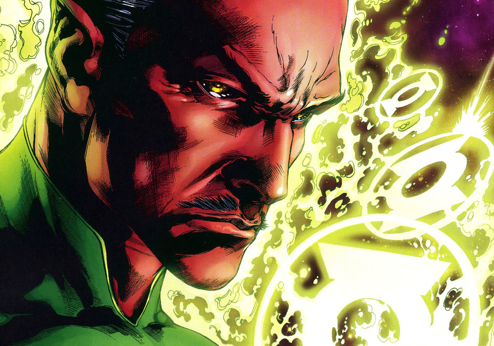
In Green Lantern #1, Hal Jordan becomes the sad, divorced dad of comics, out of touch with the world around him because he’s spent so much time among the stars. His power ring abandons him and chooses Sinestro, he’s jobless, can’t make rent, is dead to a world that doesn’t realize he protected them, and is hapless when it comes to speaking to Carol Ferris, maybe the only person on Earth who understands him and what he’s been through. Of course, that doesn’t make it any better when Carol takes Hal out to a fancy restaurant, where he charmingly asks her to co-sign the lease on his car where another, better man may have asked her to marry him, but it’s kind of fun watching Jordan and Ferris get their hopes up about two things that couldn’t be more different, only to see both dreams smashed.
This seems to be Geoff Johns’ specialty, to bring superheroes low and raise them back up. Hal Jordan, having shrugged off prior events where he killed billions of people, is an odd reclamation project, but Johns brought Jordan back into this world, and it seems he’s going to be the one to shepard him as the DC Universe moves forward. Having been around the block with a few titles written by Johns, I feel my interest in the adventures of Hal Jordan; Civilian waning even before Green Lantern #1‘s cliffhanger, which looks like the set-up for the world’s dullest, lecture-filled buddy cop movie. While giving Sinestro a place in the Green Lantern Corps is an interesting thought, Johns simply doesn’t write with the short of urgency or poise that I’m looking for. His heroes are ponderous and lost beings, looking for redemption and trying to reclaim their old glory. They’re also too well-aware that they’re better than the people around them. His villains are like that, too, but that I can shrug off. You give a guy phenomenal cosmic powers, and the best he can do is conjure a giant pair of binoculars? If I were the jobber Sinestro easily kills in this issue, I would have tried to attack him from behind, too.
Green Lantern Corps #1

Writer: Peter J. Tomasi / Artist: Fernando Pasarin
Because it’s not enough to have both Kyle Rayner and Hal Jordan down on their luck, Green Lantern Corps #1 sees Guy Gardner apply for a job as a high school football coach and get rejected, as his being on the sideline could make the team vulnerable to extraterrestrial attack. If Hal Jordan is the divorced dad of comics, Guy Gardner is now the sad uncle–he’s wistful for normalcy, has his own goofy nickname for the men and women of the Green Lantern Corps, and still wears the (awesome) jacket that got him laid in high school. John Stewart–actually referred to as the black Green Lantern in another book, in another bit of weird meta-awareness these books probably don’t need–is similarly listless. He’s hired to design a building specifically because he’s a Green Lantern, then he finds out that the building firm wants to cut a few corners, and Stewart quits. Meanwhile, in space, several Lanterns are being hacked to death by a mysterious entity. The moral to Green Lantern Corps #1? It ain’t easy being green.
There’s really not much more to say beyond that. Either Gardner is getting lectured to, or Stewart is doing some lecturing, and neither path is of particular interest to me. The larger, cosmic implications of Green Lantern Corps #1 will take center stage, I imagine, but of all the New 52 books I’ve read, this comics Threat/Hero Building/Threat set-up is the least compelling one yet. There are some nice touches, like when Gardner is being interrogated by the other men applying for the high school coaching job, but, maybe because I read Star Wars novels as a kid that did the same thing, the prospect of an entire planet being drained of its water–especially a planet that isn’t Earth–just doesn’t excite me, and Stewart, by using his ring to send his potential employers hurtling Earthward in a lantern-powered elevator because his standard of excellence is nothing short of impractical, strikes me as somewhat petulant. Like many of the books DC has recently launched, Green Lantern Corps #1 features some very strong art, here by Fernando Pasarin. But, like with many other books in the line-up, strong art isn’t enough to get me to plunk down $2.99, and Peter J. Tomasi’s script, like the one he did for Batman and Robin #1, does more to turn me away from a good concept than interest me in seeing what happens next. He’s reaching for quiet, character defining stuff in both comics, but both are let-downs.
Red Lanterns #1

Writer: Peter Milligan / Artist: Ed Benes
Red Lanterns #1 is a curiosity to me, as I missed out on the crazy widening of the Green Lantern mythos’ color spectrum, and I knew who exactly zero of the characters in this book were going in. I assumed that it was going to be a villain book, since the dudes and dudettes on the cover looked pretty feral and of the teeth-gnashing variety, but the Red Lanterns are given their power and motivation by a desire for revenge. They are, in fact, so powered by vengeance that they’re mentally crippled by rage, unable to do much more than rip people apart and fight each other. But, two pages in, there’s a cute housecat who rips apart some S&M-themed aliens, so I was immediately attached to the concept, which I’d otherwise be tetherless to.
The leader of the Red Lanterns, Atrocitus, is a kind of cosmic Conan the Barbarian. Like Conan, he’s motivated by the death of his family, is a man of phenomenal strength and rage in a universe that doesn’t understand him, a tool by which a reader is allowed to mull over the value of violence and rage in society. Atrocitus saw his whole planet wiped out by the machinations of an insane Guardian of the Universe, so there’s plenty of fuel in the tank. But, just the same, that Guardian is dead now–can one still feel rage once vengeance is claimed? Atrcitus looks into the future, sees much suffering, and determines that yes, such things are possible.
As much as I like Atrocitus (I dig Conan and Red Sonja and other barbarians, so I suppose that makes sense), Red Lanterns has some ground to cover before it becomes something I’d gladly spend my money on. Apparently, the rage-infected humans of 28 Days Later are what inspired Geoff Johns and Ethan Van Scriver when they created the Red Lantern Corps, and that influence is certainly evident in the way the Lanterns who aren’t Atrocitus behave–they’re barely capable of speech. Not that Red Lanterns is a zombie book, but my interest in the other Red Lanterns right now is like the interest that I have in a zombie that isn’t threatening a potential meal–nil. I see that there are a few possible recruits to the Core, and perhaps the potential to increase the awareness of the other members. That would be splendid.
I trust Peter Milligan, whose run on X-Force and the resulting X-Statix are perhaps the best commentary on the absurdity of superheroism, superhero teams, and fame I’ve read in mainstream comic books. I also like Ed Benes, whose art has matured considerably since I last saw it in Birds of Prey. I previously had him figured as a cheesecake artist, adept at drawing the ridiculously implausible curves of DC’s superheroines and little more, but beyond Bleez, Atrocitus’ second in command, there is little room for T&A. His Red Lanterns look properly demonic, ready for war.