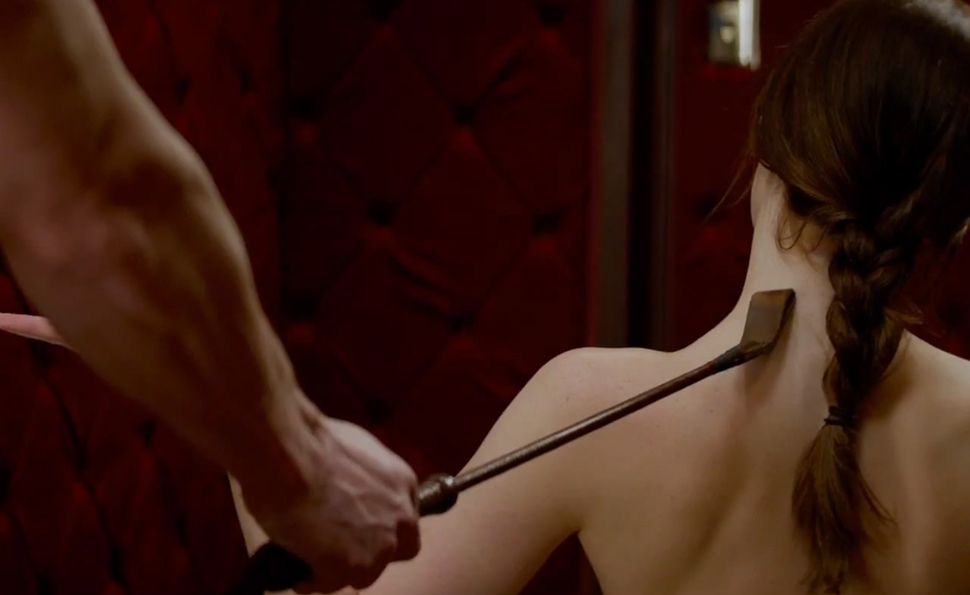
Fifty Shades of Grey is a movie based on a book about an undergraduate English major who works in a hardware store. Her apartment—an immaculately appointed two- or three-bedroom brick loft with a ton of open space that she shares with another undergraduate—is nicer than most houses. How does she—or anybody—in her position afford such a place? How killer is the hourly rate at the hardware store? How hit was Washington by the economic downturn that this apartment might be the nicest place Anastasia Steele (Dakota Johnson) ever lives? It’s unrealistic, I know, for an erotic sex fantasy to opine at any great length upon the real estate it happens to occupy, but Fifty Shades of Grey is just as turned on by space and material possession as it is Christian Grey’s (Jamie Dornan) extensive collection of riding crops and silk blindfolds. It draws up a long, involved contract detailing its heroine’s sexual boundaries but has no clue about the dimensions of its own space. I found this curious, at first, then irritating. With each passing setpiece meant to wow us not with Christian Grey’s worth as a human being or a sex object, but with his bankroll, I wondered at Anastasia’s motivation for seeing her mysterious billionaire paramour and, not being able to realistically pin that on his wealth or the way he displayed it, was left wanting to know why so many people found this white, white, white, white, white dude so appealing.
Fifty Shades of Grey is staged as a series of interrogations, all of them at least verging on creepy. In the first one, the powerless Anastasia interviews Christian—a god-king by comparison—for the school newspaper. He is cool and composed behind his desk, the Seattle skyline at his back. She is trying to collect herself after tripping and falling on his office carpet. Roger Ebert used to call contrivances like this Meet Cutes, and this is the prototypical one except that Anastasia falls and Christian does not help her. And then Anastasia keeps falling and falling and falling, and again, Christian isn’t helping. In fact, more often than not, he’s the one pushing her down. Later, he’ll say that it’s “for her pleasure.” He says this clinically, the way a pack of Trojan condoms claim to be ribbed for the same purpose. But first there is this scene, where it is all too obvious that the two should never see each other again. They are almost literally from two different worlds, and Grey is too obvious in lording it over his guest. The interview, of course, is a disaster, but Grey sees something in her—considering the impossible number of supermodel blondes working reception in his office tower, maybe its her hair—and decides that the two must have relations, but not a relationship.
The implications of the film’s plot are disturbing, but considering that long stretches of it take place over iMessage, director Sam Taylor-Johnson and cinematographer Seamus McGarvey do a good (if thankless) job of making E.L. James’ globe-conquering novel look like it belongs on the screen. This is an achievement, really, because I can’t think of too many movies where one character confesses to not knowing something, only for the other to tell them to Google it. Fifty Shades‘ problem goes beyond the fact that it settles for telling over showing—too often, its characters are the ones telling each other what they mean instead of showing it, which, given the allegedly sensual content the film deals with, is particularly disappointing. It’s good that Anastasia often finds herself in beautiful environs, even when her face is buried in one screen or another, as Christian Grey himself is as sexy as a PowerPoint presentation. He drones on and on about contracts and playrooms and pleasure like the words, on their own, are enough to convince a near-complete stranger of the worth of anal fisting. Considering the success of the franchise that bears his name, perhaps he is not wrong.
One of the film’s posters, depicting a reclining Dakota Johnson, asked a simple question: “Curious?” And, I’ll admit, I was. Until Fifty Shades of Grey was optioned by Focus Features, it was destined to live in my memory as a series of novels that gave rise to a million breathless TV spots where embarrassed journalists uttered the words “mommy porn” and pretended such things were beneath their Kindle. It was an awful display, so many major media outlets rushing to condemn the very thought of women—gasp—having an interest in something beyond vanilla sex or objectification, but now we’ve got this movie and the promise of two more, all of which feed back into this negative, patriarchal portrayal of women as weak-willed naifs without one wit of the Twilight Saga‘s camp or batshit lunacy. When Christian Grey is involved, Fifty Shades of Grey is so male gaze-y that it’s hard to believe that women directed, wrote, adapted, produced, and edited the film. As a malevolent presence (that has been mocked in remixes of the film’s other semi-iconic poster), Grey is omnipresent. If he’s not shaming Anastasia for being a virgin or not immediately being into the idea of butt plugs, he is dropping everything at his job of being the CEO of a vaguely-defined multinational corporate entity so he can fly to Arizona to break up a much-needed conversation between Anastasia and her mother, the whole thing playing out like he’s a man out to reclaim a piece of stolen property. When he takes her on a date to go glider flying, it’s to once again remind her of all the great things she’ll be missing out on by not signing the contract and becoming his weekend lover. Not mentioned, however, is the biggest perk of refusal: A decided lack of Christian Grey hovering over you, making even the largest spaces claustrophobic.
When Anastasia finally has the gumption to reject Christian (something she does not once, but several times), the moment isn’t so much victory as temporary relief. The outcome of this series being all but a foregone conclusion, however, even that relief is fleeting. I want to believe in a film ecology that has space for mainstream films about sex that are driven by women, but as each of Fifty Shades of Grey‘s 125 minutes passes, it became more and more clear that this was, really, our one shot at such a thing, and no matter how profitable it ends up being, we’ve rather spectacularly blown it. If my curiosity dictated that I wanted to see something where women are humorlessly, horrifically tortured psychologically for the sake of a man’s pleasure, I could have chosen almost anything else. Hell, some of them would have at least been films.
Fifty Shades of Grey. With Dakota Johnson (Anastasia Steele), Jamie Dornan (Christian Grey), Eloise Mumford (Kate), Jennifer Ehle (Carla Wilks), and Marcia Gay Harden (Grace). Directed by Sam Taylor-Johnson from a screenplay by Kelly Marcel, adapted from the novel Fifty Shades of Grey, by E.L. James.
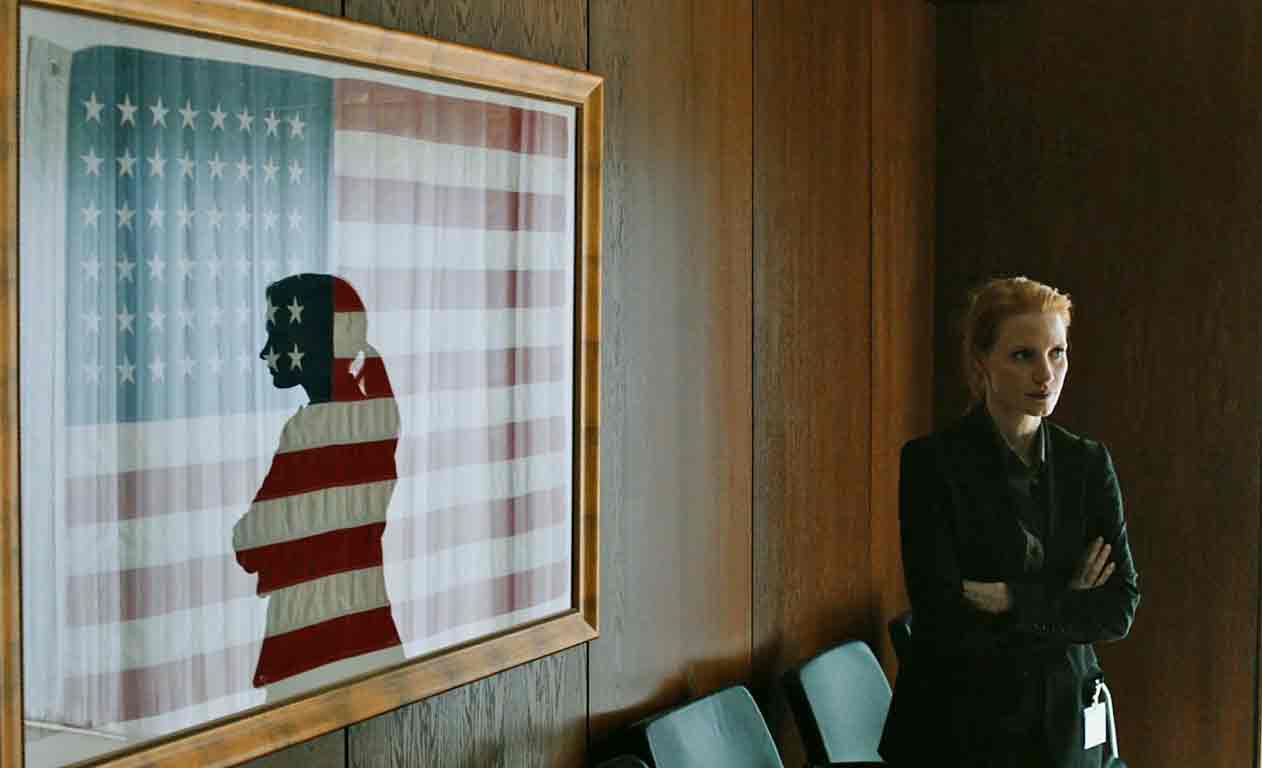
 The most difficult aspect of Zero Dark Thirty, the Kathryn Bigelow/Mark Boal dramatization of the ten year search for Osama bin Ladin, is not that the film depicts torture as a tool utilized by the United States of America, but that torture was used in reality, necessitating its appearance in fiction. The myth of American innocence is inexplicably powerful given the bulk of American history, but the idea of this country as one that did not torture died in the years following 9/11 with the approval of the Bush Administration. However uncomfortable Zero Dark Thirty’s opening act plays, however brutal the film’s depiction of waterboarding, confinement, and humiliation, Bigelow’s interpretation of events are a facsimile; what really happened was much worse. That’s the general effect of Zero Dark Thirty. The hunt of Osama bin Ladin led America into wars and the darker places beyond war, but any attempt to draw something intellectual out of the War on Terror leads either to outrage or justification. Bigelow and Boal try very hard to walk the tightrope between the two—and, based on thousands of thinkpieces on the way torture is depicted here, they failed—and the result is a sometimes thrilling, sometimes laughably clichéd mollification of a difficult era in American history.