 Given the National Hockey League’s flirtation with work stoppage-induced disaster, Goon plays like an unrequited love letter to a sport whose heart is three sizes too small. The hockey immortalized here—the slow, bone-crunching, blood curdling style of play where one or two men on every squad was hired more for their fists than their abilities with a stick—has been on the endangered list for some time now, first as a consequence of the League’s desire for a faster game, then as concerns over concussion-related brain damage rose, but that doesn’t matter. The hockey of Goon is that of pop-culture past, three twenty-minute periods of blood, mullets, and dirty-minded foreign players. Those wondering how hockey could engender such a devoted, wounded fan base would find their answer here.
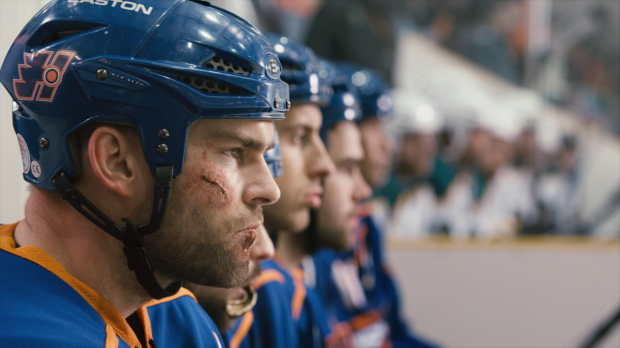
Goon’s hero is a nice, well-adjusted dude named Doug Glatt (Seann William Scott). He’s a bouncer with fists of steel and an indestructible head, skills that serve him well when his buddy Pat (Jay Baruchel, who also co-wrote with Superbad‘s Evan Goldberg) lets his mouth run away with him at a game. When a player has enough of Pat, he charges into the stands. He is promptly put down by Doug, who is quickly invited to play for the local squad. He turns into a local sensation and is hired onto a farm-league team in Halifax, where he’ll serve as an enforcer to Xavier LaFlemme (Marc-Andre Grondin), a shaken star trying to return to form after suffering a monstrous, highly illegal hit from Ross “The Boss” Rhea (Leiv Schreiber), a goon whose particularly dirty style of play sees him in the minor leagues and on his last legs.
Like Slap Shot, Goon follows its fictional team through the wilderness that is minor league hockey. Their hometown of Halifax is a veritable paradise compared to the prospect of “riding piss-hole” on the bus to another town, the punishment for turning in a particularly awful performance. Doug’s teammates are the usual assemblage of sports comedy also-rans: LaFlemme is a womanizing drug addict, the captain is an alcoholic, the coach issues meaninglessly aggressive proclamations, and the announcer is a half-hearted amalgam of Bob Uecker in Major League and John Candy in Rookie of the Year, but the Slap Shot formula—as proven successfully here and by Major League—still works, putting those stereotypes to work as parts to a lovingly constructed machine as opposed to identifiable components left out on the workbench.
It helps that Doug Glatt is an incredibly likable focal point. A well-meaning, dim-witted black sheep in a family of doctors, Doug’s a guy trying to make the best of the gifts he has. He’s incredibly polite to the men he bludgeons, but his parents look at his barbaric conquests on the rink—and the signs in the crowd reading “Glatt is Hebrew for ‘Fuck you!’”—with obvious disdain. He’s supported by Pat and his brother, but those guys would support him through anything. In a strange city, teaming with a bunch of weird men who look at him like he’s a circus freak, its understandable that Doug looks for some outside validation. He finds it in Eva (Alison Pill), a self-described bad girlfriend who loves beer and finds the violence of the hockey rink a huge turn-on.
The only character beyond Doug who receives more than an embellishment of detail is Ross Rhea, his rival in the pugilistic arts. That’s thanks largely to reputation. With his mullet, his goatee, and his seen-it-all attitude, Leiv Schreiber is an amalgam of the game’s deadliest goons, a caveman philosopher who sees the destruction of Doug Glatt as a last chance to define his legacy before the game phases him out completely. The miracle of Goon is that it’s able to build anticipation for the eventual slugfest beyond the occasional reminder that, yes, this is important stuff. Even better, the fight lives up to the hype, a gladiatorial death match that’s more gruesome than the pile of dead teenagers at the end of a slasher film.
If you’re able to look past Goon‘s flaws as a sports movie—the relationship between Scott and the talented but underutilized Alison Pill, being a romance between a nice athlete and a girl with low self-esteem, begins saccharine sweet and ends up somewhat grating—what’s left is an incredibly pleasant experience, made better when the credits roll without the film taking an uncalled for detour into pious sermonizing. Sports movies have become a mostly toxic genre thanks to the odd notion that without several manufactured moments of life-affirming uplift, the events depicted will register as mostly pointless. Goon is proof that if filmmakers love a subject enough, something worthwhile will emerge.
Goon. With Seann William Scott (Doug Glatt), Leiv Schreiber (Ross Rhea), Alison Pill (Eva), Jay Baruchel (Pat), Marc-Andre Grondin (Xavier LaFlemme), and Eugene Levy (Dr. Glatt). Directed by Michael Dowse from a screenplay by Baruchel and Evan Goldberg.